
12 Months To $1M: The 8 Step Playbook
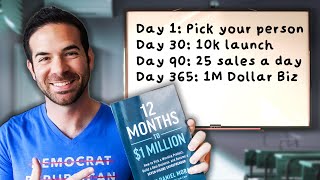
Ryan Daniel Moran lays out eight steps to hit $1M/year in e-commerce within 12 months. Start with one target customer, build an email list of 100 prospects, launch and get 100 reviews, then use ads and ambassadors to reach 25 sales a day. Add more products until you hit 100 daily sales at a $30 average price.
Chapters
Today I'm going to be walking you through the eight step playbook that we developed here@capitalism.com in order to help people who read 12 months to 1 million implement the plan and actually build a million dollar business in a 12 month time frame. If you are new to my work or if you recently read my book 12 months to 1 million, that 12 month time frame feels aggressive or hypey to a lot of people. But I think as a result of seeing how we lay out these eight steps, you'll be able to see it in a step by step framework that will allow you to see where each step of the process falls in that 12 month time frame. I'm just going to lay out the steps for you and go through the action items that you would need to take in each one of these milestones. And the first one is very simple. It is choose your person. The first step in my philosophy is that all businesses need to be in service of a core person. And over the lifecycle of your business, you will serve many different types of people. Some people will obsess over getting the exact details right of who their ideal person is and they try to define it way too much and they come up with this three page description of who the person is. I think that's unnecessary. What we really need is just a target so that we can serve that person. The whole point of having one core person that you serve is to align your marketing efforts and to align your sales messaging to attract the ideal type of person that you want to serve. When you do this well, you are able to create content that connects with one specific audience. You are able to focus on what influencers or what messaging you might release in order to talk to that person, to serve that person. It makes all the other steps easier. The second step is to build an email list of at least 100 people that have your ideal person on it. So 100 of those ideal people on an email list, how do you do that? How do you put 100 of the target ideal buyers onto an email list and how do you do that quickly? Well, the opening move that we give to our clients inside the 1% is very simply to make an announcement post on social media. I don't care if it's on LinkedIn or Facebook or Instagram, but making an announcement post that this is the direction that you're going in, this is the person that you are going to serve, or this is the problem that you're setting out to solve, it goes so far. It is hard to overestimate the impact of one well done announcement post. I'll tell you a quick story. One of our clients in the 1% posted her announcement about the direction that she was going to go with her business. And she's serving families and she's going into the laundry space, which is actually a. It's a pretty competitive space. You've got really big companies in the laundry space. And she did an announcement post that she was going in this direction and how she made that decision and what problem she wanted to solve and who she was trying to help. And people came out of the woodwork from all over the place to support her. Here's what happened. After she made her announcement post, she started getting messages from PR sources. People started reaching out to her saying that they wanted to write about her company or share details about her company. And she was like, whoa, hang on, I'm in step two of this process. I'm just building an email list here. And they said, okay, great, come back to us when you are ready. So people start coming out of the woodwork of when you make the announcement that this is the person that you want to serve and this is the direction that you're going in. At first, when you make an announcement post, you will get personal friends and family who are going over and opting into your email list. That's fine. They're still people. And there's a chance that you've got a hundred personal contacts who are an ideal fit for the business that you want to launch. Now, anytime that you make a post on social media or that you appear on a podcast or you talk about your business to a friend, you can send them over to that page, collect their email address, and your goal is to put a hundred of those people onto an email list. It basically guarantees that you're going to get sales on day one. It may not be enough people for you to make a million dollars, but it's enough people to ensure that you're going to have sales on day one. And I am stunned at the number of people who have successful businesses that take their sales on Amazon or run traffic to their Shopify store. And they're not building an email list. In fact, one time on a call with a brand that we invested in, I pounded on the table. I said, you are being irresponsible for with my capital by not building an email list, this person was doing podcast ads in order to drive up awareness about his product line. And it was working. But he wasn't building an email list. So now he had no way to announce when he had a new product to launch or no way to ask for reviews. So the second step is to build that email list because it unlocks all of the other steps moving forward. So step two is put 100 of your ideal people onto an email list. The third step is to launch. We get our clients to launch quickly and aggressively. As soon as you've got 100 people on a list, you've got enough firepower to take your first sale. And that is such a milestone. When you take the first sale, something clicks in your brain and says I, I guess I'm in business and I guess I can do this. There's two ways to launch. The first is to pre launch your product. This is especially effective if you are low on capital or if your inventory is going to take eight weeks to get made and you don't want to sit there waiting around for eight weeks. Quick story from a member inside of the 1%. This, this guy named Miguel had never been in E commerce before. He's going into a super niche market. It's magic the gathering and, and he did not have inventory ready but he built the email list. He spent about 30 to 45 days building a small email list and he did something super smart. He put his first product on Kickstarter. That's smart because he can collect orders that way. And there is a marketplace on Kickstarter so you get exposure when your listing starts to do well. So he emailed his list that he had built using step two, sent them over to Kickstarter and Miguel did $150,000 in pre sales in his first month. Now those were Canadian dollars. So you can do the math on that. It's about 100 ish thousand dollars US. That's plenty enough damage to be able to place your first inventory order, even place a second inventory order. And most importantly here he's got customers out of the gate now that he can serve. That he can turn into feedback and reviews and testimonials is a really smart move by Miguel. There's a second way to do this if you've got inventory ready or if you've got a product that is stuck and not selling and that is to launch to the email list and send them over to the platform where you will be taking sales. In Most cases that's Amazon.com so an example of this would be Ty Mayfield inside of the 1%. Ty built an email list of a whopping 130 people and his product which is golf gloves. Sorry Ty, I'm not a Golfer. He announced his first product, sent them over to Amazon. He sold 100 units in his first, I think his first week and his first month did about $14,000 in sales. And that's perfect for the Amazon algorithm because now that Amazon sees this surge of sales coming from outside traffic, they're going to reward that business with free exposure. And that is opposite of what most people do. Most people who are in the Amazon game will pick a product, try to get it selling, spend a bunch of money on pay per click, and just grind their way to get free exposure. On Amazon, I try to do the exact opposite. I am building the demand first by building the email list. And in order to have the email list, you got to know who you're serving. And if you've got people on an email list and you do a proper launch and you send that traffic over to Amazon, your conversions are really high. You get free exposure on the Amazon platform and it makes everything else much, much easier. Ty did $14,000 in his first 30 days or so, and now he's got a really nice launching pad to be able to take that to 25 sales a day, which is a big milestone. It only takes four products at 25 sales a day at a $30 price point to have a million dollar business. And within about 30 days, he's more than halfway there. The next step after launch is to get a hundred reviews, and almost nothing else matters until you've got a hundred reviews. And this is assuming that you're taking sales on Amazon.com if you're taking sales elsewhere, then it would be a hundred pieces of feedback from your customers. So this means we need 100 sales, which we can get to very quickly if we've built an email list and we launch. But now we want to get 100 reviews. Why is that important? 100 reviews is enough to move the needle on conversation conversions so that your product converts at a higher rate. Whether you're running pay per click traffic or you are posting content on social media, if you're sending your traffic over to one page that has 100 reviews or more, it's going to convert at a much higher rate than something that has 30 reviews or no reviews. A lot of entrepreneurs skip this step. They're so in a hurry to, to get as many new sales as possible that they don't build the systems to connect with the customers that they have and turn them into reviews. Getting to a hundred reviews can be a little bit of a grind and people will get frustrated sometimes when they're not Getting reviews as quickly as possible. So the way that we do that is to celebrate the heck out of every single review. What do I mean by this? I mean, when you get a review or a positive piece of feedback, you're posting that on social media, you are sending that to the email list. In some cases, you are sharing that with all of your followers. Because what gets celebrated gets repeated. If you want something to happen more often, celebrate it well, it happens. In fact, I want you to see a quick clip from a coaching call that we did inside of the 1%. This is with Dr. Ben, who has been building a business for the last few months. He's getting progress, he's getting more sales, but he's stuck at this point of not getting enough reviews. He hasn't hit 100 reviews yet. And I gave him some advice that I think will change his business. So check this out again. I'm still focusing on those. Reviews are so tough. They're tougher than I thought. I thought it was going to be easier. The best way at your stage to get reviews is to celebrate the fuck out of every review that you do get. Sometimes when you are just focused on getting reviews, you're thinking about the next review. Yep. Thank you. What's the next one? But the more that you really celebrate every review, and I mean stretch it as much as you can so that is number one. And number two, be gritty about it. Right? You've already done this in the office where you're asking people for it. Do it with personal friends. Do it inside the 1%. Do it like just ask, but then celebrate every single one. If you post a review that gets seen by a hundred people and one of those people goes to your landing page and enters their email address and becomes a subscriber, that is a win. That is progress. It's not a lot of progress, but it's some progress. If you post another one and it gets seen by 150 people and two people enter their email, that's a win. The trouble is nobody wants to go through the time when there's very little progress or they judge the progress. What I want you to start doing is celebrating the progress. Why? Because the more that you celebrate the progress, the bigger the progress will compound over time. I want you to get excited about one quality review. I want you to get excited about adding three reviews. And I want you to feel. Feel the actual pride of that progress.
And when you can feel that, that energy will go get more energy like that. But what's happening in your brain is you're saying 63. Still not 100. 64. Still not 100. 65. Still not 100. So the closer you get, the worse you're feeling because you put all this hard work and you still haven't hit the goal. So you've got to flip it. You've got to use dopamine to your advantage. What is that? That means every time I have a little inch of progress, I am happy with that progress. I am grateful for that progress. I brag about that progress. I broadcast that progress. I tell a friend about that progress. I tell my audience about that progress. I thank that person for that progress. And guess what? You become a magnet for more of that. When people see how excited you are about one review, they're like, man, I want to support this guy. If he freaks out this much about one review, I'm going to go leave him a review. Beautiful. Yeah, Beautifully said. Thank you. The point to take away from this is when your energy is about celebrating the progress that you're getting. Rather than banging your head against the wall about not having 100 reviews, you'll show up with the type of energy that attracts other reviews. I don't mean to sound all woo woo or airy fairy on you, but when you are celebrating something that you want to see more of, you'd be surprised at who comes out of the woodwork to support you. When you are energetically grateful or appreciative of what is happening rather than resentful of what is not happening, you tend to get more of what you are appreciating. Appreciating. So at this point in the process, we're building a flywheel. We are getting reviews or positive feedback. It's sending people over to our opt in. We're getting more leads, those leads are leaving more reviews because they see reviews celebrated. And now we're starting to grow the business. That process will take us to our next step because our next milestone is getting to 25 sales a day. There is a very logical process to getting to 25 sales a day. And it is doing the work that we talked about in the first few steps. If you are building an email list and if you are sending emails to them, and if you are asking people for reviews and you are posting those reviews and sending those viewers back to an opt in page where your ideal people are opting in and buying your product, that process usually takes us to 25 sales a day. And if we've got 100 reviews at this point, our conversions are going to be higher. So this is the point of the process where we would consider running some form of advertising in the E commerce space. This is almost always Amazon ads. Once you have 100 reviews, you've got enough to be able to convert that traffic to make it worth spending the money on pay per click until that point really doesn't matter. If you're spending money on ads, it's going to be hard to convert those people without a hundred pieces of positive feedback. So that's why this is the part of the process where we might turn up the volume a little bit by running some ads. And by doing so, we'll get more exposure in the algorithm. We're building our list. We're still celebrating every single review. And that process almost always takes us to 25 sales a day. Might take some time, takes time to get reviews, might take time in order to build a relationship with the people who are following you in order for them to convert. It might take time for someone to discover you and then share your stuff on their Instagram page. But the more that you are engaging with the people who are there, the more that you are celebrating every review. And the more that you are building your email list, the more you are building a deep foundation that more times than not takes you to 25 sales a day. The process up to this point usually takes 90 days, sometimes longer. Let's say it's six months. So it might take six months of consistent pounding the pavement, getting reviews, building the list in order to get to 25 sales a day. The rest of the process happens much faster. And here's why. Once we've proven that we can take one product to 25 sales a day, every product that we release after that can get to 25 sales a day much faster. We're not starting from scratch anymore. We're going to have a retail repeat buyers. We're going to have a bigger email list. We have some exposure at this point. So that hard work of building that foundation pays off once we get to these next steps. The next step in the process is to build 100ambassadors. Ambassadors are raving fans. They're people that you know will leave reviews. They're people who are eagerly rooting for you. And the reason why this matters is because having 100 people on a launch list basically guarantees that you're going to get sales. Having 100 rating fans basically guarantees that everything that you do is going to have an impact. Doesn't mean that every product is going to work. Doesn't mean that everything that you try is going to work. But if you have 100 people that really care that you have a connection with, every product that you launch after that point has a very high success rate. So the way that we do that is we build something called a traffic triangle. And a traffic triangle is a way to get your followers and your customers to engage with you. And the traffic triangle. I've done a full breakdown, full videos about how to build the traffic triangle, if you want to look that up. But basically, the traffic triangle is we have one place of exposure. That's where we are talking about our business. That's where we are posting our reviews and celebrating them. We have an email list. That's where we are regularly sending emails to our customers and to our leads. We've already started to build that one in step two of this process. So at this point, we just add the third part of the triangle. And the third part of that triangle is what we call the hopper. The hopper is where we're going to build those hundred ambassadors that really care about what we're building. We can do this with a separate email list. We can do this with a Facebook group. We can do this with a telegram channel. I do it with my podcast because this is where I engage with my community. It's where I create content for them. And I know a lot of our customers by name because they leave comments or they come to our events. They show up on coaching calls. That's how I build really strong, deep relationships. And you will find that everything that you want is on the other side of a few key relationships. So at this part of the process, we're completing that third part of the triangle and we're building deep relationships. And we can do that in a number of different ways. I do it with long form content. I suggest to most people that they just build a Facebook group. It's the easiest, lowest barrier way to build relationships with people that you can interact with. And the way that we'll do that is we'll take the people who are engaging with our content the most, the people are opening our emails, and we'll add them to a Facebook group where we can engage with those raving fans. I was recently on stage with Tara Bosch. Tara is the founder of SmartSuites. And she built a company that sold for almost $400 million. And she did it in her 20s. And one of the things that she shared on stage was that a key part of her growth was cultivating a 500 person ambassador list. And the way that she built it was manual outreach. She reached out to People that she thought could support the brand and she put them on an email list and she emailed those people once in a while, just talking about the experience she shared, the good days she shared, the bad days she shared where she was struggling. And those relationships went to bat for her, opened up new areas of distribution, opened up new relationships for the company and it took her very far in route to a nine figure exit. So when you add those, this part to the process, you have this moat of relationships that will support every product that you release next. The next step of the process is to launch more products. Once we've got one product doing 25 sales a day and we have an ambassador list of people who will support us, we can almost guarantee that product number two is going to work. You'll get reviews faster because you've got a list, because you've got raving fans, you're going to rank higher for keywords on Amazon. If that's where you're taking your sales, because you're sending outside traffic to the Amazon listing, your conversions are going to be higher because you've got repeat customers. And you might even have a little bit of a following because you've been documenting the journey or you've been posting reviews on social media. People are starting to follow the brand. You might even have relationships with influencers and at this point who have been seeing you making content. So once we go to this part of the process, launch more products, things start to really ramp up quickly. What I experienced in my biggest success in the E commerce space was when we launched product number two. It got to 25 sales a day in about half the time that it took the first product to get to 25 sales a day. And then something really weird happened. The sales of product number one doubled. Why was that happening? Well, that was happening because repeat customers were coming back and buying again. But also it was because people discovered product number two and then came back and bought product number one. So the second product actually gave us exposure for product number one. So it did not take four products to get to a hundred sales a day. It took three, three products to get to 100 sales a day. In fact, we might have even got there with just two products. I don't remember, it was a few years ago. But this is the part of the process where you will launch more products to the existing customer list and repeat the process of getting 100 reviews and asking your raving fans to support you. And that product usually gets to 25 sales a day in about half the time. So now we've just got basic math here. If it took six months to get the first product to 25 sales a day, it's going to take three for the second product to get to 25 sales a day. And now the third product is probably going to get there in 45 days. And then, you know, product number four takes us to 100 sales a day and 100 sales a day at a 30 $30 price point. That's a million dollar business, my friends. And that's why the final milestone is getting to 100 sales a day. How do we get there? We simply repeat the process over enough products until we've got a million dollar business. And usually that takes one year to go from an idea to a million dollar run rate. If you follow this process, once you see the eight steps, it doesn't seem like funny math because at the beginning you're just grinding for those first hundred email opt ins. Then you're doing a launch and getting those first sales, turning them into reviews. You are continuing to grease the wheels until you're at 25 sales a day. Then you build an ambassador list. And now we've got the firepower to launch product number 2, 3 and 4. You might discover like I did, that you don't need four products to get to 100 sales a day, you only need two. In fact, one of our members, Alina, launched back in December of 2023. Within about 90 days she was doing 30 to 50 sales a day. After six months she had her first hundred sale day and the last time I talked to her, she was in route doing 100 sales a day with one product. And she didn't need to launch four products, she only needed one. Or maybe the second one is what tips the scales and gives her a seven figure run rate. But by building the foundation with these eight steps, you put yourself in a position to strike gold. Whether it takes four products or you get there with just one. So those are the eight steps. And I know there's nuances to each one of these, like how do you craft an announcement post? Or what type of content do you create in order to put people onto a launch list. I know those types of questions come up, but I hope that these eight steps give you a framework to see what it looks like at each step of the process in order to build $1 million business. It's not rocket science, it's not funny math, but it is work. And at each step of the process it's learning something new and doing it consistently until you start to Hit pay dirt and you'd be amazed at what can happen in a year's time. I want to remind you that if you've got a business that is stuck at whether it's 15 sales a day or it's 150 sales a day, if you've been stuck for a while, I find that when I run them through the eight steps, there's something that they missed. They're either not building an email list or they are not sharing their reviews. They don't have an ambassador list. These steps fix most problems until you have a very healthy 7 Figure your business. And if you need help executing this plan, that's our business model. At capitalism.com we teach the model, we help people execute the model and I have an investment fund that partners with the entrepreneurs that are following this playbook. We invest in those companies, help them get unstuck and then we have an infrastructure company that helps them grow into mid seven figures and beyond. And we're even starting to talk about doing roll ups with with companies where we partner businesses together and we sell them for a whack ton of money. So that's our business. And if you need some help executing this model, there's a bunch of different ways that you can get plugged in here. The best first step for most of you if you're at the beginning stages of your journey is to just download our free resources. You can get them@capitalism.com playbook and of course if you're not subscribed to the channel, hit that button and follow along. We're here to help you on your seven figure journey. Thank you for watching or listening. I hope this gives you a framework that you feel like you can actually do. And if you would like to work with us, we would love to help you execute the plan. I'm Ryan. Daniel Moran with capitalism.com thank you for being here and I'll see you on the next episode. Take care.







