
3 Ways To Find Your BEST Business Ideas
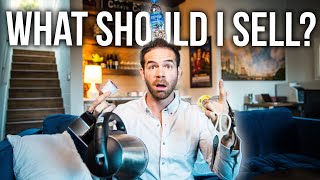
Ryan Daniel Moran shares three ways to find strong business ideas: follow trends, tap your personal network, and listen to your emotional reactions. Skip the algorithm and marketplace data alone.
Chapters
One of the most commonly asked questions, probably the most commonly asked question that I receive is what's a good product to sell? Or what type of a business should I start? And there are all kinds of marketplace tools that you can use in order to try to answer that question. Still, the question persists. Making the decision about what business to go into paralyzes a lot of new entrepreneurs. And my approach to this is very different than what most people teach when they're talking about starting a new business. So in this video, I'm going to outline how to make decisions on business ideas that you'll actually do that you know will be successful.
Hey, I'm Ryan Daniel Moran from capitalism.com I help entrepreneurs build seven figure businesses. In order to build a seven figure business that you can sell, you first need to have a clear idea of the business that you're going to build. So I live by the principle that value has to be unique. Meaning the reason why people are willing to pay for something is, is because there is something uniquely valuable about it in the world. Now, where most people will make their decisions is they look at tools and they look at data points in order to see how much volume a certain product has or where the profit margins are. But I look at data as a reflection of the past rather than a reflection of what's coming. In order for you to be valuable in the marketplace for a long time, you have to be ahead of things rather than operating from behind. So when most people are looking at data and looking at spreadsheets and trying to analyze what a good business to start is, I just think that they're doomed from the start because they're looking at old news rather than looking at what really matters, which is things like what's coming and what people are saying their desires and demands are. So I'm going to give you a few points that I would suggest you pay attention to, that you at least work into your decision making process. Because I think it will help you decide on the business that's right for you. And the business that's right for you is the one that you'll actually do. And the business that you actually do is the one that will be immensely profitable.
The first point is to focus on trends rather than the marketplace. Now that's a strange claim coming from the guy who runs capitalism.com, i'm saying ignore the marketplace. But here's what I mean. When you look at the marketplace, you're often looking at what other people are doing. When you're looking at how much of one product sells or how much demand there is for something. You're looking at what already exists based on the decisions that other people have made and they've made those decisions in the past. I instead like to look at trends in the marketplace. I look to see where there is emerging growth and emerging demand. The famous quote from Henry Ford is, if I had sold people what they wanted, I would have given them a cheaper buggy whip or something like that, or faster horses. I forget what it was. The point was he created the car, which there was no internal demand for. It completely went against what the marketplace data said. Henry Ford said, I'm going to look at the trend and the trend is faster travel and I'm going to build the automobile. He was way ahead of the trend. Today you might look at someone like Elon Musk or Jeff Bezos. Both are entrepreneurs who looked at the trend of the marketplace rather than looking at what the marketplace was already doing. Elon Musk says it's inevitable that we're going to have green alternative energy fueling all of our cars. So he was just the first person to pioneer it. Now today, other car manufacturers might look at the stock price of Tesla or they look at the profit margins of Tesla and say, hey, all of the money is in green energy. Now let's go innovate our cars and make them green friendly. But what are they doing now? Now they're playing from behind. Now they're copying the winner in the marketplace. The winner in the marketplace is the one who can look at the trend and see what's coming rather than looking at what's already existing. So when someone comes to me with a business idea and their idea is based on what other people are selling, I'm usually not interested as an advisor or as an investor. If you want to be ahead of everybody else and be in business for a really long time and stay very profitable, the way to do that is to look ahead of the marketplace. And that comes by looking at trends. And by the way, when I say trends, I'm not talking about fear, fidget spinners and furbies. Those are fads. Trends are long term changes in customer behavior. They're long changes in the marketplace. They reflect what people's long term desires and demands are. It's not looking at what the hot product is right now. That's a fad. It's looking at where people are going and what their buying behavior suggests about what they really want. And if you can tune into that, what do people really want? That's how you can identify what emerging trends are going to grow over the next several years and even the next few decades. An example that comes to mind on this is Mark Lore. Mark lore was the CEO of Walmart e Commerce and he started Jet.com, which was then acquired by Walmart for $3 billion. Mark had an eye on the trend in the marketplace. He knew that all buying behavior was going online and he started Jet as kind of a quasi Amazon competitor. He also knew that big companies like Walmart would want to get ahead of that trend and they ended up buying Jet.com mark then used that platform to help build Walmart into the number 2e commerce platform in the world. But he recently announced that he's leaving Walmart in order to spearhead a new project, a multi decade project that is an experiment on building a new type of city. Now that is way ahead of the marketplace, but it reflects the desires and the demands of consumers. Right now there is some frustration about how local governments operate. There is a desire for more autonomy in community and, and I've said publicly several times, I think that the new model is going to be little communities that pioneer their own model. And Mark has decided to leave his previous trend and spearhead that trend. Point number two, pay close attention to your network and the people around you. If you can tune into people rather than algorithms, you'll be ahead of almost everybody else who is trying to get into business. Too many entrepreneurs put all of their stock into what algorithms on Amazon or Google or Facebook are suggesting. And those are all short term hacks that can be very beneficial. Paying attention to algorithms can be a great way to grow a business in the short term. But it's a terrible way to build a business in the long term. But you only get really good business ideas by first identifying what people want, not what algorithms want. A lot of entrepreneurs have short businesses that are selling semi profitable in the short run and then go out of business because their whole business is predicated on the algorithm that someone else controls. For example, I work with a lot of Amazon sellers and Amazon sellers feel beholden to what the Amazon algorithm wants. And so they try to trick the algorithm, feed the algorithm, serve the algorithm, but the algorithm is made to serve people. Those who win long term always have people as the focus. Now when you're coming up with a new idea, instead of looking at the data or what the algorithm says or does, just ask the people around you if you can pay attention to what the people around you are saying that they want or need. Listen to that people drive algorithms, not the other way around. So if you listen to those who are immediately around you, you'll start to get ideas of what they need. Now, again, I believe that value is unique. And if you want to succeed long term, you need to do something unique. In the marketplace. There is nothing more unique than the people you know. We all know different people than each other. It's sometimes the one unique factor that we all have. Your Facebook friends list does not look the same as somebody else's. And the people that you hang out with is not the same as any other person's. Point number three, listen to your emotions over your brain. I know that sounds weird coming from a dude who runs capitalism dot com. Here's what I mean by this though. Your brain is made to think in logic and reason and safety. Our emotions are more about what we want and what we desire and the life that we want to live. Those two things are often in conflict with one another. Oftentimes we obsess over the how we're going to accomplish something, but our body just won't follow through with it. That's because there's a conflict between what our brain decides is best and what our body actually wants. So these two things have to coexist. I have found that when I'm working with entrepreneurs, especially new entrepreneurs, that if they can tune into what they really want, if they can pay attention to their emotions about a business, then their brain then can kick on and find the how to to lead them to the best destination. Mark Manson talks about this in one of his books when he says that we all have an emotional brain and we have a logical brain, and we all think that the logical brain drives the ship, but the emotions have their hand on the wheel and the logical brain is more reading the map. And if the emotional brain, the emotional self, is not happy, it turns the wheel all over the place. It becomes uncontrollable and unpredictable. This is why so many entrepreneurs have good ideas or things that they think will work on paper, but they're still in the idea phase and they haven't taken any action. On the other hand, if you look at an entrepreneur who's genuinely excited about an idea and is just moving forward and has no idea what he or she is doing, that person has a better shot at winning than the person who has a great idea on paper but isn't doing anything with it. We can't outsmart our emotions. Our emotions determine what we'll actually do, our brain doesn't. And we can try and out think our emotions and try to convince ourselves. But if you feel stuck or paralyzed, it's often because you're giving more credibility to what you're doing, thinking about, rather than what you actually want. When you can clear that up and tune into what it is that you really want and desire, the brain then can do its job of finding the best way to make that happen. So pay more attention to how you feel about an idea rather than what it looks like on paper. This is why I say in my book that the first step to building a million dollar business is to pick a person. Pick one specific person and look at what they want and what they buy. Most people will try and think their way through what's a good idea or what's going to make money. When the answer comes from people, the answer comes from knowing a specific type of person and what they need and what they buy. And you have a unique ability to serve one person. You don't have the ability to uniquely serve the entire marketplace. The smaller you think, the more unique you can create your product or your business. So going really micro is a good hack to finding the unique way that you bring value to the marketplace. Remember that all profit comes from people buying things. It doesn't come from giving Amazon or Facebook or the stock market what it wants. It comes from giving people what they want. And that requires you to be a little bit more emotionally intelligent than intellectual about your business. If you need some additional help coming up with ideas for your business that you know will work, we have some free resources over@capitalism.com start I help entrepreneurs build businesses that they can sell. And this will give you a few ideas about the businesses that are right for you to start so that you can carry out the strategy that will make it successful. I hope you enjoyed this video. If you've got a business idea that you're thinking about that you're not quite so sure about, drop it in the comments and let's talk about it there. And if you're an entrepreneur who's starting the journey of building something that can give you financial freedom, create change in the world, and maybe a business that you can sell, subscribe to this channel because that's what I help people do here on the channel. Thanks for watching and I'll see you guys next time.







