
$360M in 4 Years At 25 Years Old. Here's how she did it...
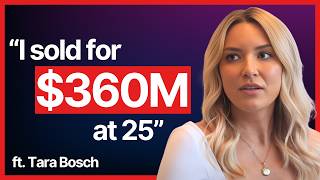
Tara Bosch founded SmartSweets at 21 in her kitchen and sold it for $360M in under four years. She hit $2M revenue in year one, scaled through Amazon and wholesale distribution, and stayed profitable the whole time while raising $3M in equity and $14M in debt to fund growth.
Questions this video answers
$360 million.
Just under four years.
Started at 21; exited at 25.
July 2016 (stated in the interview).
About $2 million.
Chapters
Yeah, we went from zero, starting in my kitchen with the idea in my head to exiting for 360 million and having majority ownership of the business still. And yeah, it was like just under four years.
And how old were you when you started and exited the business?
I was 25 when I exited and I was 21 when I started.
Wow, that is incredible. It's the best headline in entrepreneurial history. 21 year old, first time founder starts business, scales it to over $100 million in four years and sells it for $360 million. Today I'm going to be joined by Tara Bosch. She's the founder of SmartSuites. I asked Tara to come onto the show for two reasons. One, because her story is going to, I think, justify a lot of your journeys. If you've been following the work here@capitalism.com you and you've been learning about building audiences, launching products of building small communities, of people, of raving fans, of planning for an exit, building a vision that is bigger than what you can do right now. You're going to see a case study of this that is one of the best examples I've ever seen of that model. Second, I asked Tara to come by because she doesn't do a lot of interviews and she's going to be keynoting the Capitalism conference. And I wanted those of you who are going to be at the Capitalism conference to be able to meet her ahead of the event. Of course, if you're watching this before April 3, 2024, you might be able to join us if you go over to capitalism.com Capcom for the rest of you, this is one of my favorite case studies and breakdowns of a business that saw tremendous success. A nine figure exit in just four years. And yes, she owned a majority of stake of it when she sold. And this case study will give you permission to go all in on the playbook that we talk about here@capitalism.com tar Sarah Bosch, welcome to capitalism.com great to see you.
Thank you for having me.
Of course we're thrilled to be having you at the Capitalism conference this year. You were at the top of our hit list this year because first of all, you have like the best headline. I'm going to ask you about this, about the great, maybe the greatest headline in entrepreneurial history. But also you keep a fairly low profile most of the time and not a lot of people know the entire story of smartsuites which is fascinating if you dig deep enough. So first of all, I want to ask you about the, the greatest headline in entrepreneurial history, which is first time founder goes from zero to a 300 million dollar plus exit in four years. How accurate is that headline?
It's accurate. I mean your, your preempt to it is a, is big shoes to fill, but it's accurate. Yeah, we went from zero starting in my kitchen with the idea in my head to. To exiting for 360 million and having majority ownership of the business still. And, and yeah, it was like just under four years.
And how old were you when you started and exited the business?
I was 25 when I exited and I was 21 when I started.
Wow, that is incredible. Now that's, I mean obviously owning majority stake of a multi nine figure exit when you're 25 is like everyone's dream, right? You just, it comes out of a movie. I, I had an, not a nine figure exit but a sizable exit when I was 29 and most of my peers who have had similar windfall events talk about the crash that happens after something like that. I'm curious if that happened to you or if you have some sort of golden touch where now you can just go into the next chapter of life and everything is rosy. Tell us what it was like after the exit and then I want to break down how we got there.
Yeah, I mean, I don't know, I feel like almost as like a coping mechanism, you know, because startup life is just so hard and just so mentally grueling in the, the hill that you're climbing and feeling like you're rolling this big ball up that could come and crush you at any point point in time. For me, when I was building and in that intensity I always kind of had this mentality or thought that I was like, you know, it's going to be very hard for a short amount of time and then I'll have freedom of time and energy and life will be rainbow and butterflies forever and I'll like frolic in the fields and it will be like rainbows all the time. And yeah, one week after I signed the papers, my health started like deteriorating super quickly. And within like five months I was like, oh my God. What people say about burnout is real. Like here it is. It was like, it was, it was super, super bad. And then I had found out that I wasn't slowly dying, but I was actually six months pregnant. So I.
Kind of jumped into from one chaos to another. I had my like scuba flippers packed because I had never traveled really in my life. And I was supposed to leave for the Maldives and that week I Found out that I was having a baby in three months. So I like, wow. Kind of by means of that happening, I kind of dove into the, like, just getting things sorted to having a baby, which ended up being the biggest blessing. But definitely I went through a lot of, like, grief about what was my other like, my first baby, really, in building the company and going from, like, being a lot in your head of being making strategic decisions and a lot of adrenaline and highs and lows to changing diapers every single day, which is a different purpose. But I had a lot of grief about, like, where do I serve in the world now? And. And what is my purpose? So I definitely went through that.
You know, a friend of mine told me recently, every time they wonder what their purpose is, they remember that, wow, they must be fortunate to have enough space and money and freedom to think about what the heck is my purpose. So these are definitely first world problems that we struggle with.
Absolutely. Yeah.
I know you started Smart Weeks In July of 2016, and the first year in business, you did about $2 million in revenue. And that is right in alignment with a lot of those who listen to the show and those who will be at the capitalism conference of being at about $2 million in some sort of physical product brand. And then things have to change. So I was curious to hear from your side of things. When you were at the $2 million run rate, when. What did you then change or focus on in order to have what appears to be that hockey stick growth over the following four years?
Yeah, I mean, I think. I think what served me really well and. And what. What I feel really serves others wherever you are in your entrepreneurship journey is just getting super clear. The closer you are to. To day one, I think the better it is to be clear on, like, pulling back the context, you know, 10 years from now, what does the world look like with your. With your vision in the world and then really embedding that into your subconscious as if it's already happened. So for me, like, for. From day one, when I was in my kitchen recipe testing on the outside, just from a world perspective, it was like, oh, this is a girl in her kitchen recipe testing. But to me, I was like, no. Smart Sweets has already become the global leader and has revolutionized Candy. We're just working back from that. And so for me, when I did 2 million, that actually, like, felt low the first year. So I was like, oh, that kind of. That's a small step to where we're going, but getting clear on that. And then I think secondly, getting really clear on, like, what is your radical value proposition? Peter Thiel's like zero to one book talks a lot about that, but not just creating something that's adding a tiny bit more of value for people in the world, but having something that's creating so much radical value for people that that really allows you to have that kind of hockey stick growth and a lot of the kind of community that really rallies around what you're creating.
That's an interesting point that you bring up because SmartSuites was really the first of its kind in the space. And I forget that now because there's so many people who have tried to emulate the success of SmartSuites, but I forget that it was revolutionary at the time and therefore changed the category and opened people's ideas to what a product line like this could be. And what I'm hearing you say is that because it was so different for the time, there was radical value that allowed for that newness and that interest for retailers to pick it up, investors to pick it up for, for distributors to bring it up. Is that kind of what you're saying when you talk about the radical value?
Yeah, I think when I talk about radical value, I really am talking about from a consumer standpoint, like who is buying your product at the end of the day. So for us, when, when I launched SmartSuites, our very early communities, and we scaled the company a lot through niches and there's a great book called the Tipping Point that talks about that you need a thousand people to create a movement. And a lot of the early communities, they hadn't had candy in 5, 10, 20 years and they were in tears in the candy aisle. Being able to have that emotional experience of having something that brought them so much joy as a child back in their life. So, so when I talk about radical value, I'm talking about for the consumer, unlike the side of distributors, manufacturers, all those sorts of things, it actually made it a harder hill to climb because people are like, sugar is candy. What are you talking about? And so I really had to like, emphatically make sure that I was so convicted in what I was saying that on the other end, they're like, oh, wow, like, this girl really sounds like she's going to make it happen. So we'll take a chance and focus on, on the. What's in it for them. So for a retailer perspective, it's like they're going to make more money on smartsuites at the end of the day because it's a higher dollar ring and really focusing on what the value is for each of those verticals.
I find it interesting that you got to that first 2 million on tiny audiences and small niches and focusing on those few raving fans. How did you get in front of and communicate and rally those small groups that took you to that seven figure run rate within the first year or so.
So I had the fortune of when I was just done recipe testing in my kitchen, I had the fortune of being accepted into an accelerator program. It was Ryan Holmes out of Hootsuites program called the Next Big Thing. So a lot of other young people working on a lot of ideas in tech as well as beauty. And what I quickly learned was that in the beauty space, the successful brands had created communities around products, not brands around products. And so from the beginning I was very clear in creating a movement around kicking sugar and not just focusing on selling low sugar candy. And so that was really kind of the emotional connection that that got people to get have that early buy in. And the rest was just being so scrappy and using social media. Instagram at the time changed my handle to smartsuites Founder would DM people from the Weight Watchers community. That was our first kind of niche and just be authentic, be like, hey, I really like your nails. If I like their nails, this is what we've created. SmartSuites would love to send some for you to try. And within like three months to that community, it seemed like we were a big brand when we really didn't exist in the world. So just really having the putting in the scrappy, the work of, of authentically connecting, there wasn't any like secret trick really.
And I'm really, I'm really glad you're saying that because we try to pound it into people's heads that if you focus on community that they will take you far and wide. And it only takes a few hundred few thousand people to really start something that matters. That first domino matters. And so I would be really curious to hear from your perspective of how you built that community, like where they were, they were housed at the time. I know you're reaching out to the Weight Watchers community, but did you have a process for really going deep with that first few thousand true fans?
Mm, yeah. I had the fortune of running into a fellow who had been the VP of sales for Ali, that was a vitamin company that partnered with Target and went from 0 to 100 really fast themselves. And they talked about how they had what they called the advocate program where they invited like their top e Comm consumers, their top people that were engaging with them on social into this program and really made them feel like they were part of building the brand, the team on the inside. So I launched what was called the SmartSuites Champion program. Same thing, just seeing like who is showing up again and again excited, inviting them to this mart's week's champion program. And it was me just sending an email every week to them and not making it fancy like a newsletter format, literally just being like, hey, here's me in the office with my dog. Hope you have a great week. And then they were the ones ended up being 500 people at first, then a thousand, then three thousand. We would send them products when we were developing it. When we launched on shelves, we would tell them first and really ask them that, hey, we need your help to make this successful. So I'd have the Whole Foods buyer saying, you can't have your team coming into the back of stores. And I was like, our team's not doing that. And then I realized it was champions. So that's kind of where we created that community that we had that consistent back and forth with. But going back to intentionality, scaling that and scaling the communication so that they really felt like our friends, which was like a 12 hour response on email. We had to end up hiring around that to really be able to scale engaging with our consumers, which was called our friends in that way that I'm.
My heart is so happy hearing you tell this because I think a lot of founders and entrepreneurs miss the fact that if you have a true core group of really happy raving fans, they will move mountains for you. And even if they didn't, you can never really healthy business with a few thousand really happy customers. So many in the TikTok world and the Instagram world. We're so obsessed with the idea of having a million followers or even 100,000 followers or going viral. And so it's refreshing to hear that you built a company that went to nine figures in four years on the back of a real grassroots community building. I find it interesting, Tara, and I'd like for you to comment on this. I have not heard you mention Amazon strategy or retail distribution strategy or D2C funnels. You focused on an insane amount of value for the customer and creating really raving fans. Was there any other jiu jitsu that you sprinkled into this recipe or is that a fair summary of what the thesis of smart suites was founded on?
Yeah, I think where we showed up in the world for people to find Us it went back to kind of like that larger vision. And I always went back to that larger vision because I always thought found it could feel overwhelming in the day to day when it's you and you're still staring at your laptop in a wall and are like how am I going to make all these decisions? So I would just peel it back up and I'd be like, okay, we're a global company. Okay. That means we need to exist in North America first. Okay. That means that we need to get nationwide accessibility pretty quickly or someone else is going to be right behind us doing that. Okay. Candy is an impulse buy and so you want to buy candy online sometimes, but when you have a sweet tooth, you want to get it right away. So that really informed how accessible in the world which was finding national partners from day one, that we could drive that accessibility, shout from the rooftops and social media, not leave anyone frustrated because they can't find us and then use our E Comm is really like the surprise and delight to foster that friendship. So we'd have all of the special build your own box, all the special water bottles and all that stuff. The building of relationship was ecom. But for us, because it was such a candy is such an impulse purchase, we really needed to show up in the world when our consumer, she's primarily a she where she's navigating in her day to day life.
Lately I've been beating it into the head of people on the email list or people who follow the YouTube channel that you only need a few hundred or a few thousand people in order to do damage. As I'm recording this for you right now, just this week, one of our members sold $100,000 in product with a, with a list of a thousand people. It was a new product. He had no entrepreneurial experience before. A couple of months ago, one of our businesses in our community, Maple and Lark, did $100,000 in a day just by nurturing their active community. Building small, responsive audiences will take you farther than you can ever imagine. And you don't need that many people to be able to open the doors for your next chapter of growth. In Tara's case, she had 500 people to start a 500 person raving community. That's where it started. And guess what? Four years later, she had a nine figure exit. Tara, at some point in the process, you were on Dragon's Den in Canada and if my notes are correct, you, you raised $100,000 for 10% of the business. My question is, were your investors Happy with their return?
Yeah, I mean I, I didn't end up doing the Drakens Den deal offline, but I'm a big believer in honoring relationships and I think there's a way of doing that no matter what the situation. When it comes to raising, it's really interesting because I feel like there's so many formulas of like you should raise on like this multiple or blah blah, blah, blah. For me, my like philosophy on raising was like, I want to get the right people in who are going to be low energy investors. I want to move quickly and close so it's not a distracting distraction from executing on the business. And I want the people who are part of SmartSuites to truly feel like they're going to be winning and not like I'm just trying to maximize the evaluation that I can get for, to give away as little as possible. So I ended up doing a convertible note in my first round with a 3 million cap. So those people, yeah, you can do the math on what their, what their, like what their X was.
They were satisfied?
Yeah, they were, they were satisfied. They weren't mad. Yeah, they definitely weren't mad.
Tara, the way that you are talking about your understanding and your thoughtfulness about how you were raising this capital is beyond the wisdom of, of most people who are in their early 20s and you were, you're 21, 22 when you're doing these raises. So where, where did you become proficient and confident enough to be able to stand for the terms that you wanted despite the fact that you were young and had never done a deal of this size before?
You mean from the exit standpoint?
No, specifically when, when you are early in the journey and you're raising capital from investors. These are the, these are new terms to most first time founders and yet you are very firm in what your desires and requirements are to be an investor. So where did you develop that confidence and that competence at such a young age?
Yeah, I mean I think it's like such a duality being an entrepreneur of emotions because it's like one minute you're scared shitless and the other you have to go project confidence about something and to your team or to investors and whatever. So I mean, I don't wouldn't say I was sitting there confidently, I'd say I was sitting there being scared shitless, being like, wow, I just got a phone call telling someone that they either need to decide if they want to be in by the end of the week or we're moving forward without them and I need that Money because I don't have enough people right. Close yet. So I think it was like, just be grounding myself back in the why and the philosophy, but having people much smarter than myself and who had been down the path before that I could call in those moments and guide me down the road. So in that very first raise, I did one of my closest mentors who became an advisor. And just all of the things, I was calling her after every phone call, and she was even before phone calls, like, she would tell me, like, how to frame things, and I'd write it down in my notes on my phone and literally say it word for word. And so I wasn't walking that path alone. I was grateful to have the support of people much better than. Not better, smarter than myself at that time.
Tara, there has been this theme of mentorship that has come up several times in the way you're describing driving the journey of smart suites. Where did you cultivate the relationships with people that you could trust? And how did you decide who was. Who's a. Whose opinion was worth listening to? Because I'm sure you got a lot of conflicting opinions during the entire process.
Yeah, it can feel overwhelming, right, when you're like, I want a. I want mentors and advisors. But, like, where do I go to find these, like, elusive people that could really support me on my journey? And I think for me, I really, again, just kept it simple. In the beginning of my journey, I didn't know anyone in business. I had dropped out of university, was never really taken seriously in university or high school. And so I really knew nobody in the realm of business or anything like that. So I just went to Google and I looked up the journeys of people that I aspired to follow. And then I would LinkedIn, message them, you know, do the whole first name, last name, company, and you. Eventually it goes through, but I would just reach out and I would always lead with gratitude and being like, hey, like, I totally get that five minutes of your time, like, what that means for you. Your time is valuable, and really lead with that. And I was shocked to find that, like, people were actually willing to pick up the phone and talk to me. And I quickly found and learned that people almost, like, see a younger version of themselves in you. And, like, if they get that, you're gonna really take what they're saying seriously and, and. And value their time. They're also getting their cup filled through that. And so through that, I was able to meet some pretty amazing people. And then from there, it kind of just ends up Being like a little, a little trail. It's like it felt very much like high school in the sense of like once the cool kid likes you, then all the other cool kids are like, oh, I want to talk to you too. And so it was kind of funny in that way. But yeah. And I would always make sure to follow up a month later and be like that specific piece of advice you gave me in that five minutes. This is what that translated into for me. And that went a long way in people really wanting to lean in.
Beautifully said. Tara was part of that mentorship was obviously some group of investors. You didn't raise a ton of capital, but you raised some. And obviously wherever you put the capital worked because he went from 2 to 16 to 60 to over $120 million in revenue. So I'm curious, where was the capital invested that had the biggest return in terms of valuation and top line growth of the company? So where, where was that capital best spent?
Yeah, absolutely. So parallel to that capital, I scaled the company primarily on debt financing. So I treated the banks as I would an investor. So like every quarter I was meeting with them, giving them an update on where they, where we were keeping them. Really excited about our vision and what we were creating in the world. And so I was scaling a line of credit right alongside that. It was like $14 million by the time we exited. And so I was able to offset pulling for inventory needs from our line of credit always. And so that money from the raise was always able to go into. It was primarily headcount that it went to marketing. We really stayed super, super scrappy really until year three where we did lean into paid ads and, and larger partnerships where we were paying on the influencer front and that sort of thing. So it primarily went to headcount and then a sprinkle of marketing but inventory. And I'm a huge advocate of this, not diluting yourself to fulfill your inventory. Especially since SmartSuite's time. There's so many amazing avenues now that are non dilutive and not sharky with interest rates to do that. But that's kind of how I approached it. Yeah.
I was so glad to hear Tara share that she funded her inventory with debt capital and that you may want to consider that instead of equity financing or using the funds in the bank to be able to buy more inventory, this is actually a sticking point for a lot of our members in the capitalism incubator. They hit a million dollar run rate and all their cash is tied up in inventory and they feel like they're broke. One of the first levers that we pull for them is we bring in debt capital either through someone that we know or we just encourage them to go get a line of credit at the bank. Because if you're able to predict your inventory orders, there's an argument to be made that you should be financing that with, with debt. And that frees up a lot of capital for you to be able to invest in growth in the business. If all your money is tied up in the inventory of your business, it makes it very hard to hire people, it makes it very hard to grow. And plus you're always stressed about the business because where's all your money? It's tied up in inventory. I was really glad to hear Tara say that she had such a line of credit to be able to finance her inventory. And I think that's one of the smartest ways to support the growth of a physical products brand. Yeah, you deployed it into headcount. When you say that what would you say were the most important hires that you had to fill in order to again go from 2 to 125 in revenue over four years? I mean I've never run a nine figure company before. I wouldn't know who the people that I need to have in place in order to be able to handle that type of growth. How did you know who to hire and who did those people end up being that were vital to sustain that growth?
Yeah, I think it's different for everyone and just like really sitting in, in a non, in a non self deteriorating way, like what do I suck at and you know, like what are my weak spots and so, and how do I best serve in this period of growth? And it's different in every stage of growth. So for me I would try and ground myself in that. So those first key hires, the five hires were really rooted in like surrounding myself with people that I sucked at those areas. And sometimes you have to do the areas that you suck at until you have the ability to hire and pay someone else to do that for sure. But for me it was the very first hire. Um, she was someone who was had the ability to wear all the hats. So more than anything she had no ego, was able to get in the trenches and be on designer doing our packaging if she needed to, wrapping the boxes with me at night if she needed to. But having someone who's willing to wear all the hats I think is so important in that first and those first hires. Then for me it was a sales hire. So I was the one Getting the relationships, but actually on the back end serving the relationships and following through with what that looks like. Our fourth hire. I sucked at numbers. I didn't even know a sum function existed on Excel. So, so I. We were way too early to hire like a head of finance, but one of my advisors and seeing around the bend pointed that out and was like, you suck at numbers. And I was, I know I suck at numbers. This is going to start holding up the business. And so we hired head of finance way earlier than we needed to. Same with the CEO. I loved inspiring people and could get them to come on board, but I hated and like got so drained by managing people and having the one on ones and having the conversations about dynamics and, and feelings between each other and, and all the things. And so we brought on a CEO who thrived in engaging people way earlier than like, if you were looking at textbook way of doing it, anyone would have. So really just rooting in, like, how are you going to hold up the business based on your weaknesses and surrounding yourself with people that can plug in the holes when you can afford to. And part of it, I feel, is a bit guesswork too, where you have to make assumptions that you're going to be doing x dollars in six months from now, 12 months from now to also make those bets on right. What are the right hires seeing around the bend and when. When can we like, hold off until.
I found it very interesting that Tara answered the question in this way. She said that she chose somebody who could wear all the hats at first, and then she hired someone in charge of sales and then someone for the numbers and then a COO to be able to manage people. This fits right in alignment with the advice that Cameron Herold gave to me when he spoke on our stage way back in 2016. He said, the first thing that you gotta have is somebody who can just support you and jump in wherever needed. Then someone who can be in charge of revenue, and then it's knowing your numbers and managing people. If I had had that advice when I first started my business, it would have helped me out tremendously because oftentimes as founders, we're just hiring to where we think we need to grow or where we need to be freed up. But I've seen a consistent trend among successful entrepreneurs that first they hire for help, then they hire for sales, and then they're starting to professionalize the business. It's an interesting, predictable playbook that multiple successful entrepreneurs have shared with me or on the show over the years. Tara, I'm Curious. I mean, I've heard you say that when you grew the business, there was a strong emphasis on the impact that it made for the customer and those raving fans. But in my head, I'm just having a hard time seeing how such a simple approach takes us from 2 million a year to 125 in four years. So I'm just. I was. Could you break down a little bit where those biggest, those biggest breakthroughs in revenue jump were and why you think it happened so quickly?
Yeah, it's interesting, right? Because I think from the outside stories with high growth often look like, wow, like how did that even happen? Like that doesn't make sense. But on the inside it feels like it's like slow growth. You're throwing at the. You're grinding every single day.
You said the same thing when I asked him. He's like, it felt so slow at the beginning. You hit 100 million in like two years, man.
Yeah, it's so funny. Like the one day in startup life feels like a week, right? Because so much happens, the highs and the lows and all of that. And I think I remember like keeping a milestone tracker of just being like, Bob from Whole Foods finally opened the email. He didn't respond, but like he opened it and celebrating those wins and holding on to them because truly, no moment felt like a silver bullet moment. It felt like a slowly rolling the ball up the mountain moment. But I think a lot of it too was like rooting in that vision where like at the beginning of every year I would make a like desktop wallpaper that would say like, when we are doing our 16 million year, for example, I put like, we're a 20 million dollar company and we're just executing on that. And then that year we landed on 16. So 16 actually felt small to me because I was like, damn. Like we didn't hit the but, but that saying kind of of like aim for the moon and your land amongst the stars type mentality. I like it sounds so fufui. But when you truly believe that something has happened through like your own actions and like the universe conspiring around you, it just like slowly does actually materialize. So it never felt like it was like, wow, this is fast growth. It actually a lot of times felt like, wow, this is slower than I. I feel like I, we need to be going at to become a global company. But it did truly come back to like just brand awareness and distribution. And part of it is just like, you can do the math once you know you're gonna get in the doors. And you know you're gonna do certain velocity because you had the brand awareness and the people passionate about it. Then, then it. That's kind of where the scale came from. From a wholesale perspective, which was always 70% of our business, Amazon became a very big part of the other 30% of our business. We were always number one or number two in the non chocolate candy category.
But there was really no silver bullet moment there. It was that dance of scaling brand awareness and distribution so that they could really marry each other and one wasn't too far ahead or too far behind the other.
Tara, tell me about when you decided to sell the business. Did someone come to you? Did you decide that it was time? How did that progress process evolve?
For me, from day one, I was always very clear in my mind that, okay, at a certain point in our growth, it's going to make sense to partner with a multinational who can help scale our distribution and manufacturing systems to expedite the global vision, actualizing at a faster pace than we can do it alone. We were coming up on year four and crossing that $100 million mark. And for me, it was the first time where I was sitting in myself through that lens of like, okay, how may I begin to hold up the business? And I really didn't feel like I had a grasp of like, okay, how do we go from 100 to 200 to 300? That gut instinct I felt lost on. And so I felt clear that I was like, okay, I think it makes sense to bring on a CEO and then I can serve best in innovation and building the community with our friends at that stage. And then also from a timing perspective, I had dedicated my whole life to SmartSuites for that four years. It truly was 24 7. And by choice, I felt so grateful to somehow wake up every day and like have the opportunity to build that. And every single person that was part of SmartSuites also made that choice and dedicated their life to it. So all of our employees had equity and meaningful equity. So like the lowest person on the totem pole could still buy their dream car or put a down payment on a house, but when we sold. But it really felt like from just being in awareness with myself as well, from a burnt out standpoint, I knew that I wasn't showing up anymore in the way that the company needed. And for everyone that had taken a chance on SmartSuites in their journey, it really felt like the right timing to partner with someone to further the vision in that standpoint, to do right by everyone. In the journey and then to also be able to like, breathe myself and have that freedom of time and energy. And my Oma, who was a large reason why I started the business, she had just turned 90 and I really wanted also her to be able to see that journey through. And so that was also a big part of it.
Well, I'm. I'm sure a few hundred million dollars helped to breathe everybody breathe a little bit easier. Tara, I am curious from your perspective, what was the attractiveness to the buyer, meaning what did they see in SmartSuites to be able to justify writing such a large check? Every buyer has a different way of justifying how they value a business. So I'm curious, what do you think that they saw in smartsuites that made it a good investment for them to write such a large check?
Yeah, you know, I think like at like the highest level of it, I think there's, you know, all along the journey for with SmartSuites, it was people saying, you know, well, Mars or Hershey's is just going to copy what you're doing. But what these big companies can't replicate still to this day, and they scratch their heads trying to do it, is authenticity. They cannot replicate an authentic story of a reason of why a brand exists in the world. And it truly takes them years to launch one skew to try and compete against the product. So authenticity was the very top of it. We had such an authentic why and such an authentic community behind that, and then layered under that and being very clear from day one that that was a path that I did want to take building into the business. We did a lot of things very strategically, so the company was always profitable. We always had an EBITDA over 20%, which was huge and like fundamental to. To the business being attractive. We had kind of created a moat on the back end that made it harder for people to replicate. So for example, with manufacturers, we white labeled and worked with a flavor house to develop our flavors and sent those to the co man. So not one place or house ever had privy to like what the whole parts of our recipe were kind of like a trade secret, like Coca Cola does type thing. So we built in those pieces of the puzzles which made it really attractive. And then just from a brand standpoint, the brand platform is really about kicking sugar and being on a mission to kick sugar. And that really creates such a platform for a multinational to be able to take and to expand, expand that to different categories as well. So it was kind of all those pieces meshed with one another. And then I think timing also plays a role. And just like in that gut feel, knowing it's the right time. And we were hit it right at Covid. So six months later everyone had FOMO and was doing no deals. I never to this day have met the TPG group, which we sold to because we did it all during COVID which is wild.
Yeah, that is pretty wild. Tara, the way that I want to close is I have heard you say today and in other interviews that you've done how important the visualization process was for you at the beginning and throughout the entire journey of smartsuites. Now I have, I have peers that talk about this. They're all women and us dudes just this, this is tough for us because we think more in increments. And I think women are better at thinking about just seeing the vision. And I'm curious, how would you describe the importance of your visualization process to a hard headed dude like me?
I mean, you know, I think like something guys can relate to. A lot of sports, a lot of guys at least. And I think it's talked a lot about in sports, sports about. They have their own, they have coaches specifically for visualization and mental strength and that sort of thing. And so I would, I would just parallel that to like entrepreneur entrepreneurship being a sport. And if you can't see it in your head, it can't exist in reality. It just simply can't. And so I truly believe that we are our own biggest obstacle. You know, what your vision is in the world. Um, there's no limits to what you can create other than what the vision is that you are creating in your own head. And so I think it just goes back to like all those cheesy quotes of like, if you believe it, you can do it. If you dream it, you can do it. It's like all those cheesy quotes, it's. They are so freaking true. And once you experience that and those little crumbs of visualizing something and then it happening, you intrinsically like validate to yourself. Holy smokes. The other thing I think that's really magical is like the concept of everything in life normalizes and that gives me a lot of peace where it's like in the beginning, you know, it's like getting that first hundred thousand dollars in sales seems like such a big. And you're like, holy crap, how am I going to do that? $100,000 in sales. Then that happens and you're like, well that, that feels like achievable. A million dollars in Sales, then you do a million. You're like, how am I going to get to a million? Then a million happens. You're like, well, $10 million. And so just like, really realizing that everything normalizes. So if you want to normalize in your head, reaching a billion dollars in sales, that can normalize. But I always found that magical to step away from the imposter syndrome of like, something feeling overwhelming and knowing that truly anything is achievable.
I asked this question about visualization selfishly, and I was really glad to hear her answer. My dear friend Brooke Castillo told me years ago, it's all about the belief. It's not about the how. And I talked to Shannon Klingman from Lumi Deodorant, and she said almost the exact same same thing. When I've hung out with female founders who have accomplished amazing things, I've discovered that they think about things differently than me. I think about incremental growth. I think about the next step and the next step. And a lot of my male peers who are also founders and entrepreneurs think about it the same way. But the female founders who are just as successful talk about living in the end, which is very new age spiritual, but also kind of a timeless shtick that we've heard for many years. And I was so glad to hear her talk about the idea of normalizing the future, because I could relate to that in the sense of normalizing the past. This gave me a different frame for the idea of visualization because it allowed me to think about the future as one day being normal, rather than being stressed, tense, or fearful about it, which is oftentimes how we look at our goals in the future. Instead of doubting ourselves or instead of being fearful about what could happen or it not happening, maybe we can rest in the idea that once it does happen, it will just feel normal and natural to us. Tara, I'm so excited to meet you in person at the Capitalism conference. We had you at the top of our hit list this year. We're so proud to bring you down. Can't wait to meet you. Thanks for hanging out with us today.
Yeah, thanks so much for having me. Thanks for all the thoughtful questions and conversation.
All right, Tara, I'll meet you soon. The headline reads like a fantasy. First time young founder goes from $2 million to $125 million in four years. Sells for almost 400 million. But when you hear her break down, what happened, it's actually very logical. She created a product that was extremely valuable to a very core person, to a very core audience. She built an audience of 500 to 1,000 people that became advocates for her brand. She had a very clear vision for what it is that she wanted to build. She started getting the word out and being good to her customers. Does this sound familiar at all? I hope it does because my entire book is written about it. It's the playbook that we put people through@capitalism.com is what we help founders and entrepreneurs execute inside of the capitalism incubator. So if you want details on how we can free you up from the weeds, help you cast a vision that excites you, help you have the capital to support that growth and actually have the playbook to be able to scale, you can find out more resources in the description of this video. And I hope after hearing this story you can see that this playbook that we talk about and share case studies about is not just something that can build seven figure companies because we have hundreds of those case studies, but can also result in nine figure exits. It's exciting for me to think about. I felt invigorated after this conversation and challenged to think bigger. I can't wait to meet Tara in a couple weeks at the Capitalism Conference. I hope to see you guys there, and if not, I hope you'll decide to subscribe to the channel so that we can support you on your entrepreneurial journey. I'm Ryan Daniel Marw with capitalism.com, i'll see you next time. Take care.







