
Buying Businesses: How Amazon Brands Make Big Exits & Increase Profits
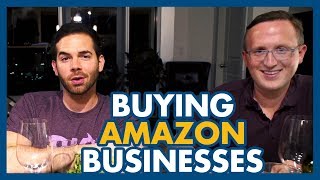
Ryan Daniel Moran, Brian Bigelow, and Dr. Clement discuss buying and scaling Amazon brands. Brian has acquired multiple e-commerce businesses using SBA financing and emphasizes the advantage of buying existing businesses over building: you get immediate marketplace feedback and asymmetric risk. They recommend starting with one product, focusing on inventory turnover, and using Amazon PPC and email lists to drive sales.
Questions this video answers
August 17, 2018
He turned about $7,000 in savings into roughly $150,000 at age 21.
Chapters
Welcome Brian Bigelow to the show. Good to see you. Hey.
I have got to ask, growing up, were you ever called Brian Bam Bamboo?
That's the first time I've heard that, Ryan. Never heard that one. Maybe just every third time.
Okay, Right. And no one's ever called me Ryan Moron.
So it's perfect. Hey, so cool thing, Brian, you're celebrating this week. You just closed on a business acquisition, am I right?
I did, yep.
So tell us about that.
I spent the last couple months going through bank process and learning what I needed to to run a my first supplement business. So new to the space you went.
Through the bank process? You mean like you had to get.
An SBA loan this time to purchase business? Okay, first time going through that process as well.
It's not the first time you bought a business though, right?
It's not. It's second time I bought a business.
Okay, cool. So the first one was a good experience, I guess.
Great experience, yeah. So I've learned a lot through it. The business has increased its profitability fairly significantly. And yeah, looking to kind of do.
This more so is the strategy to buy a handful of businesses with the expectation that you'll have like a nice portfolio of businesses that produce somewhat like.
Passive income.
I don't know that I have a clear thesis right now. So I am continuing to buy businesses that I think are a good value, that I think can grow. And I think that do one thing excellently.
Hey, is excellently a word?
Probably not, but that's okay.
All right, cool. We're good with it.
At least.
We're only half a glass of wine in.
Verbiage.
Why did you decide to buy a business versus build a business?
I think maybe similar to. You have been entrepreneurial in my career, but really with the intent of building a capital base that I could use to become an investor. I've spent really most of the last 20 years kind of really studying investing and kind of applying it. I've managed a small fund in the past.
Did you talk a little bit about your background as far as like what you did before?
Sure.
I've been pretty eclectic. So I made a decent amount of money as a trader when I was an undergraduate.
What's a decent amount of money? I turned more or less than $10.
More than $10. I turned about.
Brian Bam Bam Bigelow.
$7,000 savings to about $10, 150,000 as a 21 year old.
150,000 is more than $10. It is. I'm no mathematician, but I've heard rumors.
I think I got lucky more than being right in that scenario. But.
It was helpful.
And so sometimes being lucky is helpful.
Like in multiple ways. I would not pursue the same strategy that accomplished that.
Now, open break. So your special Skill is turning $7 into $1.5 million. Right? An info course about how to turn $7 into $150 million. Great. Would anyone like the link to this? If you talk like that, you too can get Instagram comments like I get on a daily basis. That's the hack to the Internet, right? We figured it out, everybody.
My first day on the Internet, I've got it cracked.
No, I would say my defining attribute is I look for things that are what I would call asymmetric. So if you lose, you lose a little. And if you win, you win a lot. And that's been how I've approached investing most of my career. And I think that's true of buying a lot of these e commerce businesses or starting them.
You can structure them in a way that if you lose, you have kind of defined risk. And if you're right, you can grow them many times more than what your initial risk was.
It's pretty much how you look at the world and investing as well, right?
I'm not sure. Like, yeah, everybody tries to minimize risk and maximizes return ultimately. So I guess similarly, and it's interesting.
Not the bitcoin buyers.
I feel very justified anyway, the way that you approach investing compared to or looking at opportunities versus Brian, because you look at things more like an investor. You have an investment banking background. So how is your viewpoint similar or different than Brian's?
I think ultimately we both look like, broadly speaking, it's about maximizing the return for the least amount of capital and figuring out as far as like cash flows and return on invested capital. That's probably the biggest differentiator amongst people who are investors and marketers, at least in this space. And that's. People don't think in ROIC terms, where a lot of Internet marketers are used to seeing money.
You.
You invest money right away and you take it out right away. And when you add in the complexity of inventory, that's when things kind of go off the rails for some people. And that's. That's a huge differentiating factor on why some companies win and some, some don't.
Yeah. When I say entrepreneurs, like the entrepreneurs I know are really good at making money, they're also really good at losing it because they're used to quick wins, usually for status. And then it goes away.
Even if you go back to like Warren Buffett or any one of these, some of these billionaires or people who have built billionaires, it's the ability to leverage some type of asset to keep on growing it in some consistent way. And Buffett did it with his insurance companies using some of the float. And.
In the same way I think you have this unique world in digital assets where our leverage is operational and it's through platforms like Amazon that allows us to and Facebook that allows us to project a message which was never possible before.
Brian Question came from Jacob Brown. What was the biggest lessons you learned after buying your first business?
You know, I've learned a lot. I learned a lot on the first business. I bought it primarily sold on Amazon through fba. I've learned a ton about that ecosystem, both kind of what works, what doesn't. I find that I learned the best when I can get immediate feedback on whether something works or not. I find a lot of times when I'm starting a business I don't really know quite what to focus on early on and so I can waste a lot of time. If I am working on an existing business, I can test things very quickly and get feedback in terms of how it affects profitability.
So are you saying that buying a business and having that momentum gives you more of a platform to test new things, whereas if you were starting from scratch, it would take a lot longer to get that feedback from the marketplace?
Yes, exactly.
How does that play out in a day to day basis? Are you testing things to the audience? Are you testing new products?
It could be any of those. When I bought the business on Amazon, like I didn't understand how marketing worked on there. I didn't really understand how.
How to kind of get your product in front of customers, whether it's optimizing for the words that you want to show up from a search standpoint. And I didn't really understand kind of a lot of the adding existing and new products.
So you bought it, you learned after you bought it?
I did. I had learned a lot beforehand but had not had a platform to really apply it. And so I was immediately able to just kind of put to work ideas and theories I had and see kind of what bore fruit and what didn't.
Really the secret that no one talks about is selling drugs on the Internet has an amazing amount of profit potential. Potential, really? I mean, why do you think they shut down Silk Road? They shut it down because there was so much money and the government wanted that money. It's like the Government was in on it. Guys. Like they're trying to suppress Bitcoin.
Well, you can see the fight that the FBI is putting on right now. They just don't want the government in on their business.
I have no idea what you're referencing.
Oh, the all the subpoenas into the FBI where the FBI isn't giving any documentation in the Russia.
As a Canadian, you know more about American politics than a political junkie does.
That's because they hide it from us as Americans.
Only.
Only Canadian news actually does.
It's part of the machine and the brainwashing.
I think Clement secretly hopes that America will become a police state so that everyone wants to move to Canada.
He's actually just like a secret subverter.
Of all of our national interests.
Clement walks away. Dr. Clement, Joshua Costner asks, I know you focus on physical products based business models. Do you ever advise service based business models and how do you feel about investing in service based businesses?
Investing in service based businesses. I'm gonna let you take that one. But the question on advising them. So like in every business there's some sort of, well, there's really two things. There's some sort of sweet sauce or some sort of special advantage and there's some way, hopefully that if you step on the gas, more revenue comes in. Whether that's in the form of client flow or it's coming from products, there's some way that you're getting leads and customers that can and is always going to be optimized. There's always upside to that. And whether that is dumping gas on the fire with more advertising or different types of advertising, or it's bringing in forms of outside traffic, it's where can we step on the gas with what's already working? And so when you've got an entrepreneur who has something that's working, you're coming in and looking at what pieces of that can be optimized. So what are the traffic channels? Can we plug in? How can we. A lot of times it's what revenue model could be optimized to be more efficient. For example, I have one service based client that I work with very closely who he told me what he was selling his services for. And I said, I have reason to believe that you could probably charge four to five times what you're charging right now. If we just tweaked this positioning the marketplace a little bit. And he was open to it and tested it. And on the first client that he tested it on, that client excitedly signed up and he went, oh my Goodness, I just quintupled my margins on the same service that I was doing previously. So sometimes it's a matter of just identifying the highest and best use for your service or your product and taking it to the right person and reframing it in a way that allows you to charge a premium price. And that's just an optimization of your delivery method and your revenue method. So it's finding out what's working and tweaking it in a way that is more scalable. What about investing in them, Brian? Would you buy a service based business?
I probably would not, but I have some friends and guys I really respect who have been doing an interesting model where they've been buying kind of service business models as their cash flow kind of anchor that they can then invest in kind of high leverage, higher risk startups and I think as a barbell strategy. So something like that is kind of interesting where you have, you're buying kind of service e businesses that are selling at really low multiples and throw off a lot of cash flow but then you can then take a little bit more risk with that cash flow to kind of do some more interesting stuff.
I would say I would invest in or buy a service based business if it was a compliment to the other businesses that I had or that I owned. So I'm always looking for businesses to acquire that complement either my skill set or, or other assets that I'm a part of. And in that way you have your sweet sauce or your special power that can be applied to multiple assets and, and not just one isolated asset. So I probably wouldn't buy a service based business as my first business, but I would add it to a portfolio if it made everything else better or if there was some way that plugging that into my existing businesses made everything else more effic.
I believe we have our first drunk dial. Kyle, are you on the line?
How's it going my man?
What's up Kyle? What can we do you for?
Should we try to release multiple products at the same time or focus on two and gaining a customer base?
Is this your first product?
I mean, yeah, we have, we're thinking about releasing two, but we could release more.
How much capital do you have to run this business?
We are on a budget.
Then do one at a time and nail the first one and roll those profits into the second one.
Nail the first one or try not to lose very much money on the first one. I mean there's a learning curve on everything.
So yeah, I think in order to launch well, you've got to put enough capital into doing it right and you trying to chase two rabbits on a limited budget is going to be hard, slash near impossible. So you've got to choose the one with the best upside, go all in on that one and roll every dime of profit into number two once it's profitable. If you go two at the same time, you won't have the capital to be able to push that hard enough to be able to get it to the point where it is profitable. But you run the risk of it not panning out and it not hitting. And you have to be prepared for that and know it's not failure, it's just marketplace feedback.
Yeah, for sure. Start with one, get to understand the platform, get to play around a little. Understand that it, as Ryan said, it's not if you, it's a learning experience, but it's going to be way cheaper as a learning experience than actually going to a formal education. And you'll, you'll, you'll get to, you'll get to get another sense of what is, what works, what doesn't. That being said, once you do figure things out, then you can start thinking about like massive rolling out 25 products at a time as, as one of our mutual friends is doing across, like I think he's doing 25 products across four or five brands at once.
That's, that's going to lead to a couple terrible, horrible, no good, very bad days.
Yes.
I am just not good at handling all of those different pieces of operations at the same time. And I tend to find that aligned focus behind as few products as possible at the beginning and then going wider as soon as you have the systems tends to be the most predictable model to doing it. Now, if you've got a team of people and you have much more bandwidth and capital to be able to align behind multiple products, go for it. But to an entrepreneur who's first starting out, I would, I'd say that would be a fast advice for failure.
And it's far easier to run a business when you have like six products versus 30 and you've got six products that you. Because you have to think about things like how you manage the inventory, how you manage the supply chain, review to them, and how you customize things. You have inserts and everything. Yes, every product becomes an added level of complexity. Whereas if you can have a high amount of sales but can diversify it to a lower number of products, but not necessarily across 50 to 100, that's way easier to manage and you'll Make a ton more money.
If you look at the people in our circle, there's very few that are like, oh, I just have a handful of products that are doing 20 sales a day. That usually doesn't happen. But there's a lot of businesses that have three to five products that are doing hundreds of sales a day. Now those same brands might have also 10 additional products that are doing 20 a day. But that's a really hard business to scale because there's just, there's no runaway winner where you can turn over the capital, you can turn over the inventory. Predictably.
Clement says.
You know, you made a really good point when the good doctor has nothing to add.
All right, how did you start driving sales to your business and does it still work today? Like, what did you start off by doing?
Yeah, that's. That's a really good question. How did you start actually when you bought the businesses?
Yeah.
How were they driving traffic to their products?
The first business I bought sold exclusively on Amazon or had a small amount of sales through Shopify. That business still is mostly on Amazon. Amazon stopped bidding on Google shopping ads recently and I think that's actually freed up a ton of opportunity in that as an advertising channel. So I'm right now focusing on kind of optimizing on that. The business I just bought is almost all banners or email based banner.
Oh boy.
So I'm learning that as a channel right now. And then we're in the process of kind of kicking off bringing Google online as a traffic source.
My first products were sold on Amazon pay per click and through email lists. And that is still just as effective today as it was in 2013. Dr. Clement, how about you?
Well, I think for people who sell on Amazon, I don't. No, if that's a specific. I think Amazon creates this opportunity which didn't exist before. And that is like you create products, you know, the traffic is already there on Amazon. So it's about how you. If you think of it as this massive waterfall, it's creating a bucket that starts collecting some of that flow and standing in front of, being in front of all that traffic rather than trying to redirect traffic from somewhere else. To you.
It'S more about positioning on Amazon, which is why I think selling on Amazon is more about search word or keyword optimization than it is about necessarily marketing.
I agree.
Makes sense, dude.
Yeah, makes sense.
Good luck. I'm excited to hear your progress.
Thank you.
All right, see you, dude. Abraham, what can we do you for?
I want to build a new large brand And I want to know what industry decides for drugs.
Have good potential.
All right, so the question is. I'm sorry, I'm a little. It's Abraham, right?
Yeah.
Abraham. Requesting permission to respond as drunk Ryan and not as sober Ryan.
Sure.
What I just heard you ask is I don't know what business to go into. Tell me what market I should choose. Is that the question?
Yeah.
Bring me three, and I'll help you choose the best one of the three.
I'll wait.
Wireless touchphones, cell phone cases, and kitchen products.
You're thinking about products, not markets, man. So it's very common for people who are seeking opportunities to say, what product should I sell? Because they're looking for opportunities in cash flow. So the only way you're going to be able to win that game is finding some sort of a gap in the marketplace that you can exploit for a short period of time. You're not thinking about markets right now. You're thinking about products. You're thinking about, how do I make money? That's going to be a really hard game because everybody's playing that game. But the minute you know who you're going to serve versus what products you're going to sell, that's where you start to make a shift as an entrepreneur. Now, out of the three that you just mentioned, I'm going to scrap the first two because those were very, very product heavy. So if you're going to go out of the three, go with kitchen, because at least you can find an identity on a person that you can target, which is probably going to be moms. But for you to be successful in that, you've got to get really, really clear on who the person is on that market, not just what product you're going to sell. Make sense?
Yeah.
And I'd add, like, back to the finance brain side of things. Find products where you can manage lead times a little bit better, because people who tend to do really well are ones who are able to turn over inventory quickly. And that just means less investment that you need to put in the business. And as a consequence, that also means.
The faster you make money, just sell Viagra, no drugs. You got it. Thanks, Abraham. Public apologies to Tim Ferriss, who was supposed to join us and we ran out of time to feature him tonight. Thank you to all those you. I can't even talk. This is always hard. I feel like I have to come up with a snappy outro, and I can't at this point in the night.
Have more wine.
You should just shoot it beforehand and Chris can display.
That's a great idea. Next time we'll shoot the outro before.
The lighting wouldn't match.
No. Go there. Thanks for watching the show. We covered some controversial topics tonight.
I hope it blows up.
I hope we get into so much trouble. And then on the next episode I can say, hey, Dr. Clement, remember that one time you asked me what I regret saying on the Internet? Refer back to that episode. That was the one that I regret. Thank you everyone for joining me in something that I will regret. Have a great night.
It.







