
How Grüns Sold for $1.2B in 32 Months Case Study
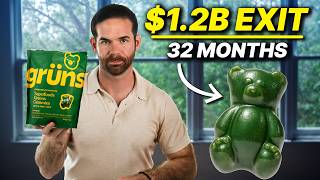
Ryan Daniel Moran breaks down how Groonze Greens Gummies sold for $1.2 billion in 32 months. The playbook: combine two big trends (supplement gummies and greens powders), charge 4x the normal gummy price with a subscription model that hits $750-$800 lifetime value per customer, and build trust through clinical studies and user reviews instead of flashy marketing.
Chapters
Groon's Greens Gummies. You might have seen this. They recently sold for $1.2 billion. $1.2 billion, congratulations! And this company was just 32 months old. That's about 2.5 years. And the founder of this company, he was just 33 years old. Imagine being 33 and having a billion-dollar exit. Well, what you're going to see is that this was not an accident. In fact, this was manufactured. So today what we're gonna do is we're gonna break down the 3 patterns that allowed Groove to become a billion-dollar exit in about 2 and a half years. Those 3 patterns are product, price, and proof. And once you see these 3 patterns, you're going to see how you can implement them into your business to get more customers, to make more profit, and to build a more valuable business regardless of what it is that you are selling. The playbook that Groon followed is visible. Once you see how this is manufactured, you'll realize that building a 7-figure business is not only possible, but it just comes down to basic math. Now, if you're new here, my name's Ryan Daniel Moran, and I invest in e-commerce brands. I've had a few exits as a founder myself. I've had a few exits as an investor, and I help entrepreneurs build 7- and 8-figure businesses and prepare them for exit. Now, I've never had a billion-dollar exit. I've had one 9-figure exit as an investor. So Groons is one level bigger than I've ever gone. But check out these numbers. In 2023, Groons raised $1.8 million, and that was their seed capital to get it off the ground. The numbers were not disclosed about what their valuation was, but it's reported to be between $10 and $15 million. So the early investors in Groons invested at a $10 million valuation, and they exited at a billion-dollar valuation. That's a 100x return on their money in 2.5 years. That's 10 times the return that they would've gotten if they had put all their money in NVIDIA during the same time period. There is no other place in the world where you can get those kinds of returns except by building and investing in cool brands that are profitable and growing and preparing for exit. It's not in crypto, it's not in AI stocks. The best return in the world is coming from starting and investing in great brands. Now check this out. You may not have a billion-dollar exit one day. I've never had a billion-dollar exit, but you can absolutely start a brand for $10,000 or less, and you can absolutely— Absolutely. Build a brand over 3, 4, 5 years that has a $10 million exit. If you were to do those two things, that would be a 1,000x return on your starting capital. And that's why the founder of Groon'd, Chad Janice, was able to reverse engineer this process. He sat on the board of Chubbies and Dr. Squatch and a bunch of other D2C brands, and he had an MBA from Stanford. He was not guessing. He knew. He went into this with a playbook in mind of taking this seed capital, building a great brand, and having a billion-dollar exit. So what we're gonna do is break apart the strategy so that you can take the most important pieces and implement them into your business. [MUSIC] So the first pattern that I want you to see, and this is the most important thing that we'll talk about today, is in product. And what Groonze did is they sat in between two billion-dollar trends. The first was in supplement gummies. You might be familiar with the company OLLY. OLLY is a gummies company. They're the first supplement brand that was all gummies. Well, they were acquired by Unilever, the same people who bought Groonze, by the way. They were acquired in 2019. And today they are a billion-dollar company. So that's the first billion-dollar trend. Supplement gummies. The second trend is in greens, specifically greens supplements. In 2022, it was announced that Athletic Greens, now known as AG1, was valued at $1 billion. So you have $2 billion trends in supplement gummies and greens supplements. But no one had taken the two trends and sat in the middle of them. Enter Chad Janice, the founder of Groonze. So what he does is he says, you've got these $2 billion trends. I'm gonna sit right in the middle and create Greenz Gummies. And I'm gonna spend a year creating a product that I'm super proud of 'cause I know when I get it right, I'm gonna have this momentum from these multi-billion dollar trends. One of the ways that you can validate your product idea to know if it's gonna be a 7 or 8 figure idea is, are there other businesses that are being valued or acquired for tens of millions of dollars? If so, then there's someone out there who is paying a premium for a company that is right in the middle of a trend. So if you can validate your product idea with trends or by other acquisitions, that's a really good sign that you are sitting on something special. Now here's a fun little factoid for you. The founder of Athletic Greens, now known as AG1, was Chris Ashenden, and he was homies with Tim Ferriss. And this entire billion-dollar company was started as a side project where Chris said, "I'm gonna start a greens powder and I'm gonna advertise it to my buddy Tim's audience and we're gonna see what happens." They actually hired me for a little bit for some consulting on their Amazon presence. That's a story for another day. But what Chris did was just partnered with one good audience with one good idea, and a few years later they were valued at $1 billion. That is crazy. And the investors behind AG1 are also the minority owners of the Cleveland Guardians. And if you're new here, my name's Ryan and my dream is to own the Cleveland Guardians. So there are people who think that this e-commerce game is too small, like it's not that big of a market. But if you start a business with one good idea, With one good product and you partner with an audience that really wants that product and you play your hand well, there is potentially billions of dollars at stake. Now, most of us are never gonna do that, but it is absolutely possible to be able to manufacture a multimillion-dollar exit, maybe even a 9-figure exit. And the first indicator that you're sitting on that is, are there other brands or businesses that are having that type of success in the sector? Mm-hmm. And a real magic winner is if I can take two different trends and merge them together. That's exactly what Groove did, and that's why they built a billion-dollar product. Now, the second thing that Groove did well was in their pricing strategy. They went in with a plan. They reverse-engineered a billion-dollar exit. This pricing strategy was created from sitting on the board of multiple billion-dollar exits and from an MBA from Stanford. They knew what they were doing. They knew what their plan of attack was. So if you are one of the many entrepreneurs who gets all in their head about, is my price too high? Is my price too low? What should my structure of pricing be? This is where you should really lean in. So the first part of this pricing strategy is that Groon's positioned themselves as a premium brand. Now, if we look at most of the gummies supplements in the market, like OLLY, which is one of their biggest competitors, you can get OLLY's greens gummies for $15 to $20. Now Groon's on the other hand came to market at 4 times that. So their margins were much closer to those of a premium brand like Athletic Greens, which today tends to sell one month's supply for about $80 to $90. Now, a lot of people in e-commerce will tell you that if you wanna increase your sales, you need to drop your price so that you get more market share. I say the opposite. If you want to increase your sales, increase your price. And Groonze is a very good example of that. Why increase your price if you wanna increase sales? Because it gives you more margin to work with to run advertising and do aggressive discounts in order to acquire new customers. But the real magic happens after the first purchase. Let's take a look at what they did. Notice on Groon's website that if you subscribe, meaning you sign up for auto-ship to get it sent to you every 4 weeks, your price is gonna be $40. That is a significant discount than if you were to go buy it on Amazon or if you were to just buy it one time. So, So there's an incentive to sign up for auto-ship. But here's where it gets a little bit sneaky. If we go to checkout and buy Grunes on auto-ship, you'll see that the recurring price is actually $59.99. So the price very sneakily goes from a $40 one-time purchase to $59.99 monthly. Yeah. $10 per month. Now that's a little bit more aggressive than I would recommend being, but they were okay with it. Giving a very strong incentive to buy one time. Now, if you sell products on Amazon.com, they also give you the option to be able to do this, where you can give an extra incentive when someone buys for the first time, but they do it on Subscribe Save. It is a very good business model to incentivize people to sign up for automatic shipping. Now there's one more thing that they do here. If we look at the packaging of Groonze, we'll see that it's a 28-day supply. That is not an accident. 28 days is 4 weeks. Sounds like a 1-month supply, but it's not. At a 28-day supply, we get 1 extra rebill throughout the year. So instead of 12 orders a year, it's 13 orders per year. So if someone buys a $40 product and they buy it on auto-ship and they stay for a full year, then that customer is not just worth $40 today. They're worth 13 additional orders at $59.99, which means that that one $40 customer is worth over $750. $750. Over the course of a year. Groonze is not banking on a $40 customer. They are banking on a small percentage of those customers becoming repeat customers and being worth $750 a year. The benchmark that I like to use with clients is 10 times the front-end price. So if you have a $50 product, you want to ultimately make about $500 per customer over the course of the first year. Mm-hmm. Groon's blew past that. In Groon's case, if someone stays with them for a year, it's almost 20 times the front-end value. A $40 customer becomes almost an $800 customer. Those economics are fantastic. So what does this allow them to do? It allows them to spend more money on Meta ads. It allows them to sponsor really good influencers. It allows them to buy ad space on prominent podcasts. This is the type of advertising that most of the competitors can't do. And they can't do it 'cause they don't have the backend margin to be able to afford it. So what Grooms has done is position themselves as a premium brand and have incentives to get that first-time customer on auto-ship. And they let the rest of the model take care of itself. Now there's one more thing that they do that gives them that extra bump to get as many customers as possible. On their checkout page, they have a banner that says it's 49% off. That is technically true. It's also very good marketing. Now this 49% off that they advertise is if you buy the maximum amount of units on auto-ship, you are saving 49% compared to if you were to just buy one. Again, technically true, but it's creative marketing. What they do, however, is they use this save 49% in a lot of their marketing. They will do Black Friday sales, they will do Memorial Day sales, they will do an It's Raining Outside sale, they will do all kinds of sales that are 49% off. So the offer that is on their website is the offer that they run over and over and over again. So there's not really discounts on Memorial Day or Black Friday or Cyber Monday. It's just the same offer over and over and over again. Now I would do things a little bit differently, but I've never built a billion-dollar business. What we're doing here is just analyzing what worked for Grooms, and it was having one incentivized offer to get people to buy for the first time. And they used every strategy possible to get people to buy that offer. And the backend monetization took care of the lifetime value. And if you know what you can spend to get a customer compared to how much that customer is worth, over a year to 2 years, then you know exactly how much you can spend to win against every other competitor that is trying to compete with you. So here's what you can do with this information. Don't try to answer the question, what does my price need to be? Instead, you answer these questions. At what price am I positioned as a premium brand? I like to take as a rule of thumb, the average or median price in my industry and times it by 2. That's a good starting point. Number 2, what is my backend monetization strategy? There's really only 2 ways that you can drive up your lifetime customer value. It is sell more in the form of upsells, or it is get people on auto-ship so that you have predictable revenue. And number 3, what is my customer acquisition cost versus my lifetime value? If I know that metric, then I know what I can spend in order to win against all of the competitors. You answer those 3 questions and you're positioned to at least build a 7-figure business. Now, if you're liking this stuff and you wanna implement some of these strategies into your business, then I invite you to get on the waiting list for our next live bootcamp. This is where we work with entrepreneurs to implement these types of strategies into their businesses so that they get results quickly within a few hours or a few days. You can get on the waiting list for our next bootcamp over at Capitalism.com/bootcamp. The third pattern that Groove did well is using proof in their marketing. And this is where founders are leaving obvious money on the table. You can borrow this part of the playbook and implement it into your business right now and increase the number of customers that you're getting. Getting. If we look at the checkout pages and the sales pages for Groove, most of their marketing is proof. And there is no better conversion tactic than the use of proof. You don't need fancy copy, you don't need fancy images if you have really good proof. Now I've got pulled up one of their images which shows the results of a clinical trial that they ran where they brought people in and measured their mineral levels after taking Groonze for a few weeks. Now, this is obviously something that is gonna take a little bit of an investment, but Groonze was able to do that. And what they have on this image are the results from that clinical study. And it shows an increase in vitamin C levels, an increase in folate levels. Now, take a look at this part of the image right here. This is their observational study. This is where they go to their customers and they ask them for their feedback about using the product. This is where they ask, is there an improvement in your well-being? Do you experience more energy? And they report the findings of that study. That's not an official clinical trial. That's just an observational study of them asking their customers and reporting on the percentage of people who said, yep, having a good experience with the product. This is something that any brand can do. Are you getting the results that you want? And then you report that data in your marketing. It's very, very effective marketing. And most of Groove's marketing sounds kinda like that. So if we look at their sales page, we will see that most of their marketing is social proof. It is reviews of the product. It is stats about the product. It is seeing how many people use the product. It's videos of people who love the product. It's comparing our product to other people. It is very proof heavy. When you go in this direction, you don't need fancy copy. You don't need a big branding agency. Proof sells a product better than any fancy copy can. Now, They also use this strategy on their Amazon storefront. So for those of you who sell on Amazon, this is an easy way to stand out from all of your competitors. What proof do you have that other brands don't? So what Groove does is they take some of the same type of proof that they're using on their sales pages and they're working it into— Into. Their Amazon listing. So the image that I've pulled up right here is— this is beautiful. This is what we call proof about the problem. This image right here says, "90% of US adults don't meet the recommended daily nutrient intake." Okay. Notice that it doesn't say anything about the product. It doesn't say how great it is. It doesn't say how cheap it is. It doesn't say what happens when you consume the product. It just frames the problem as a stat. Therefore, they are using proof proof that's not about the product, but proof about the problem in order to position their product as the solution. This is beautifully done. Wonderful marketing. Please steal this in your Amazon listings and on your sales pages. If you find stats about the problem, people associate your product as the solution to that problem. So in this case, they say 90% of US adults don't meet the recommended daily nutrient intake. And also, 61% of Americans experience weekly digestive issues like bloating, abdominal pain. And get this, Groonze has lots of fiber. So do you see how they are subtly bringing in the problem and stats about the problem? And as a result, you associate the product as the solution to the problem. The rest of this Amazon listing is very proof heavy. Lots of reviews, lots of videos from people who are happy customers. Lots of stats. This is excellent marketing. So the takeaway here is if you can find facts about your product, stats about the customers who are using your product, facts about the problem that your product solves, these are all forms of proof that will dramatically increase your conversion rate. As your conversion rate increases, you're able to spend more money on advertising. If you can spend more money on advertising, then nobody else can compete with you. So when you combine the recurring revenue model that Groove did so well with their subscription model, and you have a high conversion rate with proof, you've got the beginning foundation of a 9, or in this case, even a 10-figure exit. Now, I can't sit here and promise you that you're gonna have a billion-dollar exit. I've never had a billion-dollar exit, but I can tell you that there are hundreds and hundreds of people that have built million-dollar businesses following a very predictable playbook. If you would like to see our playbook for how we build million-dollar businesses in about 12 months or less, you can download our best free resources over at Capitalism.com/100k. Just drop your best email in there and we'll send you our playbook, some of our free tools, and our free course for coming up with your idea, getting it launched, and growing to your first million. That's over at Capitalism.com/100k. All right, so there you have it. There's 3 patterns here. There's the product, there's the pricing strategy, and there's proof in marketing. Those 3 things are what manufactured Groove into a billion-dollar company. Now yes, Groove raised some capital, they had a great founding team, they built a great team of very smart people, but they manufactured product. In a way that they knew it was going to be a winner. They crafted their pricing strategy so that there would be predictable recurring revenue, and they knew how much they could spend to acquire customers and how long they were gonna stay. And to raise that conversion rate as high as possible, they used proof in their marketing. These are all elements that you can use in your business in order to manufacture at least a 7-figure business. Mm-hmm. Now, if you wanna build your version of Grooms, if you wanna have a high margin consumable business that follows this type of a strategy in order to manufacture a 7 or even an 8-figure business, I would invite you to get on the waiting list for our next bootcamp over at Capitalism.com/bootcamp. This is where we work live with entrepreneurs who are in the hustle mode at the beginning stages of building their multimillion-dollar empire. You can work closely with us on building the foundation of your 7 or 8-figure business over at Capitalism.com/bootcamp. Just enter your email address and be on the waiting list for the next time we have a live bootcamp. My name's Ryan Daniel Moran. I help entrepreneurs build their 7 and 8-figure businesses and prepare for a multimillion-dollar exit. Groon's is an example of what is possible when you do this the right way. But even if you get it half right or a tenth right or one hundredth Right. You are still in striking distance of a multimillion-dollar life-changing exit. And when you know that, when you realize that, then it gives you permission to go all in on what it is that you're building. Thanks so much for watching. I'll see you guys on the next episode. Take care.







