
How Health And Fitness Brands Can Win In Business | Health Entrepreneur f(x) Vlog
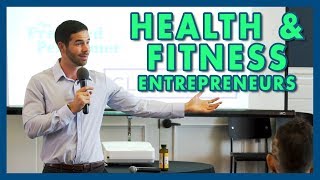
YouTube talk (Health Entrepreneur f(x) Vlog, Capitalism.com, June 8, 2019) in which Ryan Daniel Moran advises health and fitness entrepreneurs to build long-term assets (brands based on audience and trust) rather than pursue short-term sales tactics. He gives a simple growth formula (3–5 products selling 20–30 units/day at ~$30 = ~$1M/year), argues that ~10,000 engaged followers can support a scalable brand, and uses audience Q&A to illustrate targeting a niche (truck drivers) and improving customer retention for a protein-shake business. The talk stresses targeted messaging, reselling customers on results (follow-up, community, content), and that many acquisitions buy trust/brand rather than novel products.
Chapters
We're going to speak at the pre day for paleo effects because I have a special place for the health entrepreneurs. I mean, we were saying you might kind of keep your eyes peeled for potential.
Companies to invest in, partners, work with and fund. I mean, what kind of brand or entrepreneur are you really attracted to? I'm attracted to brunettes. Attracted to blondes. I'm attracted to redheads. I'm not attracted to that. Shaven. They shaved head on the side. I know that's your thing, sea money, but you can have them. Okay, is there anyone who has an undercut that's with a good man? It's kind of like a dude. In the same way, if you have a tattoo above your chin, Nope, you're not with a woman you're happy with. Oh boy, I wish we weren't recording this part.
I was peeing and I was like, ooh, that. That clip about the hair could get me in some trouble.
I know. It's like Clark Ken in Superman. Like this with the glasses. Like I do know.
Oh, hey, gang. Is anyone familiar with my general shtick? My, my general philosophy is that everything that you do in business should be building a long term asset. And in this world, that's reflected in things like bulletproof coffee, which did not exist eight years ago and will probably have a billion dollar exit at some point. Most people in this world are operating with some sort of a short term focus in order to try and sell another product, be another we person and copying what other people are doing because they're operating with I want money versus I'm building something that actually creates an impact in the world. I'm far more interested in the latter conversation than the conversation about how do I make $10,000 on the Internet by selling health stuff and changing my sales page to convert. Well, hello.
One of my biggest fears when somebody comes to something like this is they start hearing how everybody else is doing it and then they start modeling that which is the exact opposite way to build a profitable business that can then be sold. And the only way that you, that you actually make money or build something to sell is by being in the creator's seat rather than the extractor's seat. The shift then becomes. If we say if what I got out of it, if what my financial reward was, if what my financial result was, was immaterial, and what I really wanted was to build this thing that had an impact in the world, or brought this product or this message or this mission to the world, then how would I think about it? And when you have that shift and it's not about you, it has nothing to do with what you get or what you receive. The weird paradox is that's when you get rich because the world doesn't care about you and the result that you get. They care about what the asset, what the business, what the thing you're doing in the world does for them. I want to open the floor. If you want to make this super relatable and practical for what you're doing in the world, go ahead.
So if I think I'm doing what you're talking about now.
Yeah.
Got a very targeted audience. So we're doing the same.
Who is that audience?
Truck drivers.
Okay.
So there's about three and a half million of them in the country and they're horribly unhealthy.
Yes.
And it's an unhealthy lifestyle.
Yes.
Access to these things that most people do. So we're, we haven't created anything original other than the education of how do you do this when you're on the road. They don't know how to get pastured grass fed meat when they're on the road. So we're showing them how and bringing some of those products. We haven't created anything original. So where do we go next?
And we're growing. I mean, we're growing like crazy. Yeah. So great example and great question. Thank you for this. So you have a very hungry, targeted market. Hungry, quite literally.
And if you look at other examples that have done this, an example would be Clif Bar. Clif Bar, completely different vertical. Did anyone need another food bar when Clif Bar was on the scene? We still don't. Right. But what Clif Bar did differently was they specifically targeted endurance athletes. Now women at the table. Have you ever eaten a Clif Bar? You have? Why? It's marketed to men.
It's marketed to male endurance athletes. There's a dude on the packaging hanging from a cliff. Why would a girl buy it? The targeting started to male endurance athletes. And if you read the description, it is all masculine languaging. But when you have a very specific target audience, that brings it to the rest of the world. So, you know, Clif Bar also owns Luna Bar, which is just the opposite. The first time I ate a Luna Bar, I was like, am I going to grow boobs? Like, it's just.
I don't know what happens. No, it's just, it's just a different flavor of the same thing. It's just the same, it's a different wrapper on the same Product marketed to a different audience. So your products don't necessarily need to be anything different than what everybody else is doing. But if it's targeted directly to that group of people, I could envision, like if you followed this exact example and you had the trucker bar that had grass fed collagen and coconut oil. But the thing that would need to be in place is you need to be communicating that message specifically to truck drivers. That the reason that they're overweight is because they're sitting all the time, their metabolic rate is through the floor, and they're eating breads and they're eating convenience food. So your job, their journey that they're on is to be healthy while maintaining their lifestyle. And your job is to create the products that make that easy, which means easy, convenient foods that you can eat on the road and on the go. That will start as a truck driver brand. But if you get them behind that mission and message, there are a few other people in the world who want convenient, healthy foods on the go and they sit all day. So the truck driving community then brings it to the computer company, which brings it to everybody else in the world. If you follow kind of the hero's journey idea of what a business or a brand is here to do. Most people see their business as Luke Skywalker. It's all about them. Your business is Yoda and your customer is Luke Skywalker. And so your job, Yoda, is to guide Luke Skywalker on his journey to lose weight, to get healthy, to undo the damage of 20 years of sitting and eating on the road.
And the way you do that is by creating education and products that specifically are made for Luke and the challenges that he will face on his journey.
That's. That is your job.
Thanks for hanging out with me. It's good to see y'. All. Love that. Thanks. I like you back. Yeah, I, I like you more.
The biggest thing in us is we're really good at getting new customers. Like, amazing. Like, but retention is like suffering. And so obviously it's a protein shake. The thing at the moment is retention is horrible. Like, they're in. They might purchase average sales about probably 129 bucks, but that's it for 30 days and they're gone. Like, if we were to go improve our retention 20 to 30% or even talk or maybe find some ways to keep them a bit longer.
Why don't your customers like you?
We think the product works too well. They jump on the shakes for 30 days. So 1 29, $134 will get you a month. Supplier shapes just two a day. They get the 30 days and they go on. We don't have.
Yeah, that's not why they're leaving. Yeah.
Right. So that's just a theory. So we don't know. To be honest, the branding is a bit of a mess. Like it's not shy spending marketing dollars.
Yeah. It's not. They're not using your product.
You think that's what it is?
Yeah. You're giving it.
Well, they're buying 60 shakes and you're, and you, and you think the consumption on that is that they're just religiously taking two shakes a day and they're getting their result too quickly and so they're leaving. And that's not what's happening. That is absolutely not what's happening. Once somebody has bought the, they bought the decision to get a result, the rest of your job is to resell them on the result. Yeah. Right now I'm going to guess and reach, but I'm going to guess that your follow up process with your customers is non existent. That there's, that there is absolutely no. It would look like emails, it would look like a customer service team reaching out to them. It might look like retargeting ads to your customers, not to new. Not to new customers. Hold on to existing customers reselling them on the idea. It would look like a lot of social media showing results of people. It would look like content that would resell them on why they made a good decision. Like are they in a community, are they subscribed to something? My guess is there's no tribe or follow up to your existing customers and because of that you're just going out and getting more people and putting them to a broken machine. You probably heard Ryan on his podcast the One Percent. He's helped more than 500 entrepreneurs to build seven figure incomes. Please welcome Mr. Ryan Moran.
Thank you, sir. So I literally have 20 minutes to tell you how to build a million dollar business. So we're just gonna go ahead and jump right in because this room and this industry is in a really small, unique spot in the whole global entrepreneurial landscape. And that is because most of you already have audiences and in the health space it's very, very easy to build audiences. I have two things that I care about in business and it's building an asset and building long term customer value which forces you to not just be good at selling your shit, but making your shit sell itself.
I say this, this formula because every time I say it people are like Whoa.
And it's three to five products. Selling 20 to 30 sales per day at a $30 price point is a million dollar business.
And that requires you to have three to five products that are good enough to sell 20 to 30 units a day at a $30 price point. It's a million dollar business. Now the way that you kick that off is by having this much audience, this much. That's all. You don't need to have a million people. You don't have. You don't need to have 100,000 people. If 10,000 people care about what you have to say, do not deprive them of the opportunity to buy from you. The entrepreneur world that we come from is actually a resistance to working or being in other people's systems. That's not real entrepreneurship. Entrepreneurship is building something. It's building a business, it's building an asset.
And the asset in this world is audience. It's trust, which, by the way, is what a brand is. A brand is simply outsourced trust.
How many of you ever bought bulletproof coffee beans?
So half of you are smart enough to pay 20, twice the price for the exact same coffee as everybody else? Because you trust one source. That's all. That's it. You have outsourced your trust, which is fine, to somebody else to vet the product that you want to consume. That's what a brand is. When an acquisition is made, it is very rarely because the product is different, because it's some new, innovative spin. It's because the value is in the trust that is the asset that somebody else is buying. Now we live in this world right now where big brands.
Specifically old established brands that in the health world, we like to throw rocks at, you know, the enemy, the health companies and the food companies that have just been around forever, yet they're, they're driven by profit and they are agnostic as to where the profit comes from. And so if you've got a brand with trust that has high profit margins, they want to give you a lot of money. So there's a transition happening to where a lot of old money is flooding to small brands, which is why you have something like an RX bar. Go from Peter's basement to being acquired by Kellogg's for $600 million, despite starting as a bar marketed just to the CrossFit community. You do not have to invent something new, nor do you have to copy what somebody else is doing. You need about 10,000 eyeballs of people who care about what it is that you have to say. And you need products that allow them to carry out the journey that you are already leading.
This world, this community, specifically in the health space, has so much opportunity because so much has become available in the last 10 years. The way we talk about food, the way we talk about mental health, the way we talk about morning routines, the way we talk about everything has changed in 10 years.
And as a result, we have thousands of micro communities, micro tribes.
Micro messages that are begging to be led. And it's been created by this world.
It'S been created by these entrepreneurs.
And all of those microtribes are on a journey to restore gut health, to overcome autoimmune, to lose weight.
And it's your job to guide them. And if you give them three to five things to purchase under that consistent message.
You'Re a millionaire in 12 months.
I've only seen it happen about six or 700 times.
So I could be wrong. You have problems to address. You have people to serve. You have communities to communicate to. And they are all dying for a solution that many of you already have. Do not deprive them of the opportunity to purchase that from you.
Thank you.
I want this for my homepage.
Ryan is my babe.
That felt right. Okay, wait, did we get a real one?
Be willing to say things that other people will disagree with. If you believe them.
And some people will disagree and call you names, and if you let them, your real fans will come to defend you. That's when you have a tribe, you have to be willing to say what you think is the truth and be okay with other people not agree.
Innovation is super important. But innovation is sometimes as simple as aggregating information. A way of bringing an existing message to a new audience, bringing it in a way that an audience can use and that creates. Creates change.







