
How Tim Ferriss Made His First Million
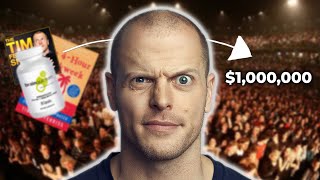
Ryan Daniel Moran breaks down how Tim Ferriss built his first million through premium products: a nootropic called Brain Quicken, then The Four Hour Workweek. The formula is simple: target a specific customer, solve your own problem first, and charge premium prices. Fifty sales a day at $60 gets you to a million a year.
Questions this video answers
A nootropic called 'Brain Quicken'.
The book 'The Four Hour Workweek'.
Five Bullet Friday.
50 sales per day at $60 each (≈ $3,000/day → roughly $1,000,000/year).
capitalism.com/million.
Chapters
There is a book that you might be familiar with called the Four Hour Workweek. It's one of those books that a lot of the entrepreneurs in our circle credit as being one of the starting points. Now, a lot of people credit that book for changing their mind on lifestyle design or travel or learning. But very few people remember the business model that Tim talks about in that book as being the best business model to have enough cash flow and lifestyle freedom to intentionally design the life that you want. I'll remind you that what Tim says is the best or the most straightforward business model for being able to live the four Hour work week is product creation. His life emulates what he talks about. The first product that he ever sold was a nootropic. Before nootropics had that name, it was called Brain Quicken. It was a supplement to help you focus better and get more work done. So Brain Quicken was a product that was the case study that he talked about throughout the four Hour work week. He talked about how he got customers and how he automated the business so that it was almost completely passive. And then Tim launched a second product. And that second product was a book called the Four Hour Work Week. These two products made him financially independent. Because of the audience that got built from that book and other books, he started a third product which was a podcast. Now, you might not think of the podcast as a product, but Tim really only had one monetization strategy and it was to sell advertising on the podcast. And so if you think about each part of whatever you're doing as a product, you'll be on the road to 1 million much faster. And Tim is a great example of this. He treats everything that he does like. It is product design, product creation. If he launches a podcast, then his job is to make the product as high quality as possible so that he can sell advertising on that. If he creates an email list like he has in the Five Bullet Friday newsletter, he's going to treat it like a product and he's going to sell advertising in that newsletter. I like this mode of thinking and find it very clarifying and helpful for helping entrepreneurs get on the road to 1 million. Product creation is one of those long term things that pay dividends for a very long period of time that very few people focus on. Instead, they obsess over the marketing tactics to sell products that they never really have good products to sell. This is true whether you are selling physical products or digital products or software as a service or consulting, it doesn't matter. We often skip over the quality of product so that we can just go figure out how to sell things. That's sexier. It's better in the short term. But remember, if you do the long term things for about 12 to 18 months, you end up passing everybody else who is obsessed with the short term stuff. First, a couple of tips about your first product and launching the first business. Number one, always err on the side of premium product rather than a cheap or run of market product. This is counter advice of what a lot of people teach. But whether you are selling on Amazon or Shopify or a funnel, err on the side of being a premium product. Dan Kennedy says that there are benefits to being the most expensive in the marketplace. There are also benefits to being the cheapest in the marketplace. But there are no benefits to being second cheapest or second most expensive. When you have a cheap product, you are selling to everyone. You're talking about the product and its features and how great it is. But when you have a premium product, you can be more selective about who you market your product to. So you know you have a winner when your product speaks to a very specific person and you target that person in your advertising, in your marketing, in your packaging, and with your price. If you've been following me for any length of time, you're probably tired of hearing me talk about marketing to your person. But the reason why I beat this into the heads of my followers and students is because knowing who you serve allows you to speak directly to them. Create raving fans and charge premium price points. When you charge premium price points, you are able to create great products. When you create great products, you create raving fans. When you have raving fans, you need to do less marketing and the marketing that you do is is more effective. It becomes a positive cycle. Rather than running to the bottom, trying to sell a cheap product and going on volume. It is a different game, and it's not a game that you probably want to play. However, a lot of people run into mental hurdles when trying to figure out who their person is. Who should I sell to? In most cases, entrepreneurs like you are selling to yourself. Tim Ferriss talks about this as scratching your own itch. He says every business that he starts, every product that he sells starts out by just scratching his own itch. This is the book that I wanted to read, so I went out and I put it together. He knows that if all else fails, he'll have one customer and it's himself. But it's likely that there are other people like him. It's likely that There are other people who struggle with the same problem or who have the same desires. And therefore it's likely that there is a market for it. And so in a lot of cases, the customer is you. Once we have addressed those questions, then all of the marketing stuff suddenly makes sense. It makes sense for us to get a little bit of attention on TikTok or Instagram or YouTube. Building an email list suddenly makes sense, makes sense to sponsor other podcasts or to pay influencers. It does not make sense to do those things. When we are selling a cheap product, that is to everyone. And when we have a premium price point that solves an annoying pain point for a specific group of people, marketing suddenly becomes very easy. And the idea of getting one product to 25 or 50 sales a day, it was within striking distance very quickly. And if we have a premium price point and we're doing 50 sales a day at a $60 price point, that's a million dollar business, right? 50 sales a day at $60, that's $3,000 a day or a million dollar business. This is the way to build a multimillion dollar business that you can sell a clear person with a clear pain point at a premium price. There's one more thing that I want to insert in here, and that's when you build a business in this way, you're bringing something brand new to the marketplace. And a lot of Internet entrepreneurs instead look for where there's data. They're looking for what other people are selling that's doing very well. That can be helpful in some cases. But I find that the entrepreneurs who build something that grows quickly, that sees results right out of the gate, are the ones who are, instead of looking for data of what's working for other people, they look at what problems they can solve for a group of people and they charge a premium for it. There's no data to back that up. There's no other people selling that thing. Because you're selling something specific to a specific group of people and you get a raving fan base that wants to buy it because you're closing a gap in the marketplace. I find that to be a better way of going about launching your first product. Before you think about all of the marketing strategies that you might leverage to sell stuff, you first need to know what your product is going to be. And the most straightforward and profitable way to answer that question is to pick a specific group of people with an annoying pain point and to aim to be a premium brand. If you do those things, you have a very good shot at winning. In my opinion, this is a less stressful way to build a business. It is a more fun way to build a business. And it just so happens that the results start to compound very, very quickly. Hope you enjoyed today's lesson. I would love to hear your takeaways from today and I hope you stay tuned for the final parts of this mini series. And once again, I'm doing this mini series because I just created a new product. It's a free, free product. The reason it's free is because I see it as a deposit into our relationship bank account. Because if I can give you some big aha's and some momentum right out of the gate, you're probably going to want to work with me or my team on actually building this business for yourself. So you can go over to capitalism.com million to go through the free 30 day product and it will help you be on the road to $1 million. I'm Ryan Daniel Moran with capitalism.com thanks so much for being here and I'll see you on the next episode. Take care. Hey, if you liked this video, you should watch this video because the comments on it are hilarious. I can't believe how much time people have on their hands.







