
How to Find Good Business Partners
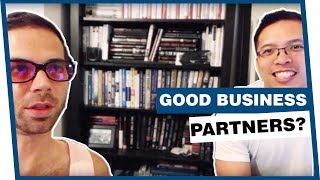
A conversational YouTube video (Ryan Daniel Moran with partner Clement Wong) about finding and maintaining good business partnerships. They contrast successful partnerships (complementary skills, shared goals, accountability, slow vetting) with bad ones (overlapping roles, unmet commitments, cash-motivated conflicts), describe practical safeguards (vesting shares to milestones, majority edge for tie-breaking), and recommend events (notably the Capitalism Conference) as primary places to meet aligned partners. The hosts also describe their work on the Capitalism Initiative (an acquisition/roll-up fund for physical-product brands) and share personal anecdotes.
Chapters
What's up, guys? Ryan here. It's like, it's super late at night. At least it's super late when you're 30 and have a 2 year old.
It's like 10:30 in Texas. So I got my blue blocker glasses on, forgive the captain, chest hair going on here with my pajamas. And we have the Indians game on. Indians game on. And the Indians are like disgusting, disgustingly good this year. It just, it's just ridonkulous. It's, it's just so much fun to be an Indians fan right now. I'm, I'm freaking out. It's insulting how good they are. They're up. They're up. One nothing in the fifth playing, playing Seattle for a late night game. And I got my late night frothy beverage. It's freaking delicious. I was actually pretty proud of this concoction here. This is some tea I found at Burning man called Sweet and Spicy. It's like a cinnamon tea. And then I put half a scoop of cinnamon protein powder from Julian Bakery, which, by the way, Julian Bakery, you really need to give me a call. All the free press I give you, you could send me like a protein bar. In fact, I have a jar full of protein bars from Julian Bakery a few feet from me. And you really need to call me about your two and a half stars on Amazon. And, and then I put cloves and cinnamon on top. Pretty proud of this little late night concoction here. I'm here with my business partner, Clement Wan over there. Neighborhood friendly. He's Internet famous. How do you feel about being Internet famous? Clement1.
He likes to keep a low profile, but he's the smart one in our relationship. And I get to take all the credit in YouTube videos, which is awesome for both of us, actually. So I figured we would talk about finding business partners because I have had a lot of good business partnerships that have resulted in me making millions of dollars. And I have had bad partnerships that resulted in million dollar ideas being zero or business partners stealing money from companies. I have had that too. So what's the difference? So what I'm going to talk about is how to find business partners and what makes a good business partner. Sean Coyne, who is my business partner on Zenactive Sports, which is a yoga company that I built and sold, said once that, you know, when Ryan and I work together, it's like 1/1 equals 5 or 2 plus 2 equals 5. Sorry if I botched your quote, Sean, if I botched your bad math, but that's What a good partnership can be like. And a bad partnership is like two plus two equals zero. Because I've had business partnerships where two people are just entirely too similar, which means that one of you is unnecessary. One of you doesn't need to exist if the two of you are exactly the same. So I'm going to turn to this guy here for a second and put him on the spot. Clement and I run the Capitalism initiative, which is an acquisition fund for physical products brands. And Clement, we kind of. We dated for like a year before we became. Became business partners. Business partners.
Don'T let the chest hair fool you people. Business partners, don't let the YouTube comments fool you either.
So.
I'm of the opinion, you know.
What we've done, I couldn't have done without our partnership. And you've made my brain think differently. And we have our sightsets on hundreds of millions of dollars with the Capitalism Initiative. So would you kind of give your perspective on how we met and what makes it a good partnership? If you think it's a good partnership.
So we just won't discuss that part.
Okay, we'll just skip that one.
Yeah. And so we met at your first. We physically met at your first conference, Freedom Fast Lane Live.
Yeah. Now called the Capitalism Conference.
And I first kind of joined your. Your group, which was part of ASM.
ASM 5. ASM 5. Yeah. And so we kind of got to know each other on those video chats that you did on Saturday mornings.
Yeah, it was Saturday mornings at the time.
And yeah. So at the initiative, we're trying to roll up. We want to build, we want to buy brands that are making a difference in specific verticals and with the ultimate goal of creating kind of a roll up of brands.
That we might keep, we might sell, we might bring public.
That can kind of leverage audiences that each of them have.
Yeah. And as a result of us working together, we've actually all. Both of the acquisitions that we've made, plus the third acquisition that we're working on have been possible. The kind of group think the idea flow that we get comes out of our relationship. And we get this awesome bookshelf that's full of books that are mostly about investing and business and very helpfully color coded by Nicola. Nicola, my assistant. So, you know, my business partner on the company that I built and sold, actually, both companies I built and sold, I had business partners Sean Coyne and Matt Davis, who I could not have done. I could not have done one fraction of what we accomplished without those business partners. The Capitalism Initiative would not exist if it wasn't for Clement bringing the idea and heading up that project.
Comment. Have you had any bad experiences in partnerships?
Oh yeah, for sure.
Lots.
Tell me one.
I think a lot of the partnerships that I haven't worked out for me are ones where.
I bankrolled them and.
Yeah, you put up the money.
Yeah. And they weren't able to deliver what they said they could.
One outright. Right. Lied about a lot of different things and just didn't meet commitments.
So what do you, what do you say makes a good partnership versus a bad partnership?
Unfortunately, I'm not really sure yet. I think it's the same thing about hiring good employees.
I think I was told once business partnerships are like marriage without the makeup sex.
And I think I heard it slightly differently, actually. The gentleman who acquired.
And partnered with us our last exit said that partnerships are like marriages without the love and they're harder to get out of.
You're really selling this.
But like, I think some of the more successful businesses are ones where you do have that partnership that you can create that accountability.
And in very similar ways. It's like having good communication.
Proven strengths, similar goals.
I mean, so I think that's a big one is similar goals because I, when I partnered with in the, in the past, I've partnered with. So for example, as of right now, neither Clement nor myself take a salary out of the capitalism initiative. We both have income streams from other sources. So that was something from the get go that we agreed on. I've had partnerships where somebody was strapped for cash and I wanted to grow the company. They were like, let's just milk the company for as much money as possible. That caused problems in the relationship. And I've also discovered that you have to have complementary skill sets or relationships or pieces of value that you bring to the table. Like they cannot be the same or else one of you is unnecessary. Now you can supplement with other people to make up for some of those weaknesses. And those aligned goals can keep you together. But I think at the initial start, you've got to be focused on different things. So many people get into business because they're like, I got an idea. Hey, you have an idea. You want to do this together? 50 50, let's go. And those are the worst business partnerships. Those are the people who end up taking drugs and killing each other. And I think the best ones are when you move slowly, like a relationship, like you would hire someone.
We talked about this project for at least a year before we found the right deal, the right Opportunity.
And then started. Right. It was like a year, wasn't it?
Possibly more like because we, we started talking pretty much at the first time we met physically about the idea.
Yeah.
We never really did anything for at least a year after that.
Yeah.
And then, and then we just started kind of looking at potential deals.
Yeah. So not every, not every idea needs to be tackled right away. Not every. Like we were talking earlier about, we have so many people that we meet and so many opportunities. How do we pursue them all? And I was like, I'm okay letting some things go. Like, it's, it's, it's okay not to figure out how to make every opportunity ROI from the get go. Comment. How do you avoid really bad partnerships?
I think like one of the strategies that I've seen is you have shares vest based on kind of the commitments and targets. And that's kind of something that I've learned over time. I think that another thing that works well is I kind of insisted that Ryan take a slight edge in majority.
Regardless how the share is vested, such that there's always, hopefully you always agree and have consensus, but you have, if you do disagree, somebody's voice has to carry forward and you just accept that that's going to be the case and support that decision ultimately when it's made.
Yeah. All right, everybody. Everybody say thanks Clement Wong. I, I wouldn't look half as smart if it wasn't for, for Clement Wong. So he's the brains behind the operation. I'm just, I'm just the chest hair. But I, it's my opinion. Let's talk about finding business partners for all because I get asked a lot of questions of how do I find the right business partner? How do I actually go out and, and get in front of or like attract the right people. Right. And I think a. You have to have something to offer. Like what is your skill set? Like, what is your unique, your new. Just like if you were selling a product, what is the thing that you bring to the table that is even valuable to people to invest in? Meaning invest their time, their ideas, their energy. And for some people that asset might just be time. It's like, I have an idea and I have time and I will grind it out making this idea happen. So what you need is not another person with ideas and time. What you need is a person with capital and relationships. That's the partner that you need to seek out if you have. So for me right now I have more ideas than I have ideas in capital. Like, I have ideas that I'll invest in 100 times an hour. Which is why I lead groups like the Tribe, so I can share my ideas and invest in some of those ideas with entrepreneurs who are hungry, who have energy and time. To be honest with you, like, at this point in my career, like, I don't have the energy for new projects. I have the energy for the projects that have momentum. When I became a dad, everything became about doubling down on what was working. And now I invest in new projects. So what are the assets that you bring to the table? And you need to go get complementary skill sets, complementary assets to that. How do you do that? That is all about being in the right room. And I think too many people get into business with like the first person they date. And you should be just as selective about who you get into business with as who you marry. Or at least like.
At least like who you're going to have a mortgage with. Right? Clement and I met at an event. Matt Davis, my business partner on my other business, he, he and I met at an event. Sean Coyne and I met in church youth group when we were 13. So that's a little bit different. But most of my business partners, most of my affiliate partners, most of my closest business relationships have all come from being at events, from being in the right room, from being in a room of people who had similar goals, who were on the same path, who seeing the same value system. Something magical happens when you're in a room of people where you have the same goals and the same vision because you're all going in the same direction. And if you're all going in the same direction, then it's really easy to support one another. Whether that is getting into business with one another or it is just sharing ideas, forming mastermind groups, investing with one another. It's why events and groups are so powerful. We run an event every December called called the Capitalism Conference, which is where Clement and I met. It is where I have met team members that we've hired. It is where I have met students that I'm investing into. And every year we have people come out of it saying what joint venture relationships they made, what business partners they made, and here's why. The reason is because we attract a different type of entrepreneur at the Capitalism Conference. Not, not every entrepreneur wants to hear about building empires, wants to hear from entrepreneurs who have built eight figure companies, nine figure companies, or people who care about investing for passive cash flow. They want to hear about latest tactics rather than hear about strategies that have built real businesses. We're after people who are building something real, building something bigger than themselves, not just looking at the latest tactics that they should really be counting on their team members to learn. We're after entrepreneurs who are building something big. And when you put that type of a thinker and you put five hundred to a thousand of them into a room, you're in the environment in which those types of, that type of magic, those types of relationships naturally happen. So that's where you're gonna find your next investor, that's where you're gonna find your next business partner. And if it's not at our event, it's at events in the industry that you need to be going to. When I look back on my life, every major breakthrough that has just completely changed my life and business has come from an event. I was actually at an event, a strategic coach event. And Dan Sullivan said, write down all the major breakthroughs that you had in your career, like the big pivotal moments, those big turning points. And as I wrote mine down, he's like, all right, is there a common thread among them all? And mine was that they all happened at in person events. It all happened with people where I was in a room of individuals who were aligned with where I was going. And if you've been stuck at a certain point in your business, the reason is not what you know, it's who you know. My buddy Jeff woods, who's speaking at the Capitalism Conference, he says when you reach a plateau in your life, it is because you're missing a person. You meet people at events like the Capitalism Conference. So if you follow me or you follow Freedom fast lane or capitalism.com or you just have a brand, either a physical products brand or a personal brand, and you have a big vision and you are an entrepreneur who is building something bigger than yourself, then there is no better investment of your time and your resources than you can make than coming to Austin, Texas for three days at the Capitalism Conference. So you can grab your ticket@the capitalismconference.com you can see who's speaking and who's going to be there. And I hope to shake your hand, maybe invest in your business or be partners at one point as a result of meeting you there. So come to the cap, come to capcon. It's really silly not to. All right, we'll see you there. Thanks for watching, guys.







