
How To Go From Zero To $1 Million With An Online Business w/ Stefan James
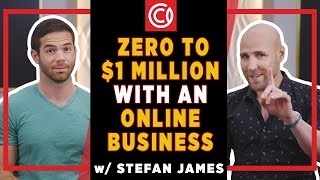
Stefan James and Ryan Moran map a three-stage path to $1M: grind to find a product, hit 25 sales a day, then expand to multiple products and advertising for 100 sales daily. They recommend spending $10 a day on content, building a few hundred engaged followers, and targeting four products at $30 each selling 25 units daily.
Questions this video answers
December 31, 2019
About three months
25 sales per day per product
Four products each selling 25 units/day at an average price of $30 (≈100 sales/day × $30 ≈ $1M/year)
About $10 per day
Chapters
We are more likely to survive when everyone's well, when everyone is taken care of, because that means that other people are also going to have our back. We're now a tribe, so giving to other people, serving other people, biologically makes us happy. It biologically puts us in better standing to be wealthy. And so in something as tactical or as simple as building an audience, you will get faster results. When you are insanely curious about what other people want and then serving them, it will also make you happier. It will also have more responsive customers. It will also be more likely to be content that gets shared. It's also more likely to go viral. It's more likely that people will respond specifically to you over everybody else. So you win by not trying to win for yourself, but winning for somebody else. We are all wired just a little bit differently. It's kind of like the universe conspires for us to work with one another. I'm a little bit differently, different than you. We have similar messages to similar people, but I'm just a little bit different than you. You're just a little bit different than me. And you're gonna connect with this. It could be the same group and we can give the same message and then hear it completely differently. And so I don't have to be threatened by your million YouTube subscribers, right? Because, like, some people would see that, like, I can be better, I want to be better than.
What makes us powerful is that uniqueness, our experiences, our perspectives. We are wired to be working with one another, but we aren't naturally in an environment to do that because we live behind screens, because we spend most of our time alone. And when you spend your time alone, of course you are going to be in that survival mode. That means I've got to be better than this other person. Everyone's a threat to you at that point because you are on your own thinking that you have to survive better than all of these other people.
Hey everyone, this is Stefan James from Project Life Mastery. I'm here right now with my good friend Ryan Moran, the founder of capitalism.com and the capitalism podcast. Ryan is an incredibly successful entrepreneur. He's built multiple E commerce brands to seven figures, eight figures per year. He's helped hundreds of other people go from zero to a million. And that's what we want to talk about today is how you, someone that's watching this video right now looking to start a business or build or scale your business to that million dollar point without buying bitcoin. Yes, without. Especially that. So, brother, thank you.
Thanks man, it's good to see you again.
Yes.
It's been so cool watching you grow, man. You remember we met in a hotel at Tony Robbins in 2012, and both of us decided to go all in on our lives. And we've done this.
Here we are.
And now we're here on YouTube.
Yeah. And we've done some great videos together, too. I want to link to as well for you guys. But, Ryan, I've seen you've been on such an incredible journey, and especially since that time, because I remember during that time, you're trying to figure out that direction you wanted to go. And now you've helped so many people. You've found that niche for you and what you're passionate about.
So how do you say that? Thank you. And I know how easy it is to look at two very handsome dudes and say they have it figured out, making millions of dollars and all this. There are still days I wake up and I wonder what the hell I'm doing with my life. I think we all hit those points in which we are reevaluating our lives. We are reevaluating what makes us feel fulfilled, does this relationship, does this business, does this path actually make me happy? And so I know what it's like to look at other people on the Internet and think that, oh, great, they hit a hard time, and six years later, they're on top of the world. But every day, I think even the most successful people wake up and go, am I on the right path? We're all figuring it out.
Yes. It's not as perfect as it seems. And that's one thing I respect about you, is your transparency and your vulnerability with that, because entrepreneurship is not easy. And we want to talk a little bit about the mindset of it, too, and share some things that can help you guys. But one thing that we're both in agreement with in terms of building a successful business, especially online today, is building an audience. And I know that's one thing that you talk a lot about, so you mind sharing just a little bit about that? It's one thing that a lot of people don't want to do, but it's one of the most important things. And there's a mindset that can help people with that.
Yeah. So let's frame this. So I help entrepreneurs get to a million, pass a million, sometimes get past 10 million, exit for millions of dollars. Yay. Big numbers.
Everybody wants the million, and they want the fast lane to a million. I've kind of become a little bit famous for breaking that into three stages. And those three stages are what I call the grind, which is figuring out what the heck you're doing. Grinding for every follower, every sale, figuring out what your product is going to be. It's making decisions as fast as possible. And if you're thinking about those decisions, you can get through that, that stage in about three months, have a product in the market taking sales. Stage two is getting that product to sell 25 sales a day and releasing product number two. And the next six months, months six to 12, are all about releasing additional products and turning on advertising so that you have four products selling 25 sales a day, which is 100 sales a day at an average price point of $30, which is a million dollar business. Now, caveat. There's a way to do it faster. And most people don't want to do the work of going faster, but if they do it, it makes things happen way faster. And that is to build an audience. Now, to take some of the scariness out of building an audience, that does not mean having millions of Instagram. You don't have to be Gary Vee. Right? And I love Gary Vee.
I've been admiring him for 10 years, which is a story for another day. But.
You do not have to have a camera in your face all of the time. You do not have to have millions of followers on Instagram. You need a few hundred people who care about what you have to say in order to start taking sales predictably for a product that you can scale. And if you put in the hard work there at the beginning, starting at zero, which is where everybody started. But did you start at zero, Stefan? Of course. Did anyone give you 500,000 YouTube subscribers?
Yeah. I started the grind of putting out content and have nobody care except maybe my friends and family, but mostly because they're curious to see what I was doing. Yeah.
And it stays that way for way longer than you think, way longer than you want. And then one day it doesn't. One day it grows faster.
So everyone starts at zero. It's a grind at the beginning. It's a grind when you're taking sales. It's a grind when you're getting followers. It's. It's a grind when you are getting into shape. It's like a test.
I think that in order for you to get what you want, you have to give more than what you expect to give back. It's like burning fat. If you want to burn fat, you have got to burn more than you take in. And it is the Same in business. You have to give more, you have to invest more than you expect to get back. And one day that comes back and you have no control over when that day is. So that's the fast lane to a million be willing to suck for longer than everybody else.
It's delaying the short term gratification for the long term gain. And a lot of people, I think they get into this with the mindset, they hear a story of someone doing really well and everything and they think, oh wow, it must be easy. Anybody, I can do it, get rich quick type of thing. And they're going in I think with that expectation and mindset and also the mindset of what they're going to get from it, it's all about them. They're maybe desperate at a stage of your life. I've been there before too. But it's the mindset of just about me and trying to get and make money for myself. But they don't realize the way you make money is by giving something first that has value, that someone else gives you money in exchange for, and ideally giving more than what they pay for. And that's what builds that long term relationship.
I'm so glad to hear you say that. I feel like it's only been in the last few years that I've realized that that's the case outside of just my head. We all know that money comes from other people's bank accounts and yet somehow we forget that it's voluntary if they give it to us or not. And in the Internet world, it's so easy to get obsessed with algorithms and get obsessed with what the rankings are in the Amazon world. It's what the reviews are, what's giving me what I want. And when you realize that behind every unique visitor per month, every subscriber, every sale, every review, is a human being, you realize that it's your job to serve other human beings. And when you think about it like that, somehow the algorithms just take care of themselves. And now you can just optimize for the little things here and there. But when you're communicating to customers, human beings, this is the big shift that I work with a lot of Amazon sellers because you can kind of guess at products, throw them up on something like Amazon and take some sales. But you don't really scale, you don't really get to eight figures, you don't really even get into the mid seven figures until you realize that if you want to be that kind of successful, you have to think about the person behind the purchase, the journey that they're on and serving that person along their journey. It's kind of like I have actually, you know, Dave Asprey. And Dave, his first product in Bulletproof was the mold Free coffee. There was no market for mold Free coffee. There was nobody out there going like, is any of this coffee Mold free? Said no one ever at the time. And Dave had an audience that he grew through podcasting and through blogging and through some speeches and through YouTube videos. And if Dave had wanted to be a coffee company, his second product would have been a dark roast or the Colombian blend or something like that. But no, his second product was MCT Oil, which also had no demand in the marketplace. No one else was talking about MCT Oil. And then his third product was a different type of MCT oil. You definitely didn't have demand for caprylic acid at the time. And he continues to innovate for what the customer who is on the journey of becoming bulletproof optimized what journey they're on. And as a result, he's probably going to build a billion dollar company. That's the purpose of business. And that requires that you get out of the mindset of what do I get out of this and what do I create for other people, Knowing that you're literally creating the pie as a result of doing that, and you're gonna get a chunk of it and it's going to serve you very, very well.
And I find with that mindset too, when you actually care about people and you care about them and you, you know, I've heard a lot, you know, Tony Robbins, who we both are fans of, one thing he's always said is that his caring is his power, that his ability to care about other human beings is what allows him to create his content, to go fly around the world to do these crazy events, to do all that because he cares so much. And that's one thing that I've tried to access more within myself is how can I care more about them? Because I know if I do, I'm gonna create better content, I'm gonna create better products, I'm gonna over deliver for them. And when you have that mindset, I think everything kind of takes care of itself. Because when you just try to focus on serving your customer, they'll promote your product, they'll share your product, they'll leave the reviews. They don't have to ask for it if they have such an amazing experience. I think a lot of people, they try to shortcut that and they're looking for the tactic or the technique or the strategy. That's kind of like the band aid for that. Where if you look at the 80, 20, if you just focus more on giving so much.
All that other stuff.
Will kind of keep.
All the other stuff takes care of itself. Yes.
It just comes back to you.
Let's make this super tactical for the person who is first starting out. You have an idea, you want to go in this direction. The first thing I tell somebody when they are starting off in their journey is when you know where you want to go. Make a list of 10 people in your network who are closer to that than you, who will also take a call from you. Start going down the list, dial them up and just listen. Hear what they're up to, what they're trying to accomplish. If you have connections, if you have anything that would support them on their journey, give it to them. If there's not, then just listen. What are they up to? Ask about them. Inevitably, they will come back to you and say, what about you? And you say, I'm in between things right now. I'm figuring it out. I kind of want to go in this direction. I'm not sure. Do you have any advice? You won't make it down the list because opportunities will open up for you. That's if you are just starting in a personal development or an entrepreneurial journey. If you know what business you want to be in and you're doing something like building an audience because you want to go faster and you want to have fans and you want to have customers from day one. That's a secret, by the way. You want customers from day one. Build an audience. Here's what you do. You start documenting your business journey. I've decided to go in this direction. Spend $10 a day advertising that content, stream, that podcast, that YouTube channel, that Instagram page, wherever it is that you're documenting the journey. And every time someone comments, every time someone follows you, reach out to them and say thank you and ask them what they need on their journey, because they are following your journey, which means they resonate with you in some way and just get good at asking. If you get really curious about your customer and the people in your network, life gets real interesting. Human beings are actually very fascinating people.
We are really weird creatures. And when you become more obsessed with them and serving them than yourself, everything that you want just shows up because now you have access to it. Whereas when you're only thinking about what I pull out of the pie into my pocket, people read and sniff that out a mile away.
What about, you know, I know people that watch, you know, they might know this concept, build an audience, put themselves out there, but there's still that fear that they have around that. The fears of I'm not confident enough, I don't speak my English, maybe isn't as good enough, or whatever it is. I think one reason they are maybe attracted to an E commerce business is so they can be more behind the scenes. I think being the influencer, if you're willing to do that, you have a huge advantage. But at the same time, there's maybe other influencers out there too that they can collaborate with as well. But just what's your mindset around that? Maybe the fears that people have around that. And I mean, I believe that even if you are afraid, it's still like I'm into self development. It's even more of a reason to put yourself out there so you can become more confident and become that. But not everyone thinks that way.
You know, this is a great question. So Stefan, let me ask you, who is the star of Star Wars?
Luke Skywalker.
Luke Skywalker. Most people think that their business is the star, so they think that they are Luke Skywalker and they feel like they have to be Luke Skywalker in order to provide value, reality. You're not Luke Skywalker. Your customer is Luke Skywalker. Your customer wants to be the hero. They want to be the hero in their own story. Your job, not you as a person, but you as a business. The journey that you're on to build a business is to be the Yoda to your customers. Now Yoda is a little green man who is past his prime. He's a little bit vulnerable. He can barely construct a sentence. He talks backwards. Talk backwards. He does. And that was a terrible joke. I'm a dad. You can tell I'm a dad. But Yoda is the wise one who serves the customer, serves the hero along his journey. So one of the things that I like to think about when I'm building or advising a brand is is there a way to make your customer the hero rather than you? And that looks a lot like crowdsourcing content rather than creating content. So when I'm working with a brand new business and they're doing something like spending $10 a day on Instagram to get followers and every time a customer reaches out to them and says, loved your product, just got it on Amazon screenshot that put that on your Instagram, you are now celebrating the success of your business, celebrating the progress of, of the heroes in the journey which is your customers. Do you know what that ends up doing? It ends up encouraging more people to leave reviews. It ends up encouraging more people to reach out. You are creating the platform for people to be able to go on their journey. And as a result, you get all the crowd sourced content that you want. If you think about your customer as the hero, all of a sudden, there's no threat to you having to be better than them. You being the wise resource, you are just the container for these other heroes to go along their journey. So for me, my business is capitalism.com. i work with entrepreneurs. I so believe in capitalism. Capitalism is the way. It's where we're incentivized to serve one another. And so I've realized that it's not my job to have all the answers. It's my job to make the entrepreneur the hero. Cause you are. Because we're the most powerful people on the planet who can create change in this world. And the minute that I confuse myself as the hero, I have now stepped on someone else's territory and prevented them from rising to the level that they can. How selfish am I to think that I'm better than that person? And I have to have all the advice that kept me stuck for so long, Stefan, that false belief that you have to be better than someone else in order to serve them. You don't. You need to be more resourceful on a specific problem in order to serve someone. And that can be as simple as knowing the manufacturer from Alibaba that creates the product in this specific way for this specific group of people. Man, life gets real good when you have that shift.
You know, one thing I'd love for you to touch on, I think I've heard you talk about this before, is a lot of people, when they're building their audience, they compare themselves to other people, other people that are further ahead than them. People have more followers, more subscribers. I'd just love to hear what your mindset is around that, because I think we all kind of get sucked into that at different times.
Yeah, comparison is the enemy of happiness, right? I have a mentor, his name is Travis, and he has the life that I want to live.
And Travis said to me once, every time I'm having a bad day or I feel down about myself, I ask myself the question, who am I comparing myself to? I was having this conversation earlier today with someone who had traveled a lot through Cambodia and they were talking about how they stayed at A$5 a night Airbnb. I don't think they have Airbnb in Cambodia, but, like, you know, some sort of hotel or something. And how she ordered off the menu, bacon, eggs and beans, like baked beans. She was English, and they brought her, like, broiled green beans and ham because they misunderstood. And they're like, they're so happy to give this to her. They have nothing. And she's sitting there realizing, like, wow, we're so spoiled. We're so spoiled. This person I'm paying $5 a day.
Is like, they're running to the store to try and accommodate this English woman's breakfast request. And they're happy about it. And we get pissed off when we get the wrong milk at Starbucks. I mean, we are so spoiled. And Tim Ferriss has said once, when you're the richest person in the room, you're comparing yourself to the person who's the fittest in the room. And when you're the fittest person in the room, you're comparing yourself to the person who's in the best relationship. And when you're in the best relationship, you don't see it comparing your relationship to other people's open relationship and a different relationship structure. We all see our own problems and we miss our own blessings because our brain is wired to find problems, not to make us happy. That's a conscious choice, to focus on what is amazing, because our brains don't naturally tune in to what is amazing. It's kind of like there's empty space right here, but we don't notice it. We notice the focal point. Problems are a focal point. We tune in to where we need to focus and we miss everything else. And when we fall into that, then anyone who is doing anything that you think is better than you is going to get your attention. And as a result, we're constantly in this unhappiness trap, moving further and further away from what we really desire and who we really are. That's no way to build a life. I had this realization once where when I first started capitalism.com, i hired some people. We looked at the numbers, optimized for the numbers, and no one was enjoying the process. And I realized that I was putting money into something to scale my own unhappiness. I was putting money to amplify something that wasn't making me happy because I was comparing my numbers to this person's numbers. I was comparing my just getting started numbers to somebody else who's been in the game way longer than me. And I'm trying to dump money and energy and time into something that wasn't Making me happy. I was scaling unhappiness. And I think that that is what was meant by the story in the Bible about building your house on sinking sand. Like, you are stacking up on something that just. There is no foundation there. There's no meaning there. There's no heart there. There's no happiness there. Happiness and ease is such a good guiding light. Not slothfulness, not laziness, but ease. Because we are all wired just a little bit differently. It's kind of like the universe conspires for us to work with one another. I'm a little bit different than you. We have similar messages to similar people, but I'm just a little bit different than you. You're just a little bit different than me, and you're gonna connect with this. It could be the same group, and we give the same message and then hear it completely differently. And so I don't have to be threatened by your million YouTube subscribers, right? Because, like, some people would see that and be like, I can be better. I want to be better than you. Like, no. Like, what makes us powerful is that uniqueness. Our experiences, our perspectives. We are wired to be working with one another, but we aren't naturally in an environment to do that because we live behind screens, because we spend most of our time alone. And when you spend your time alone, of course you are going to be in that survival mode. That means I've got to be better than this other person. Everyone's a threat to you at that point because you're on your own thinking that you have to survive better than all of these other people. I went down a rabbit hole there. What happened? Where are we? What day is it?
Yeah, I mean, you know, totally agree with everything you're saying. I mean, it's just, you can never win as long as you're comparing yourself, right? There's always going to be someone with more money, younger than you, fitter than you, whatever it is.
But even if you do win, you're still alone and unhappy. If you're on your own, the switch, like, the minute that flips is when you stop thinking about what you can get out of it. That does not make you happy. Here's the crazy biology of this. We are not wired to be happy. We're wired to survive. So we look for threats. Now, selfishness is thinking about my own survival. That's usually done out of fear. If I feel alone, I am more likely to think about, how do I survive. No one else has my back except for me. When you're in that mode of extraction, of trying to get in that fear based mindset that can get you so far, you're never gonna be happy. Cause there's no end to your own survival. Love is other people's survival. Love is being willing to do things that make other people survive. Here's why it feels good. Here's why love feels good and fear doesn't. We are more likely to survive when everyone's well, when everyone is taken care of, because that means that other people are also going to have our back. We're now a tribe. So giving to other people, serving other people biologically makes us happy. It biologically puts us in better standing to be wealthy. And so in something as tactical or as simple as building an audience, you will get faster results. When you are insanely curious about what other people want and then serving them, it will also make you happier. It will also have more responsive customers. It will also be more likely to be content that gets shared. It's also more likely to go viral. It's more likely that people will respond specifically to you over everybody else. So you win by not trying to win for yourself, but winning for somebody else.
I love that. It's a very powerful message. If you focus on serving others, they'll make you significant. You know, they'll give you that sense of. And a lot of people, they're, you know, trying to put themselves out there. Look at me. It's all about me, me, me, trying to get that significance. But if you just direct that energy, not on yourself, but just trying to serve, it comes back to you.
As you said, when I'm working with a new entrepreneur and they're looking at the path to a million, the question often comes up like, what product do I choose, what product do I sell? And what they're actually asking is, what's a good product for me to make profit? It's like, what do I get out of it? But if I can get them to flip it and say, who's the person that you're targeting and what's the journey they're on and what do they buy along that journey? And it's your job not to sell anything, but just to stack the deck for the people who are on a journey to have an easier, faster journey, and they can choose you as their mentor, as their Yoda, then they'll buy all of your products. And so we need to identify three to five products that that person already buys on their journey and just make it available to them. They will pay higher prices, they will choose you over everybody else. They will recommend you to their friends. They will voluntarily leave reviews. That's how you build really successful companies quickly. Whereas everybody else is looking at, oh, there's a pile of money over there, I'll hook up my system to that and I will bring more. And then we wonder why we hate each other. Of course, when we're thinking about it that way, we're going to feel divided. But if you're thinking about that person and then providing what they need when they're on that journey, you will be successful.
I love it. That tweak in mindset. I know this conversation might be a little bit deep. You're watching this video looking for a tactic or a strategy on how to make a million bucks. But this is something. It's not as sexy, but this is what we're talking about is that the core mindset that not only will help you get there, but make it sustainable long term and actually lead to the happiness. Because it's not just the money you want. You want the freedom, the happiness, the sense of meaning and joy and everything that comes from it, too. And that's what I respect about you. You're trying to help. You've grown in your consciousness and you're trying to help other entrepreneurs be a lot more conscious and happy as well.
Well, it was Keith Cunningham who said, if you want to make a million dollars, find out what people want and give it to them. Most people, especially new entrepreneurs, spend all their energy on the give it to them. But they never take a minute to find out what people actually want. And so they get stuck in this hamster wheel of this is what I got, this is what I got for you. This is what I got for you. Without ever being curious about what it is that you want. You want to make a million dollars, find out what people want, then find a way to get it to them. It is just practical in order to get the results that you want. But most of us live in this world of even though we talk about abundance, we live a life of scarcity because we're afraid that we're not enough. We're afraid there's not going to be enough. We're afraid that there's never going to be enough. And as a result, we don't feel like we have anything to give. You know how you find out what you have to give? You find out what other people want and then you just go be resourceful to get that. That's how you make a million bucks.
I love it. I guess one more question for you just. Any last words of advice for someone that might be watching this? That is. I mean, you've given so much already, but any final mindset or thing that you know, you wish that maybe you had when you started?
Yeah, I mean, this is Project Life Mastery. Money is a piece of that. And we tend to optimize for one variable in the equation. And it took me a long time to realize that the pursuit of money was an amplifier to whatever life that I wanted. And I had this belief that if I made the money, then I could go address the other areas of my life. And I found that that was true. But I found that when I had the money, I had neglected all the other areas of my life so much that the money just scaled more unhappiness that it amplified all the other broken areas of my life. Money is like alcohol. If you give alcohol to a generous person, they start giving things away. You give alcohol to an angry person, you better leave the house. Money is exactly the same way. If you give money to a selfish person, they become more selfish. If you give money to a scared person, they become more scared. If you give money to a generous person, they become more generous. And I wish someone had told me that the only thing that changed at the other end of being rich was that the money in the bank account changed. Now all everything else can change, like the house can change, but you're still living in here. And that is body, that is mind, that is spirit, that is relationships. Every time I'm going through a hard time, specifically in business, sometimes life has to kick me around for a bit in order for me to get a lesson. I always go back to my business grows. When I really dial in my relationships, my mindset, my body, my habits. And then business gets real easy. Because I don't expect business to fix all of the other problems in my life. I expect business to be an amplifier of my life and a way for me to serve other people. Because my cup is so full, I'm so good that I can now serve, and money just shows up. Money is the product of good work. People spend money on other people's good work. Naval Ravikant says it's like an IOU from the past. It's like, you did good work in the past, so we're gonna give you an IOU for something that you want to do in the future. Man, I wish somebody had told me that 10 years ago. Because instead, we think about money as this pile sitting over here that we have to get. And there's all these obstacles that are in our way that are preventing us from getting the money. But it's the amplifier of good work. And you can only really do good work when you are really, really good in all the other areas of life. That's how you serve other people.
So glad that you mentioned that. So, brother, I want to thank you so much for your time.
Thank you.
I know I could talk to you forever, but we'll have to do this again. For those of you that want to learn more about Ryan and what he's up to, check out capitalism.com, check out his Instagram, his podcast. We'll link all of that for you guys below. But I highly recommend to get not just with the business and the strategy, but we're in alignment with the mindset and the life as well. Thank you guys so much for watching this. Hopefully you guys enjoyed it. If you did, give this video a thumbs up, subscribe for more Leave a comment below. If there's something that Ryan mentioned that really resonated with you, share that below. I'd love to hear what that is. Thank you guys so much. We'll see you again in the next video.
Thanks for having me.







