
How To Hire Great Employees And Reach Company Goals
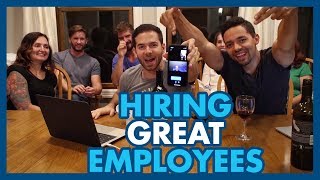
This is a casual, internal-facing video produced by Capitalism.com where Ryan Daniel Moran and his team discuss company culture, hiring stories, and strategic planning. Key points: the team uses a short quarterly-edited "Vivid Vision" document to align on a three-year direction and quarterly priorities (continuity program, product launch, podcast, social media); Ryan reflects on transitioning from directive manager to coach and on hiring/firing philosophies and how team members were recruited or joined.
Chapters
Holy crap.
There's a lot of people in here. Holy crap. Where did all of you come from?
You manifested us, Ryan.
Whoa, snap. I gotta be really careful what I'm thinking about, dude. All right, first see money. You're on camera.
Whoa.
Wait a minute. Who's behind the camera?
Chris, where's your sunglasses?
Oh, the purple.
Oh, snap. Oh, that's our product. This is our product review. You might have heard of blue blocker sunglasses, but are. Are you aware of rainbow optics? Boom. Because blue blockers are good. Purple blockers are better.
Purple enablers.
Purple enablers, seamoney. Tell us about your purple enabler sunglasses.
So I just got these for my birthday. They came with an insert.
Who invited them? Sorry.
They came with a nice insert that showed they make every sort of color on the spectrum. Every glasses aligns with a chakra in your energy center.
I can definitely sense that your aura is very. It's very purple.
These are supposed to open up your third eye.
All right, can I try these on? Hold on. Am I spiritually ready for this?
Breathe.
Uh huh.
Oh, yep. Yeah. Yeah. Definitely feeling like we should spread the wealth around. Oh, definitely feeling more socialist.
I don't know if I like where this is going.
One of the things that we do as a company is we maintain a document called the Vivid Vision. And this is something that we borrowed from Cameron Harold a couple of years ago. And Inez is the newest member of the team. And you said you had never seen that before. And I don't know why we didn't read it on your first day or give it to you in the interview process like we normally did. But you said it aligned the focus of what you understood.
So when we discussed the vision today, it was totally eye opening as to everything that we're trying to do, not just the little bit that we're working on. And it completely helped encompass the company, and it made me really want to do more and just be able to really progress and really get to the true end game of it.
Cameron Harrell will talk about this, and he's been at the capitalism conference. I think his talk is on the podcast, so you can Google that thing. Cameron Herald freedom fast lane. And basically what he argues is that the first step to building anything bigger than yourself is to lay out where your company should be in the next three years. And that's a two to three page document about where you're going as a company. So I took this very seriously and I wrote out what I wanted the company to look like, where we wanted to go. What we wanted to represent. And. And it has actually been one of the greatest recruiting tools that I've had of getting everybody aligned and on the same page. So that two to three page document, which we edit every quarter just to be a little bit clear with what we've learned and where we want to go, has been really our master document of making decisions and ensuring that we're going in the right direction. T coin.
Yeah.
What did we decide is going to be the company's focus for the next quarter?
Company's focus for the next quarter is one creating a continuity program that helps y'.
All.
We haven't gone that far, but creating a continuity program. To be continued.
We'll be launching the first offer on capitalism dot com. Yep. See?
See?
See? Yes.
And also.
We will also be creating a new podcast show.
Oh, snap.
Spoiler alert. You heard it here first. And the last but not least, some social media stuff.
Yeah, some social media stuff, you know, so we're gonna. We're gonna do some social message. Don't worry about it.
Come back to us in a couple months.
You'll know.
Brianna.
Brianna Thomas.
Brianna Thomas sent us a message, and she wants to know what is the best and worst thing about each of our jobs?
Ooh.
And she also wants to know what each of our roles are.
Okay, so first of all, that's seven people, and this could take a while, so I'm pretty sure we're just gonna go to the truth teller on this one.
Truth teller.
So to our resident truth teller. What is. What is. What is the best and Worst thing about Capitalism.com?
The best and worst thing about Capitals.com? the best thing is that everyone is super receptive on how to work with each other, which I absolutely appreciate, and we're all willing to work as a team. The worst thing is I cannot drink more wine to be truly honest about what I. No, I'm kidding.
Oh, come on. I'm so easy to insult. My entire life is on the Internet.
This is like, shit. No, I have nothing negative to say about you or the company. And that's.
Damn it.
I mean, Ryan's awful.
He's.
He can only deadlift £600. It's really insulting because, you know, I think I can do more than him.
No, I don't have anything negative to say at this point about capitalism.com?
That'S disappointing.
Except that I screwed up the wine.
Except that we're greedy. Except that we're greedy capitalists.
Ryan, compare with other employers you've had.
Wait, what's the worst or the best.
How does he compare to.
He lets you flow, which I love. Yeah, I mean, he definitely lets you be who you are and who. What you're great at, which is amazing. And I think that is definitely his best attribute, is that he wants you. He welcomes your talent.
I always thought it was my biceps. Go on.
No, we've talked about that.
The muscles.
Truth teller.
So, you know, it's truly. He really wants you to be the best person that you are and not who he wants you to be.
So I. I am a good entrepreneur and I'm a terrible manager. I mean, an absolutely terrible manager. And most entrepreneurs that I know are that way. And it's a completely different skill set to go from creative entrepreneur to having a team. And that has been a very difficult transition for me. As I've talked about very publicly about challenges of once a team is greater than like four people, I. I don't really know what to do. And my strategy up until this point has just been like, find what I consider good people, throw them in the bullpen, and say, let's all figure it out. And operating under the assumption of if you hire good people, they don't have to be managed. And that hasn't worked for me. Just hasn't worked for anybody on the team in my experience. So I've put in a lot of time and thinking into how to make the pivot from being a manager to being more of an empowerer and more of a coach. And I think that's what you're seeing is I'm not good at telling people what to do. And I used to come out of my zone of genius to try and tell people how to do their jobs. And instead I'm just committed to the vision out of a role and do my best to hold you accountable to the commitments that we make together and then get the heck out of your way because I don't want to micromanage you. So for people who have been on the team for a while, curious if that has been a noticeable shift or not. And you are welcome to be drunk.
Honest with me right now, I will say absolutely. And I've given you the feedback a few times. Seeing the shift lately away from just being very prescriptive with what needs to happen to asking questions and working with the team members to actually get them to come to the conclusion, even if you already know the answer, it's now leading versus just shoving down the path.
So, honest question. The I always thought that it was helpful to tell people how to do something. And I'm realizing now that by my perspective has been that by doing so, I actually stifled some people's creativity because I told you how I would do it. But the reality is, I don't care how it's done. I care that we're getting a result. Am I reading that correctly, or did.
I make that up 100%? So simple. But there's the adage of, teach a man to fish, he eats for life, and don't do this backwards. Or, give a man a fish and you feed him for a day. And the old approach is very much, here's your fish. Have at it. And the other thing with that is you have a focus, because you are the CEO. You are looking at the big vision. You don't know all of the pieces that are happening within someone's role. So by telling them how to do something, that may be how you did it in other areas of your life or other work, that may not be what needs to happen for the company. Because there are other pieces that might get broken by not knowing where they intersect. And what other pieces then come afterwards.
There was something that I thought was really a really big sign of the shift we're making as a company that happened today. And it was as we were mapping out what was most important for us to focus on over the next quarter, there was a moment in which it was really clear we were making our decisions based on what had happened in the past, and it was based on everything that's happened. At this point. This project is like a couple tweaks away from being done, or this thing that we're working on is really close to maybe being great. And we paused and we said, but if we do that, does it lead us to the vision and the goal that we ultimately want, or are we okay wrapping this up and calling it a day? Did anybody. Was I being super esoteric? Or did anybody find value in the conversation of leaving the past in the past and very liberating?
Yeah.
All right. So, Evan, if it was liberating, would you share how it landed with you and what that conversation was, where we went?
And part of the reason for this was we were being influenced in the decisions that we were making based on things that were either in motion or still that we were carrying with us that might be kind of leading you to where you need to go. And so we were able to then break free of that mold and think to the vision about where we want to go as a company, where we want to serve our customers and Our audience. And that actually freed us. And that's why I said the word liberated, because we could think differently. It was breaking the mold and saying, really, what do we want to do?
Our brains are memory making machines. It's constantly grabbing data. And so your brain can't accurately project what's going to happen in the future. And when it. But when it does, it bases it on the data collected from the past. So the past lives in the projection of the future, which affects our current decision making ability. If we're going in a different direction than we've been in the past, then all we need to do is look at what pieces of data we're going to allow to come with us. Not trying to bring all of that into the future, which is something that we've been guilty of as a company and I think most entrepreneurs are guilty of. Because if you think about the elusive idea of growth, we're going to grow, we're going to sell more, we're going to do more. Most people will say, well, we can take what we've done and just do more. So, for example, I think one of the goals that somebody said was, let's grow our Instagram. Following over 10,000. It was like, great, that's exciting. All we're gonna do now is just we're posting once a day. Let's post 10 times a day and see what happens. Or what if we made the future much, much bigger than what we've done in the past, and we have to go out and get new skills and come up with a new way to grow way through that goal, and it created such creativity out of how we might accomplish that goal. Would y' all agree?
Yeah, I was just about to say that. He's tapped all over my lines.
Yeah, there's no point. You already said it all.
Hey, so, Inez, a good question got submitted to you.
Yes.
Are we living in a simulation?
Tell us the truth.
Yeah.
I don't.
No, I don't think so. That's all you got?
Yes.
We have Backstage Harlequin.
Whoa.
We have a company debate about if this is your real name. Backstage. Is that your real name?
No, it is not. It's a pseudo name.
Okay.
All right, what can we do you for?
I want to hear more.
Well, tell me, you guys were talking not too long ago about videos to Brianna. Do you know before and after pics? Do people really pay attention to those, Phil?
Oh, hell yeah. I would say that before and after photos are some of the highest converting videos, no matter what your market is. If you can demonstrate real results in a period of time. Yeah, it's the greatest conversion mechanism you could probably do in just about any business.
I once directed a short promotional film for a nonprofit that helped, like, sickly kids who. Who had diseases. What they would do is they would provide kids with really specialized gifts according to their interest. And what we illustrated was in this example, that giving a kid in this crucial time point of development, like a kid who's interested in astronomy, a telescope, could lead them down a path in which they could pursue a whole career in science. And so that was kind of a high production value video. But there's ways to do that through pictures or pictures and text. So there's a lot of ways in which you can really illustrate that to make an emotional appeal to people. And yeah, the use of story really works better than. Better than anything else. Especially better than, like, numbers and data.
Yeah, it's the best conversion mechanism on the planet. I believe. I believe we're about to call a special guest. Are we not?
Very special. Special guest here.
Spirit fingers, everybody. Spirit fingers. Spirit fingers. Spirit fingers. Spirit fingers. We need square fingers.
We got. We got Billie Jean on the line, everybody. What. What's going on, man? You just got back from a mastermind, did you not?
I. I got back from St. Louis. I did Andy Priscilla's podcast. That motherfucker's a beast.
Yeah.
What.
What makes Andy Frisella a beast?
1. He keeps it honest and real. Like, everybody should use.
Like, Inez.
Yeah.
Like you.
You keep shit real too. And then also to his results, man. Like, he's kill is doing 100 million plus. Like, here. They're helping people. He's. His culture's dope. Like, he's. He's winning. He's winning. He's winning a life. He's got a really happy relationship. Shout out to his wife Emily. Like, they're just. They're great. They're doing well.
And how. What did you learn in your time with Andy Frisella that you're going to take back into your current brand and businesses?
How he leverages his current customers to sell more of his products or services, because they're the biggest believers. So we have, like, hardcore fans, but I fucking don't utilize them for shit. Like, I just am. Like, I don't ask them to be a part. And I'm not. I'm probably missing out on millions of dollars a year from doing that. So I fucked up. That was my biggest takeaway.
So turning your customers into advocates and raving fans, right?
Exactly. But salesmen, too. Like your best salesman also, you know, and doing it in a systematic way so it happens again and again and again.
I actually need to give a shout out to you because, like, this production right here was partly inspired by you. Because I was. I was like. I had so much fun getting drunk and talking about politics with Billie Jean in San Diego. We should just do that all the time, everybody. And here we are. Here we are on the interwebs, drinking wine with the team. And Billie Jean's calling in, so thank you for being a part of this journey.
Hey, Jacob. Welcome to Wine with Wine. What can we do you for, my man?
One second. I'll mute you guys.
Hey.
Hey.
Thank you for that.
Hey there, Jacob Brown. Why the long face?
Wow, that is. Okay. All right. I haven't drank enough to catch up with you guys.
Hey, Jacob, do you like popsicles?
I love popsicles.
Oh, you gotta come down to the cellar. I got a whole freezer full of popsicles.
Here's the trick. You gotta spit on it before you put it in your mouth. Kind of helps it. Everyone.
Good job, Chris.
Thank you for being here. What do you. What's your question?
Okay, so it's sort of that you have the whole team there. I was wondering if they answer why they joined and maybe how you got in contact with them or how they contacted you. Stop hiring somebody right now.
Well, we take a rule with the boys here that if you can take your shirt off, if you get toasty.
I don't know if we're gonna use this in the final cut.
Full disclosure, these are all direct quotes from Herbert the pervert from Family Guy. All right. Why did the team join?
I have a different experience than I think most of the team, except for maybe Tyler, because Tyler came on as an intern and he, like, kicked butt and proved himself. But I was kind of a very random acquisition.
I walked into the office once and Melinda was there.
So I kind of very randomly came into it. They needed help with the first. It was Freedom Fast Lane at the time. The first Freedom Fast Lane conference doing customer service.
And.
I had no past experience. I'd been a stay at home mom for 17 years.
CEO of a family.
CEO of a family. So I had no proof that I would be a good employee. But for temporary part time, they tried me out. They liked me enough to keep me. And I feel like I've proven myself since then.
Brian Lee said at the Capitalism conference, his hiring philosophy was, hire fast, fire faster. And Gary Vaynerchuk has said, look, the Best hiring firms in the world still get it wrong. Half the time you can't get good at hiring, but you can get good at firing. And I've. I've made plenty of mistakes, and I've had to get comfortable firing people. And it's usually not personal. It's just if something is a fit or not, and you keep people who keep knocking out of the park, you let everybody else go on to their next opportunity.
I think it's a really interesting story how you hire, how Tiffany joined the team.
What do you mean?
In terms of the fact that I had a previous relationship with Ryan.
Whoa.
What kind of a previous relationship?
Ryan was was reaching out to his network to find somebody Tiffany represented, like the kind of person Ryan wanted to work with.
Right.
And so Ryan reached out to Tiffany and said, hey, I want to hire somebody just like you. And then just by chance, Tiffany was available at the time.
Luckily, actually, he saw me walking around town lake.
Actually kind of true.
It is actually what happened. And I had just decided I think I might get a job. So, yeah, it was just a weird.
But yeah, it just goes to show, like having a network around you and reaching out to your network and also.
Being super clear about what you want from the person that you're going to hire, not just what are their qualifications, but what type of person would be able to achieve the things that you're trying to accomplish with this role.
If you think about any interview or conversation that you have with someone to have a working relationship with, there's two parts. They're interviewing you and you're interviewing them. And this is one thing that I'll say. I joined the team with Ryan because there was a big vision behind that that he could articulate very well at the time. And you have all now had access to the vivid vision, and that has changed and grown over the past number of years. But being able to clearly articulate either your bhag, why you exist, where you're going as a company, that should resonate with the people that you're talking to, because you want to build a team more than just someone who's going to do some of the work, but actually drive the mission forward. So there is that element that you want to see, that passion in those people as well as they want to see in you that there's a direction and reason behind the company.
In my past, I have been good at pitching a vision of where something is going, and now my job as a leader is getting out of the way and empowering and supporting people. To make it their own vision. And one of the things that I'm committed to now is I've asked the team to keep me in my zone of genius, and now I consider it my job to flip the script and also create an environment in which the team is in their zone of genius, too. And I want the team to feel as though this organization and this team, the best shot we all have of accomplishing the dreams that we have as individuals. Because otherwise, what's the point? Why are we all here? Is it just to make money? Is it to do fun things? And.
I think it is to have a more meaningful life, whatever that means to us. And my goal is to bring on the people to which what we are doing here adds to their life and to create an atmosphere in which this is the best shot that everyone here has at experiencing that. And if not, helping them, get a skill set that helps them find their next opportunity. Jacob, thanks for the conversation, man. Thanks for the question. That was great.
Thank you. This is great. Yeah.
All right, man.
All right.
All right. Have a good night. We are seven hours past Inez's bedtime. Four hours past Evans. Inez is going to be up in two hours.
Oh, we need to issue. Sincere apologies to Tim Ferriss. We wanted to get to him and we ran out of time.
That's a bummer. Hopefully. Hopefully, we'll get them. We'll get him next time. Thanks, everybody, for watching. This is the capitalism.com team. Very proud to be a part of what all of us here are doing and excited to be documenting the journey with you. Thanks for watching. We'll see you next time. Good night.







