
How to make $1,000,000...in 18 minutes
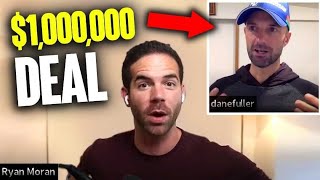
Ryan Daniel Moran coaches Dane, founder of Fuller, on scaling his oat product. Key moves: position against McDonald's, not cheap competitors; charge premium prices backed by your story; focus entirely on the product business instead of launching a side info course; build audience through QR codes and email capture.
Chapters
There are a couple questions that I get all the time from entrepreneurs who want to build million dollar businesses. And that's my shtick. I help entrepreneurs build million dollar businesses and sometimes entrepreneurs get stuck on these few questions for like 18 months or two years. So I recorded a call with one of my students who was stuck on these very commonly asked questions and they were keeping him stuck for over a year. And I want to share this with you because once you get this right and once you see it and you get it, you can avoid feeling stuck for a year.
Plus, it has been a long and windy road is the best way to describe it. I've been on this journey for probably about 18 months now and the first time that we actually had a conversation it would have been in September 2020. I reckon it was, it was quite a long time ago, but that was, I gotta tell you, that was a life changing conversation and it started me along this pathway to this new brand which I formed called Fuller since September last year. For the last 12 months I've really been working hard to identify the ingredients that I needed to create this product. And so it's really been about logistics, also redefining the brand which previously was called Unbroken and bringing that now to be called Fuller and really narrowing in on what I can deliver to my target audience.
Dane has spent the last 18 months perfecting his product and his approach and he feels frustrated by the lack of progress that he's seen in that 18 months. But because he feels frustrated, I can tell that he is trying to make up for lost time. And when he does that, he starts coming up with brand new ideas that he thinks will get him to his goal faster. You might relate to this when you feel like you've been stuck or struggling to become successful and, and so you start pursuing shortcuts that will make up for lost time. What I encourage Dane to do in this conversation is to stick to the plan because he's got a really good one. Maybe it took him 18 months to get clear, but as a result of the research and development that he's done up to this point, he's en route to a million dollar business. He's just got to cut out the shortcuts and focus exactly on the business that he wants because it's a good one.
What I would really value your help on at the moment is that.
It'S the value proposition how I can make sure that I add enough value to this product. And you did a very good podcast a few months ago and in the podcast you Spoke about having a premium product and why we need to price that premium product at a high price so that we can deliver value for our customer. And one of your best was very, very good. And at that time, I was getting towards the point where I had all my pricing in for ingredients and I could identify, you know, what my cost was going to be just to break even. And it was clear that this needed to be a premium product to be successful. Now, just to give you an idea, I'm going to have to charge around $7.50 per serve of these overnight oats.
Wow.
Okay.
Other products in the market, if it's a premium product, you know, you're going to pay probably about $4.50 a serve. And I need to charge more than that to make. To make a profit and to be able to serve the customers the best way that I can. And that's looking like it's going to be around, you know, could be sort of 6.50 to $7 50 to be able to do that. So I've got to go.
Dan, before you go further, tell me why it's so expensive. What did you prioritize or what were you unwilling to compromise on that drove up the cost of goods so high?
So the ingredients are expensive.
Tell me which ones, because there's some gold in here and I want to get it out and on paper. So tell me which ingredients are so expensive?
Well, firstly, having oats as being organic and gluten free makes them more expensive. Fruit. I've got a lot of fruit. I've got one to two servings of fruit per serve, and that's like a half a cup to a full cup of fruit per serve. And that ended up being very expensive, a lot more expensive than I would have expected. You cannot find another breakfast product with this amount of fruit in it. And that amount of fruit, not only does it is it really healthy for people, and I'd want them to be having that much fruit at breakfast anytime, but it also keeps them fuller. So it's a really integral part of the brand to have that much fruit within the product, and it makes it difficult to bring it to someone at a cheaper cost. I mean, if you just had an overnight oats with just oats and flavors and a few seeds, you can do it. But when you're starting to add that much fruit and the other stuff I've got protein, probiotics, it makes it expensive.
One of the most commonly asked questions that I get is how do I position my product in a way that's going to have high profit margins when there are other people selling the exact same thing or something similar at a much lower cost. And Dane is running up against this as well. So what I'm encouraging Dane to think about is not to compare his product to other similar products in the marketplace, but to compare his product to the other options that his current customer is considering. And that is not what he thinks his competition is. His competition is something completely different than what he's looking at right now. So pay attention to see how I get Dane to reframe who his competition is, which gives him much more flexibility in his pricing structure.
Now that I have this intel, like, it's one thing to say my product's really expensive because the ingredients are expensive. It's another thing to say, why are you willing to go to battle for every single one of these ingredients?
Yeah.
Because you started this conversation by saying, I want to find the story or the angle that allows me to justify such a cost, a high cost of goods. And you can't really skip over that. You can't really skip over the why you went to bat for every single one of these ingredients. So the juice of that story is in why you were willing to fight for every single one of these ingredients. You see what I'm saying?
Yeah.
So that. That. That is your story. It's. It starts in there. This needs to be a breakfast item, not an overnight. No, over. Not an overnight oats product. You have to delete that from your mind that this is overnight oats. It does not exist. This is not in that category. Those have never been invented. You don't know that those brands are real because as soon as you make the comparison, the customer will make the comparison. And that's not even the market that you're serving. I know enough about your brand to know that the person who's going to buy this is not a regular purchaser of overnight oats.
If they were a regular purchaser of.
Overnight oats, they wouldn't need you.
Yeah.
Like part of your brand's mission is to get more oats and protein and.
Fruit into somebody's body because they'll be.
Fuller for a longer period of time and thus lose weight, get fitter, get healthier, eat less junk. So if they were already eating overnight oats, they wouldn't need you. If somebody is going to McDonald's and they're getting an egg McMuffin and hash browns and a coffee, what does that cost? But also, Dane, what is that cost over time? What does that cost in Terms of medical bills, what does that cost in terms of clothing, what is that? You see where this is going.
So Dane was thinking about this business like an oats company, but that's product specific. He's not an oats company. He is a breakfast company for people who are going through a specific transformation. And when he realizes what the value is of helping his customer have that little change in their daily routine and how it keeps them on track to their goals, then his competition is more like McDonald's, that it is Quaker Oats. And that allows him to do an excellent job serving his person and still protect healthy profit margins.
So one of the things I wanted to do to add value to this, because I'm looking at, you know, making my offer at the moment and so going through Alex Formos material and looking at how I can really stack a fantastic offer for this. And so part of that is the digital information that I can add to it and coaching. So I want to talk to you about how I can do that. It's almost like I've got to start another business on the side and create this support community which offers advice and coaching and to be able to monetize that. So my question is, if I do that and it adds value to the product, how do you go about doing that? At the same time, I've just jumped into launching this new physical product business and then have to start an information, basically an information business on the side, which you want to charge for as well and have recurring cash flow from.
Okay, this is maybe the most commonly asked question I'm asked, and it's about Shiny object Syndrome, but really it's, hey, I got this idea over here and this person's doing this and I think that this might work. And the truth is, a lot of those strategies are good ideas or they will work. The problem is you can only do a few at a time. So I encourage Dane to just stick to the plan. Wherever you put your energy, that's what's going to grow. The grass is greenest wherever you water it. You just can't water everybody's lawn. No analogy is perfect. But I encourage Dane to stay focused on what he's already decided on, to keep serving the person that is his ideal customer. And when he does that, things are going to grow. We oftentimes look at what's working for other people and we say, ah, you're so far ahead of me, I should model exactly what you're doing. But that's a distraction because there's always going to be somebody who's beating us at whatever game we're playing. The key is to stay focused on the strategy that is best in service to your customer and make adjustments slowly. As long as they add value to the person that we're serving.
You have to stop thinking about it as an information business and you start thinking about it as your audience. I do not think that you should be trying to sell information products at the same time as building your physical products line. You've got to nail one first. But building the audience is the support for the physical products and the audience that you will eventually launch digital products to. So the way that I would do that is you have inserts and QR codes on your packaging that send people to a landing page. When they fill out the information on landing page, they also get access to the Discord group or the Facebook group or whatever your hopper is. And then you have the email capture, which is your conversion vehicle. You have the hopper, which is your community. And now if you take someone from the Facebook group and you do a coaching call with them, that's a podcast episode and that is where you're getting your traffic. That is where you are getting your exposure and that's your traffic triad that we talk about in the 1% that's completed for you. That is your responsive audience that is now supportive of this brand. And your work is producing one podcast a week or Q and a call or session with this group that is value to them, which positions you as the expert, as the coach. And then if people reach out to you for one on one coaching, you can take them on. But trying to sell products to a group that is there to support the brand, I think is a distraction. Instead, just raise your coaching fees and that's how you can have cash flow from the audience that is now buying your product and Supporting your content. 6,000 units on their way to be sold. Do not distract yourself by trying to build an information business while you are sitting on 6,000 units. Your attention needs to go to building the audience to sell through your units.
Once you've ordered inventory, your focus goes to selling through that inventory, not coming up with digital products to sell or other monetizing vehicles. It's selling the product that you know is going to be the best product for your person. And so your energy has to go into serving your ideal customer, building that audience, having a strong launch, because that's the first domino of building a million dollar business.
Yes. So what you're saying is that I should, I should do all that and I should add value to the product that I'm selling by including those under value. But then don't try and monetize that. Just keep giving it for free to.
Build your audience, I think you have two options. You have one. Do it for free to build the community and build the audience that will buy millions of dollars worth of oats and allow you to have a ginormous exit. Or you create a membership site where people pay.
Some nominal amount per month to be.
Able to get on the coaching calls with you and have access to the information. But once again, I think you're distracting yourself if you're trying to build two businesses at the same time.
Okay.
I'm stretching a little bit here, but there's a chance that pursuing too many things at once may be why you have felt stuck for 18 months and now you have a product that you're really happy with. Follow the rest of the plan, man. Instead of summarizing my suggestions of what you should do.
Ask yourself what creates the most value for the customer and thus the most value for the brand.
Because you still have a little bit.
Of like, I want to solve my short term cash flow needs. Yeah, and don't try and get that from the same business that you need to infuse love into for the next several years. If you need coaching clients, go get coaching clients. If you need to sell information products, go sell information products. But don't starve the child that is growing right now.
Starting a business with the intention of making more money is sometimes like having a child so that you can have more free time. It just doesn't work that way at the beginning. When you start a business, it requires money or energy or time or some combination of all those three. So trying to suck out money from a business that's just starting is like starving a baby of resources while it's trying to grow.
If you have cash flow challenges, go solve those in ways that don't siphon energy from the business. You've got to infuse the business with resources and energy for six to 12 months before you ever think about being paid from the business. So go drive for Uber or deliver for Postmates or get a job or or sell more stuff at something else. But don't steal resources from the thing that needs it the most. And that's the business that's gonna set you free financially forever, but only when you treat it like a long term investment.
This is so important. Don't rely on the baby business to solve your cash flow needs. Go solve your cash flow needs because you're taking food from the child.
And I don't just mean in terms of investment like money that the business needs. I mean, you're taking the value that you could be infusing into the community that is going to help this grow into a mature adult.
So go solve your cash flow needs. I totally understand. Don't do it from the thing that you want to that is in its infant stages right now.
Okay. Okay. Got it.
Awesome.
Thanks, Ryan.
You're welcome.
The first three to six months of any business are about clarity, making fast decisions and going all in on the service of your customers. And I know that after this conversation, Dane has has the clarity and the confidence that he needs to do that work that will set him up to have consistent sales, high profit margins and give him the momentum that he needs to build a million dollar business over the next year. The most questions come up at the beginning of that journey when you are wondering, am I on the right track? Am I doing the right thing? But as soon as you've got the clarity you need to make those decisions, that's really when the journey begins. And you're only six to 12 months away from the million as soon as you line them up. If you need extra help, I'd invite you to subscribe to the channel and make sure you follow The Road to 1 Million podcast, which is where I share these conversations with my students and document their journeys to building million dollar businesses. I'm Ryan Daniel Ryan with capitalism.com thanks for watching. I'll see you next time. Sam.







