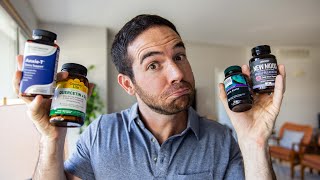
Ryan Daniel Moran shows how to make $1 million in crowded markets by building brands around specific customer personas instead of competing on price. Black Rifle Coffee and Core Power Yoga charged premiums by targeting dads and yoga enthusiasts. His formula: pick a person, build an audience, launch four products at 25 sales each per day at $30 average, hitting $3,000 daily and $1M yearly in 6-12 months.
Chapters
In this video, I want to share with you about how to go into really competitive markets and stand out from all the competitors and still have really high profit margins. So you can go into any space, go into really big spaces where there's a lot of customers, a lot of sales and a lot of profit to be had and not worry about everybody else trying to compete with you. A lot of really competitive spaces have products that they're selling, but they're not targeting specific people. And when you're going into a new industry that's big and established, you won't compete on product, but you will compete on person. If you search for any supplement on Amazon, there are all kinds of competitors selling the exact same thing in a lot of cases. And they're competing on price or they're competing on ranking on Amazon or the number of reviews. Most people will see that and they'll say, oh, this is a saturated space, this is a competitive space. I could never get my foot in the door in this industry. When I look at really competitive markets, I see people selling products, not selling to people. So a great example of this is Black Rifle Coffee. Coffee is a really big industry. Billions and billions of dollars. And you have Starbucks and Folgers and every brand in the world that sells coffee. But Black Rifle Coffee came in and said, we don't sell coffee, we sell to gun owning Republicans. Our tagline is not gonna be how delicious our coffee is. Our tagline is gonna be about, you shouldn't give your money to liberal Starbucks. And that worked for them. It got them off the ground, it got them millions of customers, and now they're a publicly traded company. It wasn't because their coffee was so delicious, it was because they targeted a specific person. I look at supplements or any competitive industry exactly the same way. I see all kinds of people selling testosterone boosters. This one's clinical and this one's aggressive, and this one has fadosia and this one is clinical trials. I come in and say, this is the one for dads. And the reason why this is for dads is because studies show the more active you are with your children, the lower your testosterone. That's a true story, by the way, because testosterone is an anti bonding agent. It's wild science. Anyway, our testosterone booster is for dads so that you can protect your hormone levels as you age while still being a present dad. You see how that speaks to a specific person rather than talking about the science of all these ingredients. What that does is it allows me to target my target audience and Speak to them directly and say, this is the product for you. Now, of course, in my companies we strive to be best in class product. We strive to be the exact product that our people need. But from a marketing perspective, what matters most is how you communicate it inside of that customer's journey. Not about all the features and benefits that make you different from everybody else. You know, I'm sitting across from a yoga so studio right now and this place is called Core Power Yoga. Now Core Power Yoga is like fitness yoga, right? You think about yoga as almost a niche market, but there is fitness yoga, there's meditation yoga, there's Kundalini yoga, there's what's, what's the partner yoga called? Acro Yoga. Acro yoga. Like completely different. There's goat yoga, for goodness sake. All of these are different markets. The person who is doing breathwork type of yoga or Kundalini Yoga is very different than the person going over to Core Power Yoga. They're very different people on very different journeys. And so if you are marketing your product to the entire yoga base, then the only way that you can compete is on price and reviews and features. But when you are building a brand that's specifically for fitness yoga, all of a sudden you're speaking, speaking to a very core audience. You have a very different suite of products that you're going to release and you can speak exactly to what that person is going through on their journey. That makes a customer say, I trust this brand because they know my pain points, they know my journey. I want to be part of that rather than just buy from the nameless, faceless brand because I don't know if they're for me or not. I will pay a premium for the person who understands my journey because it makes it more likely that I'm going to accomplish the goals and the transformation that I have for being on this journey in the first place. In terms of implementation, this frees you up to do the things that everybody else who's competing with you wants to do but doesn't feel like they can. For example, I work with a lot of Amazon based entrepreneurs and they all want to get off of Amazon. They're like, all my sales are coming from Amazon. I'm dependent on Amazon. I want to get off of Amazon. Well, listen, dude, you can't do that if you are competing on product. But if you have a specific person in mind, you can run a Facebook ad, a TikTok ad, start a YouTube channel, start a podcast, partner with influencers, you can do all kinds of marketing to a specific person, get them on an email list and then launch product after product after product after product because you are speaking to a specific person. That's the only way through, ladies and gentlemen. Pick a person, speak to the person, and then the product becomes the natural thing that that person buys in a route to their transformation. When you do all of this, getting to 100 sales a day is very straightforward. The process is to pick a person to target a person. Build a small group of them, launch four products to them, get them to 25 sales a day and that's 100 sales a day. 100 sales a day times $30 is $3,000 a day. $3,000 a day is a million dollar business. That's six figures in profit. Takes about six to 12 months to get there. There's no way around it, there's no shortcuts. The way that you build a compelling brand that gets to 100 sales a day that you can sell for millions of bucks, set you free financially forever is first to compete on person, to serve the person, then product and price point and reviews come later. If you want some help, if you want to get started on this journey, download the free resources that we have. We have a write up on the step by step plan to get to 100 sales a day. There's case studies, free videos, free podcasts, all in there. And subscribe to the channel so that I can mentor you on your journey to 100 sales a day. My name is Ryan Daniel Moran. I help entrepreneurs build compelling brands, get to 100 sales a day, have a multimillion dollar exit. Thanks for watching this video. Let me know what you thought in the comments. If you've got a product that you're trying to sell, you're trying to figure out how this works for them, drop it in the comments and let's talk about it there. Thanks for watching. I'll see you next time.