
How To Make 6-Figures A Year In Your 20s
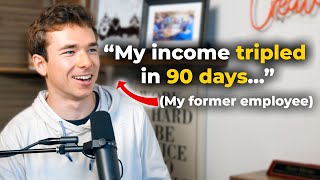
Alex King went from part-time video editor to running a multi-six-figure content agency by his mid-20s. He left his full-time job and saw immediate income growth, then spent three years scaling by defining deliverables, isolating high-impact work, and building systems around it.
Questions this video answers
March 11, 2024
$2,000 per month
Between $42,000 and $48,000 per year
About three years
A couple months (income reportedly tripled over ~two months after transition)
Chapters
What was the time frame from going from full time employee to making six figures?
A couple months?
I think you have a very modest start and then three years later you've got a multi six figure business. There's some things that happened along the way there.
This is the unknown I'm stepping into. What would it look like to actually just trust that whatever's supposed to come in will and I don't have to push myself beyond my burnout limit?
One of the backdoors into full time entrepreneurship is when you're able to isolate where the impact is. Now you have something you can build a business around.
Thought I was supposed to be this like big time, big scale entrepreneur and now I'm like, I just want to do the thing that I feel like I'm called to do. Do it at a sustainable pace, keep going from there.
If you ask most 18 to 21 year olds how much money they're going to make, almost all of them are going to say that they're going to make mid six figures to seven figures by the time they're 30 years old. That usually doesn't happen. This is not one of those conversations about a pie in the sky idea of an 18 year old going on to make a million dollars by the time he was. Instead, this is a practical guide for those of you who are early in your journey, young in your career. What are the practical steps to go from graduating college to being in your 20s, working full time, but then going on to make multi six figures and eventually seven figures. That's why I wanted to invite Alex King here onto the channel, because Alex worked for me part time for $2,000 a month editing videos while he had a master's degree and was graduating. He's gone on to start his own agency, which became a multi six figure agency without destroying his life. And now he has the choice to scale it to a seven figure thing or to live a lifestyle that allows him to do whatever he wants with his life, his talent and his time. For those of you who are early in your journey, young in your career, you want a predictable path to having stability, but also upside. You want to see what it looks like to prove your worth and then go out and make multi six figures. This is a case study that is going to give you the actual path to be able to do that within a one to three year period. Because that's exactly how long it took Alex to go from working part time with me to having a multi six figure company of his own. So I bring you the man who's usually behind the camera? It's Alex. Alex, I usually see you behind the camera, so it's good to see you in front of the camera.
I know. Great to be here.
But you've grown so much over the last three years, more than anybody else that I know. And the ego part of me is like, yeah, well, yeah, we've been hanging out a lot. I'm a reason for that growth. But. But it's also because you have, you've just become a different person. And you started your own business after working with me like you were a full time employee with me, employed by me. Then you went off and started your own business and as a result, you've just made new connections and grown as a person. And so I just want to unpack the personal growth, but also how the heck you've made a multi six figure business in your mid-20s after working full time for somebody and making that pivot. So let's just start with the journey you've gone on over the last couple years of this transformation from young college kid fresh out of school to now having a multi six figure business and, you know, with the option to go wherever you want with it.
Thank you for the kind words. The reality, I think was I moved to Austin beginning of COVID had no clue what I wanted to do, and I just really had no clue where my life was going to go. And then I met you one day completely serendipitously, like on this random interaction and we started connecting. I was like, oh, I do video, I do photos. And you're like, I need a video guy. I'm like, can I, can I make.
Some videos for you?
And then that was how that worked. But my interests have always been entrepreneurship and content and the creative world. And so I spent a lot of time in like sports photography and video. I spent a lot of time consuming hours and hours and hours of like Gary Vee's glory days when he was like making DailyVee, like when I was in high school and college. So I thought that was gonna be the perfect opportunity for me to like showcase what I can do, but also learn a ton from this person that I knew was extremely successful and was doing some of the things that I wanted to be doing.
But I think it's important for us to comment that you were making, you were working part time for us to start and part time somewhere else. And I think collectively you are making between 42 and $48,000 a year as a master's degree graduate, starting off in the World. Right. So you have a very modest start and then three years later you've got a multi six figure business. So there's some things that happened along the way there. Right. So you start making videos for me part time, eventually become full time, and then go on to make your own agency. So tell me a little bit about that transformation, not just working with me, but as an, as an entrepreneur or somebody who's interested in the space and in your early to mid-20s with big aspirations. Because there's people I talk to, people who are, you know, building seven figure businesses. But when you're 22, fresh out of college, making mid six figures, you're doing darn good. And so there was an evolution there. Tell me about a little bit that evolution.
Yeah. At first it started with. I knew I didn't know that much. Like, my ego wanted to tell me, like, okay, I could, I could go do this. I think I could always be an entrepreneur.
I have a master's degree. I watch Gary Vee.
Yeah, I mean, come on, how hard could it be? And then I started working full time and I think that's a wake up call for anybody. It was a transition from college to real life. That's a little bit of a shock. It's like, oh my gosh, I do this all day, every day and it's so fun and I enjoy it, but it's just a different pace of life. So at first I focused on, like, how can I learn as much as I possibly can from Ryan and from everyone that we're around? Like, I knew this was a fantastic opportunity to meet so many awesome people. And so I just tried to focus on that and knock it out of the park with the first couple things that we did together. And so that was the first couple of years I just focused on skills.
I remember you were going through a period of time actively becoming humble. Yeah. You were actively looking to like, let go of the ego and the, the desire to have it come back to you. That was like a practice of yours of letting that go.
Yeah, well, I had had a period in college where I had focused solely on these like, ego vanity metrics of social media and gaining a following and building an audience. And that was very important to me and it made me feel a certain way about myself. And then I moved to Austin. I didn't know anybody at all. All that went away. And so my identity was kind of changing and I was going like, oh, I can't put my, I can't put my faith in this, this thing, this Algorithm. It's the silliest thing. I had this ego of, like, I have a master's degree and I have this, and I think I should be making X amount of money. And yet my reality says completely different. Yeah, like, my reality says that I'm really. I'm not making a ton of money. I was making enough to live. And that's fantastic. And I really was grateful for it. But all of the messages in my head and the things that I've seen online, it's like there's this message on social media that says you have to make a million dollars or you're poor, or you have to be super successful, or this is what you should strive for, and if you're not there, feel horribly about yourself. And so I was going through these couple years of like, okay, I really just need to, like, what's the saying? Chop wood, carry water. I just need to chop wood and carry water. And over time, that just transformed into, like, I'm just gonna be completely present right now here, trusting that whatever's meant to be for me will be. And so I learned the skills of making good videos, putting out content online and talking to people and being social and more so the professional skills of, like, communication.
And I want to add something to this. We started working together during, like, the middle of COVID like, world shutting down. I think we might have met right before for. But, like, the world, like, the world shuts down. And what you hadn't experienced was us going to an event and hearing anyone say anything about your work. Like your predecessor Chris, who worked with me for about four years. We would go to events and they'd be like, I love your videos. You didn't hear any of that. You got. You heard no feedback except what was in the comments, which aren't often favorable.
No, they're never favorable.
So you actually went through this period where you couldn't get any affirmation about your work. You were just chopping wood and carrying water. Right. And so I just want to reflect that back to you of, like, you would set out with that intent, and then you couldn't get any of that affirmation or that stroke of your ego. You just had to shut up and do the work. And when the work became valuable enough, then other people started reaching out and saying, who's doing your videos? Yeah.
And there's. There was tons of times during those years where I. I selfishly thought, I'm going to come in here. I know how to do video, I know how to do photo. Like, I Think I'm really good at this, and I'm just going to blow it out of the water and it's going to change everything. And then that didn't happen. Like, we started working together. The videos improved, the content improved, everything improved, but not to the extent that we had hoped. I remember sitting with you and being like, if we can do this for a thousand days, you said, we should do this for a thousand days. And at the end of a thousand days, let's reevaluate and reassess. And I'm thinking in my mind, a thousand days is such a long time. That's a long time for my life right now. And I realized that over that period, you just keep going. Like, it's just an iterative process. It's not that magically, one day this thing opens up and falls out of the sky, and suddenly you have a great business or a successful YouTube channel or whatever it is. You just keep putting in the work. And we haven't missed a week of an upload in 3 and a half years. That's a long time. And so back to the thing. I was working and building the skill of that. And then people that we were coming into contact with or people that I'd see at events that we would go to would be like, hey, do you do this for anybody else? I really like what you're doing. Do you do this for anybody else? And at first I was like, no, I don't. I'm just doing it for Ryan. And I'd take on some, like, side gigs over here sometimes. But eventually it got to the point where a lot of people were reaching out, and.
I just felt like, okay, I kind of feel dumb saying no to all these things.
Was it a hard conversation to come to me and say, I want to take on other work and I want to start an agency A hundred percent.
Yeah. Partly also because I had nothing when I came in and joined this company. Like, I didn't have, like, a network. I didn't have connections. I really was, like, fresh out of college with no.
No connections, no skillset, no experience.
Yeah. And so coming to you and being like, hey, I'd like to try to take on this other work. And coming at it not from a place of like, yes, I'd like to make more money, but it was more so about. I've always wanted to be an entrepreneur. I've always wanted to grow a lot. And I think this is the route that I. That I want to grow in. And taking the risk of you being like, I Don't want to do that. That sucks. We're going to go find somebody else. That's a pretty big risk. Like, that's a. I have to be okay with that if you say no. And so I sat with it for a while of just thinking like, okay, how am I going to feel if I go to Ryan? And Ryan says to me, no, that's not going to work for me. I need this full time. We're going to go find a full time person. That's great. You can train that person. And when I got there internally, where I was like, I'm okay with that. I don't want that to happen. I love working with Ryan, but I'm okay with that because I feel like this is the leap that I'm supposed to take. Then that's when I had that conversation.
Yeah. And what do you remember about that conversation?
I remember, like, sweating bullets. I was like, terrified because any change is extremely terrifying, you know, whether you're scaling your life up or down. It's like this. This is the unknown I'm stepping into. I have this nice, cushy, like, I know what I'm going to get paid. I know what this benefit is. I know what this is going to happen. I can plan out my life, I can plot this way. But entrepreneurship is. It's unknown. It's completely unknown. I'm like, I could have a client this month and next month. Not.
That's right. That's right. That's the thing that most people don't plan for.
Oh, that's a risk.
Yeah. Is. Is you don't know if everything is going to stay exactly the same. If you're going to make the same, you probably won't make the same amount every single month. But one, one of the things I want to highlight here is, you know, again, I'm the 12 months to 1 million guy. I help people build businesses they can sell. But when you're making the transition from working full time to having your own business, one of the backdoors into full time entrepreneurship is to take that skill set that you're doing well for somebody else. Keyword, doing it well, producing results and taking the 20% of the work, that is creating 80% of the results and making that the foundation of a business where you bring in other people that hire you for it, which is exactly what you did. And we experienced where you were being pulled into meetings, you were making decisions over here, you're editing this video over here. That doesn't grow the audience. And so when you got really clear on the thing that you're here to do is to grow the audience and make great stuff that is actually this part of the business. There are things you can systemize. You're gonna treat it as an agency and now you can go and hire other people too. And I don't notice a difference. That was a huge sign of maturity of you realizing where you could professionalize your focus. What was that like for you to start to put together that into like a package, into a boundary that you could bring to other people who would hire you as well.
Yeah, it was very difficult to do because at first you're used to getting paid hourly. You're used to getting paid like, okay, I put this amount of time and this is what I get for my work. And then realizing, okay, actually probably like 20% of what I'm doing, like you said, is making 80% of the value here. Why am I charging based on the hours that I work? Um, so it was a big transition for me, but it was becoming really clear about deliverables and you were very clear about this. Like, what are you going to deliver that is going to. What is our contract going to say? Essentially?
Not like, oh, I remember this now. Okay, I forgot about. This is when you kind of brought to me, you want to go out on your own. And I was like, okay, then it has to be about the deliverables. What are our expectations? Like, how many videos? How do we think about it? Where are the boundaries? I remember this now.
Yeah, yeah. And you're so used to, as an employee, going other duties as assigned is like everyone's contract. You just do other duties as assigned. And when you're an agency or when you're a contractor, that's not the case. You. You can no longer just say, yep, I'll take on that and that and that and that and that. And so that was a big, like, learning curve for me of, okay, I really need to provide the value that I say I'm going to provide. Because I can't fill in the gaps with like, okay, I'll take this on, I'll take this on, take this on for my job security. It's like, either I hit these metrics or I don't. Okay, it's super binary. It's no longer gray. And so that was a big, A big learning curve for me.
What was the timeframe from going from full time employee to making six figures? Because I know it was pretty darn quick.
A couple months, I think.
Couple months?
Yeah. Yeah, a couple months. Because I Had had, like I said I had had those people come to me and say, could you do this for me? Could you do this for me? And I have been saying, no, no, no, because I work full time. And as soon as I made that transition, I said yes to those clients. And so that income tripled, I think, over a period of like, two months.
Yeah. It's interesting. I've had people ask me in the past, how do you prevent your employees from just becoming entrepreneurs and leaving? And I say, I don't. If they're going to leave and go start a business, they should go start a business. A, I might hire them as an agency, like our relationship, or B, if it's a different business, I might be the first to invest in it. Or three, they're going to discover how freaking hard it is, and they're going to come back and have a new appreciation for their job. So in any of those scenarios, it's fine.
Yeah.
So just empower them to do what.
They want to do. That's credit to you because you're seeing the glass half full mentality. A lot of people, I don't think, see it that way. And they think that they're somebody else in their organization. Going and doing their own thing is a loss to them. And in my mind, I was like, I can do this so much better this way, because I'm gonna have so much creativity. I'm gonna be excited about what I'm doing. I have skin in the game now, so I can, you know, like, all those things were going through my head, but from a business owner's perspective, you're like, I am losing this person's 40 hours a week of work. But in reality, probably, like, 10 hours a week of what they're doing is actually moving the needle. So, like, if they're still doing that 10 hours, like, my goal in that transition was like, don't even make it a transition. It's not a transition. I'm doing the exact same things with more clear outlines.
Yeah. If anything, there was maybe more protection from me because I was. I was like, I. This is our scope of work now, and this is where the value is. We have absolutely carved out where the value is. If we have one video that hits, it has 17 times the Iran the numbers. It was 17 times the output as something that does not perform. So. So we need to be relentlessly focused about Alex's focus. Do not give him anything outside. And that was actually a hard transition for the team of, like, protecting those boundaries. But when you're Able to isolate where the impact is. Now you have something that you can build a business around.
Yeah. And if you look at it, the channel's grown, the audience has grown, everything's grown and we still have a fantastic relationship, you know, so it hasn't been a loss. And so a lot of that uncertainty that I felt at the beginning, the doubt of like, I don't know how this is going to go, I'm not sure, like, I'm taking a risk, I'm taking a leap. It worked out really, really well and I'm glad we did it.
Yeah, there's. There's a thing that we've talked about a lot that has been a theme in our private conversations, which is the balance of doing the work versus the space for creativity. And this is always an adjustment for me and as I know, it's an adjustment for you too, where you have to have space for new ideas and creativity and fun and trying new things. But you also have to buckle down and do the day to day work. And if you over index in either one of those areas, you're either broke or unhappy. Yeah, you're always in the day to day grind. Then you're unhappy because you're away from why you got into this. But if you're just too creative, then you don't have any structure for business. You've navigated this sometimes painfully, but you've navigated it well to a point now where it feels like now you're saying no. More often it feels like you're really committed to the work that's in front of you and you're rebuilding a creative life again. Would you walk through a little bit about that adjustment period? Because this is what a lot of people don't plan for when they're starting a business or they're early in their journey.
Yeah. So at the beginning everything was really exciting. I was just like, okay, I can do this for this person and I can sign this person.
Here you're saying yes to.
I'm saying yes to everything. And I'm just filling my plate with as much things as possible. And soon you kind of get to a point where it's like it just plateaus. And I found that my time plateaued. Like I just didn't have any hours in the day anymore to do what I wanted to do or to fulfill on the stuff that I needed to do. And that's stressful. So then I plateau and I'm like, okay, I either need to scale back or I need to build systems to like get out of this. And at first, I was really excited about building systems because I was like, oh, that's how people scale. That's how you scale the business. And now I'm in a place where I can see kind of like the natural expansions and contractions. Contractions, yeah, I can see the natural expansion and contraction. And instead of seeing the contraction as, like, a loss, a failure, I'm just like, oh, I'm just recalibrating, and I'm recalibrating, and I'm going to say no to things for a while, and then I'm going to grow again.
So I'm. We work together almost every day. And so one of the things I think that you get to see is. Is when I expand and contract, and sometimes it's six months ahead of where you're about to expand and contract. So I'm thinking about a time last year where we massively contracted, where I was like, our business is way too chaotic. There's way too much all over the place. There's too many people doing too many things. We're gonna focus on the basics, and we're gonna do them really well. And one of those things happened to be, let's do YouTube really well. And YouTube growth went way up, and we're gonna do sales really well, and our conversion rate is way up, and we're gonna serve our clients. And we rebuilt product, but that took time. And now we're at a period where we're starting to expand a little bit, and you're kind of in the opposite, where it's like, oh, man, I'm all over the place. I gotta contract. I gotta say no. And I wonder if seeing examples of that, since we worked together so closely, gave you some cover of, like, this is normal, this is part of the process, or. Or if it still feels like a chaotic freakout. On the climb up, what has it been like for you?
It's not a chaotic freakout anymore. There's definitely been times where it's very much like that, but nowadays it's more so, like, okay, I see the burnout coming, and I want to change how I think about this, or I want to change the way that I'm going about this. And I've seen it enough times with you specifically and with the community where you expand because you get. You might get distracted by growth, in a sense. And that's how I feel at least. I'm like, oh, I'm distracted by all these sales, or I'm distracted by this number that I'm really rushing towards, but.
Like, and what do you mean that number that you're rushing towards?
So if I say I want to make $30,000 a month and I'm just like running straight towards that goal? Well, if I'm running straight towards that goal sometimes and oftentimes like the fundamentals of the business will start to lack a little bit. And you said this in an interview a couple weeks ago where you said, okay, if I focus on sales, then the product falls down a little bit, then I focus on marketing and sales fall a little bit. And so it's this constant flywheel of like, yeah, okay, I need to make the product better, but then when I make the product better, then I need to go get new customers. But then once I have new customers, I have to make systems to handle that many customers or I have to train people or I have to hire people. And so it's this constant like wheel of just, you know, kind of changing your attention on what you're focusing on.
Yeah. You tend to over index in one category.
Yeah.
And neglect the other ones. But it always comes back to product, sales and marketing. And you've got to be able to manage that or put people in place that keep that going. Would you just give a quick overview of what your business is and how you make your money?
Yeah. I run a content agency for entrepreneurs. So I think of my job as to make people look good on the Internet or to have the entrepreneur show up, sit down, say what they need to say, capture what it is that's the actual essence of what they're saying, and kind of direct that and add strategy a little bit and then actually manage the back end of all those channels.
And when you started, you were a full time employee doing that for one person. And that person was me.
Yeah. Yeah.
And so I have said that if you're not going to build a business that you want to sell one day, one way that you can pivot into becoming an entrepreneur is take the skill set that you do for a full time employer and turn that into an agency and then take on other clients, which is exactly what you did. And actually your predecessor Chris, our first video guy, did the exact same thing. He did it here and then he built an agency out of it and now he has multiple clients. If you're watching or listening to this and you're in your 20s, the takeaway here is if you do a very good job for one person and you develop a skill set, that skill set can be applied to other things. Because as we found in your role when you're in a full time role, sometimes things that don't fall into your sweet spot end up on your plate. And so if you create the boundary of this is what my service offering is going to be. And now I can do the same amount of work and output in 15 hours a week versus 40 hours a week. I can now take on three clients, I can now triple my income, which is kind of what happened to you. And you've got a base of clients that you go back to over and over again. And then you might have other side things in there, but you got like a base of clients that make up the foundation of your, of your agency. That's the tldr of how you make that transition. But now you're in a different sort of transformation, which is, okay, do I want to scale this or do I want to have just like a lifestyle business that allows me to do whatever the heck I want? How are you navigating that right now?
I'm still in it. I'm in the middle of it right now. But I would say that what I came to notice was, okay, now what I the problem that I have is not lack of work, which is an amazing problem to have, and I'm not complaining about that at all. But then I go, okay, well, given that I don't have a problem with lack of work, do I actually want to do all of the work that's coming in? Could I imagine myself in five years having the same business, scaling up a team, just leading it or owning it or operating it, and really, really enjoying my life? And I'm kind of sitting in the middle of that right now because what I really love is telling stories. I really love meeting people, doing strategy and telling stories. And some of the things that I do don't fall in that category. But it's where the money wants to go right now. It's where people are asking me to do. And so that's been a bit of a, like, back and forth in my brain of like, okay, well I'm supposed to grow this business, right? Isn't that what you're supposed to do? You're supposed to just keep scaling and scaling and scaling. And at the same time I'm like, oh, I'm kind of getting away from the thing that I really, really love doing that I can just wake up in the morning and do like, no matter what, I'm getting paid for it or whatever. And so I'm kind of dialing back to really focus on what that thing is again, which I Feel really good about.
Yeah. The irony is when you have people who are asking you to do a service and they're offering to pay for it, it is not often or not always the thing that you want to do all the time. But what I've noticed about you is you found a way to wake up in the morning and do what you like to do in a way that generates a very specific result. So, for example, you mentioned that your job is to make people look good on the Internet, right? You make me look very good on the Internet. When I'm in that place, I can sort of blossom and build the audience and I can give to our people, and I feel empowered to go serve our community. And when we have a clip that does really well of me serving that person makes me empowered to go do that even more. And so you kind of create that framework and structure, but the minute that somebody else is like, can you do for me what you did for Ryan? It's like, well, I can create the structure for it. But to give you, like, here, X, Y, Z, how to do it. Now you're not in your creative mode anymore. And so protecting that creativity for you has been a theme that's come up a lot in our conversations. So when you drown out that creativity, you're miserable pants. And I am too, right? If I'm not creating from a place of contribution and I'm just grinding, I hate my life, and you hate your life too. And I'm sort of jealous of the people in the world that can just go grind their face off, but I can't in that way unless it's done with some sort of creativity. You've gone through several different iterations of, like, that balance. What have you. Have you found anything to be able to keep you in the zone? Hey, you watch me on YouTube and you listen to me on your favorite podcast player, and I've been thinking, you and I need to make this official. I pride myself on bringing you the real, in the trenches entrepreneurs. These are people who often don't have followings. These are people who don't have a book to sell or a course to offer. These are the people who are doing real business and getting their fingernails dirty so that you can learn from their mistakes and their big wins. It helps me go get more people to help you when you hit the subscribe button because it gives our community more leverage to be able to get the people that don't usually do podcasts and YouTube interviews. So if you've been listening to me for any length of time. Would you make this official and hit the subscribe button? It'll take you two and a half seconds. And it will help me help you on your journey to building a successful business.
Well, we've talked about it a lot, just me and you personally, of when I am operating from a selfless place, when I'm not selfish and just like, okay, I want to make X amount of money for me so that I can have this lifestyle, so I can do this and this and this and this. That's when I get burned out. I don't get burned out when I'm trying to. Trying to carry out some mission that I feel like is bigger than me or.
Just be selfless in the way that I do business. And so we've talked about that so much. Where my creativity will come when the focus is not on how much can I get out of the situation or how much can I make out of the situation. And it's a tough reality because I fall into it all the time where I'm, like, not even realizing that I'm kind of idolizing money or I'm kind of idolizing, like, success or my ego or whatever. And then I have to wake up and go, oh, I'm way off track here. I need to recalibrate and get back into, like, the groove of just creating to create. And when I'm there, it's awesome. I can do it all day, every day, and I'm not burnt out. And I've thought a lot about this, like, why can Gary Vee, you know who you can have your opinion on Gary Vee, I guess, but he works all the time and he genuinely, like, seems to be really happy doing it. It's not like he's putting on an act of, like, I'm Gary Vee and I'm just gonna go out here and be this public person. But in private, I hate my life. And that's what a lot of people do. I think I've done that in the past where I'm like, I want to go create this business and I'm going to be a successful entrepreneur and then secretly, oh, I don't really actually like what I do.
I can relate.
I don't want. I just don't want to do that anymore. And so I've realized that if I'm not thinking so much about, like, what am I going to get out of this? Like, what am I? How is this X amount of money per month going to change my life? Because that is a fuel. But for me, it's A fuel that only lasts so long and it burns out and leads to burnout.
So this, this is the irony of it. Alex, again, when I met you, you're making like 40 to $45,000 a year and you had zero, like take nature about you. You just wanted to show up and make great videos and we did a great job. And then you started to have some success. Other people start coming to you and your brain went to like, how big can I make this? And that is when I've seen you fall out of that mode of like just, I'm going to create, create. Because now there's lots of people who are throwing money at you and you're like, how big can I go? Can I get to 30k a month? Can I get to 50k a month? Should I launch a course? Should I launch a blog? Should I do all the. And you start thinking about scale. And we've had lots of conversations about this because I do this too where when I am just thinking about how do I do a great job on this project or write a great book, it feels effortless isn't the right word, but it feels like joyful effort. And then the minute that I switch over into thinking like how do I sell another a hundred thousand books, I'm going to push it no longer has that energy to it. And so there is this. You use this phrase of. It's like there's this wellspring or this never ending energy when you're thinking about the other person, when you're thinking about giving to somebody else. It's like this never ending source of fuel that is there to fuel good work. And then the minute that you try to take from it, it shuts off.
Yeah, yeah. I mean there's a. You know, we can talk about religion if you want, but we ain't gonna talk about religion.
Funny, we've gone the opposite directions on that one.
Uh huh. Yeah. But there's a really. I've been obsessed with this passage in the Bible. It says, he who humbles himself will be exalted and he who exalts himself will be humbled. And it is. So it's exactly what we're talking about. It's like when I think about humbling myself and just following what I think is God's plan for my life. I'm not thinking about like, how much money am I going to make this month? How big is the business going to get this month? What kind of scale can I hit? It's not about that because it has nothing to do with my. My ego or like, my perceived level of success. It's just. I wonder if I can just do this thing because it's what I want to do or because what I want to create in the world, or it's because this is what wants to be created through me, you know? And that's like, that's the place I want to get into all the time. But as soon as I switch into okay, if I get X amount, that means I can be secure for. For me, it's like a lot of security stuff. So, okay, if I make X amount of dollars, then I'm going to be secure for a year, for two years, for three years, and I can create this false sense of control around security. And so I've been kind of thinking about that a lot lately, of what would it look like to actually just trust that whatever supposed to come in will and I don't have to push myself beyond my burnout limit to try to, like, sacrifice for this false sense of security that might not be actually to be there.
You bring up a really interesting point about this idea of security because you live in Austin. Austin's not a cheap place to live. But for the first few years that I knew you, you lived very frugally. And during that time, you didn't really have a whole lot of need for a lot of money, which is a great place to be when you're in your early 20s. You can just kind of live frugally and do your thing. And you've slowly expanded your lifestyle. It's been slow and methodical and thoughtful as you've made more money. But as you expand, there's also a temptation to protect because you don't want to go back. So have you ever played out like, okay, now you live in downtown Austin. You drive a nice car. It wasn't always that way. Is part of that temptation to dip into the well and take because you don't want to take a step back in lifestyle, or is it take a step back in prestige? I. I'm asking selfishly, because I navigate this too. It's like the thought of losing or going back feels like failure.
Yeah.
But the irony is, what would actually happen is you would simplify, you'd have less expenses, and then you'd feel creative again, Right?
Yeah. Which is exactly what's been happening to me. So, like, I. I made the really hard decision to follow that inner voice that was like, maybe don't say yes just because of money to all these opportunities. And I went through this period where I'M like, okay, I'm gonna try to trust this because it doesn't feel right to me. Doesn't feel like from an outside, worldly perspective, like, okay, I need to say yes to every opportunity that comes my way, because why would you not do that? And so when I started saying no, it was these feelings of like, okay, I'm going to trust and take some time and create some space. And as I created space, of course the creativity comes back again and again and again. But I do think about it, like, I fall into the illusion that something in the world is going to make me better in some way, like the car or the apartment or whatever. And so when I get those things and it's like, oh, this is comfy, I like this. I like my nice apartment. And it's true. I really have liked my nice apartment and I've liked living in it. I like the car that I drive, those types of things. But the illusion is, if I lose this, I will become less blank.
Yeah.
Less worthy. Less. Less wealthy. People will see me differently. The circles that we're in, a lot of people make a lot of money and they run really successful businesses. And the. The temptation is to be like, well, I want to be one of those people too. But in reality, the only way that I can actually do that is to just follow my actual purpose for me.
Right.
You know, I can read 12 months, 12 months to 1 million. And I have many times, but I have never had that inner, like, I want to go create a product and sell it to the marketplace. And we've talked about this so many times of, like, you can start this business and this business and this business, but that fuel underneath it. Like, like I said, I like telling stories, and I can't get away from that. I don't know why, but I could try to shove my way into an E commerce business, but I don't think it would work the same as you, who really is passionate about that type of business.
You know, the irony of this is we think that other people will judge us based on our status, like how we feel about ourselves, but really they judge us based on the value that we put into the world. So you have people beating down your door when you're in a creative place. Sometimes that means you have a more modest lifestyle so that you're not trying to defend it. You're just in a creative zone. And now you're in a place where you're saying no to clients because you're recognizing that the most important thing that you can do is be protective of that creative zone. And what happens, you say no, and people are like, hey, wait, what if I pay you more? What if we do this? So you being in that protective zone actually is upping the value that other people are putting on you. And so it's completely opposite of what we think. We think that if we have the status, if we drive the nice place, if we live in the nice place, then people are going to allow us to fit in, but they're actually valuing us based on the amount of creative work that we can give or the amount of value that we can create which comes from that creative space. It is a weird mind warp.
It's very weird. And honestly, this came from, like, I've hit burnout in my life many times, and every time I'm like, what am I. What am I running after that I'm not supposed to be running after? Because that's what burnout is. It's like, I'm chasing this thing, and it's never enough. And I don't think that it's ever going to be enough, But I just keep chasing it over and over and over, kind of like a rat on a wheel. And what my goal was is, like, okay, for me, it was. I need to really have that connection with God for me. And that feels like rest. It feels like relaxation. It feels like doing things for the sake of doing things.
It.
It doesn't feel like chasing money for the sake of money. And so when I tried to do that, every time I try to do that, I realized that, oh, my gosh, I'm going to be okay. If I live in a nice apartment or if I live, like, a really crap apartment with a bunch of roommates, it doesn't matter. And if that is what I'm optimizing for, if I'm optimizing for that feeling of creativity, of freedom, of genuine, like, joyfulness and gratitude and, like, awesome parts of life, the other stuff's gonna take care of itself. It always does. Like, it. We've talked about that many times. It's like, if we do this, the rest is gonna take care of itself. And I realized that for me, if I have that internal feeling, if I can show up with, like, presence and peace and not care about how much wealth somebody has or how successful somebody is, if I can actually just show up as me, everything's going to take care of itself.
So I remember this moment. We were at breakfast together. We were in Lakeway, Texas, and you were feeling really burnt. And I remember you were like, Inhaling your breakfast, which is usually what you do when you're stressed, is you just, like, you just, you. You like, nervous eat.
Like, when we're at breakfast and you feel like I'm, like, yelling at you or something, you're like, eat really fast and angry. And I paused, and I was like, alex, when you're happy, you make amazing stuff. And when you're grumpy, you're not as good at your job. And I'm asking you to go be happy. If that means that you need to go to Costa Rica for a month, please go to Costa Rica for a month. Do you remember this conversation?
Yeah. Yeah.
And I was like.
Thought about it in a long time.
But yeah, I was like, please, like, like, I don't care where you work. I don't care how often you work. Just go be in that creative space. Because when you do it, you make me look great. And I think the temptation when you're working for someone is to, like, like, hustle. And I've. I've. I've had different opinions about, like, hustle versus finding those moments of creativity, but in your role specifically, it was like, I need you to be protective of that creative space. Otherwise I don't accomplish what I want to accomplish. And I need you to be in that place. And the more that you've done that, the better your work has been. So I'm curious what you do to carve out room for creativity when you have clients who are demanding work, when you have thumbnails that need to be designed on social media. Social media or YouTube, how do you carve out that space? What do you do?
This is something that I'm still in the process of, but really prioritizing the solitude for me, silence and presence, and making that the number one priority over all else, because the world's, like, super noisy. I don't know if you've realized.
I have. I've noticed. Yes.
I've seen your phone. It blows up all the time, 24 7, 365, like, all day, every day. And if we are consistently reactionary and, like, I got to answer this and this and this and this. It really drains you really quickly. And so for me, yeah, I have a lot of clients, and I have a lot of people that I am accountable to. And sometimes I drop the ball on that when I'm overworking, when I'm burning out, when I can't, like, things just fall through the cracks. And so I've realized that I need to create space. Like, I need to prioritize walking in the morning. I need to prioritize meditating. I need to prioritize praying and reading. And if I don't do those things, I am like, what is the term for hamster wheel? Well, yeah, I'm running on a hamster wheel, but I'm also just draining myself a lot. And so what I've been trying to do lately is meditate more often. Take breaks.
This is the most anti Alex Hormozy podcast ever.
Yeah, yeah, yeah.
And I think there's, there's something, there's something about when you're in a creative role, which yours is like you need to have an eye for creativity, that when you're draining the battery, there's not as much fuel for the creativity. And so maybe that may not be true if you are in a type like a per. Like a role that was just about production. But yours is not that. Yours is about finding that little moment and highlighting that. And I think most businesses are like that. Like I think most entrepreneurs over emphasize the production versus the one little breakthrough that is going to move the business and we drown it out with noise.
Yeah.
And you're saying that you have to be relentless about creating that space for those breakthroughs to come through.
I'm learning that at least. And you know, going back to the lessons I've learned being around this community and these people that we talk to, it's. You look at the Trevor Blake's and the other people that really show up and really create like massive change in the world. And yes, there's a lot to be said for execution of what you're actually going to do. You have to do the work. But a lot of it is like what energy do you bring to the work that you do? And the more that I focus on that, the more that I focus on like, okay, I don't need to have all the answers right now, but if I can just be present in this conversation, if I can just listen in this conversation, I'm gonna be okay. Like I'm gonna be able to resource what I think God is trying to say through me. And I'm not gonna have to like start thinking and doing and acting from that. Like really stressed out. Like I think about it like it's very frenetic. It's like I gotta do this and this and this and this and I don't have enough time in the day to do it all. Like that's the energy that it's bringing.
You know, you just gave me an insight that I hadn't thought about Alex, which is there are people who hustle really hard. Like, my oldest friend Mark used to just hustle really hard. And I never understood how he was able to go that hard. But then on his time off, he took time off very seriously. And if I contrast that with when I go home, I still answer texts, I still answer emails, I still get back to people. And you know what happens when I get back to people? They come back to me with a reply. And now I'm on the hamster wheel. And so what I'm processing as I'm hearing you say this is you can have that relentless focus hustle in sprints if you have an equal and opposite amount of reaction time to that, which is what balances it out.
Yeah.
And I don't think I do that. Like, I think I'm. I. Even if I'm off, I'm still getting back to.
But I'll say, though, I think you've gotten a lot better at it over the years, for sure. Like 100%. And you've gotten better at trusting, too, that what is supposed to come will come and what's supposed to go will go. I'm reading, rereading this book called the Ruthless Elimination of Hurry. And I've told you about this so many times, but it's. It's an amazing book because it talks about the pace of life and the pace of modern life and how fast we go all the time and like, we people. I don't know if this is a true stat, but it says in the books. I'm going to say it. It. We used to sleep 11 hours a day in the 1800s, like pre industrial revolution era of, like, productivity era. We sleep 11 hours a day now. I don't know if that's true, but it sounds great, you know, but it makes my point. Yeah. Yeah. And so we live in a really fast world and it's just getting faster with AI and all these things coming online. And it can feel like, okay, I don't feel like my human body is, like, made to do this. I don't know that I'm meant to be knowing what's going on in everyone's life. Yeah, somebody's going to war with somebody. I'm not supposed to know that stuff. And so I went through a period last year where I tried to eliminate all the distractions in my life. And when you try to do that, you will realize very quickly how many distractions there are in the world. Like, everything is a distraction, and then everything we turn to is a distraction. And so I like that a lot. I also like what Taro said on the podcast, which was he has these periods of I'm either creating or I'm being productive or I'm resting and I'm never doing more than two or more than one at the same time. And he's very intentional about that. And I like that. I like this idea of when I'm resting, I'm gonna be resting, I'm gonna be resting. I was watching Ben Shapiro of all people the other day and he was talking about like how he takes the Sabbath very religiously because he's Jewish and they take, they, they take the Sabbath. And I'm thinking this guy runs a multi hundred million dollar organization and he spends 24 hours offline every single week. How is that even possible? You know, people, people, you look at people and you think, oh, they're running a business that's worth tens of millions of dollars, $100 million. They must be doing a hundred dollars x output than I am. But in reality they're not. They're actually maybe doing less, but they're just getting higher quality energy. I don't know the right way to say this, but it's like Mike Teku talked about this as well. He's like, all I have to do is make a couple good decisions every day and I'm going to be okay. And that's backed up by execution and all these things. But I think what I've noticed about myself is when I'm working myself, overworking myself, I'm not trusting, I'm not trusting that what is meant for me is going to come to me. And I'm actually just like overextending myself and taking it all upon myself to try to make, make this thing happen. And usually it's not for great motives.
Yeah, yeah, you have a process. I don't know if you still follow this process, but I thought it was the most creative, thoughtful process of phone management that I saw anyone do. And again, I don't know if you still do this but, but you had the smartphone and the dumb phone. Could you talk about this process? I thought it was very thoughtful.
Yeah. So I noticed the fact that I, no matter how hard I tried at this, I just could not get off social media partly cause it's my job and that's like I have an excuse, I need to be on social media cause I need to do research and all these things. But in reality you kind of know like you're just scrolling to scroll sometimes. And I realized that no Matter how hard I tried, I just couldn't put my phone down. So I was like, I'm gonna buy the iPhone mini, like the cheapest, smallest version of an iPhone, and I'm just gonna have texts and calls and emails on that one, and then on the other one that I have my old phone. Because I don't know if you know, but you can. It doesn't matter if your phone has a SIM card in it or not. It can work on WI Fi. And so you can have something that would be considered like an ipod touch, just be an old phone. So when you upgrade your phone, don't throw it out. You just keep it and keep all your social media stuff on that. And I left that in my apartment. So whenever I would go home, I would just do that or I would work, or I would do the social media checking that I wanted to do. But when I was outside my apartment, when I was like, out being present in the day, I just had the dumb phone.
So you had one phone that had WI fi only, and that's where all your apps are.
Yeah.
And then the phone that you use for calls and texts has no Facebook, no Instagram, no TikTok, no email, no slack. And so when you're out in the world, when you're at someone's house, you literally can't check email. If you're gonna check email, you literally have to go home and grab your smartphone, which has no calls and texts on it. So if you're out, somebody needs to get ahold of you. They can get ahold of you, but you can't check your email.
Yeah, I try to do the dumb phone thing, the true dumb phone thing. They have these things called light phones. Or there's another. There's a bunch of phone companies now that are making these dumb phones. But. And this might be a little vain of me, but I didn't want the green text message. You know, I didn't want that to come across. So I'm like, how can I. How can I do this in a way that still makes sense for me? Like, I need somebody to be able to reach me if I'm out. Realistically, like, we live in 2024. People need to get in contact with you if they need you. I can't just, like, dip and go be in Barton springs for like, 24 hours and not contact anybody.
Yeah.
So I need a phone on me. But I do need access social media because that's what I do for work as well. And I also enjoy it.
Yeah. I'm ready for a phone upgrade and I'm going to switch back over to that process. Exactly that. Because I've, I have removed all apps from my phone and said I'll never go back. But then like, oh, my flight confirmation's on my email.
Exactly.
So I download Gmail, right. And then I never delete it and I slowly get back into it. So I'm going to go back to this process when I, when I upgrade my phone here. We're in this interesting spot in both of our businesses now where both of us have made this decision to be protective of our focus. And as a result things are starting to pop again. But also I think we both feel a little bit calmer. And what's interesting is that's always where the big breakthroughs come from is I've simplified my business and my focus. You simplified your business and your focus. And in both of those cases we have had to say no to things that are short term opportunities. That's hard when you're 26, somebody's, somebody's dangling, you know, 3K a month, 4K a month at you. And you know, that is, that is the salary that some people your age are making. So what has your relationship been with saying no recently?
It's been really tough. It has felt kind of like.
Kind of like a death in a. Sort of like I need to take these financial dreams, these financial goals and I need to, need to like in my head throw them out real fast. And that's what I've done. So, okay, if I don't get the nice thing, if I don't have this dream outcome that I want, that's okay as long as I feel more at peace or more calm or whatever. Or whatever. And it came from just hitting these metrics that I would set for myself, like arbitrary metrics, like I want to hit $20,000 a month or $30,000 a month and I'll hit these. And I'd be like, I don't feel any different. Like I don't feel like this sense of peace that I felt. I don't feel.
The times when I felt the most happy, the most joyful, the most calm or when I was like out walking in the woods every morning for like an hour and a half and just not, I didn't care like how much money I was making or whatever. And so when I really broke that down and realized it was like, oh, I should just optimize for that. Like, I really should just optimize for that. You had a video last year where you Were talking about, if my only thing that I do this year is to be mentally and emotionally more at peace and more happy, I will be happy with that.
Yeah, that's right.
And so for me, that last year was around presence. It typically has nothing to do with, like, business outcome or business goals. Now I used to do that, and I realized again that when I would hit those, I would just be like, I don't feel any different. And the reason why I'm doing this in the first place is to feel different.
Yeah.
Like, the thing that you actually want, you could just have right now, you know, like, I want this nice car. What do you actually want from the nice car? You want the feeling of people seeing you driving the nice car, and you want to feel like you are somebody. What if you just did that right now? Like, you don't need this stuff. And it's easier to say, like, people say all the time on your videos, like, oh, it's easy for you to say, Ryan, you sold your business for $15 million. Oh, my gosh. I'm sure I could say the same thing if I sold my. And the truth is, like, over and over and over and over again, I've seen these successful people be like, just wasn't what I thought it was. Like, it just wasn't this big high that I thought it was going to be. It was great for a little bit. I enjoyed it for a little bit. And then the baseline just right back.
To where it was. Yeah.
And so I know that I can really commit myself to, like, putting my head down for five years and building something massive. And I'm really confident that I could do that, actually. But I know that I'd be miserable.
At the end of it.
And so I want to get off that train now. Not that the outcome won't happen. Maybe it does, maybe it doesn't. But I don't want to be dependent or like a slave to this material outcome that may or may not happen. But I'd rather enjoy myself along the way.
Yeah. I remember when we were talking recently and you were saying, I don't feel like I can continue expanding in the direction that I'm on. And I said, yeah, that's called scaling unhappiness. And I've done this too, where you have a business model that is not joyful. And of course, all business models are going to have periods in which they're not joyful. But when you hit a wall and then you're faced with growing, you're just scaling something that you don't actually want.
Yeah.
And that's the time to come back and reconsider.
And it's harder when that's what everyone else wants or that's what the market's demanding. And you're like, but I don't want to do that. Like, I. I'm not really passionate about this side of the business, but I could be really passionate about the money that I make from the business. And so I fall into that for a little bit, and I'm like, okay. But I can get really excited about systems. I could get really excited about the money, but the actual core work of what I'm doing doesn't excite me. And that's a little bit, like, I'm still sitting with that, because I don't know. I don't really know the answer to any of this at all. But that's something that I've been working through, is like, I don't want to scale this five more years the way that I'm doing it right now. Because if I'm unhappy at the amount of money that I'm making right now and the amount of clients that I have right now, it's just going to be way, way, way more exaggerated when it grows a lot. And not to say that I'm not unhappy at all. I just want to make that clear. Like, I'm really. I'm not unhappy with the work that I do, but there's certain aspects of the grind of the work that I do that I'm like, I don't know if this is what I want to pour my.
Yeah. I don't want to make this the business.
Yeah.
And that I relate to quite a bit. Like, if this is the business, we have a problem. It's only recently that capitalism.com, like our product line, is not dependent on Ryan anymore. And I made the conscious decision less than a year ago, we're not gonna scale this part of the business. We're not. Because if it's always been on Ryan, I kill myself. So we're not gonna do this anymore. And that might mean that we make less money for a little bit. And we did. We made less money for a little bit. And now we're back to where we were and growing beyond that because we have an actual business now, because I have more life to give to the business now.
But that takes a lot of courage to sit there and say, okay, I know that we can sell this program.
I know that we can. It takes courage if you do it early, but if you burn, like, if you hate It. It becomes real easy. You've experienced this, right? Like, it takes courage to see it early and be like, nope, going to course correct. But when you hit that wall, that's burnout, where it's like, no longer even an option to keep growing the business in this direction because you hate it. That does not require courage.
I don't know.
I would say that is not courage. That is like, oh, no. Otherwise, I'm going to kill everyone around me.
Yeah. Yeah.
I have a weird question for you, Alex, which is we have had a lot of long conversations about investing. You know, you're again, 10 years my junior, and I've given you things like, I wish that I had invested in this. I wish I had thought about this. And you have methodically invested for a long time. I'm curious, how are you setting yourself up for the future?
Yeah, well, I'll say first off that I haven't. I haven't been investing for a long time. I lost a bunch of money in crypto when the NFT boom hit. I lost all my money, and it scared me to death. And I was like.
And I mean. And you mean all your money?
Like, all my money. Literally, all my money I lost. I think I had $30,000, and I put it all into crypto and Ethereum and NFTs, and my account got hacked and I lost all of it. I lost most of it in just, like, throwing it into stupid things. But my mindset at the time was like, I'm 23. Who cares? Doesn't matter. I'm 24. If I lose this money, it is what it is. I'll make it back. It's fine. And that. That was okay. It really was. But then when that happened, I was like, I should probably not do that. So this is, like, the beginning of 2020, end of 2022. 2023 came around, and I was like, oh, I have. I have some money that I could save now. I'm not living, like, to the bare minimum anymore. And so I decided to, like, set up a thing where I just pull a set amount of money out of my account every single month, and it goes straight into the S&P 500. And I don't touch it. I don't do anything with it. And I've been really excited about that.
Was that. Was that from the lesson that I taught publicly about. Yeah, say that lesson.
Yeah. So you were talking about. You pulled up an investment calculator and you said, look, if you invest at a 9% return, which is the average of the S&P 500 for the last 80 years. And you just invested. I think it was $500 a month.
Was it $541 a month?
$541 a month. You'd be a millionaire within 30 years.
Yep.
And I was like, okay, cool. I always think about, like, how can I make a million dollars in the next two years? And then I realized, like, I'm just going to be. I'm going to be just as happy if I have a million dollars over a long time horizon too, and probably more secure and more stable inside. And it's going to allow me the freedom to actually do what I want to do, because I know that that money is growing on its own. So I actually did that and I put it into practice and I got really excited about this. Like, okay, if I save this much per month, then it's going to keep growing and growing and growing versus just, I'm going to get rich quick, have the windfall. Yeah, that's great. But I also think, like, I get personally more excited about watching that number go up every month and just saying, like, okay, cool. I know that I can. If I wanted to go invest in a house or do something with my life, I'm not depending on, like, I need to have a huge month next month for sales.
Yeah. Very few people get that lesson in their mid-20s.
Well, who knows if I won't get that lesson? The truth is that some I've had this happen even this year, where I'm like, oh, a house would be cool. Like, I'm gonna try to, like, figure that out. And. And so I'm trying to, like, actually solidify that lesson. But yeah, it just goes back to, like, not falling in love with the material stuff and really just being focused on, like, what am I actually put here to do.
I have a selfish question for you. Mm. You've spent more time with me over the last three or four years than pretty much anybody. What lessons have you seen come up over and over, either from being around me or me, working with people in the community or conversations that you've implemented and made an impact in your life?
A lot of it is probably that. None of it is about tactics. I mean, some of it is about tactics. For sure. If you need to build a million dollar business, you're gonna have to know, like, how to do that. But almost all of it, 100% of the time is the mindset or the person inside. Like, what? Who is the person that's actually carrying this thing out over and over on Coaching calls. And even in your life, I've seen it happen where, like, we obsess about, like, how do we scale this thing? What ads do I need to run? What do I need to do this way? What product do I need to sell? And it's like, it doesn't matter. None of that stuff matters. You can get there a million different ways, but it's just the person inside that makes a lot of the difference. And I've seen that in you, specifically, where you've grown. I mean, tremendously over the last, like, three or four years. I don't know if you can realize it, but, like, when I met you, you were kind of, like, all over the place. You know, you were very much like, oh, we do this thing and then this thing and this thing. And then it was kind of like the running joke in capitalism.com, when we show up to the quarterlys is like, ryan's changing everything.
Yep.
Because that was kind of like the theme of, okay, how do we. I think in your mind, you were thinking, how do I hit success faster?
Yep.
How do I get there faster?
How do I. It's exactly.
This thing isn't working in the timeline that I wanted it to work in. And so we need new plan, everything, and go that way.
It's exactly.
And I've seen you just be like, no, what we're doing is working, and we're just going to go that way, and we're not going to have these crazy changes in the direction that we're going. And maybe if they call for it, we will do that. But you're much more, like, calm and collected about things now.
Yeah. Just. Just to echo that, we just recently had our quarterly meeting with. With my two executives, and we. I put out three initiatives for the year.
Mm.
Which usually I would put out three objectives for the quarter, and they would all be new objectives. In this case, there were three objectives for the year. Two of them we had already begun. Okay. We're not adding anything to them. And three was something that we had planned and scheduled. And I said, we have to complete this by the end of the year. Oh, not this quarter. End of the year. Okay, so what do we have this quarter? And it was like, the temperature just came down. That was the first time I realized that lesson was like, I'm actually changing, like, nothing right now.
And we just talked about it with Noah Kagan, where he's like, what if we just grew, like, 10% this year? And what if we didn't have to hit a million dollars within One year. What if we just scaled incrementally over time? And that's been the biggest change I think I've seen, especially in capitalism.com, but also just in you personally. You're like, I think you feel like you're more okay with where you are right now than you ever have before.
That's right.
Where you're not like, I need to be at 100 million or I need to be at a billion dollars.
That's right.
You're just like, I feel good where I'm at. I'm helping the people that I'm helping, and that's it. And if that grows into something, then fantastic. But if it doesn't, that's okay.
You know what else it has been, Alex, is now, if we have a bad month, I pay attention, but I don't freak out. If we have two bad months in a row, then I make some corrections. If I have a bad quarter, then I freak out. But it used to be if I had a bad month, I freak out. We change everything. Now it's like a month. Pay attention. Okay. Things might smooth out. But I'm watching month two. Hey, we're going to make some changes. We're going to make some cuts. We're going to make some adjustments. Third, well, that now I'm still emotionally reactive, and we've had bad months, but I've never had a devastating quarter since I've calmed down.
Yeah, and you're just expanding your time horizon. And, like, I remember thinking in 2021, you were like, well, we need to hit these metrics and these goals and this thing by this time next year. And I can remember sitting in the room and just feeling like everyone in the room was like, how are we gonna.
Yep.
How is that even. Like, it was hard to wrap your head around. And there's something to be said for, like, let's set this big goal in the sky. Go for it. This big, hairy, audacious goal. But there's also, like, I love the idea of, like, what if I could just add, like, one great client a quarter? I'm super into that right now. I'm like, oh, what if I could just really, really get dialed in on, like, what I say yes to and only say yes to those things.
I actually, my brain's going somewhere with that because he's saying, I want to add one great client per quarter. I think about, like, you know, we. We put out YouTube videos once a week, slowing down me, like, making one amazing piece of content a month. Yeah, it's actually a great pace.
Yeah.
There's. There's this temptation. I love, I love Gary Vee, but I don't operate in the sense of like being everywhere all the time. I just can't create. Life doesn't flow through me that way. Thinking about doing one, I mean, I wrote a book four years ago, still sells 10,000 copies a month. That's more. That's more copies than most books ever sell. Doing it one time, putting the as much energy into it as possible. So if you slow down and give all the life to one thing, like this is my gift to the world. You can't lose. Because even if it's not successful, you enjoyed the process.
Yeah. And you loved writing the book.
Loved it.
You loved making that.
Yeah.
And Gary Vee loves making the content that he makes. And I've realized, like, if you scroll through Instagram, you will find for my algorithm, it's like Alex Hormozi, Gary Vee, all these people, Grant Cardone that like, hustle, hustle, hustle, hustle, hustle. If you're not putting out 10x and this and, and I'm not wired that way. And I've given up on trying to be wired that way.
Yeah. Didn't you feel bad for a while that you weren't wired that way?
I was like, oh, I thought I was supposed to be this, like, big time, big scale entrepreneur and now I'm like, I. I love hiking.
I love walking in the woods. I love that stuff. And really embracing that and being like, that's me, you know, I don't need to be these other ways of being. And when I am the way that I am, cool things happen.
Yeah.
I don't know how to explain it, but just like cool opportunities, cool I get to meet cool people and I also just have a better feeling about life for me. And so there's been this message on social media of, this is the way that you do it. This is how you build the business. It has to be hard. It has to be like, I'm gonna drive my face into the ground to do this thing. And some of that's definitely true, but where's the room for, like, what if I just want to enjoy myself? And like, what if I just want to build a business that I'm really enthused about, really excited about? This guy that I follow, his name is Matt d' Avella and he had this company called Slow Growth. And I love that name because I was like, oh, it's like not what you hear at all. You Know, and granted, like, it says 12 months to 1 million, but it's really not selling this, like, hustle culture, like, grind your face off sort of thing. You're just like, do this. It's sustainable and it works. And that's what I want to do. I just want to do the thing that I feel like I'm called to do. Do it at a sustainable pace, a really, like, solid pace that I'm excited to work from and keep going from there.
Are there any other lessons that you've picked up from me and spending the last three years following me around? I mean, you've seen my highs and my lows too. Like, I remember having a conversation with somebody where I was like, I feel so bad for Alex. He's had to deal with my sorry ass for the last year when I was just like, in the pit. Like, you've seen crazy ups and downs. So there are any other lessons that you've picked up just being around me?
One of the main ones was that you really know what you're good at and you're leaning into that way, way more than trying to be what you're not good at, you know, so you're like, I'm a really great speaker. You're like a top five, top ten podcaster in the world, I think. And so you love doing that. And when we stopped trying to do, like, we're gonna do this Instagram stuff, then we're gonna do this TikTok stuff when we really just leaned into that, when you leaned into that, you got like, way calmer, way more peaceful, and were honestly way more.
Way better to work with.
Yeah, you know, I get that. And so that was really cool. The other thing too is just like, you're really, really good with people, so you know how to communicate with people really well. That does not come as easily to me. I'm more of an introvert, I think, naturally. And so I've seen that more and more and more. And you also come at things from an authentic perspective. You're not coming at it from like, I need to get this thing out of this person. You don't see relationships transactionally, I think, as much. And so that's been a really, really big lesson too. But in the community, overall, I think one of the biggest lessons I've learned is that this community, the people that we're around, it's the people that are winning, that are doing really well, that have the 20 million, dollar, 100 million dollar companies are not assholes. Like, they're actually really genuinely Good people. They're very humble, many of them. You know, when I was showing up there first, I was just like, I'm the video guy. I need to sit back. I need to be a fly on the wall. I don't need to, like, talk to anybody. Because I've been in environments like that, in professional sports or in political environments where you are the person doing the work. You know, you're not supposed to talk. You're not supposed to be seen. You're supposed to just do your job and get out. And so realizing the people in our community, the people that were really successful, the most successful people, were, like, more than willing to have conversations. And they didn't care what I did or who I was or how much money I made or any of that stuff. And that's been a huge lesson for me over and over. Just, like, if I can see the people at the very top, at the very bottom, the same way as everybody's just a person and everybody's got their stuff and everybody's going through their own stuff, like, that's such a win.
Yeah, that's beautiful. Well, you've really grown more than anybody else I know in the last three years. Like, you're just a completely different person. And so I'm super proud of you, man. And I'm really impressed with you. So, like, it's joyful for me to watch your growth, but I also learn a lot from watching your growth.
Thanks. Thanks. Yeah, it's likewise, man. I've learned so much. I've changed such so much as a person just from, like, being around you. I remember, like, we first started working together, you said, okay, let's try out some videos. And I was thinking to myself, and this is a really embarrassing thought to have, but I'm just gonna say it. Cause it was true. I had this thought of, like, oh, I'm set. Like, I'm around this millionaire entrepreneur who makes a bunch of money and has all these opportunities. Like, I'm good. I'm going to be good. Oh, my gosh. And it was more about, like, what I could get out of the situation than it was about, like, I was very excited to do the work, but there was a part of me that was like, oh, my gosh, I'm in this network. And. And so it's been really cool to see the evolution over the years of, like, all those stories about that stuff just fall away. And it's like, I can show up now. I can show up with a bunch of different people from a bunch of different backgrounds and understand that everyone's just, like, totally the same. So that's been really cool. And I'm also. I just appreciated your friendship so much. Not even. We have conversations sometimes, and I'm like, can we just put on friend hat for a second? Sometimes it'll be business stuff. And there's been moments. There's been tough moments through the working relationship or through a business relationship. But I really appreciate your ability to just sit there and be a friend sometimes. Or, like, I called you last week, I'm like, I need advice on this thing. I'm really struggling with this thing. And so it's been really cool. I'm sincerely, extremely appreciative of that.
Thanks, man.
Yeah.
Appreciate you, dude. Good to see you.
You too, man.
If Alex brought you value in this interview, then hit the subscribe button. It actually makes his KPIs look much better here on the channel. So hit that subscribe button. And I'm Ryan Dan and Ryan with Capitalism Dot Com. I'll see you next time.







