
Inflation is coming... Here's what you should do.
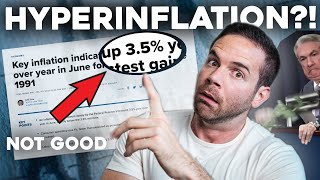
Ryan Daniel Moran argues inflation is real but hyperinflation unlikely. He says entrepreneurs should borrow cheap money now to invest in their businesses and innovate, rather than betting everything on Bitcoin or gold as hedges.
Questions this video answers
3.8%
August 1, 2021
This week, inflation numbers suggested that we're pacing record numbers. The highest inflation in well over 10 years.
The official numbers were like 3.8%. That's our pace for this year. And of course, the Fed is still saying that most of this inflation is transitory. The concept of transitory is really this. It is that the increases will happen. We're not saying they will reverse. That's not what transitory means. It means that the increase increases in prices will happen. So there will be inflation, but that the process of inflation will stop.
Meaning it's temporary. It'll be higher than normal for a little bit, and after a while, it'll settle back down. Plenty of investors, and especially my entrepreneur friends on Facebook, think that's a load of crap, that inflation is permanent. And. And because the government has printed all of this money to stave off the pandemic, that prices are going to explode. Today we're gonna talk about the real story behind all of this, because there's more happening beneath the surface than just the surface level inflation numbers. In fact, one of the entrepreneurs that I respect the most in this world, Cathie Wood, says we're in a deflationary environment. So what's true and what's not true, that's what we'll break down in this video. And most importantly, we'll go into what we as entrepreneurs should do about it to protect our wealth and grow our businesses. Have you noticed that the market responds every time Jerome Powell speaks? Well, this week he said something especially controversial. He said, you should smash the like button on ryan Daniel Moran's YouTube videos. It inflates the economy to new record highs. But seriously, smash the like button. It inflates my ego, and it inflates the number of likes we get so that we can get in front of more people. It'll also inflate your bank account because we talk about building businesses and investing the profits here on the channel. So inflation is up and the government has printed a tremendous amount of money. I happen to be a libertarian and don't like that. I don't like when the government gets involved. I don't like when the government keeps interest rates at artificial lows. I don't like when the government stimulates. I don't like when the government does bailouts. I don't like any of this stuff. I actually prefer deflationary environments where prices are coming down. I could talk all day about the benefits of that, but we don't live in a deflationary economy. And we as entrepreneurs need to accept that, and we need to plan accordingly. But it's important to note that inflation does have benefits. Or at the very least, inflation does have winners. It has losers too. And there are definitely drawbacks. Believe me, I get it. But one of the benefits of inflation is that asset prices tend to go up. Again, it only benefits people who own assets. But if you're an entrepreneur, if you're an owner, then inflation doesn't hurt you nearly as much as somebody who is living on a fixed income. Now, again, we should think about those people. It hurts them the most. It's actually why I prefer a deflationary environment. But inflation, just comparing the numbers on the surface doesn't necessarily mean that it is good or bad. It just means there are good things and there are bad things. The bad thing, of course, is that prices are going way up. And we all see this. We see this in our daily lives and in our businesses. And, and some of this is indeed transitory. Probably not all of it, but some of it. For example, when you have supply chain issues, the price is going to go up. When you have a limited supply of something and there's still demand, the price is going to go up. It's designed to do that. Why do prices go up? It's not just because of government spending. It's also because there's scarce resources and, and you need to bring in more incentives for more suppliers. That is what is transitory. As prices go up, you increase the incentives for people to be creative about how they solve those challenges. So you're going to see more suppliers come in and create more supply chain innovations that then bring prices down. Right. This is the thing that most people miss in the story, is that whenever prices go up, whenever there is inflation in one particular sector, the market tends to correct. For example, housing prices are going up. So what does that do? It encourages more people to build. And now we have a crunch on lumber, which is bringing more producers into the market. The market is a beautiful way that we course correct when the government does stupid things. So yes, prices are going up right now. And yes, that does encourage new businesses and existing ones to allocate their resources to be able to drive those costs back down. So some of this inflation is indeed temporary. Now, half of you didn't want to hear that. Half of you have already hit the dislike button. Shame on you. And half of you are already like, this guy doesn't get it. He hasn't even said buy Bitcoin yet. Relax, Rudy Giuliani, okay? We'll get to you. So what should we do about this? As investors, as entrepreneurs, as wealth builders? How do we respond to this? Well, first, let's talk about what not to do. Contrary to the opinion of my Facebook feed, I don't think it's a good idea to bet the farm on Bitcoin. Of course, Bitcoin is commonly thought of as an inflation hedge, but what has happened with Bitcoin is a very interesting thing. And full disclosure, I'm a bitcoin holder, all right? I own some. I own other cryptocurrencies as well. But bitcoin as an inflation hedge misses the full story. You see, Bitcoin actually inflates in price more aggressively because of the fear of inflation. When the narrative is that bitcoin is an inflation hedge and the price starts to go up, you see those big bull runs. More people are buying bitcoin, more people are demanding it, more people are borrowing against it in order to buy more. That creates a run on the price. Obviously, you know this. But when inflation data comes out, it doesn't necessarily move the needle on Bitcoin. The story of it being an inflation hedge is what drives people to buy it during inflationary environments, which drives the price up. It's not naturally an inflation hedge, which we make it an inflation hedge by buying it during inflationary time. And the same is true with gold or silver or anything else that is typically thought of as inflation hedge. It's fine to keep some of that in your portfolio. I have it in mine. But to allocate all your resources away from other things in order to buy inflation hedges, well, that's betting on hyperinflation, which is extremely unlikely. I heard you. I heard you. Yeah, I know you youtubers love to say that Bitcoin is an inflation hedge, and we're about to have hyperinflation. And people like Peter Schiff have been saying that since, like, 1842. We're always right. About to be in a hyperinflationary state. Look, my background's in Austrian economics. Okay, I get it. I don't like the Fed either. But hyperinflation would destroy pretty much the entire system, and even Janet Yellen and Jerome Powell know that. So if you want to keep inflation hedges in your portfolio, go for it. But making it the core of your portfolio is, in my opinion, the mistake. And the reason why those tend to go up is because, again, of the fear of inflation, rather than inflation actually driving those prices higher. Economies are driven far more by consumer psychology than we like to admit. And as soon as that Psychology changes. The numbers tend to reflect it. Yes, government stimulus plays a role in that. But our own behaviors based on what we fear is going to happen and also what we hope happens is actually what drives the most market activity. So what do we do about this? If anything, inflationary environments are really good for two things. They're good for borrowing and they're great for innovation. During times like this, when rates are stupid, low money's easy to get, and prices are inflating, that's the time for you to bet on other assets that you think are undervalued. It's the time for you to bet on your business. It's the time for you to invest in the areas of your business that are expanding. It's the time for you to go all in on the things that you control. This is where the greatest incentive is for us to have specialized knowledge. And the most specialized knowledge comes from your own business. So be all in on what you control. I would suggest avoiding the temptation to plow all of your money into everything possible, because then you are just betting on the bubble expanding. My approach specifically is to, yes, be deployed in things that I'm going to be in for a long time, regardless of if it bursts or not, but also waiting for those opportunities to show themselves, whether it's an inflationary environment or not. I like to act more like Warren Buffett, who stays in a strong cash position, waits for an opportunity, and then goes really heavy into that opportunity and rides that out for a really long time. The other thing that's important for you to think about as an entrepreneur right now is innovation. Innovation is what creates deflation. Cathie Wood likes to say that we're in a deflationary environment because there's so much technology happening, there's so much innovation happening that we're driving down the prices of all kinds of things. That's amazing and it's true if you think about it. Yes, there's plenty of things going up in price, but there's so much happening. There's. We're doing so many cool things as capitalists to drive down prices. That cost of living could go down over the next few years, even though surface level prices go up. That's insane. Like, that is a libertarian utopia right there. And it is all driven by capitalism. And you as an entrepreneur have to keep up with that. The thing for you to invest in and for you to go double down on right now is, is the innovative side of your business or innovative companies that you think have a shot at breaking out if were you to go in and say, how do I reinvent this entire industry? How do I look at the challenges that I'm facing as a business owner because of inflation and say, let's change the game, let's do it differently. It's so important for us as entrepreneurs to not get married to how we made our money up into this point, but to get married to who is giving us money. If you're obsessed with that, then you'll always succeed in an inflationary environment, a deflation environment, you'll always be in a position to flip the industry on its head. And for you to be a leader. Where we get in trouble is when something that's working starts to change because prices go up and the market changes and we try to force what we've done to work in that environment. No, when the market signals change, it's time for you to change things up. And by doing so, you actually make the industry and the economy better and you start to solve the challenge of the pricing inflation. And that's the people who end up winning and becoming billionaires and legends and Oprah, huh? So my point of all of this is that the economy changing is a really good time for you to take an honest look at where you are going to take the business next. The people who lose are the ones who see things like inflation data and they post on Facebook about inflation data and why you should be afraid. People who get afraid by data like this end up playing scared, they end up hedging, and they end up losing. But the people who say things are changing, things are moving fast, it's time for me to double down. Those are the ones who win. I have a lot of friends who very sadly have used this type of a scenario to say, see, whole world's going to hell in a handbasket. And now I am going to play scared. And well, they lost and they're losing and then they blame the data for why they lost. No, it was your mindset that is the reason that you lost. This is your most important asset, and this is what you need to invest in the most. If you take care of this, the numbers will play out how the numbers are going to play out. So, yes, you can rebalance your portfolio. Yes, go ahead and add some Bitcoin if you want. Yes, go ahead and buy real estate and land. Land is actually where inflation is going to drive things. Land is a good investment. But all of this points back to you taking responsibility for the change that you create through your business. And that's how you win when inflation's at record highs.







