
Kimbal Musk : The Future of Food, Space Travel, Elon Musk, and Capitalism
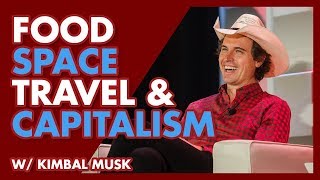
Recorded June 2019, this live interview with Kimbal Musk covers his personal conversion to a lifelong mission of promoting “real food” (motivated by a 2010 neck injury and earlier experiences), the organizations he founded or supports (The Kitchen, Big Green learning gardens, Square Roots indoor/farm-in-a-box), and how lessons from tech firms (Zip2, PayPal, Tesla, SpaceX) inform scaling food systems. Musk argues industrial food has driven obesity and that emerging tech, automation, and shifting land use (he cites ~40% of U.S. farming land used for corn ethanol) will enable a move toward local, fresher food. He also discusses entrepreneurship philosophy (bootstrap mentality, mission-first), the societal role of capitalism, and broader forecasts for disruptions in food, healthcare, and AI. The session concludes with audience questions on farming strategy, healthcare, longevity, and simulation/quantum physics ideas.
Chapters
So would you please help me welcome Kimbal Musk.
Towngold is real food for everyone in America. Real food is food that we trust to nourish our bodies. It's food that we trust to nourish the farmer, and it's food that we trust to nourish the planet. In 2010, I had a very serious accident, and it was one of these life changing experiences for me. So I went down the ski hill, I landed on my head, broke my neck, and I went into the operating room and I told myself that if I could walk again, that I would dedicate my life to real food.
Growing up, everything was cooked really from scratch. Food was always good, and, you know, food at school was actually always really tasty. We got to do gardening club at school and things.
So I just always had what was considered food cooked from scratch.
Instead of real food, we're eating industrial food. Industrial food is high calorie, low nutrient food shipped in from thousands of miles away. It causes rampant obesity, especially amongst our kids and our poor. Sometimes 20 to 40% of kindergarteners in a community are going into kindergarten obese. That is not something they did to themselves. That's something we did to them. I remember calling Hugo and saying to him, you know, while we love our upscale bistros and working with local farmers, we need to do something that's more affordable nextdoor for us. Really helps us get to the mission of real food for everyone. It complements our bistros so well. Our bistros will go in and rebuild the local supply chain, work with local farmers, build up those relationships that really make what we do more fun, more affordable. Just a great restaurant for your family and your community that goes back to the family and the accessibility across all age groups, whether it's kids or grandparents, groups of friends and things coming together.
Big Green builds learning gardens, which are outdoor classrooms that teach kids science through the growing of food. And that's a beautiful thing to invest in. Creating a beautiful outdoor classroom in every school across the country makes the teachers happy, the principals happy, the parents happy, and most importantly, the kids are thrilled to spend every day in the learning garden.
So we created Square Roots to empower a generation of real food entrepreneurs, young adults that will take real food with them for the rest of their lives and their entrepreneurship training to whatever business they go to. We literally give these young entrepreneurs the same containers you might see on the back of ships, and we park them in a campus, form multiple containers together, but each of them is a business in a box. Each is about 2 acres equivalent outdoor farming. Our goal with square roots is to build a campus of farms in every major city in America. When someone does really enjoy a meal in one of our restaurants or takes a bite from a square root screen or pulls a carrot out of a learning garden, I mean, that's what we live for. It's the reason we wake up in the morning. Join us to ensure that everyone in America has access to real food.
All right, let's give it up for Kimbal Musk.
Thank you for being here.
So, Kimball. It's Kimball Musk, everybody. He's here. You're sitting among greatness, Kimball.
I like your socks, by the way.
Thank you. I appreciate that. I haven't these avocado socks. So tell us why food. And the reason I ask this is you have been a part of some of the most celebrated companies in the world that have inspired entrepreneurs, have changed people's lives. You were. I'd like to hear about your background in PayPal as well. You saw what was possible. Why go into food? Why is that your life's mission?
Well, food for me has always been, always been my life's mission. I think it's hard to turn down working on the Internet in 1995. So for me, when I came to North America, I've been a cook since I was a kid. Kid. I took my friends at university and saw that as my calling. But when the Internet came along, it was just this incredible opportunity to go be part of a world changing technology. And so I went down to Silicon Valley, built a company there. Our first company was quite an exciting company. We built the first maps and door to door directions on the Internet and it was pretty cool. My brother and I were in a little office in October of 1995 and we were literally the first people to ever see maps in door to door directions on the Internet. And we built it and we put it out on the Internet and sort of. Then it sort of took off like a storm. But it's a pretty cool mark. On the early days when I sold that company, I went to learn how to cook, went to New York City to train on that. I was involved in PayPal, but I was more involved as an advisor and a friend and obviously a brother and an investor as part of it. But it wasn't my passion. Food was my passion. Then I went to cooking school in New York and had one of the most incredible and awful and amazing experiences. Woke up on the morning of September 11th, saw the towers, fell through my window. Actually woke up to the sound of the planes hitting the building.
Had this opportunity to cook for the firefighters after 9, 11, in fact, my mother was invited. My mother's more bigger celebrity than any of us. And she was asked to cook for the firefighters. She's like, I don't cook, but my son does. And so I got access to cook for the firefighters for six weeks. And it was a profound experience for me. I never really saw food as a business, I saw it as a passion. And it was quite hard for me to make my passion my business because I didn't really think that was possible. That's not how we grew up. And I decided to take the leap because I just couldn't really not do it. After cooking for the firefighters, they'd walk out of these giant piles of melting metal, come back in, we'd nourish them, feed them. The food we cooked that morning, real food that we knew where it came from, we understood it, Fruity was a, we trusted it, it was really good food. And they'd walk right back out into these giant piles of melting metal still melting six weeks after the towers fell. And after that, I just couldn't not do food. So from 2002 on, I did food.
Would you talk a little bit about your involvement at PayPal and some of the tech companies that you're currently a part of, what your role there is?
Sure. Basically board level roles at PayPal, I wasn't on the board because it was just I really needed to get out, but I was involved at a sort of board style level. Tesla, SpaceX, Chipotle at the board level, I find them fascinating and interesting and of course they are some of the greatest companies on the planet. So I feel very fortunate to be part of them. And I learn a lot, but mostly I learn a lot to apply it to what I'm doing in food.
What do you take away from Tesla and SpaceX that you then apply to food?
Well, there are actually quite a lot to learn. So SpaceX is interesting because it works so much with government and understanding how government works, their priorities.
What sort of pushes their buttons, how do you deal with massive, massive bureaucracies, what people don't appreciate? You know, food is a much bigger category of the government's budget than any SpaceX. Well, space exploration is a tiny, tiny, tiny part of their budget. So understanding how federal procurement works, understanding how you can work with the highest levels of government to make an impact in food, whether it's non profit work or for profit work, has been, you know, SpaceX has been a profound and Very interesting lesson. Tesla is really about a new. It's a, a new.
It'S a disruption of an existing industry, but frankly it's a new industry. We're moving from building cars to building computers with wheels. And that I think is really, really interesting. And I've learned how to take that same idea. You know, people in the past are building restaurants and we're now building computers that serve food. It's really a profoundly. The technology is now hitting the restaurant world in ways that.
It'S 20 years later, but from when we were doing maps. But it's still the same profound impact as we start to move the power of E commerce, the power of the Internet, the power of the connected world into the restaurant space, which is a $750 billion space just in the US so it's extraordinarily exciting opportunity.
Would you give us a look into the crystal ball into this industry over the next 20 years or so? What changes are coming to farming, to restaurants, and to the technology that is going to feed 10 billion people? What do you see coming?
Yeah, I think it's very exciting. So the biggest use of our land right now, I don't know if you guys know, is mostly ethanol, corn for ethanol. So we're actually not even growing food. So people are saying that we're running out of food and yet 40% of our land grows corn for ethanol.
That is 40% of farming land.
Farming land, yeah, yeah, sorry, farming land. Yeah. So we have this extraordinary capacity to grow more food if we needed to in a case of a food security issue. But I look at it more as an entrepreneur and I say, okay, if we're seeing electric cars become the standard ethanol, which is it can add value in a car. But corn ethanol takes about a gallon of oil to make a gallon of ethanol. So it's really neutral to the environment best. And it's a money losing business. And so if you see the forces coming together, you're going to have about at least 40% of land come available over the next five to 10 years for other purposes. And of course will crater the prices of corn itself because it's a massive subsidy to keep corn prices up. Corn for ethanol. So as an entrepreneur, I constantly watch farmland and I go, okay, at some point the prices will crater. The opportunity will come into growing real food on America's farmland. That's very, very exciting opportunity. And I watch that very carefully from the sidelines. Then on the restaurant side, what we're seeing is.
The way we eat in restaurants is very much people Want the gathering place, they want to sit down, they want to connect with each other, they want to break bread with friends. They need it to be faster, they want it to be real food. And sometimes they want it at home. And so that changes the fundamental business model of restaurants where if you in the past, real food was not in demand. You literally, and this is most restaurants, unfortunately, today, the chef in the back just takes a pair of scissors, cuts a bag, puts it on a plate, puts it in a microwave oven, and it goes out to your table. That is literally what happens in 99% of restaurants. It's no longer acceptable. And then you start taking the automation that's available out there. We're now able to do real food cooking at scale across the country, distributed, because from home office, we can control the recipe, we can see the food that's coming in. We can drive a particular recipe that is very complicated to cook. The reason why you have to do that sort of the bag and cut it open, the scissors, is because you cook it all centrally, because it is complicated to cook. And then you'd send it out and it would just be heated up at your table or at the restaurant. With automation, everything can be done on premises. So food is cooked from scratch that morning. It's delicious, it's fresh from local farmers. You no longer need the centralized commissaries. It's food safe because everything gets cooked at the right temperature and it's consistently delicious, considerably better than what industrial food has done in the past, which is more about that sort of processed, cloying flavor. But that's required if you cook everything centrally. And then you have the other thing which has gone on, which is this desire to eat at home, where now with the delivery company technologies, whether it's uber eats or DoorDash, you're able to deliver your full restaurant experience to serve to the entire family. So mom gets a salad, dad gets a burger, Joey gets a sandwich, and Mary gets a tomato soup within 15 minutes to your dining room table. It's quite extraordinary, the changes that are going on in the restaurant space, driven by the advent of the Internet.
And let's go to when you decided to build businesses out of this, because you come from that being your passion and you have entrepreneurship in your blood. But at what point did you actually set the ground floor of this is now going to be the purpose of the businesses that I build? And what did the seeds of that look like? Did you then go out and how did you go out and say, I have this problem that I Want to tackle through entrepreneurship and then actually start creating, digging that path, if you will.
Yeah, that's actually, it's a quite a personal reason. So as you can imagine, I was part of quite a few exciting businesses. But I opened a restaurant in 2004 that was successful and was called the kit is still around, called the Kitchen. And the Kitchen helped restart the farm to table movement. We worked with local farmers, delivered very simple, delicious food to, to our community. But I was still involved. I was on the board of Tesla, bought Border SpaceX, involved in many other companies. I was an angel investor and, and helping out a lot of other companies. So I had a number of things going on. But I love food, really, really love food. And I just didn't see how we could scale it just I had to block in my head. We also supported school gardens. We took the place profits from the restaurant and worked with schools and taught kids, connecting them to real food. But again, no scale. And I had this block in my head and I knew I loved it, I knew I wanted to do it, but something just prevented me from doing it. Maybe it was just fear of tying passion to my business, maybe it was just some deep reason I just couldn't get there. But I loved it, I loved the idea of it and I just, I wouldn't allow myself to do do it. I went down a ski Hill in 2010 on an inner tube and the tube flipped and landed on my head going 35 miles an hour. Broke my neck paralyzed on my left for about three days. Doctors weren't sure whether I'd be fine or not. And you'd really just get this extraordinary view into your life, this look back on what you have done, what you could have done, what you would do if you could, if you could do it, if you had were able to restart. And I told myself when I went into surgery, it was a Tuesday night, that if I could walk the next morning or if I could walk again, that I would focus on food and I would figure out how to scale real food. And I woke up the next morning, the doctors told me that I would be able to walk and I never looked back. I just focused entirely on food. My joke is that if not for the physical trauma, I highly recommend the psychological awakening.
It's really been great ever since then. I have loved what I do and what I do is building, also building a great business. So the combination of the two is scary because it matters so much to me, but it's amazing because it drives me every day.
You mentioned in the Video There was a line about how the, the food crisis, if you will, most directly impacts the poor. And that farm to table has mostly been perceived as a higher end service. So why do you say that food problems are harder on the poor? And how does, how do the coming changes alleviate that and create more opportunities? And the reason I ask is because as the owner of the word capitalism on the Internet, I hear a lot about capitalism and entrepreneurship being.
Exploitative to the poor. So what is the solution that you're building, doing and how does entrepreneurship actually alleviate the problems on?
Well, I mean I think first and foremost I'll say that I am a capitalist through and through. I believe capitalism solves the world's problems. I believe that the great companies of the 21st centuries will be impact companies that connect with what is actually needed. Capitalism is this very, very powerful philosophy that adjusts to the needs of the day.
50 years ago, 40 years ago, 30 years ago, impact wasn't a need of the day.
If you try and do a company today, you have to assume total transparency. You have to assume people know exactly what you're giving them, what you're creating, where you're getting it from. Because the Internet is so powerful and that transparency is just an absolute requirement of every business. And as a result, if you're doing something good, that transparency will come through and you will be more successful in your business, as I've seen in all the businesses I'm part of. And so for me, I am a capitalist all the way through. Solving the problem for real food to the less advantage or the lower income communities is an absolutely critical business opportunity. It is a trillion dollar business opportunity. It's not like, oh, this is kind of nice. This is a trillion dollar business opportunity to go so solve getting healthy food, real food to the world. And of course the larger business is going to the lower income community. In the past 50 years ago, that was solved through high calorie, low nutrient food that wasn't good for us. That.
Through subsidies and through GMOs. And so which is GMOs are, you know, no matter what you think about them.
They enabled a very, very low price for high calorie, low nutrient food. And that was funneled into the lower income communities in America. And it has been a tragedy. Massive rampant obesity. Almost 70%, I think now over 70% of Americans are overweight or obese. 70%, I mean that's extraordinary. We now spend double the cost on healthcare that we spent just 20 years ago.
Double.
I mean you're talking trillions of dollars. And this is not creating a better society. This is creating a sad and difficult and depressed society. So capitalism has its issues, but because it shifts to the needs of the day, capitalism is what will solve it and will bring us out of this as well.
I want to ask you about your brother and.
You advise Elon, and you sit on the board of some of the most recognized companies in the world. And so I just have this vision that you get a phone call and it's, hey, Kimball, I got an idea. I'm going to dig a tunnel to lax. Can you help me? Or I'm going to make an electric semi. I've got an idea. Kimball, you want to do this? Because that's been my experience, when a friend calls and says, I have an idea. Right. So you advise these companies and you advise your brother. In what capacity do you advise these companies? And when you hear the next idea, how do you deconstruct how you're going to build that?
Well, I think the fun thing about my brother, obviously, we grew up together, so I don't know, I don't have the same view as other people from other advisors or he's my brother. But the last time I stopped, the last time I worried about my brother being crazy was in 2002. So when the last time you worried about. Last time I worried. So, 2002, because we were going to do the Internet. We did the Internet together then. We did. Then he wanted to do PayPal and PayPal's fine, but then he wanted to go to SpaceX and.
Take. The original vision was to take a pot plant to Mars and not even to build a business just to prove that it is technically possible.
And I was like, okay, I think he's crazy. I think he's lost his mind. And that's when you sort of really have run out of things to spend your money on. You're going to go do that.
And so I thought he was crazy at the time, but then he turned it into SpaceX, which is going to be, and it is today, but going to be one of the greatest companies in the history of mankind.
And so since then, I've just stopped considering it crazy, you know? So then when he brought up the boring company recently and he wanted to, and he's like, hey, look at this. I just bought this machine from dc. They're not using it. We're going to build a tunnel under la. I was like, great, let's go find out how to do this. And so I'm, you know, just two days ago, walked the tunnel under. It's a mile mile long right now. And it's work, it's actually there. It's just incredible.
You mentioned SpaceX and I know, I think you're a significant investor in SpaceX as well. And there's a lot of those of us who follow the different companies that you've been associated with.
SpaceX is interesting, but we don't know a lot of the long term business model behind that. And as I've gotten a little bit more familiar, I see that there's a vision here that I had, I had never seen talked about publicly before. So would you talk a little bit about why SpaceX is going to be one of the most impactful companies of our generation?
Yeah, I mean it's Christopher Columbus of our day. So back in the 1400s when he wanted to go travel out to what at the time he thought would be East India became America, that is that, that. Okay, maybe it was crazier back then, but it's in the same category of crazy, you know, of impossible for people to wrap their head around. SpaceX is going to go to Mars and it's going to colonize that planet.
So follow up question, why is that going to be so impactful?
Well, I think if you believe in the idea that humanity is a good thing, if you believe in the idea that we should propagate our species and as you know, some people might argue not. I personally believe we should. I believe we do good things as we grow and we obviously need to have thought and manage our approach to growing, but for the most part it's a good thing. So that makes Mars the natural next step for our species.
So obvious question, how does that become a business?
It was never started as a business. We wanted to take a pot plant to Mars.
No, it's not, it's not. It was never meant as a business. It will be a great business because humanity does want to expand and that in essence will be the business. But it was really built initially to prove a point, not to. The point was that government was wasting its money on.
Visiting Mars in ways that was just not useful. And sending something that was living to Mars would be a huge wake up to the American government, Chinese government, Russian government, primarily the American government that we felt was needed to wake up, call. And so there's never meant as a business and it will be a great business.
So there's an interesting theme emerging, which is that there's a big problem and you've built something to tackle that problem. You've dug your way through to that problem, and there's a lot of progress happening in food, in space exploration. And these started as kind of impossible, unthinkable goals that are now being carved.
There's the other side of entrepreneurship, which is I started this thing to make money.
So my question is.
Do you just think about it differently and then build a business differently than the bootstrap entrepreneur who wants a different life, or can they coexist?
Well, I bootstrap everything. You did. No, I breached. I bootstrapped everything.
Would you go into that deeper? Because I didn't know that well, when.
I say I bootstrap everything. So let me explain by that I raise money, which may not mean bootstrapping to you, but to me is like, what is the absolute least amount of money I can raise to get what I need to get to the next step? The way I describe building businesses is you raise money and you're on this boat and you take up supplies on the island, and you've got to get to that island over there. And if you don't get there, you're dead. But if you get there, then you get to refill and keep going. And that was what I view as bootstrapping over capitalizing businesses just never been our thing.
We use our own capital as well to build our businesses. Really thinking about it from the perspective of control so that we can keep the vision in line once you lose the vision. Because we've had this in the past, and this happened in the early Internet days when we built our first company where we didn't bootstrap it. But I think it was the right thing to do to not bootstrap. We took money, took capital from venture capitalists, and, you know, they drove the business. We were young, so they really did drive the business, and they drove it into a really uninteresting place to the point where, okay, we made a lot of money, but we just kind of didn't want to wake up in the morning and do this. And so since then, I've already focused on, especially since by accident, but even before that, really understanding the importance of tying what I'm passionate about to what I'm. What I'm building on the business side, because if I do that, then. And by the way, that means bootstrapping. It means constantly putting pressure on the business. You know, absolutely. What can we get? What's the least amount we can raise? Or how can we drive revenue so that we can continually maintain control of the vision of the company so that we can really Build something great over time. So that's what I mean by bootstrapping. Obviously we have other capital sources that come in. We have wonderful investors that work with us in building our businesses. But it's the sort of bootstrap mentality that is, that has never left, left us. You know, for me, if I, if I build a business, I don't, I'm not interested in selling it to almost. It's probably a problem for investors, but it's, it's just the reality. I just, I'm just not that interested. If I wanted to make money.
When I was 26 years old, I made more money than I knew what to do with. So I could have been on a beach the past 20 years, but I don't want to be on a beach.
And when you say you made more At 26, was that from the exit of PayPal?
No, that was the company before that.
Which one was that?
It was called Zip2. That was the maps and door to door directions company. It was a back end maps company.
Now, as you have investors that you work with, but you're also an investor yourself, so would you talk about the types of companies that you're investing in?
Yeah, I'm not, I'm not a good investor.
Ryan Hauser, the crypto guy, Honestly, I.
Think the investments I've made in my life, including PayPal, Tesla, SpaceX, all seemed very crazy at the time. You know, just for years we talk about building an electric car company and people would just have a little giggle and you'd be like, ugh, kind of sucks. Like everyone thought that electric cars were the dumbest idea on the planet. And this is just for years. This wasn't the first couple of years. This was probably till 2012. So now, of course it's well respected and people get it, but for eight years or so, maybe even nine years, it was just considered a really stupid idea. And so while as an investor that may not sound like a good investment from the outside, we kind of knew it had to happen. And the only sources of capital were the people around the table who cared about what we were going to go do. And so that's where we got the money from. You know, whether it was my money or my brother's money or, you know, that we built in previous businesses. That's how we built businesses. You know, when I build the restaurants, restaurants are considered by most people to be a pretty tough space and tough investment. I look at it and go, it's a trillion dollar industry. Let's go figure this out.
Is it a good investment or a bad investment? My track record is pretty good. But every single time we do an investment over a new company, it sounds like a crazy idea. We just did one in New York Square Roots, which is an indoor farming company. Super crazy idea. And I think it's going to do great.
Do you fear failure when you're going after something that seems crazy?
I think entrepreneurs fundamentally fear failure. I think that's just what drives us. I think, yeah, fear failure all the time.
Do you talk about that more?
Yeah, I mean, I don't know how to talk about it. It's very, very.
Well, I mean you have, you, your, your muscles are pretty well built in terms of impossible things that you've been a part of. So why do you think you still feel it and how do you deal with it?
I mean, I think it's just primal, you know, you just, there's no, there's no.
I think that maybe comes from two sides. If they didn't fear failure.
If I didn't fear failure, I probably wouldn't do it. If it was, I'm going to build a widget that I can sell for 10% more than I can buy it for. I think I'd rather be on a beach.
Do you think you would still feel that way had you not made more money than you knew what to do.
With that 26.
I think, yeah. I mean I built a business even before Zip2 at just in university and I remember that experience. Extraordinary fear of failure even back then.
And as I've built one business after the other, I kind of, I wish I didn't fear it. But again, I think that's what drives me and keeps me awake and aware of the opportunity as well as the challenges. I'd like to learn how to not have it. Does anyone figure that out?
I have a dangerous question that I'm nervous to ask you. So here we go. I have a theory that.
Anyone who is highly driven is usually driving as a result of some sort of a wound or a fear that they built muscles to deal with and that gives them the ability to drive forward. And you come from, I mean, we might call you the modern day Rockefeller family. You, you are known for creating impossible things. So I'm curious, when you're at that level, is my thesis correct? Do you think that there.
I would say that the one thing that is correct about that is the total fear of being sent back to South Africa.
Really?
Yeah. So we're immigrants here and this country's great and South Africa is not Great.
It's great, or it's great again?
It's already. It's always been great.
I know, exactly. Jesus Christ.
This is the greatest country in the world, and it is so awesome. Exactly. It is so awesome to be able to call this my adopted country. And. And I'm such a proud American. The fear of being sent back is extraordinary. And it's still. It's an irrational fear. We're a citizen.
We'Re safely here. But that, I think, has been a huge driver for us.
How old were you when you moved here?
I was 18.
You were 18, and so. And when did you become an entrepreneur?
I mean, I was arguably even before that, but I started when I first got here.
So was there a sense of I gotta go all in and make something work so that I don't have to go back? Was there a sense of kind of burning the boats and you had to go all in and that continues to drive you?
Yeah, we didn't really burn the boats. We had no boats to burn. We came over here with nothing.
I thought you were gonna say we came on an airplane.
No, but I mean, we just came over with nothing. So going back would have been.
Just an unacceptable answer.
So what's the fear then? What is the. You said you have an irrational fear of being sent back there or having to go back there.
It's a very conflicted place from just seeing multiple deaths. I mean, it's like a bad place to grow up. I mean, we grew up in the heart of apartheid. It was collapsing at the time. We were part of the rallies to help it collapse.
But in that process, this is not a pleasant time.
This is.
People are blowing each other up and killing each other. And you see that physically, you don't hear about it. You actually see it.
So what I'm curious about is where and how does that drive you?
Now?
You said that it's an irrational fear that you feel drives you in some way.
Well, I think to you, what you said is like, is there something that sort of planted a core seed in it? Yeah, that would be it. Like this constant.
Irrational. But their fear of.
Something just kind of breaking. And then I was also there for 9, 11. I mean, that was also another sort of reinforced the fact that even though you're in America, things can. The rug can be pulled out from you in a second. It's quite intense. My daughter's school just burned down two days ago, and she's 15, and for her that's going to be a traumatic experience. All her possessions burnt and Chooses a boarding school, those kind of things just. Just mark you.
So I wasn't going to bring that up, but since you did, I fully expected to get a call from Kimball saying we're not, we're not going to make it because of that happening. And he made a point to be here. So would you say thank you to Kimball for making it priority to be here?
What have you, you've worked with your brother, but you've also built separate businesses. What have you learned from each other that you either glean from one another or are there lessons that you say, I don't think I'm gonna do that, I'm gonna avoid that?
I mean, the great thing about my brother and I, we've just worked very closely together forever, I mean, since we were born, you know. So I would say there's a lot of back and forth forth on what we do. The difference though, I think we're also fiercely independent. So he helps me with what I do, I help him with what he does. But we don't really do it. Like, I don't feel like I'm doing it. I'm not doing Tesla with Elon. I'm doing Tesla for Elon, you know, or if he's helping me on the food businesses, he's helping me, he's not doing it with me. You know, I mean, that's important difference. And that part has been we learn from each other, we advise each other, but we also respect each other's independence and to do what's important to us.
You've said that whenever you start a business, it sounds crazy. And I have a perception of you, that because you have built and grown up in an environment where there is no such thing as crazy, there is no impossible.
Is there anything that you say still that you feel challenged or afraid by, where you say, that would still be impossible for me, or when you feel that, do you go into it? So I think that kind of our perception of what's impossible changes as we grow. I kind of see you as, what other limits could there be? If we colonize Mars, we change the food industry and we have self driving vehicles all over the world. What else could possibly be impossible? So is there anything that you think is a limit?
Yeah.
I don't think of things as impossible. I think of things as improbable and crazy. So improbable would be, let's go change the food system. It's improbable and you'd have to be crazy to take that on. Just not impossible.
You know, we Built the system we have, and we could change it. That just would take an enormous amount of time and energy and effort to do that.
And it's hard along the way. And when I get stuck into a problem that I think is impossible, I usually discover, you know, a month later, after obsessing on the problem, that the way I was thinking about it was wrong, rather than it being impossible. But it does take a lot of obsession. And it's. It's. I think coming back to the fear of failure is like, you just. You have to solve it. And so you just constantly obsess and obsess, obsess. And then.
It'S either either I solve it or a month later, it solves itself in a way that I didn't see it. But it's. But sort of that obsession is.
When.
You hit a brick wall, you can't. Can't accept the brick walls. You just obsess, obsess, obsess, and then eventually figure out a way around it, or the wall just disappears.
It'd be cool if we take a few questions from the audience. All right, so if you have questions for Kimball and you want to line up, there's mics at each break here, feel free to hop out and get in line. But, Kimball, as far as I know, there are no hot tubs around, so I have to ask, are we living in a simulation?
Right. I was like, where's the hot tub reference?
There are reasons to believe that we could be. I prefer not to think that way.
You prefer not to think that way. You prefer not to think about it. You prefer not to think.
Not to think that we are in a simulation, but to think that we are. We are really. This is real.
Okay. Could you comment further?
Well, it's just too. I don't know if you guys know the laws of physics, but they're just too convenient.
And the.
If you study quantum physics, it's just so.
Profoundly obvious that it's a simulation.
But it's finally obvious that it's a simulation.
It seems to be the only answer.
But.
That isn't something I choose to subscribe to.
I did not see that coming.
But look up quantum physics, and you guys will. I don't want to take the time away from the questions, but you guys.
Are going to be standing for a while.
What is it. What is it that makes it seem like it's obvious that it would be a simulation? Because I observed it as the opposite.
So quantum physics is this idea that. Well, not this idea that with this proof, we've discovered that if you look at something, its state materializes only when you look at it.
So it's not actually there before you look at it.
Which implies that it is reacting to the observer, which is a simulation.
So it doesn't exist unless you look at it is a simulation.
So if you just extrapolate that back, you've got the whole world is a simulation.
So we're about to go into the woo here. Fine with me. I love the woo. But, but I have just interpreted that as there being reflection of their being consciousness. Not necessarily there being a reflection of an outside.
That would be a great answer. But a consciousness that builds the simulation. I mean a simulation can be used in different terms.
I see, okay.
But it's created when you look at it. That's a simulation.
Okay, so we could hang out here for a while.
Don't quote me on any of this stuff, please.
But I choose not to believe any of that stuff because it's a waste of my time.
Speaking of simulations, I would like to know from your perspective, seeing all the change and the speed of change in the world, what do you think are going to be some of the most impactful, disruptive, or the biggest changes that we'll see in the next 10 to 25 years?
You mean in the industry of the.
World or in the simulation? Exactly. How many simulations in, in what industries do you think will change the most? What do you think will change in terms of how entrepreneurs approach what they do? Where do you think that the, the, the biggest sectors will grow? What changes are we?
Yeah, so I, so I would actually look at it if we're in the information age. Right. So we're. The information age is upon us. The industrial age before the previous ages. You simply just look at which industries are being tackled and which ones were tackled first. And so the early days, it was literally information, getting content, news, the ability to connect with each other.
That was first. Finance was tackled next. PayPal is a good example of that.
Tesla is an example of the car industry. Multi trillion dollar industry. Healthcare will be, is, but will be next. Food will be next. So think about, I like to think about it in terms of the information age, tackling one industry after the other. Not a single industry will be left untouched by the information age. And so it's just a matter of how will it be touched, when it will be touched and what impact will it have. And the impact will be profound in every industry.
How do you think entrepreneurs need to approach this environment where change is happening all of the time and we all know that things are going to change faster and faster. How do you think entrepreneurs need to adjust or approach what they do?
So I like to think about it. You look three months out because you need to really tackle the business at hand, the problems at hand. And they are not these sort of giant vision stuff, you know, like, they're literally often just, I gotta make that sales call. I gotta close that deal. Those are. Those are critical. The next three months, problems to solve. And then you have to think, 50 years out, am I doing the right thing? So if you're tackling a problem that you look at, 50 years out probably won't be a relevant problem or solution, then maybe you should adjust what you're doing. But you never want to forget that. What happens today, in the next few days or the next couple months, if you don't get that right, you don't get to do the rest.
Yeah. All right, let's go over here. To start.
My question is. So the world of work has changed, and I'm trying to figure out what, like, the new recipe is for work. So when you start a job, you don't keep it for 30 years. You typically have a career path that kind of zigzags, and you might have a job, you may have a side hustle. And I work with kids in foster care, so it's a social enterprise. For every one that we sell, we gift one to a child in foster care and have them pay it forward so they don't get it for free. They have to pay in some way. They have to invest. My struggle is to move from concept to where I'm actually doing this. I sort of see parallels with what you've done and you've taken on the food industry. And I was fascinated because.
Putting farms in schools, things like that, I never thought would be a business model. I thought it would be charitable as well as what you're talking about on the restaurant side, which is a very hard industry. So I'm facing similar issues in that I get called crazy a lot. I get the look of your nuts. And I want to understand if there's a way or a strategy used to kind of get past that.
To get past being called crazy.
Yeah.
So I don't actually just talk about simulations.
As you can tell, I'm not. I haven't succeeded in not being called crazy.
I think my struggle is more like it affects me. And I'm trying to figure out it's a mental mindset issue where I want to be called crazy and get fuel from it instead of getting setback.
That's interesting.
I think that is a very good question, and it's very hard to answer, because the reality is we wear a heart on our sleeve when we build our businesses. And when people might call you crazy or they might knock it, they don't appreciate how much that actually impacts you as an entrepreneur.
I would say a good way to do it is to surround yourself with other entrepreneurs that are doing also as interesting stuff that you can kind of relate to. You cannot feel alone in the process. But.
It never really goes away because.
As you build in the beginning, people call you crazy and they write you off, and then they call you crazy and they're like, oh, they got to start paying attention. But then when you get to a point where.
You'Re actually successful and you're showing that there's a business here, that's actually when the real noise comes and the real pressure and the real knocking happens. If you look at our businesses and what we're doing, the criticism doesn't go away. It gets higher.
And I don't think that's ever going to go away. I think that's just the reality. When you're trying to disrupt something, you're going to, you know.
You'Re going to collect naysayers along the way. But the reason you're doing it is not because of those guys, you know, the reason you're doing it because what matters matters to you. It matters to the world.
So I. I have a dream that when I was a kid, was crazy to me and everybody in my family, which was I wanted to buy the Cleveland Indians. And when I was. I have a wonderful family, wonderful parents who encouraged all my pursuits. But I said to one of my family members once, do you think it's possible that I could own the Cleveland Indians? And I was probably 21 at the time. And she said, I can't. That's not real to me. And I said, well, I need you to believe it more than I do. I need you to give me the validation. And she said, I support you in whatever you want to do, but that's not a real thing to me. And I had heard once that you need to hear 17 affirmations in order to overcome one. No. So I made a list of 17 people who I knew would remind me that they could. They believed that I could own the Cleveland Indians. And I texted all of them, and that's when I started publicly saying, I'm going to own the Cleveland Indians. And that's when it started to become Kind of my thing where I would very publicly say it because I needed to hear other people say, I think you're going to own the Cleveland Indians. And the closer I get to that, the more I believe it. Now I'm starting to see what I thought was impossible as a kid. It's like I can kind of see the path to get there at this point.
Thank you.
Yeah, go over here.
Thank you. So I got into farming about two years ago by building a farm to food truck model where I could basically harvest, prepare and serve customers all in the same day. And I was running this by myself and realizing I could only do this in my local community, I came to this event last year frustrated, basically looking for answers. And it was Tom Bailu of Quest Nutrition who asked me a question that I. I had never considered. He asked me, if you had all the money in the world, what would you do differently? And I realized through that question that I didn't need any of the money. I realized I would just tell other people about it. So from that point, my business evolved from running the food truck day to day to telling other people about it. So now I have a business where I'm sharing business models for farmers that are looking to make changes in this type of economy. Because. Because there's a lot of market farmers out there that only know one way and they're all really nervous. So my question to you would be, what would you tell a farmer that doesn't live inside of a big city, that doesn't. It doesn't make economic sense for a square roots or they're worried about companies like Plenty. What would you tell them to be thinking about in the next one to five years and what they should be doing to remain as a family farm?
Yeah, sorry, the lights are really strong, so I can't see you too well there, but if you don't mind, I'm going to look over here.
The challenge of what to do with farmland today is very, very interesting. It's an amazing opportunity and for the right people, it'll be exciting.
Real food is the business that people want to be in. It's the opportunity where you can sell product that it's not a commodity that supports your family, has a great lifestyle. If you live close to a city, though, the problem is very different than if you live in the middle of Iowa. And so if you live within driving distance of Chicago, so just on the eastern side of Iowa, you've got a really great potential business to converting corn and soybean commodity cropland, which are Money losing, maybe you might earn twenty grand every hundred acres. I mean, it's really, really, really, really low earnings. And converting it to real food. We have farmers in Colorado that Service Denver on 20 acres and they make more money than someone with a thousand acres in Iowa. And they live on their farm with great lifestyle and they serve to their local community. They're part of the community, they're connected to their community and it's a wonderful, wonderful business for them. And so I think if you're a farm owner that is within driving distance to a major metro area, you should be converting to real food as quickly as possible. Getting off the government subsidized systems.
Amen. Hear, hear.
Yeah, exactly. And it's a subsidy that is like a, it's like a, it's a slow drip. It's not. You don't. Living high on the hog. So I don't, I don't think the farmers who are receiving these subsidies are in a good place. They're actually, it's more like a pension or welfare system. So we really need to help them get off that system. But if you are located in a community that is, or an area that isn't near a major city, then I think we have to really figure out how do we create infrastructure that enables them to build businesses that do get their food to major cities that are in a relevant time. If you've got fresh real food, it has to be. You have to have a cold chain which is ability to keep it cold all the way to the major cities. Get it on the trains in a way that gets to the city within a few hours or at the most a day. Otherwise it becomes not interesting. If you're competing, if you're still taking two weeks to get the food to your customer, then you're going to compete with Mexico and Australia and that's not a good business. So I think that the problem of tackling.
Farms near metro areas, no problem. Do real food as quickly as you can. The problem of, let's say take 10,000 acres in Iowa and convert it to a real business growing real food, that is an interesting problem and I haven't figured out the answer to that.
Thank you.
Sorry. Gain. We've only got time for one more, so we're going to go right down the middle.
Hello. Hello.
Great seminar so far. Enjoying it a lot. I have a company in New York where I am looking to transform the way health care is done. And sometimes I feel like I'm trying to put a plant on Mars, you know.
And the whole New York structure is very difficult to do health care in, but the entire thing is focused on the management of chronic disease. And there are some innovative doctors and companies of technology that are looking to optimize the human experience. And it's a very different approach, very different paradigm. So as someone who has done the impossible numerous times, I was just wondering, and you mentioned health care and you mentioned your passion for food. Where do you see health care, the opportunities in healthcare, and how would you approach transforming it on the larger scale?
That's interesting.
It's a great question. I do think it'll be one of the great industries that'll get disrupted over the next few years.
I'm not an expert in healthcare, so I'll just give you my.
60,000 foot view. We have an aging population. So what I would do in healthcare is I'd go to Japan and I would look at how their healthcare system works where you have an aging population, not that many kids.
People are not retiring, but they're not super productive either when they're that old. And so how does that change the economy and how does that change how they get looked after? What does the government do? I would say that the US is on a path unless we change it, which I think would be good for us to change it on a path to being a much older community in the next 20 years than we have been ever. And that will change healthcare. And then I would also look at how the Internet is changing healthcare and trying to understand how the connected world changes the way we think about privacy, how we think about sharing, the nature of disease. There's some amazing innovations going on in medicine that I can't speak speak to. That will also be really powerful. But the macro forces to me are the connected world, the information age and the aging population that fundamentally will change how we even think about health care. So that my best, very high level advice.
Thank you so much.
Do you see innovations and breakthroughs coming in terms of longevity and human lifespan?
Yes. I don't love the outcome of, you know, sort of being a lonely AI that lives in a machine. And I think that is one of the paths we're on.
Meaning like uploading our brains to the cloud and just being.
Yeah. And I think that that is a path we're on. I prefer this idea of creating a joyful life.
Yeah.
And I would much rather pass away at a younger age having had a wonderful life than obsess over. And I believe people are obsessing over this, obsess over extending life when life isn't necessarily that interesting.
It's in a machine, right?
Exactly.
Do you share the concerns of AI and what it could mean for humans?
Yeah.
No.
AI will be is a very dangerous technology and.
My biggest fear with it is the folks that are working on AI believe that it's not dangerous. That's, that's my biggest fear. It's not actually that we couldn't work around it and create wonderful technologies out of it. It's an innovations and how it could change the world. It could, could bring on a new age. You know, the AI age in a very, very interesting way. It's just that the, the people working on it are, are bright eyed bushy tailed over this and it's, it's as dangerous, if not much more dangerous than nuclear because it is not. You can't control it as well as you can control nuclear.
What do you think we need to do or will do about that?
You know, there are some efforts underway to educate government on the fact that this is, this needs to be a regulated industry.
Challenge. We always have with government and it's not their fault, it's just they're always 20 years behind, 30 years behind. In the world of AI that may be too late. So we need to educate them sooner and I think that's critical.
Well, Kimball, I love what you're up to in the world. I'm very excited by the changes that you're spearheading. So thanks for representing what capitalism is all about. Give it up for Kimball Musk, everybody.
It.







