
Make $100K/Month In 12 Months With These 8 Steps
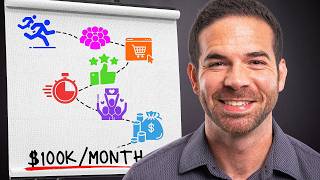
Ryan Daniel Moran breaks down eight steps to hit 100 sales per day in a year. Start by picking a target customer, build an email list of 100 ideal people, run a $10K launch, then scale through a flywheel, recruit ambassadors, and launch more products. Reaching $1M shifts how you manage, not how you live.
Questions this video answers
About 100 ideal people.
About $10,000 (over 30–90 days).
About 100 reviews or pieces of feedback.
~25 sales per day (per product).
Four products at 25 sales/day (≈100 sales/day).
Chapters
100 sales a day is a million dollar business. And you can get to 100 sales a day in just about any business over a period of 12 months if you follow the eight steps to 100 sales a day. We've been outlining what those eight steps are throughout this series and this is video eight of that eight part series. So today we're going to go through each of the steps and what needs to be true in each one of those steps so that over the next 12 months you, you can launch, build and accomplish a million dollar business with full clarity on what you're building and what your next steps are. We'll also go through what changes once you hit 100 sales a day or a million dollar business. How do you handle being a millionaire or having a million dollar business? And we'll also talk about the reasons why you won't follow any of these steps. What will keep you stuck on the road to 1 million? This is part eight of the eight steps to 100 sales a day. So, so let's dive in. Let's start by going through the eight steps. If you follow these eight steps over a 12 month period, you've got a fighting chance of graduating the year with a million dollar business. The first step is to pick a person. It's not to pick a product, it's not even to pick a market. It's to pick a person. A person that you would like to serve. The reason why this is the first step is because all of the other steps will be more much easier. If you're thinking about a person, it's kind of hard to sell products. When you come up with an idea and you try to sell that idea, you've got a lot riding on that idea. If it fails or it doesn't achieve the sales that you want, you're likely to give up. But if you pick a person that you want to serve, that person is going to be around for a very long time. And you can come up with different ways to market to them, different products that they, they will like and you can move on in the event of a failure or a setback. It's also much easier to market to people, meaning it's really kind of easy to get a group of people to pay attention to you so that you can sell things to them. So we always start with the person we know that we have clearly defined our person. When we can fill in the following blanks. I help. Blank accomplishments Blank. For example, I help entrepreneurs build million dollar businesses. That's who I serve. That's who I help. And guess what, I've been doing it for like 15 years. And in 15 years things will change. There will be different strategies. I might have a whole different set of products. I might have different types of videos that I make. Who knows, maybe I won't even exist. I'll just be an AI projection that pulls from the cloud and makes videos automatically. But if my person, the entrepreneur, is still on the road to accomplishing a million dollar business, then I am still serving the same market. That's how we build brand, by choosing a person that we will serve for a very long time. So step one is always choosing the person that you will serve. Step two is to put 100 of our ideal people onto a launch list or an email list. The first step to ensuring that we're going to get sales right out of the gate is to have a group of our ideal people that is paying attention to what it is that we have to offer them. Now this is true whether you are selling physical stuff or you're selling consultant services or you're building a local business. If you've got a small group of people that care and that pay attention, you can sell whatever you want to them. My preferred way to do this is to build small business email lists because people have to raise their hand and say, I want this thing, tell me when it's ready. It's also a very easy way to open up a long term relationship with someone when they give you their email address and then you reach out to them and you make a personal connection. That second step is just building enough of a small audience so that we got sales as soon as we're in business. The other thing that this does is it allows us to take sales even before our product is ready. Whether you're selling physical products or digital products or something else, you can take money upfront when you have people who want what you're going to provide. And that can only be done if you've got a small audience of people that are paying attention to you. So the second step is to build a very small audience of at least 100 people on an email list that are your ideal person that you want to serve for the long term. The third step is to launch and in my experience, if you do a little bit of audience building in step two, then it's possible to have a $10,000 launch with a group of a hundred people, maybe a little bit more. And you can do that over a period of 30 to 90 days. How do we do that? We do a Structured launch process of telling everyone that our product is going to be ready, opening the doors and then closing, closing the launch. When we structure it in that way, we get a surge of sales right out of the gate. And now we've got the momentum and the sales, maybe even some money in the bank to be able to fund the rest of the business. So step three is to open up the doors and get about $10,000 in sales. And that gives us the momentum and the cash flow to be able to fund the rest of this eight part process. Step four is to get a hundred reviews or 100 pieces of feedback. This does two things. One, it increases your conversion rate and the performance of your marketing. No one can convince a potential customer to buy from you, as well as a previous customer who's happy with their experience. You can tell the whole world how great your thing is or how great your business is, or how great you are. But if other people say it, that usually outperforms. So this step is about getting 100 pieces of feedback that other people can see. This does two things. Number one, it increases our conversion rate on our sales pages or in our advertisements. And the second thing it does is it gives us content that we can use to build the rest of the audience that will come into play in step five. But in this step, we're gathering 100 pieces of feedback that we can use as content marketing to get more people into our sphere of influence. That is going to give us the fresh new leads and the momentum to continue the momentum that happened when you had your $10,000 launch. So step four is getting a hundred pieces of feedback or a hundred reviews so that we can turn on the marketing machine to 100 sales a day. Step five is getting to 25 sales a day. Why is that a milestone? Well, first, it's achievable. Anyone who follows the plan can get a product to 25 sales a day. That is just. Do you put in the reps, do you put in the effort to follow this process long enough to get to 25 sales a day? Anybody can do that. And if you do that four times across four products, you've got 100 sales a day. That's $1 million business. So how do we get there? We do that with what we call the flywheel process. That is where we take the feedback that we're getting in the form of reviews or goodwill from our customers. We're posting that publicly, and we're bringing them back to our email list and doing regular promotions. This looks a lot like work and it takes about 30 to 90 days to get to about 25 sales a day. But it has been the most predictable way to get a product to 25 sales a day, which is often 800 to $1,000 a day. When you're at $1,000 a day and you realize you've only got to do this a few times to have a million dollar business, that's when the light bulb goes on and you realize that you're sitting on a million dollar business. Step six is getting 100ambassadors. These are your raving fans. Now you've got customers. Now you're getting feedback. Now we want to create an insiders list that we're going to nurture for the long term. These are the people who might create content about us, write good reviews about us, and they will probably tell their friends about our business as well. We use a process called the traffic triangle to build our ambassador list. The traffic triangle has its own video. It is step six of this process. So if you want to see how we build the ambassador list and how we nurture them, go back and watch that video. But the purpose of this step is to make it possible for us to launch additional products and know that we're going to get reviews and feedback and repeat customers. And as soon as we've got something else for sale, and that gives us the confidence and the foundation to go on to step seven. Step seven is launching more products. We only need four products at 25 sales a day. To have 100 sales a day at a $30 price point, that's a million dollar business. What do we do when it's time to launch more products? We simply repeat the process. We launch the second product, we get reviews, we build the audience, we get good feedback until it's at 25 sales a day. And then we can do it again over product number three and product number four. The good news here is that it does not take nearly as long to get a second product to 25 sales a day. Why? Because we've already got a launch list. We already have people who will give us reviews, we already have customers, and we probably have some processes that took us to 25 sales a day the first time. Notice that when you follow these steps, there's no luck involved. We don't have to get the product 100% right. We don't have to have our timing exactly right. We've just got to have a process for getting one product at 25 sales a day. And then we duplicate that process over products 2, 3 and 4. And that brings us to today. Today is about being at 100 sales a day. If you followed this process up to this point, you, you've now got the foundation to launch products, get them to 25 sales a day, get repeat customers, and most importantly, you know how to treat your customers like people. The thing that most people get wrong in this process is they look at numbers and products and data and they forget that there are people behind all of that data. Every, like every subscriber, every email capture, every purchase is coming from a person. Unless you know you're paying a bunch of AI bots to follow you, in which case they're not going to buy anything. So you just tried to skip a bunch of steps and your business is not going to work out. But if you're treating every person like a human, guess what? You're going to have some percentage of those people become raving fans and repeat customers. You're going to have some percentage of those people post content about you that hits and gets more of their friends and followers to come choose your business. So when you treat these steps like a way to build a machine that allows you to speak to and serve your target person, that's step one. That's when we know that we're in striking distance of a machine that can get to 100 sales a day. So congrats. You now know everything that is required to build a million dollar business or achieve 100 sales a day. It's not more complicated than what we've laid out in these eight steps. The temptation will be, how do I make this go faster? How do I complicate this? What new tool can I plug in so I can skip these steps? But I'm here to tell you that if you put in the four to six months of work of building that machine that takes one product at 25 sales a day, then that is the fast way. That is the way that you now have the ability to launch additional products and get them to consistent sales. That is the shortcut. What I have laid out for you in these eight steps is the shortcut. And I don't believe that you need to add any new tools or any new whiz bank strategies. My opinion is that these eight steps is the fastest and clearest way because I have seen it duplicated over hundreds of entrepreneurs who've done it. But first, let's talk about what changes once you're at 100 sales a day. I remember the moment that I realized I was a millionaire. And I was a millionaire because I had a Business that was doing like $85,000 a month in sales. And I realized that $1 million revenue business could be sold for about $1 million. Now, I didn't have a million dollars in the bank. I wasn't calling myself a millionaire, I didn't feel like a millionaire. But I realized that it's pretty reasonable for businesses to sell at about one times revenue. And therefore, on paper, I was a millionaire. Now once again, I didn't have it in the bank. I couldn't write a check for a million dollars, but I had something that someone else would write a check for a million dollars. I had a business, I had an asset, I had something that was growing. So one of the questions that has come up in the comments or the emails I've gotten from doing this series is why do you talk about revenue versus profit? Profit is all that matters because that's what you can spend. And the reason for that is because of enterprise value, meaning how much is the asset that you've built worth? Not just what's in the bank or what you can spend, but what can you sell that business for? And once you've got a business doing a million in revenue, you're at least close to a business that can be sold or valued at $1 million. That's why we focus on revenue versus profit. That might change once we're at 3 million or 5 million, but when we're building a business that is getting to its first million, we really only care about revenue. All of our money, all of our profit is going to be reinvested into making it go up, going to be buying more inventory, we're going to be buying ads, we're going to be launching new products, we might be doing some research and development, we might be buying a few tools to manage our email list. All of that profit is going to be going into building the asset that is worth a million dollars. When my business was doing about $100,000 a month for the first time, I didn't feel any different. And I didn't have a million dollars in the bank. But someone invited me to be on a podcast where they only interviewed millionaires. And I said to them, well, I'm not sure if I'm a millionaire because I don't have a million in the bank, but my business does. You know, it's pacing over $1 million a year. And they said, oh well, we factor what your business is worth into how we define a millionaire. And therefore, since you have a multimillion dollar business or a million dollar plus business, you qualify to be on the show. And I was like, huh, I guess I am a millionaire, at least on paper. And I share that with you because I want you to know that not a lot changes when you get to a million dollars. You feel about the same. Your lifestyle is about the same, Your day to day is about the same. You don't feel that much more confident. You don't feel like that much more of a baller. Your life doesn't change that much. And I'm telling you that so that you can relax into the process and know that this isn't a big deal. Building a million dollar business is not going to change your life that much. So it's a choice. It's not. This is going to dramatically change my life. This is going to fix all my problems. I'm finally going to be financially free. Although those things may be true, your day to day life is probably going to be about the same. So you can choose it or not. You can try to force yourself into coming up with the right idea and obsessing over it, or you can let it be. Your life won't be that different once you get to $1 million. Some things do change, especially with how you show up and manage the business. Because what got you to $1 million is not going to take you to 10. So there's a different skill set that is required to grow the business beyond a million. So why do it? Because you're a masochist that likes pain and likes work. It's been my experience the people who have the most success following this plan are the people who believe that they were born to be entrepreneurs. Or to say it differently, there is nothing else that they can do and still be happy. There is a burning desire to make this happen and they'll figure it out. Whether they follow the eight steps of Mr. Fancy Pants on YouTube, or they get into real estate, or they start some AI tech company, they're gonna figure it out because they can't do anything else and still be happy. And except for entrepreneurship, except for calling their own shots and they're willing to accept the rewards or the failures that come from that process. If you're not willing to accept the rewards or the consequences from taking a small risk, a calculated risk, well, then you probably won't ever go through the process. I would say if you could do anything else besides be an entrepreneur and still be happy, go do that thing and leave the eight step process for us crazy people who can do nothing else but come up with an idea and Bring it to the world. Here's what does change once you're at a million dollars. For me, there was an increase in confidence over time. I realized that I had a skill set that could grow almost any business. One comment that comes up in the YouTube videos or emailed to me is, does this model work for other businesses besides E commerce? And the answer is I've actually made a million dollars like five different ways and they all follow these principles. But I've made the majority of my wealth by building physical product brands and preparing them for exit and selling them and reaping profits along the way. That's where I made the majority of my wealth. However, once I had a million dollar plus business, I realized that the skill set of building leads around a specific person being good to them, developing raving fans, getting feedback and using that in my marketing. All of that applies to every business. So there was an increase in confidence that I could go into almost any business and help it grow. I could install the traffic triangle strategy into any business and it would grow. I can install my launch processes into any business and I can get cash in the door really quickly. I can install processes for getting feedback and using that for content and make that a content marketing strategy that grew just about any business. I just happened to apply it to E Commerce because I've seen it be the most predictable process to getting to 100 sales a day and having $1 million business. And once you're at $1 million. Now our focus moves over to growing enterprise value. We're now thinking about how we make this asset worth as much money as possible. Not just stopping at $1 million and not just trying to grow the revenue. We're now thinking about how we make this asset worth as much money as possible so that we can sell this within a few years for a truckload of money. And then we can deal with all the existential crises and boredom and what am I doing with my life that we can possibly handle that we never would have had had we not had a whole bunch of money show up and make us question what we want to do with our life. In fact, Alex Hormozi once told me that my headline should read that I help people make so much money that it causes an existential crisis and they realize that money doesn't make them happy. So let's talk about enterprise value and building for that for a minute or two. Once you're at a million dollars, one thing that you will have to look out for is trying to duplicate the process that got you here over more and more products. This is a trap. I fell into this trap and it hurt. I realized that I could take any product at 25 sales a day. And I realized that four products at 25 sales a day was $1 million business. And so I thought, well, 12 products is $3 million and 24 products is $6 million. But that's not a good idea. In fact, I find more joy, more, more fulfillment, and more focus on doubling down on the four products that got me here. Earlier in this series, I told the story about one of my products that got to about 200 sales a day. I thought we had capped out at 25, but because that was in the market for so long, because it got so many reviews over the years, because it had so many repeat customers, that product just grew and grew and grew, grew till it had almost 10x what we thought was the top of the market. I find that once you've got four to six products, you might have enough to build a $5 million plus business. Because as you get more repeat customers, you get more reviews, your conversion rates go up. You realize that you don't cap out at 25 sales a day. You cap out more at 100 or 200 sales a day per product. So the trap that you'll have to avoid is launching a bunch of products. And what you should do instead is double down on the customers that are coming to you right now. You might find that those same products that took you to $1 million have enough growth potential to take you to 2 million, 5 million, or even more. So once you're at 100 sales a day, your focus can go into not more, but better, not. What do I add to this process, but how do I make this process better? How do I be even better to my customers? How do I create even better content? How do I write more effective promotions? How do I create more connection with the people who are talking about me? How do I increase my review rate? How do I spoil my customers? How do I get more of them to buy my other products? It's about reflecting, defining the machine, not expanding the machine. Man, do I wish somebody had told me that when I was at a million. It would have saved me so much headache. You will be tempted to add more to the plate, but if you want to grow enterprise value, it's about dialing in these eight steps more and more and more that will give you a business that almost no one can compete with because you're the best in the world at serving your person on their journey. With these products that have this conversion rate and this margin. And you will have a moat that will be very hard to knock off. There's one more thing that changes once you're at 100 sales a day. And it's this, instead of pursuing every idea or new tactic, you will be paying other people to do those things for you. When you have a great idea that you want to pursue, you will want to put your attention into, into that distraction over there. But it will be much wiser for you to stay focused on the deep roots that you've planted and take some of that profit and hire someone else to do that for you. And then it simply becomes a question of roi. Is that person or that strategy paying off or not? And if not, then you still have very deep roots with the process that you have been building. So once you're past a million dollars, you, you now have the profit to be able to hire people to do experiments or pursue that new opportunity. And it doesn't threaten the foundation of the business. But what you've planted throughout this eight step process is enough for you to have a multimillion dollar business and a life changing exit. If you've watched this entire eight step series, you know everything that I think you need to know intellectually in order to build a million dollar business over 12 months. Here's some questions that you might have at this point. Number one, does this still work in today's competitive and complicated digital environment? I launched my business in 2013 and it worked. Then when Amazon was a lot smaller, I started mentoring and investing in entrepreneurs between 2017 and 2019. And guess what? It worked for them. Amazon was a little bit bigger. There were new tools, there were new opportunities. And then Covid hit. And in 2020 and 2021, when everybody thought that all the getting had been gotten and all the good markets were taken, there was more money and demand for E commerce than ever before. So it worked in 2013, it worked in 2017, it worked in 2020 and 2021. And guess what I see now. Amazon is bigger than it's ever been. There are more tools than I've ever seen before and there's actually less competition. I reacquired one of my businesses that I sold and I had been rebuilding it. It's building faster than the first time. I have a side project called Switch Supplements that I'm working on right now. It is just passing 25 sales a day. It's on the road to a million dollars. I invest in e commerce businesses that are starting and growing right now. It worked in 2013, it worked in 2020, it'll work in 2028. The strategies or the tactics may change, but what won't change is serving a person, creating a group of those people, launching products to those people, getting feedback about your products, building a machine to 25 sales a day and then repeating that process. The great thing about math is it doesn't change. So 25 sales a day, over four products at a $30 price point will still be a million dollar business. Another question that comes up is, well, a million dollar business isn't what it used to be. And you're right, inflation and government spending and all kinds of stuff. But do you have a million dollar business? Basically what you are saying is that a million dollar business is less impressive than it was 10 years ago. So it's easier now. So go do it. There's more money in the system. A million dollars may not even set you up for retirement. I see a million dollar business as a milestone. It's a milestone that your brain can check off and say, I now have a process for building a high value, high profitable, high service company that can either feed my family for years, give me financial freedom, be a side thing that I take the money and I invest it for a long term wealth or be the asset that I grow and scale. To me it's a milestone. And the way that you get to that milestone is by following these eight steps. So what does it take to do this? Why haven't you done it yet? If it's so easy, why doesn't everybody do it? I consider my work to be clarifying the plan and the process to a million dollar business. I do that because that's what I wanted. When I started my career. I was like, I'll work hard, I'll do anything, but tell me the how. Show me the steps, highlight the process and I will follow that. No one did that for me. But looking back, I can now create it for everyone else. And I know that the plan works. The reason why people won't do it is, is because they'll be distracted by other things they want to bring into the plan or the system. Please remember this. For six months it will probably feel like nothing is happening. It's after the six months that all that hockey stick growth starts to bear fruit. So people quit or fail because they aren't willing to go through six months of getting really dirty fingernails and sucking at it for a while and feeling like they look stupid and wondering if they're going to lose Money and awkwardly reaching out to that customer or that influencer. And these are all things that you can be coached through. They're also things that you can just figure out. But it's the people who feel that resistance and then say, I got to learn a whole new strategy in order to overcome this. They're the ones that have a really hard time. The people who succeed are the ones who say, okay, this plan is laid out for me. I know that it will work. Or I'm going to have faith that it will work. I'm just going to follow each step in its correct order, not skip anything. And develop the skill of taking a modest risk, Learning how to connect with people, looking stupid, dealing with a bad review, and over 12 months of feeling like it's never going to work. You end up building a million dollar business. So why doesn't everybody do this? Because it's kind of a shitty life. You stare at a screen all day. You manage inventory. People say shitty things about you on the Internet. They leave bad reviews, they return product. They say things about your product or your business that aren't true. Competitors mess with your listings. People say that you scammed them out of $30. There's just problem after problem after problem. And you can never really turn it off. You can't turn off your brain. You can't turn off the problems. And you just deal with them over and over and over and over again. And then you have a million dollar business and you wonder, was it worth it? Because you all of these problems and your life isn't all that different. And you say, I might as well go to 2 and 5 and the problems continue to grow. And then you hire people and they have personalities and they want to be paid more. And then inflation hits and your costs go up and you worry about being able to afford health insurance for your people. And like, it's just more problems. That's what you have to look forward to. But the process, process will get you there. Some people don't do this because they realize halfway through that they do not want to be entrepreneurs. And if that is what this series has done for you, then this has been very valuable for you. If you realize that you do not want to be an entrepreneur, great. Then you can remove that from your brain and you can still become a millionaire by being great at what you do and investing the excess into boring index funds. And I think that's a great life. You might have a better life than me. You might have more time with your kids than me. You might have more flexibility than me, you might have less stress and anxiety than me or the people who do this. That's why the people who are the most successful are the ones who say, I can't do anything else but become an entrepreneur. So Give me the eight steps, Mr. YouTube Man. So if that is you, if you can do nothing else but be an entrepreneur and still be happy, if you recognize that there's always going to be problems and you still want to build a seven figure business, will you please let me support you on your journey? Or at least let our community support you on your journey. We have a list of free resources, including a free course, a free playbook, free case studies, examples of what's working, and it's all for free. Over at capitalism.com playbook we've built a community of entrepreneurs because I don't know how people go down this journey alone. You'll either quit or you'll get scared or you'll skip steps. You don't go down this journey and end up a multimillionaire by trying to do it alone. Without support, you absolutely will fail. Because the problems that you will encounter are going to be new. The internal resistance that you'll feel will be unrelatable to all of your peers. So when your peers are other entrepreneurs who are going through the same challenges and led by people who have overcome those challenges multiple times, you get to speed through those challenges, overcome them, and unlock the next step of growth. So you can walk away from this series and you can have learned some cool things about how to build a million dollar business or you can actually build $1 million business. And a good place for you to start is to just go get our free stuff. Or@capitalism.com playbook we wanted to leave room in this video to talk about case studies and brag about our people. We've done some of that throughout this series, but I'm being told that I've been talking too much to be able to fit that in. So we put a bunch of case studies on my personal Instagram. We email it out to our list. We have it behind the opt in@capitalism.com playbook. I could be here all day and tell you about the hundreds of success stories and entrepreneurs who followed the plan and built a million dollar business. We would be here so long you would be bored. I think we have more proof than like anyone in the industry ever. So much so that you probably wouldn't believe it. So the plan works and I'm confident that it will work for you regardless of if you're watching this video the day it went live or five years in the future. So I'm Ryan Daniel Moran. I help entrepreneurs build million dollar businesses. I have eight steps that do it. I've taught it to you throughout this series. If you watched it and you want to do it, we can probably help you accomplish that. A good place for you to start is to get our free resources@capitalism.com playbook. And I hope if you found value in this series that that you will like this video and you'll subscribe to the channel and I can at least root for you on the sidelines with the free content that we put out here and have been doing for years@capitalism.com thank you for watching. I consider a privilege to be part of your journey and I hope you'll stick around for the next episodes and the next series here on the show. Take care. I'll see you soon.







