
Make Money Selling Naked Puts - How I Make An Extra $3k - $5k Per Month In The Stock Market
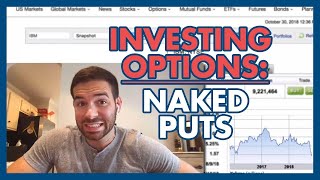
Ryan Daniel Moran (Capitalism.com) explains the ‘selling naked puts’ options strategy as a way to generate monthly income and to buy stocks at target prices while getting paid up front. He uses IBM as a worked example: he describes personal entry criteria (buy when dividend yield ≥4% and P/E ≈10), examines an options chain (Dec 21, 2018 expiration) and shows selling a $115 put for ~$$4.30 premium as a way to earn ~2% per month (≈4% over two months) and potentially buy $11,500 of IBM stock if assigned. He emphasizes only running this strategy on stocks you want to own and discusses trade sizing, limit orders, and buy-back/exit possibilities.
Questions this video answers
4% dividend yield.
P/E of 10.
December 21, 2018 (approximately two months out from recording).
$115 strike; premium about $4.30 per share.
One option contract would represent $11,500 of IBM stock (100 shares × $115).
Chapters
What's up, everybody? Today I'm gonna be showing you a new strategy that I have been deploying inside of my stock account. I'm actually gonna log in and show you the trade that I'm about to set up. And I have been using this strategy to generate a few thousand dollars a month inside of my portfolio. And I'm actually really excited about it. It's solved a lot of challenges for me in terms of deciding when to buy a stock and when to, you know, hope to make money with that investment. So before I log in and actually show you the trade that I've been eyeing, because one just set itself up really, really nicely, I want to give you kind of an overview of this strategy. This strategy is called Selling Naked Puts. And the idea of this is to sell an option on buying a stock, which basically means that you are agreeing to purchase a stock. You're agreeing to buy a stock at a certain price, and you're getting paid to agree to that amount. Now, because you might end up purchasing the stock. You never want to run this strategy on a stock that you don't want to own. So what I do is I use this strategy as a way to buy stocks that I already want to purchase at a better price, and I get paid to do that. So let me explain this. How many times does this happen to you? A stock drops and you go, ooh, I should buy it. But what if it drops even more? And I don't want to lose money because it might even drop even more, and then it goes way back up, and you're like.
Should have bought it when I had the chance, right? How many times does that happen? Well, if you're an investor, it happens all the time. Happens all the time. So what this does for me is it locks in a price that I'm happy with, and I get paid to make that agreement. And so if I end up buying the stock at a better price, I'm super happy. And if I get paid for it, I'm also really happy. Now.
This is a way of generating income and buying a stock at a price that you're really happy with. So when you. What we're gonna do is there's one that I've been eyeing. It looks like it set itself up really, really nicely for this. So I'm gonna actually log in and show you the trade. We just did a full training on this inside of my monthly program about investing, making money, and paying less taxes. It's a program called the 1%. If you wanna join it, you Can Google it. But I wanted to give you a Cliff Notes version just cause I'm excited about it and I thought it would really help you out. All right, all right, so let's make some money on camera. Okay, so the trade that has been setting up that I've been tracking is a trade on IBM. IBM is a company that I have held for a long time and the reason that I own them is, well, they're a blue chip company, has been around for more than a hundred years and also because of their dividend, their dividend is really healthy. They by the way, here's my official disclaimer which I try to put on all stock related videos. I'm just a dude who's fascinated by this stuff. I am not a planner, an accountant. I have no credentials except D U D E. Those are my only credentials. And dad, as evidenced by that piece of art on the fridge right there. Anyway.
The reason I like IBM is because they've been around for a really long time. They are I think, in a position to get their tish together and weather.
Upcoming downturns in the economy. And they have a really, really healthy dividend yield. All of that to say this is a company that I buy anyway, it's a company that I want to buy more of. Never run a strategy on any stock that you don't want to own. So this is a company that I want to buy, it's a company that I want to own. And there's two numbers that I look at to see if something is the right time to purchase. I'm looking at dividend yield and I'm looking at pe. It's price over earnings. So the multiple at which you are investing into the company. My numbers for this are when, and I'm not saying this is right or wrong, it's just my own. I buy companies once they cross a 4% dividend yield, especially when markets are really high. 4% is a really healthy kind of buy signal in my opinion. And PE gap or a PE price of 10. So if you're buying for 10 times total earnings, those are buy signals for me. Again, for me that's where I'm comfortable investing. And if we look here, IBM has just crossed those two thresholds. So they've gotten slaughtered in the market in the last couple of weeks. In fact, if we look here on this chart you can see, actually if we zoom out a lot here, we can see they're coming up and up and up. They've had some hard times and then they just collapsed in the last, last couple of weeks. I mean, look at, look at this three month chart. That is just horrifying, right? To be reaching a nice peak over 150. And now we're at 116. So I mean, the year is even worse. This is rough. Okay? So you know, over the last few years they've peaked and come way, way down. So when do you buy this?
Like, do you try and catch something that's on its way down that scares a lot of people? So for me, the way that I practice this, the way that I get in at a good price that I'm happy with and don't try to time it, is I sell a naked put. And a naked put allows me to basically agree to purchase a price at something I'm happy with without trying to time the market. So I'll get money up front in the option price and then if I have to buy the stock I'm buying at a price that I'm happy with. So I'd be happy buying IBM at this price. It meets my criteria of dividend yield. It meets my criteria of price over earnings.
All things say that we should, that I should buy this stock according to my criteria, according to my strategy. But I'm scared. And I'm scared because.
It'S cratering. I mean, this stock is, it's at a 52 week low.
So how do you manage that? Like, how do you manage the fear versus part of my brain that says I should really buy this thing? And the way I do that is by selling a naked put. So if we look at the options chain here inside of my E Trade account.
What we can see here is the price of the options to buy a stock or sell a stock. So if I wanted to buy the stock at a lower price than it is today, I could either buy a call on it, which gives me the right to buy it at whatever price I want, or I could sell a put on this, which would lock in a certain price point of the stock. So that's what I'm gonna do. I'm gonna sell a naked put. And naked just means that I don't own the stock. A put means it's the right to sell. So if we're looking here, I like a little bit of longer time horizons, mostly because my target for cash flow is 1% per month. So if I can get a 1% per month cash flow on a strategy like options, I'm really happy. So take a look at this. This is two months out. So this is, would be December 21st of 2018, which is a little less than two months from the day that I'm recording this video. Take a look at these babies. Take a look at these premiums. So if we sold a put at the $115 strike price, that means that we would get paid $4.30 for that put. So by agreeing to buy the stock at $115, we get paid $4.30. So let's run some numbers on this baby. This is where I start to get excited, and this is where the fear versus excitement starts to get balanced out by, you know, that. That fear of, well, what if the stock continues to crater versus, wow, I want to buy it now, we can get a little bit of excitement to justify the price point. Right? So if we're. If we're looking at a. We're getting paid $4.30 to potentially buy the stock at $115, we're getting almost a 4% return for less than two months. That's. Those are good numbers. If I can get 1% per month, this is about 2% per month.
I'm thrilled at 2% per month. Now, I know that seems small. If we're looking at a $10,000 portfolio, that's only 200 bucks. 200 bucks a month. But extrapolate that as a habit. Guess what? That's 2,400 bucks a year, 24% per year. That's pretty darn good. Most people would be happy with that. Now, what happens if you have to buy the stock? Well, now you've got a stock with a solid dividend that you can sell via a covered call or on a limit order. And now I'm getting technical, and I don't mean to confuse you. Forgive me, but there's other cool things that we could do to keep that 1 or 2% per month coming in as cash flow. Plus, we have the dividend in a company that has been around for a really long time. Anywho, these numbers suggest almost 4% for an upfront premium payment for holding the option for two months. Those numbers are pretty, pretty sweet. If we look at the rest of the option chain here, we could get a $2.53 premium to purchase the stock, potentially at $110, which would be 2% or 1% per month. That would be a more conservative trade because it would have to come. The stock would have to come down even further. It would have to come down to 110 for us to purchase it. Would I be happy buying this stock at 110? Yeah. Yes, I would. I'd be thrilled at buying this stock at 110. I'd be happy buying the stock at 115. I'm happy buying this stock at 117 if I'm being real honest. I'm just afraid. So what I'm gonna do here is I am going to run a more aggressive trade on here and buy. Aggressive. It's not. I mean, I think this is still a fairly conservative strategy, but I'm gonna sell a naked put for 400. 400 for $4.30. Alright, so I'm gonna do one option contract. I'm gonna put a limit order in at $4.50. So what this means is I'm gonna get $442.28 upfront for agreeing to buy this stock at $115, which is less than. Less than what it's listed for right now. So if I can buy this stock for less than it's listed at right now and get paid for it, that's pretty. That's pretty awesome. I'm really, really happy with that. So what we're looking at here is if we were to buy the stock at $115, an option contract is $100. So if we were to buy the stock, it means that we would have to buy $11,500 worth of this stock. And if you're not comfortable with that, first of all, you shouldn't go into the trade. But there are things that you can do in order to not buy the stock too, because you can sell or you could buy back the option if you were not happy with the trade, or if the stock goes way up, you could buy the stock back at a lower price. I don't mean to confuse you all on this, but there's. We talk about this more in the full lesson inside my continuity program, which is called the 1%.
But all this to say if you were to buy the stock, it would cost you $11,500 and we're getting paid $442.28 for potentially $11,500 investment, which is a 4% return in less than two months. I'm thrilled, thrilled with that cash flow. I'm very, very happy with that. I mean that. I mean, compare that to investing in real estate. Oh, you know, it's going to cost you 100 grand to buy a house. Cost you 12 grand to run strategy like this. And you're probably getting the same monthly cash flow. I. So that's the trade.
That's what I'm gonna enter into. I'm gonna enter into placing a limit order at 450. And when it hits, then I'll get the money up front, and I will be active in this trade. I have done this several times this month, and I made a few thousand dollars in premiums from running this. And if I have to buy the stock at the price that I set, I'm happy with that anyway. So what this does is it allows me to basically be more prudent with my investments. It lets me set the price that I want to buy it at. And if I buy it, I'm happy. If I don't get to buy it at that price because the stock goes up, well, then I just keep my option premium. I just made money. I just made, you know, in this case, 500 bucks. In some other cases, I did one for Tesla earlier this month, that was a $2,500 option payment. 2,500 bucks. And then the stock went. It took off. So I didn't get to buy the stock at the lower price. I just kept my 2,500 bucks. So I've been doing this to make a few thousand dollars extra in a month, and that shows up immediately. And if I get to buy the stock at a lower price, I'm happy with that too. So that's basically the rundown of something that. That you can do to make money in the stock market in a way that a lot of people aren't doing. But I look at it as a way to be a smarter investor, and I want to buy the stock at a lower price. This just allows me to justify that decision. Now, if you don't know anything about option trading or anything about how options work, this video might have been a little bit confusing for you, but there is plenty of information on YouTube or the Google machines that'll answer those questions. We also did a little bit more of a fuller training on options inside of my program, which is called the 1%. A big question that comes up at this point is, well, can't you. Don't you lose money if you buy the stock or if you put the stock at the agreed upon price? And the answer is not really. There's two caveats to this. Number one, I'm only gonna buy stocks that I'm happy with that I already want to purchase. So if I was going to purchase this stock at this price already and it goes down even further, well, I mean, I would have lost that money anyway. I actually mitigated a lot of my risk and a lot of My downside by buying at a lower price because of the lower strike price and also because I received money up front. You know, I got that $900 or so up front as a result of selling the option. So I actually lost less money than had I bought the stock outright and it continued to go down. The second thing here to note is because of the magic of expiration dates with options, the closer we get to that expiration date, the lower the value of that option. So I could just buy back the option close to the expiration date and not have.
Any requirement to buy the stock. That's pretty cool. So there's ways that you can manage if you don't. If you change your mind, you don't want to buy the stock, there's ways to get out of that trade. So I'm really high on this strategy. It's something that I do a few times a month to generate a few thousand extra dollars inside of my portfolio and still buy stocks that I'm really happy with. Hope you found this valuable and useful. Let me know what you thought in the comments and I will talk to you on the next video. Thanks for watching. Hey, before I go, make sure you are subscribed to the channel because here we talk about building businesses and investing the profits so that you can define the life that you want on your terms. So make sure you're subscribed to the channel and you have notifications on so that you see the next video that we send out. Talk to you soon.







