
Q & A With Tom Bilyeu, Founder Of Quest Nutrition
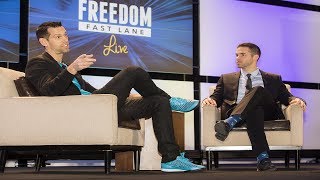
Tom Bilyeu, founder of Quest Nutrition, discusses launching the protein bar company with $600,000, hitting profitability in month six, and refusing retail deals until he could negotiate from strength. He also previews a new venture focused on the mind launching January 4.
Questions this video answers
Launched in 42 days and raised $600,000.
Around month six after launch.
They decided early to sell online only (refused retail contracts for over a year).
A chief marketing officer (social media expertise) and a production/manufacturing lead.
Planned announcement on January 4; the venture focuses on the mind (mindset/wellness) and will be commercial rather than pure philanthropy.
Chapters
All about execution. It's all about the initial idea. Half of my life was just do I have the guts to place this order?
Ended up launching in 42 days we raised $600,000.
Entrepreneurs are a billion fold over anybody else.
Solving the problems because a great problem is a great business opportunity.
Hey fastlaners, this is Ryan Daniel Moran. Welcome back to welcome to Freedom fastlane. Today you're going to hear a clip from our December event called Freedom Fastlane Live. It was held here in Austin, Texas. And what we try to do at Freedom Fastlane Live is put the best capitalists, entrepreneurs, brand builders and investors into one place, invite people to join and watch what happens. We just try to create the biggest business up leveling possible. This year's event featured Peter Diamandis, JP Sears, Cameron Herold, the founder of Whole Foods, John Mackey, a panel of people who built hundred million dollar businesses, our investor panel and a bunch more. And in past events we've had billionaire Jeff Hoffman, Pat Flynn, Robert Herjavec, Gary Vaynerchuk and others. So today you're gonna hear a clip from the recent event. We don't release the entire event for obvious reasons, but there are certain clips that we find particularly beneficial that we want to share with you. So that's what you're going to hear on today's episode. If you want to be on the waiting list for the event in 2017, you can go over to freedomfastlane live.com enter your best email address and you will be on the notification list for when we release the speakers. Until then, enjoy this clip from Freedom Fastlane Live.
So I'm very curious to see that slide of you making bars, making 1200 of them a day. One, two, skip a few, 99, a few million. And.
Now the company is where it is today. What happened in between?
Well, it really is just a learning process. Yeah, I mean you could go down so many branches. So when we started, I think the only thing I really understood was human psychology. So the first phase was manufacturing and that was sort of the everyday. And then we were in the business of giving bars away and that was it. We just wanted people to try them and we knew that was gonna be our most powerful marketing message. So then it was about building up the infrastructure, learning how to forecast. Like here's a problem that I never saw coming as a kid. When people tell you that you're never gonna use math, if you could just punch them in the mouth, that would be awesome because I believed them and then found myself in math. Hell, where imagine that you double month over month in sales, which happen to us all the time, and you have a six week lead time on an ingredient. So now you have to order and factor in the amount of time that it takes for the product to get there. But remember, if you're doubling month over month, that that's actually an exponential number. So it's not simple linear math. So now a, you probably don't have a lot of cash, so that gets real hard, real fast. And then B, do you really roll the dice? Because you have to be so cocksure to say, yeah, yeah, we'll double again, right? Like that you get into these terrifying situations. So half of my life was just, do I have the guts to place this order? So that was like, you know, where we spent a lot of time or convincing someone to sell you a pallet of protein. You can't imagine how hard that was. No one knew who we were. They didn't want to sell us protein. Protein is hard to get if you don't know protein is tied to cheese. And so whey protein is a byproduct of creating cheese. And at some point bodybuilders realize, hey, hey, hey, give that over to us. But still, the cheese business so dwarfs the protein business, that protein can't grow faster than cheese. So unless people eat more cheese, the protein business is tapped out. So everyone's fighting for those incremental gains every year.
What was the infrastructure built out? What was that process like? Because it's one thing to say, do I have the guts to place this order? It's another to say, do I have the guts to place this order on this person's salary and then navigate those waters. And you said on the podcast, at first it was like, hire.
Bring your downtrodden into quest and we'll turn everything around. But at some point that had to change. So what was that process like to both develop the grit in the ordering process, but also then becoming a person who hires as well?
Well, becoming a person who hires is pretty easy because we were doing that right off the bat. And we had a company before, so at a much smaller scale, we were actually way more used to hiring people that were white collar workers. And hiring blue collar was totally new for us. Really, the thing that I did really, really badly was recognizing those transitional moments of it doesn't make sense anymore to hire the former drug dealer. Now it's gotta be people with real experience. And I was all. I always felt like I was a little too late to that. Like it required some Major pain point. Because I'd gotten so close to. I loved at one point in the early days, I had this huge fantasy about how we were really going to be able to transform things in inner cities and that that was going to be just a big part of what we did. And then as you get more into knowledge work, it gets tough.
How did you make the margins work? Because I know that food is a pain in the rear to bring everything in and then get those margins to work it. You said that you were able to do it profitably from day one.
So from day one. But we, like month six, I think is about where we were profitable. The, the thing that we did was we, we made a really critical decision early on to sell online only. And the stores were coming to us and saying, hey, you know, you should be selling with us. And we just kept saying, no, no, no, no, no. Because their contracts are so predatory. So when people think, oh my God, I'm just, I'm going to get into, you know, Kroger or Ralph's or whatever and H E B, we're in Texas, I'm going to get into H E B and like all my problems are going to be solved. But they don't realize Heb knows that. They know that they're the kingmaker and they're going to act in accordance with that. And so a lot of little brands find themselves making a decision to get in the game at the expense of winning the game. So, and this goes back to understand what year we're in, right? It's 2016, almost 2017. It's like social, social, social. You can build, you're not going to build your. I mean, hey, here's a limiting belief. This is how the matrix gets you. I was going to say you're not going to build a billion dollar brand online, but you could, right? So.
In this kind of business, you're always trying to get on the shelf. But we were willing to be patient for a while until we had some clout so that we could push back and say we're not willing to agree to those terms. And then we had built so much momentum online that when they wanted us, we got on shelf, didn't pay slotting fees, and then they wanted us to do promotions and we refused. So we were a premium brand. We were already more expensive, we didn't do discounting, and, and we had a contract that was actually reasonable and the.
Strategy was just E commerce. Right. I mean, in the beginning and it was, I mean, right now the is the monthly auto Ship is really hot just because brands like Dollar Shave Club have done that really well. What was it at the beginning with Quest? What was the actual strategy of getting eyeballs into. Into customers enough to be able to prove the model?
For us, it was to be online. That's all we cared about. Wanted to market socially, wanted to build a community. Wanted, like basically every gym rat, every trainer in the world to be talking about our product and then to. When they came to touch the company, to find that there was this really warm ecosystem of people that wanted to celebrate your victories. We wanted to know if you'd lost weight or added muscle or gained weight, which we were huge, still are huge in the anorexic community, which was totally new for us and literally was like, whoa, what's happening? But ended up being just this really beautiful relationship between people who are struggling in a direction that we hadn' really thought about. So that was really neat. So it really was going back to build a community, Build a community, make the product available. And then we said no to major retailers for over a year. At one point, we actually hired somebody to say no more artfully, because we were. And it's funny, but it was like we were starting to damage relationships where they were like, hey, at some point I asked so many times, I stop asking. And so you have to be really careful about where people. People will then do things to spite you. And.
There are still some regions of some very, very famous stores regionally that won't carry us because of those days. And we kept saying no.
Who were the hires that you found to be the most advantageous during that time of scaling up the online presence? Do you remember what metrics were being measured and who is managing those and who you brought in to really develop the online presence?
Yeah, we had two really critical hires. Our chief marketing officer, who was just young enough that he really understood social in a way, like, now I get social. I did not get it at all. Like, when to this day, if you follow me on Facebook, it's gonna tell you that my birthday is January 1st. It's not. I was so paranoid, I didn't want to put my real birthday out there. So that's like this sort of lingering artifact. And now I've got the photos of my wife and I on Santa's lap. It's a whole different ball game. Like, I get now what the game is, but didn't at the time. He really, really did. And then another key hire for us not to do with marketing, but was production. You know, we were three Guys, we didn't know anything about production at scale, so we finally had to bring on somebody that didn't just work hard, actually knew that world.
What do you mean when you say production? You mean product production?
Yeah, yeah, the actual manufacturer.
Okay, I see you have transitioned out of any day to day operations. You said you're in a founder's role now. I think we were talking backstage, what do we say? The chief cheerleader?
More or less. Yeah. Chief evangelist.
Yeah, that's right. So how would you describe your role now and how did you transition from making the bars for several years to now being the evangelist? Yeah, so it's like a quick transition.
It is and it isn't. I mean, so my partners and I have been working together for 14 years and the business has kind of changed, but our roles very much stayed the same in terms of what parts of the company that we handled. So originally I was doing production just because I had to. There was nobody else there and everyone knew that wasn't going to be a long term strategy. So that was one of the first things that we replaced. Got somebody in that could do that. And then we got to the point where we built up enough infrastructure within the company that to look at the way Richard Branson has handled his businesses, his big thing is hire really, really smart people and then get out of the way. And so in doing that, I was moving more into really telling the narrative of the company internally. Doing the show inside Quest, we're bringing on just amazing thought leaders. And that was really an important thing to me because when we launched Quest, the three of us each said, okay, this company needs to be a platform because it's going to be a forever company. It's not something we're looking to just build up and sell. And so if it's going to be a forever company, what are the things it would have to accommodate? And for me, there are two pandemics that I believe is my calling to address. Pandemic. One is the pandemic of the body. You got people 2, 300 pounds overweight and they're dying of malnutrition. Really impacted my family. I've already lost people that I love to food. Essentially didn't want to lose more. But the other is the pandemic of the mind. And you've got people who, on the sort of bright and cheery side of the spectrum, just feel lost, feel that the system is corrupt and broken. And having gone from scrounging in my couch cushions to find enough change to put gas in my car, to fantastic wealth all through hard work, discipline, learning, learning to get the timing right, all that stuff, I realized that it is the mindset that's holding them back. And I want to know what happens to the world if we find the next 1000 Elon Musks. What happens? I've worked a lot in the inner cities. I big brothered for eight years when I was younger and saw what it really, really means to grow apart. And my big brother for this kid who was adopted and being abused and I was the ward of the court when they took him away from his family and saw him through that. So I've seen the real impacts of generational poverty. And then when we were doing manufacturing in the inner cities again, working with people that just really, really have suffered at the hands of what I call generational poverty, which is a mindset. It has nothing to do with money. I mean, it echoes in money because they don't understand it and they don't know how to escape that sort of vicious cycle of keep your head down, do as little work as possible and avoid punishment. But so that I wanted to be able to do that and I feared that I wasn't going to be able to make the two gel and that it would be bolting something on to this thriving, beautiful, amazing business. I didn't want to confuse it, but for me that's a must in my life. I need to be able to do both of those things. So Quest had gotten to the point where it's mature, it's stable, and so I felt it was time for me to, to launch the new venture which we'll be announcing January 4th, which I'm incredibly excited about. But it's all focused on the mind, but not in. I don't believe in the efficacy of pure philanthropy. I just don't think it's as good as commerce.
So it's amen, brother.
Well, thank you. But I believe it can do more good. So in fact, ask Peter Diamandis his feelings on that. And he says, you know, a lot of your creativity as a philanthropist is stifled by some of the governmental regulations around those bodies. And so part of knowing that I wanted to make this a commercial venture was from his wisdom. So knowing that we could create something self sustaining that could have true global impact, be a billion dollar business. So that's what we're doing.
I think Quest so represents the idea that commerce and free markets solve problems better than any other way ever devised at solving a problem. If you want to end metabolic disease, you profitably create the Infrastructure and the products that people want, and they vote with that. Whereas you could throw a government program at something and get Nowhere and in 50 years, even make the problem worse. So when you're setting out to solve this big challenge, you have this entire suite of products now. But what was the conversation like when you're saying, okay, we have this big audacious goal. Was it product driven first me like, let's make a bar with the perfect macronutrient profile. Or was it, here's the problem now, how do we solve this problem? It leads me to this snack. Which came first.
Yeah. In the company itself would start it as a bar. So we knew there is a niche, it's underserved. We were making bars and taking them to work ourselves because there was nothing on the market that we would eat. There was nothing that didn't have sugar, which we later find out. The reason for that is because the equipment can't produce things without sugar. And nobody was willing to engineer their own equipment. So we knew that, okay, if we're going to have this grand effect, it really does have to start there. But the grand effect was it hadn't been boiled down into, like a marketing message that we could transmit in the first, whatever, six or eight months. It was, hey, we know that there are people out there that want to eat healthy like we want to eat, but they want it to be delicious as well. But every day I was thinking about my mom and my sister and how this was important to them. And that's the reason that I could get behind it, because, I mean, we went through a whole debate about what is the next company going to be. And it was one of those where it had to be something that we cared about. We had started this whole gyration of selling the technology company because I was so pissed and so tired of chasing money. And I wanted to do something that I believed in. I wanted to do something that mattered, that had impact. So the only reason that I was interested in getting into nutrition was because I felt that it was, one, it could save the two people that I was most worried about in the world. And two, I thought that it could address what I saw as the greatest health crisis we face as a species, quite frankly.
So, health question for you, because I've been very curious about this. Does Quest consider themselves when you say you want to solve metabolic disease, do you consider yourself a low carb company because you believe that is the most advantageous way to eat? Do you consider yourself a ketogenic company? What do you consider yourselves. And what about the macronutrient makeup of your products do you think is the most advantageous from a health perspective?
That's a big question. We could do a six hour lecture on that one. Go something like this. We're a choice company. We don't want to tell people how to eat. We want people to decide how to eat themselves. We just want them to know if we put our name on it that it's healthy ingredients and that it's going to be delicious. But at the end of the day, here's the real. There's two types of nutrition. There's what I call blunt force trauma, which is what I use to drop whatever, 60, 70 pounds. And then there's calculus, which is what you have to do if you want to be up on stage in a bikini. I've never gotten into the calculus.
It just takes too much time and energy. So I like to do things that are really simple. So the really simple answer is drop carbs that already just solves a lot of problems, especially sugar. And then cycle eat different things at different times. I'll tell you how I eat. Four days a week I eat high protein, low carb. And then three days a week I eat ultra high fat, low protein, zero carb, which is called a ketogenic diet. I do that for inflammation and just general well being. It feels awesome. There may, may nobody knows for sure. Qualification, Qualification. There may be advantages from anti cancer properties, anti Alzheimer's. There's a lot of very interesting research coming out in ketogenics and it makes me feel good. So that's how I eat.
Tell me more about the new company that has a completely different mission. And I'm curious what has the same mission.
And so here's. And I know how confusing that is, trust me. So super confusing to me. So let's take myself for a second. I hate working out. I hate working out. I go to the gym five days a week. Absolutely hate it. And the reason that I go to the gym is twofold. One, yes, it's good for me and I am interested in longevity and so that's part of why I go to the gym. But the more important thing, I needed to earn credibility with myself. I needed to make a promise and then keep that promise. And I wanted it to be a micro promise. So you're going to go to the gym five days a week. And so when I made good on that promise, it's like, hey, I said I would do it, I did it and now I can tell myself a story. About being the guy that does things he says he's going to do. So at the end of the day, for me, the body is a way to get to the mind, and the body is a reflection of the mind. And if you see someone struggling with the body, I promise you they're struggling with the mind for sure. So I want to help people with that. I see wellness as a holistic thing. It isn't just body, it isn't just mind. And I promise you, every stitch of research that comes out from this moment forward, you're going to see they're going to more and more say, huh, it's weird. There actually is no delineation between the mind and the body. You have neurons, neurons in your digestive tract. Neurons. Like, how crazy is that? So when you say you have a gut feeling, it's because you actually have neurons in your gut, your brain, literally. It's nuts. But, like, the more that we really begin to understand the body, and trust me, we do not understand it yet, the more we begin to understand the body, the more we begin to understand the brain, the more we're going to see that they're linked. What I care about, every company that I will be involved from Quest Forward has to do with one thing. That moment of awakening that somebody has where they realize they can trust their life. That's it. And whether that was you were obese and now you got in shape, whether that was you were anorexic and you want to get healthy, whether you were tired of being pushed around and so you want to add muscle, like, whatever. You want to make sure that your kids grow up with a good diet and that they have every advantage that they can. Awesome, man. And seeing that people go, whoa, like, you guys are really doing the things to put me in control. Which is why we don't say, oh, you should be ketogenic or you should be low carb. I'm not telling people what they should do. I just want to make sure they know that they're in control. And so the other company is going to be literally as foundational as you can culturally be to help people understand that they, A, are in control and B, that they have the tools that they need to execute against that.
You are speaking my language, my friend. I asked this question to Gary Vaynerchuk last year, and he took it down a political way, and I didn't intend for it. But my question is, what you just said is, it feels like there's almost this split of there's more opportunity and there are more choices now than ever. And some people have used that to get better and to create more and to do more and to achieve more. And then there also seems to be the fact that there's just more stupid people alive than ever before that just wait, like, just do the blame game. Like we, we see more out in the world and it's easy to pick and just blame and, and be victims to the situation that we have. Do you think that things are trending in the right direction there? Do you think that we have way more work to do? Do you think it's inevitable either way? What's your take on kind of the psychological direction that has resulted from social media and all the opportunity and choice.
That'.
So I think that we've hit a really, really fascinating time where you've got the most optimistic people feeling the most disenfranchised. And I think all we have to do is nudge them. And if you guys read the book, Nudge, it is so powerful and it talks about and gives really amazing examples of a small little change that you can make that will send somebody's life in a completely different direction. Amazing. So I think right now, when I, and I don't know how you guys felt, and I really don't mean for this to be political, I'm not a political guy. But when I saw Occupy Wall street, it made me so sad because here I was, a child of the 80s who just believed that you could get rich, that you could do what you set your mind to. Which is why it was so easy for me as a little kid, even though my family teetered between white collar, blue collar. At one point, my dad was working as a mechanic. But it never dawned on me that I couldn't be rich if I put in the work. But now people really believe that that system is corrupt and it's broken. And sure it is. Assume that it's all terrible and it's all bad. But how does that help you? You need to identify how it works and what you can do to come up in it. And my thing is, don't worry about whether the American dream is alive or dead. Ask what is the American dream? Because the American dream used to be that if you abided by the rules, you got a good education, you did well in school, you were going to get a better job than your parents, you were going to have the house with a white picket fence, you were going to have 2.5 kids going to retire with a gold watch. Like there was going to be this mechanism that took Care of you simply for doing the right things. Yes, that is dead. It never existed, by the way. The thing that really did exist, probably.
Because 2.5 kids is really hard to have.
Not impossible, though. Not impossible. We'll talk later about how you pull that off. Talk to Peter. So it is now. It really is. We're living in the era of the entrepreneur. And all of us here know that most people aren't an entrepreneur, meaning that they're never going to get a company across the finish line. Why? Because they won't enjoy it. And I don't think they should. And I think everybody's different. And some people are meant to be stay at home dads and write just amazing poetry. And other women are meant to be CEOs of Fortune 500 companies and crush it. And I really think once we let go of who's supposed to do what, people will get to what they want to pursue. And notice. I did not say natural inclination, because my natural inclination is to lay in bed all day. But I have other drivers that make me want to get better now. But that was it. My driver was to get better, to improve. And I believe that humans are an active species. You put them in any room and they're going to try to hold dominion over it. They will first explore it and then they will try to master it, right? That's just what humans do. So you can put them in the Arctic, they will explore, and then master. You can put them on Mars. They will explore and master. That's what humans do. We have that innate drive. It's what made us the most dominant species on the planet. So now you take that same species and you let it loose in this world today, and they still want to explore and master, but they feel like there's some part of that system that's broken and it's coming down on them. If you can remove that, get them back into their natural state where they're trying to explore master. You just have to teach them how to answer some very fundamental questions. How do you find your passion? Most people don't know. And so they sketch off into the corner because they're expecting someone to hand it to them and be like, you love race cars, right? And they're like, oh, I guess I love race cars. So people have no idea how to find that passion. And then on top of that, they think that they're supposed to be in this system and they're not. They're supposed to be doing the hard things to develop their potential in a very specific direction. That they have chosen by cultivating their passion into something that they're really interested in. Display, grit and see it through. Like, that's the American dream. The American dream is still alive for anybody. If you're willing to learn and grow, first of all, if you're willing to accept you're not yet the person you need to be to execute at the highest level, you're willing to acknowledge your deficits and understand what skills you need, and then go out and relentlessly acquire those skills that have utility and then be willing to put those skills to the test against something. For me, the test is business. It's the test I enjoy. It's not the test everyone enjoys. But that's what Quest was largely me asking and answering the question, am I acquiring the right skills in order to end metabolic disease? Yes or no. And if the answer was no, I changed.
We're sadly out of time, but there's one question I just really want to ask you, and it's that when Quest was founded, you were complete pioneers. You built products that were very, very unique to the marketplace. And then within a few short years, oh, yeah, bars, Julian Bakery, all these other companies that were very similar started to pop up. How did you navigate those waters and continue to grow?
And I asked this because there are.
A bunch of people in the room who are just terrified that they. If they even talk about their product, that other people are gonna come out and steal it.
Yeah.
And you put it out there and are like, bring it on. Oh, yeah, bars, Bring it on. Muscle, tech. And they did. And you continue to grow. How did you navigate that?
So only value is sustainable. And let's be honest, our sales would be way bigger if those guys hadn't come in. No question. Like, they've come in, they've taken sales from us. That's the reality of competition. So enjoy the time. If you get it where you're sort of the lone wolf and you're out there and nobody else is doing what you're doing, put a clock on it. Know that it's probably 18 months to two years is sort of about the max. Sock away some money for a rainy day. And most importantly, innovate. Innovate. There's so many other problems that people are facing. There's so many other things that they want that they need from your company. And if you're putting the resources behind developing that stuff, then you're ultimately going to win, because there is only one thing that wins, and that's value. And if you're delivering value, people will come to you time and time again and if you fail to deliver value, then you will go away simple as.
Tom I think capitalism is the way we solve all the world's greatest challenges. I think Quest is a shining example of that. So thank you for what you do.
Let's give it up for Tom Bilyeu.
Thank you guys.
Thanks Tom.
Thank you so much. Real pleasure.
I hope you enjoyed today's clip from Freedom Fastlane Live. In my experience, all of my biggest breakthroughs in both the people I've met and the information I've consumed have come as the result of attending events like Freedom Fastlane Live. And our attendees, even our speakers, would say exactly the same thing. So I'm going to encourage you to head over to freedomfastlanelive.com make sure that you are signed up for the notification list for when it goes live. We'll also be teasing out speaker announcements throughout the year as they become official. You're not going to want to miss Freedom fast lane live 2017, so make sure you're on the notification list at freedom fastlane live.com hope to see you there. Hope you enjoyed today's episode. Make sure you share it with someone you think would find value in it, and we'll see you guys on the next show.
Ra.







