
Zero To $51k Per Month Profit: Case Study w/ Nick
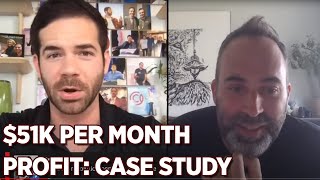
Ryan Moran interviews Nick Breau about building an online coaching community to $51k monthly profit in 10 months. Nick used a free video course as a lead magnet, ran cheap Facebook and YouTube ads to an email list, then converted subscribers into a paid membership that hit 500 members.
Questions this video answers
About 10 months prior to the call (launched ~10 months ago).
Around 500 ("now that's at like 500 going on 600").
About 220 signups during the biggest month so far for the Collective.
22,000 subscribers ("Last I checked it was at 22,000").
Up to ~5,000 email signups in one month ("I think the biggest month was 5,000 in a month").
Chapters
Oh, Nick is here with us.
Oh, no. Special guest Nick.
What's up, everybody? We'll start in 3 minutes and 47 seconds.
Hope you have our beverage ready.
What's up, david? What's up, josh? Hey, arl.
Hey, greg. Hey, brad. Hey, tiffany. Hey, switlana. Hey, amanda. Hey, adama. Nick adama is a big fan. You should know. What's up. Drew.
Me up. The time is now.
What's up, Keith? See money in the house.
Hey, amy.
What's up, Walter? Brendan Collins. What's up, buddy? It's like we're in church together again. What's up, Nathan?
Hey, Melody.
Melody, Lovejoy. It's been a long time. Good to see you. Happy birthday, Jason.
What's up, Jay? Baby's good. Very happy. Hey, Jesse. Hey, Ron. Good to see you, dude. Hey, Helene.
What's up, oas? Good to see you. Hey, herb.
Hey, Vincent. What's going on, Daniel? Leo, you did make it. Good work.
Josh. Baker's a fan of your dance moves. What's up, Mark Johnson?
What's up, Samit?
To the.
We got 48 seconds to the simultaneous sip.
Grab your cup.
We got 29 seconds. Grab your beverage quick. Water's boiling.
Oh, yeah. It's Sunday morning with capitalists. Some call it church for business owners. Some call it the capitalism cult. We just call it.
A random song on a Sunday. We call it coffee with capitalists. Good morning, everybody. Grab your cup, grab your mug, grab your chalice, your stein, your tankard, your vessel of any kind could be a flask.
Here we go. It's time for simultaneous sipping. Ready? And go.
That's good. Simultaneous sipping, ladies and germs. Nick bro is ready on that one. Good work. All right, we're gonna bring Nick on here in a second. First, I wanna. I want to give you some context for today. And also I want to kind of summarize what we covered last week. Last week was extremely well received. It's so good to see that you guys are responding to this. I just want to recap kind of the high points from what we talked about. You know, we're in this series right now talking about audiences, talking about audience building. For those of you who have followed my work for any length of time at all, you know that I have been harping on this idea forever and ever. Amen. That the foundation to everything in your business is your audience. And last week, I'm actually going to share my screen here again. I'm going to remember, remember, if we could break this down into just one thing, that I would do one thing that I would go back to if I were to lose everything. It would look like this. I would build a giant email list in the niche that I was excited about. I would, let's flip this. I would.
Put all of my attention into building a giant email list. A direct way to connect with my customers and my subscribers. I do that and for most people that's done with email. We would then build that list with ads and content. But we really use content to warm up and connect with our subscribers. So the foundation of the business, if everything else were to go to go away. You can build a six figure business in about 90 days by having your focus on an email list and then using the email list as a way to bring your content to that group of people to warm them up and prepare them for whatever it is that you have to offer, whether that is affiliate sales or it is your own business, or it is your physical products or whatever it is. As some of you know, I built my $10 million a year business with a list of like 5,000 people. So it doesn't take a lot of this in order to do damage. It doesn't take a lot in order to do really, really well. So that's the context with which we're operating in. And if you missed last week's call, we streamed it on YouTube or it's in your members area, you can watch it there too. So what we're going to do today is we're going to go into a case study. We're going to do a case study with somebody who's become an acquaintance of mine. I want to tell you exactly how, how I met Nick and it's got actually Nick, I don't think you even know this, this part of the story. So one of my acquaintances slash mentor slash friends is Susie Batiz. She's the founder of Poo Pourri which is a hundred million dollar ish a year. Go before you go spray or the before you go spray. And Susie was telling me that her her mentor's name is Gay Hendrix. Now Gay Hendrix is a pretty well known author. I wasn't familiar with his work but my brain for some reason didn't store Gay Hendrix. It stored Abraham Hicks who I also did not know. And so I go into YouTube to look up who I think is Susie Batiz's mentor. And I type in Abraham Hicks. Now had you told me what Abraham Hicks was and what that content was about, I would have been like wow you woo woo people please stay away from me. But this ad Pops up and it's this dude and he starts talking and his content is basically making the Woo Woo stuff practical. So he brings the Woo Woo spiritual stuff, kind of like your Joe Dispenza type of stuff into the practical. Now, you couldn't get more specific of a market than making Woo Woo spiritual stuff practical, right? So for those of you who think my, my niche is too small or my market's too specific, or I sell yoga pants for new moms and I don't know how to get in front of them, your. Your niche, your market is plenty big enough if you can make a six figure or a seven figure income making the Woo Woo practical. And Nick doesn't have a slew of products. He doesn't have a physical product line. His business is abundantly simple. And that's the beauty of what we're going to deconstruct today. So first of all, if you are watching live, please say hello in the comments and then I will bring Nick on. Hey, Adana. Hey, Greg. Happy birthday. Jason. Hey, Rebecca Turner. Good to see you. Hey, Tiffany. Adam says she loves Susie as well. Nick, give me a thumbs up if you are good to go. All right, I'm going to bring you up here.
Hello, my friend. Good to see you.
How you doing?
Great, man. I've been looking forward to chatting with you.
Yeah, I have no idea what I'm getting myself into here, but I'm sure it's going to be fun.
Yeah.
So Nick's coming in a little bit blind, which I appreciate of him. So, Nick, I don't want to put words in your mouth, but you said some. When I, when I asked you if you'd be willing to be a case study today, you, your, your first response was, well, I'm not a marketer. What the heck am I going to talk about? So explain to me a little bit what, what you meant when you said that.
Yeah, well, I mean, I know what you teach and what you do just from the last four or six weeks that we've been connected and I figured you teach about marketing and sales and entrepreneurship and all that stuff. My background, my niche is personal development, self help, and basically teaching people how to be happy and overcome their blocks. So when you asked me to come on this show, I was like, okay, I have no idea what you want me to share, talk about or where we're gonna go. But yeah, sure, sounds like fun. You're a cool guy. We'll have a fun chat.
Well, thank you. So. So you're not in the marketing space you don't have a marketing ish background. Right. But like you know enough to, to run an online business, obviously. So like you're basically. I'm telling everybody this because Nick's one of us. Right, Nick. Nick is one of us. A marketer building an online. Or not. Not a marketing background, an entrepreneur building an online business. And Nick, when did you start the Collective, which is your, your online group?
Probably about a little less than a year ago, maybe 10 months ago.
Okay, so 10 months ago. And I know when we met you were at like 300ish members. And now that's at like 500 going on 600. Is that right?
Yeah, we hit. This was our biggest month so far with about 220signups so far this month.
That's amazing. That, that's great. That's great. So you had this big, this big spike. And so I think you told me like a month ago, I want to get this to about a thousand people, which would be about a million dollars a year in income. And in my mind I was like, on it, done, let's do this. I love goals like that. And seeing your content, I was like, oh, we will absolutely get there. And there's been this big bump lately. But your business is pretty simple. I mean, you don't have, you don't have a mastermind, you don't have a, you don't even have upsells on your funnels, right? And your product, your product is, is you talking once or twice a week, right? I mean, if we were to simplify this, you, you do calls where you go live, sometimes you have some things to say and mostly you just help people with their mindset blocks and they prepare all the content. Am I saying anything that's misrepresenting what you do?
No, that's spot on. So like, you know, my background's tech. I did 10 years of startups and computer science, left that world focused on this world, did about five, six years of one on one work as my, my main area of focus till I realized that, you know, there's only so many one on one sessions I can do in a week.
Right?
That evolved now into launching, you know, the couple of books and now the collective. And the Collective is where I'm most passionate about now because I can, you know, the sky's the limit of how many people we can get on those calls and help. So for me it's all about, you know, how many people can I serve, what can I teach, how can I help people grow, expand, shift their blocks so they're living their best lives possible.
Yeah. So how did you. Coming from this world where you didn't have an audience, like, you didn't have a major podcast, you didn't have any influencers talking about you, you weren't a blogger for a long time. You were in the tech world for goodness sake. And then 10 months ago, you launch what is. I mean, I'm just going to call it a coaching problem coaching program for simplicity's sake. That's not really what it is.
But.
But 10 months ago you launched this. How do you take that to 500 paying customers in less than a year?
Good question.
For me, my game plan is just. Is instinct, right? It's just, what's the next logical step? What's the next logical step? What feels right for me? It's not about, you know, finding the magical online formula from, you know, Gary Vee or you or whoever. It's just, you know, what's the next impulse? What's the next impulse? And being okay with getting it wrong.
Right.
For me, I always just, oh, if it feels good, I take action from it. I don't care if it's going to fail. I don't care if it's going to succeed. Everything I do, I do from the energy of, like, the pleasure of that action. Right. Does this sound fun and exciting for me? Awesome. Let's go dive in and do it and then we'll see where it takes us. Right? And sure, maybe that leads to more banging around and maybe is necessary, but again, it's a building up of life experience, which serves me both in my business and outside of my business.
Yeah, well, I mean, a lot of people do the opposite where they're doing what they think is going to work completely, and once they make the money, then it'll be fun and pleasurable and they never really get there. And now your email list has gone from like zero to about 10,000 or so. It was a little bit smaller when we met, but starting with nothing. I mean, your ads are you in front of your computer being like, hey, I've got a thing. If you want the thing, click the link.
I was just hoping you could walk us through. Forgive me for calling it a funnel, but, like, what did you give away on the front end to build the audience? How did you build the list? How did you start? Your audience isn't huge. It's a few thousand people, but you've got a $50,000 a month business. It's awesome. So what was the beginning?
Yeah, so I never really put Much focus on platform growth. Until probably about a year ago.
Coming from a tech background in social media, I was always kind of like just not wanting to deal with social media, not wanting to dive in, but knowing it was a necessary evil. So I kind of played the bare minimum in that world. And then about a year, maybe a little over a year ago, I realized that, you know, when I looked at the big players in my space, which are, you know, Joe Dispenza, Abraham Hicks, that I, what I do fills a big void that they're not covering and there's room for me on that stage. So I was like, okay, next step, platform growth. And, you know, that's where I really started looking at. Okay, so how do I. I'm starting to interrupt.
But by platform growth, you mean like your brand recognition, right? You don't mean like YouTube presence. You mean people recognizing Nick bro.
Growing my audience. Yeah, yeah, yeah. And that's when I decided, okay, so time to, you know, invest in more time into a YouTube channel, my mailing list, all of these things. And the way it unfolded was synchronistically, which is kind of how everything unfolds for me. I got off a call with one of my clients and she's a coach, and I said, you know what, as an opt in, you've got so much good content. You should take all that content and put it into a free E course. And she was like, great idea. That's what I'm going to go do. I get off the call with her and I'm sitting there, I'm thinking, you know what? I got lots of great content. Maybe I should do the same thing. So I went, I threw it all into an E course, put it online. It took me like, literally the first iteration was like six hours of work. And people were just loving it, signing up, like, sending me like messages of thanks. I was like, okay, cool. People really love this perfect opt in. Now I'm gonna go shoot a YouTube video to promote it and I'm gonna, you know, do some Facebook ads and play around in that world. And it probably took me, you know, a couple of months to get the copyright and play with it and figure it out. But I found, you know, a couple of keywords that worked. I cranked it up, I think on YouTube. Actually, the only reason I went to YouTube, I started on Facebook and my Facebook ads account got banned for like, no reason, which was happening to a whole bunch of coaches at the time. Luckily, in my mail, in my emails for like four or five months, I kept getting Emails from Facebook saying, book a session with one of our marketing experts. Book a free session. And I was like, now's the time to book that session. So within a week, luckily, I had my ads account reactivated. But again, to me it was like, shit, I can't let my whole platform be dependent on just Facebook. So then I went over to YouTube and I shot a YouTube ad and I was thinking, nobody ever clicks on those like YouTube ads. Like everybody skips them after five seconds. But I'm gonna give it a try anyways. And you know, I was getting less than a dollar conversions into my opt in, so I just, I just cranked that up and it just kept flowing from there.
So you built it with ads and there was really one ad that stood out. And the E course that you created, which was behind the opt in, from what I remember, was you summarizing a lot of your content into like six videos. Six five minute videos or so. Am I remembering that correctly? Yeah, about.
It probably takes less than an hour to do and it was just super high value, right? So for me, I've been working in this niche probably for, I don't know, eight years and studying it for 15. So I know exactly what people are doing wrong. I know exactly what they need to be looking at that they aren't studying. So it was just five or six high value pieces of content and then an invite to join the Facebook group and then get on the mailing list.
So question for those of you who are watching live, how many of you, after last week's conversation.
You walked away with like, okay, what's my lead magnet? What am I doing to build this audience? Because that's what we talked about was the core root piece of audience building we've talked about. For those of you who sell on Amazon, I mean, there's people, there's people in the 1% who sell 5, $10 million a year just on Amazon but have no audience at all. And so making that switch back to like, well, what do I give away for free? To start building the audience can be a little bit of, of mental jujitsu. If you, if you, if you struggled with that, put it in the comments. I'd like to, to, to chat about it. But what Nick is saying is that he took kind of his best stuff, summarized it into like five minute videos, made a very simple series around it, and then that was his give, that was his lead magnet. And well, some of the other things we talked about last week were making one really high value video or putting all of your best resources into a PDF. We went through a couple different examples from last week. But Nick, in your case, when you did the video series, what was the offer? Or was there an offer in the video series? Or were you just purely trying to build opt ins?
Yeah, so that E course came before the collective. So a couple of months after that, once the collective got started, I went in, I threw a few things at the end saying, you know, here's some links to some more resources. You know, here's some free resources, which is my YouTube channel. You know, here's a link to my new book if you want to grab that. And then if you're really serious about implementing this stuff, here's a link, a discount code to join my collective for like 25 bucks for the first month.
Awesome. So you started building the platform before there was any way to really monetize the audience. Yeah, so many people come into building audience with like, how am I going to monetize this? Rather than how am I going to create a really good deposit in the relationship bank account? So, Grace, I see your question where you posted in the comments of I want to offer something to my audience different than a discount we talked about. If you sell physical products, then a discount is really easy in.
When you're building that audience. But in this example with Nick, his entire approach was, okay, how do I help the person who's going to watch this have some sort of meaningful shift and then I'll worry about the monetization piece of it later. So Grace, if you're in weight loss, for example, and you sell a weight loss supplement, then your entire approach is, okay, what could I give away that is meaningful to the person who is on YouTube or on Facebook struggling with this? And it might be a video, it might be a PDF with resources, but what's the thing that can help shift this person from one point to another point? And then I can say, and you know, if you need extra help, you, here's a coupon code where you can get me on Amazon and you can worry about the funnel and all the random stuff later when you've got the foundation of this growing, which is the email list, the direct response email list. That's when you are starting to lay the foundation of the business. Traffic from SEO, from content, from even paid stuff from Amazon. All of that doesn't have a business foundation until you're able to directly go out and connect with your customers. Nick, you said you had a really big jump this past week where your paid membership almost doubled in a 30 day period. And I think you started more actively emailing your list about the collective. At that point, you really weren't hitting them real hard with collective stuff. Is that a correct assumption?
Yeah, I would say if a marketer were to analyze my business and tell me what the biggest thing that I'm not doing enough of, it's probably pitching. And then you came in, you gave me some suggestions. Somebody else gave me some email suggestions. I had a great idea for one of our group calls this week, which I promoted and set up like a seven sequence email to promote. And it probably doubled the signups for this month at least so far. Doubled. So doubled at least. Probably it'll end up being 60 to 70% higher than any other month.
Yeah. In one month that you started actively doing this stuff.
Yeah.
Can I ask how big your list is or how responsive it is? I just want to give those who are watching kind of a benchmark.
Yeah. Last I checked it was at 22,000.
Okay.
At one point it was growing by. I think the biggest month was 5,000 in a month. And that's with like Definitely less than 5,000 in ad spend. Probably 4 or 5,000 in lead generation ad spend. So less than a dollar per sign up.
Okay. And, and wow, that's great. Getting, getting leads for a dollar in 2020 is pretty awesome. And I, I think the reason for that is just because your ads are so specific and the content is good enough that other people are probably voluntarily sharing it. Yeah.
One comment.
I get a lot from people who come in from YouTube is they'll, they'll literally like DM me or message means they say, nick, I never click on ads, but like there's just something about the authenticity in your video. Right. So for me, coming from the energy of, and I talked to other coaches about this, but like most people either coming from the energy of sales or coming from the energy of service and people can really feel what energy you're coming from when you're talking about your product. And when somebody can really feel that you're authentically trying to help them, I think that comes through in a video. And when people can really feel that, then I think the odds of them opting in and, and moving forward with your offer are so much higher.
Yeah, that's great. So like Dustin asked, the dollar percent was through Facebook, YouTube, or both. It doesn't matter when you do what Nick is just talking about people, people can feel the authenticity in the way you're communicating with them. I've had my best, our best Ad results are when we're not trying to sell, it's when we're just, we're completely giving and then the ad starts to get shared and now we're getting free traffic. And the metrics are great. I had an ads team at one point, they were trying so hard to convert these ads. I'm like, please stop doing what you're doing here, run this. And I typed something up and it was like an actual give to the audience. Like, your numbers are amazing on this ad. Where did you learn this copy?
I just gave the person a shift from one place to another. There's a question that was posted that I think is relevant for this, of how did you get ideas for the seven sequence email? I'm gonna hit this in two parts. Number one, if you're talking about Nick's give on the front end, in terms of the free course that he does for his audience, that was purely identifying the challenges that the person struggles with and speaking to them. That's it. And they weren't highly edited videos. They were one shot takes on his webcam. Just answering really common questions that come up on the seven sequence email series. Nick, how would you answer that question when you were more actively selling this past week?
Yeah. So for me, the key to anything is like doing things really from the energy of like, fun, joy, excitement, pleasure. Like my latest book, I don't think I have it here. Here it is. So my paperback, which went out a couple of months ago, I wrote the whole thing in like three weeks. And you know, six months before that, I talked to a mastermind of writers and they all had writer's block. And the reason they had writer's block was because they all had this mindset of it's got to change the world, it's got to be done by the state, it's got to have this many pages, all this pressure that they're putting on their shoulders. And when you approach something from this energy of like stress and pressure, it's like it cuts off your flow, your. Your magic, your genius. But when you do something from that energy of like fun, excitement, pleasure, it's like it just flows. It's just things become easy.
Yeah.
So for me, my best writing, my best inspirations are always first thing in the morning when I wake up, I'll put on some good music, I'll make a good coffee, I'll sit down, and then the inspirational flow, or it won't. And if it flows, that's when I type up those emails.
Right.
So for me, there's no magic formula. There's no, you know, I looked at, you know, some stuff that you had and some stuff somebody else sent me to get some ideas on, you know, emails that can have converted for other people. And then I just take that as inspiration and take my own flow of inspiration and merge it together and just see what comes out.
Yeah, that's great. And when Nick and I first met, I sent him the email series. I modified them for his voice. But the email series that is in your members area, the one that is my email swipes, my like standard swipes that I use. They're in your members area, 1 percenters. So that's in there. You can, you can modify them for your own market. That's kind of the style that has always worked well for me. There's a question from Maria. This is long. I'm going to summarize. Maria, if you're willing, I'd like to pull you out live when we go to Q and A because.
Your question is very. You're thinking really hard about this. Your question being like, okay, so first step, I'm going to do something in exchange for email. And number two, I can tell you're thinking really hard about it. And so I would like to try and remove whatever like thought block is with you. And I think that would be a fun case study. So when we go to Q and A, what's the hashtag we use? Steamoney. Hashtag go live. Okay. Hashtag go live. Type that in the comments and Chris will see it and he'll shoot you a link and we can. Oh, I never shot you today's link, did I? Wow, that's embarrassing as heck.
So just hit golive in the comments. Chris. Chris will see that and he'll bring you live here. So Nick, I was hoping that just like now that we kind of understand the strategy a little bit, where you were running ads to one simple give and then basically softly selling what it was that you have to offer. I mean, that's basically the business model at this point, correct?
Yeah. If I take a look back at what I'm doing, I would agree.
By that I interpret you saying is like, yeah, I guess in retrospect that's what I did. But in the moment I was more just having fun.
Yeah, like for me, you know, I understand the concept of a funnel, but for me it was just again, like an organic. Oh, this feels like a next logical step. Okay, I should probably put this here. Like there was no magic formula of like, you know, the XYZ Entrepreneur's Guide to the Perfect Funnel or anything like that. But, you know, it's. It's just if somebody said, is that a funnel? Yeah, it's a funnel. It's an opt in to an E course, to an offer to join the Facebook group and join the collective.
Yeah. So I know a lot, like, I'm. I'm seeing a lot of your messages that it's like trying to deconstruct the strategy in all of this. And that's the strategy. Like, and like, the strategy is like, do what is do well by your followers and customers from a place that feels genuinely.
Contributive.
Right.
You're genuinely helpful to the people who are showing up. And then you've got an offer or series of offers that helps them even more. Frank Kern put this really well. He used to say, my entire business strategy is to give people things for free that make them happy and then sell them things that make them even happier. That's. He's like, that's. That's my business strategy. And I kind of live by that now. The first time we ever did one of these coffee hangouts, it was interesting. Bram Spiro sent me a message. I think he texted me and he said, he's like, ryan, please do that more often. That's you at your best. Was in here going, like, I just drank coffee in front of my computer, like, what are you talking about? That's me at my best. I didn't plan any content. I just hung out with you guys for an hour and a half and answered your questions. And the harder I make things, the harder I think about an email, the harder I think about a funnel, the harder I think about an ad, the more that I spend time reading copywriting books so I can perfect my sales letter, the more it sucks. And the more that I just ease into, like, who am I talking to? How can I help them? And like, what do I got? Do I believe in what I got? And if I believe in it, then how would I talk about it? And the more I operate from that place, the more just go, go, go, go, go. There was a post inside the 1% group this week from Yasmeen who said, ryan, like, what funnel are you running? I joined the 1% on a dollar trial, and now I just joined the tribe for $10,000. What did you do to me? I was like, yasmine, I've just been helping you with your challenges. And then you launched a business and it's doing really well. That's it. Like, there. There was no Jujitsu. That happened to this. So, Nick, I was hoping that next we could go into a little bit about what it is that you teach. Like, you do some YouTube videos that are not. You don't have a. You don't have anybody following you around with a video camera doing highly produced content, but you get a decent amount of views on your videos. You have like five or six thousand subscribers. Like, what. How do you. And I don't think you do more than maybe two videos. One or two videos a week. I was hoping you'd go over, like, what you teach and kind of how you go about sharing it with your audience.
Yeah, so as I mentioned earlier, my background's tech. So I did 10 years in computer science. The last tech company I played a bit of a key role in, and that was acquired for over 300 million. So that gave me the financial freedom to step away from tech and focus on, you know, what I call this world full time.
To be clear, you didn't get a $300 million check. No, no.
The business sold for 300 million. I was the. I was the first guy to write code. I was the architect. So I made enough money to walk away from that world. Not enough to retire, but enough to kind of take the next logical step in my life and follow my biggest passion, which. Which is what I do now.
And I just wanted to highlight that because I didn't want anybody to have an excuse over, oh, well, Nick has $300 million. Of course you can make YouTube videos.
So my tagline is kind of the computer hacker turned people hacker. So what I recognized and what I realized as I was studying law of attraction and self help and mindset and happiness and all this stuff is that people are just like computers. What drives a piece of software's behavior is the computer language the source code that you write behind it. Well, human beings are the exact same thing. The only difference between a human and a piece of software is the programming language is different computers. It's JavaScript, it's C, it's HTML people. It's the perspectives we choose, the emotions we practice, and where we put our focus. Anytime we have a block in any area of our life, whether it be relationships, moving forward in our business, even chronic pain, it's often tied back to, you know, something got going on in here. In here.
Mm.
Before I move on to my next question, just curious. What's the difference between what's going on here and here?
I'd say mental. So what you're thinking and what you're Feeling okay, cool.
This is going to put us down the rabbit hole slip and I, and.
I can take you guys deep down the rabbit hole.
Oh yeah, you and me both. This is fun.
I have cannonballed into the rabbit hole in the last three months or so, partially due to Nick. It's like once you can kind of get out of your head about it. I have just full on cannonball right down into the. And it goes. It's a lot deeper of a rabbit hole than I expect.
And I mean, I was the rational computer science, science based guy like, you know, like back in my tech days. And you know, some of the things that I've experienced and that life has shown me have just radically flipped my perception of like the entire reality. So like one example that I use is, is the synchronicities that I experience. So I, I ended up leaving my marriage about eight years ago and then six months after that I met my current partner. So her name is Anik. My name is Nick. So both our sets of parents both call us Nick growing up, which is extremely confusing when we visit our parents. So we both share the same name. When we met, we were just driving the same type of car. We do similar work and after we started dating, we even realized that we had both left our marriages on the same day before we'd ever met. So for me, I experience these types of synchronicities and experiences quite frequently and I attribute that to much more than what the rational, logical mind can really understand or comprehend.
Yeah, Chris, my right hand man over here, and I stayed up way too late last night talking about like, what, what are our brains actually doing? They're really just like compiling a bunch of stuff that's going on into a message that we can understand. Wait a minute, Chris, what was that magical thing you said? Well, what does energy live in? What's the vacuum? I was like, whoa, whoa, whoa, hold on. Are we gonna go down this road?
We're basically exploring what the heck is consciousness? Which took us a.
Even like, you know, killer instinct or your gut or your intuition, like entrepreneurs know, like that's your greatest asset. But like, where does it really come from? Or like that experience where, you know, you're sitting there trying to remember somebody's name or the name of a place and you've got it on the tip of your tongue and you just, you just can't get it and then 15 minutes later you're completely off the topic, you're not even thinking about the topic, and all of a sudden that name pops into Your head, Where does that come from?
Right.
So I think, you know, yes, we have our logical, analytical, rational mind, but there's also another, deeper part of us which fuels that intuition, that killer instinct. And what most people don't understand is that's something that, that's a muscle you can learn to grow. That's something you can tune into at deeper levels. And for me personally, the more I've grown that muscle, the more magical, the easier and the more successful my life gets.
That's beautiful, Nick. Thank you for that. Owase, I have your comment, your question highlighted on screen. But.
Like Maria, if you're willing, I'd like to do this live with you. So let's make this easy. If you just put in all caps, question or all caps Chris, just find a way to get in front of Chris, and Chris will put you here.
Inside the waiting room, and we'll bring you here live. So always, I really like your question about how do you feel comfortable on camera? How do you loosen up and actually make that content and not be so stuck in it? Because we can totally help with that, but it's probably not what you're thinking about. That is the way through that. So for all of you who either, we'll kind of pivot over here to Q and A at this point. If you either want to talk about the rabbit hole stuff or if you want to talk about audience building in the context that Nick and I are talking about it, or if you've got to give for the rest of the community a question that you want to bring to the rest of the community someplace that you're stuck in your business, you can put, just put all caps question or Chris, somehow get Chris's attention and he'll bring you here into the waiting room and we can work on it. I want to summarize what we've talked about up until the this point. So last week we talked all about building an audience and building an audience profitably. And we talked about using email or some sort of direct response communication to communicate with your ideal person and then using content as a way to connect with and serve that audience. And you build it with ads. And Nick is our case study for this week, who started with one free video series where he summarized his best talking points that were based on the questions that came up a lot in his conversations with people. So in your case, if you're in the, if you're in the weight loss space, it might be the five places where you see clients get stuck, or if you are in the Grilling space. It could be as simple as your best recipe or your best, your five best tools that you use when you're making amazing, amazing hosting amazing parties at your home. But whatever your best give is, is the exchange for the email address. Nick did not monetize that audience for a while until he had a program which he now has grown to about 500 members, which is about a, you know, it's a really nice mid six figure business and will probably hit 1000 members within the next few months with a trajectory that he's on, which is pretty amazing because he's only been doing this for less than a year. So that's the summary. We don't put a whole lot of thought into this. It is about serving a group of people and then serving them deeper with your products and services. That's capitalism, people. That is business 101. It is strangers finding ways to help one another.
David is saying, let's go down the rabbit hole.
David then put question, get Chris's attention and come on here into the waiting room. Do we have a WAIS anywhere sitting around?
All right, oas, we're waiting for you, dude. So, Nick, when you're working with clients, like you work with some business owners and you work with entrepreneurs, where do you see people that get stuck in their mindset and the way they go approach their business?
So everybody's got a unique thumbprint of beliefs, perspectives, emotions that they're carrying. So really, everybody, it's different. One of the processes I take people through is what I call an attraction point audit. And what you do is you look at all of the current and past circumstances and you identify the negative emotion that surfaces in all these different circumstances. So you look at past relationships, maybe business failures, dynamics between you and your family members, and you ask the question, how did that circumstance make me feel? So you identify kind of the dominant negative emotion that surfaces in all these different circumstances. And with about 80 to 90% of the people that I do this pattern exercise with, it's the same one to three emotions that keep coming up over and over and over and over again. And when you identify one of those patterns, then those are one of those emotions that when you work through them, when you clear them, when you completely let it go, you have one of your more significant outer reality shifts. So that's one example of kind of some of the things that we look at.
So, so what you're saying is that when people are. Most people are operating from like one to three emotions that keep coming up over and over Again, and those patterns are subconsciously running their decisions and thus running their lives. Is that what you're saying? So.
So the way we kind of operate as humans is. Is in childhood, we develop these kind of emotional wounds or emotional voids. And what we do is we seek out desires to compensate for those emotional wounds. So, for example, somebody in childhood who maybe by a parent was abandoned, then as an adult, as you grow up, you're going to actually attract relationships where your partners will often not be there for you, abandon you. So the circumstances that you experience almost reflect those emotional wounds that you. And once you identify what those wounds are and you work through them, then those circumstances begin to change.
And how would this approach in. How would this manifest in business?
Like the clients you attract or the money that you make? How is that reflected?
Yeah, so with things like client attraction, oftentimes it's about emotions, like, not good enough, fears of putting yourself out there, fears of putting yourself on social media. From a business standpoint, I've mostly worked with coaches, and with coaches, the biggest block that I've seen is either they're too much in effort, they're too much in struggle, they're trying to push too much rather than rely on that instinct, that gut, that intuition I was talking about earlier. Or it's fears around not being good enough, not getting results, not being successful. Know, everybody's got a different set of things going on in here, so it's all about really just using the right statements to help uproot those things that are holding somebody back. But it's almost always rooted in childhood.
I want. Well, you know, I would love your theory on this. I'm having seven thoughts at once. Forgive me, but I would love your thoughts on this. I'm currently of the opinion that those emotions that we feel and the beliefs that we have just take root when they're given enough practice. And the reason why childhood is where a lot of our stuff comes up is because that's where the thought started. There's nothing really magical about childhood we don't need. You don't always need to go back to childhood and, like, fix all your childhood stuff. It's just that that's the first time that a thought or a belief got planted and you didn't know any different. And so there was nothing to reject or reflect that thought, and it just took root.
And where it comes from doesn't matter. Right. So what matters is what you're practicing now. So a lot of people on the call, you know, the most dominant negative emotion I see in people is this feeling of not good enough.
Right?
And sure, it might have been rooted in something your dad said when you were seven. Doesn't matter. What matters is are you still practicing that belief right now? Right. And behind every emotion. So an emotion is an indicator to a perspective. So without the perspective, the emotion has no fuel. So it's like your emotions are a guidance system to your perspective. So if you've got a feeling of I'm not good enough, you've got a perspective that I'm not good enough. So then the decisions you make in your business, whether you're aware of it or not, are going to be impacted by this underlying perspective that you're not good enough. And the way you uproot or understand or figure out what the perspective is is just ask the question, what must I believe is true to feel that way or I feel this way because. So if you notice that you've got a lot of emotions of not good enough or unworthiness or whatever that emotion is, just ask that statement and see what the first thing that comes up in your mind is. Right? And then your job is to invalidate that statement. Because if you can invalidate it, if you can find one perspective, one counter argument to show and to prove that that belief doesn't make sense, then the emotion will go away.
Beautiful. I want to tell all of you who are watching how this has kind of shown up for me. So, you know, one of the times my business really shrunk after I had my big exit in 2017, 2018. When was that? When I got my more than $10 million check. Once that happens, what that did, money is just like alcohol. It just amplifies everything else that's going on. If you're a generous person, you become more generous. If you're anxious, you become more anxious. Well, for me, what that amplified, and I've been very honest publicly with y' all about this. Is it amplified these questions of like, well, it was I a fluke? Did like.
Am I able to recreate this? I got really stressed. I stopped being able to sleep. I got more stressed about money after I had a lot of money show up. And then guess what started to happen? It started to go away. I started investing in people I shouldn't hire. I started investing in ads I shouldn't have run. I started going down traffic, short pursuit of short term wins rather than building a long term business because I was looking for the short term fix to how I felt. But that made me feel even worse. And so I was pushing away the success that I'm now starting to really enjoy. Because I'm not now. I'm not trying so hard now. I don't really care what other people say or what the end result is. I still have those desires of having $100 million a year business, of having a million followers. That all sounds really nice. But now I'm not trying to make them happen. I am, I am. I keep them as fun goals and I'm having a lot of fun along the way getting there. If you listen to my two part podcast series with Brooke Castillo, she talked about how she is already enjoying her hundred million dollar a year business, even though she only makes $35 million a year. Right. Because in her mind she's like, I'm enjoying the entire evil. I set the goal of $100 million because it sounded like a fun path to get to, not that I would get to $100 million and then enjoy. Sounded like a fun path to go down this route of getting to $100 million and seeing what came up for me and what I needed to click. That sounded fun. That's the work. That is the work of. Brook has told me this. Set a goal and watch. What comes up for you is like your resistance and your beliefs of not being good enough for that or not knowing how. And that's the work.
Yeah. Every desire that we have, the reason we have that desire is because how we believe that desire is going to make us feel what we're really chasing and is an emotional state. And oftentimes that emotional state we're chasing after is to compensate those voids that I, that I mentioned earlier. So when you deal with those voids, that desperation for those desires eases up and that actually opens up the flow to letting them in in a much more satisfying, pleasurable way.
A comment on YouTube says business success comes from strategy and capital, not because of some feelings. So, Sam, I'd be really curious to see how big your business is right now. That would be really fun to talk to you about. All right, I want to bring David, if you would give me a thumbs up if you are ready to come on. All right, here we go. Here we go. David. What's up? David, what's up?
What's going on?
Hey, man, good to see you. Hey, man, good to see you.
I'm super nervous, but good to see you too.
How can we help? How can we help?
Well, you guys were hitting it pretty good. I want, you know, I wanted to go down the rabbit hole. Whoever just made that comment on YouTube. I think that's wrong. I think that everything stems from your mindset. I think you. You can only. You can only get to as far as your mindset will let you go. And, you know, you really have to break that block to get to the next level.
Great.
And, you know, that's. That's why I said I wanted to go down the rabbit hole. Sometimes I feel like I just hit these walls. And, you know, it stems from probably my childhood where I feel like, you know, I'm just maybe not good enough.
So. So a couple things. First of all.
What'S that? Are you in a cop car? Are you in a cop car?
I. I am. I'm in the front, though.
What did you do? What did you do?
I'm in the front.
So, David, tell me what you're trying to accomplish and where you're getting stuck.
So what I'm trying to accomplish is. So right now, currently, I'm a police officer, but at the same time, I'm an Amazon seller. But I really, you know, I want to build a brand, which is why I joined the 1%. You know, I want to build a brand, specifically a food company, you know, and I want to serve, you know, that market and my people.
But, you know, like, I have all those feelings of, you know, is it going to work? Am I good enough? Will my product be good enough?
You know, and I really just, you know, I guess you never. You'll never know until you try it. But those. Those feelings are pretty scary.
So, Nick, how would you address it? Sure.
So two big things came to mind.
When you're not talking.
Okay. It's probably because I have it through the radio.
That's 100 it. Yes.
Are we good?
Yeah.
Awesome. Okay, so one thing you said was, was what if it doesn't work? Okay, so if you had if in that project, could you do that project just for the fun of the project, for the pleasure of the project, not do it because of any potential outcome, but simply do the business, run the business for the joy of the experience and running the business itself. So that's one thing that comes to mind.
Second, around the not good enough, you know, can I ask a question so, you know, what must I believe is true to feel like I'm not good enough? When you ask that question, does anything pop in your head?
What's the very first thing that pops in your head when I ask that question?
What must I feel is true?
Yeah, so you said. You said for you, the dominant emotion is, like, not good enough, right?
Right.
Yeah. So what must I believe is true? To feel like I'm not good enough?
I guess, you know.
I guess just looking for, you know, my. My parents love when I was a child.
Okay. And just because. So were your parents the planetary authority on who is or who isn't good enough?
Yes.
Okay. And why do you believe they were that authority? So if they say you're not good enough, but Ryan says you are, if I say you are, if every person on this call says you are, you know, who wins out? Your parents or all of us other entrepreneur type people?
I think it should be everybody else. Yeah.
Just because your parents couldn't see it, just because you can't see it doesn't mean that it's true. I know you're good enough just by being you.
Right.
You obviously care about helping people, being a police officer, right?
Yes, I do.
Isn't that an indicator of being good enough?
Yeah.
Good. So how does it feel now?
Feels pretty good.
Good. So can you just take a nice deep breath and just let that in?
And your parents not being able to express your good enoughness to you isn't because you're not good enough. It's because their own fears of being vulnerable, their own insecurities. Maybe they believe they needed to be hard on you to push you further. Right. Their perspective of you and the way they treated you is not an indication of you and who you are. It's simply an indication of their own belief systems.
Okay.
Makes sense.
Makes sense.
And with where you want to be in your business, there's somebody that's there now that was once in your shoes. And if they were able to find their way there, you can, too. I mean, you're in the right place to do that right now by being on this call, aren't you?
Yeah.
Yeah. So you're totally on the path. All you need to do is relax into it more, Keep approaching it from the energy of pleasure and fun and excitement, and just do it. Do it because it excites you for no other reason.
All right.
Awesome. How does that feel?
That feels good.
Awesome.
David, give me some confidence now.
David, let me give you some more confidence from the business side of this. So you. You came in saying, like, I'm afraid it's not gonna work. I'm afraid, like, what if my idea fails? But I really just want us, like, serve this group. Would you tell me a little bit more about that?
So me, myself, personally, I'm very big on, you know, eating a specific way, and there. I feel like there's a small amount of products that serve this market and not a wide variety. So I know what I would want and you know, I want to see other people be able to enjoy that as well.
So, David, I'm going to quiz you to see how well, how closely you follow my content. Are you ready? Okay. What is the physical products brand that I'm actively working on right now?
Fifth flower.
Yeah. Okay. You follow pretty closely. I've mentioned that a couple times, but I've got one that is a food company for police officers. Really?
Very interesting. I don't know.
Right. So the reason I'm telling you that is because like what, you're a police officer who wants to do a food company, wondering if the idea is gonna work and if it's good enough and you come to me for business advice and I'm telling you, yeah, it's, it's a damn good business. Right. And, and the fact is it's what you want, which makes it good enough.
Okay.
And can I add something really quick? What you just shared about your business, how it was going to help other people. You could tell you were speaking from your heart there. That's your opt in video.
All right.
That, that whole part is new to me. Like I was saying earlier, I sell on Amazon, but I do like a wholesale business model and I sell all food.
And I, you know, I've been having this burning desire to just, you know, start my own brand and you know, have, have a community.
And so that's why I came here.
Sounds like, so sounds like you're right on the path.
All right.
That'S fun.
Good. Well, thanks for hanging out with us, David. It's good to meet you. Thanks.
Ryan. Good to meet you. Nick, Good to meet you.
Pleasure.
Take care, Dave.
You too.
That was good.
Oas, I can't, I can sort of see you. I'll see a thumbs up if you give me a thumbs up. You're good to go. Okay, oas, you're up next.
What's up oas?
How you doing?
Doing good, man. Good to see you again.
Yeah, you too. Hi guys. So my question was just around recording videos, so I, I think I put it on the Facebook and it popped up on the screen. So essentially yesterday I spent two hours trying to record a one minute video and then when I played it back to my wife, she basically said you sounded like a robot too. Monotonous. You're trying to remember a script in your head and it needs to be conversational and kind of free flowing. So I just wanted to Know what strategies that you guys use to have a video that's kind of free flowing and conversation are not robotic.
So the way I'll answer this question is the reason why you feel robotic or in your head two hours and make a one minute video is because you care about what's going to happen on the other side of it. And by care I mean you, you have a fear around it being wrong, it going wrong, someone telling you you sound funny. And so as a result you, you procrastinate and you make the video suck. So because you're sitting there thinking like, please don't hate it, please don't hate it, please don't hate it, please don't hate it. When you realize that that's the actual thought loop going on in your brain in the background, regardless of what you're saying in the video. If you're in the background, it's like, please don't hate it, please don't hate it, please don't hate it, please don't hate it. You're gonna make a video that people hate because it's actually what you're communicating, even if it's not what you're saying. You're saying, please don't hate it. I was working with a client recently where he showed his pitch video to me and I said, alright, are you open to some feedback? And he said, yes. I said, I listen to what's being communicated, not what's being said. And what you communicated in your video was please, oh please, oh please, oh please buy this.
And he's like, I know what you're saying.
The thing for him was to drop out of the result and just say what you got for him, it was, here's what I do and here's how I help people. And these are people that I help and I help them in this way. And if you want it, click the button for you. Rather than you're sitting there thinking about the result and what could go wrong. If you just drop into thinking about who is the person who's watching this and you speak to them, you're golden. That's the flip where Nick said that it's something between here and here. This is thought and this is emotion. People feel connected to on the emotion level, not the thought level. So when you're building an audience, if you just drop into how it is that that person wants to be connected to, you're golden. You can say you could, you could talk about poop for nine minutes, but if it connected with that person in the way that they Want to be connected to you, build an audience and it doesn't matter. So.
Give me your thoughts on that. We can go deeper into that.
Yeah. So I watched the climb, for example, the one that you did, Ryan, a week or two ago.
Yeah.
And you were able to talk, I don't know, for 15 minutes. So I was thinking, do you actually have a script or is it. Do you have like points beyond the camera or is it just all kind of come from the heart naturally? You just go ahead and talk.
When I go to a video, I never have more than three bullet points that I'm going to. And usually I have nothing. Almost all my podcasts are nothing. They sound. They might even sound like I'm reading it because you put a microphone in front of me and for whatever reason, I just speak like I am speaking to.
But I'm almost no point. I'm just sharing whatever feels easy to share. So, oas, can you ever remember a time in which speaking or creating or sharing was really easy? Can you remember any times that that was the case?
Yeah, so I kind of, I do it on the job, but it's more like teaching other people how to do things. So by trade I'm a software engineer, and so kind of one of my roles because I'm quite senior in that position, I help train juniors. And that kind of comes easy because I really know the content and I'm seen as the SME in that sense. So, yes, it becomes easy to teach somebody else who doesn't have the kind of knowledge or experience that I've got.
So, Nick, you're a. You've been a software engineer. So how did you overcome this when you were in Oasis Spot?
Yeah. So first, understand that the first time you start any learning anything, you're gonna suck. And that's okay, right? My advice and what helped me a lot and by the way, like, I don't know, last year I went and I went back and deleted a whole bunch of my old YouTube videos because, like, oh my God, I can't believe I was putting those online.
Right?
So like, be okay with sucking, right? And the way you be okay with sucking is by not caring what other people are going to think. So that's one piece of advice. And again, to get better at that, work through those emotions of not good enough rejection, fear of failure. And I love this because these are perfect examples of how this stuff is going to impact your ability to grow your business.
Right?
So second, just be authentic. Pretend you're having a discussion with a friend about whatever the topic is, right? So, you know, pretend somebody just asked you a question, and what you want to share in the video is the perfect answer for that question. And just answer that question into the screen as if you were talking to a person. Right? So you know, you. How you say it isn't going to matter. What's going to matter is the energy that's coming through that screen.
Right.
That people are going to feel. Yeah, he knows what he's talking about. Yeah. He is being authentic with me. That's the important stuff. It's not the words. It's the impression you're giving through the video. So I would say just, you know what you want to say, right?
Yep.
Set up your camera and just say it and see how it looks. And if it doesn't totally suck, put it up. If you're afraid to put it up, just ask yourself, if I put this up, what's the worst thing that could happen? Right? And whatever comes to mind, just work through that block, Right? And if. If it's, you know, everything can always be better, Right? So if you're like, okay, well, that works for now. Put that up a week later. If you feel inspired, shoot it again, and shoot it again. Have fun with it. Understand that everything in life is a learning process, and that's okay.
And, Nick, I think you said something so important there, which was when you feel so. Something you think of, when you feel inspired, then go do it. I think a lot of times we try to sit and plan content rather than just doing it. I mean, we've all experienced times where making content or writing the email or doing the thing that we're procrastinating on feels easy. And what I used to do is force myself to do those things and then hate every day. Whereas now. Do you read my emails? Oas?
Yeah.
All right, so every email you've ever gotten from me was written in the moment when I sent it. I don't schedule them. I don't. Like. No one writes in my voice. It's like I type them up when I want to type them up, and then I send them.
That's why there's so many typos.
He always finds a typo.
And, I mean, that's a podcast unless I have it scheduled with a guest or something like this. But everything that I do is just when I feel like doing it.
Okay, what do you say about kind of sitting down or standing up? Because sometimes that can impact as well. Like, you could use your arms a little more, not kind of sit stiff.
You're thinking about it too much.
Right, Okay.
I would say, I would say, you know, what do you do that makes you feel good? Do you like listening to EDM music? Do you like, you know, playing racquetball? So what do you do that really makes you feel good?
Oh, that'd be sports for me.
Go do a bunch of sports, get into a place where you feel really good and then shoot the video. Don't do it all sweaty and out of breath, but you know what I mean.
All right, cheers. Thanks guys.
Your advice, it's good to see you.
Yeah, you too, mate.
Thank you.
That was fun. I'm gonna go over to Maria here in a second. But Nick, you record content like once or twice a week or so.
So I just started this new YouTube series called 5 Questions Where it's kind of like a reverse podcast where some of my audience members or people in my platform get to come on and then they ask me five questions and we record. It's about 20 minutes. And now we're cutting those up into like five individual videos on my YouTube and people are loving them.
Yeah.
But when it came to my YouTube, prior to that, I would just post when they felt inspired. Sometimes there'd be three posts in three days, sometimes there'd be one in two weeks. So I don't follow a formula. It's just I act on impulse and inspiration.
Yep. I'm exactly the same. Exactly the same. And I used to think and plan and outline and then I would spend a week doing one video and then be upset when it didn't kill it. And then what are the chance, now that I'm beating myself up over the video sucking, how likely am I going to go make another video?
Totally. Here's another rabbit hole concept. So the way that I'm seeing the evolution of the human being in the mind is what I call old paradigm. And old paradigm is where we're acting dominantly out of thinking out of mind based computation of should I do this, should I not do this? The next kind of step or level up from that is by integrating intuition and feeling into the equation. So the next step up is dominantly acting out of emotion. Yet still checking through with your mind to see does this, you're combining the two. And then the next level up from that, which is what I call the new paradigm, is getting into that place where you feel really good, you're really connected to your guidance, and then acting purely on impulse. Right. What's the next impulse? What feels next? What feels next? Without question, just following that Flow of impulses. And that's how I mostly live my life now. And it really creates this level of, like, ease because there's no more needing to mentally figure everything out all the time. Right. It creates so much relief and ability to just relax and just follow that flow. And when you're good at that and when you're doing that from the right place, everything works out in such a brilliant, fun, magical unfolding. It really changes the whole way you experience your reality.
I had the privilege of getting to know Gary Vee a little bit over my years as an entrepreneur. And one of the things that struck me as I've spent time with him is that's the mode he's in all the time. Right. He isn't like, I did a wine company because I wanted to do a wine company. I did do a Q and A session because I like doing Q&As. I do this because I like doing. I like. And that allows him to work 16 hours a day and have a blast doing it.
And it's not. It's not about being impulsive, as I see one of the comments in the comment window, but it's about following your inspiration, following your excitement. It's about asking, what's the next most exciting thing that I can do? Oh, it's take a nap. I'm going to go take a nap. Oh, it's to write a new page, a new chapter in my book. I'm going to go write a new chapter in my book. It's about understanding the power of impulse. But the important thing is doing it from the right headspace, the right mindset.
Right, Right. Okay, Maria, give me a thumbs up if you are ready to go. All right. Hello, Maria.
Hi. How are you?
Good. It's good to meet you.
Good to meet you too.
What's going on?
I'm really nervous.
Me too.
That's nice to know. Makes it easier. So thanks. Thanks so much for bringing, bringing me up here.
So. Okay, so. And thank you for the 1%. I'm so excited to be a part of the 1%. My husband used to be a part for like a year. Then we sign out and then I sign in now. And what got me in is one of your emails announcing the last Sunday, the coffee, it was so, so good. And I think in some way.
Your way of doing things inspires me to do that. There's someone that is so excited also to be a client of mine because I'm just waiting to do so much money to join your tribe. So I think in that sense, I would love to have a client like, I am a client to you.
So what you're saying you want clients that are as excited about your stuff as you are about my stuff?
Yes, exactly.
I appreciate the compliment. And that's a really good sign because now you have a reference point for how you want your clients to think about you. That's a really good sign.
Yes. And I connect with you in several things because sometimes I think, okay.
Why did I join the 1%? And I'm so excited. And I didn't join, for example, something Gary B. Does or some of your mentors do. And sometimes I ask the same question about my own business. Like, why would someone follow me? Because of course, everything is invented. And so I have a mix of information that I've gathered along the years and that has been really helpful for me and that's what I'm willing to. And I'm very excited to share. But sometimes I ask myself, like, why would these people follow me and not some of my mentors who maybe invented or, or canalize or whatever the information they're sharing? And, and, and you are an amazing answer. Because I prefer because. Because some people would. Will connect with me. That's why I believe and will feel.
Yes. Will feel like empathy with me and not with others. And. And they will love to be my clients or they will be a standard stage, like an expert two. And I'm an expert, maybe level six. And then when they get to six, I'm really happy for them to follow the next mentor if that's. And I will grow in the process, of course.
So it sounds like you're answering your own question. So how can I and. Or Nick help?
Okay, thank you. So I'm really like paralyzed with all the Internet world I had before financial freedom. Like it was. We used to call it like that, like a financial freedom or personal finance school. And we had it for two years. It made about like $150,000 a year. It was a hobby. Like, we. We didn't live out of that, my husband and I. And it was. We started just sharing.
The information that was so powerful for us to have, like passive income. So after two years, we were working so much. We were like burnout because of the other businesses. And we decided to close the school. And we did like five sabbatical years. We traveled all around the world. I got pregnant, I have a kid, etc. And now two things happened. One was really transcendental was my mother's death. Like, suddenly it was like very hard it was seven months ago, and so it made me realize. And the other one was us losing a lot of our income. It was not because of COVID but we lost, like, our main source of income. So.
We were wondering, like, what to do next. We still have live in a really nice place and have a nice lifestyle, but.
We want to have a better lifestyle and more passive income. So the business comes from two motivations. One is from my mom. I learned that we are here for a reason. Like, the soul is not here on vacation. So I don't want to do nothing anymore. I really want to share what has transformed for my life and what, what lets me, like, be a present mom and educate my. Like, do homeschooling to my child and those kinds of things that are really valuable to us. So I used to have a school, so I have the product. I have some followers that have been not attended for five years.
So. Maria.
But I don't know, like, where to start.
Maria. So where are you stuck?
I'm paralyzed with the Internet. Like, I don't know what the heck to do. I don't know if I should do a video, if I should define the buyer Persona, if I should, like, read copywriting books because I don't have anything digital. It was all, like, live workshops, what we used to do. So I have the knowledge in the field. I know it's transformational. I have clients with, with amazing results. Like, some of them tell us, like, we saved their lives, like, literally. And that's not what we intended to do. But. So I don't know where to start. I. I'm like, totally freaked out. So I haven't done anything online. And that's my question, like, should I do YouTube videos? Should I do. And. And you have answered a lot of that in the, in this session.
Let Nick and I help you out. I'll go first here, because I'm just going to call bullshit because you just said all the things that you're good at, all the clients that you've helped, all the momentum that you've created, all the great things that have happened, all the ways that you can help people. And then you said, I don't know what to do. You know exactly what to do. You know exactly what to do. And you're using the mechanism, should I do YouTube or email or, like, what approach should I take as a way of stopping from just going forward? But if you just flipped up, open your phone and spoke on YouTube, you'd be golden because you know exactly who to talk to, what to say, and how to help people. So. And you could do that on Facebook or you could do that on a pod. You can do it wherever you want, wherever it feels easy and light and fun and free. Because there is no right answer. There's just what feels right for you. And you've got all the goods, so all you need to do is share it in the way that feels easiest for you to share it. But I want to ask Nick, because, Nick, you didn't have a following or platform at all a year ago, so.
How did you overcome the thought of I don't know where to start when you've got a blank canvas.
Yeah. So here's my woo. Answer to this question is what excites you? Right. Get into a place where you feel good and then just follow your impulse. Oh, I've got an impulse to shoot a video. I'm gonna go shoot a video.
Right.
Just follow your next logical step. Whatever feels good, just go do it.
Right.
What's the worst thing that could happen if you just pick one of those things, the one that inspires you the most, that excites you the most, and you just went and you did it?
Yes.
It might as well be fun.
Something in the process.
Fun is the whole reason you're here.
Yes.
Okay.
What's the point of making it to $100 million a year if you're not having fun while you're at it?
Yes.
Yes. Yes. I guess. I guess for me it's connecting with people. I love that.
Do that and do that.
Okay. Okay, cool. Yes. Because sometimes I feel it's so much things that I don't know, it's so much work and I value so much time with, for example, my, my, My only child. So I'm like freaked out all over the place. And I, I said like, ah, why.
Should I do what I do? Maria, you, you just went back into practicing the thought pattern of why you're stuck. Okay, so like, so we, we just gave you two. Two things to.
And then you went back to. Yeah, but sometimes I'm stuck.
That was your reference point.
But guess what? Sometimes you're not stuck.
Yes.
Sometimes you know exactly what to do. Sometimes you know your stuff so good and people say that you change their lives. Sometimes clients just show up. Sometimes it feels light and easy. Sometimes you got content coming out of your ears and your biggest frustration is you can't record it all. And in nine hours because you got so much coming out of you. Or you could sit here like, yeah, but sometimes I'm stuck.
Okay. Yes, I get it. Thank you so much.
All right. Great to see you, Maria.
Thank you. Great to see you, too.
We're going to. We're going to close Q and A from there. Nick, I. That is something that I have been thinking about a lot, which is, like, every time I come up with an. An excuse of my own limitations, it's. It's like I just realized that I'm just practicing that limitation over again rather than thinking about, like, well, sometimes I'm really confident I'm going to run a million, a hundred million dollar business, or sometimes I'm really confident I'm going to own the Cleveland Indians. And it's just like, what program do I want to run? And I'm curious. I'm curious on your thoughts on that.
One of the exercises I give people sometimes, if you want to be a 50 millionaire, do everything from the energy of being a 50 millionaire. Make your coffee from the energy of a 50 millionaire. Gas up your car just the way it would feel as a 50 millionaire. Take a piss like you're a 50 millionaire. Embody the energy of what it is or who it is you want to be. The other thing I do is I tell people to identify who their v2.0 is, right? So that version of you, six months, 12 months down the road, who has the business that you want, who's living the life that you want, what's the difference between them and you? How do they feel differently? How do they act differently? What are they doing differently? And then once you map that stuff out, your job is to now be that person today.
I love that, like, Mark Cuban still makes his coffee and takes a piss. He just makes it as a billionaire.
Here's another kind of rabbit hole thought I want to run by you. I've been thinking about this. I'm just going to take it one step deeper. Into the cannonball here or to the rabbit hole here.
If consciousness, if we're all just like a sliver of consciousness, then someone else's perspective is just as valid as mine. And since I can choose whatever perspective I want to tap into, then when I doubt myself.
I think about someone who never doubts me. It's like my best friend Mark, like my best friend Mark, always believes in me. Is like, Ryan, you can run $100 million business whenever you want to run $100 million business. Ryan, you're so much better than you give yourself credit for. Ryan, I see you at this level. You see yourself at this level. So I can just choose to tap into Mark's perspective.
Totally.
And validate Mark's perspective and know that Mark's perspective is just as valid as mine. So why am I giving so much attention to this limited perspective that I keep playing over and over and over again?
Yeah. In power manifesting, I talk about how negative emotion is just a point of view, right? It's like saying, oh, the Cleveland Indians are the best team, or the Red Sox are the best team. It's just a point of view, Right. You're good enough.
The Indians are better than the Red Sox. But I understand math is just a perspective, too.
That's all perspective, Right. Everything you perceive is a perspective.
Right?
Most people allow circumstances to define those perspectives we're choosing instead of us choosing the perspectives that best serve us for ourselves.
Nick, I want to run one more question by you. That was posted by Amy. This is great. How do you know your ambitions are realistic?
Who cares?
As long as you're enjoying the ride and having fun, have all the ambitions you want, who cares?
And Elon Musk wants to colonize Mars. That was not realistic when he said it. Everybody thought like.
I think he's been smoking far before he was on Joe Rogan. I mean, that was. That's what everybody thought. And now everybody's like, actually, I think he's going to do it.
I've seen. I bet people thought about that with the Wright brothers. Any major invention, right? People probably thought that's unrealistic. But who cares? Just have fun.
Yeah. What? Just have fun. That's the mantra. Nick, there's a bunch of people saying that they want to find out where they can consume your stuff. Join your groups. What would you. Where do people find you?
I got lots of stuff in lots of places. So. YouTube channel, YouTube.com nickbro B R E A U. I got a couple of books on Amazon, Power Manifesting that came out a couple of months ago. That's on Amazon. My free e course funnel.nickbro.com eCourse.
There'S.
Also that website.
Google.
I'm a Google.
Or it might be. It might be jugled. Could be a soft G. I've heard of it. You type things in and they show up.
Yeah, I got lots of stuff everywhere.
Yeah, just tune in, watch it, enjoy. I'm usually pretty responsive when people reach out. Feel free to reach out. But yeah, I just. This stuff is my jam. I love helping people shift. I love talking about this stuff. I love going down the rabbit hole. Life is amazing and it can be amazing for anybody.
It's just a blast.
And do you notice how we'll bring this full circle. Do you notice how Nick is genuinely joyful about the content that he's creating? So many of us try to make the content we think is going to work, or we make the content that we see other people make in order to get views or subscribers. But Nick's living proof of a you don't need that many people. You don't need to overthink the content. And if you just go all in on helping the people that you want to help have a shift, the world kind of gets out of your way. Is what I do on these calls, is what Nick does on his YouTube channel and for his clients and customers. And when you take that type of an approach, world just kind of rewards that because even on a super practical level, people want to be served by other people who genuinely want to serve them. And if all that, that's all you think about if you. If you stay super practical about this, human beings who are the ones paying you at the end of the day as customers want to be served on their journey, not your journey. And when you connect with them on their journey by serving them in a way that helps them take the next step, that's how you build an audience, and that's how you do it profitably. Nick, we give applause here at the 1% by giving hashtags in the comments. So if you can see the comments, there's hashtags all over the place.
So thanks for hanging out with us. It's good to see you. I appreciate you sharing your wisdom with us.
Yeah, I appreciate the appreciation and thanks for having me.
All right, everybody, 1 percenters, we'll see you next week. We'll do a Q and A next week to wrap up our series on audience building. Until then, I'll see you in the Facebook group. Take care, everybody. Thanks, Nick. Thank you.







