Aarron Walter and Designing the Future of HealthTech | Now What? by Wix
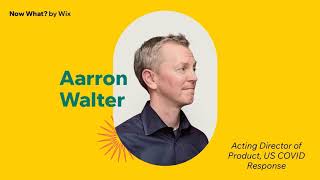
Aaron Walter, a designer who started in fine arts, discusses his work on contact-tracing tools and vaccine-passport systems at Resolve to Save Lives. His updated book Designing for Emotion now covers the full emotional spectrum including trust, fear, and equity, with a case study of Headspace.
Chapters
Hi everyone and welcome to now what the podcast from WIX about how technology is changing everything. I'm your host, Rob Goodman and in this series we're talking all about evolution in business, design, development and beyond. Over this past year, business and creative leaders have had to evolve to meet the challenges that come with this overwhelming amount of change. Here at wix, we're interested in the ways that creative people are evolving to build new businesses, grow beyond their limits and shape the future of the web. So we thought, what if we got together a bunch of our friends, leaders in design, development, e commerce and the agency world to talk about how they're dealing with change and how it's affecting their careers, teams and industries. This is a place to prepare for tomorrow's ever changing world and apply those lessons today. In our first episode, we're joined by design leader Aaron Walter, who is now serving as the acting product director for us Covid response at Resolve to Save Lives. Aaron has a long history at the forefront of product design, having previously founded and led Mailchimp's UX design practice and more recently running InVision's design education team. Aaron is also the co host of the Webby Award nominated Design Better podcast. Aaron and I sit down to chat about his journey from fine arts to the web world, how he's bringing all that he's learned about world class design practices into health tech and how technology, and more specifically design, can help billions of people navigate life through a pandemic. We also dive into the practice of designing for emotion and talk about the new edition of Aaron's book by that same name. You'll hear fantastic leadership advice in this first episode and and get a front seat view at the opportunities and challenges ahead in designing for health tech. Now let's get into the show.
Aaron, welcome to the now what Podcast. You're our first guest. What a pleasure it is to have you here.
Well, what a treat it is to be here.
Yeah, I feel the same way. I mean, we go back obviously from working together at Envision and I want to hear about your backstory. I want to hear about what you've been up to at Resolve to Save Lives. And let's just start kind of early days. I know that you studied painting undergrad and then in graduate school at Temple, the Tyler School of Art. How early was art and design a part of your language as a child? And I know you were in the Midwest and you were working with your hands and farming and all of that, but like, you know, how early was your eye going to Design?
Yeah. So I was not interested in design as a kid. I was interested in art. And it started out I was interested in cartooning. But as a kid growing up in Iowa and Nebraska and kind of moving around the Midwest, not a lot of exposure to the arts. I did have an uncle, Tom Palmerton, who was a professional artist. And, yeah, he's pretty successful artist and sculptor, painter. I kind of looked up to him, and I would see him every once in a while at a family reunion. And it was sort of like, you can have this as a profession is what it told me.
It's like that saying, if you can see it, you can be it. And so that was in your world early.
Yeah, and it was also helpful for my parents because my parents, like, my mom's an accountant and my dad was a personnel manager. So they didn't exactly have, like, creativity flowing through their veins. They had creativity in lots of other ways in their lives, but just not in terms of, like, the arts or design. They could see that it was a viable profession, too, and they supported me, and that was great. I think it's kind of a key thing that kids need is just like, someone to see their interests and give even a little encouragement to press them forward. But I studied painting, and all I wanted to do as a young person was to be a painter. And, you know, I thought, I'll change the world with a painting. And then there came a point. I had gotten a BFA in painting and drawing, and then I was getting an MFA at Tyler School of Art in Philadelphia at Temple University, and I was just sort of like, you know, I don't know if I can actually change the world with a painting. I was going to New York and in the gallery scene, and I kind of just realized, like, it's very hard, like, to break in and to have a space.
Right. It's an exclusive kind of area. Yeah, yeah.
And even if you get in, then what? It's such a narrow group of people who see your work and what's it all accomplished. But at the same time, one of my close friends who I went to high school with, went to undergrad with, and we were roommates in Philly. He taught me HTML and he was teaching me how to, like, hand make image maps, which most people won't know what that is. Handmade GIFs, you know, this was the 90s. So I started to learn, like, some technical stuff, and I was prototyping my paintings with Photoshop and I started to learn some programming, and that led to a job like When I got out of grad school, where I was teaching artists how to use technology, you know, like, bring your studio work and technology together to make something new and interesting.
Yeah. And I heard, I think it was an interview with you. You're talking about kind of playing around with your paintings in Photoshop and then realizing that you were enjoying more of that Photoshop process than the actual pushing of the pigment.
Yeah, totally. That's exactly what happened. And I had, you know, my painting professors and drawing professors were like, you need to get the hell away from the computer because it's going to ruin your work. And to their credit, it was right. It ruined my work in that I didn't want to do my work anymore. I wanted to, like, do a different type of work.
Right.
But my instincts of chasing creativity in a different medium, they were not wrong. You can change the world with the web a whole lot better than you can change the world with a painting these days.
Right. And so then you went off and joined an agency and you were working on early CD ROMs and websites, and I know you worked on early Bowie stuff, which he was, you know, really early on on web and digital. So that was kind of your first professional step forward.
Yeah, I got a job at an agency because I was kind of a weird art kid. I went in with a suit and tie and they're like, oh, who's this stiff? Yeah, this is like sort of like the startup environment. Before, there really were too many startup environments.
Right, right.
And then I showed them my work, which was super weird and like non linear and like, what is that about? Very non commercial. And like, okay, this is the guy for us.
Wow.
I think it was only a year I was at that agency, but I learned how to work with clients, I learned how to deal with budgets, I learned JavaScript, I learned some PHP, all kinds of technology, but also just the mechanics of a business.
Right.
I also learned what not to do with business. It was also a good unlearning as well.
Yeah. And then you went off to teach for about eight years. Teaching. Do I have that order? Right. In design.
Yeah. So I was kind of teaching in parallel while I was at this agency and then left that agency and then was teaching full time.
Okay.
But I've always found that there's this connection that for me, I like to make things and for myself, kind of an experimental way, make things in a commercial way and then teach people about those things. And the teaching brings mastery of that subject and that feeds back into creative exploration. So there's this cycle of creativity, for me, that teaching in some respect, if that is, you know, doing a workshop or doing some public speaking or teaching a class or doing a podcast one way or another, that that helps me just sort of codify the thing that I've learned.
That's really interesting because I see that ping pong throughout your career. Then going in house at mailchimp and, you know, redesigning the whole experience and leading design there and spending. Was it about eight years or so there as well, or.
Yeah.
And then moving to InVision, where you were leading design education. So moving, going in house to education and giving talks all the way throughout. And then up until today, now, recently joining Resolve to Save Lives, to go back into the product design field. Do you find that kind of zooming out and going back in, it helps you be a better creator and teacher?
Probably yes, the zooming out and zooming in. But I think the key thing is throwing myself into the unknown on a regular basis. So joining an NGO like Resolve to Save Lives, for those who don't know what that is, it's an organization created by Tom Frieden, who you probably see him on CNN, Fox News, whatever channel you watch, you'll see Dr. Tom Frieden talking about COVID and kind of what's happening. Former head of CDC under Obama. So I did not know anything about global health coming in, and it was a very, very steep learning curve. There's some things like just, you know, creative thinking. Design thinking is a conversation that, you know, pops up. I just had a conversation with an epidemiologist today about design thinking and jobs to be done. So some things are kind of immutable. They work in different places. But putting myself, as my wife often calls it, putting myself in harm's way, where I'm forced to learn a new discipline or expand my purview of the world, I find that to be just essential to growth, individual growth, to creative growth, and I think just personal growth as well, and getting different perspectives on life.
How do you overcome the fear that comes with those moments of putting yourself in harm's way?
It's like jumping off a cliff. You can't talk yourself into it. You just got to do it.
And more specifically, in terms of your role at Resolve to Save Lives, I believe you're now acting director of Product Design.
That's right.
Talk to me about kind of the collaboration, the partnerships, and the language of design that you have to speak in this role. Obviously, it's so critical to the world today, what we're facing with COVID But there's a larger mission there as well to stop epidemics and cardiovascular disease and things like that. So talk to me about that leadership role and what you're up to on a day to day basis.
Well, we're working on a few products to support contact tracing in the United States and so we work with public health jurisdictions on those things and steep learning curve of like what are the other systems that has to tie into? How does public health work and fitting into that workflow. That's complicated. I do spend a lot of time working with epidemiologists, which they are inherently curious people. They're looking for what causes infections and disease and they're very analytical. I really enjoy working with them. I'm working right now on a Covid tracking dashboard for Africa, cdc, so for the whole continent of Africa and then every country in Africa. So there's a lot of information design, there's information hierarchy and thinking about how could we use design to communicate to decision makers so they know like, hey, we actually should have a mask mandate right now because we're seeing a pretty huge spike or we see a lot of movement in the population and that's correlating to an increase in cases. What policy changes could we make? Designers, I think we have this quest for simplicity and there's like this razor sharp balance between being overly reductive and breaking functionality, making something less useful and being overly kind of like everything is there and it's super powerful but it's so complicated I can't process it. There's such a high cognitive load. So we're trying to find this balance and make it easy for people to see like here's our current situation, here's where things stand with our hospitals and testing and cases and that turns out to be a kind of a challenging thing to do. And then also to do that in a cross cultural way that is accessible and works in kind of dodgy connections. It's a lot of constraints that make for really fun problems to solve.
And at wix we talk about this relentless focus on, on the user. And I know in your work you've done a lot of work in terms of focusing on the user, but also the internal users, the stakeholders, the business leads, the development leads. When you think about that kind of work that goes into what you're doing at Resolve to Save lives, how are you building those bridges and kind of focusing on the users internally to help them learn the language of design, but also learning their language. I'm sure this learning curve for you to learn about These sciences and health tech, that wasn't something you were intimately familiar with before. That must have been a challenge.
It definitely was a challenge. What's great is the people that tend to show up and raise their hand to contribute their service in a crisis like this. They're kind of cowboys. They want to, like, let's get going, let's know, roll up our sleeves. And they also tend to be not rigid in their thinking. At least that's my experience with my colleagues. They're very curious and open and they see the value of design and they're just very willing collaborators. So that part is easy and fun. The challenging parts are when you've got different jurisdictions. Could be a public health jurisdiction, like a county and a state, could be an entire state, could be a country, could be a continent, could be the who. There's so many different partners we work with trying to understand what are they trying to achieve, what's their perspective? It's not as simple as like, oh, I'll go talk to the head of marketing so we can get this product out. It's like you've got to talk to the head of Ministry of Health and maybe the head of IT who's kind of managing data security and person A, B, C, D. There are a lot of stakeholders and you've got to know what is their job to be done, what do they care about and try to be able to speak to that effectively.
Yeah. And now that you're in this world, looking ahead, how do you see the impact of design in health tech and how do you see the potential of where health tech can take us as humanity as conquering these kinds of challenges we have, like we have today with the pandemic. But as you look ahead, now that you're in this world, where do you see design fitting and where do you see technology?
So I think there's some interesting things that are emerging right now. The crisis of the pandemic being a forcing function. For example, vaccine passports is a phrase. You probably have seen it in the New York Times or in the news on a regular basis. There's a lot of energy and effort around this, and I'm contributing to a WHO working group on this topic and working with the CDC a little bit on that as well. But responding to the crisis of the moment that people will need to have proof of vaccination can actually open up a lot of possibilities, not just as a vaccine passport, but as a health passport that if you've had certain testing a whole variety of vaccines, not just your COVID vaccine. Right now, when you're crossing borders into certain countries, you have to have what's called a yellow card. So you can prove that you've had like a yellow fever vaccination, but it's just a piece of paper that you tuck into your passport. And that's, that's pretty old school and not very secure as well. So we're learning a lot from the work that's happening, trying to make these things digital and also designing the system to be flexible for more than just the moment, but for something bigger. Bigger, I think also like telehealth is now like a thing that people can accept and they say actually if I don't go to the doctor, but I could just talk through video and maybe you could even like send over your heart rate from your Apple Watch or you've got some basic stuff at home to be able to communicate your vitals, that you can get good care through that as well. So we're seeing that doctors can see that this works and patients can see that it works as well. So I think that's a good possibility. And then there's some brute realities that as we're confronting the pandemic, the data and how are testing labs connected to medical record systems, contact tracing systems, super broken, super duper broken. And we have a long ways to go. So that part I'm excited that we're paying attention to it and people are investing, but we got a ways to go.
Yeah, it sounds like there's user experience built in there too, but more so on the information connectivity. There's a lot of design that has to happen in order to connect systems and maybe the less visually exciting, but yet a critical role for design to play in order for information to flow and for people to benefit from all of this.
Yeah, and if people are looking for what's next in my career, where might I go to do meaningful work? There's a ton of opportunity in global health and health tech. It's much needed.
Hey everyone. I wanted to jump in and tell you more about Editor X, the new advanced web creation platform brought to you by Wix, the folks behind this podcast. I'm actually learning Editor X right now for my websites and I've been loving it. Editor X gives designers complete creative freedom to build incredible websites within a sophisticated workspace. It's super intuitive to use, leverages cutting edge responsive design and combines CSS level controls with smooth drag and drop functionality. This means you get developer level controls in a beautiful design environment. Editor X is built from the ground up for collaboration and teamwork. Shareable design libraries, live commenting, and advanced roles and permissions means you can get to market faster and with easier workflows. For hardcore digital designers, you can define the exact position and behavior of every element at any viewport. With Flex and Grid layouts, you can design custom interactions and you can have full breakpoint control. You can seamlessly integrate business solutions into your sites with industry leading e commerce tools, blogs, events and booking systems. Plus advanced SEO and marketing tools are baked in to support your client's success. You can learn more about editor x@editorx.com and you can start your training with free video tutorials, lessons, webinars and more at Academy X. That's how I'm getting started. Now let's get back to the show.
I want to dive into your book Designing for Emotion. I have my copy right here. The second edition came out last year in 2020 and I know the first edition came out almost a decade prior in 2011.
That's right.
I think when you were at Mailchimp and I love the book, I learned so much about not only design and users, but also psychology and how it all connects together. So talk to me a little bit about this topic that you've been focused in on now for quite some time, and also the evolution between those releases of the books and what kind of brought it up to speed for you in 2020 with this new edition.
So the first edition came from this unprecedented freedom to explore creatively that we all had at mailchimp in those early days. We tore down every line of code and redesigned every screen. We experimented with technology, but we also experimented with user experience. We were trying to design a product that met people where they were emotionally, but also kind of like transcended just being simply a usable thing. If we think about the history of creativity through architecture, industrial design, and many other crafts and disciplines, the pinnacle of the craft is not that it does the thing that you want it to do. It's not that it's just functional. It is that it engages us on a very human, emotional level. And we had this observation at mailchimp of why can't digital products do something, kind of learn from the past and do that as well. So we designed that product to do that and we learned a lot along the way, accidentally tapping into some fundamental principles of psychology. So that's captured in the first edition. But hitting 2019 and 2020 as I was writing the second edition, I actually wrote the second edition twice. And it started out as just like, let's Update some examples. And as I got further into that, I spent about six months doing that working with my editor at a book apart. We said, like, hey, we kind of need to make this a more fundamental rewrite and maybe burn a good chunk of this down and rewrite it. So probably 60% or more of the book is brand new.
Oh, wow.
And that is because the first edition over indexed on positive emotion. And I think the zeitgeist of the moment in 2010 and 2011, when I was writing and when that was published, was that the web is gonna be
like, it's gonna save us all and
it's gonna save us super positive. Yeah, it's. Tech is magical and design is magical.
Right.
And then the world kind of unfolded in unintended ways. And the good intentions that designers and developers that we bring to our work, we found a gap. In fact, we found a pretty huge gap between our good intentions and the actual outcomes of those who were affected by what we created. We saw technology and design shape our elections in very negative ways, shape our communities. In a nutshell, the technology that could bring us together could tear us apart just as well. And so this book is looking at the full spectrum of emotion. And what does it mean to design for trust? What does it mean to design for inclusion and equity? What does it mean to design for fear and uncertainty and all those negative and very real emotions that we've felt for a long time? I think cortisol has been flowing through our brains and our bodies for a very long time during this pandemic. And so I think that kind of accidentally, what was happening in that second edition of the book speaks to how we need to design with a more mature perspective today.
Yeah. And, you know, one of my favorite apps is Headspace. I use it all the time. It's featured in the book. And there's amazing examples from your work at mailchimp as well. But talk me through maybe one of these examples that for you, feels like it hits it just right in terms of design. Meeting a user where they are, you know, welcoming them in, calming their emotions, or potentially just meeting their emotions where they are and where that's kind of benefited not only the business, but the design of the interface.
Well, let's. Let's pull apart Headspace a little bit. I think it's a very interesting example. Headspace is a mindfulness app. It's pretty successful. I'd say it's probably not the very, very first mindfulness app, but it was the first successful one that I'm aware Of. And what's fascinating to me about that is if we were to look at just the creative execution, the color palette, the type, the character design and illustration, the animation that's built throughout this, the brand design, the logo design, each step of the way, including the user experience, and even the auditory design, speaks to the emotions that people bring to the app. What are those emotions? Well, if you are resolving to use a meditation app or to make this a practice, you probably have some stress. Stress, like negative feelings going on in your life that you're trying to sort out. So the design that. The characters that are a little bit silly, a little bit funny, but they don't come across as juvenile, but more as, like, sanding off the edges of that stress of, like, okay, it's gonna be fine. There's also so many people have the preconception that meditation is like a thing that you do in a cave on a mountainside, and you've got to do it perfectly.
Perfect setting and the candles.
I can't sit for 30 minutes.
Right.
And so they're normalizing those fears and judgments that people bring to that and saying, like, yeah, the mind is a messy space. And they illuminate those abstract concepts of meditation and mindfulness through animation, and they make those accessible, even their logo. And that circle of headspace, if you look at it closely, if it's small, it just looks like a circle. If you look at it more closely, bigger, it's imperfect. It's not a perfect circle.
Right.
It's not perfect, just like our minds. So all of the creative execution acknowledges that, and I think that that is a big part of why they've been so successful.
Are you seeing more designers and teams out there starting to build these practices into their work? And you talk about how designing for emotion also bridges to inclusive design, to building a sense of belonging for users. Are you seeing that adoption happen in. In the next kind of generation, the next wave of design that's coming up now?
I am. I'm seeing a lot of teams who are very curious about this, and they're thinking about it. I think there's also interest from, like, an executive level or VP Director level where we need to design inclusively. That's another part of the pandemic or the times that we've lived through in the past year and a half. Those things have been present in equity, have been present for a very long time, but they are heightened, and our awareness is there to see that. So I see design teams thinking about how to design for equity. I've Talked to lots of different types of teams. Zendesk, ww, which I think is a very interesting product and service. Lots of different organizations who are thinking about this and doing some cool things.
And let's talk a little bit about the web overall. I mean, we talked a little bit about your early career, but over those early years working at the W3C, working on the web standard project, and really these early day formative moments of the web, you've kind of seen it through your work and then through the education that you've done. As you look at that evolution and you look forward to at what the web might mean over the next five years, one year, decade to come, what are the things that you think we're going to start seeing, feeling touching when it comes to the web? And how do you think maybe those principles from Designing for Emotion can be imbued into a new version of the web that serves humanity in a better way, in a more connected way, in hopefully a more positive way as well?
I think that there is a reckoning with tech right now and the shine has tarnished just a bit and that might even be generous. You know, I love technology and I am fundamentally an optimistic person, but even the greatest optimist has probably been shaken over the past few years of just tech and how it's influenced culture in some positive ways. I don't want to paint a bleak picture here, but let's face it, like in very negative ways. And the reckoning that I think we're in the middle of and we'll see unfold in the coming years is there are rules that are needed for the things that we've made. And we can't just say like, hey, we didn't know it was going to be used this way. That's a bummer. That's not enough. If your product that you design, if the car that you design tends to cause fatalities and you said, hey, we didn't know it's going to be used that way. It doesn't matter whether you knew it or not, you need to do something about it. And also maybe you could have known that it would have been used that way. Maybe you could have actually had different groups involved, participating, questioning, debating how this product could be used, what's the worst case scenario and on whom. We need to be asking those questions on a regular basis. And I do see teams doing that more. But I think again, we've got a ways to go. So, I mean, technology will only be more prevalent in all we do. And as such we will need Designers, people who understand humanity, understand how humans think and what their workflows are, who can bend technology towards humans instead of us forcing humans to bend to the needs of technology. That's my hope. And I think as part of that, I think that we're going to see some folks exit big tech and look for work that feels like it's meaningful, feels like it's for the greater good. I mentioned health tech. There's huge opportunity with that.
Huge.
Do you want to spend the rest of your life designing the next like button, or would you maybe like to do something to help another human being? I think that people are asking themselves that question and having those conversations with colleagues and friends and wondering, what else could I be doing with my limited time on this planet?
Was that part of the soul searching that ultimately led you to resolve to save lives?
Absolutely. Now, I'm a bit of a cliche in that, you know, I'm a middle aged man who at a certain point was like, you know, what could I be doing? But, you know, I do think that reflection is a healthy thing. And it's a number of things, like taking on new challenges, I fundamentally believe is a good thing for me. I think trying to do something in a crisis is a good thing. And it's not just good for me. I've got two little kids and. And I do think it's important to model the life that I hope for my children, the choices that I hope that they would make as they grow older.
Yeah. And we started to talk about your connecting with people and talking to teams. And I want to dive into the work that you do with the Design Better podcast, even just looking at all of the work you did in envision. I mean, 10 books, from design Leadership to Business Thinking for Designers, Design Engineering, the Design Genome Project, obviously the Maturity Report.
You know these really well, Rob.
Some or most we had the pleasure of working on together. But you leave an amazing body of
work that not only reflected back to
the design community, but helped educate everyone who got a chance to read these resources. So let's start there. I'm curious, as you kind of look back on that moment of working on education and leveling up teams, in reflecting back to them what's happening across the whole industry. How do you reflect on that work and that time in your career and what you took away from really kind of drinking from the fire hose of what teams big and small are doing to reshape design?
I would say that that body of work is a great team of people who worked on that including you, who were instrumental in launching those books and producing them. So just want to make sure that you get that credit. But I think that it's a great opportunity to be able to look across lots of different companies, different ways of thinking, different models, to do a survey. Instead of looking at the details. The way I often describe it is like, it's nice to be able to look through the telescope once in a while instead of always looking through the microscope that, you know, so much of our work, our day to day is just like, I've got to get this project done. This is my to do list. What's my calendar look like for today? It's very microscopic. It's momentary thinking and to be able to zoom out and see the big picture of things, especially when it's an opportunity to look at the space that you're working in. Tremendously valuable. And what a great learning opportunity because it helped me see that many of the challenges that I had as a product designer, as a design leader, they weren't just my struggles. They were the struggles of the circumstance, they were the struggles of the discipline. And that's interesting to see. It makes it less of, like, the flaws of the individual and more of, like, here's what's happening. And it also shows us if it's a common problem, then there's probably a pattern that we can solve for that we could find some common solutions to try to alleviate some of the struggle. And that's what all those books are about and much of what the podcast is about. The Design Better Podcast, which, by the way, is just a vector to continue learning. It's just such a great opportunity to talk to. We talked to Brian Chesky just a few months ago before Airbnb went public. He's the CEO and co founder of Airbnb. We talked to John Cleese. We talked to a lot of interesting people.
Yeah, Debbie Millman and Jason made in that episode, I was just revisiting and gosh, what an incredible person, an incredible conversation that you had together. So how about advice you have for designers who are maybe starting out into the world today? I mean, we talked about this idea of really looking at good work at health, tech and different areas where your superpowers can be applied to helping the world. But talk to me a little bit about some of the advice you'd share and maybe even separately also for design leaders, maybe some of the key takeaways that you've absorbed over these years.
I think design leaders will already have taken this principle on board, but as A younger designer. It took me a while to figure this out, which is that the easy part is doing the design work and the real work is building the relationships to get that design into the world. Design is really not unless you're running a one person shop. It's not a one person activity. It's really, you need partnership with developers, you probably need partnership with sales, marketing, any number of people, even your stakeholders, the client or whomever you're working with. And being able to recognize that there comes a point where you need to spend more time away from your desk or more time in conversation with those partners, the people you need to build relationships with. As you kind of grow in your craft, pushing pixels is something you can do very quickly and you realize that there's a point of diminishing returns for most work, not all work. There's definitely some work, like if you're an architect, if you're an industrial designer, spend extra time and make sure you get it right because it's going to become physical. But if you're a digital designer, there's opportunity to make changes. So really focusing on the relationships to see that design through. Because when you're done with goes to other people. And there are 50 ways that it can be destroyed on the way out the door, so. And then some.
Yeah.
And then for design leaders, building off of that advice for young designers, the relationship connection there, and having enough knowledge of how others speak and being able to speak other people's language, you really have to be multilingual to be an effective design leader. From the Design Better podcast, a while back, we talked to Alex Schleifer, who's head of design over at Airbnb. And he said most mornings he meets with the head of engineering and the head of product for breakfast. And he builds rapport, he builds that relationship, but he also, through that repeated investment of time, he knows what's important to them. He knows their value system and he learns how to speak their language. And design leaders that I've seen who've had successful careers, they learn to speak that language of business, to be able to think about their work, not just in fonts and colors and user experience, but what's the business trying to achieve? How does what my team works on, how does that make the company money and how can we kind of connect the dots there that becomes essential to being successful as a design leader.
That's great. I was listening back to some previous interviews with you and hearing you talk about critical moments in your career and that teacher you had in 8th grade who instilled in you that idea that you're capable of more than you think you are. And knowing you from our work together, I think you instill that in a lot of the people that you work with. I'm curious, that idea of a mentor in your life or serving as a mentor, how does that play into kind of evolving you as a person and helping to see people see their own potential in the growth ahead?
I think at this point in my life, what is clear to me, I want to be in the habit of service, making service a habit. And those can be small things or they can be larger things. I'd say even a year ago, I thought, I have to be doing good for the world to live a fulfilling life. I think I have a slightly different perspective of that, that it doesn't require great effort, great energy to do good. There's a lot of small things we can do that are huge for people's lives. And I'm recognizing that because there are a few people, maybe somebody I hired or maybe someone I talked on the phone with for 15 minutes to give them a little help. Help or guidance. And just to be clear, I don't fancy myself some sort of sage with genius wisdom, but I have little gray hair, you know, like, I've made a collection of mistakes in my life. And so being able to pass on, like, hey, don't step there, right? That is a little good. And I think it does help. You know, I think it's a worthwhile endeavor to be doing on a regular basis. And I've had people who've done that for me. As you mentioned, my 8th grade teacher, small encouragement was actually pretty major encouragement, but those points resonate throughout a lifetime. And so that's why I think it's a worthwhile thing to do. I don't know if I do that effectively, but I see others who do that effectively, and that shows me it's worth trying on a regular basis, worth investing.
All right, let's change gears. Tell me one thing that is really exciting you right now. Anything could be book TV out in the world, something with family. What's like your go to that's giving you juice and energy at the moment?
I'll give you a very weird one. There is a Russian lawyer who lives in St. Petersburg, and he is super multidisciplinary. He has a YouTube channel called Advoca Makes, and he is one of the most creative people I have seen. I watch his YouTube channel and it's such a treat to watch him solve problems. So what he does is he goes out into the wilderness and he has built a cabin out of fallen trees. And then he proceeds to engineer everything out of what he can find in the woods. He built a water wheel and put that in a stream that's near his cabin. And just think about the geometry of building a water wheel without a wood shop. And how would you make a circle and then how would you cut interlocking joints without a wood shop? That's perfect. He's got a couple chisels. He doesn't have power tools out there. That water wheel he made a laundry machine that hooks to it.
Oh my gosh.
A grinding stone that sharpens his tools. It can hook up to mill to grind flour out of wheat that he's grown. The guy is doing so many amazing things and he's just figuring out how the world works and the history of humanity from modern day engineering and building that from the woods and things that go back into the dawn of man, like early man and figuring out agriculture and shelter and exploration. I just find that tremendously inspiring.
That's incredible. I'm certainly going to tune in for that. And it sounds very inspiring to watch that creation from nothing and survival.
Yeah.
Aaron, thank you so much for joining the show. This has been such a pleasure, such a treat to talk to you and wishing you so much luck with resolve to save lives and obviously we're all rooting for that endeavor to be a great success for us all. But thank you so much.
Thanks, Rob.
Thanks so much for listening and big thanks to our very first guest, Aaron Walter, for joining the show and sharing his knowledge with us. Some of my biggest takeaways from this episode are that idea that Aaron spoke about when it comes to putting yourself in harm's way, meaning jumping in front of challenges, projects and roles that are going to get you into that discomfort zone because that's the place where real growth happens. I really enjoyed talking about this understanding of the consequences of technology and the critical role that design can play in righting some of those wrongs and the new jobs of tomorrow that will be made for designers who want to fundamentally make the world a better place. And talking about how designing for emotion creates incredible customer experiences and a better business outcome too. You can learn more about aaron walter@aaronwalter.com that's two A's and two R's in Aaron get his book Designing for Anywhere books are available. I read this book. I love this book. And here Aaron and his co host, the amazing Eli Woolery on the design better podcast. Thanks so much for listening. This is now what by wix, the podcast about how technology is changing everything. Now what is hosted and produced by me, Rob Goodman, Executive Producer for Content at wix Audio Engineering and Editing is by Brian Paik at Pacific Audio. Music is composed and performed by Kimo Muraki. Our executive producers from WIX are Susan Kaplow, Shani Moore, Omer Shai, and me, Rob Goodman. You can discover more about the show and our guests@wix.com nowwhat? Be sure to subscribe and follow the show for new episodes wherever you get your podcasts and if you like what you heard, please leave us a review on Apple Podcasts and share this show with your friends and colleagues.
We'll see you soon.
More from Cardinal





Chef Noah was tired of dull tools - so he made his own #cooking #knives #chef #fyp #kitchen #shorts


every day Chef Noah wakes up and chooses violence... professionally🔪 @forgetotable #knives #chef

Mother Nature knew what it was doing with these color combos #graphicdesign #design #designinspo


Trying Modern Bread & Bagel for the first time 🥯 #nyc #glutenfree #food #shorts #foodreview
