Alexis Lloyd of Medium and the Evolution of Content | Now What? by Wix
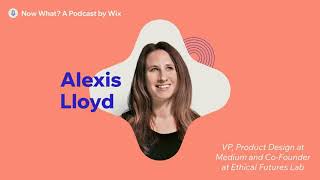
In this Now What? podcast episode, host Rob Goodman interviews Alexis Lloyd, VP of Product Design at Medium and co‑founder of Ethical Futures Lab. The conversation covers the historical cycles of disaggregation and aggregation in publishing, the challenges creators face with fragmented platforms and email newsletters, and Medium’s strategy to become a unified hub that emphasizes reader‑writer relationships, agency, and social features such as ebooks and annotation. Lloyd explains her design philosophy, arguing that traditional user‑centered design often hides the impact on non‑user participants and proposing a systems‑thinking layer to anticipate unintended consequences. She shares practical tactics for incorporating this mindset into research and design, and describes the work of Ethical Futures Lab, which focuses on nuanced, maker‑centric ethics rather than punitive theory. The interview also touches on remote‑team practices at Medium, the pandemic‑driven rapid response (e.g., the COVID‑19 blog), and the importance of informal social moments for distributed teams. Lloyd discusses emerging technologies she finds exciting—AI companion models (C‑3PO, Iron‑Man, R2‑D2), knowledge‑management tools (Roam, Notion, Coda, Descript) and the fluidity of media formats. She reflects on her career trajectory, the evolving role of product designers as generalist synthesizers who must consider societal impact, and personal strategies for recharging (nature, exercise, meditation). The episode ends with a forward‑looking view on how design, publishing, and AI will continue to co‑evolve.
Chapters
By focusing on the user, we have a tendency to obscure other participants in the systems we design who aren't end users but who interact with or are affected by the system. By focusing on ease of use, it doesn't eliminate friction in an experience, but instead kind of gets offloaded onto some of those other participants who aren't as visible to us.
Hi everyone and welcome to now what the podcast from WIX about how technology is changing everything. I'm your host Rob Goodman and in this series we're talking all about evolution in business design development and beyond. Today I'm speaking with Alexis Lloyd, VP of Product Design at Medium, the platform and website for people to write, read and connect with one another about the role technology can play in evolving user centered design. Alexis has spent much of her career at the intersection of publishing and technology. She's the co founder of Ethical Futures Lab, where she aims to influence the future of AI and technology platforms for good. And she's worked as a creative technology leader at the New York Times, focused on the future of news before joining Axios and then Automattic to transform their design practices. In this episode we talked to Alexis about the power and pitfalls of the creator economy, how Medium is building relationships between readers and writers, and why artificial intelligence might just supercharge human creativity. You're in for a very future forward conversation with the engaging and enlightening Alexis Lloyd. Let's get started. Alexis, welcome to the now what Podcast.
Thanks for having me Rob.
Absolutely. So excited to talk to you. Let's dive in and I want to talk to you a little bit about the future of publishing. You've worked at Automatic at the New York Times, you're now VP of Product Design at Medium. You have had a hand and an eye on what the future of publishing is going to be now for years and years. Where do things stand for you and where do you think it's going when
you look at the longer arc of publishing in the past? I don't know, 20, 25 years or so, I think we're seeing these kind of cycles of disaggregation and aggregation happening. So we started out in this space where publishers and publisher brands were dominant as a means of distributing and discovering content. So your sort of legacy media brands, what we'd had going on for a long time and then earlier in the Internet we started to see this disaggregation of that to some extent with the blogging ecosystem that came up in the early 2000s. But then we saw some of those blogs kind of turn into publishing brands themselves and then more individual bloggers. A lot of those got hired by traditional publishers and now work for the New York Times or the Atlantic or whatever. And then simultaneously, as social media became a dominant means of discovery, a lot of that kind of indie website culture lost some traction, as did more in depth long form blogging. But now we're seeing a resurgence of that independent creator ecosystem. And there's just been this huge wave over the past couple of years of writers and creators kind of hanging out their own shingles and doing their own things. And that's happening both because there's a range of tools and platforms that allow those creators to do that, to build an audience or make money, but also because of course, we've also seen journalism jobs continue to be decimated. So in many cases it's also happening out of necessity. Right. So we're deep in this disaggregation moment. You have all these independent creators making newsletters, sending out their stuff, writing in a new way, and there's this fantastic influx of great writing on this variety of niche topics across the board. But I think we're seeing kind of two big issues with the current state. So the first is that I think we're all starting to see how overwhelming that can be to manage as a reader, where you have all these subscriptions across different services. Some of them are paid, some of them aren't, and a wide variety of places that you have to go to get the content that interests you. And the second is just kind of email. Newsletters have been one of the primary mediums for this resurgence and they've become dominant because they're easy to publish. Your inbox kind of acts as this aggregation platform and there are mechanisms for writers to get paid. And historically, websites have been harder to make. They have limited mechanisms for notification or aggregation, and you don't have built in payment methods. But if you look at email, it's really limited in terms of the kinds of sophisticated media and content experiences and interactions that we've developed on the web and in apps. So it's not really ideal. And this is part of what we're trying to do at Medium. Like we're really trying to address those issues so that we can create the best connected space for ideas. And we want to make it easy for independent creators to share their ideas, to find their community, to get paid if they want to. And for readers, we want to create that kind of vibrant hub for a place you can go and discover those writers, those ideas, and engage with them in all the ways that we've come to expect from modern web and app experiences.
Yeah, it does feel like we're at this kind of critical turning point where, as you said, all of these capabilities are at creators hands for podcasts, for articles, for newsletters, for social media following. And at the same time, yeah, we're starting to reach that point where the consumer, the user, the reader, the viewer, the listener, it can be overwhelming, aggregating it, sifting through it, consuming it at the right place at the right time. So I love that, that intersection, that axis is where you're focused on with Medium. Talk to me a little bit about your role at Medium and your overall purview there.
I am VP of Product Design at Medium, so I have my hands in all aspects of the product experience and really work on the product strategy to help figure out what are those overarching goals that we're going after? How do we evolve the experience of sharing ideas, engaging in those conversations in a deep and thoughtful way on the web and what does that look like going forward? And I manage a team of product designers who then all work in these cross functional teams across the company to focus on different areas of that experience.
And I've heard about your work at the New York Times in the R and D lab, kind of deconstructing our current templates and models for content and thinking about the future, new technologies, new systems, new products and interfaces. When you step back and think about the future of what devices might look like and interfaces and things like that, how do you think publishing and Medium publishing fits into that when you remove it from perhaps the website, from the app system and environment? Where does content kind of meet the future of user behavior?
I think everywhere is the short answer. And that was actually a lot of the work that we were doing in the R and D lab at the Times was kind of looking at historically information, but especially news. The artifact and the content were inseparable from one another. News came in the form of an article that was printed on a sheet of newsprint and was ephemeral. And then you got a whole new set of them the next day. And a lot of the work we were doing was really trying to decouple those and investigating what happens when you decouple the content from the artifact and what needs to happen to that content, both in terms of how you conceive reporting it, how you put metadata and other kinds of information around it when you're publishing it, what those publishing processes look like when you don't necessarily know what the artifact will be because you don't just want to build that for all the current capabilities, but you also want to future proof that. Right. So if you create something now that you want it to be able to be integrated into whatever kind of device or platform comes along down the road. And so that's a lot of the investigation. And people would constantly ask, this was several years ago, but it was kind of like people would ask, what's going to win? You had this idea that print media was the winning content mechanism for a very long time. And people kept being convinced, like, okay, well, we just have to figure out which one of these things that's emerging is going to be the new thing and then we'll adapt and optimize for that. And my answer was always like, all of them. It's everything all at once.
Because technology is evolving so quickly and also because users want the content in the way that they want it at any point.
Exactly. And so I think that as those ecosystems for content and for media become more complex, it's actually for a while it was like, well, every company needs to play in each one of these spaces equally. But I think as it becomes bigger and more complex, it's more about figuring out which channels, which delivery mechanisms are appropriate to what you're trying to do and really designing a strategy around that as well.
So how about the future of Medium? We've talked a little bit and you've referenced some of the recent announcement that Medium has had in terms of ebooks and adding more social layer. Where is the evolution of Medium next in that role of digital publishing?
We really recognize that the core thing about publishing is building that relationship between readers and writers. It's incredibly valuable. It's what makes it satisfying in many ways, certainly to the writers and to readers as well. And we're working to make those relationships really core to the product experience. So for a while, Medium had been more algorithmic, where we try to understand your reading habits and then surface the best stories for you. But that's very kind of tactical. It doesn't necessarily lead to deep relationships. And if the recommendations we give don't resonate with you, it's not clear how you fix that. So we've been shifting towards giving readers a lot more agency by focusing on those relationships. So letting you explicitly control who you follow and subscribe to as a way to make it clear to give you more control and really let you develop a longer term relationship with the writers that you care about.
Yeah. And I imagine that proximity of the relationship is going to feed into the ecosystem of supporting those creators. Right. The closer the reader is to the content, the more they're going to want to support it financially, share it socially, all of that to amplify what they're loving.
Exactly. And in terms of ebooks, you mentioned that we recently acquired Glows, which is an ebook company, and we're working to incorporate books into the medium reading experience. So there's a really exciting opportunity there to bring a lot of the fluidity and the social aspect of reading everything else on the Internet to how you read books, which have typically been kind of walled off from the rest of like the digital experiences that you have. So to be able to highlight, annotate, share, excerpt and blog about books all together with everything you already do on medium can lead to something really powerful. And the goal there is really just to become the most interesting place on the Internet where you can discover and engage with ideas that range from someone's short thought or blog post all the way to a full length book.
And this might be a simplistic way of describing it, but is it about breaking books down into article formats and finding new ways to collect those article chapters into collections and then layering on some of the new features from Medium in terms of social and reading and highlighting and sharing and all of that, or is it kind of a new system for a new way of experiencing books?
I think in some cases, I mean, certainly you still want to be able to read a book as it was intended as a book, but then the way that you engage and talk about that book, or share your thoughts about it, or understand other people's thoughts about it, to be able to leverage a lot of the things we already have on medium, like the idea of social highlighting responses, annotations, to be able to pull a quote from something and then post about it on your blog, there's that kind of flexibility to it where it starts to becoming a much more digital material than it has been before.
And this kind of conversation in social experience around reading has been like a long chase in the publishing industry. I remember at my time at Simon and Schuster, leading online marketing, there would be new startups and web experiences and apps and things like that. And then when I was leading marketing for digital publishing at Google and Google Play was we were always experimenting with new ways to bring that kind of social interactive experience into apps and into the epub and ebook files. So I love this idea of finally the technology and the social sphere, the social layer we have around our media marrying up with the content. And I'M very, very excited about the experience that you all are building and I think Medium is amazingly poised to be the one to deliver one of these incredible experiences.
Yeah, I'm super excited about it as well.
So this past year has been one of such change and challenge for companies, for technology organizations, for teams. Talking about you, Alexis, as a leader specifically, how do you feel you've evolved over your time at Medium and even in your career? What are some of the things that you've leaned into over this past year specifically that have gotten you through and also helped your team manage to survive, but also hopefully thrive a bit too?
The team at Medium, we were already somewhat distributed. We had some folks in our San Francisco office, some folks in our New York office, and some folks who are totally remote. Now we're even more so, of course. Luckily I think I have a fair amount of experience working with remote and distributed teams, including at Axios and at Automatic, which is very, very distributed. And in some ways it's actually easier when everyone is remote than when you have a kind of a hybrid because it levels the playing field. So there's been that. But of course this isn't a normal remote working experience. There's been a whole lot else going on. So people are doing this with kids at home, with other folks they're taking care of, trying to work in small apartments with their partner across the room also trying to do the same thing. And everyone just having a lot of like anxiety and stress over the time as well. So I think they're kind of different levels to how we've adapted to that. So some of those are really typical remote working practices. So going really deep on real time collaboration tools. Figma, Miro, figjam is really cool. I just started playing with it. I think they've done some really nice work there. Coda, Zoom, Slack, all of those things are like tools in the repository for like getting as close to that high bandwidth kind of engagement in real time with other people as you can. And then I think that one of the pitfalls of even typical remote working is that relationships between people can start to feel really transactional. You're in meetings with people, you have these scheduled times with them. There's a lot less of that, like meeting up at the coffee station and getting into a random conversation. So I think one of the things I try to do is find time for non transactional moments. Our design team has a, every couple of weeks has a coffee time where anyone can just drop in. It's like not work talk, just get to Hang out. And just finding time both within the team and across different functions to do that is really important. And then on the emotional level, honestly, I think as a leader, we're all going through something really hard. Since it's been a long time, we can sort of forget that in some ways that this is hard. And I think there's this balance of being strong and being vulnerable. Like you want to be that rock that's there for your team. You want to make them feel supported and safe and solid and like they have the resources that they need and that you've got their back. And that's really important to have that sense of strength. But it's also really important to come to the table with like, I'm going through this too, to make that space, to have it be okay for, for them to bring that to the table as well. Because nobody's done this before, nobody's gone through a pandemic and worked together and figured it all out on the fly. So it's just been a lot of really centering in being human and compassionate with people. And honestly, I mean, I think one of the things that has been eye opening to me from the past year is just how much people can really adapt to anything. Like, who would have thought we could do this? But here we are, we're still building stuff, we're still making things even in the midst of the world kind of turning upside down.
Yeah, and let's talk about that a little bit because I am really curious about the adapting that's happened in Medium on the design team specifically. And I want to talk a little bit about your organization and, and new practices and principles that you're bringing into the systems of working there. So let's talk specifically around design at Medium and how you and your team work.
It was really interesting at the beginning of the pandemic because a lot of people turned to Medium to both share and get information about what was happening. And a lot of that was changing in real time. And it's a user generated content platform. And so there were a lot of really interesting questions to answer there to make sure that we were guiding people to the right information, to make sure that people were getting information that was up to date and that we're taking that responsibility as a platform really seriously. So I think there have been things like that that have been really specific to the situation. And I think that some of the projects that we spun up early on in response to Covid taught us a lot internally about how responsive we could be. We launched the medium Coronavirus blog within a week or two of everything shutting down. And it's been an incredible resource. And so I think that's just been a silver lining in all of this is understanding, okay, we have this ability to really see an opportunity and take it. And so that's been something, I think that's fed into the way we think about the work that we're doing. It's like, okay, if we see an opportunity, how do we jump on that? How do we move forward on it and maybe question what might have blocked us otherwise?
Hey everyone, I wanted to jump in and tell you more about Editor X, the new advanced web creation platform brought to you by Wix, the folks behind this podcast. I'm actually learning Editor X right now from my websites and I've been loving it. Editor X gives designers complete creative freedom to build incredible websites within a sophisticated workspace. It's super intuitive to use, leverages cutting edge responsive design and combines CSS level controls with smooth drag and drop functionality. This means you get developer level controls in a beautiful design environment. Editor X is built from the ground up for collaboration and teamwork. Shareable design libraries, live commenting and advanced roles and permissions means you can get to market faster and with easier workflows for hardcore digital designers. You can define the exact position and behavior of every element at any viewport with Flex and grid layouts, you can design custom interactions and you can have full breakpoint control. You can seamlessly integrate business solutions into your sites with industry leading e commerce tools, blogs, events and booking systems. Plus advanced SEO and marketing tools are baked in to support your clients success. Editor X is a highly visual platform for responsive design that also makes it so easy to add custom code and CMS to build data driven sites and complex web apps too. You can learn more about editor x@editorx.com and you can start your training with free video tutorials, lessons, webinars and more at Academy X. That's how I'm getting started. Now let's get back to the show. You wrote this article on Medium that drew a lot of attention towards the end of 2020 and it was around this idea of the evolution of user centric design and the need to basically add more perspectives to user centric design. Can you talk to me a little bit about that concept?
This really came out of some thinking I was doing and just to clarify, it's not kind of anti user centered design, but it's talking about user centered design as like. This is a framework that has been dominant in the way that we design. And if you look at one of the things that's become apparent to everyone over the past several years is how the digital products that we design and build can have these really complex impacts on the world around us, you know, from national elections to all sorts of other things. And I think that that's led a lot of people to feel a greater sense of responsibility and to demand a greater sense of responsibility from the people who are making these products and these services to anticipate and be accountable for those kinds of unintended consequences. And so really thinking through, like, from a design standpoint, how might we approach this differently or are there things that we're missing in our dominant approaches? And if you think about user centered design like it was developed in reaction to other kinds of blind spots, where previously it was really just business goals that were top of mind, users weren't really considered in the equation, and that led to a whole other set of problems. Now we have this practice that has produced some amazing products through this practice of empathizing with users, designing with their needs and wants in mind. But it is a particular lens, and like any lens, it focuses you on some things and it makes other things less centered in your view. So there are some gaps that I think we can identify. So the first is that by focusing on the user, we have a tendency to obscure other participants in the systems we design who aren't end users per se, but who interact with or are affected by the system. And in some cases, by focusing on kind of ease of use, it doesn't eliminate friction in an experience, but instead kind of gets offloaded onto some of those other participants who aren't as visible to us, who are less visible, who are less privileged. And so I think that the thinking we're doing, and I co wrote this piece with Devin Mancuso and Liz Hubert and Diana Sonis. And the thinking we were doing was really around systems thinking and how that might become sort of an additive layer on top of user centered design. So not to replace it, but to add to it as a way of better thinking through what unanticipated consequences might happen as a result of the systems that we're designing and thereby be able to preemptively counter any kind of negative effects that we might see.
I love that. How has that started to make its way into user research, for example, or UX design in your work in some cases?
So much of this is about like looking at the things that we haven't been trained to look at. So some of it comes in this really kind of organic way of just introducing kind of new ideas into the conversation. But in that piece that we wrote, we actually ended it with like, these are five kind of tactical techniques that you can start to incorporate as a way of making this not just this heady, like we should make good things and not bad things, but to actually give you some tools in the toolbox. So some of those things are really about taking practices that are part of user centered design and extending on them. So basically, if you're not just designing the happy path and the ideal flow, but actively plotting out all the ways that system might be able to be exploited, thinking through what's the worst thing that someone might do with this system, or who are my most vulnerable participants, and then thinking through those incentives, why might someone be incentivized to operate through this flow? And then how do we counter that? So there are practices like that, or really just you mentioned user research. I think making sure you have a really diverse range of voices in the room, both in terms of the team that's building things and also in terms of the users that you're talking to is important. And then there are a couple of other tools in there that are drawn more from kind of futures and forecasting practices as a way of kind of understanding, like if this, then what, like what does this make possible that we might be able to anticipate?
And these ideas, I see them come up a lot in Ethical Futures Lab, which is this organization that you've started with Matthew, your partner, I believe. Talk to me a little bit about that lab and what you're up to there.
So Matt and I first met when we were working in the R and D lab at the times, and the work that we were doing there was kind of incorporated a lot of this kind of future facing, looking at emerging technologies, looking at emerging consumer behaviors, and kind of experimenting in that realm of the recently possible, like trying to figure out what can we do now that we might not have been able to do, what could that lead to? And then like not just what is possible to make, but also what's desirable or not desirable to make. We really wanted to find space to continue that kind of work that we had been doing independently. And I think there's been a lot of conversation in the past couple years around kind of ethical design, responsible design, ethical technology, similar kinds of threads. But it felt like the way that people were talking about those things was not resonating for us. And I think it's easy to talk about ethics in broad strokes. Like doing good or evil. And we found ourselves really much more interested in the levels of decision making. What are the defaults? What's the expectation for how people use this? How do we make explicit these implicit choices that are built into the frameworks that we design? And I think really coming at it from the perspective of makers, and it allows for this much more nuanced conversation. A lot of the conversation around ethics feels very punitive almost. And in a lot of cases you have theorists talking about ethics and they're talking at the people who are making it in this very, you've done bad things, now go fix it kind of way. There were two things that were missing. One was that kind of nuance and that, like, getting down to the ground level of like, well, what does it actually mean? What choices might you make differently? Or like, what are some examples of things that people are building that point us in a different direction? Like, starting to get to that much more nuanced conversation and also like retaining this sense of possibility and curiosity about making with technology that I think a lot of people have sort of lost that sense, have become really skeptical. And I think it's possible to be skeptical and also curious and optimistic. I think you can bring both of those things into the fold. And so I think we're really looking to bring that sensibility with ethical futures labs. Like, how do we come at this? Like, well, how do we make these good things? Like, what's possible? Like, what kinds of weird, interesting stuff is emerging that we wouldn't have anticipated and then really bring it down to that nuanced level and not just have it be this very black and white
conversation From a technology perspective, what is getting you super excited right now? I have seen you post fun things about robots, so it seems like you are into robots, which I also love. But are there things happening right now in the past month or couple of months where you're like, wow, that is really exciting. I can't wait to dive into that either in my work or just for fun and experimentation.
I think there are a bunch of different things. So I. Without going too deep into it, you mentioned robots. I'm going to talk a little bit about that mostly because I think that one of the things that's really just fascinating to me is this kind of interrelationship between humans and technology and how those things respond and react to one another. And when you think about intelligent systems and AI, the three models I've talked about are C3PO, Iron man and R2D2. So C3PO is like, okay, we have AI, let's make it try to act exactly like a human. And that's really not interesting. And most of the time not super successful or a little creepy. And we have humans. We're good at being humans. I don't know, it's just not the most interesting avenue. But that's kind of the first place everyone started. And then there's the Ironman thing, which is like, okay, we have these intelligent systems, let's use them to augment ourselves and give ourselves superpowers. That's starting to get a lot more interesting. But then I think the thing that's really fascinating is this R2D2 model of these are just these kind of companion species that we get to play with and work with as these creative companions that you. You don't aim for them to be perfect facsimiles of the way a human would think about something or approach something, but instead you take what's unique about the kind of computational gaze or the machine perspective and you bring that into play and there's this way of thinking about those things not as errors or as gaps to be filled, but as differences to be enjoyed and explored. I think there have been a bunch of art projects that are really looking at neural networks, at machine learning, at AI, in ways that are much more playful with that sense of these are kind of these weird intelligences that can do things that we can't or see things in strange ways. And I find that really compelling. That's much more on the kind of playing side, though. It's not necessarily the most practical, but I get really into that stuff. I think the one other thing that I've been tracking a lot. Well, two other things really. One is I'm really interested in the kind of knowledge management space. I don't know exactly how you describe this, but there's this emergence of things like roam research and like all these like emerging startups that are doing different takes on like kind of note taking or like document management, coda notion. Things like that that I think are really interesting in terms of. There seems to be an explosion of different approaches to how you capture ideas and connect them to one another, which I'm super fascinated by. And I think that there's a lot of interesting fodder there. And that's something I'm tracking really closely and somewhat related. There's also. Do you know Descript?
Yes, of course.
That's the kind of thing like this kind of increasing fluidity of different media types is really interesting to me for Listeners.
Why don't you explain that technology?
So it's basically an app that allows you to, for example, you can record a video, it'll automatically transcribe it, and then you can edit the video by editing the text. And so there's just this kind of back and forth interplay between text and video and audio. So if you combine that with those kind of documentation knowledge management tools, you have this kind of really interesting pioneering space around kind of how we capture our ideas and our thoughts and then how we connect them to one another and then how we package those up into something that can be consumed by someone else.
Yeah, I love that. And also I think about, well, the layer of AI you might be able to add onto that so that there's learning that happens on top of your own categorization and not knowledge keeping of your life. In a way you get those superpowers, but in a different kind of way, in kind of an extended brain kind of way.
Exactly.
So are you categorizing your whole life? Are you in notion or coda? Like, have you cracked the code on tagging your life and work?
Never. It is an ongoing project. My problem is that I'm really interested in all of these. So I'm trying out like seven different apps all at once, which means I can never find a document anymore. But I'm having a lot of fun doing it.
Amazing. How about these ways of talking about ethics in design and products? I love what Ethical Futures Lab is focused on. What about these kind of micro decision moments that can impact change? Talk to me about that philosophy and talk to me about how listeners might start bringing these into their workflow.
I think it's really great to have just a set of questions in your head that you're always asking. So what's the worst thing someone might do with this is always a good one to bring to the table. Like, how might this be exploited?
Which could be awkward. Right? Like, I mean, that could be. You kind of have to stick your neck out and if everyone's vibing on something, you have to be kind of like, what's the worst case scenario?
Yeah, I think that's the trickiest part, to be honest. I think it's a way of bringing those questions to the table without losing the enthusiasm. Like without being the naysayer in the room.
Right.
I think that is super important and a hard balance to strike. But it's really understanding what people are excited about, getting on board with the excitement and then also approaching this more as like, we can make this better. If or how might we bringing this up as more of a constructive collaborative conversation rather than now this isn't going to work because people will do this with it.
Right. It's just bringing a different and new and additive perspective to the lens of product development.
Yeah. I was recently on Julian Bleeker's podcast for the Near Future Lab and he had a great phrase where he was talking about being an optimistic contrarian. And I really like that. It's this idea that you're not this total skeptic. You're not crapping on everything, but you're still excited, you still see all this possibility, but you're going to be the person who's like, but what if. You're going to bring those questions to the table, but in a way that feels really collaborative and constructive with everyone else in the room.
Yeah. We talked to Trevor Hubbard from Butcher Shop Agency on this podcast and he has this practice of pre mortems on projects where they go through what are all the ways that this project could fail in order to then safeguard its development through to launch? So, kind of similar ideas, different executions, but I love that idea of kind of let's predict the future in this room a bit and then build a better product while we're at it.
Yeah, pre mortems are really great for that. I love that practice.
So I want to talk about your career specifically because you've worked at this intersection of technology, design, publishing, future. What is it in you? And maybe it's from being a kid or growing up that has kind of driven your career choices in this way towards working on what is next.
This is actually a question I've been working on with my coach a lot. So I love that you brought it up. You're right that I work at the intersection of these different spaces and I often find it hard to describe what I do because there is this complexity to it, but it often falls into this bucket of user experience design. Because the thing I like about the practice of UX design is that you're not just designing artifacts. The artifacts aren't the primary purpose. You're really designing the constraints and possibilities for how people engage with the world. That's what fascinates me. And those constraints and possibilities also change when technology changes, which is why I'm interested in that futures space. I like to examine how people and technology co evolve in response to one another and both how the systems around us change our experience as people, and then also how we design those systems to give ourselves new capabilities or superpowers and Then the media and publishing piece is about how do we then create systems that if we're talking about constraints and possibilities for how you engage with the world, how do you create interfaces that allow us to see our world from a different perspective, like frameworks for sharing ideas to help people to absorb information and make sense of it and better understand the world around them.
Incredible. I think you're doing great work with your coach because I think that was very eloquently articulated. And it's always challenging, right, to predict where our careers are going to go. And sometimes to find that through line in the rearview mirror can also be a challenge to find that narrative. But I love glimpsing at your lens of your career in that way. So knowing you've had this front seat view on future and publishing and technology, do you have a sense of what the jobs of tomorrow are going to be in could be broader around tech or could be more in design and product development? Are you anticipating those internal evolutions as well as the product ones?
For sure. I think a lot of it comes back to what we were talking about in terms of this deeper understanding that everyone now has, that digital products can have this huge societal impact and that there is this push for people designing and developing those systems to take responsibility for that impact, which kind of changes the scope of the job. So we talked a little bit about bringing more systems thinking into play. And I think there is a tendency within design to have it accumulate more and more skill sets from other realms. But I think of it more like about deep collaboration with people who have specialization in other areas. Like I actually really believe, especially in product design, of the ability for people to be strong generalists. Specialists are really important as well. But there's this thing that is increasingly important, which is the ability to kind of take information from people with lots of those different kinds of deep specializations and like see across that and synthesize that and be able to really understand what the hole is and like how you shift something over here and what kind of impact that might have. So I think that there's going to be more of a need for those kinds of product leaders, those people who can really like synthesize and tell that story across and like start to really see how the whole thing hangs together. And that's going to be increasingly important.
Alexis, I want to ask you, over these past months, what has put fuel in your tank personally, professionally, where are you turning to kind of get a breath of fresh air and recharge?
I think the hardest thing for me over the past year or so is that it can start to feel like you're just a brain in a jar in a zoom window. And that's not a great feeling. So I've been really finding a lot of energy in anything that reconnects me with the physical. So some of that has been. Been spending a lot of time in the country in upstate New York, just like being in nature, exercise, meditation, anything that really shifts me into my body and into the world around me and, like, out of my head has been great for kind of recharging myself, not just kind of mentally and emotionally, but, like, also bringing my creative juices back if I'm feeling, like, uninspired.
Amazing. Yeah. I'm of the same mind. Running over this past year has been an amazing place and space to get a breather. And, yeah, I'll often even plant a seed in my head about a work challenge or creative challenge I have and just go for a run and see if any wires connect that may not otherwise have.
I think that's so important, actually, in terms of. I think there are two different modes of creative problem solving. And one is the mode that we're mostly in most of the time, which is, like, there's a specific thing that you're trying to achieve, there's a problem you're trying to solve, there's a project that you're working on, and you're working in this really focused and targeted way. And then there's this thing that happens when you stop, when you zoom out, when you just look around and you're not focused on anything in particular. It's kind of like the thing that they say happens when you're dreaming, which is like your subconscious brain starts to plant these seeds or tie together threads that you wouldn't ever be able to do by looking at it straight on and trying to come up with something.
Alexis, it's been so great talking to you, so appreciate your time and thanks so much for joining. Now what?
Thank you so much, Rob. It's been a pleasure.
Thanks so much for listening. And big thanks to Alexis for joining the show and sharing so much with us. I really enjoyed this conversation. It felt like a window into the future. A distant one, yes, but one that we can start working towards right now with our teams and in our practices. Some of the moments that really stood out to me from this episode were when Alexis talked about the adaptability of people and how inspiring it is to see people building, making, and finding new solutions for products. Even when the world is completely upside down. Though this past year and a half or more has been incredibly challenging and difficult. Knowing that people are out there finding a way to create and serve others in that time is definitely fuel for teams and innovators everywhere. Another part of our conversation that really stuck with me was this notion that Alexis has written about that by focusing exclusively on the end user, we can overlook other people that are a part of the system in this connected ecosystem that are still affected by what's designed but aren't necessarily the end users. She likes to direct the focus on ease of use, which helps to include those that are less visible and less privileged than end users into the design and product development process. Alexis spoke about staying curious and optimistic in product design conversations rather than being black and white about processes. So much of Alexis's thinking and her career has been future focused in her work, so I think this takeaway is really key to opening up new avenues for discussion and discovery. And lastly, when it comes to thinking about jobs of the future and where a need will arise in design and product development, we talked about the value of being a generalist, of having people on your team who can take in information from those with deep specializations, but then they're able to see across all of those areas and synthesize learnings. I couldn't agree more, and I think that those cross connecting generalists can also open up new opportunities to go deep as they see intersecting avenues that may have been less visible before. You can learn more about Alexis and all of her work, including writings, interviews and talks on the future of design, product development and AI@alexisloyd.com and follow Ethical Futures Lab@ethicalfutureslab.com too. Links to much of what we discussed are available on our website for nowwhat@wix.com nowwhat where you can also get a full transcript of this episode. Thanks so much for listening. This is now what by wix, the podcast about how technology is changing everything. Now what is hosted and produced by me, Rob Goodman, Executive Producer for Content at WIX Audio. Engineering and Editing is by Brian Paik at Pacific Audio. Music is composed and performed by Kimo Maraki. Our executive producers from WIX are Susan Kaplow, Shani Moore, Omer Shai and me, Rob Goodman. You can discover more about the show and our guests@wix.com and slash now what? Be sure to subscribe and follow the show for new episodes wherever you get your podcasts and if you like what you heard, please leave us a review on Apple Podcasts and share this show with your friends and colleagues. We'll see you soon.
More from Cardinal





Chef Noah was tired of dull tools - so he made his own #cooking #knives #chef #fyp #kitchen #shorts


every day Chef Noah wakes up and chooses violence... professionally🔪 @forgetotable #knives #chef

Mother Nature knew what it was doing with these color combos #graphicdesign #design #designinspo


Trying Modern Bread & Bagel for the first time 🥯 #nyc #glutenfree #food #shorts #foodreview
