Building Your 2021 eCommerce Strategy | Wix eCommerce School | Wix.com
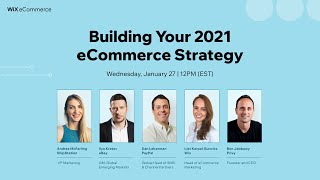
In this Wix eCommerce School webinar hosted by Liet, a panel of e‑commerce leaders from ShipStation, Privy, PayPal and eBay discuss how the COVID‑19 pandemic accelerated online shopping and reshaped buyer and seller behavior in 2020, and what merchants should prioritize in 2021. The session opens with growth statistics from the Wix platform (active stores rose from 400 k to 600 k; global revenue grew 139% in the first four months of lockdown) and personal anecdotes about unusual purchases. Ilya (eBay) describes a "quantum shift" in buyer adoption worldwide, noting that 70‑80% of shoppers in major markets intend to keep buying online post‑pandemic and that categories such as home‑office furniture, sporting goods and food delivery saw explosive demand. Andrea (ShipStation) highlights the lengthening of delivery expectations (from 4 to 8 days) and the rise of curb‑side pickup, lockers and flexible return windows. Ben (Privy) explains the surge in direct‑to‑consumer (D2C) activity, the doubling of average revenue per email subscriber ($16 → $33) and the strategic value of owning customer data. Dan (PayPal) stresses the need to support a wide array of payment options, especially buy‑now‑pay‑later, and to remember preferred payment methods for frictionless checkout. Across the discussion, the panel repeatedly stresses multi‑channel selling: adding a second sales channel can lift orders by ~35%, a fifth channel by ~255%, but merchants must balance complexity, resources and focus. Practical advice for 2021 includes testing and optimizing channel mix, investing in micro‑fulfillment and local delivery, improving website friction points, prioritising retention (loyalty, subscriptions), and treating channel decisions as probabilistic experiments rather than linear plans.
Chapters
You.
Hi everybody. Welcome to our WIX E commerce online event. Today we're going to be talking about building your e commerce strategy for 2021. We will be recording today's event. So for those of you who aren't yet part of our community, we invite you to please join our Facebook group, the WIX Stores Facebook group. And you can also find a recording of today's session on our WIX E Commerce School. My name is Liet and I lead e commerce marketing at wix. I'm very excited to be the host of today's event and I welcome you to connect with me on Twitter and I'm happy to answer any questions that you have there too. Today we're going to be joined by some of the top experts in the e commerce industry from some of the leading brands including eBay, PayPal, Shipstation and Privy. Let's talk a little bit about what 2020 looked like. So 2020 was a year that pushed brands and businesses to adjust and adapt in order to survive and thrive. The pandemic changed E commerce forever, causing a surge in growth with more businesses than ever before selling online and more consumers than ever before shopping online. If we break that down from what we saw on the WIX platform, we started 2020 with around 400,000 active selling stores and that grew to over 600,000 active selling stores worldwide. In the first four months of lockdown, we saw over 139% growth in global revenues and that continued to grow throughout the year, peaking again in the holiday season. So I'm going to go through the group and ask each of you to please introduce yourselves. You'll do a much better job than me, so just give us a little bit of background about yourselves and I'm also going to ask you to please share with us what was the craziest or most unusual thing that you bought online in the last year. So, Andrea, we'll start with you.
Hi there, my name is Andrea McFarling and I lead marketing for Shipstation across the globe. Super excited to be here with this, this great group of e commerce thought leaders. In terms of the most interesting thing that I bought online over the past year, that's a really tough question. I have been an avid online shopper for the last probably ten years or so. So most of my goods come from online. But I would say the most competitive thing that I bought over the last year was a bike for my child. That was a hot market and there was a lot of competition there and a lot of inventory challenges. As you can Imagine. So that was by far the most fun purchase that we had.
Awesome. Thank you. Yes, I too have purchased many children's items in the past year. So, Ben, over to you.
Hey everyone, I'm Ben Jabowie. I'm the founder and CEO@ privy.com we're a all in one marketing suite for small e commerce brands, email, text conversion, and this year for us, I think just kind of switching away from in store shopping to online was the theme for so many of us. And honestly, just buying things like toilet paper online and trying to get that quickly I think gave us a lot of laughs.
Totally. Dan, you please.
Hi, everybody. I am Dan Lieberman. I work at PayPal. I lead our business that supports our small and medium businesses globally, as well as the channel partners and platforms and marketplaces where those businesses sell. Very excited to be here, man. There are some dangerous answers to the questions you're asking already about shocking things we might have bought. But I do think a safe answer is you find your favorite restaurants and those that that have made the switch to effectively giving you good takeout versus not. And we found the really good ramen noodles in San Francisco that you could get takeout for that were really good. So ramen can work in a delivery format. That was surprising to me. But excited to be here. Thanks for having me.
Thank you for joining us. And Ilya.
Yes, thank you, Liad and hi everyone. My name is Ilya. I'm based in Russia and I'm general manager for ebay for global emerging markets. Actually, my team is responsible for developing 200 countries across the globe, from China down to Mexico, Brazil and so on. So for the most interesting thing, well, the one which pops up in my mind were the Oakley sunglasses which I bought at ebay. I saw them first in New York on the fifth Avenue and then I found them on ebay twice cheaper. And I think that was a very good purchase. But if you think about the most recent purchases, that was my lunch today. I'm amazed how the food delivery works now. And that's what I never did before 2020.
Amazing. So I'll share with you guys my weirdest purchase. I also bought many things, all of the staples, all of the quality groceries. Then I moved on to plants to get my house looking happier in lockdown. But I think the worst one was I have these bagels that I really love and I ordered 36 frozen bagels online and then I ended up like taking over most of the freezer with these bagels and my family was really unhappy about that. Purchase. So I've decided not to do bulk ordering anymore. I'll just keep ordering again and again. So I think we're gonna dive right into it. And I'll address the question to one of you, but please feel free to add if you have anything else that you think that you want to extend there. So, Ilya, let's talk a little bit about what you guys have seen over at ebay, how you've seen the changes in online shopping behavior. And I'm also really curious to hear your opinion on how much of that you see as short term pandemic related and how much of that you think is here in the long term.
That's a very good question. Thank you. So I think that when we speak about e commerce, it's obvious that we are speaking about buyers and sellers. And obviously as we are working across the global emerging markets, we see a lot of patterns. And there they were roughly the same across the whole globe during 2020. So I want to speak probably about three major, major things. So the first one is about buyers. What we saw in 2020 is that the market, and that's not unique to any market. Most of the markets across the globe, they made what I call a quantum shift from where they were into where they are now. We see huge amount of buyers coming into the E commerce and if we speak about statistically, US Market shifted to a year and a half in advance to what everybody forecasted in the more emerging markets. For example, Russia, we saw shift by three years. So basically we are now at the levels what we expected to have in year 24. At the same time, it's always a question like will this shift stay? Will this buyer stay or will they go? We see that first of all, so far it's not an ending story. But at the same time, there are multiple researchers right now with new buyers who made their first purchase online in 2020. And it's interesting to observe for the e commerce business that from 70 to 80% in a majority of countries, like from India to United States, United Kingdom and so on, from 70 to 80% of buyers claim that they will keep buying online after 2021, even when pandemic period is ended. So which gives us a lot of hope that yes, the world changed for e commerce and it will probably will never go back. So also interesting that within this market shift there is a tremendous shift from like, from a classical retail into online retail. The second thing is that the buyer behavior changes and I think like two major categories which were more in a latent State, but now are very, very active. One is the house whole supply. And especially in Q2, Q3 last year when everybody literally across the globe sat down at home, we started to see that people started to buy chairs and furniture and monitors and everything to make their life a little bit more comfortable. Same with the sporting goods and yoga mats. That was like one of the best hits, at least on ebay. So the home supply, the second big category is of course the food delivery. A lot of restaurants, a lot of companies shift into groceries and food. And I think this habit will definitely stay. Also. What was interesting, and maybe this is not that unique to United States or United Kingdom or more developed markets, but what I observed across more emerging markets, that the trust to the delivery very much changed. So with the pandemic, there are a lot of rules saying that hey, you need to have this contactless delivery, just leave the package in front of the door. But now it's de facto, it's the rule of the games. And we see 90% goes to click and collect, but 50% of the parcels go to the door and leave there. And so we solved somehow the trust issue. And the third thing of course is that we see that there is a shrink in disposable income. People became more savvy. They want to sel like they want to make goods not just based on the quality, but also based on the price. And here the role of the marketplaces comes in very, very important. So I think this trend will stay. We see this more and more people coming to the marketplaces and I think like, if you ask me, like one advice, like one message to the SMB population and businesses population around the globe. This is not like going. Being on the global marketplace is not a considerable strategy. It's already a must have strategy. And from there you can develop into more granular strategy across being like in a specific market with specific deliveries.
Right. So I think probably all of us have seen this massive growth over 2020 year on each of the platforms with so many more businesses and sellers moving online and changing the way that they work and do business. And as you said earlier, I think a lot of that in 2020 was that reactive mode that businesses had to just adapt to survive. They had to figure out what they were doing to keep functioning and doing business and figuring out what that looked like online for them. So I don't know if any of the rest of you have an opinion here about how this carries forward with us, what you think shoppers keep doing when hopefully life gets a little bit More back to normal. And there is the option to go into a retail store or into a brick and mortar and shop again.
Yeah, I can speak to the really the delivery experience and kind of what we saw with regard to consumer behavior over the last year. It's funny, when we looked at 2019, we actually surveyed consumers to really understand how long they expected a particular order that they bought online to reach them. And in 2019 that was four days. When we resurveyed them in 2020, it extended to eight days. So it really speaks to the supply chain challenges and consumers adaptability. I think in the next year obviously, or the year ahead, we'll see that number resume back a little bit. As more brands have overcome this and that the expectation will still be closer to faster delivery, more free shipping options. Another thing that we kind of looked at over the last year is how creative merchants, retailers got when it came to getting orders to customers in the sense of turning their storefronts into fulfillment centers, giving customers the option, you know, buy online, you know, pull up to the curbside and have their, their order put into the back of their car, maybe utilizing obviously lockers and local delivery services. So I think all of that innovation is here to stay. We saw a lot of adoption from consumers over the last year. I know myself utilized a lot of these more often. So I love to see that as we look ahead. And then the third thing we like to focus on, especially this time of the year is around returns. We just came off of the busy holiday season and brands were really much more lenient when it came to the returns policies over the holidays, giving customers more time to get their returns back to them. Before there may have been like a 15 day, 30 day returns window but you know, it's taking longer to get orders to customers. Of course when they need to return, they need to initiate it from home. So we could see, you know, those, those longer return policies kind of exist through 2021 and more flexibility there, which is great for the customer obviously. And I'll be curious to see if anybody implements curbside returns over the next year. I think that's maybe the next logical step as we think about the evolution. But a lot of great innovations over the last year.
So I love the concept of curbside returns. I would definitely take some people up on that. But Andrea, off of that, how do you think businesses need to adapt their strategy for online selling and e Commerce in 2021 and what should they be thinking about differently this year than last year?
Yeah, so competition. We saw it heat up over the last year, so many more retailers that didn't have an online presence actually moved online. So that will continue. I don't foresee any brands kind of moving back brick and mortar, going exclusively back to brick and mortar. So it's really, you know, the first thing is what Ilya mentioned about, you know, marketplaces and adding additional selling channels. Consumer behavior shifted in the sense of when people moved on. They're utilizing a bunch of different ways to find products and discover new brands. So over half of searches, product searches actually take place on marketplaces now to 30% on search engine. And then of course there's consumers that go straight to brand websites as well and buy direct. So you just. There's going to be increased pressure to be in more places I think over the next year. If you're a brand that's really looking to grow and grow sales volume. And when we looked at shipstation's data, you know, looking at merchant data, when that merchant adds that next selling channel, maybe they're exclusively focused on one and they add a second. On average they see about a 35% lift in orders, which is significant. And it keeps growing obviously as they add more and by the time they add their fifth selling channel, it's, it's 255% more orders. And while this is great, it can be very intimidating obviously if you're a smaller merchant looking to kind of fulfill and manage inventory and all these products. But there are a lot of great tools on the market today to help you with listing management, inventory management, shipping. So it's it, we're more capable, it's easier than it was historically to kind of manage this. And then the second thing I think selfishly that I always like to talk about is the delivery experience and how important that is. I mentioned the kind of the research study that we do every year where we talk to consumers about what they expect with regards to the delivery experience. And we found that 84% of consumers last year said that it's one of the most important pieces of the shopping experience online because it's really that last interaction that a customer has with your brand. So you really have to make it great and stand out. There's a number of different ways to do this, right? If you're selling, you have your own website that you're managing and you're selling exclusively through. It's really being able to answer for customers, when is this product going to get to me? How much is it going to cost me? And then what's your returns policy? Three main drivers of acquisition or converting that sale. Right. The second is really over communication around timeline for delivery. I think this last year with all the supply chain challenges, you know, somebody may order a product and then be kind of left in limbo in terms of when it's going to get to them. So there's a lot of great tools out there that can help you provide those real time updates and expectations on delivery. You know, if there are challenges with a carrier or something's delayed, making sure that the consumer really knows that when the product is actually going to arrive and it just helps with that brand experience. Right. And then I think it's going to be really important over the next year to make sure that you're getting products as close to your customer as possible and so that you're able to fulfill that, you know, that faster delivery timeline, save money on shipping. Especially when we think about the global economy and getting products across the globe. And you know, as we look back at 2021 and or 2020 and ahead at 2021, there's a couple different areas that I think there's some innovation, the first of which is kind of this concept of micro fulfillment. And we saw, you know, the big box retailers really kind of converting their part of their storefront into little fulfillment centers so that they can get products to nearby customers faster. Smaller merchants can do this in the same way by utilizing smaller kind of fulfillment centers and really densely populated areas. The second would be fulfillment networks. Merchants, you know, of all sizes can take advantage of fulfillment networks to really make sure that their inventory is, you know, housed warehoused closest to their end customer so they can get those orders to them faster and then drop shipping, which obviously works for some, some sellers, you know, maybe you can work directly and pull inventory from a wholesaler and completely opt out of really having to be part of the fulfillment process because those orders are actually being fulfilled by a third party dropshipper. So I think in the year ahead that we'll see a lot of focus there and it's just going to continue to grow. For that fulfillment piece.
I think that's really interesting. I think definitely this year posed so many challenges this past year in terms of supply chain and certainly how you're getting those orders out and dealing with the really swamped shipping providers who are dealing with all the growth too and really everyone trying to use the same providers to get their goods out. And I think that one of the things that's been interesting for us to see is certainly, for example in the uk, with changes Coming up there with Brexit and additional changes coming in that, that really takes that like micro fulfillment conversation to a whole nother level. So I agree with you. I think it's super interesting. Certainly a great way to improve customer service and time to delivery. So it will be great to see what brands and businesses are able to do in that area this year. I'm going to segue from there, Ben, to you, kind of going off of that customer experience discussion and talk a little bit about D2C. So the whole direct to consumer approach, I can even say from the wix side that this year we've seen more businesses than ever before adopt a D2C approach. So I wanted to hear a bit of your thoughts on how important you think that is for e commerce businesses and also how you recommend they invest their marketing resources this year.
Yeah, I mean this was a huge year for us. We saw over 50% growth in New installs of Privy. And those are all founders or hobbyists or scaling businesses that sell directly through their own store to the consumer. And I think a few trends we saw this year. And then I'll speak about the power of the direct channels we actually saw. Like what were hobbyists that, you know, maybe they were doing $1,000 a month on the side, maybe they got let go of their full time job this year. And we saw a lot of those kind of hobbyists convert into full time. And then we saw a whole bunch of new stores coming online, a bunch of which were kind of selling exclusively through marketplaces and wanted to kind of grow through some of their own direct channels like their own site. And so it was a really big year. I think everything that we do is about empowering these small brands to build direct relationships with customers that they own. I'm a firm believer in you need to be selling anywhere where you're potential customer is, and that includes the marketplaces. But I think if your intent is to build a standalone brand that can last and thrive, you know, I'm a big believer. And that's why we built Privy to focus on channels that you own. And to us those are your website, your email list and your text or your SMS list. So you know, one of the interesting things. So Privy, we've got about 500,000 stores that use Privy for email and text. And one of the things that we can track is just the average revenue from each of those contacts. Right. So of course not everyone on your email list is going to make an order, but in 2019, the value of an email contact was 16 bucks. Right. And in 2020, with everything that's happened, we saw the value of an email subscriber go to $33. Right. So almost double that value in terms of average revenue from a relationship that you own. And it makes sense, right? You can tell your story to that customer. You can communicate with them when you want, how you want. You can meet them in their buying journey through automation. There's so much power that you can unlock through owning that direct relationship with the customer. And I think 2020 really proved that out.
Yeah, I agree. And I think one of the things that is spoken less about in terms of all the growth is also the growth of competition that online merchants face. So it was a great thing that everyone was able to pivot. All these businesses moved online, shoppers were buying online. But at the same time, businesses today are facing, you know, on one hand, you have all this increase in demand and potential shoppers, but you also have a lot more businesses selling alongside you. So I think that focus on that D2C relationship, investing in the brand, investing in the customers that you have acquired, and building that out is a huge benefit for brands.
Yeah.
And one example there, right? Like, I think story is the foundation for great marketing. If you're a small business or a new entrepreneur selling online. And I think, you know, you can. My advice to founders that I work with is to think about the channels as really important distribution tactics. Right. You want to get in front of, you know, large volumes of existing customers, Ebay, Amazon, et cetera. But in terms of like your ability to tell your story and differentiate there, it's just harder, right? Versus if you're building your own customer database, your own community, you can be telling your story at every turn, right on your site, through your cart abandonment emails and your monthly newsletter. When you launch new products, there's so many opportunities to regularly weave in your why and remind people why you're different and you know, why they should be buying from you versus other people. And I think the founders that understand that, that go direct that focus on building that owned customer list and really weave that story in are really the ones that are seeing tremendous growth through the direct channels.
Right. And I think off of that, when we go back into this potential hybrid model where businesses are able to return to, to their brick and mortar, I think that data that you have about your customers, whether it's in store or online, and making sure that you're really able to track that full experience is so important. So I don't know if you have any thoughts about how you recommend for businesses to approach that connection back to retail when hopefully they get there.
Oh, totally. I mean, think about it. When you have the transaction data, when you have the browsing history data, you're picking up on stuff like where is this person, you know, how regularly do they engage? It's going to give you ideas on, oh, maybe you want to test the waters on retail and you want to launch some pop ups so you can look for, you know, within your own customer base on where you've got geographic focus from your existing customer base. Right. If you do end up opening stores or your stores open up, you can instantly segment a list and understand, okay, you here are all my customers in that geographic region. I want to communicate with them, tell them the reopening plan, all of that. So I think I've never heard a good reason not to build a customer list that you own. It's just kind of like the gift that keeps on giving.
Absolutely. So Dan, I'm going to hand over to you here from this. I always find that this is like the most controversial question that people want to ask me about E Commerce. Is it D2C or Marketplace? Like which way should the merchant go? And then I love the fact that you kind of own the fact that it's both and you need the marketplaces and they are amazing channels for your business. So that's kind of always my approach. But Dan, I'd love to hear from you in terms of how you guys think about it and what you've seen happening this year.
I think I am largely in line with what everybody said around the growth across all of these channels. But more than that, just the compounding of any individual sellers opportunity to grow by multiplying their own sales, by hitting many channels at once. And I think the controversy, if there is any in the question, is what's the right starting point for a merchant? Should they go build a website in the first instance? Should they sell on one marketplace or several marketplaces? And what I am so excited about, our whole ecosystem, this whole world is it's still evolving. It really is changing every day and in different ways in different verticals, in different types of industries. I think that it probably has been fair to say that the trend of the last 10 years has been to build a website and use that as a hub for selling. And of course with big marketplaces emerging, there's some types of businesses that have been very marketplace centric amid that. But I think that as we go forward, you'll see greater comfort in experimenting in one starting point, but speed and expanding to others if that starting point either works or doesn't. And it's the ease of that choice that's becoming so much more frictionless and not technical for a seller to make that choice in the first instance. And so they really do have this different menu of options to choose from as to how to get started. But I do think that what everybody's saying here is really important, which is the general trend is, and the data supports it clearly, that if you're seeking to grow your business and build a real business, not just a hobby type operation, multiple channels are the answer that is the key to growth. And relying on only one, either because it's the most cost effective to you or only one because it's a good center for demand generation is a recipe for limiting your growth. I think it was Andrea that mentioned some data about the incrementality of sales that happens when you add that one new selling channel and then the even greater incrementality when there's five. What that proves is, I think also Ben made this comment too. There are unique shoppers in these unique channels. They're not going to just meet you where you have product. You have to go meet them where they exist. And so I think as you seek to scale, more channels is likely to be better. There is going to be a question about, well, how many apps do we want on our phone? How many channels do we sell through? What's the kind of efficient frontier of that? And I don't have a strong point of view about that. But the answer is more than I used to think, and where that really comes from is I am fascinated by the trends around unique marketplaces that are popping up that sell to unique buyers. It's more surprising to me than the evolution of large marketplaces that we can name and ebay, of course, being one of them. But these more niche players have really come out quickly and gained a lot of demand. And what it shows is there's an affinity there between a buyer and a seller that you can really speak to and you can find some common ground. That makes it even more of a powerful story to tell, Ben, like you were saying, I mean, you know, some brands, they'd rather be in that unique channel as a specialty item than be on one of the biggest marketplaces where you can find 50 different competitors. Competitors. So I think those choices and that way that we see sellers evolve in those different ways, it's going to be more diversity in what we see than just one model or another.
Absolutely. I think one of the other things I really wanted to pick your brain about Dan, was what you think about the diversity, I think of payment methods and also how much shoppers expectations are changing around that. So you know, I think one of the biggest requested areas and methods in 2020 was everything to do with installments and the ability to pay over time. And you know, obviously that's relating to the situation that the world was in and people's financial situations. So how do you see this affecting businesses and how quickly they have to adapt to these changes?
Sure. First I think we can talk about just accepting payment methods that consumers want and then the specific trends there, some of those pay later trends that you mentioned. I think on the first point the simple answer is just like the channel story that were saying you need to meet customers with the way they want to pay and the way that they want to remember that payment so that they can have a frictionless experience. And so you need to provide basically every choice that your customers could reasonably want. But you have to do it in the simplest possible way. You know, 10 years ago there wasn't a simple way to accept, you know, ACH payments in the US and also the local debit scheme in Sweden. Swish. There was just no way to do that unless you went and had all these different technical pipes into your platform. And that's no longer true. You can work with providers like PayPal to have a one stop shop for all those payment types. And you can take advantage of the intelligent data that exists behind consumer shopping behavior to know what payment types are most relevant to present certain geographies and to certain consumers. But of course there's the simple technology of and then make sure that you have the capability to remember that person's payment preferred payment type so they don't have to re enter it over time. Marketplaces will do that for you. But on your own website that is something that some merchants don't yet take advantage of. And it's a simple but important tool. So holistically give your customers choice. But what we're seeing in those choices are some very interesting trends around what some people call buy now, pay later. And there are several different providers out there that are offering the opportunity for a merchant essentially to either get paid everything now, but the consumer can split up payments over a set number of terms or there's some other nuanced versions of that. But essentially merchant gets paid now the consumer can split up the payments. What I think it illustrates is whether you conceive of this as credit or not, which is a slightly controversial angle on it. It's the power of giving consumers the leverage to buy more than what they want to pay for all at once. And the need for that is something that exists in every economy over all history of commerce. What I find fascinating is the way that there continues to be innovation and that there's still relevant new experiences that can be built. And what I think you see in PayPal's pay in for option, as well as the many other providers that are out there, is there's a better experience that's been waiting to be shared by consumers. That's a simpler way of understanding the cost of those payments, and that's a really easy way of repaying it. And all of those things come together to be somewhat disruptive to what some people might think of as a staid old credit industry where you're helping consumers finance things and you're really bringing people in, especially a younger generation of buyers, who actually have a bit of a generational question about traditional credit and they're not sure whether that's right for them. But now they're learning about borrowing or spreading payments out in a way that's much more accessible. My belief is financial services are a powerful thing for economies, that they aren't villains of any kind and that they're helping build an economy and helping consumers improve their lives. And I think these innovations are just going to continue. I think you'll probably see different winners emerge in different markets. You already have seen that. And it feeds then into the importance of maybe not relying on just one option, that if you're a seller that's really looking to grow and especially be relevant in many markets around the world, that finding a payments partner and a platform partner that can accommodate choice for your customers is the real key there. But to start taking advantage of it now, because it's pretty amazing how much traction those pay later options have had. And PayPal, seeing it in our data with our recent launch, it's pretty incredible.
I think one of the common threads that keeps coming up here from all of you really is this focus on a really understanding your customer and understanding their preferences, whether those are preferences in terms of how they want to ship and get their delivery, if that's how they want to pay or where they shop, which channels they're on, which marketplaces they're in, and then meeting them where they are. And that will extend back into the brick and mortar. I think for me, the big shift when I think about 2021 is that people will still want to shop online and they will still want to shop in person and in brick and mortar. You just want to shop where you want to shop, when you want to shop. And the expectation now is that every brand and business will meet you where you want to be. So I think all of this focus that everyone's talking about, about really diving deep into that and putting that focus on understanding your customer and then making sure that you have enough choices and enough variety for them is an amazing theme for 2021. So really going deeper on that e commerce strategy, if we're shifting away from the world, kind of having to everyone shift and just get online and now how we deepen those experiences and really focus on giving customers a great customer experience online the same way that you would if you were selling in a brick and mortar. So I'd love for each of you to maybe share, as we get ready to wrap up here, share your best advice or tips for 2021 and what you think merchants can do to succeed this year and grow their business.
I'd be happy to start and I wanted to actually add something to what you said and to make a connection. I think we're seeing clearly that we've made that jump to a lot of businesses coming online that weren't before. But what's incredible is the momentum of that continues. You're continuing to see new sellers and new buyers come on board at very elevated rates to what you saw before lockdown in various places. What that says to many of us is there's still so many businesses and buyers that aren't online yet. And many people take for granted that this whole world has become digital. And what you see is there's still a lot of verticals, a lot of use cases, healthcare. Now we're all dealing with and probably have similar digital experiences that are not great. There's a whole bunch of industries that are still yet to really come and give a good experience online. So it's a bit of a balance to the point, Liat of getting in more channels, growing and becoming more sophisticated. I think one of the big themes for 2021 is not leaving behind industries that are struggling or slower to move into this digital era and helping our friends and our colleagues and our families that are in these other industries, helping pull them in and find the right tools for them among the many providers that are out there. And so for me, thinking at scale globally, that's really going to be a focus in 2021. And I want to help those industries that aren't there yet get there so
yeah, Seju, first of all, every one of you, it was an interesting perspective on the world from different angles. So I think if you ask me what I advise to think for the 2021 for the businesses, my advice would be to consider the world not as a linear consequences but as a set of probabilities and to point on like what Dan and you build on earlier regarding the distribution channels. Should I be on Marketplace? Should I be with my own store? Should I have like a direct to consumer? I think like if to put it very simple, I would say like try like all of that for your business and see like where the probability goes. Yeah, because like you never know. Like on ebay alone, it's more than 182 million buyers. Sometimes there are very weird cases that somebody from Texas in the United States want purchase from Brazil. Yeah, you never know that.
I love that Ilya And I think for all of us in E commerce and certainly where we think about marketing, it's an endless game of testing and optimization. And a channel that might work great today won't necessarily work six months or a year from now. So I think it's also something that businesses need to just accept as part of the road and you need to constantly check where your customers are, test what works and adapt as you go. I love the probability theory. Ben, did you want to add to that?
Yeah. So I'm a big believer in multi channel. I really am. The thing that I like to coach new entrepreneurs on though is like any one of the channels that we've talked about today, Marketplace, email, text, direct to consumer, like it doesn't matter. Choose a single channel. Because if you spend the time to kind of focus on a single channel, any one of the channels that we've discussed today can get your business to a million in revenue. It really can. I think the challenge that we see is when people are kind of not focused and they're chasing shiny toys and they don't spend the time to go deep. So I really think like choose one, go right, focus there. The other thing is like every single year for the last five years, there's always been some breaking change. And right now the change that so many brands are talking about is the battle between Apple and Facebook. A lot of brands buy that sell direct buy ads on Facebook and there's going to be some changes that kind of again, just like with the newsfeed, algorithms kind of make it harder to get in front of those customers. And so I think like time and time again we've seen shifts that Kind of drive the significance of that owned channel. And I know it's not the sexiest channel in the world, but like email is the gift that keeps on giving. So I think whether you start and focus on marketplaces and get to a million and then think about D2C or whether you start DTC, the earlier you start building that list, the healthier business will be.
Yeah, I love the focus there. I think one of the things that people don't think about when they're choosing channels is how much resources it's going to take from the business. And usually when we say resources we're thinking like marketing budget, but really it takes up time, it takes up your team, it takes up focus. So I agree there. I think focus in win in an area and then extend out from there.
And I would add to Ben's point, we're sitting on so much data about consumer behavior, especially on our own websites. So really identifying some of those micro improvements that you can make, tackling small things that may be causing friction in the customer journey on your website, whatever it may be, making sure to clean those up in the next year. So going and building a new fulfillment network may be a very large undertaking. Going and adding five new channels may be a large undertaking, but there's small improvements that you can make that feel a little bit more digestible. And then I would also want to point out that the focus should be really also on retention. I think so many brands picked up a ton of new customers over the last year. And while we want to focus on growth and acquiring as much market share as we possibly can, it's important to pause and look at the customers that we have and what can we learn from them, what makes them unique and figure out ways that we could get more from that existing customer base. Whether, you know, it's through a revamp of your loyalty program, starting a subscription model, there's a lot of different things that you could play with around retention that is certainly worth the consideration for the year ahead.
Yeah, I really love that. I agree. I think we spent so much time and energy and resources on acquiring customers. And of course the sale is great, right? For any E commerce business, making a sale is great, but like the long term benefit is really your ability not just to make that one sale, but to continue earning from a customer for a lifetime. So putting in that investment and thinking about that long term relationship is so important. So first of all, thank you all for joining us today. We really, really appreciate the time and I think we'll just wrap up for all of our viewers today and say that we know that 2020 was about just shifting, adjusting, adapting and surviving. But E commerce is here to stay. So whatever road you're choosing for your business, having a strategy for 2021 is important. Putting in the time to think about a plan, think about your focus, think about what's next, what's right for your customers and for your business is going to be a huge benefit to you and we hope we were able to help you think about that today. I remind you again to please join our community, our Facebook group, and also to follow our WIX E Commerce School. You'll be able to see this recording as well as other sessions and sign up for future events. I'd love to hear more about your e commerce strategy for 2021, so please share with us either in the chat here or drop me a line on Twitter. I'd love to hear what you're up to, your thoughts and plans for the year ahead. We wish you all a lot of luck and thank you for joining us today.
More from Cardinal





Chef Noah was tired of dull tools - so he made his own #cooking #knives #chef #fyp #kitchen #shorts


every day Chef Noah wakes up and chooses violence... professionally🔪 @forgetotable #knives #chef

Mother Nature knew what it was doing with these color combos #graphicdesign #design #designinspo


Trying Modern Bread & Bagel for the first time 🥯 #nyc #glutenfree #food #shorts #foodreview
