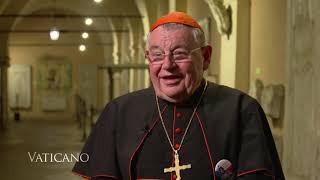
The Vatican news program covers several recent Church initiatives and stories. It begins with the World Day of the Poor, highlighting the free "Walk in Health" medical center in St. Peter’s Square, the new four‑story homeless shelter called the Palace of the Poor, and Pope Francis’ invitation to 1,500 poor people to celebrate Mass. Volunteers such as Patrizia Piacelli and Cardinal Dominik Duka describe the care provided. The segment then turns to Pope Francis’ announced visit to South Sudan, with the Pope’s remarks on the poor and a detailed analysis by peace‑process expert Mario Garofalo on the fragile political situation, the end of the pre‑transitional period, and recent floods. A report follows on a Czech pilgrimage honoring Saint Agnes of Bohemia, with Cardinal Duka recalling his own imprisonment under communism. The program moves to the United Nations Human Rights Council in Geneva, where representatives of the Holy See and the Order of Malta, notably Michael Vuthy, condemn modern human trafficking and propose consumer‑label and training measures. The centerpiece is a profile of Lithuanian Archbishop Sigitas Tamkevičius, who secretly published the underground "Chronicle of the Catholic Church in Lithuania" during Soviet persecution, endured KGB imprisonment and exile to Siberia, later became archbishop and was created cardinal by Pope Francis. Finally, the show visits the Cardinal Della Rovere palace, the headquarters of the Order of the Knights of the Holy Sepulchre, describing recent water‑damage restoration of Pinturicchio’s frescoes by conservators Cristina del Gallo and Molika Gaetani, and art historian Maria Cristina di Chio’s interpretation of the medieval bestiary iconography. The program weaves together humanitarian outreach, diplomatic peace efforts, historical testimony of faith under oppression, and cultural heritage preservation.
Chapters
Sam. This week on Vaticano, Pope Francis announces that he'll be traveling to South Sudan in the upcoming year. Discover the reasons for this trip. Meet newly appointed Lithuanian Cardinal Sigitas Tamkivicus and hear his courageous story about his fight against an atheistic regime. Take an exclusive look at works by Raphael's teacher Pinturicchio inside the headquarters of the Order of the Knights of the Holy Sepulchre in Rome. For this and more, Vaticano starts now. This year, the World Day of the Poor, instituted by Pope Francis, celebrated its third edition in Rome. The most visible among the initiatives was the Walk in Health center, built in St. Peter's Square. For 10 days, this center welcomed all those most in need free of charge. Pope Francis made a visit to greet the patients and to thank the volunteers for their dedication and time. Patrizia Piacelli was one of the volunteers, offering her time and expertise.
Pope Francis deeply wanted this for the poor. So we are in Vatican territory, right here. They have a point of reference with these doctors that come from there and all the staff that you see here are the support for then all the medical care. We have gynecologists, we have radiologists, we have the different branches that you'd find in a hospital.
Of course, in a limited way, Patrizia
welcomed patients, registered their names and passed them along to family doctors, where the patients were then sent to specialists according to their needs. Dr. Loris Pagano coordinated the work of the family doctors unit, but in urgent cases, he would intervene immediately. What did your steady.
Today? We worked on a patient whose finger was cut back in his country. He had to make a dressing, but the dressing was all dirty. We intervened, we fixed him, and he will now return to his country under antibiotic therapy for his wound.
So far, and I would say it's a good thing we didn't have anything extreme. What we see a lot is they talk a lot because they're very lonely people as well. So that's the big drama of today's world.
It's an important time. It's not my first experience, but I think it's a very useful experience because a doctor is the person's doctor. Maybe here we fully realize the reason why one studies medicine, to help others.
So here in this little room, we try to do our best. Also under that aspect, then if there's something more serious, of course, medical wise, these people will not be abandoned in the future. After this week of the poor is over, they will be cured in the hospitals here in rome.
Perhaps the 10 days of free medical care couldn't completely resolve the health problems of all the people in need. But the aim of the initiative was to introduce them to the hospitals of Rome for further care. For the World Day, Pope Francis opened a four story homeless shelter right off St. Peter's Square's colonnade, called the palace of the Poor. Pope Francis chose the name him. The building belongs to the Holy See and will be managed by the community of Sant Egidia. The Church never forgets its his first mission is to bring Christ to the people. That's why among the humanitarian initiatives, Pope Francis also invited poor people to celebrate Mass with him on Sunday's World Day of the Poor.
The poor are valuable in the eyes of God because they do not speak the language of the self. They do not support themselves on their own by their own strength. They need someone to take them by the hand. The poor remind us how we should live the Gospel, like beggars reaching out to God.
At the end of Mass, Pope Francis invited roughly 1,500 poor people to the Vatican's Paul VI hall to share a festive l.
I address a special thought to the dear people of South Sudan, whom I will visit this next year with the memory still vivid of the spiritual retreat for the authorities of the country which took place in the Vatican last April.
The spiritual retreat, with the moving gesture of the Pope kneeling in front of the leaders of South Sudan, had a huge moral impact on the situation and all the leaders of South Sudan, from President Salvaqir Turek Machar, felt this huge amount of moral pressure to achieve something, to proceed in this path of dialogue. Again on last Angelus, the Pope called again for a renewal of the efforts of dialogue and announcing also a forthcoming visit next year to the country. This could represent a game changer because in a situation in which the international community almost lost its hope on the country, still the Pope encouraged the actors to work on dialogue, to work for peace.
Mario Garofalo has been engaged in the peace process in South Sudan since the birth of the country in 2011. He explained that the Pope's announcement came at a very delicate time in South Sudan's political situation.
First of all, because we are in the proximity of the end of the pre transitional period. It was supposed to expire on the 12th of November and it will expire in 90 days, so at the end of February. So it's a last chance for them to achieve all the points that were that were mentioned in the agreement of Addis Ababa. Second, I think he mentioned South Sudan Also because of the big amount of sufferings, because of the floods, we know that Baraghazal, Jongle and Equatoria are now flooded, and it's very difficult in the country to bring food and first aid.
Around 2,000 pilgrims from the Czech Republic came to Rome to celebrate a saint honored as the overthrower of Communism.
This is a pilgrimage. It is a national pilgrimage. Thirty years after the canonization of Saint Agnes of Prague or Bohemia, actually, after this canonization, there were several demonstrations against a communist dictatorship. And it can be said that the canonization was a great signal for our way to freedom, religious freedom, political freedom, economic freedom, and in the end, really a renewal of sovereignty.
At that time, many clergy were imprisoned for the sake of the faith. Cardinal Dominic Duca was one of them.
For me, I am a Dominican, and during my novitiate I was in prison. And faith in prison is very important. There were large numbers of priests in prison, but this period was a possibility not for me, but for colleagues, because we were together with the men of Charter 77. And after the fall of Communism, our colleagues in prison became President of the Republic, Minister of foreign affairs, etc. And so at that moment, in our country, religious, ecclesiastical life was favored.
Saint Pope John Paul II canonized the Virgin Saint Agnes of Bohemia in 1989. This canonization for Czech Catholics was the first opportunity to visit rome after almost 50 years behind the Iron Curtain. And this year's pilgrimage is a reminder of the price of freedom. Next on Vaticano, a Holy See delegation at the United nations in Geneva stands against human trafficking and laments that global efforts to combat this evil are still too disconnected. Slavery is one of the gravest criminal offenses in the modern world. With over 40 million victims and an annual generated profit of $32 billion, the effects are disastrous for individuals with physical and psychological repercussions, social isolation, loss of self esteem, emotional instability, and a high risk of being retrafficed. Here at the UN in Geneva, the Human Rights Council held a session to address this scourge. Delegations from both the Holy See and the Order of Malta participated. An observer from the Order of Malta, Michael Vuthy, calls human trafficking a new form of slavery and says that the Order is working to combat this issue.
And actually, now you have more slaves today than ever in history. And slaves are even so many, so hidden, so badly treated, that indeed, we need to do something. Some people will tell you, oh, yes, I know exactly what we need is to have criminal prosecution of traffickers. I would say, why not? I would not say it's a first priority for the auto Malta. But still I know people including attorneys at law, including judges and so on, who clearly think this is one way.
Another way to combat human trafficking can be as simple as creating special labels for products.
That's why consumers should try actually to check supply chains and to say, okay, I will support this because I know this product is clean from slave labor. That could be one way. Another way would be also to try
to
make people aware of that they could prevent or they could even protect victims. And those people could be priests, could be social workers, could be humanitarian workers, could be police officers, could be immigration officers, could be airline, airline staff, or all these people, if they would have some training in identifying victims of human trafficking and possibly after that in having ways and means to take those people out of slavery.
The Order of Malta and the Holy See agreed that all of us have the ethical duty to raise our voices on behalf of the the victims and to give people a chance to live a life worthy of their human rights and dignity. Lithuania, a picturesque and peaceful city of Kaunas. Sagittas Tamcevicius was enjoying a serene life as Archbishop emeritus. And then came a completely unexpected announcement. Pope Francis was inviting him to Rome to participate in a consistory and make him a cardinal in recognition of his heroic example of faith. A few days before being made cardinal, the elderly archbishop shared with us that this special honor from Pope Francis belongs not only to him, but to the entire church in Lithuania that carried the cross of oppression during the Soviet era.
I finished the seminary in Kaunas in 1962 and at that time you could very realistically feel the sophisticated system of persecution by the Soviet regime. For example, it was forbidden for the priest to catechise children and the seminary was allowed to accept only five candidates from all of Lithuania. There was a strict limitation. As a group of younger, active, courageous priests, we came together and discussed what we could do in this situation. And we decided that if the Soviet government, if the public opinion in the world would be more informed about what is really going on in the Soviet Union, because theoretically the Soviets proclaimed that there is the freedom of conscience and freedom of faith here. So if the world would really know what was happening, they could change their attitude.
Therefore, Tom Kivicius, together with other like minded priests, initiated in 1972 the underground publication called Chronicle of the Catholic Church in Lithuania. The publication would put together concrete cases on the persecution of believers rights with details and names written down.
I have here the copies of the English language. They were published in New York. As I mentioned, we smuggled our information to the west, and sometimes in most cases, it was smuggled in the form of microfilm. The Chronicle was filmed and our friends in New York translated the material into the English language and they published it in these kind of small books.
The publication was highly effective and hit the Soviet regime in a very sensitive way, revealing their hypocrisy. He also was one of the founders of the Catholic Committee for the Defense of believers rights in 1978, where Tom Kvicius openly signed documents with his own name. He was the editor of the Chronicle for 11 years, until the regime responded by accusing him of alleged anti Soviet propaganda. Before the court sent him to Siberia, he spent some time in a KGB prison that Pope Francis actually visited during his apostolic trip to Lithuania in 2018.
Precisely speaking, I spent eight months in that KGB prison. That was the time of the investigation of my case. And then, according to the Soviet system, there was a court and the highest court, the Supreme Court at that time Soviet Lithuania, sentenced me to 10 years in prison and sent me to Siberia.
With the liberalization of Soviet politics under perestroika, Tomkiewicius was released. St. John Paul II appointed him Archbishop of Caunas in 1996. Recognizing his courage in service of truth, Pope Francis made him cardinal at St. Peter's Basilica in the Vatican on October 5th of this year. In a few moments, we'll be back with more on Vaticano. The Cardinal Dominique de la Rovere palace has a long tradition of beauty and nobility. Designed by the same architect that drew up the Sistine Chapel, the former residence of the cardinal is today the headquarters of the Order of the Knights of the Holy Sepulchre. The Governor General of the Order, Leonardo Visconti di Modrone, welcomes us and explains how the palace is a biblical talent for the knights to guard and make flourish.
So we had this talent, this wonderful building donated by the Holy see in the 90s, and we must put it to good use to the best of our abilities. Now, how do we put it to use? Maintaining it? Well, of course. And then trying to make the most of the beauty of this palace, to draw resources that we can then allocate to the Holy Land.
At the end of the 15th century by Baccio Pontelli, the architect of the Sistine Chapel. The palace is one of the finest examples of Renaissance residences. Since the time of its splendor, the palace has changed hands several times and by 1950 was almost in ruins. Then the palace was restored. However, a few years ago, the rooms experienced water damage and Quick intervention was needed. Cristina del Gallo, together with Molika Gaetani, were tasked with rescuing these important frescoes from degradation.
When we assembled the scaffolding, we realized that they were rebuilt in plaster, so the wood is only painted. And with the water there were collapses, dangerous ones. Even so, we had to rearrange the beams by putting them in real wood and fixing, securing all the painted boards of the 400 that have been re adhered with very strong screws and checked all of them in this room.
Then there was the same difficulty here as in the Grand Master's room. So there has been water damage, and because of this table damage, several terracotta tiles have fallen. Over the years,
We have been called by the Holy sepulchre to restore two niches representing St Matthias and St Simon damaged by water. The first thing we did was to secure the paint film. So we tried to extract the salts from the masonry that obscured the paintings, as well as eliminated and absorbed the yellowish stains of the water that ran behind the wall. We discovered that under these salts there were very evident remains of the painting. For example, parts of an eye, a hand, very well preserved because it was painted on a wet plaster, which then resisted the damage.
The fact is, as my colleague said, we rediscover that under these mineral deposits, the color still exists. So the color has been rediscovered also because much was covered by the old restorations made in 1950, before the restorer was a painter, so he would repaint the missing parts. But now we only do conservation. So we clean it, we fix the color, we maintain it, but we do nothing else. The aim is not to see anything that has been done. The biggest compliment is if someone says to me, but you haven't touched it. You haven't done anything, because it's a job you shouldn't see.
The frescoes were done by one of the greatest Italian artists, Pinturicchio, together with his pupils. The fact that the fresco survived such extensive water damage demonstrates its impressive quality, similar to those found in the Raphael rooms or even that of the Sistine Chapel. Art historian Maria Cristina di Chio welcomes us in the fourth room and shows us the jewel of the palace, the ceiling of the hall of the Semi Gods. Il bestiario medivale di questi animali fra veri fantastici.
The medieval bestiary that was made of these animals was both truthful and fantastical and was nothing more than the reflection of the word of God towards man. So the man of the Middle Ages, through these figures that seemed fantastic, monstrous, was trying to get at revelation. The animal that represents Christ is the griffin. The griffin that has the wings of an eagle. And therefore, like the eagle, is an animal that can look at the sun without being blind. And then there are other animals. There's the deer, which represents the faithful, the deer that drinks at the source of truth and that feeds on the fruits of nature. And therefore it is the faithful that is educated through what nature offers him. All this iconography we see here has a didactic, moralizing purpose. It is always the explanation of what the soul, what man faces during his life, meaning the eternal struggle between good and evil. Everything is crowned with the weighing of the soul, which is this archangel, this little angel here, which is actually the archangel Saint Michael, who is in charge of this task, to weigh the soul, to take him as a psychopomp, which is a companion of souls to hell or to paradise.
These magnificent paintings of the Renaissance, with battle motifs in some way tie the past with the present and resemble the mission of the current owners of the palace, who fight the battle for good.