Transforming Culture
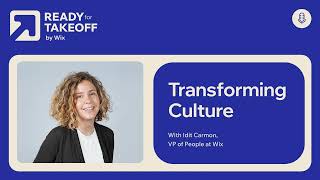
Adit Carman, VP of People at Wix, explains how the company builds culture across a distributed workforce. Trust is foundational, especially when new hires never meet in person. Wix shifted to hybrid onboarding with home-office support and regular communication, and lets managers lead differently as long as core values hold.
Chapters
Hey there. Before we get started, I wanted to ask you a favor. If you've been enjoying this podcast, we have a super fast and easy way for you to support the show. Head over to Apple Podcasts or Spotify and give us a five star rating. It takes literally a split second and will help us reach more listeners on those platforms. You can also leave us a review with suggested topics or just let us know what you love most about the show so we can bring you more of it. Okay, let's get started. Thanks so much for listening and for being here. Over the past few years, we've seen the way people work be totally upended. So how do the strongest companies adapt and how do you maintain company culture, that elusive but deeply important thing that binds your team and your company altogether? Hi everyone and welcome to Ready for Takeoff, the new micro podcast series from wix, all about hyper Growth. I'm your host Rob Goodman, executive producer for content at wix. In each episode, we go deep on one single topic in under 15 minutes, sharing insights and lessons learned from the leaders that built wix as we talk about everything it takes to build a world class global organization. Today we have Adit Carman, Vice president of People for the US at wix. For many tech companies, the distributed workforce isn't going anywhere anytime soon. So I spoke to Adit about how companies can create that sense of culture. Even as people are working from home, others are in the office, and teams and employees are spread all across the globe, as is the case here at wix. I started out by asking Adit about what she thought the most crucial part of culture is, especially for a company that's growing rapidly. Here's Adit.
So I think for me this is trust, right? Like I trust the leadership, I trust this company. And how do you gain that where you have so many people joining the company during the past two years that have never met each other and what we saw specifically in the US that we've hired so many people, we also hired their team leaders and their team leaders, managers and their group managers and site managers. And so we have chain full of people that are completely new to the company, new to this culture, new to the week's way of managing. Okay. Which is sometimes maybe not typical or not similar to what they knew. And like, how do you create that connection? And I believe that with the connection you can create also the trust, like you can nurture this trust. And I feel like at the beginning of this journey we were very reliant on the fact that we will go back to the office, and things will just go back to how they were. And once we realized that it's not happening and it will change probably for the long term, we started to make things differently in the way we onboard and the way we trust, train and maybe the support we give managers in that sense. So people really feel that they're still connected. And I have to say, it's very hard to measure it. Like, how do you measure trust? Right? Like, how do you measure connection? It's hard. You learn a lot from conversation with people. You learn a lot from people that are leaving, unfortunately. So, you know, what worked for them, what did not work, and you're trying to improve in that sense, but you really need to put that on the top of your priority. And this is definitely for us, top of priority, to see how we're able to help people get connected. I want everybody at wix to feel like happy waking up in the morning and trusting their team and trusting their managers and trusting the company, you know, on a daily basis. Otherwise, why would they. Right. We were having a lot of communication going on, sometimes a little bit over communicating, right. Like, we were new to this. We wanted to communicate all the time, to meet with the team all the time, to communicate all the time.
At the start of the pandemic.
The start of the pandemic, and then you start changing it. Okay. And you're. And you're starting to find, you know, different things and you have to reinvent yourself all the time. So again, it could be something like, how does your onboarding look like? Okay. And what type of activities we offer you after work sometimes, and how we can support you with building your home office and, you know, simple stuff like that. Or what are the courses that maybe we offer you to manage your time better or if you're a manager, you know, to manage a team remotely. And this was gradual. Like, it's. Again, it's a discovery. So you're trying to find the things that will help people understand who you are as a company. When we saw that, we had times that were unbearable to our employees. Sometimes, you know, as a company, we said, okay, hey, let's take a day off, just, you know, to relax and recharge. So we're trying to, you know, in different ways, help people connect to who we are. Okay. And understand through that and through how we're working and how we communicate with them, understand what this company is about. And hopefully with that we'll build trust. It's not about us promising something and now, you know, meeting this promise or not, it's not about that. It's about, you know, day to day, day in, day out, like how do you connect with the team? What is the message that you get from your manager? What are we pushing our managers to do and to communicate all these things that are on a daily basis, on a day to day that hopefully then builds up and nurture a better relationship and then trust as well.
We've talked about through the crisis of the pandemic, we've talked about growth in terms of number of people joining the company. How do you think of culture as it relates to all of these teams spread across all of these geographies across the world, where there's local culture that needs to be infused, there's the corporate kind of vision of culture and it all needs to connect and it all needs to work, but also needs to be personalized. What is the approach and the strategy when it comes to dealing with that kind of growth and that kind of distributed team?
So I think the beautiful thing at WIX is that we never hung up on any conference room in our company. The list of values, we talk about it sometimes we have it in our library for people in their own boarding so you can review it. But most importantly, I don't think that everybody remembers our value by heart. It's not about that. But I want to be in a position that for the majority of people, if I ask them what's the culture of wix or what our values are, they will say something that is probably very, very, very close to the formal values or the list of formal values that we have. And this happens in, I think in a company that has a really, really, really strong culture. So the way I feel it's working here is that there is some kind of a magic that happens in the energy between people talking at wix, I guess. So there's something just very natural that allows you to bring your true self to work. Like you don't have to wear any imaginary suit or be someone that you're not. And I think it frees a lot of the heavy weight of you trying to perform or you're trying to be something you're not. And when that doesn't happen and you can just be yourself with everything and we're none of us are perfect, right? When this happens, really, you know, I feel like the magic happens and then you don't need to know or remember the list of values. But you understand just from seeing how people communicate, how people interact with each other, what they're wearing. Sometimes how they talk, you know, what is the process that they follow or how they think that makes you kind of understand, oh, this is it. So if someone is just talking very freely and giving, you know, straight feedback in a meeting with multiple people, this can surprise me at the, you know, the first meeting that I participate in. But then on the 10th meeting, I understand, oh, this is what they mean by just being direct. Okay. You know, just be yourself. Right? Just say, you know, so you don't necessarily need to learn the values, but you know them because you're part of what's going on. So the culture doesn't have to be exactly the same. Okay. We don't need to see everything the same way. There's also something, you know, we have differences between teams, between different groups, between different products within weeks that creates a little bit of a different culture. We have differences just from being spread all over the world and, you know, being from different areas on the globe, that also changes something in the culture. We have different managerial style. There's no one manage like, we don't force you to manage it in a very, very strict way, right? Like, you get the tools, you get advice, you get, you know, things that are important for us, but we don't necessarily tell you this is how you do it. So different managerial styles also creates, you know, different subcultures. So all of that is great. I think it happens. It's very few things that we care about mostly, and if we're able to recognize them between teams and between countries and, you know, between different products, that's the most important thing. The how is less important. And if you're a manager and this is what you want to adopt, go for it. Nobody's going to tell you, but as long as it's aligned with really the
core values that we have, yeah, I love that. Freedom and space to move and be oneself and work in a way that's going to be most productive. It feels freeing, but it also feels like a chance for everyone to bring their own personalities, their own Personas, their own experiences to the role in the goal of moving the company forward through all the work that these teams are doing.
And by the way, it's not great for everyone, right? Not everyone can feel like they connect to that. Some people need a lot more framework. They need to understand exactly not only what to do, but how to do it. And for some, this might not work perfectly. And also, I'm always concerned when I talk about the culture because I really love the culture of this company, but. But I'm not here to say that everything is working smoothly. Right. And everything is great. Yeah. I think it's really important to be connected to our values, to remind ourselves, hey, why are we here? What are we doing these things for? Why are we trying to change things so we are able to maintain the things that are really, really important for us at the end of the day.
Thanks Adit, for joining the show and for sharing so much with us. One of the biggest takeaways for me from this episode is that everything is constantly changing. We all know that and it's okay to admit it to ourselves and to our teammates and to the people that we're leading in our organizations, and that you don't always have to have everything figured out or know all the answers. So much of both business and life is just paying attention to yourself and to the people around you, seeing what's working and what's not and adapting as quickly as you can. Company culture is no different, especially during these turbulent times. So how has your team been evolving over these months and years? Is your company culture changing or just taking on new forms and shapes, new habits, new rituals? Maybe in person, Maybe remotely? Tell us what you've learned on social at wix. We'd love to hear about how your teams are building culture and are still thriving on amidst all of this change. Ready for Takeoff is brought to you by Wix Now. If you don't know about Wix, we're the all in one platform for running your business online, trusted by over 210 million people around the world. With Wix, you get incredible security, reliability, performance and SEO. No matter the kind of business you run or the size. With Wix, anything is possible. So visit Wix.com to start building and growing your business today. Thanks so much for listening. You can find more episodes and information on our website@wix.com readyfor takeoff ready for Takeoff is hosted and produced by me, Rob Goodman at wix, with production by Lindsay Jean Thompson at wix. Audio engineering and editing is by Brian Paik at Pacific Audio. Music is composed and performed by Kimo Maraki. Our executive producers from WIX are Susan Kaplow and me, Rob Goodman. We'll see you next time.
More from Cardinal





Chef Noah was tired of dull tools - so he made his own #cooking #knives #chef #fyp #kitchen #shorts


every day Chef Noah wakes up and chooses violence... professionally🔪 @forgetotable #knives #chef

Mother Nature knew what it was doing with these color combos #graphicdesign #design #designinspo


Trying Modern Bread & Bagel for the first time 🥯 #nyc #glutenfree #food #shorts #foodreview
