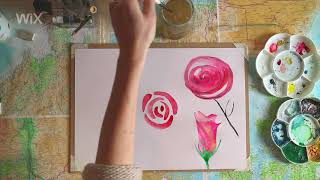
In this instructional video, the presenter walks viewers through a watercolor tutorial for painting roses, beginning with a light pencil sketch to map composition. Three roses are painted, each illustrating a different artistic approach: a simple, stylized shape; a detailed, realistic rendering using wet‑on‑wet techniques; and a semi‑abstract, stamp‑like version viewed from above. Throughout the demonstration, the presenter discusses the pitfalls of perfectionism, encouraging learners to accept the medium’s inherent unpredictability and to view mistakes as creative opportunities. The tutorial highlights practical watercolor methods—layering, color contrast, and controlling water flow—while drawing parallels between the fluid nature of watercolor and life’s uncertainties. The speaker emphasizes mindful practice, the value of experimenting with both detailed and abstract styles, and invites viewers to explore their own preferences, promising regular future videos.
Chapters
So, as you can see, I have set up and ready to start this painting. You can see I did a very light sketching at first. It's just a bit of pencil on the paper, and it helps to know in your mind's eye where the different flowers are going to be. I often paint straight away with paint, but for many of us, it does help to make little light sketch before we start painting, just so we don't get distracted and that we know where what our composition is going to be and where all the different flowers are going to appear on the page. So, as you can see, I've started with the red flower at the top. And it's a very stylized, simple depiction of a rose. It doesn't have really many individual petals. It's a very simple shape in a simple form. And anyone can make this. It's so easy and so fun, and it looks beautiful if you make a whole bouquet full of these round flowers, or if you use it to decorate, say, stationery, or you write a letter to put a few of these flowers around the corners. So there's many ways in which you can use something like this to just make normal pieces just a little bit more special or a little bit more fun. Something else that I wanted to talk about today, and I already hinted to it earlier, is perfectionism. Perfectionism is shown to not be good for us at all, even though being a perfectionist in our modern society is often seen as a quality that we should strive to. The problem with perfectionism is that it can wear us down and it can stop us enjoying things that we should be enjoying, instead of letting the weight of trying it to be perfect hold us back. Perfectionism is when you set yourself such high standards and often unattainable standards that it's so easy to feel them, and it's almost unrealistic to actually match these standards. And if you don't actually hit the standards that you've set for yourself, you feel deflated, you feel maybe a little bit sad about it, or it gives you anxiety, or maybe, yeah, it makes you feel really bad about yourself in other ways. And that feeling is actually not very helpful. As you can see, we've moved on to paint our second flower. It's a very different style from the first one. Even though it's the same flower, it's still a rose. We look at it from a different angle, and I'm using much more detail to actually show all the different petals and the different textures of these leaves. But the first one was just a round, very simple shape. This one has much more edges and it's much more precise and detailed. Even though I'm still using wet on wet techniques, I've made the paper a little bit wet where I used to paint. You can see that there's much more detail in this, in this little painting. When we make a painting like this, there's so many examples on, for example, Instagram and other social medias where people make the most beautiful, amazing flower paintings. And sometimes it's so easy to compare yourself to what others have made. But don't forget that everyone started as a beginner first. No one just knew how to do these things straight away from the first time they tried it. And there's so much joy. And it's so amazing to go through the learning process and actually enjoy the failure and enjoy the fact that you're learning something new. And it isn't easy, but with hard work and dedication and practice, you'll get better. In going through that process of seeing yourself slowly improve. There's so much to learn, and it's so fun to see yourself go through a stage of improvement. If you be perfect at everything you did the first time around you tried it, wouldn't life be a bit boring? I think so. When we make a painting like this, where we paint flowers, there's so many different ways of painting a flower and showing off a flower. And I think so there's something in there for everyone. You can make really detailed, really detailed painting with lots of little petals and where you show all the nerves of the leaves and all the. All the little intricate details. But you can also make something a bit more stylized and a bit more. Maybe a bit more blunt or more robust or something that is a little bit more abstract, maybe, and both are equally beautiful. And if you. It depends a lot on what setting you want to use the flower, how much time you have to spend on making something, and what the final result is that you're aiming for. Sometimes it can be really good to pick something really precise and focus on the details and really spend a lot of time analyzing what something looks like and then try to make it as lifelike and precise as possible. But other times it can be really fun to analyze the bigger shape of something and just make an impression of that object, of a flower or house or an animal, but make an impression of that object in an expressionist and fun way where the emotion is more important than the lifelike details of that object that you're actually painting. I hope this makes sense. So what I'm Saying is that it's good to practice something that maybe is not your first instinct to make it. Maybe if you always paint really detailed, try and make something a little bit more abstract and try and make something that focuses more on the color or on the larger shapes, or focus something where you can use the contrast of the color to give it a really fun and vibrant setting. I bet if you paint quite regularly that you will see other things in your painting, that here you will see other things in your painting come forward because of trying something else and looking at it from a different angle. So I've started to paint the third flower of this collection. Now, as you can see, this, again, is a very, very different style from the other two. It is much more stylized again, so maybe a little bit more similar to the first one than it is to the second, second one. And you can see the rose from above, so you can see all the individual leaves that fold into each other. And I really love how the middle of a rose is really tight and has leaves really close together and really folded really neatly into each other. And then towards the outside, they become a bit more loose and a bit wider. And that's the sort of effect that I try to create in this painting. It does help to make a little sketch here, which I did as well, just so you know where the different leaves are going to be. You can also just start in the middle and put. Start with a little circle and then start folding all these leaves around it and make it wider and wider the further you go out. So you can make it as detailed in the middle as you want or keep it quite open, as I've done. I actually really like this so much like a stamp of a rose. And I think it looks really fun and, yeah, really pretty. And it's very quick to do. You can really use your watercolors to your advantage here. So you could even, say, put some darker colors in the middle and some lighter colors to the outside, or paint some leaves, some green leaves around it once you're done with the inside. And you can really play with it and make it a really good, fun and playful little painting. The. What I love about water paint is that being a perfectionist is almost a bit impossible because the water has a mind of its own. Water just flows in places without, you know, asking you for permission to go it. To go there. And it just flows in places to. Yeah. And moves the painter. And sometimes it can be a bit unpredictable. And once you accept that. That the paint can be unpredictable, actually, sometimes these fun Little accidents that you have because you know it's spattered somewhere. Or the paint run to a different area of the paper and created a big blob of color there. Once you accept the fact that the paint does that, it becomes so much more fun. And actually, these shapes that it creates accidentally can sometimes be the most beautiful shapes in your painting. Because it looks natural and not forced. For me, watercolor painting is almost an analogy with life. Because you can't always control everything. You can't always know what to expect. You don't always know what the outcome is of things that you do. And for me, watercolor painting is just that. You don't always know what the outcome is of what you make. Naturally, the more experience you have, the more easy it is to predict the outcome. And that's the same in life. The older we get, the more experienced we get. And with actions we take, it becomes easier to know what the results of our actions are going to be. But still, there's always an element of unpredictability in this work. In watercolor as well as in life. And I think because of that, it makes it such a perfect medium to do mindful painting with. I really love watercolor. I love how you can create these really soft, light areas of the paint where you blend it with lots of water. And I love how you can make it more opaque by layering it up. Sometimes you can see the layer underneath shine through. And there's so many different effects that you can create up way. And I absolutely love them. I'm really curious to hear what your approach to painting is. And if you prefer something a little bit more abstract or something a bit more detailed. And what is your favorite and what do you prefer making? I'm planning to create at least one of these videos every month. And maybe more when I get the hang of it a little bit better. And I hope to see you again soon. Thank you, Sam.