Wix | Live Webinar: How to rank with AI content
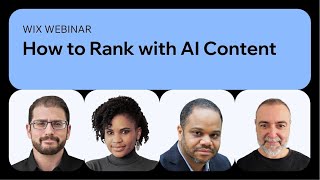
The webinar, hosted by Wix SEO Communications lead Crystal Carter, featured a panel of AI and SEO experts—Dale Bertrand (Fire and Spark), Giuseppe Caltaviano (Raw Content), and Morty Oberstein (algorithm specialist). The discussion covered a shift from traditional, traffic‑focused SEO to an "SEO for revenue" mindset that prioritises high‑intent searches and conversion pathways. Dale presented four AI‑driven content templates (niche buying guides, Q&A, comparison pages, and niche calculators) and demonstrated how to select intents, align calls‑to‑action, and reverse‑engineer SEO from conversion goals. He also shared a toolbox of AI utilities (ChatGPT Plus, Chathub, GPT Store, GPT‑for‑Sheets) and practical spreadsheet workflows for generating content ideas at scale. Giuseppe emphasized the importance of humanising AI output, integrating expert‑driven content, and maintaining quality—highlighting that Google penalises low‑quality, un‑humanised AI content regardless of its source. Morty reviewed recent Google algorithm changes (product reviews update, the now‑integrated helpful‑content signal, March 2024 core update, and spam update) that target low‑quality, programmatic content and reward first‑person expertise, nuanced experience, and original research. The panel discussed client case studies (medical weight‑loss, financial institutions, food‑delivery, insurance comparison) illustrating the impact of these updates, and explored emerging challenges such as measuring visibility in generative AI search (SGE, chatbots) and the concept of LLM optimization. Throughout, the speakers offered actionable advice: use AI for research, briefs, and short‑form copy; always edit, fact‑check, and add human nuance; focus on engagement metrics; and monitor evolving search platforms. The session concluded with a Q&A, a reminder of post‑webinar resources (slides, QR code, Wix SEO Learning Hub), and an invitation to an after‑party on Discord.
Chapters
We are going to be sharing here and hearing from today from Dale Bertrand, who is the founder and the head speaker and he goes all around the world. He's spoken at Inbound and every other conference you could possibly think of, including Brighton SEO, about AI and lots of other things as well. So Dale Bertrand is going to be joining us from Fire and Spark. And we are also joined by the incredible Giuseppe Caltaviano who is joining us from Brazil. And you can observe his fantastic horticultural skills in the background background of the, of his, of his setting as well. But he's also going to be sharing some wonderful things about some of the things they're doing with AI. And you're in for an absolute treat today because our very own resident Mr. Morty Overstein, Algo Smith extraordinaire, is going to be talking to you all today a little bit about just jumping in a little bit to talk about how AI is, is impacting Google's algorithms. Today we're gonna have a little bit of a round, roundtable discussion about that as well with our illustrious guests. So just a couple of FAQs for anybody who joins a little later and all of that. Yes, the webinar is being recorded and yes, it will be sent, the link will be sent to you in an email when it's posted. It normally gets posted around, around Friday. So if you go to the wix channel on YouTube, you should, you can see it there. You could also see our other webinars from the past there, which all still have fantastic, wonderful information. So do check those out and you can ask questions in the Q and A panel. You guys are using the comments panel, which you can use to, you know, to put fire emojis and lots of other wonderful things in throughout the session. But we also have a Q and A panel and people will be answering as many questions as we can there and we'll receive themes, we'll pick up those questions towards the end as well. And also you can check out our future webinars and at the WIX SEO Learning Hub, which is you can find lots of information about, about AI, about lots of these other topics and you can get stuck into all of that. And today's running order, we've done our introductions. I'm Crystal, I'm the head of SEO Communications here. And so I'm going to be sort of guiding us, guiding us today. And then we're going to hear from Dale Bertrand who's going to be talking about some of his work that he's done with AI and ranking AI content and how that all works. We're going to hear from Giuseppe as well, talking about how he has helped clients talk, get some great results with AI. And we're going to talk to, we're going to hear from Morty about some of the AI, the AI implications of some of the algorithms that are going on. And we're going to have a little discussion and a little Q and A. So thank you so much for joining us. I am just going to stop sharing my screen and I'm going to pass it over to Dale.
Awesome. And I want to thank you for having me. We're going to be talking about growing, basically growing your business, not just your rankings and how we're using AI for SEO content with the SEO work that we're doing. And I'm going to jump into it because we don't have a ton of time here. But what I always like to start with is old school SEO for rankings versus SEO for revenue. Old, old school SEO for rankings is really about traffic acquisition, where what we care about is ranking, often for vanity keywords or high volume keywords. SEO for revenue is really about customer acquisition and this is really the mindset that we want to be in for the changes that are happening with Google. And then also when we're using AI to generate content, we want to make sure that we're building content that is designed to convert our customers and attract high intent searches. So I'm going to talk a bunch about that. Now when we're doing old school SEO for rankings, we're asking questions like what keywords have the highest volume and does our pages, do our pages load fast enough? And how are we going to track all of these rankings that we're going after? But when we're focused on customer acquisition with what I'm calling an SEO for revenue approach, we're really focused on what are the highest intent searches that we should be targeting because these are the most likely to convert for us. And and then also what information do our best customers need when they're making a buying decision? These are the questions that our best customers ask when they're, when they're searching for a product or a service like what we offer. And then also how are we tracking sales and conversions, not just rankings. Now this is some info about me. You guys can get the slides and learn more, but I'm a technologist and programmer. I moved over to Marketing in 2008 and I run a marketing agency right now where we're focused on SEO. So we only do SEO strategy. Strategy we don't pretend to be world class in anything else. And we've worked with a bunch of clients. You may have heard of some of them. Now I'm going to start off here with a quick story. Now these are some creepy looking dolls. These are American Girl dolls. My daughter found them online watching YouTube videos. And right when the pandemic started in 2020, she wanted to go to the American Girl store in Boston for her birthday, but it was closed. So we ended up finding an American Girl doll online. But they're very expensive. You often have to sending your daughter to college and buying her one of these dolls. Then one of her friends told us about a used American Girl star. So we were looking for that, trying to find it. It was open, but my daughter didn't want a used doll. Lesson learned there. What we ended up doing was taking a road trip down to American Girl place in New York City from up here in Boston. It was a wonderful trip. And what I found, what I learned at the American Girl doll store, is that you can make a an appointment to have your doll's hair styled next to your daughter's hair. And they just confiscate your entire wallet if you want to do anything like that. Now you guys are all wondering, why is Dale talking about American Girls on an AI for SEO content webinar? The reason why was during this entire process, we were typing American Girl into Google, but we had a different intent behind our searches every time. At the beginning we were looking for the store in Boston. Then we were looking for the use American Girl doll store. Then we were looking to buy this, the doll on Amazon. Then we were looking for the store in New York. Then I was looking for directions to the store in New York. Then I was looking to make an appointment to have a doll's hairstyle. I can't believe I just said that out loud. But every time we were searching, we were searching for something different. So this is the keyword that has a lot of different intents behind it, what's important for us and when I I'm going to show you guys my AI powered content recipes. What's important for these recipes, how we chose them, the reason why they work is that we're targeting the right intent. The intent. If I, if I run a used American Girl doll store that is brick and mortar in Boston, I want to target intense where people are looking for an American Girl doll store, not people who are looking to have their doll's hairstyle. These are all different intents and targeting the right intent is what's going to make our content convert. Now, when we're planning for conversion, what matters is we choose those intent which match up to what we the product or service that we sell and we match it up with a call to action. Now the call what the call to action needs to be relevant to that particular intent. Whether somebody's looking to buy a dollar online or they're looking to make an appointment, or they're looking for directions, the call to action and the messaging needs to be aligned with that. And then the content that we create for SEO, the role of the content, the only purpose of the content when we're focused on conversion is to bring people from the intent that we're targeting to the calls to action that we identified up front. Now, quick example here. We had a client that came to us, they were a financial institution, they wanted to rank for the keyword donor advised fund. I had to tell them that's probably not the right keyword because people who are searching for donor advised fund, usually they already have a donor advised fund account and they're looking to figure out how to file their taxes. Now a donor advised fund is if you have a, a lot of money, you can put some money in this account and you get a tax break, just like if you had given it to a nonprofit. That's why people want one of these funds now. So instead of starting with a keyword like donor advised fund, it would be better to start with an intent like the search intent to open an account with a financial institution, to open a, a donor advised fund account with a financial institution. That is the right intent for us to target, to build content that will convert if we're a financial institution trying to, trying to basically sell more of these accounts. So what we do instead of keyword research upfront, we identify the search intents up front. That's the first thing that we do. And one trick that'll help you to identify search intents is, is start with a verb. Like you're trying to get people to come to your website that are looking to open account or buy diapers or apply for a mortgage, things like that. The other thing we do up front before we do keyword research, before we do an SEO technical audit, is we identify the conversion point. So how are we going to convert these people that are searching with the intent that we identify? And that's important because the role of the content, when we choose the type of content and the topics, is to bring people from the search intents we identified to those conversion points. So Basically what we end up doing is reversing the SEO process where we're starting with conversion up front, then we're thinking about authority, then the content types and then we're. The icing on the cake is the con, the optimizations, the page optimizations that you would normally do. Now I'm going to give you guys four AI driven content recipes. I'm going to go through this quickly. You can grab my slides at the end. But we're looking for types of content that can be assisted by AI in terms of the copy and the visuals. And we're also want to make sure the content targets the right intent like I just talked about and it's trusted. It could build authority for the website and it will convert visitors when they land on the page. So that's how I came up with these content types. We're doing a lot of niche buying guides both for products and services. You can see the example here is pretty niche. It's not just curtains, it's blackout curtains. As long as these pages are helpful, they have to be useful. Google needs to see engagement with these pages in order to prove that they're useful. These will work for you then. Also Q and A Content is doing well. We want to make sure that we're targeting high intent searches. So if somebody's searching how do I clean my ski boots? They're probably not in the market to buy ski boots. Like somebody who's searching for how do I size my new ski boots. That's, that's a higher intent question to answer. Then there's comparison content. This is an example from a startup here in Boston that I advise. They have a paid page on their website, like a thousand of them that compare every insurance company, every other insurance company. These pages will rank for keywords like is farmers a scam? Or what is farmers pricing or is foremost pricing competitive? Things like that. And they need to be useful. We build out one template that's visual and it uses data. This is data in the financial space. So you can just download the data and then niche calculators. This is a mortgage calculator. Now we all know the web does not need another mortgage calculator. But what we did is we created one calculator and we put it on pages on their website. You know, one of them was beach house mortgage calculator. Another one was second home mortgage calculator. Another one was vacation house mortgage calculator. The reason why I like this strategy going forward, even though mortgage calculator is probably not the best place to do it is because it's getting easier to make these types of calculators on your website with AI tools. So it's important to read the results. The the what this is about is when you've got a keyword. In this case, the example is medical weight loss. Type it into Google, see what Google is showing on the search results page. Google knows what the intent is behind this keyword. That's how you'll figure it out. In this case, my client wanted was selling medical weight loss drugs. But what Google was showing was a map. So that means that people who are typing this keyword, they're actually looking for a local clinic, not a medical weight loss drug. So that was what we figured out. Now I'm going to very quickly go through some AI tools that I use. I have a chat GPT plus account. You're going to need one. It's 20 bucks a month. It's worth it even if your employer won't pay for it. Very important because you get access to like advanced data analytics which allows you to process spreadsheets and build visuals. This is a no brainer at 20 bucks a month. I use a Chrome plugin called Chathub. It allows me that when I type in a prompt, it'll give me the result from six different LLMs like chat GBT at the same time. The reason why I like that is because sometimes Claude is better, sometimes Gemini is better, sometimes Chat GBT is better for a prompt that I'm developing. So I like to see what all of them say. Then there's GPTs. When you buy your chat GPT plus account, you'll have access to the GPT store. There's GPTs that write content briefs, there's GPTs that create infographics. Like it's just insane how useful these GPTs are. So highly recommend that you buy that ChatGPT plus account and check out the GPTs that people have submitted. These are GPTs that people created that are submitted in the store. Then the last tool that I use every day is GPT for sheets. So if you go to gpt4work.com you can install this GPT for sheets plugin. And what it gives you is a new function in Google Sheets called the GPT function. And that will allow you to create a prompt in a spreadsheet and then send that prompt to ChatGPT and you get the result in the spreadsheet, which is insanely useful. Imagine I'll tell you about this example, but imagine you have a spreadsheet of product data if you run an E commerce site, you could drag this GPT function once you've created the prompt in the spreadsheet and get metadata or content ideas or whatever it is for all the different products. The example here is giving me content ideas for, for construction companies looking to, or sorry for a client that's targeting construction companies that are looking to hire people in the trades. And what you can't see here is that there is a. Oh well this is the prompt right here actually you can see the prompt and you can see the result from the prompt here. And there's more in this spreadsheet because every row is a different type of content. So I can just plug in the target audience, the search intent, basically these four things up here and I get rows and rows and rows of. I get rows and rows and rows of different ideas for content, like brainstorming ideas. Now last thing I'm going to show you guys, I have my SEO for Revenue Resources guide that has more AI driven SEO content types and more of the tools that I use. So feel free to use this QR code to download my guide and here's my email address. I'll put some more contact information in the chat if you have any questions. Absolutely. Reach out to me because I love talking about AI tools and SEO content.
That was absolutely fantastic. Such a great introduction, really. I've got. You are awesome in the chat from Flow Mint in there and lots of people saying that it was really helpful. Kenzie asked if we were going to send the slides. We will send the slides afterwards. They'll be on the website. I should also point out that we will have a little after party on the, on the WIX studio. Discord and I will share the links that Dale's shared in this, in this section as well. So. So yeah, Dale, thank you so much for that. We everybody hold your questions or put them in the chat or put them in the Q and A now. We'll discuss them at the end. I want to make sure we've got some time for Giuseppe to share his, his great insights as well. You guys are in such for such a treat. We really got two great experts here.
Thank you very much. Crystal, can you hear me well? Okay, I think everything works. Thank you. Well, first of all, good morning, Good afternoon. Depending on where you are connected from. Hello from London. I would love to be in Brazil. Unfortunately I'm here in London where it's still raining. So what we will see today is how to create AI content from a content perspective which I think it pretty well complement with what Dale just presented. There are some overlaps, of course. I mean content and SEO are good friends. But let me, let me talk about first of all who I am. I'm the guy on the left. The guy on the right is my dog, Eddie. Raw Content is a technology company. I'm vice president of Raw Content or marketing. Raw Content design marketing solutions that allow brands to manage the full content creation cycle. And our offering combined SaaS platform, but also global network of content creators which help brands with building content creation for brand awareness and activation. Let me start saying that we all know this so I will not spend too much time on it, but 2023 last year was pretty interesting for all of us. All the new updates created some kind of instability in rankings and that's something that we have seen with many clients. Very well established blogs with a long term content marketing strategy that was already consolidated, you know, and had pretty good results. Well, they were impacted pretty hard. And the interesting point is the traditional strategies like updating content or increasing publishing recurrence, well, they no longer started to bring the impact that they previously had. And then this year, just a few weeks ago, we discovered about the new core update which in a way reinforced exactly what happened one year ago. And it is interesting to note first of all that Google is not penalizing AI content. I think this is one of the answer we need to provide to today questions. So it's not necessarily related to AI, but at the same time what we discovered is that the majority of the sites that were penalized or the indexed were all using AI not properly. And that's really the difference. It's just about quality. It doesn't matter if content has been written by AI or humans. That's really what will be penalized. Poor content creation, quality. Regardless where this is coming from. Now let me go with our approach, which is basically the one we use with our clients. First of all, we test everything before we suggest anything. We have a content lab which is by the way, our blogs. We have two main blogs, one in English, one in Portuguese. Overall they attract about 2 million visits per month, which is pretty significant. So it give us the possibility to test, you know, all things on our blog even before we suggest anything to our customers. And then at that point we validate and, and finally we implement with our customers. So that's usually the approach we follow. Now I think the big question today is can AI create content that rank? Well, the answer is yes. And I think Dale already proved this, explaining pretty clearly how to move forward. I Will give you a couple of additional indications. Again from the content perspective, the first one is don't just rely on AI. If it's possible, don't go with boot generation. Try to humanize content before publishing. Of course you can use ChatGPT or Gemini or Perplexity or other tools. As Dale already mentioned, there are also some specialized tools which basically add one layer to those basic tools. For example, our copilot Jasper. So many doesn't mean adding one layer, it means that you will not need to prompt. Usually there are interfaces that let you handle AI in a much easier way and sometimes in some specific case they are specifically built for writing pieces of content, while ChatGPT is not necessarily built for that. Of course you can do this, but it's not a writing tool mostly. While there are many additional tools that can definitely help you from the writing standpoint. Humanize AI content. That's important. AI is always a good starting point, but try to have human editors can be internal, can be external, and they can help you with accuracy, style and user intent. As they mentioned multiple times again, there are many services around in the market. We have one of them, we call it Humanizer. It basically combine AI tool tools with the people with editors who are experts in handling AI kind of content. And finally, quality is not negotiable. I mean there is a huge difference between publishing content and publishing high quality content. As I mentioned already, it's not about AI, it's about quality. So focus on quality first of all. So let's try to explode the first point. Humanize AI content. What does it mean? Of course, I mean you can do this manually so you can do this on your own or eventually you can hire services from other companies. Now humanizing content means first of all making, well, trying to match first of all the style with your company style. Follow your brand guidelines. Eventually you will discover as much as you use ChatGPT and similar tools that these tools tend to to repeat the same words multiple times. Try to replace them with appropriate synonyms. In addition, intent. I think again Dale mentioned this multiple times. I will not focus too much on it, but this is critical. And finally, double check data and fact authenticity. These are some of the points you need to focus on whenever you want to humanize in a way the content you have been generating with AI. And then the second point is after you humanize your AI content, focus on what we call expert driven content. This is of course part of Google's guideline, but I will show you a couple of examples with our clients first of all, try to focus on experts expertise. If possible, incorporate expert quotes within your content. So again, start with AI, but then make your content better. Include expert quotes with proper attribution hyperlinks, for example, clearly identify authors and their qualification experiences. Of course, add links and profiles, add media. I think Dale presented something like a mortgage calculator. You use interactive content, use calculators, use videos, use infographics, they provide complementary information and they focus on your content searching or your audience content, search intent, use data and evidence data insights if possible from third party research institutions, maybe some relevant bodies in the field, backup claims with statistics, number research, credible sources. And finally the last point is not really about quality and AI. It's just to be very practical. If possible, try also to focus on bottom of the funnel kind of content for a simple reason. The focus on top of the funnel sometimes simply doesn't work because of, I mean it's covered by Google, it's covered by snippet, it will just not help you with conversions. But if you focus on mid bot or mid of bottom of the funnel, that will be definitely different. Let me go with one example. This is one of our clients. It's a very large food delivery company. They started this new content strategy which is based on using expert driven content at the beginning of 2023. And they went through the full year without any big change. Actually they survived pretty well to all the Google updates. And the strategy with these guys was extremely simple. Using expert driven content, using quotes, including interviews, including quotes, starting from the content brief. So every single piece of content was structured in a way that it included originally some quotes from experts. And being a company that deliver food, experts can be simply restaurant owners for example. So try to identify who are the experts in your field. You don't necessarily need to pay influencer, you need to identify who are the experts, eventually interview them, be in agreement with them that the content will be integrated within your content and then use them as a quotes, as interviews. And you can see the numbers, they had 177% increase of traffic in the last nine months of 2023 and they went pretty well this year going through the Google Update. Similar example, this is an international client, these guys, yes, they come from Brazil and you can see some copy in Portuguese and specifically you can see a quote. They follow the same approach, expert quotes. So that's exactly what they do. They interview people, they use quotes, they use the full interviews, they link authors and they of course route people to the main experts. And you can see the table on top of they improved in one year, third position from 17 to 5 with an improvement of 67%. Same with the CTR, massive improvement. And this is pretty simple by the way, and not super expensive. Again, one more time. You don't need to hire influencers. What you need to do is understand who are the SMEs subject matter experts in your field, starting to interview them. Use a very structured approach whenever you create content, embed quotes, interviews, sentences from the experts in your piece of content. And with the time, not immediately, but you will see something happening. And the most important point is you can start with the AI, you can humanize your AI content and in addition you can integrate expert driven content within your AI generated content and that will be a winning situation. All right, so summarizing, don't rely just on AI Bright with AI, feel free to do that. But then try to humanize content. And we have seen this match with your company style, brand, tone and voice. Try to avoid repetitions and finally add expert driven content following simply Google guidelines within your content creation. And this should put you in a very safe position. And I think I'm done with this.
Thank you, thank you so much for sharing. There were some great insights there and I think that we are going to be moving on to some insights from Morty shortly before we get to that. And obviously I think the 12 punch of both of those tactics would be like would you just send your traffic to the moon, really thinking about it from an intent point of view, humanizing it with some expert information. Just for those who ask, someone asked me in the chat. The after party for the webinar will be on Discord. We'll share this link in the chat. Morty, have you had that, did you pop that in the chat?
Wonderful.
If anybody wants to do the, the, the, the, the QR code, now's your time. I'll share it later as well. And now without further ado, we're going to get fear from here from Morty on some of the algorithm stuff that, that Giuseppe was talking about and that and some of the, some of the ways that site's been in fact to.
Okay, so I'm going to try to run through this a very, very brief sort of history or, or state of where we're at with the algorithm and AI content. And my mouse just went crazy. There we go. We could be here for an hour or more about this and I, and I don't want to do that. We want to get to your question. So I'll be as brief as possible. Just know there's a lot more depth to this and a lot of this speaks to what Giuseppe and we heard from Dale before as well. And there's two updates I really want to focus on, and that's the reviews update, which is formally known as a product reviews update, and the helpful content update, which actually doesn't exist anymore. I'll explain that in a few minutes. So the reviews update, what it would do is and it would start off as product reviews, so content around best microwaves or best refrigerators or best whatever. Now it's all reviews like best vacation with for kids in, in the springtime. Anything that's reviewing whatever is a product or a service falls under this algorithm and for good reason. I don't want to throw affiliates under the bus. I think affiliates can do some great work and they serve a very strong purpose on the web. But I think what Google noticed was that a lot of the time, or too much of the time, there was a little bit of an issue with affiliates not worrying so much about the nature of the content and making sure that it's helpful and that it provided a service to you, the user, but more about making sure they got the click to the affiliate so they earn the revenue, which obviously is understandable, but really isn't the best thing for the end user at the end of the day. So Google said, hey, we need to focus on this and improve web quality around reviews or spaces where there might be a little bit of a push for the affiliate click. And what they basically did was this. I put this is a screenshot straight from Google's guidelines around product reviews or around reviews rather. And it's talking about evaluating from a user's perspective. It's showing you as an expert your own expertise and quote your own experience. Explain what sets something apart from its competitors. Or one of my favorites I like to call situational content. Explain which might be best for certain uses or circumstances. Like, hey, if you want to use this microwave, well, it's only good in this situation and not for you and not for you. But be great for you in that situation because that shows real experience and real expertise. And of course, Google advises to have your own original research TLDR AI can't do that. So a lot of the guidance in the reviews updated in this algorithm, it's an entire algorithm is directionally pointing towards human experience, human perspective, human empathy and human expertise, which is very similar to what's happened with the helpful content update. Now, the reason why Google created this was very similar to what we saw with their product reviews or the reviews update, but much wider across the broader web, not just focus on review content. And it basically meant to target content that was, you know, your top five ways to do this or top five reasons to do that. But it really wasn't very informative. It really wasn't very original. Maybe they only wrote it to rank and pull in some traffic, but not really to help users. Hence, helpful content update. And here, looking at the guidance, again, a screenshot from Google. They're talking about original information, original reporting, substantial, complete and comprehensive description of the topics, talking about the topic in a beyond obvious way. And again, if you zoom out or read between the lines just a little bit, we're talking about content that is not possible to be created by AI. And I'm not saying that AI like Giuseppe talked about and like Dal talked about can't help you create this content. It absolutely can. But there's an additional layer like we just heard from Giuseppe that you have to add on your own human experience, human expertise. Now, by the way, as I mentioned before, the helpful content is now core. Very recently, the beginning of the month, Google announced the March 2024 helpful content update and said the helpful content update is not a separate algorithm. It's now baked into the overall core algorithm. And this is part of Google's March 2024 core update, which is a massive update, which is literally happening right now. So if you're seeing rankings shift around and so forth and so forth, be patient. Wrote an article about this on Search Engine Land last week. You can take a look at that, where you can see that just there's endless amounts of volatility and reversals. You have to wait till the thing plays itself out to really feel like, okay, you have a handle on it. So don't panic if you're seeing your rankings fluctuate right now. Who knows where things will end up by the time the algorithm rolls out. Now, what Google said here was with this update, quote, we expect that the combination of this Update, meaning the March 2024 core update and our previous efforts will collectively reduce low quality unoriginal content in search results by 40%. Now, again, we're talking about low quality unoriginal content. Again, I'm reading between the lines just a little bit, but pure AI content that serves no intent or doesn't really target a purpose would probably fall into low quality unoriginal content that Google's trying to reduce by 40%. And this falls in line with another update that Google just finished rolling out Last week, And that's the March 2024 spam update. And Google implemented new policies into a spam spam algorithms, one of which had to do with the bulk creation of content without again, without targeting a real purpose, without being helpful, just you're just programmatically spitting up content in order to pull in search traffic. And SEO started to notice, hey, wait a second, I'm seeing this AI spam getting de indexed, meaning Google wasn't just using the algorithm, Google was implementing a manual action. There was somebody at Google, a person saying, oh, this website is the worst of the worst AI. And I've seen some of these websites. It wasn't even good AI. There's good AI. This was just like really low quality AI just spitting it up without any purpose whatsoever. It didn't help the user in any way whatsoever. It was really just meant to target search terms, pull in rankings and pull in users. And Google started removing these websites from the index, meaning those websites no longer appear. We're talking about thousands of websites no longer appearing in the search results at all. And this really goes to where the direction of where Google wants to go with its search results. On top of the reviews update, on top of the helpful content update, on top of what I mentioned before, with the March 2024 update going after 40% of low quality on top of the spam update, Google has talked about things like putting more firsthand knowledge in search results. So to quote Google here again, as part of the work that they were doing, they're saying we've also rolled out a series of ranking improvements, this from a few months ago by the way, to show more first person perspectives in results so it's easier to find this content across search. So again, another announcement where Google saying, we're specifically looking to show first person experiences in the search results. So when it comes to AI and content and ranking, there does seem to be a direction. And we can talk more about this in the Q and A where Google is basically saying, look, AI is fine to do X, Y and Z, but directionally speaking we're looking for first hand experiences, we're looking for true expertise, we're looking for content differentiation. And AI can't really do that. So if you're at this fork in the proverbial web where you're saying, well I guess I can spit up as much content as I want with AI and I can do that really quickly and really low effort and really seamlessly, or I could decide to do something a little bit less on the programmatic side it might take me a little more effort and a little more time, but it does kind of align where Google seems to be going with the algorithm. Well, I'll leave that decision to you, but as Yogi Berra said, when you come to a fork in the road, take it. I would advise you to take the one where you don't just programmatically spin up the AI, but you put the work into really spiff it up and adding your human experience and expertise.
Wow, what a whirlwind tour of all the AI stuff. Thank you so much, gentlemen. No, honestly, I think it's a really, really, really interesting. I think there's so, there's so much going on with, with all of the algorithms and everything. And yeah, they've seemed to been looking at a lot of AI and things. But I think that, you know, when you've got lots of insights and you're taking a lot of the care that Dale and Giuseppe have been talking about, then you, then this is something that you can get a lot of great wins out of. Just as a quick roundtable, you know, Giuseppe, Dale, have you seen Giuseppe, you mentioned a little bit about some of the impact you, some of your clients have seen around, around this particular update that's rolling out right now. Has anyone else, have either of you seen any more? Can you share a bit on that?
Well, I can talk. What we've seen looking at client websites is really only the lowest quality sites have been deindexed or affected. We've also seen a number of sites in the medical space that were affected. And, and what that tells me is like Google's continuing to raise the bar when it comes to, to medical content.
That's, that's absolutely, really interesting. And it's also a space that they're getting into themselves. They've been talking like Dr. Google might actually be looming in the future, as they said. We've heard from Google AI and things like that. Giuseppe, are you able to share any of the insights from your clients?
Yeah, we didn't really experience too much troubles with the March update, quite frankly, I mean, because most of them were already equipped with this kind of expert driven kind of content and mixing AI content with human reviews and fact checking. So I didn't really see too many problems, you know, with our clients. I had to search all around for website index. But this really didn't happen to us or to our clients, luckily.
Well, I mean, that's what they pay you for.
Well, you know, the thing is, I mean we are a content marketing company so we of course, promote since ever content quality, you know, regardless of AI and you know, all the problems that we had in the last couple of years. So this is still what we are promoting today. This is still what we are suggesting to our clients. And well, one more reason is now the new updates are very explicit in showing us what quality has to be.
Yeah, and that was one of the questions in the chat. And we'll get to the questions just a minute ago where people said, you know, what is low content quality and more. Do you. You, you led into that with, with some of the things that you were pointing out from Google that Google's like sort of saying this is what low content, like this is what not good content is.
I mean, yeah, there's a lot of ways you can, you know, parse that out. Like what does low quality mean? Are they going after AI content? Are they just going after low quality content? I think it's. Well, it's the low quality content. But if you're not humanizing and you're not putting the effort into the AI content, I would say that really just falls into the, into low quality bucket. So Google is kind of like playing its cards a little bit close to the vest, not telling you exactly if it's going after AI content or not. Although with the spam update and the programmatic nature of the, of the content, they're penalizing. You kind of see that you're just spinning up AI content and creating. I'm talking about people who are creating entire websites, just pure AI content. Google has indexed them and that could kind of tell you everything you need to know.
Yeah, that's definitely something to think about. I am going to share my screen as well. Marty, have you got the questions there?
Yeah, I have a bunch of questions. That was actually getting my first one about the low quality, but we kind of addressed that. I thought it's a good question. I think it's a good roundtable discussion. You know, Dale, how would you define low quality? Because it's such a ethereal concept.
Like
anybody what I feel quality, you could think, no, that's quality.
Yeah, I mean, just quality content. Quality content is useful to like real people and it satisfies the searches that it ranks for and it answers people's real questions when they're making a buying decision. I could go on, I could go on it for a long time. But when marketers that I know when they first start using ChatGPT, the first thing everybody tries to do is to get it to write a blog article. And it's a disaster because you should not be using AI to write long form content. So lesson learned. And we, we've all been there. But so the, the what we, the way that we're using AI is to help with research and then also to help us write content briefs and then short form content, which might be a headline, be a meta title, or it might be rewriting a sentence, you know, to make that flow, using a tool like Grammarly or something like that. But, but then the last thing I'll say is like Google is looking at engagement signals. So if people are clicking on your pages in the search results and they're staying on your site and they're getting the answer that they, they were looking for and they're diving deeper into your site and discovering more useful content, then that's the engagement that Google's looking for for.
Right. I think the usefulness there is really important, like really, really important. I've, I've gotten helps from chatbots that was, that was really useful and it was more useful than the human that wasn't there to answer the phone because they were having a nice sleep. And like it's definitely the case that if something's useful that's, that's absolutely, absolutely helpful. Giuseppe, what's your, what's your litmus test for whether or not something is more quality content?
I mean that's a long time debate, right? Quality versus non quality content. I think Dale just gave the perfect answer. I mean quality content is the content that answer your audience questions and do it properly. So it's a matter of intent, it's a matter of being useful to your audience. I mean that's really what high quality is. Someone say that high quality is high impact. Yes, if you know it's high impact for your audience, that makes sense. We also use by the way, AI like, like you Dale do. I mean we, we use it for rephrasing con existing contents, we use it for generating ideas, we use it for repurposing, you know, from a piece of content written by us and then we repurpose it in several pieces for different social media. Always reviewing and fact checking, you know, all this kind of stuff. But we never start from scratch with AI or better, we never publish something without supervising or filtering first. But I think again, that's really what AI quality content is.
Yeah, I think that's absolutely true. And I think that making sure that it's clear and useful, useful is so, so, so, so important. Morty, have you got some more questions for us?
Well, yeah, just to that point by the way, real quick, like one for like pro tip if you are. I like the thing about quality is it has just the right amount of nuance for the target audience. Right. And all content should have some level of nuance to it. But also somebody was asking about the, the WIX AI content generator and how preventing ranking. The truth is that first off, when we're talking about the websites that Google has hit with the manual action and de indexing we're talking about, there's absolutely no human involvement. It's just the AI has run completely wild, which is not what's going on with the, the WIX AI content generator there. You're creating content, you're looking at it, you're reviewing it, you're seeing it. Now if you want to take that content and turn to something that's really useful and high quality for your audience and we do recommend that you review it, you edit it, everything that you've heard down the deception talk about you should be doing with the content in the WIX AI generator. You need to add on, you know, your, your spice, your human spice to it.
I, I agree and so, so many times like it. It really particularly the tools that we have are very, they, they help you to tailor some of that, some of that intent. So you, you'll say this is for an about page about this product, about that product, et cetera. And you know, some of the short form content that, that our experts were just talking about, meta descriptions, things like that, we have tools for that to help you with AI as well. But one of the good things that they're great for is getting rid of that blank page syndrome. And I've had so many clients who, if you ask them to write a bio about themselves, they don't know what to say. And what the AI can do is it will give you something and then you can respond and you go to no, no, that's not what I want. I want it like this. And that is, that is the good work that you should be doing with that. So it's, it's useful to help you get started so that you don't spend 20 minutes with a blank page. You can sort of, you know, get, get something going on there. And then sometimes it's easier to respond to, sometimes it's easier to say no, I don't want that. Now that I see it, I don't want that, I want something else. And definitely do that.
Interesting. Oh, just one, one anecdote. There were many customers we had in mid 2023 moving 100% to AI, which makes sense. I mean, it's, it's a way to save money and save cost. And we have seen many of them coming back now after the March update, not necessarily switching back from AI to humans, but using humanizer services. So they are still generating content with the AI. And again, that's absolutely fair. And what they hide from us is the humanization service. So someone who is specialized in handling AI kind of content and can easily match the tone and voice and all the things we have seen before. So that's something that we have seen especially in the last three, four weeks since the new update has been released.
And one thing I'll add to that is for folks on this webinar who are just getting started, Maybe you're using ChatGPT for the first time or you haven't been using it. Well, what I always recommend is use it for the first draft of everything that you're doing, whether it's emails or reports or analyzing spreadsheets. And the first draft, because you're going to need to fact check it and revise whatever it is. But that'll help you learn how to use it. The other thing that's been really useful for my team is to let the AI teach you how to use it. So instead of going to IT and saying, write me a blog post, which isn't going to work out well for you, instead you say, how can you help me write content? How can you help me turn this spreadsheet into content? How can you help me analyze this data? One of the exercises in my marketing AI workshops I always have people do is when you, when you sit down to do your work in the morning, ask ChatGPT how can you help me with? And then give it four or five tasks that you're working on that day and do that every day for a week or a month or however long. It's interesting to you and some of what it gives you will be not very useful. But there'll always be one or two things in there where you're like, oh, I didn't know you could help me with that. And that's how you learn. So I noticed early on with AI, like when I was using code interpreter or advanced data analytics inside a Chat GPT plus account that I wanted it to help me analyze a spreadsheet of data. But I didn't know what to ask. I didn't know how to write the prompt. If you're in that situation where you don't know what to ask, don't Know how to write the prompt ask Chat GPT. How can you help me analyze this data? How can you help me visualize the number of people who signed up for my event last week or, or this content performance data or something like that? And that's, that's really a, a power move to learn this stuff pretty quickly.
So going in a little bit of a different direction, I wasn't going to ask this question. I saw it pop up once, then I saw it pop up twice and then I saw it pop up three times. I have to ask the question essentially I'll summarize the various versions of this question that were out there and ask thank you for the folks who asked this question. Our LLMs, Gemini, ChatGPT are they going to replace search engines where people are going to go to get the answer from Chad GPT and they won't be looking to Google? Should we be worried about LLM optimization, whatever you want to call it and not search engine optimization?
Are you asking?
I will let either one of you step on that landmine and take that question. By the way
Giuseppe, go ahead or otherwise I'm happy to jump in.
No, well, I'm starting to investigate what someone called geo someone else LLM optimization. JIO is Generative Engine Optimization order, which is the SEO for AI. Right. The problem today is there are no tools to measure the number of mentions or how much your brand will be how many times your brand will be mentioned within AI tools. So my point is we are starting to go with assumptions. You should do this, you should probably do that. But the reality is we are still not in a position to measure if those assumptions are correct or not. Whenever the first tools to measure the output of the AI tools in terms of brand mentions and recognition will come up then at that point we may start with some serious thoughts and activities. The funny thing is all the assumptions I've seen so far seems to me very old school SEO. I mean something that we have seen probably 10 years ago, right? So it's the same story coming back. I mean you should do exactly what you have done in the past with SEO. Probably search AI search engine will act in a similar way. But again I'm not in a position to say more because we are still waiting for the way to measure, you know, how brands will be mentioned by how many times, how much does our brands would be mentioned by AI search tools and I want to have any other. Any other. Dale, I don't know if you have any other.
Yeah, yeah, I want to, I want to throw like, one thing that's important is SEO is a mindset. We've come to think that SEO is like, how do we get rankings in Google? But what it's really about is how do we get in front of our customers when they're.
That's very true.
And when you think about it that way, what we're expecting is that there'll be fragmentation. Like right now, Google as somewhere around 90% market share. There will be more searches on search engines like YouTube and Amazon and TikTok, like the. And then there's Bing. Right? Oh, sorry, I forgot about Bing. I so that we're expecting that SEOs are going to need to spend time figuring out whatever the changes are in Google's algorithm and figuring out how to rank and get basically target the right customers in these other search engines. And the other thing I'll add to it is like we what monitoring for our clients is like our searches getting longer. So that's something that we can see. And Giuseppe, just like you said, it's very frustrating that we don't know if our customers are actually searching in chatbots. But we can do surveys and some organizations have, and we're starting to do that to understand if what search engines people are using and are they using chat search. And then the other thing is like Google has SGE and that's a generative search engine that scared a lot of people because it can give you the answer. So we have zero click searches where people aren't coming to our website and there are less, less links to click on. So people might not come to our website. But what we're expecting is SGE is not going to roll out as in, you know, tomorrow Google decides everybody's using sge. We see SGE as a testing ground for generative AI features and they'll roll out one at a time into Google. So it'll be a slow process and everybody's going to have time to think about it and figure out what's going on there. And then there are a number of tactics and I found, I forget the name of it, but there's a tool out there that will measure your visibility in generative AI search engines. Like in ChatGPT, the spreadsheet that I showed at the end of my presentation today, we use a spreadsheet like that to measure visibility in a number of different chatbots for questions that our clients care about. So for the most part, it's frustrating to figure out if people are finding you in chatbots, but we're starting to
measure that that is a fantastic answer. There are so many fantastic morsels and things to chew on around this AI topic. So thank you very much for joining us, Dale. And thank you very much, Steffi, for joining us. And thank you very much, Morty, for sharing your insights on the app algorithm. As I said earlier, we're going to have a little bit of an afterparty chat if you really want to talk more about AI stuff. We're going to be in the WIX studio. Discord. Well, then by, by we, I mean definitely me. We will be there chatting about, chatting about AI for the next sort of 30 minutes and Simon Cox is already there, so. So if you want to jump, jump in, please do. Otherwise, thank you so much for spending your time with us. We will post this video on YouTube and it will also be on the WIX SEO Learning hub at wix SEO or wix.com SEO forward/learn webinars and you can find the webinar. Thank you to both our guests and thank you to all of you for joining us.
Thanks for having me.
Thank you. Thank you. Thank you, everyone.
Bye, everybody.
More searches on search engines like YouTube and Amazon and TikTok. Like the. And then there's Bing, right? Oh, sorry, I forgot about Bing. I. So that we're expecting that SEOs are going to need to spend time figuring out whatever the changes are in Google's algorithm and figuring out how to rank and get basically target the right customers in these other search engines. And the other thing I'll add to it is like what we're monitoring for our clients is like our searches getting longer. So that's something that we can see. And Giuseppe, just like you said, it's very frustrating that we don't know if our customers are actually searching in chatbots, but we can do surveys and some organizations have, and we're starting to do that to understand if what search engines people are using and are they using chat search. And then the other thing is like Google has sge and that's a generative search engine that scared a lot of people because it can give you the answers. So we have zero click searches where people aren't coming to our website and there are less links to click on. So people might not come to our website. But what we're expecting is SGE is not going to roll out, as in, you know, tomorrow Google decides everybody's using sge. We see SGE as a testing ground for generative AI features and they'll roll out one at a time into Google. So it'll be a slow process and everybody's going to have time to think about it and, and figure out what's going on there. And then there are a number of tactics and I, I found, I forget the name of it, but there's a tool out there that will measure your visibility in generative AI search engines. Like, like, like in ChatGPT, the spreadsheet that I showed at the end of my presentation today. We use a spreadsheet like that to measure visibility in a number of different chatbots for questions that our clients care about. So for the most part, it's frustrating to figure out if people are finding you in chatbots, but we can, we're starting to measure that.
That is a fantastic answer. There are so many fantastic morsels and things to chew on around this AI topic. So thank you very much for joining us, Dale. And thank you very much, Steffi for joining us. And thank you very much, Morty for sharing your insights on the algorithm. As I said earlier, we're going to have a little bit of an after party chat. If you really want to talk more about AI stuff. We're going to be in the WIX studio. Discord. Well then by, by we, I mean definitely me will be there chatting about, chatting about AI for the next sort of 30 minutes. And Simon Cox is already there, so if you want to jump in, please do. Otherwise, thank you so much for spending your time with us. We will post this video on YouTube and it will also be on the Wix SEO learning hub at Wix SEO or Wix.com SEO forward slash learn webinars and you can find the webinar. Thank you to both our guests and thank you to all of you for joining us.
Thanks for having me.
Thank you.
Thank you, Piso. Thank you everyone.
Bye everybody.
More from Cardinal





Chef Noah was tired of dull tools - so he made his own #cooking #knives #chef #fyp #kitchen #shorts


every day Chef Noah wakes up and chooses violence... professionally🔪 @forgetotable #knives #chef

Mother Nature knew what it was doing with these color combos #graphicdesign #design #designinspo


Trying Modern Bread & Bagel for the first time 🥯 #nyc #glutenfree #food #shorts #foodreview
