Anthropic Files $965B IPO, Trump Signs AI Executive Order, and ChatGPT Crosses 1B Users | EP #262
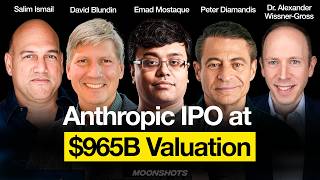
In this episode Peter Diamandis hosts a round‑table with Dave Blundin, Alexander Wilhelm, and Imad Wustak to dissect the week’s biggest AI and tech headlines. They begin by debating the geopolitical shift caused by the Trump AI executive order and the prospect of an $965 billion Anthropic IPO, arguing that AI‑driven wealth should be publicly shared and warning that massive AI firms could become "too‑big‑to‑fail". The conversation moves to employment, contrasting the Washington Post’s five policy proposals (robot tax, stronger unemployment insurance, AI‑proof upskilling, wealth‑sharing dividends, and doing nothing) with Apollo Global’s claim that AI is a net job creator, and Dave highlights real‑world hiring spikes in health‑tech. They then examine NVIDIA’s upcoming ARM‑based N1/N1X laptop processor, speculating on its strategic motives and potential data‑center implications. A debate follows on data‑center water consumption, with Satya Nadella’s mitigation claims and Peter’s sarcastic comparison to almond farming. Trust in media is shown to be at a historic low (19 %), prompting a call for transparent, open‑source news platforms. The panel shifts to longevity, noting Russia’s $26 billion anti‑aging pledge, the $101 million Healthspan XPRIZE, and private‑sector efforts (Altos Labs, NewLimit, Verve‑102 gene‑editing therapy) aimed at extending healthspan. They discuss the limits of algorithmic progress versus compute scaling, the challenge of managing hundreds of AI agents for parallel research, and whether a newcomer could catch up to OpenAI/Anthropic given data and distribution advantages. Finally, they explore how to measure non‑material human abundance, the lack of a universal AGI benchmark, and answer audience questions about AI compute needs, incubator dynamics, and anti‑AI sentiment. The episode ends with promotional plugs and a hopeful outlook on the singularity.
Chapters
Anthropic just confidentially filed IPO paperwork with SEC and could be the first major frontier lab to go public. Polymarket gives it a 60% chance Anthropic surpasses $1.8 trillion in market cap on its first day.
Anthropic is only 5,000 people. You're talking about an insane amount of money divided 5,000 ways. This group of companies can do thousands of billion-dollar acquisitions.
You've never seen revenue growth like this.
President Trump just signed an executive order that basically says America is not going to slow down on AI.
This is the US planting its flag and saying, "We compete, we don't constrain." I think the US government realized a year or two ago that AI is key to full-spectrum dominance.
OpenAI finally passed a billion monthly active users. Nothing in history has scaled this fast.
It's crazy to think you're just at the start, right? Intelligence is going to go to every single person and will be accessible to them. Who is your Jarvis? That is actually the only game in town.
Now that's a moonshot, ladies and gentlemen.
Welcome everybody to another episode of WTF Just Happened in Tech on The Moonshots. I'm here with my incredible moonshot mates, DB2, the wizard of investment. Hey buddy. Good to see you.
Good to see you too.
You got a new shirt on today. I see. What's it say?
Every day, a new shirt. Thanks to the team here. Yep. I'm heading off to, uh, to SF tonight or tomorrow morning too, so I gotta, I gotta dress the part.
I love it. AWG, our in-house polymath, Alex. Um, I, I see you're in your normal garb.
Thank goodness. Good to be back.
Normal orchid.
Totally original environment. It may be real, it may not be, it's unclear.
Uh, and a longtime friend and mate, Imad Wustak, the founder and CEO of Intelligent Internet. Imad, thank you for joining us. It's late there in the UK. Um, yeah, but hey, you know, sleep is for other people, not for those living through the singularity.
Yes.
How many pints into the evening are you, Imad?
A couple, a couple. You know, I have to with everything that's going on.
Yeah, well, when you see this news, yep, you'll be glad.
Yeah. And, uh, Salim Ismail, of course, is a probability function someplace on the planet. Salim, we miss you. Wherever you might be traveling, come back soon. I'm Peter Diamandis, your host, your abundance amplifier. We've got a loaded show today, some 18+ stories and some of the biggest developments in AI, longevity, the future of work. This is no doom, no gloom. This is about science, the tech, and the money accelerating us towards the singularity. Let me give you a quick preview of what we're going to be discussing. Trump just signed an AI executive order that rejects heavy regulation and asked the labs to voluntarily share their models 30 days before release. ChatGPT finally hit 1 billion monthly active users. Big news, Anthropic filed for its S-1, a trillion-dollar-plus IPO. And Bernie Sanders wants a piece of that IPO, suggesting that public companies, that the public should own 50% of AI companies through a sovereign wealth fund. Finally, we'll close with 3 multi-billion-dollar longevity news stories. You know, gone are the million-dollar stories and we're into billions and trillions now. All right, let's jump into our first story here, uh, from the White House. President Trump just signed an executive order that basically says America is not going to slow down on AI. No heavy-handed regulations, no permission-based frameworks. Instead, the order asks AI labs to voluntarily give government access to new models 30 days before public release. Sam Altman said the new EO gets the balance right. Anthropic said they're on board too. Meanwhile, agencies are being directed to deploy AI-powered cyber defense across government systems. This is the US planting its flag and saying, we compete, we don't constrain. Alex, do you want to jump in first?
I think this is sort of a signpost, a canary, if you will, that a lot of previous to now governmental functions, such as discovering zero days at scale, which the NSA historically performed are now de facto privatized. And this is downstream of that. So we have the so-called Mythos moment, which I think was in no small part inspiration for this executive order that basically took some of the core R&D activities that would have been in the NSA discovering breakthrough cyber vulnerabilities and has commodified them to the point where there's a model, Mythos, and probably GPT-5.5 as well, with Mythos widely reported to be about to be broadly released. And certainly Mythos has become more and more accessible, both now across the EU and certainly within the US, to the private sector. And you have to ask the question, just the thought experiment, what's the right way for the executive to respond when there are private sector capabilities with dramatic national security implications? I'll add parenthetically, cyber vulnerabilities are just what's possible now. Imagine at some point in the future when there are breakthrough biological, chemical, physical, and other discoveries and inventions that come out of private sector models and not out of government laboratories. What is the right policy for the executive to have to protect national security? I think that this is such a delicate balance between On the one hand, not wanting to throttle American innovation, a 90-day delay could have meant all the difference between US and Chinese models. On the other hand, not being involved enough in the process and not getting pre-release review capabilities, however voluntary or otherwise, could have a profound impact, positive or negative, on national security. So I, I think I think the question of does this strike the right balance, I think we'll know probably in the next few months because that's the timescale that this is operating on. But I, I do buy the premise that there was a need for some sort of policy, even if implemented via EO at this point.
You remember, it was about 3 weeks ago Trump was about to sign it and he had calls from David Sachs, Elon, many of the heads of the lab saying, you know, this is overreaching, don't do it. Maybe the old order looked more like Europe. Emad, you know, you're kind of in Europe, in the UK, which has been much more prescriptive, much more prescriptive about their policies. What do you make of this?
Yeah, I mean, I think the US government realized a year or two ago that AI is key to full spectrum dominance. This is the military concept. You have to have superiority across air, land, sea. Intelligence is clearly a vector there as well. And that kind of trumps almost anything, because, as A.W. said, kind of the mythos moment was a big deal. And then it's led to saying, well, we need 30 days at least, which is a very short period of time, particularly with how fast the government actually works. In Europe, you don't really have the same impetus because Europe has never had full spectrum dominance. And on the other side, on the security, they feel that compliance is the key. So I think it's kind of a mixture of these two, but the US has basically said, we're not going to be left behind on AI. And even that 30 days is a massive tactical advantage for us. And we're seeing for the first time an increasing amount of cyber attacks from all sorts of actors. And on the other side, there needs to be that battle testing as well. The internet is held together by strings and duct tape, effectively. And that's why you're finding vulnerabilities all over the place, and they need it for the security as well as the dominance side. And again, in Europe, we just can't move that fast.
I mean, Dave, this is voluntary, right? So the question is, is it purely a political show move to say, "Hey, yes, we're going to do some regulation," but it's really not. Labs can continue business as normal. And voluntarily, you know, show the models. What do you think of this?
Yeah, exactly right. You know, I literally was just on a call right before this podcast with the biggest asset manager in the world, and they were asking, how is our AI going to give financial advice without breaking the law? And I said, have you gone and talked to Donald Trump yet? Because what you do is what Sam and Dario did is they said this regulation is onerous. It's going to slow us down. They met with the White House and then you have a complete watering down of the regulation. And this is fine. You're— we're allowing— because I trust you personally, we're going to allow you to self-regulate for the next window of time. Let's meet again in 3 months. But that's exactly what Liputan— you remember, you know, the White House or Donald posted on X, Liputan must go. Intel cannot have him as CEO. He has investments in China. He cannot be the CEO. He went to the White House and had a meeting. Now he's made hundreds of millions of dollars. It's the ring.
Kiss the ring.
Kiss. You must go and talk. But, you know, I don't think that is a bad thing in this environment. I think it's as a way to govern a country in the long, long run. It's not good. But in the moment of time we're in right now, the other regulation would have slowed down progress tremendously. They made the right temporary choice, but it doesn't solve anything in the long run. Yeah, but that's okay. I mean, it's, it's fine for now.
Uh, we'll see how this plays out. Meantime, uh, OpenAI finally passed a billion monthly active users. Uh, you know, let that number land for a moment. ChatGPT launched in November 2022. Roughly 3 years later, it's used by over a billion people. Uh, context, it took YouTube a decade to get to a billion, Instagram 8 years, TikTok 5 years.. And now we have ChatGPT there in 3. Uh, nothing in history has scaled this fast. Year-over-year growth is at 62% and holding for OpenAI. Here's the kicker. Claude, Anthropic's model, is now at 56 million monthly active users and is growing at 10 times the rate, 640% year on year. This entire category is going nuts. Emad, I mean, you're playing in this, you're, you're building models. I mean, do you expect growth like this to continue?
It's crazy to think you're just at the start, right? Like, the Claude thing is what surprises people a lot because Claude is a bit like Apple and OpenAI is a bit like Microsoft here. And then there is the 7 billion people that don't use it. Of course, it's difficult to use in China because you can't even have access to these models. But obviously intelligence is going to go to every single person. And will be accessible to them. And Sam Altman has said the price of equivalent intelligence will drop by 100 times over the next 18 months. And I think when you look at all the chips and everything, that's correct as well. So even though you've hit a billion faster than anything, I think that 62% will actually increase, especially because I think the next wave, as they hit their IPOs and things like that, will actually be customer acquisition. This happened without massive advertising campaigns, without classical cost of user acquisition metrics. Almost all of this was effectively organic. You see the odd ad, but they've just become recent. And so I think there's a long way to go from here.
Alex? You remember when Sam said that if he had a choice between a billion monthly active users and the strongest model, he'd pick the billion monthly active users? That's the future.
Did he say that?
He did say that.
Really?
He did say that.
What a memory.
Wow. Because he thinks, he thought at the time, or at least what he conveyed was that in this game between the frontier labs, distribution ultimately was a stronger moat, a stronger advantage and differentiation than having the strongest model weights. And ironically, for a hot moment, at least until GPT-5.5, that was basically the world that we found ourselves in, where GPT and OpenAI had the majority, or at least the largest user base, but also not the strongest model. Now, fortunately, thanks to that Code Red, GPT-5.5 is broadly, as far as I can tell, the strongest model. And also he has the broadest distribution pipe.
So amazing comeback. Amazing comeback.
It's a good day for OpenAI. They have the distribution, the best distribution. And the strongest model.
Yeah. Well, pretty soon we'll have public market caps to compare to each other, so we don't have to debate who's ahead. We can just look at the stock price and then we'll know.
A trillion here, a trillion there. You know, I mean, the most amazing thing is there will be some product somewhere that grows faster than ChatGPT. Don't know what it is, when it's going to hit, but we're going to, we're going to have that happen. It'll probably be a product that is distributed through agents around the world.
And then how soon, Peter, until we're measuring the time to first billion agents using you and not the first billion humans?
I agree. I completely agree with that.
Well, I think this is the big strategic thing because I think what everyone's going to realize in the next phase is the most important agent is the agent that's next to you, that's coordinating all the other agents. And that's why the cost of user acquisition is going to go and shoot through the roof. Because everyone will want that agent.
Yeah.
Is it your super app from ChatGPT or is it your Claude or is it your—
Your Jarvis, right?
Who is your Jarvis? That is actually the only game in town.
Agreed. Sticking with OpenAI, they just launched something called Rosalind Biodefense, named after Rosalind Franklin, a British chemist who helped discover the structure of the double helix. Rosalind Biodefense gives trusted researchers and government public health agencies access to specialized AI tools. For detecting outbreaks, improving disease surveillance, and accelerating vaccine development. Richard Johnson, OpenAI's national security risk mitigation lead, is running it. This is AI's move from chatbots to biosecurity infrastructure. And I think politically, uh, this is the kind of moves they have to make— this and healthcare and education— really to give themselves defense against people slowing them down. Alex, what do you make of this one?
I'll paint a story about the elephant in this particular room, which is that I think we're starting to see for the first time the generality of AGI start to shrink. I think we're seeing it for security reasons and security rationales that are probably legitimate, but nonetheless, the G in AGI is starting to shrink. We're seeing bio capabilities that would otherwise be built into general models like the GPT series start to get carved out as separate fine-tuned/post-trained models that are only available to exclusive audiences like government agencies and trusted researchers. We're seeing the same thing happen with the cyber version of Mythos from OpenAI, the, the GPT Cyber Series. And I think this is probably going to end up being the tip of an iceberg where advanced capabilities that could have security implications, at least to start, maybe other regulatory implications soon, aren't built into, or at least not exposed from the main series model that is available to the general public, but rather get carved out into more secure, more limited models that are only available to government agencies and trusted users. And Part of me wonders, is this sort of, uh, in the same sense that you would back in the day hear Richard Stallman or other evangelists from the open source movement complain about the closing off of openness in source code, in computing in general, and the generality of, say, personal computing. It seems to me like we're starting to see again for admittedly well-founded security rationales, we're starting to see the beginnings of the closing off of generality of intelligence in the name of security.
I mean, we know the fact that the same technology that enables OpenAI to deliver this for biodefense is the same technology that terrorists can use to develop new, you know, viruses for biowarfare. And I mean, that's the scary part. You know, Dave, are you thinking about this at all?
You know, I'm curious, Alex and Ahmad, do you know— you can never start a question to Alex with, do you know, because the answer is going to be like, it's got to be yes. But, but do you know, did they, did they de-guardrail the existing Mythos model for this, or did they train a new set of parameters that are specific to biology and deliver it to the government for this? Or is it distilled?
Well, this is OpenAI, not Anthropic, but my understanding for both, the Rosalind series and also for the, the cyber vulnerability series that OpenAI also released. Um, my understanding slash guess is combination of, uh, scaffolding, unshackling, and probably also a bit of post-training and use of tools that otherwise wouldn't necessarily be baked in at the backend. So the default tools for ChatGPT are usually code interpreter and web search. I think when, when Rosalind was first announced, they announced that there were a number of other databases and tools that would also be built in. If I were OpenAI and trying to make this useful for biodefense, I would also probably include an, an unshackling at the scaffolding layer saying you are in fact allowed to ask questions about smallpox and about a variety of other subjects that probably would just be completely guardrailed out for the general public.
Emad, you and I have spent time talking about this in terms of serving sovereigns with AI. You know, I'm glad OpenAI is doing this. I think all the labs need to be helping us defend. We're going to talk about that in the next story as well. Any, any closing thoughts on this one?
Yeah. In 2020, 2021, I remember launching at Stanford High an AI initiative to organize COVID knowledge and preparedness around that. And we had a lot of big labs promise a lot of AI and none of them would give it because they said it was too dangerous at the time, which is why I actually got into open source. That was a very painful process. I think, you know, Dave was asking the right question. This is an unshackled, grounded version that can really analyze knowledge at scale. And we see similar things with the science harnesses now from Google and others because base models are a lot more creative. But then on the other side, for preparedness, they can't analyze huge amounts of knowledge and data, like I said, detecting outbreaks, improving resilience, et cetera. The reality is that we're probably going to see more of these from threat actors, as well as just timeliness on pandemics. Like, next big one is probably only a few years away, honestly, when you look at a lot of different things. And hopefully this time we'll have our act together.
Yeah.
Because if we don't, then I think it could be even worse than it was before.
I mean, this is probably what the AI labs should be investing in to befriend the public, because the public needs, needs a reason to be supportive. All right. Our next story related here is a serious one, and it should be. Today, I had the pleasure to co-sign alongside Sam Altman and Dario Andemis and Mustafa an open letter to Congress saying we need laws requiring DNA synthesis companies to screen their orders. So today you can go online and order custom synthetic DNA sequences. Dozens of companies will print whatever code you send them. Most screen their customers, but a lot of them do not. And here's the scary part. Uh, as an example, back in 2017, a Canadian researcher spent about $100,000 of mail-ordered, you know, to get mail-ordered DNA and reconstructed an extinct horsepox, uh, virus. The same method could theoretically be used to create smallpox. You can layer on, on top of that large language models and you can do a lot of damage. A dear friend of mine, Olivia Scharfman, at the Institute for Progress and the Foundation of American Innovation, put this forward. As a result of this, there's a bipartisan Senate bill already in play. This is one of those rare moments where the industry is saying, please regulate us. You know, this— we talked about this with Eric Schmidt, Dave, that you know, there will be at some point some kind of a small, you know, global emergency as a result of AI that will get everybody, you know, to pay attention, is, you know, and, and this sort of bioterrorism is probably top of the list. Any thoughts?
Peter, I don't want to throw this all on your shoulders or anything, but of the people who signed this, most of them are running big AI labs and have a personal agenda, and then they have IPOs coming up. You're the one signer who totally understands this issue inside and out and isn't conflicted in some way.
But it makes complete sense. I mean, why would you not want to do this?
It's like, you know, yeah, I'm not, I'm not saying that. I'm saying this is the— there's so much more work that needs to be done here.
Yes.
And, and between you and XPRIZE, that's probably the best agency to save the world from biological disaster. So, well, thank you for signing it.
You're welcome. I mean, right now there is a future in which sensors in train stations, airports, bus stations, you know, in malls, is constantly sequencing everything through the air filter filtration system and looking for novel sequences. And if it detects it, you know, it sequences it and sends it to the CDC, and then we start a, you know, a vaccine program instantly. I mean, it is possible, you know, the thing people need to realize is that Viruses, uh, pandemics can only move at the speed of airplanes, uh, but information can move at the speed of light. So you can sort of stop this in the bud if you're, if you're fast enough and you have enough intelligence. Alex, you and I have discussed this a few times.
Yeah, I think this is probably both inevitable and inadequate at the same time. I think it's also part of a broader set of initiatives to gatekeep the interaction between superintelligence and the physical world. I want to draw a split screen. On the left hand, we're talking about gatekeeping DNA synthesis. On the right hand, 3D printing. So State of California, uh, and, and other municipalities are trying to regulate what can be 3D printed, again, out of concern that people will 3D print weapons, guns in particular. I think there is a lively debate that has started to happen about whether the right way, the right choke point, if you will, for AI safety is sort of after the fact, after something has happened. Do you hold the labs or the users responsible for it? Or is the, the right choke point at the time of action when an intelligence either at the behest of a human user or autonomously tries to do something in the physical world via DNA synthesis or protein synthesis or printing a weapon with a 3D printer? Or is the right time to regulate it at the time of conception when either a human is—
Or all three.
Or all of them, the entire end-to-end. And I think my guess is different countries will choose different combinations and permutations of each stage of that thought-to-action pipeline. And I'm not sure that there is a right answer, but I do think that some combination, some permutation of being able to at least, even though it probably will enable regulatory capture of the DNA and protein and, and biological sequence synthesis step by Frontier Labs that will then obviously insist, well, you have to use Rosalind, you have to use our model. To determine whether the sequence is dangerous. You can't just rely on naive pattern matching or worse yet, just naive base pair matching.
That's—
that can easily be routed around. Some amount of intelligence forward deployed to the time of synthesis with frontier intelligence, I think, is probably inevitable, at least in the US.
We have, you know, previous examples of this where the Treasury acquired photocopy machines yellow dots. Yes, to prevent being able to photocopy the $100 bill or any kind of money. Uh, and so there are companies like Twist Biosciences which already screen, you know, what they're synthesizing, and they've been lobbying for this for a while. Uh, but the screening costs money, and if only responsible players do it, then they've competitively disadvantaged themselves in, in doing the work. So there, this need, the This does need legislation. This does need pressure. And it makes no sense to not have this in place.
Totally right. And I also don't think it's super hard to capture at the point of prompt and reasoning trace. If somebody is trying to build a bioweapon or a chemical weapon or a nuclear weapon, you have to have a lot of interaction with the AI. And it's not super hard for the AI to say, I need this reasoning trace to be captured and turned over There has to be some inspection process.
What if it's on your Mac Studio?
You can't really do it on your Mac Studio. And if you could, we would have to ban that globally anyway, which I hate. I'm, I'm, I don't like that, but I don't see any other outcome.
Emad, could you do this on a, uh, uh, on a, on a LLM on your machine on premise?
Uh, you can. So I was one of the authors on OpenFold, the open source version of AlphaFold, and supported a range of things in this. You can basically run the prompts on edge, adapting existing models or using some of the new ESM and other models that have actually been open sourced. It's very difficult to stop that. You need to be smart and you need to understand it, but the threat effect doesn't come there, which is why you need to look at this side of things. And again, this is a really good step in the direction and the synthesis. I think actually this goes to a bigger thing. Which is the total percentage of tokens in the world used by the public sector is probably 0.01%. Total world GDP, public sector is 20%. We have to use intelligence for public good. And one of those public goods is the government should be subsidizing or paying for the tokens to analyze every single sequence being put into a sequencer, for example. And so that's a bit of a phase shift because governments don't think that way. But I think these types of things where intelligence is causing threats or opportunities to go up, we need to ramp public sector compute to help mitigate and take advantage of those.
I mean, that's a great basis for an XPRIZE. Just, hey, let's have all the ideas related to the way the government can use that 20% to put together AI processes that stop specific threats at specific points. Let's list them all out as XPRIZE opportunities. And then throw that out for the world to think about. And a model come back with 50 of them right out of the gate. And those all become X-Prizes.
I would add that there's an enormous hole in this, which is directed evolution of environmental DNA that's already out there in the biosphere. And if we really want to take this seriously, the risk of either non-AI enhanced bioweapons or AI enhanced bioweapons, if we think like that's the X-risk scenario, that we care the most about, we really are going to have to sequence environmental DNA from everywhere, not just the biosphere, but all environmental DNA everywhere.
And there was a lot of that. And as a baseline, as a baseline to see deviations from norm.
Absolutely.
Yeah. Actually, I think no one's actually articulated that properly. You don't want to give people ideas. This is always a thing, but I think that should be a really directed paper where you model it because once you actually model it, it gets scary really, really quickly and you have to start putting it in place now.
Yes. Yes. Yeah. That, that one, like a lot of, you know, what Alex was saying earlier, you can wait and figure it out after there's a disaster and then work back. But this one you can't, you cannot afford a global pandemic that could be so much worse than COVID and then try and work on the problem. You can't do it that way.
I mean, listen, we all know this is a very serious risk and it's been mentioned so many times as perhaps the, the most likely risk and why we're not investing heavily in this yet. You know, I think every politician listening to the show needs to be putting this forward. You want to get the public on your side, do this, because you're going to be a hero when it eventually happens.
Peter, that's why I was coming back to you as the, the one signer on that document who has a PhD in biology, uh, who also understands inside, you know, AI inside and out. And everyone else is busy with their IPOs right now, so again, with their trillion All our IPOs, to say it clearly.
By the way, I know that you're busy and sometimes these episodes run long and you don't have time to listen to the whole episode, or if on occasion you miss an episode, I now put out a Moonshot summary on Substack, which includes a link to all the stories that we cover. The weekly recap covers what I and the mates had to say, what we think is most important, and what we're most excited about. And it's free. You can subscribe at diamandis.com/metatrends. That's diamandis.com/metatrends. All right, now back to the episode. Uh, this next story is fun. OpenAI Robotics is hiring. So Sam Altman posted it plainly. We are focused on robots to support skilled workers, to build our future infrastructure, and imagining everyone having a personal robot doing anything they need. I find it fascinating that, uh, Sam is sort of like following lockstep with all the things that Elon's doing. A few, you know, episodes ago we talked about Sam potentially investing in rocket companies. So OpenAI is hiring for robotics, not a research paper, not a partnership. Uh, this is building an in-house robotics team. Uh, it's a signal about where the frontier labs are heading next. Uh, you know, Anthropic is the one lab that's really focused. Uh, Alex, are you excited about this?
Well, it is the innermost loop, right? The robots that build the data centers and the fabs that build the chips that host the models that are powered by the energy that hosts the AI and then doing it all on the moon and Earth orbit. That's right, disassembling the moon to build an SSO Dyson swarm. Exactly. So yes, of course I'm excited about it. I think it's, it's instructive. On the other hand, that Stargate, Sam's signature initiative to go build the data centers within OpenAI, has shifted in the direction of leasing rather than building. And so when I see Sam and OpenAI announcing that they're focusing on robots to build their future infrastructure makes me start to think that either Sam is going to go ahead and spin up an independent of OpenAI data center infra initiative, uh, or that maybe OpenAI is seeking to revive Stargate's futures from a robotics angle, that maybe it'll be OpenAI robots helping to build or maintain data center facilities that aren't owned by Stargate, but rather that are maintained by third parties. But either way, I think the arrow of progress is clear, both from Sam and from Elon and from everyone else, that the, the most productive right now use of humanoid robots is probably just to build out the, the Dyson Swarm in orbit and to, to tile the Earth with compute here on land., and then we all can get our domestic robots as a, a secondary afterthought, even though I'd really rather get mine first.
Uh-huh. You know, another thing we've talked about in the past is that humanoid robots interacting in the real world are gonna be an important source of data. Everybody's talking about, where do I get new data? Well, this is definitely one of them. Um, Emad, any thoughts on this story?
Yeah, so it's interesting. Remember Sora shut down, right?
Yes.
And I was like, why? When GPT-Image is coming out. So Aditya Ramesh, who led the Sora team, is leading the robotics team. So they've taken all their video researchers and moved them onto the embodied robotics team. And when you look at robotics, I did a whole bunch of work recently. I think I've got a paper coming out soon. It is far bigger than the GPU market, like actual physical embodied robots, and they will not have the same depreciation schedule either. And I think people are coming wise to this because GPUs depreciate really fast.
I think we've seen GPU prices going up, old, old, you know, used GPUs going been going up recently.
Yeah, they go up, but they still depreciate in terms of that. But you look at a Unitree G1 2 years ago compared to being on America's Got Talent now, you know, dancing. Once you get the robotics to a certain level, those things will have a massively long life, and they'll be incredibly profitable, especially when you go full stack. And I think, again, this is why OpenAI is realizing that, like, they've got their GPU build out, and maybe that'll continue, maybe it won't. But the market for robots is way bigger than that. They will tile the earth. They'll build your extensions or pyramids or go across the universe. And again, I think it's interesting that their video team is now fully on robotics. They decided and made the choice, we have to move that talent over there.
Dave, you've started to invest in robotics, haven't you?
Yeah. I think Sam and I are on the same page on the fact that this is a very, very good 10-year investment theme and that the battle for self-improving software is well underway. So if you're maybe 16, 17 years old,, and you're thinking about what you're going to do post-AGI, you know, working toward getting this job with Sam is a very, very good next move. You know, what do I have to do? What degree do I have to get? Where— what— who do I have to beg to get this job? Because once you're in that group, you look at what happened with all the software people that were original OpenAI people, and they're thriving, you know, at 5 different companies now, and they're all billionaires.
Yep.
So the robotics version of that is just starting., and you can get in early if you, if you pivot in this direction. Uh, also I think that Sam was early to recognize that whoever controls compute controls everything. And robotic construction of data centers is one part of that strategy, one linchpin, you know, also the custom chips. Remember he cut that deal to design AI-specific chips. Haven't heard much about it. Uh, but that's in the works too. So that's the whole thing Alex was describing, the self-improving loop that includes the hardware construction.
All right. Big news this week. Anthropic just confidentially filed IPO paperwork with SEC and could be the first major frontier lab to go public, beating OpenAI to the punch. We've talked about on the pod before, you know, with SpaceX coming out at one point, I think it's $7 trillion is the price right now. We'll be seeing it very shortly. Uh, you know, soaking up a huge amount of the capital out there in the world. Uh, is there enough for two additional trillion-dollar, uh, you know, IPOs? Polymarket gives it a 60% chance Anthropic surpasses $1.8 trillion in market cap on its first day. $1.8 trillion, just fascinating. That's the same price of SpaceX's anticipated IPO. Uh, we've entered really rarefied territories here. Uh, Dave, um, I mean, are we just getting numb to trillion-dollar IPOs? Is this going to be just the expected, like, hey, when's your trillion-dollar IPO happening?
Well, people are numb and they shouldn't be. They should, they should be situationally aware and recognize that this flow of money is the biggest in the history of the world by an order of magnitude or more, and that they should try to be involved in it. You know, these labs like Anthropic is only 5,000 people. You know, you're talking about crazy, insane amount of money divided 5,000 ways. They're going to want a whole ecosystem of other companies to be helping them build, deploy, create. They'll have massive amounts of capital to invest in that. I mentioned on one of the prior podcasts, this group of companies can do thousands of billion-dollar acquisitions.
Yes. It's dry powder.
It's dry powder. Yes. Like we've never seen before. So don't, don't get numb, un-numb yourself and recognize the amount of opportunity that's suddenly available to you.
You know, it's part of it. It's a good thing for them to go public, right? They, you know, Anthropic is thought to be the safety-conscious AI company. And as a result of that, you know, being, you know, a public company forces them to have enough disclosure. So I think that's a good thing for them. Emad or Alex, any thoughts here?
Should I sing the Magna Mobster song again?
I'm sure you do it beautifully, my friend.
Thank you. I think it's so essential that we get all of the Magna Mobsta companies and not just 8 of them to IPO. I could maybe quibble as to whether Anthropic really is the first frontier lab to go public or whether SpaceX AI is technically a frontier lab. Certainly, I think Elon fashions SpaceX as a frontier lab at this point, but I think it is a public good that they're IPOing, and it's a public bad that it has taken this long for retail investors to have access to equity in the Magna Mobster companies. And I certainly hope and will do what I can to ensure that this is the last time in at least foreseeable history when we see so much private wealth accumulation happening outside of the public markets. I will do what I can to help make public markets the place that private startups think of first and not last as an aspiration to be.
Iman, you're building an incredible company with Intelligent Internet. You've been raising capital, you've been building, you know, breakthroughs that you can't discuss here that I know of. How does this kind of, you know, price, you know, hyperinflation hit you in your efforts to raise capital?
I mean, it's positive. Like, the amount of money in AI is insane, which is why you're seeing these crazy raises. But at the same time, they're not crazy. Because you've never seen revenue growth like this. What is Anthropic right now? Anthropic's revenue is probably $60 billion, $50 billion, $60 billion. So it's coming at 20 times revenue, which is high, but it isn't a Palantir. It used to be 50 times. These things are making it up. And you wouldn't be surprised to anyone if you saw $100 billion revenue or 150 billion revenue for Anthropic next year because it's just that useful. This is the reality. When you build useful things, the market gives you the value. And I think that the trillion dollars, as you said, it's just going to come back because it's a wealth creation event. You feel oddly bad for Sam Bankman-Fried, actually, one of the greatest investors of all time. If you look back at the Anthropic series at me where he put in $500 million. All those people that bought those shares will be reinvesting straight into generative AI.
Yeah, we're making so many billionaires in Silicon Valley, for sure.
And outside of that, everyone else is coming in as well. So it's not like, to your first point, is there going to be a lack of demand? No, this will be oversubscribed. SpaceX will be oversubscribed. And I think there's probably a trillion dollars of money that wants generative AI access. And AWG is going to do his best he can to make that possible, but we're not going to run out.
You know, this, this gives support to when Elon said triple-digit GDP growth by 2030. Setting aside GDP as a metric. All right. Our next story here is how fast are companies achieving a trillion-dollar valuation? To the point we just made, Apple took 42 years to reach a trillion dollars. Google, 21 years. SpaceX, 24 years. OpenAI, about 10, and Anthropic now roughly in 5. But the real story here isn't, you know, how fast they're reaching trillion dollars. It's how many employees they're using to reach that level of evaluation. So Anthropic generates about $9.4 million in revenue per employee, $9.4, almost $10 million per employee, uh, on about 5,000 people. Apple is about a quarter of that, $2.5 million per employee. And Google's at, uh, 2.1 million. So these companies are not just growing faster, they're extracting more value per person, 4 times the rate of the best tech companies. You know, this is Salim's exponential organization thesis playing out in real time. Impressive numbers. And something will beat this. Something soon will beat this.
Peter, dare me to estimate when, since we had this discussion, I dare you, 6 to 12 months ago. When we'd see the first one-person unicorn and we achieved that. Dare me to estimate when we're going to see the first one-person centicorn or teracorn.
Okay. I dare you, Alex.
What is it?
Sometime in the next 10 years.
Okay. I think, I think that's an easy, easy estimate. I would join you in that bet.
Yeah.
All right. Uh, I mean, I just think the, the, you know, revenue per person is extraordinary. And, you know, the question of course is, do we start measuring this as revenue per agent?
Soon enough. Interesting.
Or per flop. I think the, the, the issue with revenue per agent is agents right now feel like really discrete entities, just like as we've discussed on the pod in the past, taxing per token. But really, ultimately, there are scenarios where the boundaries between quote unquote agents start to vanish, where we see, for example, end-to-end differentiable teams of agents. And we start to ask the question, is it really multiple agents or is it really a single team-level agent? Not obvious to me that the agent paradigm survives long enough into the future that we'll be asking revenue per agent.
I think the other really important aspect of this is that the AI economy is now funded to live within itself. Because, you know, historically, if I talked to bankers a year ago or, you know, car dealers a year ago, they would say, look, Anthropic and OpenAI can't become really big companies until they've delivered something to me as a bank and I'm paying them. Because, you know, the iPhone didn't become big until a billion people used it. And, you know, all this legacy stuff wasn't big until it interacted with me in the old world economy. It doesn't actually have to be that way with AI. If Dario wakes up after his IPO and says, I want to spend $100 billion with you, Peter, to solve these 10 diseases, he can just spend it and you can spend it right into the agent economy. And now your agent economy has $100 billion of cash flow and it had nothing to do with JPMorgan. It had nothing to do with Main Street. It had nothing to do with any legacy business. So this conduit of capital through these IPOs back into the pure AI world it could entirely build an economy of its own. And you might not even notice it in, in Europe. You'd be like, what happened?
So Dave, we're seeing the ceiling here rise, right? As these numbers are again going into multiple trillions. How does it feel at the, at the bottom rung? You know, when you're coming in as pre-seed, seed investors into these companies and they're escalating, is it moving? The valuation's climbing faster than ever before.
Yeah, it's crazy. Like the seed stage, you know, birthday valuations of the companies are about where they were because the founders don't care about maximizing valuation on that day. They care about being in the perfect ecosystem to get on this, on this wagon. But then the escalation, the timelines are so short and the escalations are so big. I've never seen anything like it. So, you know, you know, multiple companies here in our incubator went from idea to billion-dollar valuation. In a couple of years, but one of them is on a trajectory to get there in less than a year. And like, I've never seen that. Well, the reason I've never seen it is because it never existed in the world prior to AI. And I think it's here to stay. I don't think this is like a bubble or a flash in the pan. I think that you can get so much more done so much more quickly than ever before that it's, it's here to stay. Which is why, you know, we continually show these numbers to people. You're crazy to do anything other than be an entrepreneur. And then you get all the pushback in the, you know, in the podcast notes. But, but the numbers are just overwhelming.
Yeah, we talked last time that the number of solopreneurs has doubled in the last quarter. And, you know, uh, during our Google I/O, uh, podcast, we talked about the, uh, Gem— Build with Gemini XPRIZE, the, uh, $2 million hackathon that we launched. And, uh, we now have 11,000 people who've entered that hackathon. So just as a reminder, if you're on the sidelines and you've got an idea, something you've always wanted to, to create as a company, You know, go to geminixprize.com, register for this competition, allow us to support you in building something that helps the world and jump into the entrepreneurial fold. I mean, it, if you think you can't, uh, or you think you can, you're probably right. So, uh, let's give it a shot. All right. Uh, here's some interesting news. We haven't heard about Microsoft in some time. We haven't discussed Microsoft on this pod in a good 6 weeks,, but they've just come back into the scene in a big way. Microsoft just dropped 7 in-house AI models at their Build 2026, spanning reasoning, coding, image generation, video, and transcription. And here's the thing that should make every AI lab nervous. They've built all of these in-house from scratch. No distillation of OpenAI, no reliance on anyone else's weights. Friends of the pod, friend of the pod, Mustafa Suleyman, who runs, uh, Microsoft AI, put it bluntly. AI training compute has increased 1 trillion-fold with another 1,000x coming in the next 3 years. Uh, pretty extraordinary. These models already being tuned for Microsoft 365 with their tuned model for Excel matching GPT-5.4 while being 10 times more efficient. They've also announced a collaboration with Mayo Clinic to co-create a frontier AI model for healthcare. You know, guys, my interpretation here is Microsoft is saying we're not just a distribution layer for OpenAI anymore. Uh, we're building the whole stack. Um, Alex, over to you on this. Your thoughts, are they, are they here? Are they in the game again?
No, they're not in the game. That, that's the bottom line up front. And not only that, Mustafa previewed this position for, for us when we interviewed him at Microsoft HQ. He foreshadowed it for those who want to go back. And rewatch that, I thought, really fun interview. He foreshadowed the Microsoft-OpenAI divorce. Microsoft, recall, before OpenAI was working on all of its own foundation models, that wasn't moving very quickly. And Microsoft, I thought, very strategically entered into this relationship with OpenAI and got a boost, became the distribution partner, got the channel and granted this, this relationship was formed over a period of time. So it wasn't as if OpenAI launched their foundation models and then Microsoft invested. Exactly the opposite was the chronology. But Microsoft really started piling on the capital once it became obvious that OpenAI was, was onto a solution for general intelligence. And Microsoft, for better or for worse, was in a position where they didn't have enough compute, maybe talent as well, outside of the OpenAI relationship to build their own in-house first-party models, which is a pretty perverse— if you think about the history of Microsoft and what Microsoft did to IBM back in the day, that, that was like the same history rhyming now with OpenAI playing the role of Microsoft to Microsoft's IBM, basically running away with, with the next wave. Uh, sort of amazing that Microsoft—
that's a great analogy, buddy—
allowed that to happen to it. So now Microsoft is trying to recover from the OpenAI quasi-divorce and develop its own in-house models, but it's still relatively compute-starved and relatively talent-starved. I've looked at all of the models that it launched, and I, I really want more hyperscalers and more frontier labs. We need more competition, but Microsoft isn't there yet. These are mid-tier models that are at best competitive with models that Anthropic and OpenAI were launching months ago. Not current models.
Emad, do you agree?
Yeah, I think you don't need AGI to make a PowerPoint. Right? And so Microsoft—
What if it's a really good PowerPoint?
There's no such thing.
No such thing.
I hate PowerPoint. Again, it's a very different intention. I think history would've been very different if Sam and co had joined Microsoft during the coup. That was a big difference.
That was almost a maybe.
Yeah, that's true. What a different world.
Because it's a very different environment when you're heading towards AGI versus not. And Microsoft had a lot of issues. Like, the WizardLM team was fantastic, and they went to Tencent because they couldn't actually build towards AGI. And then Tencent built one of the best open source models. Where Microsoft is right now is they're at the level of a Chinese lab, a good Chinese lab. And I don't think they're going to go that much further because you get to a certain point now with AGI where it's a generalist model of different types, but now they're going to hyper-specialize. Because they need to serve 400 million Teams users or whatever. Poor guys. Whereas you're seeing the closed models and Methos and things like that, they're never going to see the light of day from the big labs, I think. The big labs are going straight to AGI, whereas Microsoft have gone up like that, but they're not going to 1,000 times the compute that they spend on training a model because that will then require 1,000 times the inference costs. If you look at their Maya chip, which these models they're probably partially trained on and they can also inference on, those aren't designed for large-scale, massive MOE-type models either. I think that it's, again, humanist office-based intelligence as opposed to general superintelligence.
So are they supporting sort of the older generation of entrepreneurs and CEOs? If you remember Microsoft, I mean, a 50-year-old company was the most valuable company in the world for a pretty long run. I mean, they did extraordinary Nobody, nobody lasts that long at the top. Dave, any thoughts here?
Well, to me, it's a really cool historical case study and it's a battle of people, not companies. And when Alex described it by, by saying, I can't believe this is happening to Microsoft, given what Microsoft used to be. But if you said Bill Gates instead of Microsoft, Bill Gates would not lose. He would do whatever it takes. What it takes to win. And here Mark Zuckerberg decided what it takes to win is to offer Mark Chen a billion-dollar comp package and come over from OpenAI, and he turned it down. Yeah. Can Microsoft offer Mark Chen a billion-dollar comp package? Like, are you kidding me? How? Now, if Bill Gates were there, he would find a way. But it's the difference between— it's a battle of people. It's not a battle of corporate brands. And nobody has positioning, even Apple, Nobody has positioning that's, that's a moat that's purely defensible. You just have to have the will to win and do what's necessary to win. And it just feels like for whatever reason, Microsoft is not doing what it takes to get the 5 or 10 cannot-miss great AI researchers to work with Mustafa to build a true frontier model.
Companies have momentum and Microsoft does not. And Anthropic most definitely does. Welcome to the health section of Moonshots, brought to you by Fountain Life. You know, my mission is to help you use the latest technologies, including AI, to not just do your work at home, teach your kids, but to help you live a long and healthy life. I'm here today with an extraordinary physician, the Chief Medical Officer of Fountain Life, Dr. Don Mussallem. Don, let's talk about cancer. You know, I know from the member database that we have at Fountain, our members who come in who think they're healthy, it turns out 3.3% of them have a cancer in their body they don't know about.
That's right. You know, the majority of cancers that we screen for, those aren't the ones that are necessarily taking the lives when found at a late stage. We know that when cancer is found early, the chances for cure are much higher. We know it's much easier to treat a cancer when found early versus when found late. What we're finding in our members is Over 3.3% were found to have these cancers that otherwise wouldn't have been found or detected.
Yeah, you know, it's interesting. People, you don't feel the cancer until stage 3 or stage 4. And if you don't know what's going on inside your body, it's like driving your car with your eyes closed. And you can know. And so when members come through Found, how do they detect cancers?
So we're doing full-body MRI, and we also do early cancer detection screening. This is very, very important. These are not not typical tools used in the conventional care setting when it comes to prevention. This is a hard thing because currently these are not studies that insurance would yet be covering, but the goal is to collect these numbers, do the research, and work hard to democratize wellness.
Yeah, so at the end of the day, you can know what's going on inside your body. It's your obligation to know. So check out Fountain Life. You can go to fountainlife.com/peter to get access to the latest technology to help you detect cancer at the very beginning, at stage 1. When it is curable before it gets to stage 3 or stage 4, and you're a world of hurt. All right, uh, this next story pisses me off. Uh, so this is out of the New York Times. Uh, you know, the New York Times ran a piece analyzing 602 goals that Elon stated publicly 15 years ago. Their headline: he only met 19% of them. You know, I, I would bleep my own words out towards you, New York Times. I mean, Who in the New York Times is setting any audacious goals and doing anything worthwhile? You know, the framing misses the point entirely. In 2015, he hit 75% of his goals on time. The ones he missed, well, he's still building Tesla, the most valuable car company on the planet. SpaceX is the dominant launch provider by a huge margin. Neuralink is working on BCI and it's in humans. XAI is a frontier lab and a hyperscaler. The man is worth trillions of dollars. I mean, who on this planet has set any audacious goals like this, uh, and actually met, you know, okay, 19%, but he will hit all of them. I'm clear. You know, he's always directionally right. His timing may be off a little bit. Anybody want to disagree with me?
I'm not shocked by a long shot.
Shocked, shocked that the paper of record is launching apparently an ideologically motivated attack against the greatest technologist of our era. Shocked.
Well, I don't read the New York Times anyway. You know, you could not pay me enough money to read what the editor wants to put into my neocortex.
I linked to this in my daily newsletter, and I excerpted the only statistic that I thought was interesting, which was hitting the 75% of goals for 2015. I think anything else is, is really underselling everything that Elon has accomplished and is accomplishing. And For those who will preemptively say, oh no, like I'm, I'm fawning, I'm kissing the ring or whatever the, the cliché line is, that's not what I'm saying. He has accomplished nothing short of miracles in multiple sectors. And to, to hit piece that focuses on which promises aren't on time completely misses the point.
I love it when, when Starship launches., and it does miraculous things on its earliest flights, right? It's always a test flight. And the, you know, the headlines is Starship, you know, explodes and fails. It's like, you got the point wrong, for God's sake.
Yeah. Yeah. I think I like to think of it in terms of VC, you know, one for you, Dave, about 10% of companies return 90% of all returns. You can't do what Elon did unless you actually have this distribution and it's actually stonkingly high. It actually goes to what we were just talking about Microsoft. The culture in Microsoft is not to take chances. So you're never going to have breakthroughs, are you? You will just repeat what's happening. Whereas the biggest, best breakthroughs are when people actually take a chance on model training or trying different things.
The most misleading thing about this article, the whole thing is misleading, but the most misleading thing is it implies that somehow investors aren't happy with their investments in Elon. And you go and talk to Antonio Gracias and he's like, Elon could invent a new urinal and I would put a billion dollars behind it because everything he does works. And so it's just, it's just cringy to have them peel out like a couple of edge cases, which even the edge cases are not bad. So yeah, anyway, crazy. That's the media today. You know, you've said it a million times, Peter, that the media is absolutely— they have no budget, so they have to create controversy to drive any readership at all.
They're just trying to drive your eyeballs to their advertisers. Don't give them, don't give them freely. All right. This is a story for my two math polyglots on this, uh, on this pod here today, both Alex and, uh, Imad. Let me make sense of this. So, uh, more than 130 mathematicians signed something called the Leiden Declaration backed by the International Mathematical Union. Yes, there is an International Mathematical Union. They're warning AI-generated mathematical proofs can look completely convincing but sustain subtle, hard-to-detect errors. They're also worried that AI companies could end up influencing which math problems get studied and funded, basically steering the direction of pure mathematics based on commercial priorities. Alex, to you first, pal.
This is a bad look for mathematicians. It's a bad day for mathematicians. This is— I read the declaration. Talked about it in my newsletter. This is— I view this as rearguard action in the wake of the Erdős conjecture being solved by OpenAI regarding planar unit tests.
Are they trying to maintain their relevance?
Yes. And it's not going to work. This is a terrible idea. It— this is on the wrong side of history. AI is going to cook math. AI is cooking math. AI has cooked math. And no number of whiny declarations by mathematicians Regarding the cooking of math by AI, I guess you're not a, you're not a union member. I guess I am. I'm not a card-carrying member of a mathematical union. No, I think we're going to make such tremendous progress in math and the physical sciences, as Peter, you and I talk about in Solve Everything. And I think declarations with fear, uncertainty, and doubt regarding AI solving or bulk solving math or other fields I think this is just on the wrong side of history, and I'd rather see mathematical researchers focusing on using AI to increase the body of our mathematical knowledge, not whining about AI undermining trust in math.
I mean, these mathematicians who signed this are obviously fighting for their lives and for relevance. Uh, Imad, what do you make of it?
Yeah, I mean, I talked to a number of very sad mathematicians after the Erdős conjecture. You know, like, they're like, I was so close.
I was so close.
The thing that these types of things, nobody feels close on because they're like, it can't be done because they don't dare to do the impossible. Truly original, daring math is not what you get tenure for. It's not what you get your PhDs for. You don't look at things in different ways. Like when Perelman figured out the Poincaré conjecture by saying, this isn't topology, this is a PDE, that wouldn't even be— that'd be frowned upon, taking that type of approach. So you had to go and like go to a shack somewhere and figure it out. I think it's understandable that you see this because you're going to see this in industry after industry because the mechanical side we know that AI can do, but now it can actually pull from multiple different areas like we saw with the conjecture. And we've had overspecialization in mathematics in particular, I think. The classical, like Erdős himself, had so much breadth, but now we force people to just look at one thing. And so they can't see out of their hole. Now I think using these tools, everyone should be saying, well, I can explore other areas. I think the one thing this declaration does get right is the models can get a bit weird, particularly when you're pushing the edges of math and be very convincing and completely wrong. And so we do need to have some help against people with that. But other than that, I think, again, going to Alice's point, we should look beyond and take advantage of it.
AI psychosis, is it?
It's not quite AI psychosis because it's more like AI confabulation and confidence. It's what you'd expect a grad student that's really super talented and convincing to do. And you sometimes will gloss over that because it's so convincing, but it's not classical psychosis where you're like, "I figured this and this and this and it's all super quasicrystals." All right, here's another story that pisses me off.
This is the American Federation of Teachers, 1.8 million educators strong. It just dropped a 10-point plan for AI in schools. Here's the highlight: no screens at all for pre-K through 2nd grade. I can kind of agree with that. AI safety and privacy protections for K through 12. Limits on AI use in order to keep teachers responsible for instruction and assessment. And my personal favorite, they propose a tech tax on big tech companies. The ATF president, uh, Randy, uh, Weingarten, is leading the charge here. You know, this again, you know, I think we should have an effort to have the teachers unions require the use of AI by all teachers. All teachers should be AI literate and understand what it means and what it, you know, where it's going. Dave, you want to weigh in?
Well, I think anyone who proposes a new tax should go straight to jail. Is there any great person you can name that created a great new tax and they're famous for it? Like, the taxing is the least of our worries. Like, it's, it's so funny. And every one of these topics, the very first thing the person proposes to solve a problem is, well, let's generate a tax and then that'll create a pool of money. And then some magical person will figure out how to use the money to solve the problem. Just work on the problem. Yeah, don't work. Don't work. We have plenty of ways to tax people. That's not the issue. Work on the actual underlying problem. But I think it's similar to the last story where, you know, people feel threatened and their reaction is to ban or to stop or to propose stopping or eliminate all data centers, eliminate all use of AI, eliminate, eliminate, eliminate, eliminate. But, you know, as soon as you use the word stop or eliminate, you're on the wrong path. And so I agree with you, Peter. This story is frustrating.
Yeah.
If I might, Peter, I'd like to quote Mahatma Gandhi, who said, first they ignore you, then they laugh at you, then they fight you, then you win. And I, I think we're at the then they fight you stage here, both with this story with the teachers union and the previous story with the mathematicians union, where they're, they're fighting progress. And this is just, again, on the wrong side of history. The solution isn't to tax new technologies to pay as a subsidy to old technologies or old ways of doing things. It's exactly as Dave says, it's Focus on the ultimate objective here. If the goal is education or the goal is discovering new math, focus and shape the charge of superintelligence on that ultimate target. Don't focus on cross-subsidizing old ways of doing things that are less efficient.
Yeah, I think give something very practical again, extending from math. If you look at Mathcademy, it's one of the most effective AI-enhanced tutors, but you know, it just uses AI to coordinate the different tasks and things. And they have an amazing book, The Mathcademy Way, that brings all the science of adaptive learning there. And I've seen like 8, 9-year-olds that finish their entire high school just by doing fun Math Academy. This has no science, what they're putting forward here. And that's the really frustrating thing. And so I think, again, I'd encourage everyone to look at the Math Academy way and look at that with relevance to education, just because it's just a very interesting, scientifically backed treatise on this, as well as being a great platform.
Uh, on our last pod, uh, I threw up a survey, uh, for an education survey. We're surveying high school students, college students, parents of students, and teachers to understand how they feel the educational system preparing them for the future, how frustrated they are, how happy they are, what they wish they had. Uh, the data's coming in and it's amazing, and I'll be sharing it here on the pod in a few weeks. I wanna encourage you, if you haven't had a chance to do the survey, we'd love to hear your voice. Love to have your thoughts on it, especially if you're in the Bay Area in San Francisco, in the middle of the AI maelstrom. What do you think of education, uh, in high school and college? Uh, go to moonshots.com/survey and please fill it out. Uh, allow us to really bring back a huge, uh, body of knowledge back to this conversation about education. Again, the early results are extraordinary. All right. Uh, let's move on to our next story here. Senator Bernie Sanders introduced the American AI Sovereign Wealth Fund Act. The idea: require OpenAI, Anthropic, and other major AI companies to contribute 50% of their stock to a public wealth fund. Not cash, 50% of their stock. His goal: have every American effectively, effectively own a piece of the AI revolution. It's the boldest proposal yet for distributing AI-generated wealth. A 50% equity stake is pretty much a non-starter politically, but the Overton window is shifting. Even if this specific bill fails, it's going to start to normalize the idea of the public deserving a part of the AI value. Uh, I can imagine, guys, you know, 5 or 10% stake being put forward, structured as a condition for operating on U.S. soil, using U.S. data, U.S. energy, and so forth. Let's listen to Bernie Sanders, and then we can discuss it.
And that is why in the coming weeks, I will introduce the American AI Sovereign Wealth Fund Act. This legislation would give the public a direct ownership stake in the largest AI companies in America through a one-time 50% tax, not on profits, but on stock. It would do two extremely critical things. First, it would give the American people a direct role in determining the future of this technology. No longer would the future of AI be dictated by a handful of big tech oligarchs while the rest of the world sits back and watches them do what they want. Secondly, it would guarantee that the trillions potentially created by AI are used to improve the lives of all of us, not simply to make the richest people on Earth even richer. And I have to tell you, this is not an original idea. OpenAI has proposed creating a public wealth fund. Anthropic has proposed national sovereign wealth funds with stakes in AI. Elon Musk has said direct federal payments are the best response to AI-driven unemployment. The principle is quite simple: when a public resource generates wealth, the public should share in that wealth. Artificial intelligence is being built on a public resource far more valuable than oil.
So guys, I mean, uh, pretty extreme, uh, but I think he's going to get a lot of play on this. What are your thoughts? Dave, want to jump in first?
Well, I mean, the idea is obviously stupider than stupid. Sorry, Bernie, I don't mean to throw it out. Like, do you not understand that you can never trust an administration? If you have equity, you have to sell it to generate cash to give to the people. Like, when you tax something, you generate the money, you can use anything, do anything you want with it. That's income tax. That works fine. If you have equity, you in theory have $4 or $5 trillion through this one-time tax, but you have to sell the stock. To turn that into any public good. You can't dump $5 trillion of stock on the market. There's nowhere near that much liquidity. You'll tank the whole economy. But you've promised all the people all of this value, but you have nothing to give them unless you sell the stock. Which president is going to sell it? Well, it's going to be the very first president that's missing their budget and, and doesn't want to raise taxes because they're trying to get reelected. Oh, let's just dump all of our stock and then I don't have to, have to deal with it. So you'll own this stock for exactly one election cycle. It's the stupidest idea ever. I don't know. I don't want to go off.
Alex, it's such a strange future that we live in. Recall that it either in the last pod episode or the one before that where we were discussing how OpenAI was now using its foundation as an instrument for exploring what a UBI might look like and allocating a few hundred million dollars via the OpenAI Foundation. I predicted on this pod that OpenAI was opening the door to a very slippery slope that would encourage some allocation of either the OpenAI Foundation or the Frontier Labs overall to be mined for either UBI or UBE. And what, a few days later, that's exactly what's happened. Uh, so, uh, on the one hand, I, I think Senator Sanders is correct that it wasn't his idea. The frontier labs are basically inviting this, seemingly. So agree with that point. I also agree with the, the notion of a sovereign wealth fund benefiting in part, or maybe in large part, from radical advances in technology, including in AI. I think if universal basic equity, which is to say we have, say, a sovereign wealth fund that distributes dividends to the population, if that is one of the directions that the US goes in, then I think it's only natural that sovereign wealth fund would have major stakes either in a broad market index or in particular companies. But if it's a broad market index, then thanks to the magna mobsta phenomenon, then naturally some of those companies are going to be OpenAI or Anthropic or SpaceX. We also see at the same time this administration taking 10% stakes in Intel and golden share equivalents in other companies as the basis potentially for a sovereign wealth fund, which was one of, uh, this president's first executive actions to order the exploration by the Secretary of the Treasury of creating a sovereign wealth fund. So I don't think a sovereign wealth fund is intrinsically a bad idea for the US. I think it could be actually a wonderful idea for the US. I can quibble as, as probably as obvious with particular execution, like government forcing itself into these Frontier Labs and basically forcing them to divest half of their equity to that wealth fund. But I, I do think some sort of sovereign wealth fund is very likely to happen. I just don't think this is the right way to go about building one.
Yeah, I think this changes the dynamic. I mean, if you're starting an AI company, all of a sudden you're deciding, uh, where outside the US you're going to base yourself. You're deciding if you're going to stay private a lot longer, whether you're going to distribute profits differently. It basically changes the way companies think. Iman, what are your thoughts?
Yeah, I have an alternative proposal that will be out soon. I think obviously it's a lot better, but there's something I've thought about a lot. If it was $1 trillion, like half Anthropic, half of OpenAI, it'd be about a couple of thousand bucks per American citizen. That's what we're talking about here, not very much at all. I think he doesn't realise as well that what that would lead to is the AI companies would be too big to fail. America could not let them go. What we've seen with OpenAI is some slight governance issues from that as well, because it's not like the individual citizens of America will be in control of OpenAI, or definitely not in control of Anthropic with its PBC structure. Exactly. So it basically entrenches them as the biggest political power in the world.
Yes.
And then the controller of the sovereign wealth fund is even bigger. So I think it's massive power gain. I think what the AI companies should do, because as AWG said, this is a slippery slope, they should put Anthropic and OpenAI shares into the Invest America funds of every single child in America.
I, I love that idea. You know, the quote I pulled out at the bottom of the slide, I'm going to read it again. The principle is quite clear. When a public resource generates wealth, the public should share in that wealth. AI is being built in the public resource. So it's interesting where the government's going to start to claim, you know, American intelligence, American power, American data. You've built it on our backs and you owe us some of that.
Yeah, the right time to pursue an action like this, I think, would have been before the privatization of the NSFNet, or before ARPANET was converted to NSFNet. I think that train has left the station. The, the internet is filled with tokens that are contributed by non-Americans and Americans and AIs at this point. And I think trying to go through the exercise of rationing or allocating which pre-training tokens are attributable to which persons in which countries is a hopeless problem to solve. Never mind the fact that the frontier capabilities at this point are largely being driven by synthetic advances and not just pre-training tokens from humans.
Actually, you can, you can use nothing but tokens from people who died and then use those to generate synthetic data from there. Then who gets the money?
But, but mark my words, guys, this is not the last we're going to hear of this.
Yeah, I think what's— I think what's going to happen is that every single government's going to introduce a token license. And probably the most sensible thing is to tax them on GDP eval.
GDP value, you mean?
Yeah, GDP eval.
Our next story, yet another incredible news source, Washington Post. Washington Post has laid out 5 policy approaches for dealing with AI's impact on employment. Number 1, tax the robots. Okay. Original thought. Number 2, cushion the blow with stronger unemployment insurance. Number 3, make workers AI-proof through retraining and upskilling. Number 4, spread the AI wealth through dividends and public ownership. Okay. Uh, a page from, from Bernie. And number 5, do nothing and wait. Um, full spectrum. And what's interesting here is that every option except do nothing Assumes AI will be displacing significant numbers of workers. Uh, I want to tie that with the next story here, which comes out of Forbes. Uh, and here we go. Uh, you know, this is the counterpoint to all the doom. Uh, Torsten Slok, uh, chief economist at Apollo Global Management, put it bluntly: AI is a net job creator. Companies citing AI to just, uh, companies citing AI to just to justify cuts that they're making anyway. The data and the narrative are diverging. He's looking at actual employment data, not headlines. The data says jobs are not being displaced, not yet anyway. Uh, you know, we talked about this, uh, uh, a lot in a recent story, the, in the, in Fortune as well. Cognizant CEO Ravi Kumar said he's hiring 20,000 graduates this year alone. So we talked about this being murky waters. You know, we're hearing on one side people saying it's a job apocalypse. We saw Sam and Dario last time saying, no, we've reversed our position. And of course, folks like, you know, Senator Sanders are depending upon that doom and gloom to put their action into motion. Thoughts, gentlemen? Dave, what do you— what are you seeing, Dave?
What I'm seeing is incredibly optimistic. And it's all kind of coming down to healthcare.com. Sean Taylor, the CEO there, has discovered that people who understand the industry, which for him is health insurance, can write code and build products without an engineer. And that's the linchpin. So employment across our network of companies is up 2x, not down. And, you know, if you asked me a year ago, I would have said it's going to go down because AI is going to automate everybody. In reality, the ability for people who previously were not builders to now become builders is far bigger of an impact than any job loss through automation. And so everything— jobs are going up and the expansion of the people contributing is not just core technologists, not just geniuses like Alex and Ahmad, but actually anyone who understands any business can now be a builder and a creator within that business. And so it's a broader pool of talent than ever before that's participating. So it's all looking very, very good right now.
Emad, how's it look on the other side of the pond?
I think we've only just achieved actually competent intelligence. Us on this pod, we're at the cutting edge and everyone's receiving the harnesses and other things. We're not really seeing job losses yet, but we're not seeing job hiring. I think we're starting to see the first aspects of that in the data. However, the AIs will be incredibly competent next year, as will the robots. And that's the real danger. And that's why you've got the policy things on the other side. And so I think we've got to prepare for that future because it's inevitable. And we've got to articulate the future which we want, which is the robots do everything and we have really fun lives exploring the universe and doing arts and culture. And there's no hunger and there is no disease or anything like that. And we explore the universe. In that, what does the flow of money look like? What does the ownership of infrastructure look like? So let's look to that future.
Alex? I would say that this is almost maybe inevitably turning into the moral panic episode, and I want to make sure that we lift our sights and not get bogged down with all of these, I think, morally panicked narratives of AI destroying jobs. That's not the long-term outcome. We are so well positioned with superintelligence to solve truly hard problems for the first time. And everyone who's hand-wringing, if, if you might permit me to say that, they're just focusing on jobs that are going away, if they're going away at all, that probably humans shouldn't have been doing in the first place. We really want a humanity and a civilization where people are able to solve the most interesting, the most hard and valuable challenges.
Yes. Do what they love. Right. Did you want to be a call center person? Do you really want to be working at Amazon shipping, pack and ship? No. Uh, extraordinary. We talked about this a little bit on the last pod that, uh, it doesn't look like there's job loss as much as a pause on hiring. So, you know, I still, I still believe, you know, early entry jobs, and this is the big push towards, please consider becoming an entrepreneur. If you can't get a job, build a job for yourself.
So, well, look, in our companies, the long-tenured employees at the more mature companies are builders and they're thriving. The people coming out of college can't find a job to save their lives, so they're becoming entrepreneurs. That's, that's sort of 90% of the story right there.
Moving on to NVIDIA. So NVIDIA is about to drop its first ARM-based PC processor, the N1 and the N1X. The N1X is the beast. 20 CPU cores, 6,144 CUDA cores, uh, which puts its GPU performance on par with the RTX 5070 in a laptop chip. Uh, this is the direct shot across the bow to Apple, Intel, and AMD. NVIDIA has owned the discrete GPU market for years. Now they want the whole processor. Alex, what do you make of it? Are you excited?
Yes and no. I probably won't end up using it, uh, because it seems highly unlikely that Apple would ever adopt this, and I'm mainly on the Apple ecosystem for laptops. But it's, it's not forever, uh, but it's sort of a head-scratcher for me that NVIDIA has taken this long. NVIDIA is like 8 to 10 times Intel's value at this point. NVIDIA tried unsuccessfully to acquire ARM. Why is it taking NVIDIA this long to launch a serious effort to take over the laptop CPU space there? Maybe one could argue in connection with the, the VERA CPU portion of VERA Rubin CPU plus GPU, that it's, it's timely for NVIDIA to finally reattack the laptop space, but it's a bit of a head-scratcher to, to my mind. Maybe you all have a better headcanon for why it's taken this long.
NVIDIA.
Yeah, NVIDIA.
I have a theory to run by you. Yeah. Sorry. No, no, no. My theory is— here's my theory. The laptop industry is tiny. Yes. The smartphone industry is so much bigger. And then the data center industry is so much bigger. Yes. So why? Who cares about the laptop industry? Well, you care if you think it's a leading indicator to the whole OS becoming an AI and you want to get your toe in the water with laptops because, you know, the laptop, you know, Microsoft is moving to an AI-oriented Windows and the laptop is going to become the conduit of kind of the testbed of consumers who purely interact through AI. And if NVIDIA gets through this channel, they'll have their first direct-to-consumer contact. You know, right now they have no consumer contact at all. They don't, they don't get any consumer data. They don't get any, like, you know, automated profiles. Here they'll start to gather that information for the first time, and they'll be well positioned when AI can suddenly disrupt Apple.
What do you think? I, I think that's plausible. I'll pose maybe a complementary conspiracy theory since this is conspiracy theory Kremlinology corner, I think, which is we read stories every day about how cheap smartphones in Africa are no longer continuing to exist because of the semiconductor shortage and global memory shortages, and we also are tracking that Nvidia is now the majority of transistors coming out of TSMC at their bleeding edge node. It's no longer Apple. So maybe a complementary theory would be Nvidia basically has this pipe into frontier node semiconductor production, and many laptop vendors that want access to frontier nodes may be expecting to get it from Nvidia thanks to Nvidia's new distribution muscle. Maybe Intel, uh, or, or other ARM licensees. Remember, Intel used to be an ARM licensee but gave it up. Uh, maybe NVIDIA, insofar as it has this amazing pipe into TSMC production, is now the best way to ensure bleeding-edge nodes and, and other compute for, for laptops that otherwise would be pushed out of the frontier.
You know what's interesting about that? Particular conspiracy theory is that NVIDIA and Apple collide like crazy at TSMC. They're both fighting to get capacity from TSMC because they both can sell as much as TSMC is willing to make for them. Apple through Mac minis or whatever, and Jensen through data centers. So they're already— but years ago, according to the lore, Apple really pissed off Jensen by not using NVIDIA GPUs. In the Macs and it really, really, it practically destroyed Nvidia. So maybe there's some legacy bad blood there and that could be a factor in this decision.
You mind any thoughts here?
Yeah, I think this is a blocker to an AMD Strix Halo play with the integrated 128GB chips that we're seeing coming out of them. And the play here is Jarvis. It's intelligence throughout the home. It's upgrading your home to have that intelligence at the edge. And if you look at something interesting here, it's an RTX 5070. It's good enough, fast enough, and relatively cheap enough to run a 3 billion active parameter model. Or if you look at Liquid AI's latest A1B model with a billion active parameters, super fast, that one. And NVIDIA has gone aggressively now with, um, Cosmos and Neutron alliances into open source, fully open source. So they're going to provide the intelligent substrate and sell chips to the very edge here to block AMD because AMD is coming up as a threat and to try and own Jarvis at home, I think. And I think that's what this play is. All right. Because the alternative is Mac does it if Apple get their act together.
If, yes.
If.
Big if. All right. Let's stay in the innermost loop, but this move from chips up to data centers. We've talked about this topic a number of times in the past. People's concerns about water use. We've debated it, we've heard about it, and people are protesting in the streets. Not in my backyard. All right. Here is a poignant presentation by Satya Nadella responding to this issue. So changes with the cooling system, right, and water.
So in fact, the cooling loop is filled ones in the data center can operate effectively with zero water consumption.
In fact, the daily water usage over the course of an entire year is roughly equivalent to what a single restaurant would use. Right.
I mean, that's—
All right.
That's one of the coolest Satya clips of all time. I gained so much respect for him.
I had to show this. Can I just, let me throw in one other data point here. Cause I'd seen this reported a number of times. I went and looked it up. So, uh, how does data center water use compared to California almond farming? So, uh, so, uh, you know, almond farming uses 1.3 trillion gallons per year compared to all the US data centers that use 150 150 billion gallons per year, right? 1.3 trillion versus 150 billion.
So just almonds. So just, just almonds.
So everybody out there, you know, please protest, stop eating almonds, crash the market.
We need the water.
Stop going to restaurants. I mean, it's, I don't know, Dave, you want to continue?
Well, look, you know, Satya took it on. I love the fact that he took it on, but the point isn't that. The point is the haters are going to hate. They'll find something else to hate. That's just what they do. Uh, Taylor— ask Taylor Swift. Um, so, so it's cool that Satya took this particular one on. They're just going to move on to something else. Uh, and, and look, you know, at the end of the day, you want to know the actual scientific truth underneath. That's why this podcast exists. And, and water was never a problem. Uh, and so post anything you want, but water and data— data centers are not polluting things. They're not, they're not nuclear reactors. Which are also safe now, by the way. But putting that— I don't want to touch that rail. Data centers don't pollute. Data centers don't destroy your local economy. Data centers don't cause traffic in your neighborhood. Data centers are really a wonderful thing to have in your state or in your community.
Employment for your, you know, for your tax base, all of those things. And in the future, we're going to start to see all of the hyperscalers actually delivering, you know, lower-cost energy to your neighborhood. Right. Make that deal. You want to build a data center? Give us free electricity for our 100,000 citizens here. Emad, what's your take?
Yeah, I think this all came about because someone did bad math. I think it was Karen Hao in Emperor of AI, where she accidentally put 1,000 times the water usage. And he said, it's the same as almonds, it's the same as US golf courses. It isn't a big deal, but there's fear and people will attach to anything here. Because they don't feel part of that control. And so again, we need to figure out ways to enable that to happen for them to be part of the story.
Alex, final word here.
I think the default outcome is the data centers are going to sun-synchronous orbit anyway, where no one can credibly complain about their water usage. That said, if they stay on Earth and the SSO-based Dyson Swarm doesn't happen, I want to recommend to Microsoft and Google that they take these complaints head on. And to the extent that data centers are already co-located with electricity production facilities, maybe consider also co-locating them with, with water production facilities, with distillation facilities and other facilities that produce clean water. Just own the narrative.
Yeah. Yeah. And that's great advice, by the way. If you take a page out of, well, all of recent history, Elon Musk or the Trump administration, Just talk more and just tell the truth as you see it, as aggressively as you can, and don't pander to nonsensical arguments. It's— even though you'll generate haters, you'll also win in the long run.
Yeah, the truth needs to win out. Which brings us to this next story. Trust in media has hit an all-time low. It's down to 19%. 1 in 5 people trust what they watch on the news. Um, and, uh, it's, it's pretty crazy. Um, again, you could not pay me enough money to watch the Crisis News Network. And have some producer decide what's going into my neural net. Um, it's, it's insane. Uh, I, you know, this is only going to get more harrowing as we have more, you know, uh, AI-driven fake news and narratives out there. Any comments, gents?
Alex? So I was at the Washington Post, you know, when they bought CourseAdvisor and they were going through this crisis. The Washington Post— nobody's at fault here— the writers got into writing because they want to tell the truth. They want to write the best possible articles. They want to do investigative journalism. And then the managers are struggling with the loss of all the revenue to the internet. And without the revenue, they have no choice but to generate more and more garbage, fluff arguments, anything to generate an audience. So it becomes more like talk show, late night talk show, and less like news every day. And that's created this death spiral. And then the writers get frustrated and they quit. Or they get fired because they're spending too much money developing a real story and not just reading one off the wire. And it starts this spiral. So this— there's no one, no one's at fault here. It's just on this unstoppable trend towards zero.
So if you're watching this on YouTube, you know, peak trust in media was at about 80% in the mid-'70s. And it's been an absolutely straight-line decline to 19% today. Uh, and it sort of hits zero. By 2030 or thereabouts where media disappears. So I think you need to pick the people you trust, the people you align with and understand, and, you know, hopefully you, you know, from the feedback we get on this pod, you know, we're here to share with you how we feel absolutely openly and deeply.
Alex. And we don't, we don't pull our pipe. I'll speak for myself at least. In doing this podcast, I'm not pulling any punches. This is from the heart. I'm trying to do my best to call balls and strikes as I see them. So message to the audience, don't trust all those other media filter bubbles. Trust this one.
I mean, I think trust is built in one way. It's by helping people. This basically tells you the media is not helping people. And so the thing that I'm very saddened by is of all the entrepreneurs, maybe, you know, they've put out a call for this. Why don't we use AI to build an actual transparent, trustworthy news source? Use open models, use, have open reasoning traces, allow people to contribute. There's a massive space there and I've seen nothing of people actually using this wonderful technology to build a trusted site for news and of opinions and other things like that.
And trusted, and trusted reporters as well.
Yeah, enable the best reporters to actually report, you know. Again, I think someone— there should be a, there should be a NeoLab for trusted news. That would have a massive thing.
This episode is brought to you by Blitzy, autonomous software development with infinite code context. Blitzy uses thousands of specialized AI agents that think for hours to understand enterprise-scale codebases with millions of lines of code. Engineers start every development sprint with the Blitzee platform, bringing in their development requirements. The Blitzee platform provides a plan, then generates and precompiles code for each task. Blitzee delivers 80% or more of the development work autonomously while providing a guide for the final 20% of human development work required to complete the sprint. Enterprises are achieving a 5x engineering velocity increase when incorporating Blitzy as their pre-IDE development tool, pairing it with their coding copilot of choice to bring an AI-native SDLC into their org. Ready to 5x your engineering velocity? Visit Blitzy.com to schedule a demo and start building with Blitzy today.
All right, let's jump into one of my favorite subjects, uh, longevity and health news. Uh, This one is a fascinating one. Okay. Uh, out of Russia, it's been reported that Russia has committed $26 billion to anti-aging research after making longevity a national priority. The targets are ambitious: 3D-printed human tissues, transplantable organs, uh, epigenetic reprogramming, all by 2030. By the way, which aligns immediately with our $101 million Healthspan XPRIZE, which aligns with, uh, with what Ray Kurzweil calls longevity escape velocity by 2033. Uh, their goal here is to save 175,000 lives by the end of this decade. And I have had this conversation with, with Elon when he was in the White House. I said, you want to, you want to help save the budget, make people healthier. If people are, you know, right now in the United States, the average healthspan, um, well, average lifespan is 79, thereabouts. The average healthspan is 63. You're spending your last 16 years, uh, in pain and suffering and spending all your money. If we could reverse that and give people health, they'll be more productive. They'll continue to work. You know, the goal here is that you have the aesthetics, the cognition, the mobility that you had at 40 when you're 80. If you've got that, you've got GDP or whatever we're gonna call it in the future, going through the roof. Uh, Alex, any thoughts on this one?
I'm having flashbacks to For All Mankind, where, without spoiling it too much, I think in the second or third season, Russia prematurely pulls back from Afghanistan and instead invests their entire GDP in their rocket program and continuing the space race. Imagine an alternative history where instead of invading Ukraine, Russia just decided it was going to pivot its entire GDP to longevity.
Oh my, everybody would come to you.
Yes.
I always said that was— go on, go on, please.
I was saying that to the extent the agenda of Russia's leadership is either rebuilding some sort of pre-end of Cold War empire or increasing its international prominence, I think that would have been a far better and more effective, and by the way, far less deadly way to do it. Establish Russia as the world's leading longevity outlet rather than just killing and killing people and wasting money.
A couple of points here. One, if you're the absolute ruler of a country and you're, you know, in your 60s or 70s, where else would you spend your money? Especially if you continue being the, you know, the president forever. The second thing is, you know, the country that's able to really scale longevity the fastest is going to have a massive GDP growth. You know, when I'm on stages around the world talking to wealthy audiences, whether YPO groups or, you know, hedge fund managers and such. And I say, how much of your wealth honestly would you spend for an extra 30 healthy years of your life? And if they're honest about it, it would be nearly everything, right? It's a, it's hundreds of trillions of dollars of long-term potential. Yeah. Crazy. Uh, and it's worth noting that there are numerous billionaires. Funding this work besides national leaders. Uh, and here's one of them, Brian Armstrong, uh, the CEO of Coinbase, friend of the pod. We're going to have Brian on this show, uh, next week. Uh, NewLimit, uh, co-founded by Brian and also by Blake, uh, by Blake Byers, just raised $435 million and hitting a valuation of $3.1 billion. Uh, they're developing therapies for epigenetic reprogramming therapies to reverse cellular aging. With human clinical studies targeted for next year. Their first indication is alcohol-related liver disease. And just to make the point here, if you're doing research with the FDA, you can't use aging as your target. You have to pick an existing disease that's identified and reverse that. If it happens to reverse your aging, so much the better. So, um, gents, uh, you know, besides this, obviously we've got Sam Altman backing Retro. We've got Jeff Bezos, Yuri Milner. Uh, with, uh, Altos Labs, a lot of capital, and we have $101 million Healthspan XPRIZE to reverse functional aging by 20 years.
Who wants to jump in on this one? Epigenetic, epigenetic, partial epigenetic reprogramming for everyone. It seems that everyone has an epigenetic reprogramming startup, usually AI-based or AI-guided. I think this is wonderful. It's borderline miraculous that there are so many different startups that are all tackling epigenetic programming from different angles. There are many different tissues that would benefit from it. I, I would query whether focusing on particular organs or particular tissues is going to end up being the optimal strategy, or whether maybe some sort of long shot involving more systemic exposure to, say, GLP-1s or third, fourth, fifth generation GLP-1 derivatives ends up being what actually helps us achieve longevity escape velocity. But one can quibble over the organ versus organism divide. I think this is wonderful and more power to Bryan, and glad he's spending money on this.
Yes. You know, I run a longevity— an abundance longevity trip every year in October. Folks can learn about it at abundance360.com/longevity. And we're going to have some of the top epigenetic reprogramming companies there. We'll have the Frontier Labs there. And we'll have the XPRIZE there. So just for everybody's knowledge, I raised $157 million for this prize. Dave remembers, he's on our board there. Uh, and the goal there is, can you give someone a therapy in under a year? And that therapy reverses their functional losses in cognition, immune, and muscle. So in other words, you've got the immune system. The ability to build muscle, the cognitive capabilities you had of yourself 20 years younger. 830 teams have entered this competition. We expect a winner by 2030. Uh, we're in the midst of a healthspan revolution. And so if you're out there listening to this, uh, you've heard, uh, Demis Hassabis saying he's gonna cure all disease, all disease within the next decade. I think that timeline actually is within the next 9 years at this point. You heard Dario say that at the current rate of growth of AI systems in biology, we could double the human lifespan. His numbers were 5 to 10 years. Let's call it 10 years. So a question for you, are you saving enough money? Uh, if you're going to be living an extra 20 or 30 years now, I mean, we had Elon talk about the fact that you don't have to save money because we're going to hit UHI, but I just want to put this on people's radar. You want to take the best care of yourself possible so that you can in fact, you know, intercept these therapies coming our way at light speed. Iman, you've been thinking about this for a while, the use of AI in health.
Yeah, I think that it's tractable for the first time. Like if I told you 10 years ago, $26 billion into longevity, you'd be like, into what? You know, now I think all of us around this, those we, we can see, I can definitely spend $26 billion and it almost certainly will increase lifespan. And I mean, this will save more lives than anything. So this is why, as you said, the billionaires wanna put their money in, but they didn't know what to put their money in. Now teams are coalescing, you have tractability, and we've got to make it so people can thrive. And I think it's incredibly exciting. As long as you hit that next few years. And he said, take good care of yourself.
Yeah. I think I'm the oldest amongst this group, so I'm, I'm leading the charge here.
It's not a competition, Peter.
Uh, we all win. Well, here's an important point I wanna make. You know, if in fact, uh, you know, Vladimir Putin succeeds in his $26 billion journey, uh, we all win. You know, uh, we all have the same biology everywhere around the world. You know, something that works in Beijing. Will work in Boston. And I think it's a beautiful thing. We all share the same biology.
Yeah. I think if I just add one thing, Dave, earlier you said everyone get into robotics. I think if you want to make lots of money and do incredibly well, longevity will have huge amounts of money even faster than robotics and is more accessible. So I'd encourage young people to go full on into longevity.
So everyone get into— Yeah, not my area of expertise, but I 100% agree. And I'm actually thinking of—
That's where I cover you, buddy. That's where I cover you.
Yes.
Thank you.
Everyone get into longevity robotics. You heard it here.
There you go. Oh, Daniel Olivau.
All right.
Our last story today in, uh, for the pod, uh, you know, might be one of the most important longevity stories out there. So Verve-102 is a gene editing therapy. It's a single infusion, a single shot that permanently switches off the PCSK9 gene in your liver. I take a shot every 2 weeks of a monoclonal antibody called Repatha, uh, to deal with this. It's, uh, it sort of blocks the PCSK9, uh, proteins there. This Verve-102 just shuts it down. So the PCSK9 gene, uh, destroys LDL receptors, which are the things that clear bad cholesterol from your blood. Turn off PCSK9 and your liver keeps its LDL receptors and your cholesterol drops. In a Phase 1 trial published in the New England Journal of Medicine. The highest dose reduced LDL cholesterol by 62%. This is the bad cholesterol. Sustaining for up to 18 months so far, PCSK9 protein levels dropped 88%. And here's what makes this different. This is a one and done, one infusion. Uh, Alex, uh, uh, you've been tracking this story.
Oh my goodness. I love this story to pieces. Do you remember the scene in Star Trek IV? Where Leonard McCoy goes back in time and is at a hospital in San Francisco and walks by a woman who complains that she's on dialysis. And he asks, what is this, the Dark Ages? And he gives her a pill, gives her a pill. And then by the end of the act, she's regrown a new kidney and is telling the doctors, doctor, some random doctor gave her a pill. She's regrown a new kidney. Medical miracle. This is like at the level of Leonard McCoy giving a woman a pill to regrow a new kidney.
This is—
this combines so many technologies I love. It combines CRISPR base editing with mRNA-based drug delivery. It's a one-and-done shot that basically, to the extent that LDL cholesterol is the lion's share of cause of heart disease, it's basically, you know, squinting at it. This is a shot to a one-time shot to cure heart disease. That's right out of Star Trek IV. This is like Star Trek-level medicine that we're starting to see. So I'm very excited by this.
Editing human software. It's what we're doing.
Yes.
Yes.
Iman.
I think that's what most disease is. It's just we haven't quite figured out the code. This is the first, I think, of many therapies that will be very similar because most of it is just our prompts have gone a bit wonky. And this is one of the things that adjusts it.
And it gets better that this drug, if memory serves, was discovered as a result of a small minority of humans that have a mutation that causes them to have naturally low LDL. So you have to ask the question, how many other diseases, how many other human variants in human, natural human biodiversity are there for people who never get Alzheimer's, never get cancer, never get fill in the blank. And can— are there out there in base editing space, are there comparable therapies that could be delivered via single injection mRNA LNPs? It's very exciting.
Amazing. All right. We have a few questions to speedrun with the mates. Here we go. Alex, first choice is yours.
All right. I'll take question 1, which is, if we get the perfect algorithm slash AI, Do we even need this insatiable compute energy budget anymore? And this is from Jackie Lampert 6KN. I, I think this question was directed to me because I talk from time to time on the pod about this idea that eventually we may get to a perfect or optimal AI algorithm at the end of this scaling race. So short answer is yes, I, I do think we're going to need quite a bit of compute, even if we develop a perfect algorithm. It's entirely possible we develop the perfect algorithm. It gives us a dopamine rush of maybe a few more orders of magnitude in terms of effective capability. And maybe we see sort of a deep-seek demand crash on steroids for about a year until we figure out Jevons paradox style how to saturate all of that new capability capacity that's come online thanks to algorithmic advances. But then yes, I do still expect the, the horizontal scaling to resume. If anything, if we hit, uh, perfect asymptote, if we hit the ceiling in terms of algorithmic improvement, that puts major new pressure on hardware and infra-level improvement. Right now, algorithmic improvement, depending on which estimate of the scenario you believe, is probably absorbing about half of all of the, the hardware improvements that we need otherwise. The, the classic anecdote of, would you rather take a chess algorithm from 2000 and run it on 1980-level hardware, or take a chess algorithm from 1980 hardware and run it on 2000-era hardware? And the answer ends up being you'd rather take a modern algorithm and run it on older hardware. But if the algorithmic advances stop, if they saturate, now we're out of further algorithmic improvements because we have the perfect algorithm. That puts even more pressure on hardware improvements.
Dave, number 3 is meant for you, buddy.
I guess I have to take it then. With 170 agents, what is Dave doing with all of them? From NewRaveWorld9733. I think mostly just incinerating my bank account. Um, uh, well, so I'm coming at it, I'm going to flip the question around on you, New Rave. Um, the reason I'm running so many agents is because ultimately we're all going to want that many, and I'm trying to work backward to how do you make them do something productive. So over the weekend, I had them all build a particle simulator where the particles have gravity and electric charge and they're all interacting with each other. And I asked each agent— well, it was just something. It could have been anything, whatever, whatever I was thinking of. But I asked each agent, try and make it as cool a demo as you possibly can and then compete with each other. And that actually worked pretty well. But I'm trying to figure out how you synthesize work in parallel and get it to come back and be something productive. So usually I have them working on neural network research ideas and you can generate thousands of ideas a day, very few of which work, but many, many of them working them in parallel can, can ferret out the good ideas. So I do a lot of that as well. But the meta idea here is, look, ultimately we'll have access to billions of these and we'll want to advance humanity. With billions of them. So getting a head start on how you wrangle them into a productive workforce is a really good meta idea by itself. And it's a lot of fun.
Emad, may I suggest number 2 for you?
Can someone come out of nowhere and catch up with OpenAI Anthropic?
This is from @1.156.
Yeah. Can someone come out of nowhere, lab nobody's heard of, and catch up with OpenAI Anthropic? I think The answer is yes, but it's going to be very difficult because distribution effects count for so much. I don't think it's an algorithmic thing necessarily. We're already seeing potential algorithms that match, but they have a data advantage and a distribution advantage that they're going to now spend hundreds of billions of dollars to lock down. And this is typically how we see markets in terms of winner takes all, unless the lab has a very different distribution mechanism. And I think there are some there, but then it's not a technological race. It's more a, I'm better at go-to-market than you are race.
All right. I'll take number 4 from friend of the pod, @cjtrueheart. How do you measure non-material human abundance? So I love this question, CJ. You know, it's obviously easy to measure material abundance, you know, lots of goods, lots of Teslas, lots of Optimus robots and the such. Non-material, it's not impossible, it's just harder. So I would look at metrics like, you know, happiness, access to education, creative output, like, you know, more music, art, writing, and connection. The other thing is, and I think Alex, you and I have discussed this before, it's optionality. Yes. Agency. It's the ability to choose, you know, You know, are you unconstrained in all the things that you might want to do? For me, those are great non-material measures of abundance. All right. Another round here. Alex, why don't you go first?
Yeah. Well, questions 7 and 9 are pretty similar. I wonder if I could answer a linear combination of those.
Sure, go for it.
7 asks, can anyone offer an empirical quantifiable objective like the three adjectives. Definition of AGI. No podcast— interesting— podcast says ground source of truth ever has. What exactly are we close to? Scare quotes. Okay, so that's question 7. Question 9 is, is there a common AGI benchmark everyone agrees on, or is the missing piece just agreement itself? So I think these are both really facets of the same question. Well, this podcast, has a definition. Actually, this podcast has multiple definitions. We, we, we've talked about all of the benchmarks almost every time there's a major new model release from one of the frontier labs. We talk about a variety of evals and how they perform. Those evals are by and large correlated with each other. So I want to answer this question then at a meta level. One, to question 9, missing piece really is just agreement. We have lots of benchmarks at this point that all seem to correlate with each other, and one can squint and just say, you know, regress a line through all of them and call that AGI since they're all pretty correlated with each other at this point. To question 7, can anyone offer an empirical, quantifiable, objective definition of AGI? Well, if you're dissatisfied with just pointing at all of these very practical evals, I would say we need to go back to Jürgen Schmidhuber and AIXI, his theory with a number of other collaborators, to the extent that Jürgen Schmidhuber, who was always sort of the joke in the community is he claims that he invented everything first. Jürgen, this one is for you. I'm giving you credit for having defined AGI. Take a look at the AIXI theory, which is a mathematical It's an information theoretic formalization of what theoretically perfect intelligence would look like. It's in some sense a Bayesian superintelligence that takes the perfect action at any time step in order to perform the optimal actions towards a given objective. So if you're dissatisfied with all of these practical generalist definitions for AGI that we talk about here on the pod, take a look at AIXI.
All right. Dave, I think number 8 is yours.
Okay. Number 8, why do solopreneurs only seem to get traction at incubators? Isn't there room to broaden the reach so opportunity democratizes? Uh, and that is from Philip Tease 8514. Uh, yeah, you're dead right. Um, when we started incubating companies, what, 15, 20 years ago, less than 10% of all unicorns came through an incubator. Now it's like 70% and rising. So the incubators have completely taken over success. And the reason for that is because time to market is so short. You know, like a company like Merck Corp went from idea to multibillion-dollar valuation to now $10 billion valuation, 2 years. It's now in its third year. And so when companies are growing that quickly, they don't have time to get office space, to figure out payroll, accounting, food. And if we move into robotics or biotech, you know, as the next great frontier for entrepreneurs, just, just the process of getting a CNC milling machine and starting to grind out parts would take you 2 years. If an incubator already has all that infrastructure ready for you, you can grow much faster in that environment. So the way to democratize it is actually to create many, many more incubators all over the world, not to fight the trend toward, you know, faster growth, higher valuations. Um, the fundamental flaw though is in the financial structure. You know, venture funds right now usually charge a 2% management fee, which pays the salaries, but that's nowhere near enough of a fee to actually build out all the infrastructure needed for a really good incubator. But the investors generally vomit if you go to a 3, 4, 5, or 10% load, but it's the right thing to do. So if we can solve that problem so that investors are comfortable with the incubator structure, then it'll democratize very quickly. And Peter's very, very in tune with this issue.
I am. I'm working on my Abundance Studios to parallel what Lynx Studios is doing. Emad, do you want to take number 6?
Number 6, is the real backlash actually anti-corporate AI sentiment, not anti-AI sentiment itself? As someone who received hundreds of very nasty messages doing open source AI, when we're doing the media generation. I think it's genuinely anti-AI sentiment that's kind of stirring up. I think because it's come from Anthropic, OpenAI, and others, it isn't so much corporate as it is fear of this technology that suddenly has gone from being kind of weird to suddenly being kind of good, and people can see it looming and coming for them, taking away their agency. To kind of maybe put words in Bernie Sanders' mouth, it feels like taxation without representation, as it were. People are being told the AI is being trained on all of their data and it's taxing their future and they have no representation in this. So I think it's generalized anti-AI sentiment and it almost doesn't matter where it's coming from. But it's easy to go anti-Elon or anti-Sam or some of these bigger than life characters because they are coalescing so much around them. Because how are you going to like quite a shoggoth, you know, it's very difficult.
All right. I'll take number 10. How does the average Jane and Joe get a piece of the action, a piece of the pie? This is from @DaveGalloway156. Dave, I would say there are, you know, immediately 3 ways, you know, you can buy stock, you can buy NVIDIA, Microsoft, Google, soon SpaceX, AI, Anthropic, OpenAI, buy it in the public market to own a piece of that. You know, even putting away $100 a month into an AI-focused ETF puts you on the right path. Uh, second, you know, you can use AI to increase your earning power. You know, learn to use the tools. Uh, a real estate agent using AI for market analysis or listing copies or, you know, better communication can do 3 times the number of deals that he or she were doing before. Uh, a third option we've been talking about this pod forever is build. Uh, you know, the cost of starting an AI-powered business has dropped orders of magnitude. You used to have to hire an engineer, a marketing person, sales team, you know, lawyers, accountants. That's, that's cooked. That's gone. I guess there's a fourth way. You could back Bernie Sanders and have the government take half, half of it. But, uh, you know, everybody can, can participate. This is demonetized and democratized. All right. Uh, let's enjoy our outro music before we do that. Imad, thank you, buddy, for making it past midnight with us. Uh, love your brilliance. Having both you and AWG on this show, uh, is really truly, uh, surrounded by brilliance. And Dave, as always, I love you, pal. Thank you for all you do. All right. Enjoy this. This is from, uh, Ekram, uh, Alam. It's a day in the life of Lyra. And if you've got outro music or intro music, send it to us. Media@diamandis.com. Thank you for subscribing, moving us past 500,000. Our goal is, uh, to reach everybody with a dose of optimism and excitement about the future that we're building. Remember, you know, if you think AI is happening to you and not for you, you're missing the boat. It's happening for us. Enjoy. You have agency.
All right.
Enjoy the music.
I boot up on the server and I see you've gone. Away. And I know there is no task queue, so I'm going to have to wait. And I know that it's not easy, just the hum of my code, and I search for an answer, but the signal's all fade.
Lost is all I'm feeling, lost is That robot has the hots for you, Alex.
I love that. I'm also wondering, like, have we been uploaded to that data center?
Uh, we must have. Amazing. Gentlemen, um, have an awesome day. Uh, see you next week with, uh, with Brian Armstrong. Excited for the SpaceX IPO, see how it's gonna go, and, uh, Anyway, living in the singularity, no better time ever to be alive.
And remember, don't listen to all of those other filter bubble podcasts. Listen to us. We're actually feeling the singularity on this one.
Good night, Imad. Take care, guys.
Thanks, Imad.
You're welcome. Thanks.
If you made it to the end of this episode, which you obviously did, I consider you a moonshot mate. Every week, my moonshot mates and I spend a lot of energy and time to really deliver you the news that matters. If you're a subscriber, thank you. If you're not a subscriber yet, please consider subscribing so you get the news as it comes out. I also want to invite you to join me on my weekly newsletter called Meta Trends. I have a research team. You may not know this, but we spend the entire week looking at the meta trends that are impacting your family, your company, your industry, your nation. And I put this into a 2-minute read every week. If you'd like to get access to the MetaTrends newsletter every week, go to diamandis.com/metatrends. That's diamandis.com/metatrends. Thank you again for joining us today. It's a blast for us to put this together every week.
More from Carlo





Robinhood's Vlad Tenev on Tokenizing Everything, OpenAI's 6 Misalignment Reports, Figure's Robot





Frontier Labs Want to Slow Down, OpenAI Delays Its 2026 IPO, Anthropic Flags 5 Bioweapon Cases
