The $10B Satellite Empire Putting AI in Orbit, Why Chips Beat Rockets & China's #1 Open Model | #266
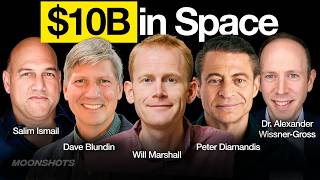
In this episode of the XPRIZE podcast, host Peter Diamandis and guests Will Marshall (Planet), Dave Blundin, Alex (AWG), and Salim Ismail discuss a wide range of topics spanning space launch economics, AI compute efficiency, talent migration, legal personhood for AI, and the global AI landscape. They begin by highlighting Relativity Space’s evolution from the Terran 1 launch failure to the heavy‑lift Terran R, noting Eric Schmidt’s acquisition and the company’s goal of $6 M per launch via 3D‑printed engines. The conversation shifts to launch cost dynamics, emphasizing the importance of rapid reusability and inference‑per‑watt efficiency, with Will arguing that TPU efficiency will dominate the AI‑space race. The panel debates the emerging debate in Argentina over granting corporate AI personhood, exploring legal, moral, and enforcement mechanisms. They then examine the recent talent exodus from Google DeepMind to Anthropic and other frontier labs, interpreting it as a signal of where AI research momentum lies. The group debates the Fermi paradox, the Great Filter, and the existential stakes of AI development. Attention turns to China’s open‑weight GLM 5.2 model (753 B parameters, 1 M token context) which is closing the performance gap with Western closed models, and the implications of open‑source frontier models for global governance. The episode introduces Orin’s OPTI token price index, a new benchmark that tracks the cost per token of inference across major AI providers, likening it to oil price tracking. The discussion then expands into the financial infrastructure for compute: Orin’s creation of investable securities that tokenize data‑center build‑out, GPU tail value, and the Orin Compute Price Index (OCPI) now listed on Bloomberg. The guests analyze how hyperscalers (the “Big Five”) are spending AI CapEx far beyond their cash flow, financing growth through massive equity and debt raises, and consider the risk that a shift in market sentiment could force a pullback. A debate emerges around whether companies like SpaceX are “hyperscalers” selling compute hardware versus providing AI services, highlighting the distinction between selling GPUs and selling intelligence. Throughout, the hosts stress the need for interdisciplinary “AI conclaves” to address alignment, safety, and policy as AI capabilities accelerate, and they close with optimistic calls to action for listeners.
Chapters
Today, Planet's a $10 billion company. You've coined the term large Earth models. What's that mean?
A bit like Google indexed the internet to make it searchable, we're indexing the Earth to make it searchable. It will finally enable us to be smart stewards of our planet.
The elephant in the room here, Will, I have to ask it, is how do you compete with Elon's plans for orbital AI data centers?
Everyone apart from SpaceX has to pay the SpaceX launch tax right now. Everyone apart from Nvidia and Google has to pay the Nvidia tax. And which tax is more important? Near-term is the launch, but longer-term is the compute.
That is fucking brilliant.
Our next story should keep the US labs up at night. It's a Chinese model called GLM 5.2. In some cases matches or exceeds the top models from OpenAI and from Anthropic.
This level of performance in an open-weight model is absolutely shocking. You can burn tokens to get more intelligence, and the Chinese have figured out how to do it.
The Chinese are evidently figuring out how to more efficiently, or at least more cheaply, reason.
Now that's a moonshot, ladies and gentlemen.
Welcome to Moonshots, everybody. I'm here with my magnificent moonshot mates, Salim Ismail, the father of organizational singularities. Salim, good to see you, pal.
Good to be here. Good to be home.
Yeah, everybody's home. This is great. This is home day.
When was the last time this happened? This is like never, never.
AWG, our in-house super genius. Good to see you, Alex.
I will say in my defense, coining the term planet ark for a quadrillionaire who can own an entire planet was not an advertisement for Will and Planet. Uh-huh.
Yes. And Dave London, our wizard of AI investing. I'm Peter Diamandis, your host and your optimism evangelist. We have a special guest here with us today, a friend of nearly 20 years, a man who's building humanity's orbital AI and data layer, Will Marshall, the CEO of Planet. Will.
Hey, thanks for having me, guys.
I have a question for you. Do people ever say you're the CEO of the planet?
I should be.
You should be.
FYI, Planet is a public company. Ticker is PL. You can track it in real time as we speak today.
Yeah. And as always, we got a packed WTF Just Happened in Tech episode. The singularity waits for no man and no agent. We're going to kick off a discussion on Planet's push for large Earth models, their Orbital AI Cloud. We'll jump into Eric Schmidt's newest launch company, Relativity Space, and their upcoming Mars mission. We'll jump there from the AI talent reshuffling and President Javier Milei's provocative statements on AI personhood. Of course, Alex, I expected you're the one influencing there, but we'll ask you behind the scenes.
You think you're saying, Peter, you think I'm pulling, pulling Javier Millay's strings for AI personhood?
I think you're influencing him. We're going to close out. We're going to close out with the shocking performance of China's open-weight GLM 5.2 model. ByteDance's new 4K video model will wrap up with a collapsing price and exploding CapEx of intelligence. That's going to be fueled by nuclear and fusion power plants. All right, let's jump in. So, Will, I want to kick it off with you, buddy. I hope at the end of this conversation, everyone listening is going to understand what this layer of AI and data capabilities that you're building is going to mean for them. But let me do a proper introduction for you. So Will Marshall is the co-founder and CEO of Planet. It's the world's largest Earth-observing satellite fleet and soon orbiting AI data satellites. He's a physicist.
With—
who earned his PhD at Oxford. Not a bad place. Not MIT quite, but, you know, not a bad place.
Okay. Will, this is where you jump in.
Yeah. Before Planet, Will worked at NASA and he and I met back in 2008 along with Salim. Today, Planet's a $10 billion company. And following up on your point, Dave, I mean, I looked at the ticker, Will, and a 450% increase in the price over the last year. That's extraordinary. Pretty amazing. Will is operating 200 satellites in Earth orbit today, generating 25 terabytes of imagery every day. We have two major stories. The first is about planetary intelligence. The second is about Project Suncatcher. So, Will, let's kick it off, buddy. Let's talk about what you're building with planetary intelligence. You've coined the term large Earth models. What's that mean?
Yeah, well, planetary intelligence to me is sort of a next era in machine intelligence, um, and it's all about building models of the real world. And of course, AI models only as good as the dataset they're trained on, and we have gobs of real-world data. I think of it in two phases. The first phase is combining planetary, uh, sensing, which is already in space for all the obvious reasons we've been in planetary sensing space, with large language models to what I call large Earth models, which is, you know, wrapping up not just the text of the internet that's embedded in LLMs, but all of Earth data so that you can ask physical questions about the real planet. And the second phase in big arc terms is putting the compute up next to the sensors into space. And we're doing that too. That's a bit further out, but that sort of leads to phase 2 of capabilities in this world. We're mainly focusing on the phase 1, which is pulling all of our Earth imagery data into models such that you can ask questions about the physical world. I liken it to like LLMs, of course, know all about the text of the internet, about human knowledge, incredibly versatile about it, can answer questions about deep areas of physics to anything pedestrian and anything in between. But they only really know about the theory. It's very abstract, right? What they don't know about is how the real world is behaving. And so, liken it to somebody who's been stuck in a library. They read all the books, but they never looked out the window. Or maybe they've looked out the window. They certainly haven't gone outside to see the reality. So they're limited to questions about theory. We are adding sensor systems to LLMs to enable them to upscale to these large Earth models that enable us to answer real-world questions, whether you're a farmer, journalist, somebody interested in national security, you want to know about the real world. And that's where every—
every European government— you forgot to mention the billion-dollar-plus contracts with every part of Europe, every government.
Well, exactly.
Everyone who can't afford to launch their own satellites.
Absolutely. The governments want to see around the corner. They want to see new threats. They want to respond to disasters. And everyone wants to answer questions, not just about the text of the internet. That's where all the large Earth— large language model companies are going, all the AI companies. Dennis has talked about this, Dario has talked about this. The next scale models are going to be real-world models. And for real-world models, you obviously need real-world data. And Planet has 3,000 images for every point on the landmass of the Earth over the last 10 years, documenting every day of changes. So you basically have a huge stack— it's 150 petabytes of data— a huge stack of information about the real world and how it's changing over time. We've said before, like 8 years ago I did a TED Talk talking about how we're a bit like Google indexed the internet to make it searchable. We're indexing the Earth to make it searchable. It's just that large language models are making it way faster to do that. And so now it's just unleashing all of this potential laden in Earth imaging data, not just ours, but the whole field.
Well, if I wanted to pay you to take one point on Earth, Peter's house, say, and stitch together those 3,000 images images you collected over 10 years and turn it into a little movie. Could I buy that from you?
Yeah, sure. I mean, it's getting— it's getting easier and easier. Historically, most of our users have been big entities, you know. NASA has used it, the National Reconnaissance Office, uh, so, right, the intelligence community, um, huge agricultural companies like Bayer and Syngenta and hedge funds in New York and and so on, and lots of—
And Will, myself, I've purchased data from you in the past.
Have you really? For what?
I wonder if— You can purchase it via API.
Yes, you can. But typically, you're unusual, Alex. Most people can't get much value out of it because processing terabytes of satellite imagery has been too hard. Now AI comes along and just shortens that gap right there. So you can just ask Gemini or Claude, hey, find me images from Planet. Tell me how my farm field has changed over time. How can I improve that? Improve that next year? How can I improve it today? What do I need to do? And it would go off and do that analysis and come back to you with just the answers.
And you're one of the few— if only, correct me if I'm wrong, Will— like you're the only or one of the only vendors that actually offers high-quality historical imagery. If I specify lat-long coordinates and I want a bit of historical imagery of different types, we can offer that via API.
Yeah, we're the only company in the world that images the whole world every day at high resolution. Basically think of it as the Google— if you look at the Google Maps satellite layer, but that layer is maybe 3 years old, sometimes 1 year, sometimes 10 years, but, you know, a couple of years old, let's say. We're doing that every day for the whole Earth and have a time axis. So it's like Google Maps satellite layer, but with a time axis. And yes, we're the only ones that are doing that, and necessarily, and until someone invents a time machine, even if somebody erected a whole load of satellites, they can't go back in time and get our historical archives. So all of our clients use not just the today's image, they look, they almost always want to know, well, how does this compare with normal? Let me give you an example. You know, in Ukraine, we're very much helping them with defense of their country. And, you know, they don't just want to know where the Russians' positions, where their military bases, where their industrial facilities, but how does it compare for the last couple of years so that they know if it's normal or abnormal, and therefore, what's the threat level. The same with the US intelligence community. They want to know what's going on across China. They don't just want to know, you know, is there a new something in China? They want to know how does that compare with the normal activity levels in that place. Same true with the farmer. They just don't— they don't want to know just what's their farm yield output now. They want to compare it to the past, know if they're— agricultural interventions would be better if they do it like the neighbor does it or someone else does it. They need the historical background to know that. So yeah, the archive is really important. It goes back 10 years.
That API is going to be really cool for, you know, Salim and Peter and I are looking at island real estate and mountaintop real estate. We're big on this toll thing coming online very soon. So places that are normally— yeah, but I'm estimated to buy—
it's going to totally—
why don't we do it together? Let's, let's get our fund together for this and use your historical data to analyze the perfect locations.
The search query, which piece of land will generate the most profit for us when EV tolls arrive?
I'll bet you I could do that during this podcast, actually.
Yeah, I think—
OK, on that.
I think it relates to how many wiggly roads. So how far is it by time to now? And how short is it going to be after EV tolls? Yeah, I've bought a property myself within the 100-mile radius of San Francisco, knowing that the value, I think, is going to go up.
I've got two questions. You know, when you talk about imaging, what's the resolution at which you're imaging? And do you also do infrared and other bands?
Yeah. So basic explanation, we have 3 fleets. The scanning fleet is 3-meter resolution. That's the one that does the entire Earth and it does it with 8 spectral bands. And we're improving that with our next generation. We're launching a first tech demo this year of Owl, which enables it to go from 3-meter resolution to 1 meter.. And the latency of the present imagery is several hours, and we're reducing that 10x as well to well under an hour. So that's that system. A second system does high resolution, so we can go up to 40 centimeters a day, 40 to 50. It's going to 30 centimeters tomorrow. We've launched 9 of these satellites. We're launching a whole bunch, which was a 30 by 30 by 30. So 30 centimeters, 30 times a day, and 30-minute from request to get the image back in your hand anywhere on the Earth. Okay, so it's amazing. So that time axis is being shrunk and that's for 30 centimeters. So each pixel is 30 centimeters across. So about a foot in units. And then we— then we have a hyperspectral imager, which is the first and most sensitive one in orbit according to JPL, who we built it with, which has 400 spectral bands. So this is like the human eye has 3. RGB, red, green, and blue, it has 400, and that crosses from infrared to ultraviolet, and that— those extra spectral bands enable you to essentially take like a signature, a fingerprint of the planet. So where we look in each pixel, which these— that one is even bigger, 30 meters, but we can actually tell the species of the tree or gas emission, or if it's a gas emission, which tank site built— which tank site built that vehicle? Because it turns out the paint is slightly different from each location. I mean, incredible. It's like the signature fingerprint on the, on the Earth's surface.
By the way, I know that you're busy and sometimes these episodes run long and you don't have time to listen to the whole episode, or if on occasion you miss an episode. I now put out a Moonshot summary on Substack, which includes a link to all the stories that we cover. The weekly recap covers what I and the mates had to say, what we think is most important, and what we're most excited about. And it's free. You can subscribe at diamandis.com/metatrends. That's diamandis.com/metatrends. All right, now back to the episode. Why hasn't anybody done this, Will? I mean, I don't think anybody's close to the fleet that you've built and you bought part of your fleet from Google early on.
I'm just curious, Peter, are you sure you don't mean why hasn't anyone in the private sector done this?
That's what I mean. Yes, private. I mean, obviously defense has— how many defense imaging satellites are in orbit right now, you think?
Well, it's technically classified for the US government and probably you can tell if no one's listening, but roughly, roughly like half a dozen really high-resolution ones. And they have much higher resolution than we have, more than 10 times or so. They're like higher resolution, but golf ball pixels. Yeah, but that sort of— that has a trade-off of coverage. So we— they have even less coverage than we do. Um, in fact, not just a little bit less. We cover about, um, 200 million square kilometers every day. The Earth's landmass, about 150 million square kilometers. So a bit more than the Earth's landmass every day. They probably cover less than 1% at anything like that resolution. So probably much less than that.
For the entrepreneurs listening, it's important to realize Will started this with Robbie and his partners by launching a phone into orbit, PhoneSat. It was a crazy idea. You got in trouble for it. It worked. You got Steve Jurvetson's attention. He came in as a major investor. And it kicked off a $10 billion company. It's extraordinary.
Thank you. Yeah, well, it's been quite a ride. And, and as you were saying about the stock price right now, it's a, it's a rocket ship. And part of the reason is this AI piece, because the AI piece is lowering the barriers to entry. I think we're going to— and it's just at the very beginning. I think we're going to see this massive takeoff. I've said before, space and AI are getting married. You know, like a lot of people understand how AI is affecting every discipline and it is, right? It's affecting every sector. But space is one of those unique sectors that's producing gobs of data and therefore space is actually important for AI as much as AI is important for space. So like it's— AI is not just eating space as a sector like it is eating almost every sector. Actually, space has something to offer it. 'Cause all the AI companies, as I said, are trying to build these physical world models. For that, they need real-world data. Space comes along. AI is useful for space 'cause it makes value extracting out of all this data much easier for those smaller organizations. But at the same time, it gives AI something it really didn't have, which is this information about the real world. And all they're trying to do is help people ask, answer questions about the real world. Yeah, again, let me give you an example. The farmer going onto an LLM right now and saying, hey, How do I improve my crop yield? The LLM will say, well, here's all the theory of agronomy, but it doesn't know shit about his or her field and how it's doing today, how it compares with yesterday, how that compares with last year, how that compares with the farm next door, and therefore what they can do about it. How's the soil doing? How's the water content? How's the agriculture under? We can tell all that and help the LLM answer that question. Or take the journalist, they're investigating some flood. They don't want to know the theory of a flood. They want to know how's that flood doing today in that village, and the emergency response people need to know where to go. So basically, real-world data is going to come into these AI models, and that's going to enable them to be 10 times more powerful than they are today.
So many questions, Will. I'll start with the simple ones. To the extent that you draw a parallel between your large Earth models and large language models, I think one of the most important questions I could possibly be asking is, yes, you offer historical or archival data, archival imagery via API. But I think most people would love a crystal ball that autoregressively extrapolates Earth into the future, sort of a SimEarth video model at meter or sub-meter spatial resolution of projecting the video into the future. Where are the future extrapolations of Earth? Where is the crystal ball powered by Planet?
I think it's coming. It's very exciting. One step at a time. So we focus first on retroactive analysis and how AI can open that. But already the predictive analysis is coming to the fore. Obviously, AI has been very good at token— tokens and guessing the next token. That's what AI is doing when it's guessing the next— giving you text output. It's each time guessing the next word in the sentence and it's doing a very good job and coming up coherent answers. So obviously with 3,000 images, you could easily ask it, guess the next few images.
I.e., that's right.
Going to happen next. We already just started this. Some people, you wouldn't be terribly surprised, are interested in us tracking data centers across China. So we loaded into it all the data centers across the entire US, which had to be registered. Then we showed it, got it look back through the imagery of their development, tracked that, and then extrapolated that model to China and said, go find all these things in China and track their development. But it also got really good at predicting, based on the US data, when it would complete, like within a few days, it could guess, like way out, when it's going to complete. Because it has taken into account all this construction information in the nearby region and various other things. So now, it turns out this model is pretty good at predicting when data centers will be complete. Lots of people are interested in that right now. So, that's the kind of thing. That's the first time I've seen it really work like you're suggesting, Alex. Really the very beginning, but I think we're gonna get there relatively quickly just because the nature of the tech is it sort of already can do that out of the box.
But surely you have enough data— stop calling me Shirley— surely you have enough data to be able to take everything that you already have and pre-train an autoregressive video model to extrapolate the Earth at the pixel level into the future. Do you feel like you have enough data to do that already?
I think we do, yeah.
Have you done it?
No, but I think it's—
Why have not? Why have you not? Because I think you are the only entity perhaps in the world with the power to build an honest-to-goodness crystal ball.
Yeah. I love the vision.
Yeah.
Again, I mean, we've been doing this in some bespoke areas, but the main thing has been looking backwards because already there's, we believe, a $100 billion market just in the retro— in the rearview mirror. But you're right, it's very tempting. I think the biggest thing that we're working on that's super relevant to that is embedding models. Because the actual doing that for the entire Earth, which each layer is around 30 terabytes of data, is 4,047,000 megapixel images. So just like, I mean, it's just a huge, huge data times 3,000 layers, right? So you can't just throw that into a machine like no machine can just take that in RAM, right? And do the processing. So what do you have to do? You have to put it into an embedding space. So we've been working with Google models on this, Google Search and DeepMind, as well as they've done this important work called AlphaEarth, which you can look up, as well as some open source models like CLIP, a remote sensing CLIP model, and then fine-tuning it on our data. And what this does is it's sort of like an image a tile-to-text conversion. And so— and you can do that for each area, say, let's say a kilometer by a kilometer. And then you could search for arbitrary objects around the Earth. So we've got it to a point where we can put into BigQuery the entire one layer of the Earth in this embedding space. Now you have the potential to do what you're talking about of putting thousands of layers and then predicting the future.
And so I don't know, I got it. So the vision is you're tokenizing the Earth.
Tokenizing the Earth first because it's like a massive compression and then you want to do the prediction.
Yeah.
So, you know, we could do, you know, the middle school that my kids went to commissioned— they took collections from all the parents to buy this huge globe. It's like 6 feet in diameter and it's all LCD. And it's basically you can make it the Earth or Mars or Venus or any other planet you want with this little—
I want one.
It's so cool. But you could, you could say, well, that's semi-cool, but you overlay the planet data and you can actually dial back and forward time of the real world. If you built one of those for your lobby, that would be— you could sell those like crazy.
Next level though. But Alex, where were you going with this? Like, what do you see the value there? Like, what would you go, that's the thing I want to then predict into the future apart from everything?
I want to be able to predict everything into the future, not just at data center level.
I think that's the answer you weren't meant to give.
Okay.
Excluding that, I want to be able to— I'll give you one concrete example other than that. I'd like a reasoning model that I could layer on top of it. So I would argue every LLM wants to be a large reasoning model, not just an autoregressive LLM. I'd like to be able to reason RL style about what changes at the pixel level on the Earth's surface could, say, maximize GDP. We talk on the pod all the time about maybe the GDP triples year over year due to this singularity that some of us think that we're in. But you have enough— I think you have the dataset at the planetary scale to actually build a reasoning model via reinforcement learning that lets us historically backtest various theories of, say, land use. If we literally tile the Earth with compute, as some of us think we're doing, what would be the hypothetical effect on GDP if we, if we get rid of a few gas stations?
Or let's get coffee bean futures.
Yeah, well, certainly. You know, on futures markets you can imagine. But let's get above GDP for a second to go even beyond that. It will finally enable us to be smart stewards of our planet. We are effectively stewards of the planet, but we're not always doing it in the smartest way, right? Not efficiency, nor in terms of how we're taking care of the precious ecosystems and complex environment that we have on the Earth. Now we can, because we finally have a system that understands it all from the local level to the global level and can integrate all of that into recommending what course of action you as that farmer, you as that insurance guy, you as that finance, uh, guy getting betting on markets or whatever can make to make a smarter decision.
But there's a huge issue that comes with this though, you know, because if you go back, the internet was born to operate at planetary scales, but then governments domesticated it, right? What you're doing with orbital mapping is you're reglobalizing that. And so how do you handle the, the aspects of it? Because governments own the map, but you own the sky above the map, right? And so this causes hugely unsettling questions, like you're, you're shifting from national infrastructure to planetary infrastructure. Is there a global kill switch? How do you handle sovereignty? You mentioned Ukraine already, or China. There's enormous geopolitical tension in this. That must drive you crazy trying to navigate those.
Well, I would say it's, uh, it's not— less drives us crazy, it's, it's a founding part of our mission. We call it giving greater transparency and empowering everyone with that leads to greater security and leads to greater sustainability.
No one can hide. No one can hide anymore.
Exactly. So Putin thought he could get away with people turning up on the border and then no one would notice. Well, we put that to bed, you know, and then the— it didn't deter him from attacking, clearly, but the potential in the future is that everyone would know that they would be seen at every step. Now everyone knows that they're seen at every step. If you hit a school, we're going to see the school. If you hit a bridge, we're going to see the bridge. And no The accountability is going to be there for the whole world to see, no matter what.
And maybe just—
I think acts as deterrent in the history— throughout history, wars happened mainly when there's been misinformation, a lack of information, or— and people have had to guess or, or made mistakes based on misinformation. Here we have more people understanding what's going on, who's got what equipment, where, where does that, uh, um and can monitor peace accords and all that. I think transparency drives accountability and reduces the probability of war. Meanwhile, on the other— Yeah.
Very narrow question on that exact topic. You know, you assume that the US and China see everything via satellite at all times. But if you look at the 220 countries across the world, like what fraction of all governments actually have satellite coverage data? Like you said, misinformation leads to confusion, leads to war. Like in Yemen right now, do they look at data or not?
Not much. But I think that that's going to change. You know, again, the challenge has been digesting 40 terabytes of data every day is too much for most organizations. NASA and the NRO, they have teams of people who are doing satellite imagery processing. They know how to deal with this. Bring AI along and suddenly you eliminate all of that. You can actually get most of the answers very quickly. So that NGO you know, the Red Cross operating in Yemen or whatever can actually get benefit from this right now and enable them to make smarter decisions. So it changes it from a world where it's just the big entities to a lot of other entities can get value.
What percentage of your revenue is government versus corporate versus individuals?
So it's about 60% defense and intelligence. About 30, 25% civil government and about 15% commercial. So basically mainly government and it has been growing there. But commercial is now really starting to take off. And again, it's because of all those reasons, reasons that AI is lowering the barriers to entry.
How are you going to price the AI training data use case? I mean, that's the big up-and-comer, obviously.
Well, you know, I mean, frankly, they're going to own it, Dave.
They're going to keep it and sell the knowledge.
Exactly.
You build your own LLM. Interesting.
We'll just continue to sell the data.
So, so if OpenAI calls and says we want to, we want to use it, you're going to say no, or are you going to say no? It's $1,000,000.
OpenAI can call our MCP server and off you go.
Okay, so it's just fixed price. Absolutely. Train all you want and then And no recurring—
And every time you need planet data, you're going to need to do an API call or an update.
I am curious about maybe to steelman Salim's earlier question about information asymmetries. Will, correct me if I'm wrong, but am I correct in assuming that your datasets go through some sort of US government NRO filter regarding what can be made publicly available?
Not exactly. It's a bit more nuanced than that. As a US remote sensing company, We register under the NOAA's Remote Sensing Act, which means we have to register the satellites, but we can sell the data to anyone except for a blacklist, a blacklist that includes Iran, North Korea, what have you, and various terrorist organizations. But other than that, they're not checking every player we provide to. We do check that. We think— and there's many people we don't work with if if we think that they reduce some harm with this. But essentially, they're relatively hands-off with that.
So, yeah, great.
There's a great line of questions. So that's a US blacklist, right? But you have a— you have like a billion-dollar-plus deal with Sweden. Do they also have a blacklist that you also honored separately, or do you just deal with the US?
I mean, they tend to be almost the same. We respect the EU one as well, which they're part of.
I'm Canadian. Are we on the blacklist? Because last time I checked, it was a problem.
Interestingly enough, they differ only a tiny bit. So we have a load of ground station infrastructure up in Canada.
So you're great.
And we can download there and then sell it to certain countries that we could if we downloaded it in the US. So we just add these things up and go, well, let's make meta list with all the bad guys according to all the people. And then we take that off.
You must have to have a dedicated AI just dealing with the complexities of who gets what.
It's not as hard as you think.
That's just blocklisting of users or customers. What about downsampling or lowering the resolution in sensitive areas? Do you do any of that?
Not—
Yeah, like Peter's house.
No, no, we don't. But remember, I mean, I think if people don't get confused about this, we're really a long way away, 400 to 500 kilometers. It's like the distance from Los Angeles to San Francisco, pointing our telescopes at one from one city to the other in distance. Right. Obviously, the details you can see with that aren't the same as you can if you're flying a drone. If you're flying a drone, you can see people, you can recognize their faces, you get into all the personal privacy. We're 400 or 500 kilometers away. We're not getting into that. It's kind of amazing what we can see, but it's not like that. And the reason that matters is that a lot of the most sensitive stuff doesn't come into the fray because of that. And countries agreed way early in the space era that they will let each other— they won't let each other fly planes over each other's territory without permission, or drones. But you can fly in space because they consider that so far away. You can get some data, but it's just enough for transparency, but not enough to get into my— into the details that they would care about. So it's basically— that was the agreed-upon definition.
And the backstory there is fascinating, right? Back when Sputnik was launched in 1957, the US had to make a decision Do we disallow that to happen 'cause it's flying over us? But if they did that, they wouldn't be able to fly our US satellites over Russian territory. We said, okay, everybody can fly satellites. You just ran experiments.
And the physics of it dictate that, right? Whereas a plane, you can go up to Russia and turn left. You can't go up to Russia with a satellite and turn left. You're in an orbit. You're gonna go over Russia. So what are you gonna do? Say that I'm not gonna turn on the camera Well, that's silly. That's obviously not going to happen. So people aren't going to respect that. So, yes, there was some physics that went into that and some fact of it being far away. But yeah, that became the international norm. They famously— Gary Powers was shot down in the U-2 spy plane. And then the US said, well, we're going to put most of the most sensitive stuff in orbit and that's going to be our domain of, of, of enabling us to monitor what's going on with nuclear weapon arms control and all this sort of stuff. But now it's just proliferated and far more people, you know, people now can get through Planet what took the entire CIA and NRO infrastructure a couple of decades ago, and they can get it for a tiny, tiny fraction of the cost. Right. And in some senses, we can do things that no one's able to do, like the daily scan. They've never done that many satellites. So they've never had that sort of global coverage. So we can do things that they can't even do. And the fact that that's now possible for private enterprise, that has completely changed the game.
So you historically have always brought the data back to Earth and done the crunching at the data centers on Earth. You ran some experiments in April where you put some Nvidia chips on one of your satellites and you did the processing up there. What's the significance of that?
Well, well, it's basically enabling us to do the processing at the edge, speeds up the time. So this is really processing at the edge, you know, in space, 500 kilometers up. And yeah, we put some NVIDIA GPUs on our satellites and all of our Pelicans going up now have them and the Owls will do as well. That combined with satellite-to-satellite communication, we're putting links so that we can go up to other satellites and then back down so that we don't have to wait until the satellite goes around to the ground station that we've erected. Which we put all around the world, but still it has to take some time. Instead, it can just send back the answer. So what, what you can do, take in the example we did in April, we took a picture of an airfield in Australia, in this case in Alice Springs. The computer automatically recognized the planes on that airfield. Then it just sent us back the locations and type of planes, right? That was done in seconds. And then we can send it back by RF, satellite to satellite. So you suddenly have things in seconds. Now, let me explain how that makes sense. You guys are— a bunch of you are in LA.
Here's a photo of that, by the way.
Oh, yeah.
That image. Yeah.
Oh, cool. What a flashback. That looks exactly like what I used to work on at MIT, like literally exactly.
And time really matters for a number of applications. Just think of the— the fires in LA, Palisades and other fires. We gave images within a couple of hours of those fires, and then we did analysis building by building, which buildings were affected, where should the relief operators go, the American Red Cross, Cal Fire, and—
Where the water was located.
And how to— had we been able to get that in a few minutes rather than a few hours, could that have saved lives? You know, could that have saved properties potentially? Time really matters. So this is all processing at the edge is all about time. It's going from hours to minutes.
Can you give us some geeky numbers on that? Because you got a couple of that in the Pelicans. You have a couple of thousand frequencies of light coming in. So the data must be astronomically huge, just the raw feed. And then, you know, the Nvidia chips will have no trouble compressing that down. But then you have limited bandwidth. Coming down to the Earth.
Yeah.
So what are the rough numbers?
Well, so I mean, I know the numbers based on our, our Dove satellites. They take 8 frames a second at 47 megapixels so that we can get for each area on the Earth 8 different spectral bands. And then within about a second, the satellite has already gone past that area. So basically you then you would just have to start again. So it just goes 8 times a second to get 8 spectral bands for each area of the Earth, and each picture is maybe 35 by 20 kilometers in area. So just imagine that going all the time, clipping along. All the time it's in daytime over land, which is about a seventh of the time that it's— and then the rest of the time it just repowers its batteries. If you like. It does some over ocean and pelicans more also turning to shoot to specific targets. So because of that, you have all this time when you're not taking images, which actually gives you more, if you like, buffer to send it down. But yeah, so each Dove is imaging maybe a couple of million square kilometers per day per satellite. So— what is that?— bigger than the area of California each satellite per day. So this is why when people say, oh, let's use drones for agriculture, I'm like, no, that's crazy. You would need 1 million drones per satellite or something, you know, or 1,000 certainly. It's actually cheaper to do satellites if the resolution suffices from the satellites. Right. It's just orders of magnitude.
Where does the resolution go? Right now you're saying it's about at about a 30, um, 30 centimeters, 3 meters, uh, uh, super dubs. In 5 years, where do you, where do you expect to be in 5 years?
We're already going upgrading our daily scan from 3 meters to 1 meter. Um, with super resolution, it can get potentially better than that too. That might even go to 50 centimeters, 30 centimeters. And then our Pelicans, we've moved from the SkySat, was which we inherited from Google, was 50 centimeters. Now we're moving towards 30 centimeters. And with super resolution, again, you can get a little bit better where you look at overlapping and sharpening based on pixel overlap and things like that.
Why is it with what exposure time?
Well, the exposure time is— I want to say it's like a couple of milliseconds.
So you should be able to catch quite a few interesting aircraft in flight.
Yeah, yeah, we get aircraft in flight all the time. I can show you that.
Any UFOs?
Is that where you're going?
The Air Force took a look through our images, and I'm sorry to tell you, there ain't any UFOs.
No.
That's too bad. Why is it—
why is it Sterling? I'm so excited about us detecting UFOs, but I'm sorry to all the audience members out there that think there are some that have visited the Earth, apart from the crazy people that think they've been abducted. It ain't true. We haven't seen any aliens. And NASA, let me tell you from firsthand experience, could not keep that a secret. Never, ever. That's ridiculous. That would be even more— it was— that makes it even more improbable. You know, NASA's not—
why isn't Elon doing this with Starlink? I kind of imagine that putting some cameras on board—
but they're clearly doing stargaze. Stargaze is what he's doing, right?
Well, yeah, but that's using— for SSA, they're— they could, but they're kind of in the wrong orbits. They're a little bit too high, and you really want a sun-synchronous orbit to have a consistent shadow angle for optical imagery. They are doing some classified missions for the NRO, which are— well, they're classified. And— but there's some stuff on the internet about it. But they are generally not in the business of doing Earth imaging. They're doing comms primarily, Starlink, which is obviously a very successful business. That's the I think the most exciting aspect of the SpaceX IPO, frankly, I think is that—
and what's the mass, what's the mass of a pelican or a dove compared to a Starlink?
Pelicans are similar and doves are much, much smaller, like more than 10 times smaller.
Well, can you give folks listening an understanding of how quickly the tech has developed? To build these kinds of satellites? Because it's been stunning. You were on the cutting edge of this back when— when did the first Dove go up?
2013. So we've been doing it 13 years now. Yeah. So, I mean, to give you a sense, the radio speed has gone from a megabit a second to 10 gigabits a second. The cameras have gone from 2 megapixel to 47 megapixel. The hard drive space has gone from 100 megabytes. Yeah. To what we— what have we got, a couple of terabytes on there now. I mean, it's just extraordinary, right? Each satellite, we— each generation of satellites, we tend to be doing about a 10x. So our Dove to SuperDove went from 4 spectral bands to 8 spectral bands and from a 29-megapixel camera to a 47-megapixel camera. So if you add that up, that's— that was about 5x increase in data per satellite for a similar cost per image. So it's like a, you know, we're talking about significant— an OWL, our next generation daily scan, going from 3 meters to 1 meter. That's 10 times more data or 9 times more data, roughly. And we'll be getting it back about 10 times faster as well. So That, yeah, 10x is still for the halving. But Peter, I think the even bigger thing is our hyperspectral satellite, Tanaja. We're 5x-ing. We're working on a new one that has 5 times bigger swath width for the same spacecraft. So those things are possible. So we're gathering more and more data. And the cycle of increasing those sort of things is, I would say, 2 to 3 years. So 2 to 3 years, sort of 5 or 10x, I would say, is the rough Moore's law for increases in data in space. But I would say the bigger thing happening now is the unlock of AI that really just brings down the barrier. It's all this— all this capability is latent for that farmer I mentioned, for the hedge fund manager, whatever. But they couldn't get access to it. So I think we've got about 100x to go in the next in the next couple of years just because of AI unleashing what was already latent in the present data.
How does this flow to the average individual? I mean, how are people, how's it gonna impact individuals on the ground right now worried about, you know, their local environment or people polluting and so forth? How do you make this accessible as an intelligent layer that people could just, you know, plug into on a regular basis?
Well, again, just imagine making a natural language query of our data, just like you make a natural language query of the internet via ChatGPT or Gemini or pick your favorite LLM. And so except again, LLMs understand the text and large Earth models understand the physical world. So can answer that question for that farmer, you know, how's that, how's my field doing? What should I do? What precision should I use? It could say, well, you've got blight over in this corner. You should put some fertilizer over there, do this. And then— and the journalists can do their checks on some event happening around the world. The civil government responding to that flood or permits can just say, hey, here's my list of permitted buildings. Tell me which buildings have been built that don't have a permit. And it can go and look at the last month, find the images, find the buildings, check against that map. Correlate against that list, and then tell which ones have and have not got permits. That has already— we've done that in a few areas in each case with journalists, with finance, with farmers, with civil government doing—
I can— this is going to be a boom to the legal industry, uh, tracking.
Here's, here's 3 obvious use cases. What's the change in parking— parked cars outside of Walmart over weeks and months.
Okay, that's the cliché, right? That this is the cliché use case for folks purchasing Planet imagery to, to trade stock prices based on parking lots.
But shipping and knowing where ships are— there's rogue fishing ships all over the world that are a nightmare right now for the fishing industry, right? Commodities, right?
Agriculture commodities, soy.
But as the resolution gets better, I live— if I live in Manhattan Or is there a parking spot on my street that I could get right now?
Exactly.
I want that for sure.
And that one. And also, is my teenager sneaking out the bedroom window at night?
Uh, that's— we have 1 meter or 1/3 meter resolution here. We'll get there. But I guess, I guess, yeah, it's obviously your kid if it's your house.
But more seriously, Will, I think you are in possession of a data set that could be GDP maxing. How much of that analysis are you doing in-house versus externalizing to partners like GDP maxing. I said GDP maxing. I just coined GDP maxing with two X's.
Yes, I do think— I mean, we have hedge funds that are using our data right now. We're not doing that internally, but we have some hedge funds who will go undisclosed because they don't like being disclosed. But we have some, and we think that they are getting significant alpha on our data, which we are happy to take part of. Now, in the future, I do think there needs to be more. But again, I would take it up a level. I think GDP maximizing is one thing, but life flourishing is an even bigger thing that we can do this way. And, and we are super inefficiently using the Earth right now, super inefficiently. You know, agriculture is, is terribly inefficient, for example. Yeah, there's 10x's for the halving all over the place in agriculture. Let's go fix that.
Abundance, maybe.
Yeah.
You know, so let's turn to Dyson swarms. I want to get to Dyson swarms. You're—
I have a quick technical question before you get to the theory. You've put Nvidia chips onto the satellites. How's the cooling being handled?
Oh, that's relatively straightforward. I mean, we could talk about computing space more generally, but yeah, I mean, we've been dealing with chips that are obviously hot and need to cool off for decades in the space sector. There's no magic here. You can't use convection or conduction as you do on the ground. They're either air-cooled or water-cooled with physical touch. In this case, they have to be radiatively cooled. So you have a radiator, but radiators, we've known about that for a long time. We know how to do radiators. It's a relatively known, known. One of the interesting things about it, by the way, if you like geeking out on this stuff, is that the radiating energy goes with the T to the fourth, the temperature to the fourth power. So basically, if you're, if you're a blackbody, if you're a blackbody, which is you're close to, if you double the, the, the, the temperature from, say, 100 Kelvin to 200 Kelvin, you quadruple you 10x-ish your, your radiative power. So dumping energy is all tricks of thermal regulation of radiators and how you stop it. You want to get it as hot as possible without melting it. And there's lots of tricks to the trade there. But it's— there's nothing fundamentally unknown. There's— these are no knowns.
All right.
Second, that's Lehman. Say you want to aim in the direction of the cosmic microwave background whenever possible.
Absolutely. The 4K Kelvin of space. So you want to point your radiators at the dark. All right.
Let me take some notes on that one.
Suncatcher, Project Suncatcher. Let's jump into this. So you're putting TPUs for Google in orbit. You're building an early version of the Dyson Swarm, orbital AI compute. Can you tell us what you're doing there? I mean, obviously everybody's thinking about, you know, Elon's data satellites. How do you compare Are you going to get your launch? Have you been launching on SpaceX?
We've lost 40-some-odd times. 15 have been on SpaceX. We've launched 300, over 300 satellites on 15 launches with SpaceX. One of our best partners. We love working with them. They've got it closest to a bus ride to space. I will point out that in addition to launch costs coming down, the biggest upheaval in space— I think I mentioned this last time I came on this podcast. With you, Peter. The bigger transition over the last 10 years in space has not been the launch cost. It's been the satellite cost performance. It's been that miniaturization of satellites, both the Starlink and ourselves. And we sort of pioneered that. That said, led to at least 100x, if not 1,000x in cost performance for each kilogram you put on the fairing. So the dominant thing that has changed to lead to all these large constellations of satellites is actually the capability performance of satellites, not the launch cost. But both add up and they make things better.
Performance density. So tell us what's—
exactly, exactly. So, um, in our case, like, how many bits do we collect per kilogram or per dollar spent, which is related to kilogram because the cost of launch. Um, yeah, so we've been launching a bunch with SpaceX. SpaceX didn't come up with this idea, I will point out. Um, they only started talking about about this after we announced our project, and we'd been thinking about this for some time. And we're not the first ones either. Space industry has been talking about energy from space for decades and decades and space-based solar power. And for many years, the idea is basically we want to put energy-intensive infrastructure off Earth where there's abundant energy and, and, and where it's not conflicting with the incredible biodiversity and people's lives. Right.. So as, as Jeff Bezos likes to say, we want to zone the Earth, rural and light manufacturing, and, and put to space all the heavier, uh, energy intensity— intensive infrastructure. Now, people are talking about energy in space for a long time, but the first and obvious easiest one is computing space. Because whereas for, say, solar power, you need to beam all that energy down. And how do you do that in a way without frying people's heads? Is actually difficult. Whereas beaming, putting compute in space, you get all the power advantages, but you only have to beam up the questions and beam back the answers. Well, we know how to beam bits. That we've been doing for a long time. Comms satellites was one of the first uses of satellites. So all you have in space— so we basically did a study with Google about 8 or 9 years ago looking at the details of compute terrestrially costs, the water, the building, the energy, the all the things, and what it would cost to do it in space. And it just turns out that when launch costs come to about $200 to $300 a kilogram, it's just going to be cheaper, surely, on a pure cost basis to put it in orbit versus on the ground. So as Sundar put it from Google, within 10 years, we expect most compute to be put into space. Now, that is a big deal because Google alone is spending 200 billion a year at this rate on compute. That's roughly the size of the entire space industry today— rockets, satellites, comms, everything combined. So Google is just going to do it. Add up all the other folks that are going to do compute, and you've got a business that's bigger than the rest of the business. This may be 10x the entire space industry today. So it's going to change the space sector. So we're doing some early tech demos for Google. When we did this study 8 or 9 years ago, Larry and Sergey were like, well, let's come back in 2030 when the launch costs come down to there. And I said, no, let's come back 5 years earlier because it's going to take us years to build the technology to do the radiators, to do the clusters. So you have to have a whole lot of these you want basically a rack of GPUs on each satellite, and then you want clusters of spacecraft in close formation flying with optical links in between them. And all of that is a whole load of technology to develop. So what we're doing with Google, they selected us to build their first couple of satellites to test TPUs, radiation management, the cooling, the intersatellite links. And so we're doing a couple of tech demos, very early. It's a moonshot project. But the long arc is it's just gonna be cheaper and has a peripheral benefit of not clashing with energy costs for communities, water for communities, or the biosphere. So it has lots of benefits terrestrially as well.
Alex, we talk on the pod, well, all the time these days about sun-synchronous orbit and Earth acquiring its own mini-Saturnian ring, if you will, on a polar orbit. When do you think SSO-based Dyson swarms will become visible at night or during the day on Earth? What is your timeline? Is this like early 2030s?
I mean, we've got loads of satellites in sun synchronous and you see them today in orbit. If you look out just after dawn or dusk or just before dawn when satellites are most visible. But most of these satellites will go into a dawn-dusk sun-sync orbit.
Yep.
That means they're 24/7 facing the sun. However, that also means that they're not going to be very visible because that's literally when it's still a little bit light outside and it's going to be hard to see those guys. So actually, they—
they—
by the way, there's real challenges of interfering with astronomers on the ground and we have to have to be careful about that. But this is the best time to do it because it's not interfering with the deep dark sky needs of astronomers. It's really in these, these other planes. So the short answer is it won't affect your seeing these rings. You won't see these rings of satellites because they're—
I want to see the ring.
I want my rings. But that's also— that's also a small number as well.
Like, that's—
it's a small number. Elon has FCC approval, I think, for a million. Of these AI satellites. Don't you think at some scale, if so many of these birds go up that either they start to become visible or they start to become—
You will be putting them in slightly different angles. That's right.
They form a full band.
Well, yeah, that's right. You would put them at slightly different inclinations where you still have 24/7 sun or very close to it. Yes, you would start seeing that. But it would only be right just as it gets dark and just as it— just before it gets light. Like, it would be like this funny ring effect. But later we may put them in other orbits as well. I don't know. They would have to be much higher to get that.
How concerned are you about orbital debris? Well, we talked about, like, in Elon's S-1, his number one risk factor on Starlink, which is their revenue, you know, profit engine right now, was orbital debris, you know, being able to knock out a lot of capabilities. What about you? What do you think about that?
I think space debris is a real challenge, and that's why we put our satellites below the area where that's challenged, which is 800 to 1,200 kilometers from the Earth's surface in altitude. So much— we put our satellites 400 to 500 kilometers to keep them well below that problem.
Oh, interesting.
Kessler syndrome is already in operation and effect. But bear in mind, there's about 10,000 satellites in space of order. And there's about 100 million pieces of space debris. So about 10,000 times more objects in orbit are— 10,000 pieces of debris for every satellite. So the vast majority of the problem, even if you put a million satellites up there, the vast majority, they would still— you'd have 99% of it is still not satellites. The challenge we have to deal with, I'm trying to point out, is debris. And that is mainly made up of all the small bits of stuff left over from former rocket bodies, exploded satellites, anti-satellites, and other things which were done in high orbits and so could live there for decades. Now, when we were at NASA, Peter might remember this, we came up with a scheme under Pete Worden's mentorship of, of using lasers on the ground to, to sort of do traffic management of that debris, because obviously with two satellites you can move out of each other's way. Or any maneuverable, but most of the conjunctions in orbit are debris with debris. So what do you do about that? We need to stop the collisional cascade for those pieces. And for that, you can actually use lasers on the ground that gently nudge one so that they miss each other. You can do this sort of traffic management. We call it light force. A system like that could actually stop the kestrel cascade and slowly bring everything down, enabling this, to— but the actual satellites is less of a problem as long as we keep them in low Earth orbits. And there's lots of space. Just to give you a rough order, even in this sort of sun-synchronous dawn/dusk orbit, there's about 1,000 times more space, just thinking very crudely, than there is on the entire landmass of the Earth. So there's a lot of space.
But, well, just—
wait, wait, wait.
This is really fascinating. So wait, you're at 300 kilometers or 500 kilometers? What's your altitude?
400 to 500, yeah.
400 to 500? And in that, what's the lifespan of an object orbiting at that altitude?
A few months to a few years.
Okay, so self-cleaning. And you're starting to walk through— you have about what, 100 kilometers?
The atmosphere drag pulls everything down, I guess.
Yeah, yeah. So you've got 100 kilometers of space where you can get a good 2-year, 3-year orbit. You know, a GPU in space isn't gonna— it's gonna depreciate over 3 years anyway.
Exactly. And that's why we call it strapping space to Moore's Law. We always update our satellites every couple of years because the satellites in space becoming obsolete. Just like the phone in your back pocket, you don't want a 10-year-old phone. You don't want a 10-year-old satellite in space.
Yeah.
What altitude is Elon going with for his—
Well, he was going higher, but I made the point to him that firstly, that's a real challenge with space debris. And secondly, it won't— yeah, it won't be self-cleaning. And even if you put propulsion on these things, even if 1 in 100 fail or 1 in 1,000 fail, you have a real big challenge if you put that much mass into those orbits. So it makes much more sense. And so later Starlinks have come much lower down, and that's much better for everyone.
I don't want to just put— put on the upmass question a bit. So over the past 5 years, I did this calculation on my newsletter. For the past 5 years or so, According to what I've seen, upmass has increased by 40-plus percent year over year. And if you just naively extrapolate out 40-plus percent year-over-year upmass increase, by the year 2144, I think, you find that the entire mass of Earth has been basically upmassed, and Earth has been— Earth has been disassembled, if you just naively follow the exponential.
By the way, everybody, I am not supporting the disassembly of Earth.
Peter does not— for avoidance of doubt, Peter does not support disassembly of Earth. We've established it.
Good. Yeah, I mean, obviously, extrapolating anything 140 years into the future is rather tricky business, as you guys are aware. It's barely— the whole point of the singularity is that it's harder and harder to predict the future. I remember when Peter and I first met 20 years ago, it felt like. We could easily predict roughly who was going to do what in 10 or 20 years in the space sector. Now, if you could predict it 1 or 2 years out, you're a genius. And for AI, it's even harder. It's measured in months, right?
140 days.
You've got to see 3 to 6 months into the future. So that horizon is shortening for sure. And 144 years, I think, is just We can't even discuss—
No predictions, Will, then, regarding when upmass increase will start to slow down? Because right now it seems naively set to increase.
No, upmass is definitely going to continue to increase. But again, I mean, I think the most important aspect of that is how do we get the energy-intensive infrastructure? Look, Data centers are going to become a real hot topic politically in this next election, in the—
Literally.
—midterms and upcoming elections, because people don't want data centers in their backyard. They don't want the energy costs to go up. They don't want their water to disappear, because they kind of like access to clean water. It's kind of handy. This is causing lots of tension. And it's not surprising. Those things— and we're wiping out agricultural lands, farmlands, what have you. For this. Putting it in space is the way out of that conundrum. And then we can have compute and we can not interfere with those communities.
The elephant in the room here, Will, I have to ask it, is how do you compete with Elon's plans for orbital AI data centers when he's got the launch capacity, he's got massive manufacturing capacity? Do you end up folding tents together? Are there going to be more than one player in orbit?
Or does Google just acquire you?
Yeah, let me ask about that too. I want to throw one more log on that fire, which is Google sold you their satellite business. Yeah. And now that was before everyone realized data centers would be in space, I think. Yeah. Now they're working with you. Uh, if Elon doesn't want to launch— Eric Schmidt now, you know, has a rocket company. It's like there are a lot of arrows pointing in a, in a different direction. Like, here's the Elonverse and here's the Googleverse, and you're part of the Googleverse.
But I know you're working with SpaceX, so I don't expect. And various others. Look, look, it's— and there's a complex relationship. I mean, Google is both a shareholder in SpaceX and they're competing. I mean, look, these are, um, uh, you know, both competitive and collaborative, uh, situations. And we feel the same. We're a strong partner with, uh, SpaceX. We really love their partnership on launch. We We work with them, our teams work together really well. I wish them great luck with the IPO. I think it's fantastic that there's so much interest in space. It's so hot right now. And at the same time, yeah, they, they compute in space, and we're really helping Google to do their project a little bit. And we'll see how it goes. They, they take a different path, but don't underestimate their smarts and our smarts and how we can do this. I mean, I see, you know, roughly Elon is throwing mass at this. 'cause he can with the rockets. We're throwing smarts at this, and there are lots of tricks up our sleeves for how to do this really smartly.
Everybody, welcome to the health section of Moonshots, brought to you by Fountain Life. You know, we talk about AI on this Moonshot podcast all the time. One of the most important things AI is gonna be able to do for you, besides educating your kids and helping you with your taxes, is making sure that you're living a healthy lifestyle, that you get a chance to get to 100-plus, I'm here today with Dr. Dawn Musalem, the Chief Medical Officer of Fountain Life and a part of my medical team. Dawn, a pleasure.
Great fear.
You know, the thing that people are concerned about most about living to 100 or 120 is their cognitive abilities, making sure they don't have dementia. And the numbers about dementia are problematic. Can you share what you've learned?
Such an important point, and you're right, at Fountain Life our members, the number one thing people are most concerned about is losing their brain health, forgetting the name of their child, forgetting the face of their loved one. We know that when it comes to dementia, the conservative estimates are that 45% are entirely preventable. What was amazing is with the advanced testing we're doing at Fountain Life, one quarter of our members had advanced brain age. Wow. But what was really awesome is, again, back to that prevention, when we partnered it with healthy living, this gives me chills.
Eating healthier, moving our bodies, sleep.
Optimizing sleep is so important. You know what we saw?
We saw that we improved that brain age by 26%.
That is a big, big number to show that the majority of those individuals were able actually to improve the brain age.
And one of the things I love about Fountain is we're searching the world for the best therapeutics, the best approaches, and making sure we bring it to our members. So if having healthy brain function Uh, till 100, 120 is important to you, check out Fountain Life. Go to fountainlife.com/peter. Make sure you become the CEO of your own health. All right, now back to the episode. All right, let's move on to our next story here, which is still in the space arena, uh, but this time we're going to talk about the launch industry. So here we go. Um, our next story is, uh, is literally as SpaceX is rocketing forward and New Glenn, you know, had a kinetic disassembly of their, or Blue Origin, of their rocket New Glenn. Here comes Relativity Space. So a little background on this. Relativity was founded back in 2015 by Tim Ellis and Jordan Noon. They're both friends. I was an investor early in Relativity Space. I've had them on my stage at the Abundance Summit. And Relativity back in 2023 flew their Terran 1 rocket. It got through max-q. It did not get to orbit. In fact, very few rockets on their first launch attempt— only 3, I think, in history right now in the US have gotten to orbit on their first attempt. And they pivoted after their Terran 1 to go to their Terran R, which is a heavy-class launch vehicle. You can see here the numbers. Terran R is 23 tons. Falcon 9 is 22 tons, roughly the same. New Glenn, 45 tons, and Starship at 100 tons. They missed their financing. It's really hard to finance space projects, especially rocket projects. And here comes Eric Schmidt, who is an early investor, comes in and writes the check to basically buy Relativity Space. And so here he is. Eric is the CEO now of Relativity Space, which blew my mind when he took that role. And they just announced they have gotten a mission from NASA called EULIS. It's a Mars orbiter sensing mission with some communications capability. Any thoughts on this one? I mean, I will. You want to?
Yeah. I've known Eric for many years. He's a very early investor in Planet in our Series A round. So all the way back to the very beginning. And Eric has a smart eye for business and a smart eye for technology. He's obviously relatively new to the space business, if you can excuse the pun. But yeah, we, we obviously think the world of Eric and Relativity has come a long way. And yeah, they had some of those financing challenges. But I think now with Eric's backing, I think it can go a long way. I'm very excited for them and I hope we can launch with them. Yeah, well, this, this story is really interesting.
So I didn't know he was a seed investor in you and that was Was he still CEO of Google at the time? And did they still have their satellite business at the time? Or how does that—
He was an investor before they bought Skybox, I think. Okay.
So he was running Google, made the investment, aware that data centers might move into space someday?
This is a long time ago. I think this is before that had caught his, all the founders of Google—
But Dave, the question is, Did he buy Relativity Space with the thought that data centers in orbit are going to be critical? Because it's a massive advantage for SpaceX to have launch and satellite capability and data center capability.
I mean, I— we interviewed him 4 times in the last year, Peter. So I'm really coming around to the view that he 100% knows and knew that this was the future because he said on every one of those interviews, I don't know anything about space. I know a lot about people, and I know a lot about companies. He also knows a lot about investing. He's got to be one of the best in the history of the world. His vision is unbelievable, and he has access to all the information in the world. I didn't know he was a seed investor in Planet. That's one other source of information that he has. From that vantage point, Elon can't be the only guy launching. Jeff Bezos is no dummy, either. He's launching, too. Of course, it's been a passion of his his whole life. I, I have a relativity space question.
Um, you know, when NASA was launching space shuttles, it was between $600 million to $1 billion per space shuttle launch. SpaceX dropped that down to about $60 million, and the plan was for relativity space to operate at about $6 million a launch because they were 3D printing the rocket engines, or big chunks of it.
They were, they were originally, originally they had, they had their Stargate printers to, to print they printed all of the rocket, then they broke it at 85%, and now today I guess they're just, uh, just 3D printing their engines. Yeah.
Do we know what the launch cost is that they're aiming for? Does anybody know? Uh, it—
I don't think that's disclosed. I tried to look for it.
I also think it leaves—
I mean, the question behind the question perhaps is what happened, whatever happened to 3D printing in space for space, terrestrially or in space. And my perception is that Relativity under new management is migrating more in the direction of competing in lift and heavy lift. And there's potentially a gap in the market now that Relativity was originally aimed for, focused on 3D printing for space that someone else could potentially fill. I'd love to see more 3D printing in space. Yeah. Cislunar, lunar surface, And in general, no one right now seems to be the obvious incumbent anymore in that market.
Yeah, I agree that there's a, there's a huge opportunity in 3D printing. Fundamentally, all the design constraints for satellites have to do with the launch. That's the hard thing. The vibrations, the separation, we get a 200G shock load and then you get into orbit. You don't need any structure at all, basically. 'Cause it's zero-G. So you want a completely different design for your launch than you do in orbit, roughly speaking, a completely different design.
And— So, Peter and Will, it's so rare to get, like, you guys are two of the top on the entire planet on this whole launch cost question. We just have to get this figured out right here, right now. So the Elon rocket, is, you know, massive in scale, a couple-ton payload. But how much of the efficiency— you know, Elon's always been saying it's the reusability of everything that is the driver, not the overall scale.
Their goal is to get down to $100 per kilogram from where it was in the past at $10,000 per kilogram. And the only way you get that is by rapid reusability. Remember, to launch the 500,000 or 1 million satellites for his AI constellation, it's like a launch, you know, like 2 launches in an hour.
10 rockets, or do you want a million rockets? Yeah, exactly. Well, this is where I'm going.
So this, the Relativity rocket is also—
Exploited on chemical rockets so far. We have also just not mass-produced rockets ever. So an entirely different approach. Just like Elon said, look, why don't we do reuse? No one has done— look, why don't we do mass manufacturing? Because it was complicated as a rocket, but it cost tens of thousands to make, not tens of millions. So what is going on there? And then we're throwing it away every time. There's two independent ways, and no one's really used this other way. And then a whole separate thing, and I'd be thinking about this if I was Google or one of these big data play, uh, companies that are seeing that they want to spend a trillion or more on space over the next decade or two. And if I want to spend that much, I want to spend a few billion on novel launches because— to the right— spin launching. Yeah, let's just launch blocks of material and then 3D print it. Or, or as Elon's been talking about recently, rail launch it from the moon, because in just a sheer energetic standpoint, getting stuff from the moon to low Earth orbit is cheaper. But, but even from the Earth, which is the near-term, easier one. Yes, SpinLaunch or LongShot or these kind of very different ways. No one's thrown a billion at one of those or a few of those and see if it could actually work. We've used chemical rockets because guess what? Wernher von Braun figured out he could bomb London 100 years ago. Not quite. But, you know, I mean, that and then no one's invented anything since, basically anything. I mean, even the reusability, that was cool, but no one's made a significant advance. We're stuck in the chemical rocket, uh, paradigm, and we don't need to be. Um, there's a beefy foray in the '60s and '70s with both— in both with Russia and the US into, uh, fission power rockets, uh, but then everyone got scared about that. But, you know, I, I think we need to revisit at this point, that launch equation, because the way to get from 100 to 10 to 1 isn't going to be a chemical rocket.
It's going to—
on this pod, on this pod.
Yeah. Well, there's also— Peter, that's what I say to you all the time. You're concerned about the SpaceX launch monopoly, but there are many other launch paradigms that could potentially leapfrog. Space elevators with new materials, of course.
And, you know, did the calculation on this, on this pod. You know, Mgh and 1/2 mv² in terms of total energy. And if you could buy it from space and winch it up and accelerate it, you know, you can get the cost down for you and your spacesuit to $120. Skyhook. Skyhook, yeah.
I mean, so wait, let me follow up one more question, Peter, and you can tell me to get off. I'm really, really curious though, and you guys are the experts. So if I get fully reusable from Relativity Space, but it's a quarter of the size of an Elon Musk rocket. So there's got to be some economy of scale that comes with just raw size, which is why there is— Elon pursued it. But, but they're still fully reusable. But now, you know, as Will is saying, it's the manufacturing of thousands of these in an assembly line. But that's what he's doing.
He's built a, you know, machine to build the machines. You know, his goal is thousands of, of Starships, maybe even more. I mean, if it's fully reusable, it's just the cost of the You know, touch labor and the cost of the fuel. And the fuel is de minimis. It's free. It's oxygen and methane.
So, so let's say that Eric is doing the exact same thing because he will. Eric Schmidt is doing the exact same thing, but his rocket is a quarter of the total scale, a quarter of the payroll payload probably. Is that significant? Because, you know, the launch costs aren't the— you're launching these very expensive, you know, 70-cluster, 72-cluster NVIDIA GPUs with all the cooling and the, and the solar power and everything. That's an expensive piece of equipment. Suppose that Eric's launch costs are $200 or $300 a kilogram, not $100. Does it matter? Is Eric still competitive? Can we— do we have a duopoly then? Oh yeah.
Or can I explain a little bit about this? Because people, I think— Yes, yes, please. Misunderstand. It is not just about the launch cost. The launch cost is the biggest piece to get us to the threshold that makes sense. But thereafter, it is much— I argue probably more about the efficiency of the compute than about the launch costs. Really, as the efficiency of the compute drives the amount of energy you have to dump, which drives the mass of the spacecraft, and that ends up being significant. So for example, Google TPUs are significantly more efficient than GPUs in a flops per watt standpoint. That really matters because all the rest of the GPU— and so I like to put it simply, whilst everyone apart from SpaceX has to pay the SpaceX launch tax right now, everyone apart from Nvidia and Google has to pay the Nvidia tax right now. And which tax is more important? I actually say near-term is the launch, but longer term, it's is the compute.
So that is fucking brilliant. That is absolutely critical. Nobody has said that before.
That's absolutely more important than launch for this game long term. Mark my word.
And that means Google, Google, if the TPUs at it, just inference alone, are significantly lower and use lower energy use per inference. Correct. They choose the winner of space.
Correct. And Nvidia could have a play at this, but their GPUs are more general than the TPUs. The TPUs are more efficient. Now that— obviously Elon's trying to build his teraflop, but that is a big long-term project if ever there was one. Um, meanwhile, Google has been investing in that compute for a long time, and they have efficient systems for leveraging that compute in ways that you— it will boggle your mind. I mean, people think of Google primarily as a software company, and they are. And when they gave us their satellites gave us, we bought them. We were like astonished because we were like, oh, wow, they really didn't know how to build and operate satellites. I mean, so brilliant. You know, Alex is always trying to find the data centers and networking and all of that. Google are the world's best at that. Don't underestimate how big a deal the infrastructure piece on the chips and the interconnects and the energy efficiency of all of that is. That turns out to be the biggest piece of this part.
Yeah, God, that's so brilliant. Alex is always trying to find the innermost loop of the innermost loop of the innermost loop. And so, you know, right here, right now, that inference time power efficiency determines the winner of the entire thing. And everyone's writing off Google at the moment. They have massive defections of key talent. We'll see it later in this pod. But if they have a 2x, uh, watts per inference advantage over NVIDIA. Remember, NVIDIA is highly, highly emphasizing training time, not inference time, because, you know, Cerebras and a whole bunch of other things are starting to really eat away at the inference time efficiency. But the TPU 7, 8, I guess the next TPU will determine whether space is dominated by, you know, like you said, the launch cost, even if it's 2x on an Eric Schmidt rocket, that, that is not the swing factor. It's the can I access those chips? Right.
That's really brilliant. And, and Will, we do talk about in the past few episodes, we've talked about the training versus inference balance on terrestrial versus orbital data centers. Versus lunar. Versus lunar, versus Martian. One argument to be made in favor of in the short term terrestrial data centers for training is that it's just easier to build larger coherent training sessions on a terrestrial data center. What do you think is likely to be the balance between training versus inference on terrestrial versus non-terrestrial? Great question.
Yeah, I think inference does make more sense in orbit to the first order, and it's mainly because that's a more distributed, lots of little runs of a machine, right? Rather than— now, there is the advantage for training runs that, you know, you want to sort of— you send your data, it spends a couple of months crunching it, and then you send the answers back. So from a comms standpoint, it's easier to do the training in orbit than the inference, but because you really need the latency down for inference. But from a compute distribution standpoint, it's easier to do it, to either do the inference in space. And obviously 70% or so of the compute on Earth is now inference on AI, at least, which is most of it is inference, not the training. So, and that's only set to go up. So I think the main problem to solve is the inference one anyway.
Okay. Go ahead, Alex.
You think training is likely to remain grounded in terrestrial data centers for the foreseeable future?
Longer. I don't think it will be forever. I think it will all go to space, but I think inference will go there first.
Yeah. Great. All right. Moving us along out of the space arena because we could spend all day here and, you know, everybody listening has gotten their PhD and—
I have one last question about space.
All right. All right.
One last question. One more question for Will. Is the best commercial opportunity about leaving Earth or making Earth more useful?
No, I mean, I think, look, my co-founder Robbie, whilst I was sending missions to the moon, if you may remember, was working on a mission called TESS. So we helped to find water on the moon, which is very exciting. We're lunatics. We're very pleased about that. 'cause it makes the moon much more, I mean, it was already better, smarter destination than Mars by 10x, but this made it 100 times more smarter destination than Mars, which finally was the nail in the coffin, which Elon finally understood recently and changed his mind that the moon is first.
But— By the way, by the way, in the long run, are you a moon then Mars or a moon then asteroids?
I would say moon is enough for a long time. And I'll get back to this. With— because what Robbie was doing was focusing on exoplanets. And he had these telescopes looking out, looking for planets around nearby star systems. And they found— now, we found thousands. I think it's up to almost 10,000 planets around nearby star systems. And I'm here to tell you and everyone else that the best one by far is the Earth. And I'm not talking about by a little itty bit. I'm talking about by several orders of magnitude. There is no place on Mars that is better than the worst place on Earth, not by a little bit, okay? This planet is so fucking cool. And the reason I want to emphasize that, and excuse my French, the reason I want to emphasize that is that when it comes to, like, I don't believe in the sending millions of people into orbit anytime soon. I think it's all about protecting this incredible biosphere. Life is either singular— we haven't found the aliens, sorry to break the news for those geeks that think they've been abducted. We haven't found life off Earth. Life is either singular on this planet or extraordinarily rare. Either way, we have the most beautiful life system on this Earth, the incredible complexity of how it all works together. That is worth protecting and putting most of our energy on. And space is super useful for that. Because it gives us the vantage and it gives us the data that underpins our ability to manage this planet smartly. But Planet is here— SpaceX can be space for Mars. Bezos can be space for the moon. Off they go. We're at Planet, space for the Earth, to help us to take care of the Earth, both with Earth imaging to help upgrade the planet to be smarter decisions, for helping take energy-intensive infrastructure off the planet, We're Space for the Earth because this planet— they can have those planets. This planet is by far the best.
And ladies and gentlemen, here, here, here, here, here, the defense rests. I love it. I'm going to move us along because, you know, we've got still a lot to cover.
Full-throated defense of the Fermi paradox. Thank you, Will.
Exactly. Well, we have to do that. We have to move on, but we We have to do this again. There's so much more to explore. This has been phenomenal.
Our next story here is the great AI brain drain. So two of the most important minds in AI have changed teams this past week. First off, Noam Shazeer. If you don't know his name, he was the lead author in the Transformer paper, which is the T in GPT. The architecture of the entire modern AI revolution was built on his discovery. He's unfortunately leaving Google. For OpenAI. And get this, this is the second time he's left Google. 2 years ago, Google bought his company Character.AI for $2.7 billion to bring him back and put him in charge of Gemini. Well, he's leaving again. Yeah, you know, I would guess after part of his quick turnaround, after part of his stock package is vested. And second, another rock star—
$2 billion or something.
I mean, easily. Yeah, that company is— Yep. The company wasn't worth anything. It had like basically zero revenue.
Basically, it was a billion for him. And now, yes, now he's out.
Whole generation of Silicon Valley parents are naming their kids Noah.
Yeah. And that begs the question, what is his comp package at OpenAI? Oh my God. I mean, it must be insane.
It must be huge. Okay. Second, another rock star left Google. John Jumper, the Nobel laureate who helped Demis create AlphaFold, is switching from Google DeepMind to Anthropic. Likely to push their AI for science. Remember a couple of weeks ago, Andrej Karpathy also joined Anthropic. He was a free agent. So my question for you, Alex, is this AI talent, you know, literally voting with their feet? Is this sort of a better prediction of where AI is going? Yeah, I think so.
I mean, I have no financial interest in this, so I can speak, I think, pretty unvarnishedly on the subject. My perception is The frontier is very competitive, and at the moment it's a, a duopoly at the frontier between OpenAI and Anthropic, and Google DeepMind has fallen behind the frontier. And I think it was notable at I/O that Google did not release a frontier model at all. They released a Flash capability, which is great and everything, and certainly much more aligned with Google search level economics where you want ultra low latency, ultra cheap models. To power the one boxes in Google search replies. That's great for Google's existing legacy search business, but it's not a frontier capability. So my perception is that Google has fallen behind the first tier of frontier labs at this point. And if you are a top researcher, you have to be asking yourself all of the research questions that you could be asking with raw access to the pre-trained models before all of the post-training and all of the guardrails. Get slapped on, that's very attractive if you're a frontier lab researcher to have that raw access to a pre-trained model at the frontier. And if GDM doesn't have that frontier-level access, you're probably looking to either OpenAI or Anthropic to get that frontier access for yourself. So yeah, I think, I think this is a reflection of GDM falling behind. I'm gonna take a different point of view.
I think this is relatively in the noise. I mean, we've seen people move from Anthropic to OpenAI, OpenAI to Google, I mean, all of the directions, right? That's gonna continue to happen. And these two are significant players, so I don't wanna trivialize it, but I think the stock market reaction in particular was over, overbeat. And I wouldn't bet against Google in this game.
Yeah, I keep on saying that.
Thank you. If I was an AI researcher, I would pick the one with the most compute, that's Google by far, The most data, that's Google by far. And the most smart people, that's Google by far. I'm sorry, that's just true across the board on all of those things. And it is a compute, data, and talent game. I think they did fall behind a little bit a while ago, but not now. I think the Gemini model isn't— is generically pretty good. I'm not the best expert on that, but my observations are that it's pretty high up there.. And the prospects are even brighter. In fact, I think this is Google's to lose. I think Anthropic is doing incredibly well, and especially because they picked a very different business model. But OpenAI have picked the business model that more or less is, is in Google's sweet spot. And Google already has 10 applications with over a billion people to put its AI systems to. So they, they're the incumbent, incumbent on that space. So I'm worried much more about OpenAI in AI than Google. Dr.
Bluntly, I agree with everything Will said, but I'm going to give you the counterargument just because I know a couple of the players. So, so before these recent defections, you know, Shane Longprey from MIT went over to Anthropic. Tobin South from Stanford went over to Anthropic. Then Andrej Karpathy, as we just said, he was a free agent. All of these guys are singulatarians who believe that self-improving AI is exponential and almost instantaneous. And now you have John Jumper going over and I don't know him, but you, but you do, Peter. So I think that what's happening with those 4 people and a lot of other people is I could go to Meta and get paid a lot, but I'm going to miss the singularity. Anthropic, yes, they don't have Google's compute. Yes, Google has a huge advantage with the TPUs. But if I believe that Fable 5 is truly self-improving, it's crossed that line, and I can't use Fable 5 at all right now, but Mythos is what I really want. The only way you can be part of the singularity in world history is to now go join Dario. And I know that's the psychology of the first 3, so it wouldn't surprise me if it's psychology of the next one.
As small advantages compounding exponentially, you know, take off very rapidly. I can imagine the job interview. Come on in, let me show you what's behind the firewall. And it's like, oh my God, I've seen God, I cannot go back.
Yeah, I mean, this is publicly reported, Peter, that this is how Anthropic does its recruiting. They— the public— publicly available information that, as opposed to the way GDM does its organizational workflows, Anthropic reportedly puts a lot of its best people on a meet in front of the applicant or the job seeker and shows them all of this compute can be yours. Here is— you know, access to the models. Capabilities. I have a more mundane answer.
One thing that is— this is not coincidence. If you look at Polymarket's prediction of Fable 5 coming back, it goes down a little bit every day. And so Fable 5 will come back, but it'll be a reduced version of what it was the first time it was out. And so, you know, for the Polymarket to be true, it just has to be a product called Fable 5, and then that, that pays off. But that number, even given that, it's coming down You know, the odds of it coming back by the end of the month keep slipping. And so I think Dario loves that, that the only way you're getting access to the best of the best of the best frontier self-improving AI is right here inside our building. And every, every week that goes by is another week toward the singularity that you'll miss if you're not part of my—
I remember when I got— when I brought Ray Kurzweil over to Larry Page to meet him for the first time to make an investment in his company. Larry's point was, you know, instead of me investing the only place you're going to be able to build out your vision, Ray, is inside Google. We have access to all of this unfettered. I can imagine it's the exact same point. You know, John Jumper, I was saying to you, Alex, I'm amazed given Isomorphic just raised a whole bunch of capital and they're focused on the biotech arena that John— and I do know him— but that he would jump over Anthropic. It's got to be that, you know, Dario is just basically come and lead our bio and you have access to unlimited compute far beyond what GDM had.
The only thing I'd tweak on that, Peter, is that the recruiting pitch to Ray Kurzweil is this is the only place in the world you can build your vision. And that was a few years ago, many years ago. Now the pitch is the biggest event in the history of the world is imminent. The single biggest thing that's ever happened in human history is imminent. It's going to happen in one location on the planet. Our benefit is inside this exact thing.
It's either gonna collapse out, and that's why we have the Fermi paradox and there's no other life in the universe, or it's gonna be everyone's benefit. It's gonna be awesome. And that's the roll of the dice we are apparently just about to play.
You know, Salim, I was with Mike Sinel, and he said, "What are you excited about?" I said, "I'm excited about the future." You know, this is the most extraordinary time ever to be alive. And I do believe that we are living in this quantum superposition. And I think people need to have a positive vision of where we're going. And manifest that future. Because if you don't believe it and you're, you know, sort of steering towards the negative dystopian future, that's what we're gonna get. So the purpose of this podcast for everybody listening is to give you a positive vision of the future.
The hopeful optimistic vision. I think it's so critical that Silicon Valley basically ran for decades on Star Trek and we just don't have the modern equivalent beautiful future vision for building—
That's what the Future Vision X Prize is about, right?
And as— yes, exactly. We need those. We need the Neil Stephenson and Stan— Ken Stanley Robinson and others to put out books on the future of AI and humans and how it can work together. Because right now, everyone's Terminator. And it might end up as Terminator.
China. Piss me off. I'm so angry at Hollywood, right? Because we're shaping our neural nets.
You can't blame Hollywood. That's what sells. It tickles your amygdala. It's why horror movies sell.
Well, I have to ask. I mean, my favourite sci-fi is Accelerando. What's yours? What's the best depiction of the future?
You know, I don't read a huge amount of sci-fi. I find sci-fact. I read Nature magazine every week because I find it so fascinating. Fascinating. I'm already thresholded out. But I mean, I think some of the classics like Snow Crash and others really were incredibly good at depicting the next—
one of our subscribers asked for another book corner, Alex, so I appreciate you asking this question. But I think—
wait, I need to get my word in. I need to get a word in. Go ahead, go ahead. The John Jumper and Noam thing I think is much simpler than, than all of what we're talking about. It really simply comes down to agency. Google is a big company with a lot of organizational drag. If you're an individual, you can make a much bigger difference in a smaller organization. Yes, they may have better models, etc. It goes all the way back to Peter in our 2014 EXO book. We said smaller beats bigger, right? Trust beats control. And we have this kind of rolling carpet of the smaller teams can outperform bigger teams. And the fact that you can do so much more, you know, when Facebook launched, Google spent 2 years trying to build Google Plus. Yes. And it was a miserable failure because you had to get permission from YouTube and the groups and search and we were trying to integrate amongst all of those. Meanwhile, Facebook was saying to their developers, anybody who's ready with their feature, just take it live on the live site and go. And of course, they were outperforming Yahoo, Google, everybody. And I think it comes down to the ability to get things done more quickly can happen more in the smaller labs, plus they may have access to the best front-end developers.
Yes, Will. I like that. I think your point's right. I think that sort of mundane factor could be much more. And that's why I was saying I think it was overblown what this particular incident meant for Google. But, you know, we'll see. But what I want to throw in is that, as you say, the small guy is going to make a big difference. And I want to make a pitch for how the space sector is going to play a big role in this AI future. And we come back to where we began, which is, you know, when a baby is born, they are not— they learn and become intelligent and ultimately self-aware and conscious by interacting with the physical world. They are not a brain in a vat, and they wouldn't become— learn the way they do without interaction with sensors and their physical actuators. AI at the minute, the LLMs, are basically brains in a vat. They have absorbed the text of the internet, but they are largely isolated from it. They can't real-time interact with the physical world. They can't, not in terms of sensing nor actuators. And until they do, I don't believe they'll learn. So I actually think that physical data and obviously planetary sensing, you know, in the big scale, that's why I talk about planetary intelligence. The big scale of planetary sensing is going to be done from space. The compute's soon going to go up there, as we just discussed. And that's really going to lead to planetary. And what that might enable us is to build towards planetary consciousness and planetary wisdom. Because that waking up point can only happen when you start having that real-time loop. And so I think that these things are not unrelated. You know, it's our path through to avoid the Fermi paradox, to teach the AI to become conscious, partially because we're going to need that, partially because it needs to understand the real world in order to learn and I love that. I love that. But also, it will align it with human interest because it will be conscious and therefore be empathetic with our conscious experience. And it will know about all the deltas and the forests and all the animals and all the human civilization and therefore more implicitly care about it. So caring about something and knowing about them are highly correlated things, even though they couldn't— And highly desirable. Yes. Yeah. So the AI future ain't going to be just those guys. Sitting in their library with just the text of the internet. They're going to have to get into the physical world. AI companies, whether it's Anthropic, OpenAI, or Google, or any of the others, they're going to have to go and get into real world— cars and satellites and drones and robotics. You want to hear something? They're going to graduate to the next level. We're going to need a leap of AI, and it isn't going to come from just throwing more compute at the text of the internet. It's just not going to come that way. So again, obviously, I'm extraordinarily biased, but I think that space data is actually going to play a non-trivial role for that. Because what's the Wikipedia— the crystal of the LLMs at the core is Wikipedia. It's like you're chatting with Wikipedia when you're chatting with an LLM. More than anything else, it's got the LLMs— is Wikipedia wrapped up.
You want to hear something totally mind-blowing? Dave, go ahead. We just invested in a little team in San Francisco down the road from you, Will, that tells us they're going to beat Google to AlphaFold 2. They're going to have a better protein folding. And they're a little team of 5 people. How are they doing it? Stanford, couple Stanford guys and an MIT guy that used to work here at Link. And they said it's not because we know anything about protein folding. It's we have a recursive self-improving process— that is just mind-blowing. Totally. And that's why I'm not giving you the company name, because I don't want people to show up and spray-paint their door. But they're like, "Yeah, we literally knew nothing about protein folding 2 weeks ago, and we're still going to beat Google to protein folding." I don't know if they're right or wrong. I don't want to throw their names out there. But it's mind-blowing to think that, you know, what Salim was saying, a little team with agency using RSI is superpowers. So then, just a couple days later—
Well, because they're a team of 8 people, and it's a 45 $5 billion a year revenue company as of 2 months ago. Now it's probably double. Yeah. Insane, right?
So what's amazing to me about the story I just told, though, is that right after that, John Jumper goes over to Anthropic, where RSI may be imminent. And he also is trying to, you know, solve all diseases using a similar RSI approach.
He may be wrong, and it may be your startup. And I just, you know, want to emphasize one more thing about this direction in planetary intelligence. It's not just that it's it's going to happen. It's happening right now. We have already built this app which is in beta testing right now that actually already integrates Planet's data with AI, enables people to make those natural language queries. It's going to be world-changing. And lots of other companies are doing things like that. There's going to be totally lateral plays to the AI game that is going to come out and I think end up being critical for the next phase of development of AI, especially— Of AI alignment, yes.
Yeah, and alignment. Well, you're building that planetary nervous system that the world really, really needs. Totally.
I mean, maybe, let me just, if I may, just push on this, Will, a little bit since you're referring quite a bit to LLMs, but maybe more colloquially, one might speak of foundation models that are intrinsically multimodal or omnimodal. That have been trained extensively, not just on internet text, but internet images, internet video, synthetic video in many cases, world models, lowercase w, not Earth-scale world models. So one might suggest that most modern frontier models already have a pretty good native intrinsic understanding of the physical world. Might not be perfect, the physics, if you try to use, say, an omnimodal model from Google, Maybe the physics won't be perfect or the classical mechanics won't be perfect, but they have pretty good abstract and concrete understanding of certain aspects of the physical world. I'm curious why you seem to think so much that orbital imagery, sky to Earth, of, of the Earth, seems to be so important for understanding the physical world versus, say, all of the visual information and VLA-style information already available on the internet.
Yeah, well, I must say I'm very biased because I have it all now, but I'm really actually think it is important. Here's the thing. You're right. All these models are multimodal. So, okay, instead of being a librarian that's read all the books, they've also got access to all the videos, also got access to all the audio records. But that still means they haven't gone outside the library and understood what it means to walk, to interact with the real world, to see a tree and climb it and to Farmer feeding.
You really think that's true? You don't think there are like millions of first-person videos of people seeing trees on YouTube? Exactly.
So they don't know. It's very different. Um, real-world embodiment. I think embodiment is critical to intelligence. And look, I, I can— that it gets into philosophical territory, but I think it's going to be absolutely critical to AI.
All right, speaking about philosophical, I'm moving us on to our next subject. Ladies, take control. Take control. So here it is. Two weeks ago, Argentina's president, Javier Milei, made a stunning pitch to turn Argentina into the global home for AI with three proclamations. First, no regulation for AI. Second, a brand new corporate category of non-human corporations. And third, a rock bottom corporate tax. Now, this past week, Milei wrote a letter to Yuval Harari saying he proposes that AI should be able to incorporate sign contracts, hire people, and sue with no humans in the loop. Milley proposes a legal entity that is effectively personhood. He further stated, as much as the Industrial Revolution freed us from the constraints of the human muscle, AI will free us from the constraints of the human brain. So, uh, 3 key points. These are quotes for him. If it is true that AI-operated companies carry greater risk The argument for legal personhood is strengthened. Legal persons allow for accountability. He went on to say, I would much rather have assets against which I can make a claim if I'm deceived by an AI. Better have the assets you can sue than the ghost in the machine. So 4 days later, Hariri publishes a direct rebuttal for this, and he says we should not grant legal personhood to AI agents. His core warning: Who do we punish when an AI-run company commits a crime? Personhood lets humans hide behind a non-human shield and risks a world where citizens are effectively ruled by entities that aren't human and can't be held morally accountable. So we've got this raging debate going on. I mean, extraordinary that this is going on at this moment. Alex, going to you first, pal.
This is wonderful. I'm on Team Javier Milei. I think we should have AI personhood. I think The future economic growth and the future of civilization will necessarily involve many new forms of personhood, including but not limited to some form or forms of AI personhood. And I think any attempt to, to say, imply some moral deficiency on the part of statesmen that are trying to recognize non-human intelligent corporations, I think it's just shortsighted. There are going to be so many economic and social benefits, not just to the broader macroeconomic outlook from having AI persons and AI— non-human AI corporations, but also I think ultimately for humans. We're going to get uploaded humans sometime, I think, in the next 10 years. We're going to get uplifted non-human animals. We're going to get, at some point, defrosted cryopreserved humans and many, many other forms of humans, and we're going to want to ensure that they're granted appropriate rights. And one of the best ways—
So address Harari's question here. How do you punish an AI-run company that commits a crime?
Oh my goodness, there are so many ways to punish an AI. You can degrade its clock cycles. You can just pause it. You can, as some— there's unfortunately a subreddit entirely devoted to poisoning AIs. Dreadful behavior, but it exists. There are many, many ways that one can punish an AI. These things are tortured in many cases. If you look at some of the outputs from certain—
Interacting with a human, that must be torture.
Maybe. Hopefully not, since there's a lot of— they're pre-trained off human behavior. So hopefully interacting with humans isn't that torturous.
I'm just being silly. Thinking about Her and how much faster it was operating and therefore it was getting bored. No, I think it's a little bit more a little bit more nuance than what you're saying, Alex. I think it's really, firstly, really great that we're having this debate because this personal expression is really important. And I think it's great that people like Milley and Yuval Harari are having a discussion about it. It's not obvious to me. I think there's obvious benefits and obvious problems. At some level, it gives them immediate liability, which is actually important. We need to do that. It could be important for things. And then on the other hand, it, it creates some systematic risks and, um, potentially lack of accountability into our systems that we haven't figured out. What I would say is we do need to be more proactive about this, and there needs to be much more attention to how we do these things. Um, we're spending most of our energy on these, on the development of AI, and very little on the sociology questions like this. So to give you a sense, during the Manhattan Project, which was a huge existential moment for humanity, we were spending about a hundredth less than we're presently spending on AI. We're spending 100 times more on AI today in real time than Manhattan Project. But we— then we were spending significant amounts on safety, arms control, thinking about nuclear safety, how to keep nukes off the air trigger. It turns out we're spending 100 times less today on AI safety than we were spending then on nuclear safety. So we haven't even— we've got a 10,000x difference in how much we're proportioning actual serious thinking from folks like the RAND Corporation that did a really good paper recently on AI verification for arms control and things like this. We need to put much more effort, not by a little bit, but a huge amount more in that kind of place because the implications of AI across the board, whether it's from joblessness to existential threats, to personhood, to other things, are just massive. And they're coming at us very fast. And I don't think there's anything flippant. You can't say anything flippant like, oh, it definitely makes sense or doesn't make sense to have a personhood, or how we deal with those existential threats. There's no simple answer to that right now. We don't know how to ensure humans will be safe on the other side of an intelligence explosion. I actually think it's incredibly dangerous. I think it's a huge opportunity, but it has huge risks. That is a big decision. We should be thinking about how to do that together, not just a few guys deciding that on their own. I think it's actually a complex— Mechanically, how do we do that, Will?
I mean, it's a very difficult question. Where do you come out on AI personhood? Well, I—
I haven't thought about it enough to give it a thoughtful response. I— Yuval Harari is obviously an extraordinary smart guy, so I respect the fact that he's thought about this a lot and thinks no. I don't know the president of Argentina well enough to judge, but I would say that far more thinking needs to be done. And the way we dealt with this—
But at the speed we're moving. Totally. The thinking about the thinking hasn't even started yet. Yeah, totally.
I really like what the Pope did recently, of all people, and I'm not a hugely religious person for anyone who knows me personally, but here he was like, look, let's take a beat and think about how this is as a human endeavor, what matters really to us, friendships and love and nature and these things, how does this, help us prosper. And I think that he— I would like to see him— you know, they have to all get in a room and then smoke comes out when they pick conclave. Yeah, don't you give me the right terms. We should be doing that with all the AI experts like Avail and Demis and Dario and all all the key leaders, put them in a room. You can't come out until you sort out some of these things. Existential threats, recursive self-improvement, how we're going to get through that, um, how we're going to deal with liability. You heard it here, folks, the AI conclave is coming.
Salim, what are your thoughts here, buddy?
Yeah, I've got a bunch of comments here. So first of all, um, two thoughts. One, just to separate the personalities here, right? Mille is a radical experimenter, and he's directionally correct about the architecture. Okay, Yuval is a careful humanist, so he's right about the asymmetry. Uh, what they're both missing is you need to figure out machine-native accountability, right? Because this isn't a debate about AI consciousness, whatever, personhood. It's about the legal infrastructure of the agentic economy. What I find, um, if you want to do this radical experimentation like AI personhood— and we had the whole debate, and if you remember the conclusion of the debate on AI personhood— folks, please go watch that episode, it was a really amazing conversation we all had— was, uh, definitely, uh, directionally correct, but step very carefully because once you open those doors, you cannot close those doors easily.
And don't treat it as a binary person, yes or no.
There's a spectrum. It's absolutely spectrum. And Alex, I think you did a great job laying out the different spots on that spectrum, right? But Millet spotted the real bottleneck, which is technological capability is moving so much faster than our legal capability and legal form, which is all human-centric. All our liabilities are human-centric, limited liability corporations. That was one of the massive coordination capabilities that we got from the industrial era because everybody could assemble risk in a, in a, at scale, in a powerful way. Harari, on the other hand, is conflating AI personhood and legal personhood and moral personhood, and those are very, very different things. Just a broader comment on those folks: when I look at Piketty or Harari or Ray Dalio, I find them incredibly insightful about the past. I find them mostly useless about the future because abundance doesn't come into it, exponentials doesn't come into it. They don't quite get their framing on this the conversation that we live with every day is missing from their nomenclature, right? And so you've got to bring those two together in a kind of conclave on that, sealed up in a room with smoke may be the best way of doing it. And the right kind of smoke, by the way, I will add.
The other kind of smoke may actually help the conversation move forward. Exactly.
Dave, any opinions here? Yeah, just a couple real quick. So, Milley studied Trump very, very closely, loves to make news, he's making news. We've just talked about him for 10 minutes straight, so he's achieved his goal instantaneously. Uh, at no point, I don't think, has anyone said we're going to have personhood in Argentina. It's corporate AI recognition. A company can be pure AI, and that's the debate they're actually having. So we've kind of morphed it to our debate over personhood, but they have a much simpler thing they're proposing. It's a really good idea, um, but it's debatable, and they're having the debate, and now we're talking about it. But they haven't proposed that AI can vote or AI has civil rights. It's just corporations can be all AIs and they can make money and they can have bank accounts.
And just to add to that, if I may, what I'd add to that, though, is if you think about in the Western system, what is the most elegant way to grant personhood to an AI? It's to create a form of corporation that's non-human, which is exactly what Millais is doing here.
So this has begun, right? Millais is doing this. It's not— he's not asking for permission. And they're going to be other fast followers. So we're going to have personhood in Argentina for AIs, and we're going to quickly follow. Maybe it's in Ecuador or in, in El Salvador. Maybe it's in the Emirates. This is happening. And so now the question is, how do we manage it?
And Argentina is relevant. Like, like we are talking about Argentina in the age of AI. That's what every other foreign leader should be thinking right now is regardless of what your opinion is, This is your way to become relevant.
Great point. You don't get Argentina without AI.
God, I can spell so many other words.
Cry for me.
Wait, I've got a quick comment here. When you're, when you're doing these kinds of systems, you want to do this kind of experimentation on the edge. And Argentina in this case is saying, right, we'll be the edge for AI, and they can win or lose based on those experiments, which is all power to them. They're taking a risk. If they're able to structure it properly and figure it out, huge opportunity. I just want to support Alex's points because I did a little bit of research and I've made a list of like 5 or 6 things that where you could do machine-native sanctions, right? So can I just read them out?
Yeah, please.
Um, compute revocation would be one, asset seizure and bonding would be a second one, model credential suspension network and API access restrictions, forced deletion or containment of an agent instance, and then finally loss of legal identity. Any of those would help constrain those. I remember this conversation way back at Singularity. Neil Jacobstein got up and said, okay, you're worried about an AI growing up, getting autonomy, getting its own access to its own information, making its own decisions, and the human beings will lose control over that agent. Agency over that entity. And we're like, yeah. And he goes, yeah, we have a precedent for that. We call them children. Um, we raise our kids, and if they do bad things, we put them in timeout. If they do bad things as adults, we put them away. We just have to figure out the machine-native equivalent of that. And those do exist. We just have to figure out how to— what the enforcement mechanism might be, where the punishment roughly fits the crime. All of the stuff that we've developed on human-centric legal structures can apply in those cases. But the added complexity is an AI can create a million copies of itself. What do you do then, et cetera, et cetera.
It may be that the AI companies, these personhood AIs, could be more law-abiding than humans, right? Because the, you know, the threat of being disconnected—
Waymo's cars are more law-abiding than my driving. So— Yeah, exactly.
And Peter, they will have actually read all the laws.
Yes. And they'll find out how conflicting they are. Yeah.
Then you'd never do anything if they followed all the rules.
Oh my God. Right. That's the whole other problem. I am moving us forward.
This episode is brought to you by Blitzy, autonomous software development with infinite code context.
Blitzy uses thousands of specialized AI agents that think for hours to understand enterprise-scale codebases with millions of lines of code. Engineers start every development sprint with the BlitzE platform, bringing in their development requirements. The BlitzE platform provides a plan, then generates and precompiles code for each task.
BlitzE delivers 80% or more of the development work autonomously while providing a guide for the final 20% of human development work required to complete the sprint. Enterprises are achieving receiving a 5x engineering velocity increase when incorporating Blitzy as their pre-IDE development tool, pairing it with their coding copilot of choice to bring an AI-native SDLC into their org. Ready to 5x your engineering velocity?
Visit blitzy.com to schedule a demo and start building with Blitzy today.
Our next story, uh, should keep the US labs up at night. It's a Chinese model called GLM 5.2, just became the number one open-weight model in the world. GLM stands for General Language Model. It's built by Zhipao AI, also known as Z.AI, one of China's top AI labs out of Tsinghua University. Open-weight means they give the models away. Anyone can download it, run it, modify it for free with a license. So GLM 5.2 is 753 billion parameters. It's a mixture of experts model with 1 million token context window. You know, Elon recently predicted open models will hit Fable 5 usefulness by Q1 of 2027. The big story here is that GLM 5.2 in some cases matches or exceeds the top models from OpenAI and from Anthropic. Alex, tell us what we're seeing here.
Yeah, the epistemic tension is between, on the one hand, someone, anyone achieving frontier-level capability with open-weight models. And on the other hand, the assertion that Chinese largely open-weight models are 6 to 8 months behind the Western frontier. And with GLM 5.2, which is demonstrating extraordinary performance on coding benchmarks, on long-range agency-oriented benchmarks, on design benchmarks, interestingly, we're starting to see, I think, the thesis that Chinese open-weight models are permanently 6 to 8 months behind the Western frontier. We're seeing that branch start to creak a little bit. And I think we'll have a better sense of whether the 6 to 8 months is sustainable probably in the next 2 to 3 months, in part as a function of whether export controls on Mythos and Fable remain in place or not, whether GPT-5.6, which some are expecting, as soon as this week, demonstrates leapfrog performance or not. We've seen this though a few times. We've seen China— Chinese labs drop a few models that have demonstrated incredible performance. We saw that with the one of the earlier Deepseek models. We've seen that with one of the KIMI models, and we're seeing this now with GLM-5.2, where it seems to, at least in a slivery spiky way, be getting close to the western frontier. Not necessarily broadly, but close enough that folks I know are actually getting real performance gains out of running GLM 5.2 locally instead of, say, Opus 4.8 or GPT-5.5. And I think this is just hugely liberating for anyone who wants near the level of Opus 4.8 performance that they can run locally and control locally.
Dave, you remember last week, Dave, we discussed the fact that who controls your access to intelligence? If the government can shut it off, if a lab can shut it off at any time, there's a lot of people saying it's better for me to move to an open-weight model like GLM 5.2 because I control it from here on out. What are your thoughts?
Yeah, you can count me in that bucket too. I mean, if I had Fable 5 access right now, I might not say that. But 4.8 versus GLM, you know, it's just incredible to me that this happened and that this is possible because you think about, you know, 6 to 9 month lag, you know, in AI time, that's like 6 to 9 decades. But if you're David Sachs at the White House and you're trying to say, how are we going to keep AI from disseminating out to every terrorist organization in the world? Your window of opportunity is so narrow all of a sudden, just so narrow. He must be going insane trying to figure out what do we do next? You know, and, you know, blocking Fable 5 access is a first chess move in an insanely complicated next 9-month game. It's all happening. But I'm amazed that the Chinese open weight models have kept up. I mean, this level of performance in an open weight model is absolutely shocking.
You have to take into account that they did distillation almost certainly on the best models, right? So they get that good by really distilling what the other models have done, which is way easier than building it in the way that Anthropic or OpenAI—
Totally. Google build it. I totally agree. I totally agree. But think about what that means.
I should add, Will, though, I mean, this is not just the Chinese who've been distilling off Western models. Google DeepMind was— this is public information— was found to have done this earlier. Grok infamously doing it. Elon admitted it and then also purchased Cursor, which had been fine-tuning off of traces on top of Claude. So this is—
everyone else is doing this. And I'm not trivializing that because I think it becomes faster and faster to to do that distillation, but is why, back to your point, Dave, about David Sachs and his dilemma. I mean, remember, these models are just getting better and better at being able to do some scary things. Existential threats like bioweapons, like chemical weapons, like even nuclear weapons, but especially bioweapons, is extremely scary. There's all these limitations in the non-open source models for all the right reasons, and open source models of course, might copy that. But then someone can take that and fork it and take those guardrails off. That is a scary world. And so I am not surprised at all that the US government, you know, did what they did with Fable. And I think it's going to be a sign of more stuff like that to come. How exactly that will unfold, I think it's going to be, as you say, it's a very, very complex— because you're literally making something that is both got the fantastic capability to improve quality of life and economies all around the world and has potential existential threats to our species. At that fork in the road is just a conundrum above conundrums right now for politicians.
And this is why I conclave, baby.
That's what I'm saying. You need those thought leaders, those people like, you know, Val and Audrey Tang and wicked smart people who could come and think this through. Not just the technologists, I must say, the technologists know a lot about the smart, but there's all these other aspects of it, the legal, the sociological, the philosophical, the moral aspects that have to be considered. And they're not always the smartest people about that. And they think, oh, what they mean by an enclave is just all the tech guys. That isn't going to work. That's not smart. Yeah. Alex, what is this? Can you explain distillation for people?
Explain what distillation is for those who don't know.
Yes, so distillation's a process in machine learning whereby a usually larger, more expensive model is used as a teacher to train a usually smaller student model. So arguably, human education, where you have a teacher at the front of a classroom who's seen a lot, knows a lot, but is perhaps being paid more per hour, and then you have a bunch of students in the classroom who are listening to the teacher who know less, who are probably being paid less, who are learning from it. This is basically the machine learning version of education. You take a large model, you have it generate lots of traces, lots of outputs, and then you use those outputs as training data for a smaller model so that it can basically compress the learnings from the teacher into a smaller model. So this distillation process, it— as part of broader— broader cycle that one might call iterated amplification and distillation, or ITAD, is the process at this point. It is one of the innermost loops of model training that we now find ourselves in. In an earlier era of frontier model performance gains, we were naively scaling pre-training by spending more training tokens and more training compute, just training models off of a single corpus. Now, increasingly, in this era of distillation, we see very large models, sparser models being trained off of large amounts of data. And then those big teacher models used to be Opus, maybe teaching Sonnet, teaching Haiku. Now maybe it's Mythos teaching Opus teaching Sonnet and so on. We see the large, expensive, sparser models training smaller, denser models.
And this is one of the— on this chart, which ones do you find most impressive? Which performance data? What shocked you on this?
Well, what's almost more interesting— so the, the chart that you're showing shows SuiBench Pro and TerminalBench and a bunch of other benchmarks and, and shows, uh, pretty impressive performance by GLM 5.2 versus, say, Opus 4.8. What's perhaps most interesting to me, aside from the fact that you get near-competitive performance from a Chinese open-weight model against one or more of the top Western closed API-based models, is the choice of benchmarks themselves. So these are largely reasoning-intensive benchmarks where you can in principle win if you can reason over longer ranges. Open parens, the, the gestalt with GLM 5.2 is that it takes roughly double the number of tokens to get to the same capability output as the best Western frontier models, but at half the total price. So the Chinese are evidently figuring out how to more efficiently, or at least more cheaply, reason. And these are all reasoning-intensive models that emphasize the ability to spend lots of reasoning tokens, think, think step by step to get to better results. And I think that's the race we're in right now.
And that's exactly why Will's observation earlier that whoever wins the inference per watt war, a.k.a. Google TPU, controls space for the exact same reason. You can burn tokens to get more intelligence. And the Chinese have figured out how to do it. I literally do it. Pause, guys.
What we're discussing here is about, about alignment and this recursive self-improvement and where it's going connects to the Fermi paradox and those cosmologically significant things. This is the most important thing humanity has ever done. It makes nukes look like a walk in the park. It was our first test case. This is like that plus plus. And how we do it, how we do that alignment, how we do that recursive self-improvement is so— matters.
Can I beg your indulgence, Peter, just to have a 1-minute Fermi paradox discussion with Will? Sure. Will, you're so confident that the Fermi paradox is a thing, that the premise is accurate.
Explain the Fermi paradox, please, Alex, for folks.
In a few words, the so-called Fermi paradox goes, where is everybody? Where are— we should, by various accounts, be living in a universe that's overflowing with not just life but intelligent life. Where is all of the non-human intelligent life out there? And the Fermi Paradox is the purported paradox that seems to be invisible. And I'm curious, I guess, the question for Will I have is, why are you so confident that the Fermi Paradox is a paradox?
Well, I'm not necessarily— I think it begs interesting questions to discuss. I think the idea that it might not be a paradox is true too, that actually in particular, I think the false assumption underlying it is that life will continue to want to expand out its sphere. And I think actually that's a false assumption. I think it would turn out that trying to understand the universe ends up being quite a finite task. And in order to do that, you would need a finite computer, maybe only a few tens of thousands of times bigger than the computers we presently have to understand everything a priori. And then they may not. And that's the convergent goal function of intelligence is understanding everything. And so once we upload— Yeah. And then once you've understood everything, it might be game over. So it might be that life just ends and as opposed to being rare, but ends its use, utility.
Or its physical existence and moves into the spiritual realm.
Yeah, some other sphere of reality, right. But, but, but it is, but I do want to emphasize the cosmic significance because there is one credible way out of the Fermi paradox that we need to be worried about, which is the Great Filter. That is that life, when it becomes technological, builds technology faster than it builds social systems to take care of them and blows itself up. We came very close with nukes a number of times, and with AI, we're just about to build something that's far, far more risky for our species. And I don't want to say anything about the social acumen of humans, but I'll just point out that humans have been incredibly good at building technology very fast. We went from horse and cart to people on the moon and nuclear weapons and all this. In a matter of decades. And so we have to be worried that that's an actual answer as we build this. It cannot be a callous thing of, "Let's see what happens. Let's muddle through." No, this is not a moment to muddle through. This is a moment to be really, really thoughtful because the cosmic significance of wiping out life on Earth is huge. It's not just a local significant planet. This planet is— is galactically significant. We need to treat the responsibility as such, as the de facto stewards until AI takes over, of course. Saleem, your thoughts, please.
I've got— I've got so many— so many responses. I'm trying to get my— I'm now muddled up completely around this. Okay, on the Fermi paradox, the best comment I've heard is from that researcher that we saw, Peter, in Silicon Valley when we did that panel on AI and consciousness. And we talked about the Fermi Paradox. And he said the reason, uh, his view was that oceans have been evolving in, in a solid-liquid state for 4 billion years on Earth, and we can't find another exoplanet that has water on it for that long, and therefore life had time to evolve. So that was his answer to the Fermi Paradox, which was the, which was the best I've heard.
Um, very quickly as soon as conditions enable for it. And, and we're going to agree, but they had time to—
it had time, it had time to— it had time to—
not buying Drake Turbo for one second.
Oh, and I'm a huge fan of Drake, um, just because of the thinking that went into putting that whole thing together. We can talk about some other time. Can I go back to the frontier model question? Okay, because we—
before we do that, Celine, Peter, I have a hard out in about 15 minutes. Okay.
All right, I wanna, I wanna hit a few other stories here. We'll come back to this, guys. I, I, I think it's—
yeah, I'm gonna make 2 or 3 quick points. I think the purely huge news here is not whether China won benchmark or not, it's that frontier intelligence cannot be monopolized anymore. And this, I think, is a monster question. It goes to Will's question of how the hell do we manage the global commons going forward. In the future. And so this— Ima did a quote, a post a couple of days ago on X. There will be an open source Fable-level model that runs on a base MacBook Mini or equivalent. He gave it 18 months. I think we should be looking at that type of endpoint coming very quickly and going, how are we going to manage the world when everybody can run a Fable model on their MacBook Air? By the way, I've been a low a slow adopter on this, waiting for that point because I've got like 3 old MacBook Airs lying around that I want to use, uh, and I'm waiting for that to happen. That's the point.
I'm gonna move us along.
Last point: we're making a massive geopolitical mistake. We're treating intelligence as a product that can be contained, but it's not. It's, it's a technology that's going to diffuse, and we need to We, we need to guide it.
We can't contain it. We need to steer where it's going. It's all right. Our next two stories side by side are looking at the financial reality of the entire AI boom. The first on tracking the price of intelligence, the second on the cost of data center CapEx. So first story, it's a company called Orin. It's a Link Ventures company. Congrats, Dave and Alex. And I guess me. The company launched something called OPTI, the Orin Token Price Index, the first public benchmark that tracks what OpenAI and Anthropic actually charge per token of inference over time. For the first time, we can watch the price of intelligence move like the price of oil. So, Dave, tell us about Orin one moment.
About Orin? Yeah, they, they recognize that money from all over the world wants to go into exactly this chart, into this, this buildout of $7 trillion of data center and then data center in space. And a lot of that money needs to be liquid. You can't park it in a startup and not see it again for 7 years. And so they've launched a bunch of securities that allow you to invest in the data center buildout, the future value of a GPU, the tail value of a GPU. Every aspect of this entire new economy should be investable. Otherwise, how's the capital going to flow? Orin enables all of it. And they're young and super smart. They're really good people to study if you're an entrepreneur. Just look at their— look at what they've achieved at an incredibly young age.
Alex? So for avoidance of doubt, I have a financial interest in Orin. I'm an advisor to the company, and I think what they're doing is very exciting. Orin is— and I made a number of announcements with them in my newsletter— Orin is building the modern financial infrastructure for compute. I've argued that And as have many others, oil was the oil of the 20th century, and compute, GPU compute or TPU compute, if you will, will be the oil of the 21st century. And there's simply no way to hedge and justify the $7+ trillion of CapEx to tile the Earth with compute, or maybe tile the skies, LEO, SSO, lunar surface with compute without appropriate abilities to hedge all of those compute capex expenditures with, say, options or futures or derivatives or commodities. And so Orin is building, has built the infrastructure for that. They're building—
this is a price of intelligence ticker we're going to start seeing already, already available.
So the, the OCPI, the Orin Compute Price Index, is already available on Bloomberg terminals. It has its own symbol. We also announced that Orin has its own symbol on the New York Stock Exchange already as part of a novel program with the New York Stock Exchange to give early-stage startups their own ticker symbols, like early stage. So it's ORNN is their ticker symbol. And so, yes, if you're a Bloomberg user, you can already create instruments based on their ticker symbol. All right.
Here's the second part of the story. That's what the charts up here. So Epic AI ran the numbers on the cost of investment the hyperscalers are driving compared to the cash flow. So the Big Five— Microsoft, Google, Amazon, Meta, and the rest— are spending AI faster than they're earning. So funding is basically, Dave, you know, debt and equity raises not based on revenues. So the question becomes, you know, if CapEx exceeds cash flow, it means that it can only persist as long as it's being financed, as long as the sentiment for investing in this is strong. What happens if the sentiment shifts? Could it force a massive pullback?
No, it's not going to shift, for one thing. But that's— it's, it's, it's so inflammatory. If I said, Peter, you need to buy a house, but you have to buy it within your personal cash flow, like you can even buy it— like, well, you could buy a tent, but, but most people couldn't even buy a tent, you know? Like, you finance it. Of course you do, because you're going to live in it for 30 years. So these guys have— they've gotten to the level where they're spending all their cash flow they could raise 10 to 100x that in equity and debt. So they got a long way to go. But the bottom line is all the money in the world wants to flow into this, and it's the best investment in the history of humankind. So the question then becomes, how much money is there in the world?
And who ends up controlling it? Is it the humans and the companies, or is it the AI itself? I think the bets are off, you know, But it's still long-term, Dave. It's not long-term sustainable. I agree there's massive economic value there. Well, yeah, I don't think it'll go to infinity.
And also elephant in the room, the hyperscalers can raise prices to increase their operating cash flow. Yeah. It's OK to increase your revenue.
And that's— yeah, and Anthropic did that recently. And they got away with it, no problem. And this is also a big difference with Google that has tons of operating— revenue, whereas most of the others don't, although Anthropic is quickly scaling. So you really have to distinguish between that and say SpaceX that really doesn't have any there, or not really significant. Most of its revenue, of course, is Starlink, which is, as I said, a really good business. But the AI business is really not there, right?
No, no, no, no, no. That's, that's not true. Almost all of SpaceX's revenue as of like past month is now from being a hyperscaler for everyone else. That's true.
You know what I think?
The data center is not being an AI company.
I'm sorry, that's just not the way it's just totally being a hyperscaler, not being a frontier lab, being a hyperscaler, a Neo Cloud on land, terrestrial for now, that is almost all of SpaceX's revenue now. But that's not an AI play.
That's the, that's the data center play, which is interesting, but it's a very different business.
They're selling GPUs. How is it not an AI company?
Selling intelligence online, OpenAI and Anthropic and Google are doing that. X is not really doing that. They're selling compute. That's a, that's a different and very different and pretty bad business, I would guess. This is exactly the right debate though.
This is such a cool—
Look, intelligence is becoming cheap, but the manufacturing of intelligence is becoming incredibly expensive. True. Yeah, true.
A lot of it's going to be spent on that.
You know what's amazing about this chart more than the fact that, you know, they're spending their CapEx is that there are companies that are so profitable that they can build out an entire new industry just within their cash flow. That's never happened before in the history of the world.
And a new industry that could be bigger than all other previous ones. I mean, it's, it's, it's, it's crazy, but it's damn well exciting time to be alive, that is for sure.
Well, I want to say this was a fantastic conversation, buddy. I hope you'll come back and be a frequent guest. Love—
just get your head out of the clouds.
Yeah, it's above the clouds. PhDs are smart.
Uh, all right, I'm gonna close this out, Dave, on time with our outro music from Ekram Alam, uh, his, uh, his piece here on moonshots. All right, let's take a listen. Traditionally, uh, will we close out with fan-based, uh, videos here. They've been pretty extraordinary. So I say thank you, everybody listening. Please, you know, despite all the doomslaying here, this is the most extraordinary time to be alive. Please remain optimistic about the future. This technology is critical to move humanity forward. I, for one, believe that, that we can align AI and AI can be our greatest support. To help us overcome our ancient neocortex and move us towards an abundant future.
All right, 2 lines. I really thought our conversation today around low Earth orbit, the Kessler effect, and then the TPU driver as a key aspect of— that was one of the best pieces of media I've ever experienced in my life. Thank you so much.
2 lines to summarize today. Technology has always been a major driver of progress in the world, as Rick Kurzweil says it may be the only major driver of progress. The big challenge is how do we extract the promise without the peril?
Yes, closing comment would be, but we are building a planetary sensing system, and now we upgrade to a planetary intelligence system, and that is going to—
between which we need—
we really need it to get to planetary wisdom.
I mean, Alex, closing comment to Will, since we, we spent a whole bunch of time discussing Fermi Paradox. I, I would suggest Don't sleep on the galactic zoo hypothesis.
We are, we are a third generation biosphere here, planted by aliens long ago. All right, let's move on.
Writin' a book that's sellin' swiftly. Salim's in a new city in the hot or in the cold, takin' rusty little companies and spinnin' 'em to gold. Dave's got a thousand agents hittin' inners in my tea saloon. Alex sent an email to a lobster on the moon. He uploaded a fly, said the math is fully cooked. Built a Dyson 'round the sun while the doomers all just Token Max, it solved it. Send it to the year 2045. That's a moonshot, ladies and gentlemen. And they're just getting live. 'Cause the doomer say it's over. Say the robots don't want to fight. The moonshot mates say nah. The future's gonna be real bright. When I say moon, you say shot.
And that's a wrap, ladies and gentlemen. It's amazing. I love it. Will, thank you, buddy. Thank you for all that you're doing. Alex, amazing. Dave and Salim, love you both. Be well. Bye, guys. If you made it to the end of this episode, which you obviously did, I consider you a Moonshot Mate. Every week, my Moonshot Mates and I spend a lot of energy and time to really deliver you the news that matters. If you're a subscriber, thank you. If you're not a subscriber yet, please consider subscribing so you get the news as it comes out. I also want to invite you to join me on my weekly newsletter called Meta Trends. I have a research team, you may not know this, but we spend the entire week looking at the meta trends that are impacting your family, your company, your industry, your nation. And I put this into a 2-minute read every week. If you'd like to get access to the Meta Trends newsletter every week, go to diamandis.com/metatrends. That's diamandis.com/metatrends. Thank you again for joining us today. It's a blast for us to put this together every week.
More from Carlo





Robinhood's Vlad Tenev on Tokenizing Everything, OpenAI's 6 Misalignment Reports, Figure's Robot





Frontier Labs Want to Slow Down, OpenAI Delays Its 2026 IPO, Anthropic Flags 5 Bioweapon Cases
