164 - Courage to Leap & Lead with with Hortense le Gentil - part 1
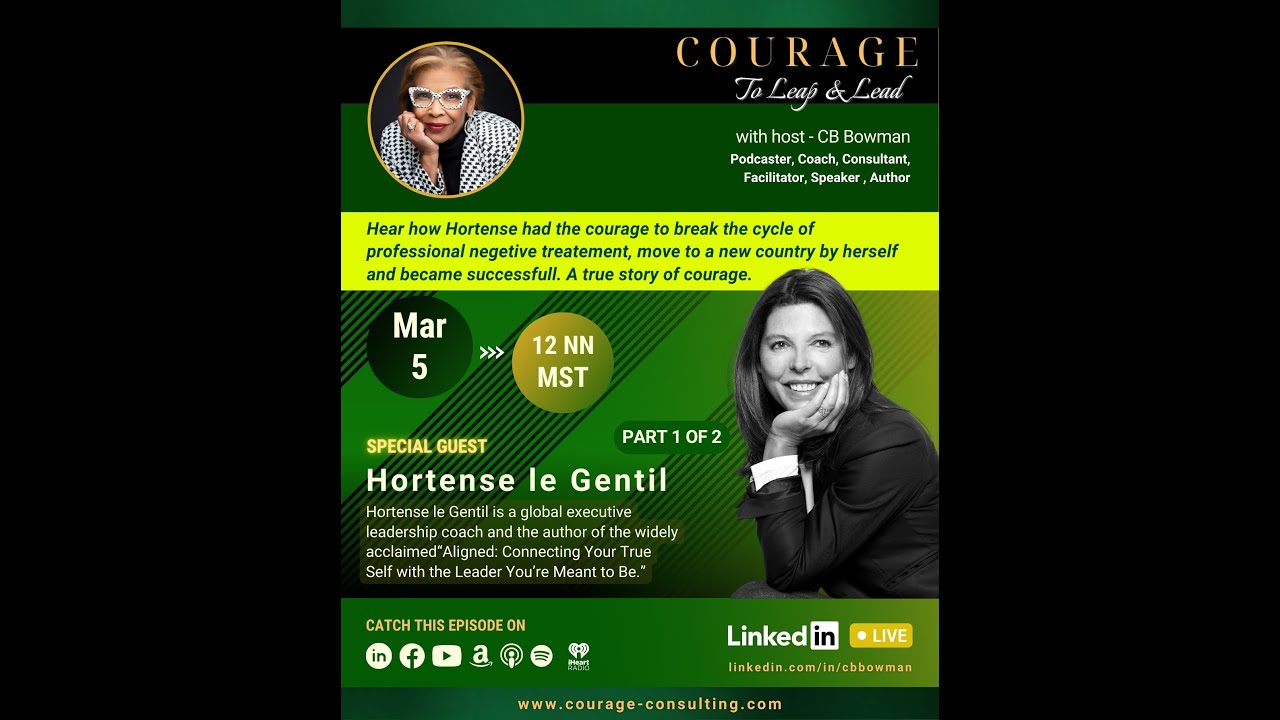
Hortense le Gentil, a French coach who moved to New York four years ago, draws leadership lessons from show-jumping: empathy, clear vision, and trust. She describes how a rider must feel the horse's mood and trust it to jump, just as leaders must understand their teams. True empathy means stepping into another's shoes, then returning to yourself to act.
Chapters
You've got courage to leap, courage to lead.
Be brave and be bold. Whoa, let it roar.
Welcome to the Courage to Leap and Lead podcast, where each of our guests share the stories of courage that helped them become powerful leaders. Before we start today's show, please remember to visit courage-consulting.com. Where you can find all the episodes and other excellent resources, all at courage-consulting.com. Now, here's your host, Leadership Courage Coach CB Bowman.
Hello everybody. It's Tuesday. And today on Courage to Leap and Lead, I have a guest who has become a dear friend. And actually, I think I know her husband better than her, but that's fine. I won't tell you the secret behind that. I'll leave it mystery. But my friend Hortense, she is a powerhouse and you're gonna love her accent. I just, I'm mesmerized by it. You know how we Americans love foreign accents, and she's got a French accent. It's so charming. Oh my goodness. You know, she's here because, first of all, she's a friend, and I've had her on before. So if you've seen her before, it was a couple of years ago, um, you'll know that she's a powerful guest. And so I couldn't wait to have her back on, especially since she's released a new book. But, you know, we can't talk about that out loud on LinkedIn, but we are. So we'll talk about that, but we'll talk about her. And I want to know how she had enough courage to write this book. What inspired her to write it? And I want to find out a little bit about her life because she came from France here to America and That must have been a challenge to get acclimated into a new country. And I know many of us are interested in how people do that. What gives them the incentive? What gives them the inner strength to know that they could succeed in another country and be welcomed? So with that, I want to introduce my friend Hortense. Hortense, welcome back. Thank you.
CB, what a delight to be with you today. You are beautiful. You are absolutely beautiful.
Thank you. Thank you. Well, you know, you have that French sophistication, so, you know, there you go.
I don't know what you're talking about.
So Hortense, how long ago did you come here?
4 years ago now.
Wow! And you just picked up and came over? What made you decide?
Oh, it's a long story, but making— to make the story short, it always has been my dream to come to, to live in New York. And I studied, I was a student at Boston University, no, at Northeastern University in Boston. And I just wanted to come back and to move to New York. It's always been my dream. Don't ask me why. I don't know. I always felt at home here. And so it took me a while, scenic roads to come here, but all, you know, all everything gets aligned. And, um, I, it was a moment in my life. I wrote the first book, Aligned. And I wanted to interview, to have a— to interview interesting people for my book. And I had an interview with one guy and we fell in love. And because I was divorced at that time and he was also. And so we decided to move to New York together. And here I am. So very happy and very, you know, very remarried and very happy. And also because my work always— I always work with America and with the US also because Marshall Goldsmith took me, as you, in his amazing group of MG100. I was part of the— at the beginning. So I went, I was there very, very often. And my work resonated a lot with this country. So I love the, I love the energy. I love the spirit. I love the freedom. And I knew that I had to come.
So where were you from in France?
I mean, I'm from Paris.
In France. Yeah.
In Paris. In Paris. From Paris.
But, but I'm curious because I love Paris. I love Paris. I think I would move in a heartbeat, right? Um, what, what did you find was the different energy between France and New York, or Paris specifically and New York?
Yeah, it's, it's It's a lot of a spirit in— so you don't do generality, but this is what I always felt. In Paris, it's more about— it's less positive.
Ah.
Here in the US, you have this ability to, even if it's hard and something hard happened, you are resilient. So very fast, you find a way to move forward. And we saw that during September 11th, right?
Mm-hmm.
And so if you have this spirit, you can do a lot of things because you can try, you can fail, you can try again. It's like, okay, so let's move on and let's try. This is not exactly the same in France. In France, it's more about habits and it's difficult to change, more difficult even if now everybody is moving forward. But yeah, I would say that the main thing is that, is this energy of positive energy. Well, you can have negative energy also, but after you choose what you want to listen to. But I mean, this is that, and I think you don't realize when you are American, but this something very, very important.
You know, I am blown away by what you just said.
Okay.
I have, in a positive way. I've never thought about the differences in that way. And you're absolutely right, because I think that in France in general, the culture is steeped in tradition, right?
Mm-hmm.
Whereas in the United States, we don't have that tradition. You know, we, we, and so the positive is that we are more experimental with life. The negative is that when it doesn't succeed, we often stumble and can't get back up because we don't have the past to say, okay, you know, this has happened before, we can go forward, right?
Yes.
And you have this, you know, well, my great-grandfather, my great-grandmother, my great-great, you know, and, you know, they've been through this war and that war, and we've come through, and this is how we did it. So you have like, um, you have a history, a directory, if you will, To open up and say, okay, I can do this next. But it doesn't allow for much change, but it allows for you to survive. Here, the survival mechanism is very different because we don't have a history. We have to survive based upon what's happening now and create a new survival pattern for ourselves.
No, makes sense. It makes sense. But, and this is true. So, you know, America is, uh, the country of immigration. So everybody has to recreate your world and things like that. And this is the beauty and the difficulty.
Absolutely. You know, so I'm curious about one thing. So I would say, you know, as a Black woman, I had very different experiences in corporate America a different struggle than others. So I'm very curious to know, many in the United States have, um, how can I put it nicely, an anxiety against the French.
Oh.
And so, yes, so did you experience any negativity being a French woman coming here?
Not at all. Not at all. Tell me more. What kind of anxiety?
Well, I think that, you know, people here say, the French, you know, they don't know that, you know, they're this, they're that, they're this, because they have all these concepts from the war and/or France not supporting United States and all of this stuff politically. And so I was curious to know, and I will also say, A very interesting thing in my mind is that women tend to escape some of the biases that men face from the same background. So a Black male is going to experience different biases, stronger biases in this world than a Black woman. I think maybe a French woman will experience different biases than a French man. In the United States.
Maybe, maybe, maybe you're right. Yes, I, I don't know. I don't know. I personally, I never felt— no, I felt a curiosity very often. Curiosity. And yeah, and you know, you make link with, um, whatever, with Paris, the City of Love, that, you know, yes, the fashion or whatever. So it's funny, but, uh, I never felt any body. So maybe people think of, think of, think like that, but they, I didn't feel anything.
Yeah. Uh, um, you know, I also find that when you are accepting of people, people accept you for the most part. So, uh, perhaps that was your, um, your presence that allowed people to welcome you into their hearts. You know, so now tell us, as a child, did you picture yourself as a successful writer?
Yes, it was, it was my passion for years. I just wanted to continue. Yeah, so I was, I was, I was at school, still at school. I was in the junior team. But, uh, yeah, I did, you know, a lot of show jumping and as an equestrian, and I even came here in the US, by the way. Yeah. At that time.
Yeah.
It teach me, taught me a lot about leadership and everything and about life. I think it's a very, very good, um, exercise or learning.
You know, there, there are people that do therapy, equine therapy. And so tell us, what did you learn being an Enquestian about leadership? A lot of—
let me think. I think I would say empathy.
Ah, oh, what a great connection. What?
Yeah, empathy. I think share your vision and communicate, I think, and trust. I think if I— it's about those 3 things.
Well, the, the one that I don't understand is sharing your vision. Is it how you lead a horse?
Yeah, because imagine you want to ride a horse. Okay, follow me. So you imagine that you are on the, on the horse now, right?
Yes.
So imagine that you want to compete, so you want to Uh, to jump an obstacle.
Mm-hmm.
In order to do that, everything begins with you. So you have to have a clear vision where, what is, you know, the, the road you want to take. Are you going to straight? Are you going to be, you know, do a little, you know, um, turn? What do you want to do? If you are not clear, your horse is going to feel it.
Mm-hmm.
This is empathy. So your orders, your commands are not going to be right. So you're here, you're with the horse, you communicate with the horse with your hands, and it's your fingers because you have these reins who goes through the mouth of your horse. And this is how you communicate gently, gently, very gently, how you communicate. And also with all your body. You communicate with your legs, with your body and everything. It's you make one with the horse. You are very aligned and you listen, you listen, you feel, and your horse is feeling you too. I don't know if you never experienced something. If you want to approach a horse, for example, or do something with a horse, if you're afraid, he's not going to respect you. He's not going to let you put yourself on his back and things like that because he feels it. If you are— he feels everything.
Before you even touch the horse, they can feel it?
He feels it. Yeah, it's empathy. So you as a horse rider, you also have to develop this empathy and try to understand what What is in his mind? Because it's a being and it has mood. So one day it can be good mood, good mood, or maybe it can also be hurt from something and something like that. So if we go back to the horse and to finish, to jump the obstacle, so you're here. So it's very important that you're here, completely here.
Yeah.
You know, cobbler here with a horse and you communicate very clearly where you want to go. Okay, so I know that I go straight and after I turn. It's clear in your mind and it's clear in your order. So your horse is trusting you and is going to go, you know, with you. And 3 days, 3 steps before the obstacle, we used to say that you have to stop. You cannot do anything. because your horse is going to do the work. Your horse is going to jump. You're not going to jump. The horse is going to do it. You have to follow it.
Wow.
And yeah, and when you are up, you can imagine that. So now you make, you know, this very good, very good and interesting, very good jump. You're here on the top, and on the top, You have already the vision of where you want to go next. This is how it works. So it teaches you, it's like, you know, in leadership with your team, be one with your team, develop your empathy to what, you know, the person in front of you or your customer are not telling you, but what is important to know for you in order to help them to create a new product, whatever it is. Trust. Leadership is about trust, right? If nobody trusts you, nobody's going to follow you, right? And communicate. Yes, having a vision, of course, and communicate. And the 3 steps before the obstacle, it's really this trust. So now that you, as a leader, you're here for your team, for your horse, Now you trust, you trust your team. Your team is going to make, to do the job, and you follow the team.
That is so well said and so beautiful. So 2 things come to mind. One is I want to know more about the word empathy, but I also want to tell you a funny story. The last time I was on a horse was the last time I was on a horse because I got kicked. By my boyfriend's horse in my leg.
Oh my, sorry.
Yeah, and I'm thinking now, did I not have empathy? He was trying to kick the other horse, but he kicked me instead.
Instead.
Did I not communicate well?
But he's an idiot.
Trust? I certainly didn't trust him after that.
You know, it's um. It's, uh, but you have to learn also, you know, you know, it's, it's, it's a work. Yeah, you, you, you, so you, you can have it or not have it when you are, you are, you are small. So, but, but you have to learn. It's a lot of work. I worked, I can tell you, hours.
I can imagine. I can imagine because after that situation Oh my God, her tits. And then the doctor put liniment on my leg.
Oh my goodness. Oh, that's so funny.
And then I had to fly home with my leg like that. I'm gonna go horseback riding for a while.
Okay, okay. Just in imagination is good, right?
Yes, exactly. But, but I love your analogy. And you know what? You talk about in your new book, this one, by the way, thank you so much. And I love the endorsement.
Thank you. Thank you.
You talk about empathy, and we just spoke about empathy, and we hear this word so often. It's, it's, um, it's almost at the point where it's overused. Uh, and I'm not sure that everybody has a Clear definition of empathy. Do we, do we think of it as part of our heart? Is it part, is it part of us, or is it part of somebody else? When you say, dare to free your own voice, lead with empathy, and shine in your light in the world. Can you define empathy for us so we have a universal understanding of the word?
Empathy means feeling with. It's coming from a German word, and in fact, it's not really empathy, it's inpathy. You know, if you do the translation, really the translation, yeah, translation from German to English, it's inpathy. in, empathy. And it means it's the ability to feel, to put yourself in other shoes. So it's the ability for me to put myself in your shoes, the ability to feel what you feel.
Mm-hmm.
And this is it. This is this this ability. And how you do that, it's all about what we call the mirror neurons. And a very well-known neuroscientist called them Gandhi neurons.
Why?
Because you can feel with others, and this is very important. So those neurons are the neurons Who help us. So imitated and having empathy. So for example, if you do that like you do now, the part of my brain is doing the same. So chances are that maybe I'm going to do the same and I'm not even thinking about it. So that's the mirror neurons. That's what the mirror neurons are.
Mm-hmm.
And those neurons help you to feel. to feel with. So this is what empathy is about. And of course, because you feel with the person, you can understand what is not said.
Mm.
And so you feel. So imagine now, for example, imagine that you feel you have a friend who is very, something very bad happened to this friend. Imagine. So This friend is very sad. You can feel the sadness. You almost cry sometimes with a person or even watching a TV or a movie. You almost cry. This is empathy. And now this is what we talk, we talk of empathy. The only thing is, if you want to help this person, your friend, for example, This is good to feel because you feel how sad this person is. And now if you want to help this person, you have to come back to yourself and to understand, oh no, it didn't happen to me, it happened to his, her, and you're going to help. Because if you stay with this person, it's not going to help this person if you are as sad as this person, right? It's not, you cannot help if you are as sad as this person, but you can help if you come back to yourself and you can find the right words and the right way to help your friend. So this is what empathy is about. This is this feeling. And after you come back to yourself, you don't stay there.
So many questions coming out of that. That's a beautiful definition. 2 major questions is leadership around with empathy, and the second is courage with empathy. So is it possible that we can feel empathy within ourselves in order to have courage to solve a problem?
Okay. So could you repeat again? So if we have empathy—
Yeah. So it's, it's a concept I'm thinking of.
Okay.
So empathy, meaning that you can step in the shoes of somebody else. Yes. Their experience. And then you have to come back yourself in order to, to help them or to support them. Right?
Yes.
Yeah. So if you fail at something personally? Is it possible for you to have empathy for yourself and be able to step out and help yourself in a way that's— and that stepping out is very courageous— to solve your problem?
Yes, I like that. Because empathy becomes— begin with yourself. So what we mean here is if you are not aware of who you are or your emotions, if you're not aware of your emotions, some people, they are not aware of, they don't want to be aware. They say, no, I'm strong, I continue.
Okay.
So if you're not, the first thing is you need to have compassion. It's not compassion here, it's empathy. So feel. Be aware of what you feel, your emotions, how you feel. And imagine that you just, okay, you take this time, you take the time to reflect and you take the time to feel. And you say, oh, I just discovered that. Oh my goshness, I have plenty of here strained or I'm here and I have pain. I didn't know that I have pain. Oh gosh, why am I so sad, by the way? If you discover your emotions, so yes, so you can go because you are trapped somewhere. This is what I call a mind trap. You are trapped somewhere. You are locked. You cannot move forward. In fact, you try, you try hard, but in fact, think about it, you don't move very, very, very far. And this is because you are locked there. And so how to free yourself? You're going to ask me, how do you free yourself? Because now, so okay, you're locked. So this is this ability to trace the source of it. Why am I so sad? So sad could be whatever something happened to you, but it could be also Something that somebody told you. There could be also a trauma, what I call a trauma. So something that happened a long time ago, you completely forgot, but something triggers this souvenir and you're here and you say, oh gosh. So really find the source, track the source, try the source of the trauma and From there, you go back to yourself. It's not exactly you go back to yourself, but yes, from then you free yourself. And how to free yourself? So how to challenge these beliefs? You say, okay, these voices or whatever it is. So I can explain more, but in challenging those voices, you free yourself and you can, because it's all about stories at the end of the day. You will see that a lot of, a lot, not everything, but our brain is making a lot of stories, right? I should do that. I'm not good enough at that. Oh, I was not good with this person. I should, oh my goodness. Oh my goodness.
Okay.
There are so many noise here. So you're not aware of your own voice, your inner voice. So what By the way, what do you think? Stop trying to continue to try to please or to listen to other voices that are not yours, because maybe this is why you are very unhappy and locked somewhere, like you said. And so you free yourself. So you challenge those beliefs in order to rewrite your own story. And you'll find this courage because you talk about courage. Sorry, I forgot the courage. The courage is to face those fears, to face those beliefs, to face whatever you thought was helpful until now and to challenge them and to change because change needs Courage. You know that, right?
Yeah.
You know that better than anybody. Change needs courage. So you can do it only if you are courageous.
More from CB



211- Courage to Leap & Lead with Louise Story part 1Courage to Leap & Lead







