166 - Courage to Leap & Lead with with Urs Koenig
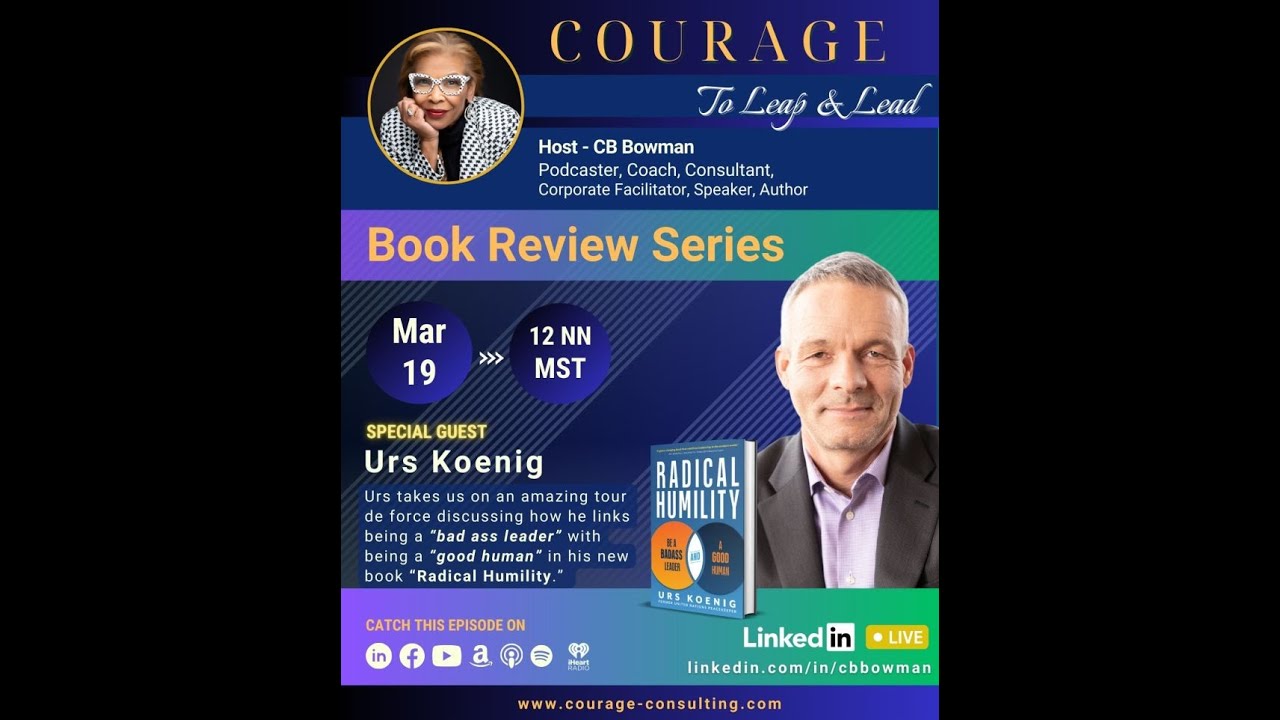
Urs Koenig, a former UN peacekeeper, argues that strong leadership and humility aren't opposites. He shares stories from a New Zealand commanding officer and a United Airlines pilot to show how leaders can invite feedback and build trust without sacrificing results or ambition.
Chapters
You've got courage to leap, courage to lead. Be brave and be bold. Whoa, let it roar. Welcome to the Courage to Leap and Lead podcast, where each of our guests share the stories of courage that helped them become powerful leaders. Before we start today's show, please remember to visit courage-consulting. Where you can find all the episodes and other excellent resources, all at courage-consulting.com. Now, here's your host, Leadership Courage Coach CB Bowman.
Hello everybody. This is CB Bowman. I am the author of Courage to Leap and Lead. And I have an incredible person that I want to talk to you about who's written an amazing book on leadership. Now, you know, so many people have written books on leadership, but this guy has turned a different page on leadership because he is teaching us how to be a badass leader and a good human being at the same time. And we all know that's a challenge, right? So with that, I want to welcome Uris. Uris is actually a former United Nations peacekeeper. So imagine the hair-raising activities he's been through in his life, and he is the perfect person to talk about how to be badass and how to be good. Uris, welcome.
Thank you, CB, for having me. It's It's a pleasure. And congratulations on the success of your book. So well done. So well deserved.
Thank you. Well, you know, I have big footsteps to fit into with your book out. And I want to, I want to talk to you about this because it seems like it's a contradiction on being a badass leader and a good human being. We don't normally associate those things together, especially in our world of politics.
Right. Yeah.
So tell us, what do you mean? How in the world can you be both at the same time?
So I really strongly feel that the notion that we either have to be a nice person or a tough leader is actually a false dichotomy. We can all execute what needs to get done and still be good humans at the same time. And You know, it's funny how you ask that question. People often ask me in a different way about this. They ask, well, how can I be humble and not be an emotional doormat, right? How can I still be an achiever and so, and, you know, be confident and ambitious? And I actually really like to turn this around. And so let me answer your question in a bit of a roundabout way. So people—
Wait, wait, you know what? First, I hear an accent. Tell us about that. And then go back to it.
I'm from the depths of Texas. No, can't you hear it?
Yes, absolutely. Absolutely.
I am from Switzerland and I have an accent indeed. Yes, yes, yes.
It's a beautiful accent. So a peace-loving country, is that the part that brings in a good human?
It does. It does indeed. So the notion that, you know, you can't be confident and have high standards and be humble is actually, you know, is a wrong contradiction. If we think about it, what does humility mean? It means, for example, asking our teams for feedback on how we can do better. Only if we're fundamentally confident in ourselves are we actually able to then humbly and with vulnerability ask for the feedback. I know for myself, when I'm already feeling a little bit down about myself, I find it very difficult to invite hard feedback. But when I'm fundamentally confident, then I can, you know, invite that hard feedback. And the same with ambition. I can be a badass and have real ambition. And what does ambition look like? It looks like asking the hard questions. Why are we failing? What's my part in this? And only if I have the humility to ask these hard questions can I be actually ambitious. So rather than be a contradiction, I actually think they go hand in hand.
Can I ask you, you know, the term a badass leader—
It's a good title, right?
It's a wonderful title. We can dissect it in so many ways, and here goes another way for you. It sort of implies it's for men. Being a good human sort of implies it's for women. Is there any Crossover? And do you think that a woman could be a badass leader without being called a bitch?
You know, that's an interesting point. So I actually never thought about it through that lens. I've plenty of colleagues, you included, who are badasses, female colleagues, right? So I actually really don't see it through that lens. You know, I think the bit stereotypical to say, you know, the guys are Type A and macho and hard charging, and the women are more caring. So I see this across all gender spectrums, no doubt.
How fascinating. Okay, so we now have permission to be badasses.
Always, you know. So I actually write in the book about a real badass leader who happens to be female. My commanding officer in the Middle East, I was deployed as a UN peacekeeper 2 years ago in the Middle East. And my commanding officer who happened to be from New Zealand, so she was a real badass. She was also a great human being. And one little story that I will never forget and that I write about in the book, she opened an after-action review after an exercise. An after-action review is a postmortem where we assess what we did well and what we need to improve as a team. She opened the whole thing with these words, I screwed that up and I know it. The top dog, the commanding officer. And that then made it safe for all of us, her direct reports, to own our own mess-ups, all because she went first. So then we went around the room, and me included, we mirrored her vulnerability, appropriate vulnerability of owning her mistake. So she owned her mistake, increased trust, and led to better operations on the ground, all because she went first.
You said something that I struggle with— vulnerability. How did she get away with speaking her true north, her vulnerability, And still be respected as a woman?
You know, because she was competent. She was very competent indeed. And so, and I really didn't— nobody else looked at it through that lens. Like, she's a woman. She was considered, or we all considered her, an amazingly strong leader. And, you know, the And her vulnerability actually builds trust. I mean, if we think about it, for us as leaders, our people already know that we're not perfect. They work with us every day. Let's not kid ourselves. Us as leaders actually owning our shortcomings makes us relatable. You know, everybody admires perfection from a distance, but nobody can relate to it. And so vulnerability, appropriate vulnerability, and we can talk about what that looks like, Yes. Yeah, it's the quickest way to build trust. You know, I, I quote the study, if I may, CB, in the book where pairs of complete strangers are brought into a lab and they were tasked with asking and responding to meaningful questions like, you know, if you had 1 year to live, what would you change? Or what does love and friendship mean to you? When they were asked to rate the level of trust they built with their partner, 45 minutes, Participants rated the level of trust about as high as the level of trust they have with the average person in their lives. Some even rated it as high as they have the trust they have with their significant other. And so the research for 45 minutes, the research is crystal clear. Showing up with appropriate vulnerability with our teams is the quickest way to build trust. You know, Brené Brown, of course, is, you know, the queen of shame. and vulnerability. And she says, you know, vulnerability, and rightly so, is the last thing I want to show you. And it's the first thing I'm looking for in you to build a connection.
You use the term appropriate vulnerability. What does that word mean in front of vulnerability?
Well, you know, I don't have to tell you about the fight I had with my teenage son last night, right? Necessarily, unless we have a very deep personal relationship.
Okay, let's hear about this.
That's the real juice you like to get to, right?
Yes.
So, so, you know, this is a— we often say this, right? Leadership is a thinking person's sport. So I need to assess and make decisions in the moment with every single person on my team, what is appropriate and what isn't. With some people, I might simply talk about My weekend plans. Maybe we call that small talk, but that's appropriate vulnerability, sharing something from my personal life with others. We might go deep very fast and, you know, share our views about end of life or whatever it might be. And so it really depends on the depth of relationship we have with each individual. Yeah, yeah, yeah. And we— and obviously there's a cultural lens through this. Right? So when I was deployed in my missions, we had local interpreters that worked for us and helped us translate. And with some of them, you know, we could go very deep, very fast, and others were very reserved. And then you have to be culturally sensitive and make the calls in the moment.
In your book, do you feel like you've given solid advice so that we know When to use what vulnerability? When are we appropriate and when are we not?
Yeah, well, I basically— I think I did, and I think I just said it, actually. I don't think there is a better way of putting it that it's situational and contextual, right?
That's what I want. Okay.
Yeah, yeah. So that's— and, you know, in the book, and thank you for, you know, your kind words about it, I really worked very hard on being research-based and also personal. So I share a lot of personal stories and at the same time give sort of no-nonsense, tangible takeaways that we can immediately implement. Sort of, you know, I call them now leadership, now prompts that readers can immediately implement.
So, okay, now we've got the background on the COVID title. You know, this— the circles are almost more important than the title. It tells— whoops— the whole story there. Tell us about— let's go back a little bit. What motivated you to write this book? Why did you feel that the universe needed this book at this time? Yeah.
So a little bit of background. I always was drawn to humility on a personal level. So I have an ultra endurance background, I always was drawn to competitors who let their legs do the talking versus the big words. So I was on a personal level always drawn to folks like that. And then, you know, much like you, I've been an executive coach for a long time. And as we came out of the financial crisis, 2008, 2009, and social media started to explode, I experienced my coaching clients seemingly always being a step behind. And a lot of them were still leading top-down command control. And that sort of got me thinking of, you know, we might need a little bit of a different leadership approach. And then, and that got me digging into humility. And 2 things happened then. Later on, I deployed on these 2 peacekeeping missions, the first one in 2017 in the Balkans, and then in 2020 in the Middle East. And ironically, transitioning back into a traditional hierarchical you know, organization like the military, I've experienced firsthand that the best commanders, not just quoted by my commanding officer, actually are deeply humble. They develop deep self-awareness. They ask, and I know it sounds foreign to many people who don't know or think of a military, of the military in a certain way. They ask their team members for feedback on how they can do better. They build meaningful and trusting relationships with the team members. Military is a people's business like any other business. And they develop, you know, what we call the growth mindset, meaning they embrace mistakes and failures as an opportunity for learning and growing. So I experienced that firsthand. And then, of course, the COVID crisis happened. And when the world shut down, we all had to humbly admit how little control we really have over our own lives. And, you know, another leader I talk about in the book, the former Prime Minister of New Zealand, Jacinda Ardern, you know, she propelled herself to rock star status during her time as PM of New Zealand because she shared her life outside of governing the country. As a young woman, she gave birth while holding the highest office in the country, and her sharing that made her relatable and propelled her to rock star status. So all these experiences then led me to really dig into the importance of humility in leadership. And of course, if we go back into the literature, Collins, Good to Great, was the first author who talked about humility in leadership in 2000, 2001, in what he called Level 5 leadership. When mistakes happen, you know, I look in the mirror. When good things happen, I look out the window. And then Edgar Schein and Peter Schein, they published their book on humble leadership later on. But there really, there hasn't been anything practical written by a practitioner like myself that's research-based, personal, and also has tangible takeaways. So that's a long answer to your question, but that motivated me to write this book.
And by the way, I love, one of the things I love about this book is that it's an easy read. It's written Not as an academic journal where you have to— in teeny little print, it takes you 2 years to get through one chapter, especially if you're dyslexic like me. This is written in what I call speed read type. It's— well, I don't know if you could see it. You see that? And it's broken up nicely with nice charts and to match being badass and good human. Now, Uris.
Thank you, CB. That, that was so well said. So I so appreciate it. You really captured the spirit of what I was trying to achieve well. So I appreciate that.
Thank you. And you did. You did an amazing job. You talk about vulnerability building trust, as you did about your commander, et cetera, et cetera. It still feels like an oxymoron to me. And maybe it's the cultural thing. Like, as a Black woman in corporate America, this vulnerability thing, you don't— you don't let it— you're not letting it be seen. Let me put it that way. Because the daggers and the knives and everything comes after you, you're going to have to put up a shield of armor. How can— and I know you talk about this— how can the two be relatable in cultures that are not white America men?
Right. Well, thank you for bringing your lens in, CB. I appreciate that. And I think you're absolutely correct. And I do write about this. There are certain situations, and you maybe have just touched on one where vulnerability is actually not called for immediately. And so where we have to earn our right to be vulnerable a little bit. So for example, you know, if I'm considered an outsider, and I think it's fair to say as a Black woman in corporate America, you were still an outsider, right?
Oh yeah.
Yeah, exactly. We have to earn our ability to show up with vulnerability. Also, for example, if we're going into an organization or a culture that is very what I called, you know, old school, top-down command control, where a lot of the leadership is by expertise versus by relationship, there too, we have to earn our right. And similarly, if there's questions, if I'm hired into a new position and there's questions about my competence, my technical competence. Once again, I have to first deliver good results to earn my right to show up with vulnerability. And people often ask me this, you know, how do I do this? How do I show up with humility and/or vulnerability in a top-down command-control culture? And I do write about Amy Edmondson, you know, the queen of psychological safety from Harvard, in quite some depth in the book. And she has a wonderful metaphor to think about this. She talks about building a pocket of humble excellence within your team. So, you know, we often throw up our hands when we're in a top-down command-control culture and look up and sideways and say, well, I can't change anything here because the culture is just XYZ, whatever it might be. But what we have control over is our team.
Our team.
You know, we run, right? And so we can actually build a pocket of excellence, of vulnerability, of humility, whatever it might be, psychological safety. That's how Amy talks about it with our team. So instead of looking up and throwing up our hands up in like frustration, we look down, we look down into our team, and that's where we can actually make a difference and move the needle, even if the overall culture is not what we'd like it to be.
I think— I'm not sure I'm going to agree with you 100%, having been through this experience myself. It's very difficult to build that trust even at the team level when you're an outsider. It's almost like a fish swimming against water. Salmon swimming against the current. What I would like to know is, what is the first single step, the very first, that you can do to at least break the ice so that people are intrigued that you can offer this vulnerability and trust?
Well, I think the first thing is to I think the way you're describing it, the first thing that comes to mind is actually putting our listening ears on and getting to know our team members one-on-one. And I think if, you know, in, if you're in a situation like you're describing, and by the way, not only in a situation like you're describing in general, Getting to know the other people, the other person, the people on our team deeply and in depth. And, you know, at the beginning when we don't know anybody, it's small talk. But tell me, it comes back to the things first. Tell me about, you know, your professional goals. I mean, the usual stuff. Where do you want to be in 1, 2, 3, 5 years? And sort of start to build that relationship by asking questions. Not displaying your own vulnerability to getting to learn more about the other person. And that is how bonds are built, right? And so I would start one-on-one, and I would start by building a relationship with each person one-on-one by putting our listening ears on.
And that, I think, better advice has never been given. It's excellent. I remember when I was being certified to sit on a corporate board. And in the class, somebody raised their hand and said to Susan, who was teaching the class, what's the first thing we do when we go to our first board meeting? And her response was, shut up.
Yeah.
And zip it for a long time. Understand each person in that room, understand their goals, understand who they are, understand where they want to take the organization. Learn first, speak second.
Very wise advice. No, no doubt about it. No doubt. I mean, I, yeah, and not, you know, I, I also experienced this again in the military. So I remember I was 2 years ago when I was in the Middle East, I got a little promotion and I got promoted as a national senior. So I had to represent all the Swiss officers. And I was a relatively low-ranking officer compared to everybody else who were like colonel and up. And so I made a point of doing exactly that, relationship-building meetings, like getting to know each person with no business agenda up front. And again, asking a lot of questions. I think that's very wise indeed.
Yes. And I remember when I was in corporate America, people all around me were constantly having lunch with each other and I thought, What the heck are they doing? That's more work. And I'd go off on my little silo. And as I grew up, I understood I was creating more of a distance for myself.
Yeah.
Than I was being inclusive of others. I love it. I love where you're going with it. We talked about Amy, who is a friend of mine, um, and her focus on psychological safety. How do we know, from your perspective, when we are providing psychological safety to the people that work for us and with us? And I might add, those even above us need that psychological safety too, which I don't think many people think about.
That's, you're absolutely right about your second point there for sure. The one and best indicator I can think of is, do my people share information with me I don't want to hear?
Do I?
I'm serious. Do my— so I know I provide psychological safety when My team members bring stuff, problems, data, whatever it is to me that I disagree with, that they know I'll have a problem with. And I really have psychological safety when my team members come to me and tell me, hey, manager Urs, leader Urs, you rubbed me the wrong way in that meeting, and here is why. Tak, tak, tak. So that's To me, the best indicator. Are they able and willing to share information I don't like to hear?
That is wonderful. That is— my gosh, you're giving us so many kernels of knowledge that imagine what'll happen if you read the book. Okay, let's talk about— and you talk about how this all works. When you're trying to build a team, tell us what you say in your book without giving out too much information, because we know everybody's gonna buy the book.
So I'm assuming you mean, how do I show up as a badass and a good human when I build a team?
Yes.
Right. So the— I keep coming back to this relationship building piece.
Yes.
So But aside from that, okay, let's aside from that.
Yeah, that, that's where it starts. So I build deep and meaningful relationships with each of my team members by getting to know them. I also am crystal clear about my expectations, and that's why we're not an emotional doormat. As, as a humble leader, we— I talk about tough on results, tender on people. I make it crystal clear We need to make it crystal clear to our team members what the expectations are, what the performance standards are. So, and while at the same time building meaningful relationships with them, I then ask my team members regularly for feedback on how I can do better as a leader. So that's the first sort of step of vulnerability. So I'm increasing my self-awareness and doing the same for them. So a practical thing people hardly do, and it's such an easy one. At the end of every one-on-one, ask this, what can I do better as your manager? The famous, what should I stop, start, continue doing? And, you know, presumably you've done the same for your people. So that's the— I'm helping them to become more self-aware and me demonstrating self-awareness. And then the last piece, which is the third piece of the definition of radical humility, is what you touched on before, building that psychological safety. And that is reframing failure for my team members, you know, saying, you know, failures and mistakes will always happen. I don't mean I said low performance sense, but they will happen.
Yes.
I want to hear about it. So there's a beautiful story about the a United Airlines pilot, and Amy writes about this, I believe, actually. And he brings his crew together at the start of every flight and he goes, I never done a perfect flight before and I'm going to prove it to you again today. That's right. And you go like, get me the hell out of this plane anyway. And then he goes on to say, so I need you, I need your help. I need you to speak up when you do see me do something wrong because it will happen. And I will do the same for you, right? So it's reframing failure. There is no such thing as a perfect flight. There never will be. And there's no such thing as a perfect podcast, book, whatever it might be in our world, client deliverable. So reframing failure while still having high expectations and then inviting, speaking up, you know, talk about praising the messenger versus punishing the messenger, inviting people speaking up and always, and, you know, we both know Alan Mulally at Ford. You know, he applauded when Fields spoke up in that famous meeting where Fields said, well, we're gonna put this particular car on hold because it's not ready. You know, nobody else shared the bad information. He had the guts to do it. And Mulally applauded, right, for a bad outcome. But so they're encouraging speaking up and then, You know, thanking no matter what the input or feedback is. Thank you for saying this. I might still disagree and not do anything about it, but thank you for bringing this to my attention.
I knew where you were going, except you threw me a curveball with the thank you. And I like that. And that requires an awful lot of strength. Those 2 words to use in those situations.
It does. It's, you know, I mean, our, you know, mutual mentor Marshall Goldsmith talks about leadership as a contact sport. You get bruised, you get knocked down, you know, and being humble, it's not weak. It's not for the faint of heart. It's tough. The soft stuff is tough. It's really tough. And you're absolutely One of the hardest things to say as a leader is, thank you for bringing this to my attention. Stuff we don't want to hear, you know, we disagree with, but we need to still acknowledge and thank for them to bring it up.
Okay. Oof. Is— do you say thank you in different ways to people or just the words thank you?
Thank you for bringing this up. You know, I mean, I—
And I know that sounds like a weird question I'm asking, but I believe it goes to communication, right? Some people will hear the words thank you like, oh yeah, they say that all the time, but nothing happens. Or some people, it's, it's thank you, like remembering their birthday.
Yeah.
Oh, you know what I'm trying to say? Yeah. The way that you position it means different things to different people.
The way you say it. Absolutely. The, the way your, your facial expression, your whole demeanor. There's no question about it. Absolutely. I think, you know, it's maybe a bit simplified or too simplified to just say thank you, but then follow up with, and here is why we're not gonna do this. X, Y, Z, you know, or he— or let me, you know, let me do some brainstorming or exploring around this and get back to you next week on what I'm thinking we should do about this. So it's, you know, giving some context around the feedback absolutely is important.
It reminds me of a situation I have recently where I have a committee that's developing the 2025 leadership conference through ACEC, and they said, CB, we want to develop a survey. And I thought to myself, oh my God, surveys don't work with ACEC because nobody wants to respond. Nobody has the time. And I caught myself just in time, and I said, that's a great idea. I can't wait to see it. And the response was, thank you for trusting us.
So here's my question to you though, CB. So you obviously disagree with the survey because you say they don't work. And, um, and then what was your motivation or thinking behind saying, this is a great idea, I can't wait for to see the results?
The reason is because I thought really quickly, Maybe the way that I've done surveys before was not good.
Oh.
So let's leave the door open to this. Maybe a different way, a different way of asking the question, a different way of asking for the information back, a different way of distributing it. And let's face it, it's for a different cause than what I've asked for before.
Right.
So I needed to open my mind To say, to provide the psychological safety for them to say, oh, she trusts us.
Wow.
Yeah. Yeah. And I do.
I mean, that's beautiful. Like, you know, another approach we can apply as well is asking more questions. So, you know, what are you thinking about in what sort of survey and what are we trying to achieve? And so because often, and well done on your part, by the way, I don't know, you don't need to hear this from me, but well done. We jump in too quickly. Oh, it's not going to work. And this is, here is why, talk, talk, talk. And we go off onto this potential rant when actually they're talking about something totally different than a different survey that we didn't even consider or think about. So that's another way to sort of work with our internal struggle. And you described this a little bit. You had this— impulse, you wanted to jump in and you didn't. Another way is to ask a lot of questions and really do discovery around the other person's idea if our initial response is, you know, immediately a negative one.
Yes, I thought about that, but then I thought, I don't know, I don't have the confidence in myself to ask the questions so that I don't sound negative.
Yeah.
So let it ride. And let's see the results.
Great self-awareness on your part. No question. Yeah.
It's books like this that help us get there. You spoke about the leadership factory in your book. Tell us about that.
So The Leadership Factory is a concept where we make it the explicit goal for each of our teams to become the producing factory of leaders for our organization. And so going, leading my team with a mindset of, I want everybody on this team to go to the next level, right? And, you know, and so, and many of us are actually reluctant to really fully embrace this because let's face it, we have talent shortage. Like, what if I make them even more employable? Like, will they leave? And all the rest it. And of course, 2 things are true. By holding our people to the highest standards, by developing them, by helping them to go to the next level, that actually induces loyalty. The good people hang around longer the more we challenge them. But then, you know, if people leave and they will, let's face it, right? Then, you know, a couple of things happen. We all are aware of the famous boomerang employees, right? I mean, there's been a survey out where almost half of the applicants to a job were actually boomerang employees who came full circle. They tried a startup, they tried a different company. The culture didn't work. The startup went belly up and they came back home. Home. You know, if we treat our people well, if we mentor them and challenge them, they think of our team as home. So they might come back. So it's sort of the boomerang effect. And then in other pieces, I talk about this, the ambassador effect. When our people, when my people get promoted into senior positions in the organization, they become ambassadors for us.
Yes.
They, we can rely on them and their work now in finance and I'm in marketing and we always have issues with finance. Now we have, you know, CB who's been promoted to VP of Finance and I can just call CB and she understands my world and she can become our ambassador. So, so that's something I'm really personally as a coach as well, passionate about developing our people to go to the next level. And, you know, a lot of the senior leaders, I'm sure you'll find the same, that I work with, they really look at the people that developed. They look at those folks as their legacy. You know, we all will move on. You know, at one stage, we're all gone anyway. What do we leave behind? It's the people, the relationships too, but the people we developed and their success then becomes our success. And many leaders I work with are extremely proud of the legacy they leave in that way.
You know, when I was in corporate America, what I found is that leaders would help other people get better. The other people would get better, but then they would become jealous. The original leader becomes jealous of what them, you know, the other person growing up and sort of moving on, you know.
Yeah.
And so what do you attribute to that? Is that just not being a good human, or is it?
So that's gonna sound judgmental. That's deep insecurities. Deep. I mean, the best leaders, the best leaders surround themselves with people smarter than them. You know, they surround themselves with people who are better at XYZ, and they understand their own weaknesses and compensate that by hiring out their weaknesses. I think And I've experienced this, of course, as well, sort of this jealousy that comes down to a deep insecurity on the part of that leader about their own sense of self, their self-worth.
Interesting. Interesting. So, all right, you have an interesting chapter in your book called The Buffer Zone. What is the Buffer zone. Am I, am I covering myself with bubble wrap so that I—
You know, the buffer zone is actually a story about the social media company called Buffer. And this is in the chapter—
Oh, yes. Okay.
This is in the chapter on transparency and where I challenge all of us to share more about ourselves, coming back to the vulnerability, but also about our business. So Buffer actually publishes on their website for everybody to see the formula they calculate, they used to calculate the salary for each of their positions. So there's no debate about how much everybody earns. There is clear variables going into the formula. They also publish on their website for everybody to see the actual salaries of each of their employees. That is, and by the way, if we think that's just, yeah, yeah. You think it's only for hip startups?
Whole Foods.
Whole Foods. It's not publicly available. Everybody at Whole Foods knows how much everybody else is making. So they internally publish their salaries. And, you know, by the way, public servants, the federal government, you can pretty much look up how much everybody's making.
Yeah. Yeah.
So it takes the, it takes the, and, you know, I'm not a specialist on salary transparency specifically because it's not just a question of, you know, tomorrow we're gonna go transparent. That's not how it works. We need to, you know, actually be thoughtful around how we go about this. But the businesses that are transparent around their salaries, it takes a lot of the guesswork out of the question. out of the discussion, and it actually removes some of that jealousy piece. And by the way, if I'm the CEO and I make $2 million a year and everybody knows it, I better produce that value, actually. So it is sort of an accountability built in into that.
That's something I did not see coming. I like that. I was thinking back in corporate America and some of the salaries that were being made. by people— how can I put this nicely— that contributed less than what you would have thought they were making.
No, exactly.
Is that nice? So I could see where publishing that kind of information openly would require a lot of work.
And yet Well, and you lose people, by the way, as well. I mean, that's the— if you go radically transparent, it's not for everybody. And so you lose people. But for this particular company, actually increased retention and attracted way more applicants after they went transparent.
But what I like about it is increases accountability, not just to the person receiving the money, but to the company to be able to justify why X, Y, and Z are making this money versus ABC.
Yep. You're absolutely right.
Without fooling themselves because they can always face ridicule or questions.
Yep.
Right. Okay. We talked about the ability to build trust. I'm going to ask you a simple question. A new person walking in, Old established company. You're new in a department. You want to build trust. What's the first question you ask?
As the new person?
Mm-hmm.
Well, of my boss, what does success look like? What do I need to deliver? So I'm living up or exceeding expectations here. So that's, that's, that's what comes to mind immediately as a, as a first question, if you want a first question.
Yeah. And what's the first question to your colleagues on equal level, your teammates?
Yeah, maybe not dissimilar, actually, you know, or, or how can I best support your work? How can I best help all of us to be successful? So something along those lines. So being, being of service as a new person in any situation, coming back to the learning, to the, to the making myself listening, making myself of value to the team and having the humility. I'm not the most important person at all. I'm just part of the group. How can I help the group to become more successful?
You know, Joris, listening to you, I can now see all the things I did wrong. I wish you were around then.
Well, but, but see, these things are hard. I, it's not, you know, we all get, we all get caught up in ego. Let's be like, and let's be honest, that comes back to the self-awareness. We all have our hangups and our, and our challenges. And so I advocate for, you know, and we all have flaws, plenty of them. I do have plenty of them, but really working hard on building that self-awareness, what my trigger points are, you know, where do I get kicked up and my emotional hijacking it, as Adam Grant says, and then, you know, combating that. So, you know, it's a messy world out there. There's no question about it. And it's not, Not black and white. It's not always easy. There's no question about it.
Thank you for making me feel better. What, as a leader, what's the best advice you're going to give me, CB, in relationship management?
In relationship management with your team members? As a leader, you mean?
Mm-hmm.
One thing that comes to mind is when we talk about, you know, tough results tend to run people, being a good human, being a badass leader. So, and I advocate, obviously, as it's by now clear, for the Venn diagram, right? The overlap. And yet we all fall on one end of the spectrum, all of our us over-index. You know, some of us are so relationship-focused that we never, you know, we never confront anybody. We don't have the hard conversations. And then, you know, nothing ever gets corrected. On the other hand, we have the only badasses who all they care is results and bottom line, and they couldn't care less about the people. So my advice is understand where do I fall on this continuum and how can I move from either/or to and? How do I challenge myself to lean into the other area and expand my leadership behaviors into, you know, the other area where I'm maybe weaker?
Joris, this has been an amazing interview regarding your book, Radical Humility: Be a Badass Leader. And a good human. This has been a special edition of Courage to Leap and Lead. I am so excited about Uris's book. It's on my bedstand, and I'm actually reading it.
That's right.
I really encourage you, even if you feel that you're not in a leadership role, You just are deciding which card to pull out of your amazing deck of cards. So with that, Joris, we wish you amazing luck with this. You know what? No, we're not going to wish you amazing luck with this book. It's a good book.
Thank you, CB. It was such a pleasure to be on your podcast. I appreciate it.
Thank you so much. Bye, everybody.
More from CB



211- Courage to Leap & Lead with Louise Story part 1Courage to Leap & Lead







