169 - Courage to Leap & Lead with Jennifer Fondrevay, part 1
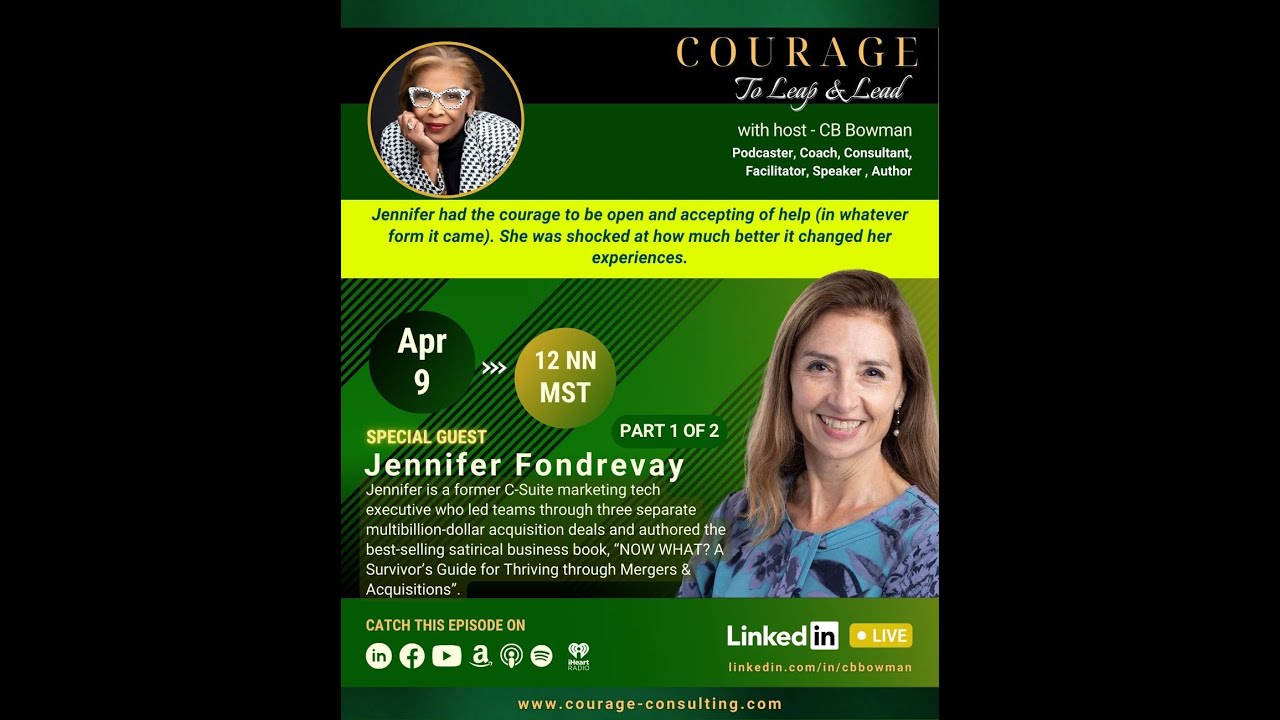
Jennifer Fondrevay left a 25-year marketing career after seeing three multibillion-dollar mergers fail to account for people. She wrote Now What? and now consults on making M&A deals more human. Her father was a French diplomat, her mother a Chicago fashion model, and she learned to combine analytical rigor with executive presence.
Chapters
Before we start today's show, please remember to visit courage-consulting.com where you can find all the episodes and other excellent resources. All at courage-consulting.com. Now, here's your host, Leadership Courage Coach CB Bowman.
Hello everybody! It's Tuesday. And it's your favorite person. And we are in holiday season, so I should have on red, but I don't. But my guest is making up for it. Doesn't she look gorgeous?
Wow.
You gotta love the earrings, the holiday sweater. I love it. I feel bad now. I should go up and change. No, I'll do it next time. Okay. Um, so we have Jennifer on today. I'm so excited. Now, in true transparency, she is part of MG100, which is what I'm part of. It's a fabulous group. Fabulous, fabulous. And the women in it kick ass.
Love it.
So we're going to have a really good interview today. Jennifer, welcome. Thank you.
Now, what's funny, CB, is when this airs in March, people are like, why does she have a Christmas sweater on?
It's to keep the holiday spirit throughout the year.
Absolutely. Absolutely. I'm the same way. We keep our tree up for weeks.
So Jennifer, tell me, why did you want to be on the show today?
Well, one, I think you have amazing guests who tell courageous stories. And I find as someone who is inspired by other courageous stories that the more people share moments of courage that you might not think you could do, but then you hear other people share their stories. I, I would like to think that it inspires people to be more courageous in their own lives, that it just takes, just takes one small step and then it leads to more, I think, more courage.
Absolutely. You know, that's what this show is really about because People who are going through a period who don't feel courageous think they're all alone and they're the first. And it's so not true. Everything that you're going through, somebody else has gone through. It's just, it's hard to get people to talk about it.
It is.
So the purpose of this show is to get people to talk about it and so that everybody can see there is sun at the end of that troubled zone. So, Jennifer, tell us about you now. What do you— what's going on for you now?
Uh, in terms of just life in general, or courageous, courageous moments that I've experienced?
No, we want to know about your successes now first, and then we're gonna go back.
Well, and it's the other reason why I was excited to be on this is what I do now is because of my first courageous step. I left a corporate career that I had worked very hard to build, 25 years as a marketing, advertising communications leader. But I went through 3 multibillion-dollar merger and acquisition deals. And I thought by the third one, dear God, there has got to be a better way to do M&A. One where people don't feel devalued, where the success rate happens faster. It's not a 5-year plan, but that it happens within the first 3 years. And I just, I wasn't seeing that. And in my view, A lot of that was because of a lack of attention to the people piece of business and mergers and acquisitions. So my quest was to bring humanity to the M&A strategy, the development, the approach and execution. But that took courage, I'd have to say. And so the first courageous step was to write a book. I wrote A Survivor's Handbook. called Now What? A Survivor's Guide for Thriving Through Mergers and Acquisitions. And as a result of writing that book and interviewing C-suite executives and HR leaders, even private equity leaders, I had enough people say, well, what are you doing besides the book? That at first I thought, well, do you know how hard it is to write a book? Like, that was my answer. I was just gonna go on and be a CMO. But with so many people asking me that, but I have to tell you, CB, I was— maybe it was my lack of courageous moment. I thought I was being courageous writing a book, a survivor's handbook. But now when I look back on it, they were absolutely right. That in order for me to have the impact that I wanted to, I had to be— I had to be more courageous. I had to step out of you know, still being a CMO and going down that path and, and really explore what it would look like to build a business around the book. So that's, that's what I've done, and that's how I'm part of MG100.
So Jennifer, you're talking big time, you know, over, over many of our heads. So let's just take it back a step or two because we have people who are listening who have no idea what an M&A Is what a CMO is. Why, why such a big deal about it? All of this and that. Because they're in other professions like doctors and, you know, that are not dealing in that space. So let's—
Or they, they might think I'm a chief medical officer. Yeah, that's right.
Absolutely. So let's go home. Let's go home. Tell us about when you were a kid. What did your parents do? How did you get influenced to be in an area that's male-dominated? Let's start there.
Yeah, there is no— there is no prediction for what I'm doing now based on where I came from. Um, my father was a French diplomat.
Whoa!
Uh, moved to the United States in the '60s.
So you speak fluent French?
I do, I do. Um, although my daughter corrects me now, so I'm not sure I can hold on to the fluency. Um, but that's a whole other podcast conversation.
I love that. We're gonna go there in a minute.
Yes. Uh, and my mom was a Chicago fashion model, so, uh, I had, I guess, the benefit— and I, I've written about this on LinkedIn— She passed away in 2020. So I wrote about what it like— what it was like to have a fashion model mother. And it was, it was an amazingly influential relationship beyond just being a mother.
Well, first of all, we could see that it rubbed off on you.
Well, I actually, as you just said, we'll go back. I was like, oh my gosh, my first thought was my mother would be so embarrassed that I'm wearing dangly cherry earrings and an ugly Christmas sweater. But sorry, Mom, you know, can't keep up the look all the time. You look fabulous.
I love it. I love it.
This was my courageous moment, CB, to wear this coming onto your show.
I absolutely love it. I think your mom would be so happy that you did that. So thank you. You're so lucky that you speak another language. I'm so jealous. I really am.
I agree. It is. It is. I'm thankful.
Jeez. So, okay, so you came here, you went— you— or you— were you born here?
I was born in Chicago. So my— my father moved here, married my mom in '66, had me in '67. So—
French diplomat meet a fantastic fashion model.
A mutual friend introduced them.
Okay.
A mutual friend. So it was, uh, I feel very, very grateful to have had a father who was international sales and business, and then a mom who was a fashion model. Because, and I joked about this in my LinkedIn post, my friends in graduate school would always laugh when they would hear me on the phone And they could always tell when I was talking to my dad and when I was talking to my mom. Because with my dad, he'd always ask me, what were the questions that you got asked on the interview? Right? So I'd talk to them and they'd have me replay it. He would ask, what were the questions and what were your answers? And then he'd evaluate whether he thought I could get the job. And then my mother would always ask, well, what did you wear?
What did you wear?
And we—
I had to describe the suit, the blouse. We even went down to the stockings, the high heels, and the earrings. And after this intense review of my outfit, she would say, I bet that you will get this job. You, you looked executive. All right.
Well, your mom would love this story that when I was looking for a job, I had an interview. It was in with an insurance company, and I walked in and I was wearing the exact Same suit and shirt and tie as the guy that was interviewing me.
Oh, wow.
We both— and he said, nice suit. Love the coordination. And I said to him, yeah, that's a really nice suit. We both shopped at Brooks Brothers. And during that time, the women wore the little bow ties.
Yeah, the little collar. Yeah.
Same suit, same material, same shirt. I got the job.
It was, it was hysterical. My mom would always think, well, they're just incompetent boobs, if I didn't, if I didn't get the job.
I like her sassiness.
Oh yeah, yeah. I used to, I used to tease, um, people, you know. My after-school activity was practicing walking in high heels, so, which, uh, I still, I still have to practice. After COVID, I was a little out of practice. But all that to say, because I know this is what you were getting to, I'm enormously grateful for that upbringing because I realized it's smarts and executive presence and having confidence, right? The two go hand in hand. And you can be as smart as you want and work hard and just hope someone sees that. But I also knew from my mom, it's how you show up. It's how you present, how you can read a room and how you can, you know, get people on your side, right? That's what she did as a, as a model, right? Have people feel like they could wear those clothes too. And so it was just, it was subliminal education, but I'm, I'm really thankful for it. It's influenced so much of, of how I approach the world.
Well, we can see from the images that you have on your wall, the way that you have them arranged, It's very evident. And so you had both a left brain and right brain upbringing in your family? Yes.
Yeah.
Any brothers and sisters?
One sister. A younger sister.
Uh-huh. And what does she do?
Uh, she is in LA and she works for an artist. She actually is the CFO for a successful artist. I'm very proud of her. I'm a bit shocked because she couldn't balance a checkbook to save her life. And she knows this, so even if she hears this podcast, she would laugh. Um, and now she's an amazing— she's an amazing— not, not, you know, beyond bookkeeping, she does, she does everything. So she's a spectacular CFO.
Wow, that's great. I like how both women rose to the top. So, okay, so what college did you go to? What was your major?
So, uh, I went to University of Illinois. Uh, the funny part about that is, uh, I had planned to go to Thunderbird from the age of 8. So Thunderbird's an international business school.
Yes.
Uh, when I was little, my parents— my sister wasn't born yet, and so my parents would drag me to parties, uh, if they, they, they, they claimed they forgot, uh, to get the babysitter or the babysitter didn't come. But I have found out years later that my dad I would come with my backgammon board, and my dad would send people over to play with me at the party, essentially hustling them because he'd say, hey, you know, bet you $5 you can't, you can't beat my, my daughter. And so, you know, I think to indulge him, they'd amuse him and come over. And I learned later on that he made a lot of money on, on my backgammon prowess. But the reason I share that story is that one party, The grandson of the woman who was hosting the party came and sat down and and said, you know, mind if I play? And I said, I would love to. And he asked me if I spoke father like my French, and I said, oui, je parle français. And so we had a conversation, and he said, you should consider going to Thunderbird. Now, I had no idea what Thunderbird was, but this was a boy who was talking to me, and you know, I thought, oh. So at the end of the party, on the drive home, I said to my dad, I'm going to Thunderbird.
Yes.
He was like, what are you talking about? And apparently, I think at the age of 8, I thought that boy would still be at Thunderbird by the time I got there. So, uh, when I found out that Thunderbird was a graduate school, I made up my major at University of Illinois because in the '80s they didn't have international relations. So I made up an international relations program and took— I double majored in poli sci and French and a minor in marketing. So— Holy Toledo!
Holy Toledo! Talk about overachiever!
Yeah, yeah, it was, uh, it was— yeah. I'm now— I find myself with my daughter giving her advice, don't do that.
But it represented both sides of your family, of your parents, so I love it. I love it.
And definitely from there, let's skip to your daughter and come back.
Tell us about your daughter.
So we moved to Paris in 2005 for a job. I was hired to be the marketing director of Europe, Middle East, Africa, Russia for a company called Navtech. That was The company I mentioned earlier, that was the first acquisition I went through because Naptek was acquired by Nokia in 2008. And I loved that company. So we went to Paris, France. My daughter was 3 and a half and my son was 1. And we put them in French public school. I wanted them to learn true French and not American. The American schools there are fabulous. So this is no knock on them. I just wanted her to hear the French accent, right?
Yes.
To be completely immersed. Uh, and it was, it was rough at the beginning, but now she has, um, I will, I will absolutely confess she has a better fluency in French than I do. She learned in a French public school, so enormously proud, uh, of her. And now she's doing international relations at, uh, NYU.
I thought you were gonna say Fettnerberg.
No, no, that was— there was, there was definitely, I'm not gonna do everything you did, Mom. So, um, that was her veering, veering from that path.
And your son?
Uh, he, he was younger when we moved to France, so he didn't, um, he didn't pick up French. And no, you know, It's more, I find that the challenge was she at least had a foundation in both French and English, um, because she went to a French school when we were in Chicago. But my son had, had none of that. So he just had English at home, then he was hearing French at school, and it all just got, um, mashed up in his head. So he actually took Chinese in high school, I think intentionally, so that none of us could correct him or understand what the hell he was saying. So, uh, And he is going to Northeastern and he's pursuing a degree in public policy. Wow.
Your dinner conversation must be amazing with the children.
Oh, most definitely. Most definitely. I want to know, how did you land in the financial field?
As a woman? Because how many years ago are we talking now?
So I pivoted essentially, I'd say, in 2016. But in 2016, I was still interviewing to be a chief marketing officer. So marketing and advertising is my background. And I am grateful that I worked for blue-chip clients in both marketing and advertising. But it was really, um, what I do now. Um, there's no other way to describe it, CB. It's my calling. Like, I, I can say that now looking back, it's what I was meant to be doing. I just didn't know it. Uh, and I say that because my marketing skills that I fine-tuned and developed over 25 years are what has allowed me to be successful in this role. I'm in the finance world and I suck at math. So, but I also understand how, how private equity, how C-suite executives, I understand what the role of business, right? The, the, the power of capitalism. So I'm not, I'm not out espousing like, oh, can't we all just get along? I understand what business is trying to do. And, and my, my pitch always is, I want to help you make your merger or acquisition more successful. So you see the value that you forecast sooner because you value the people who are going to make it happen and they see the value that they can contribute. So I just look at it from a human value standpoint.
Right.
But the fact that I'm in finance and have succeeded, I will tell you, it's every— everything I did leading up to to this moment. That's what has helped me be courageous in an area where I, you know, they can talk EBITDA, that I get. But, you know, quality of earnings, value creation, I am, you know, it starts to sound Greek to me.
Okay, let's talk turkey here now. You're a woman. And you constantly landed positions as a chief dot dot dot. How the hell did you get from school graduation to these chief roles without being scarred? Or did you have scarring stories along the way?
I, I'm, I'm really glad you had me talk about my parents. at the beginning. I wouldn't have thought about it, but just describing to you the parents that I had, uh, they treated me as an adult from a very young age. And having my, my father school me on the business piece and my mother on the executive presence and, and how to connect with people and how to inspire and motivate people. I guess I never— I approached life that way, that anything is possible if you just put your mind to it. And so thankfully for me, I've had both. And trust me, I've had my fair share of bad bosses too. But the benefit I had of that upbringing was I just— I felt like I could bring something to that discussion and be successful in it.
But Jennifer, this is great for you, but what I want to know and our listeners want to know, when you had a bad boss, describe a bad boss to us and describe the steps you took to keep your projection going forward.
Those are hard. I mean, I, I won't deny I've had, I've had bad bosses and I've had bad clients. Right. And I've had bad clients that I couldn't, I couldn't fire. Right. They were, they were clients that I just had to work with and deal with. And I remember one client in particular who I was assigned because Jennifer was known as the person who gets along with everyone. And this client was particularly difficult to deal with, I think is the nicest way. And I For me, the lesson learned is you don't necessarily have to get along with everyone, right? You don't have to be friends with everyone, but critical to your partnership is respect. So respecting them and meeting them where they are, and then equally showing, okay, I'm not going to take this personally, but getting them to respect the work product that we deliver. Uh, it takes patience and it takes removing the emotion out of that dynamic. And for me, that was a critical lesson learned, particularly when you are young in, uh, in your career and you're thinking, oh, if they don't like me, then I'm not doing well. I'm, I'm not doing my job. No, you gotta focus on, well, what's the job you were hired for?
Mm-hmm.
Befriending them may be a nice aspect of that, but the first foremost critical piece is what's the value you bring? How are you helping your client and being their trusted advisor? Because then I find that people will see Jennifer does a good job. This is just a difficult client. And, and, and so to me, um, I'm thankful that for all the bad bosses or clients, I took away lessons from each of those experiences. And that was probably the biggest one early in my career.
This is fantastic information that you're sharing. Because, including me, I am very sensitive. I can kick ass, but I'm very sensitive, right? I said to my husband the other day, well, you have a hard nose wife. And he said, she likes to think she is. And I'm like, darn it. I said, if you tell anybody that, I will never talk to you again. So how do you actually— what is going on in your head when you say you take the emotions out and focus on the job? Many people say that. And what's the step-by-step that goes on in your head?
And, and CB, what I want to say too is this took time to figure this out.
Okay.
The scars, they're internal scars. The bleeding was internal. I'll say that. But once I figured out, and it's the core of a TEDx talk that I did, is to focus on what you can control. I can't control how the client reacts to me. I can't control if they've had a bad day and now want to take it out on me. What I can control is the product and the value that I bring. So if I feel like I have delivered on that, right, and I respect myself enough to know, okay, listen, hey, you had a bad day, whatever. This is not a reflection on the work product. There's something else happening here. And so the ability to separate from that and look at it unemotionally was something I learned over time to do. But once I did, I feel like it was an epiphany moment. It was just, you know, it didn't— because I'm a sensitive person too. And I realized the things that used to really, I'll say, trigger me or make me wonder like, oh, is my product bad? Like, what did I do? Once I realized, okay, this has nothing to do with me. I just need to make sure I'm delivering the best product possible. And that, that was enormously rewarding for me personally, but also professionally, because then people would see, what are you talking about? You know, Jennifer did a great job, or this is— this— you may not want this strategy, you may not want to pursue it, but that, that, that doesn't mean the strategy is wrong or bad or that she's incompetent, right? And I think when you shift that, that also helps bring you more confidence and courage. So the two go hand in hand.
You know, I think this is interesting because I just had a situation. I had to call a friend of ours, Howard. I said, Howard, this is the response I wrote. And he said— he's so good at this. He said, CB, that's really a great response. What I would do is— He rewrote the entire thing. And it was about a board seat that I was offered. at a pickleball company. And we had agreed to a certain— how can I put it— compensation. And they came back and changed it.
Hmm.
And I was fuming. And I had to really sit myself down and say, this is not about you. This is about them not understanding the value you can bring. The letter that was written, the end letter, talked about the value that I can bring as a reminder and took it out of— this is not an attack on CB.
Right.
Is that the kind of thing that you're talking about?
Absolutely.
Okay.
Absolutely. And, and that is a perfect example of removing the emotion from it. And the other thing that, that I'm sure went through your mind was, wait, we agreed to this. What are you trying to pull? You're trying to pull a fast one on me, right? So if you just remove the The deciphering that goes, because we all do it. We've— I've got— I'm sure every listener has probably had that moment where there was something that you thought was an agreement that people change their mind on. So you just have to remove your emotional reaction to it and say, okay, how do I get us— how do I get us back to where I want to be? And how do I demonstrate in an unemotional way?
Mm-hmm.
Why, in your case, right, the value that I bring and why the compensation that we agreed to is merited.
Now, it's hard to do. It's really, really hard to do. So anyone who's listening, call Jennifer if you need help doing this, separating out the two.
I have friends call me all the time. My sister calls me, right? Because those are You and I, we— it's easy for us to go back in hindsight and talk about a situation, but we learn that from the times where we didn't do it well.
Yes. Right?
So when people say you learn from failures, those are the failures I feel I've learned from. Times where I didn't, I didn't respond the right way. I didn't write the email that I should have. You know, I, I, um, I learned from those. And, and for me, that's the key.
Yeah, I like that. I think if I was to examine it, I probably should have written a follow-up letter immediately outlining everything. But having said that, that's putting it back on me when in fact it was the person who didn't go to his other investors and say, this is what I committed to. And you cannot, right?
Yeah.
So really examining your role and the other roles that were involved in the situation, I think, is key.
Agreed.
So, all right, so your daughter is successful, your son is successful, you're successful. What do you do now?
Well, I'm hoping this will be successful too. So I am— so I've mentioned earlier, I went to Thunderbird, and I had the privilege of being on the alumni board for 4 years.
Wait, wait, you skipped something here. You told us that you didn't go to Thunderbird. No, I—
well, I did for graduate school. I went to University of Illinois. Okay. I went to University of Illinois first. Made up my international relations degree to go to graduate school at, uh, at Thunderdome.
Oh, okay.
All right. Oh yeah, I remember. I thought that boy was still gonna be there. So, uh, turns out he wasn't.
I thought that you were saying that you thought he was gonna be there once you got there, but not— I got it jumbled. Anyway, I love this. Go ahead.
So, uh, I wanted to, and it's— what's interesting is I was asked to join the board after I wrote an article because Thunderbird was acquired by ASU in 2014. And a couple of years after the acquisition, they—
For those that don't know, ASU, Arizona State University.
Arizona State University. It's based in Phoenix. And once about, I'd say almost 2 years after they acquired the school, they closed They sold the original campus for Thunderbird and moved it downtown to the Phoenix, uh, their graduate camp playground, you know, the, the graduate area. And I wrote an article, uh, about what it felt to be acquired and the role that we played as alums in helping preserve what Thunderbird had meant to us.
Mm-hmm.
And working in partnership with ASU to preserve that and evolve it. And so thankfully, the dean of Thunderbird, the incoming dean of Thunderbird saw the article and said, I love this energy. And so I joined and was part of the board for 4 years. And now I am creating in partnership with him an M&A, a global M&A initiative that will help, in my view, It's, it's teaching M&A, mergers and acquisitions, how those are done and executed differently. It's highlighting the change management and culture piece of business and how you need to prioritize that during a merger or an acquisition strategy development. And that will be part of the curriculum.
Jennifer, these are High-powered, incredibly important positions that you're taking on and that you have taken on. Do you ever become afraid that you're not going to do the right thing, say the right thing?
Oh, all the time. In fact, CB, had you not just said, Jennifer, you— these are big, high-powered things, I'm always thinking, man, I could be doing more? How do I, how do I, you know, amplify this or make it move forward? Um, and, and, and again, I just, I think, I think back when I watched my mom at fashion shows, right? I would see my mom backstage, right? The models would be running around like crazy people, right? Putting on pantyhose while putting a dress over their head and then getting shoes on and a belt and then Walk out that curtain and look like swans, right? And I saw that as a kid, so I appreciated that with the, with the grace and beauty comes the chaos and uncertainty, and the two go hand in hand. So I never assume that someone who looks like they have it all together, that they, they may not, that they, they, they likely have struggles also.
Mm-hmm.
I, I, I think I just, I know inherently that that's just part of life's package.
Mm-hmm.
So I, I guess I'm not overwhelmed by the fear. I just know it's a natural emotion and it's up to me to deal with it and, and, and move forward. Uh, and again, I think I'm just thankful for the exposure as a kid to, to seeing that, the, the distinction of, oh, I, I know what happens fashion models. I've seen, I've seen them without makeup, you know, like, you know, it's just, you know, that there's a lot going on and that we all are dealing with things.
Jennifer, I'm going to break now and break this into part 2. So everybody stay tuned as we talk more about dealing with fear. This is CB with my guest, Jennifer.
More from CB



211- Courage to Leap & Lead with Louise Story part 1Courage to Leap & Lead







