173 - Courage to Leap & Lead with entrepreneur, best-selling author, and speaker, Seth Godin
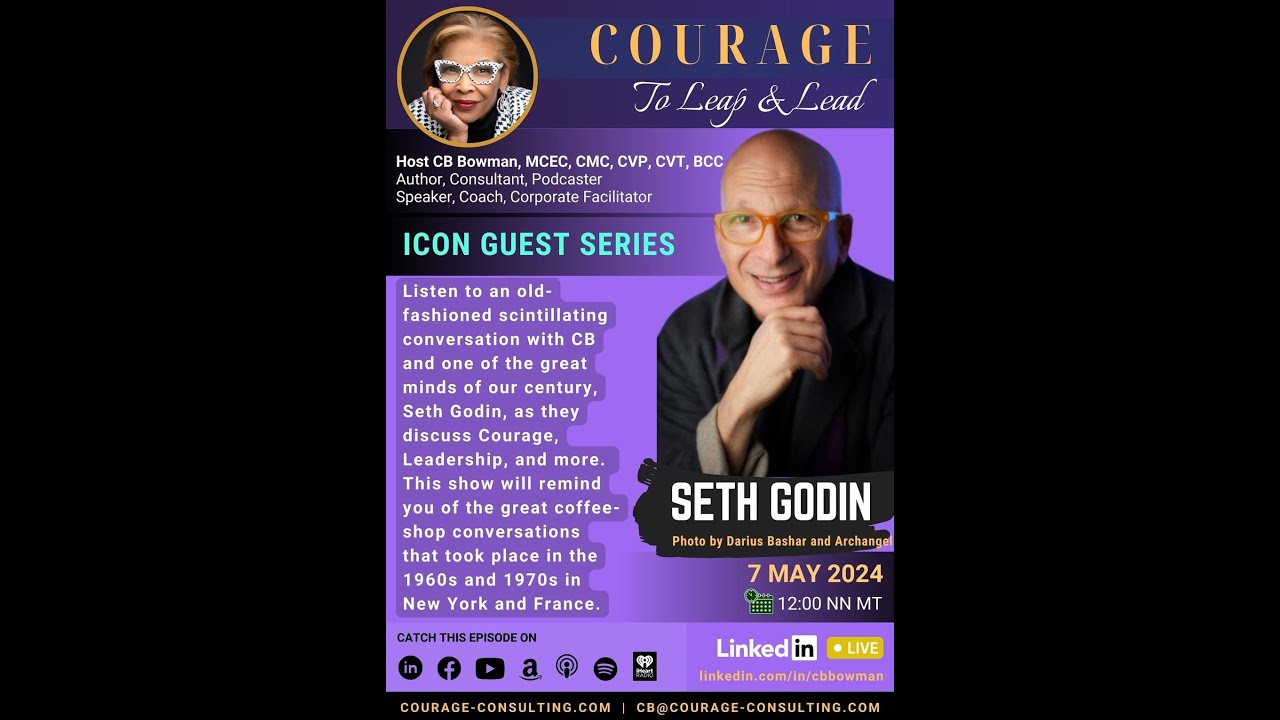
Seth Godin talks about microcourage—small everyday acts of bravery that add up—and why culture beats strategy. He explains that true courage isn't selfish, shares his costliest mistake, and compares AI tools like ChatGPT to hammers: useful but unconscious.
Chapters
You've got courage to leap, courage to lead.
Be brave and be bold. Let it roar.
Welcome to the Courage to Leap and Lead podcast, where each of our guests share the stories of courage that helped them become powerful leaders. Before we start today's show, please remember to visit courage-consulting.com. Where you can find all the episodes and other excellent resources, all at courage-consulting.com. Now, here's your host, Leadership Courage Coach CB Bowman.
Oh, first of all, audience, hi, it's CB. And you know, it's Tuesday and I am so excited That Seth has agreed to be on the show. I feel like I am interviewing a rock star. And so let's start right away. Seth, you know, I never prepare for an interview because I'm from the school of the Lower East Side where you sat in a coffee house and you debated and you disagreed and you agreed and you just talked over coffee. And then you walked away, not in agreement, but enlightened, and it all flowed. And then I thought, I cannot interview this man this way. So what am I gonna do? And so—
I gotta tell you, CB, you do prepare for every interview. You just don't prepare by doing what most people do.
I'll take that. Well, this time I actually sat down and I read your Well, I listened to your book because I'm dyslexic, so listening is better for me. So I ordered it and I listened to it and I thought, you have a problem, CB. You have not listened to every single one of this man's books. Because I sat and I laughed and my head fell off from going, yeah, yeah, yeah, yeah, that's right.
Yeah.
And so I am prepared to discuss your book. And hold on, let me get the name of it right in front of me. It's the one with the blue cover and the orange— Significant—
The Song of Significance. I don't think the COVID is blue, though.
Oh, on my iPhone it was blue.
Okay.
Okay. The Song of Significance.
Right. This is the one that has the blue cover. It's called The Practice.
The Practice.
Song of Significance has the orange cover.
Oh, that's interesting. Well, Audible has the wrong cover on it.
Color. You know Amazon, they'll do anything. Yeah. Anyway, thank you for reading it. We should talk about whatever you want. That's why I'm here.
I read it. I mean, I listened to it, and then I ordered it in print because I have to have some of those principles by my side as I talk to people. Look, Seth, this, this is about Courage. Courage to Leap and Lead. And it's a very casual, have your coffee, tea, whatever. I want to know about you, but I also want to know about the book. So I, I wrote down so many questions about the book, so I'm not quite sure where to start, which is unusual for me. But I'm going to start with, since few people know about you, the person, May I start there?
You can, but I probably won't answer your questions because I'm not that interested in me, the person. I'm interested in the people who are listening to this.
Are you going to throw me those kind of curveballs throughout this? Because I don't know where to go. All right.
Why don't I start with this?
Yes.
There are 2 kinds of courage, and courage is misunderstood. Courage has to be generous. If it's not generous, It's this selfish act that doesn't deserve the word courage. And there are 2 kinds of courage, the courage where we do something that feels risky and the courage where we do something that is risky. And too often in our culture where media narrates everything, we've decided that if something feels risky, we did a courageous act. And we've decided that if it's good for us, it's courageous. And I don't buy that. I think that real courage is what happens when we show up and do something outside of our comfort zone that might not work for other people. And that's, I think, the best versions of courage.
So my book is coming out in January. It's called Courage to Leap and Lead. And it's— the subtitle is Redefining: A Roadmap for Redefining Failure into Success. And I have to say, I agree with you and I disagree with you at the same time.
Well, you're the expert, so go for it.
I'm not going to say I'm the expert, but when I wrote the book, I thought there's so many people that tell you to be courageous. And nobody tells you how that could happen. And we also look at courage in the, in the same way that you described. We look at it as this big, huge elephant in the room that some people have and most of us don't. It's running into a building to save a child. It's jumping into the pool to save a dog when you don't know how to swim. But I looked at my life and people said to me, you're very courageous, and I denied it. All the time. And then something happened where I was asked to speak about courage, and I sat down at the computer, and you know this as a writer, well, all of a sudden your fingers just keep flying and you realize maybe there's something in what people have said to me. And I thought, okay, so if I'm courageous, why haven't I run into that building to save somebody? And I came up with the term microcourage.
Okay.
Microcourage talks about the daily acts that we do every single day that are courageous. And we ignore them because we think of it just as part of life's journey, when in fact, we're being courageous. And when you put all these microcourages Together, it equals one big courageous person. And you need to learn how to recognize it and accept it. And so my theory is, if, for example, you ask somebody who's visually impaired if you can help them cross the street, that's an act of courage. Why? Because you can be hit by a car. They could be hit by a car. They could say no and damage your ego. There are millions of reasons. If you get out of bed in the morning with a migraine and you make that meeting that's very meaningful to you, is that courageous?
Yeah.
Because you can be nauseous. You can be sick on the way there, sicker. You just don't know what's happening. And so I have now broken down courage into small acts that we need to recognize. I'm a COVID long person, and I was just told that the reason I'm having pain on my right side of my head has to do not with allergies, as the doctor said, but being courageous enough to go to many doctors to find out. It has nothing to do with the weather. It has nothing to do with sinus. It happens to be what they call shingles. But I had no lesions.
Yeah. Sorry.
It's fine because now I have the courage to know what to do about it. But it first took the courage to challenge the doctors. Who said we can't find anything wrong? Yeah, it's called non-symptomatic shingles.
So no, it sounds symptomatic to me. It's just not matching what other people have.
They probably have the name wrong, but it shows up very differently. Sure, it's nerve pain.
And so let me build on what you're saying though about yes. These small— I think these small acts of courage aren't so small. I think that the courage of Neil Armstrong is rare in that not most of us are not going to get the chance to be the first person to go to the moon. So we shouldn't wait for the giant famous acts. Small acts aren't small because someone was glad you did that thing, and one person is enough. But where I would put a small difference in is I think there's a difference between overcoming, say, a physical disability or the fact that you don't feel well and what Steve Pressfield calls resistance, which is the fear of failing, the fear of being seen as a fraud, the fear of writer's block, the fear of criticism, the fear of being rejected. Those things, when we overcome them, we're committing an important act of courage. I think that if someone is fighting long COVID, I don't give you any points for showing up at work. You need to take care of yourself.
I like this discussion. I'm not sure I agree with you, but I like the discussion. It'll cause me to think some more on it. Chef, how did you become— this is going to sound stupid, and it's okay— how did you become so smart? How did you become the person that people look up to, that admire your work? And let me put a caveat on that. When I listened to your book, what occurred to me is these are simple statements. And they are penetrating statements. And then again, they're simple statements. So why is it that everybody thinks like you? Not agrees with you, but thinks like you. What creates that difference? What makes you a superstar?
Well, you're very kind. I'm not that smart. I'm thinking of all the people who I passed by when I should have helped them. And I'm thinking about the choices I've made that were uninformed or rash. And I'm thinking about stuff that I announced to myself I wasn't good at just because I wasn't willing to try. So I'm not willing to give myself the label of smart. I am willing to say that I have developed a skill, which is to tell people things that they know deep down are true, but they didn't realize. And if I can see something in the world and I don't know why it works, I don't walk by it. I got to figure out why it works. Why is that popular? Why is that a problem? And then if I can decode why I think it works and I can tell it to people in a way that they say, of course, that's my skill. And I've worked very hard to practice that by being wrong a lot. The most expensive mistake I made cost me $40 billion. That's a big one. And so you end up hypothesizing out loud. I don't know if you spent much time with 2-and-a-half-year-olds, but they call them toddlers. And the reason they're called toddlers is that they toddle and they don't walk very well until they do. And so the way we learn how to walk is by walking poorly. And the way I learned this skill of explaining things, of blogging the way I do, Is by doing it. And then I got better at it.
So in your book, The Song of Significance, you talk about the fact that we should ask what the— correct me if I'm wrong, because I need to read it again— what the other side wants. And So my question to you is, how do you find out what the other side wants when it's not a person? So how do you know what AI wants? How do you know what Chat wants so that you can produce what's needed?
Okay, so there's some layers in your question. First, other side is a tricky concept. When we are in the world trying to be of service, trying to sell something, trying to make a difference, we're doing it for somebody else. That other person doesn't know what we know. They don't want what we want. They don't see what we see. And we have to begin with the empathy of saying, that's okay. I am not you. I'm going to assert, imagine what you want, and then I'm going to watch If over time I'm right, I'll do it more. And if I'm not right, I won't. And the second part of your question is about inanimate objects or dogs. And in that case, the way humans navigate complicated worlds is we imagine that complicated entities are people. We imagine that the dog has a voice in its head like we have a voice in our head. Right? He's wagging his tail because he wants an egg. Well, no, actually, he has no idea why he's wagging a tail. He's a dog. We just invent that narrative. And the same thing is true for how we deal with an AI. I know how ChatGPT works. It doesn't work the way most people think. It doesn't know anything. It's doing a trick. And when it does the trick, we think it's talking. to us. It's not. This is doing a trick with numbers. And if you learn which things, well, here's a great thing you can do with ChatGPT. If somebody sends you a 6-page memo from work, copy the whole thing, paste it into ChatGPT and say, please summarize this memo. And it will take a 6-page thing and make it 1 paragraph long. It's really good at that. Does it know what it's doing? Does it want this? No. But it's really good at it the same way a hammer is really good at hammering nails. But if you try to use a hammer to screw in a screw, everyone's going to be disappointed.
Does that mean that ChatGPT or AI has no value because it doesn't have a mind and a heart?
No, it has plenty of value, same way a hammer has value. But I would feel no compunctions about unplugging an AI that wasn't helping me, but I would have a lot of trouble unplugging a person that has a heart. And so it counts for more. But the thing is, you know, let's say you have a chess computer. The chess computer can beat you at chess all day long. Does it have value? It does if you need to play chess with someone who's better than you, because it's really patient, but it doesn't have a soul or heart, doesn't have narrative or consciousness. It just plays chess.
Okay. I want to skip to something else. I've noticed that companies these days that start small and grow like an Amazon or an eBay or Even Airbnb, they seem to come out for the people to use. So what do I mean by that? Amazon, you used to be able to go on and sell your books that you've read and you no longer want, and it was fun and you'd make $5 or something like that, and you really warmed up to Amazon.
Mm-hmm.
On eBay, you used to be able to sell something. That you didn't want, and it was fun, and you got a few dollars or whatever. On Airbnb, you used to be able to go and rent a nice house. Now Airbnb, you go on, my husband and I just went to National Speakers Association, and it turned out it was a hotel chain that put their rooms that weren't renovated. In other words, they considered them the garbage. Amazon, you can't really sell a book anymore because the big bookstores are on. eBay, retail chains are on. Why is this happening? How do we prevent it? Why is it that companies no longer realize how they got started and support those that started them when they were babies? That's, I guess, a bunch of questions.
Well, you're talking about industrialism and Song of Significance has a lot to say about industrialism. Industrialism made us all so much richer than we would be if it hadn't occurred. It fed us, it invented billions of jobs. And, you know, at the beginning, you could go to just about any company. Sam Walton would answer the phone at Walmart. You could call the CEO of Nordstrom and they would answer their own phone. At the beginning, human beings are serving human beings. But what industrialism demands is scale. And if they're shareholders, they want to be able to sell to the stock market. The stock market demands scale. If people own stock options, they want them to go up in value. They demand scale. So where do they find scale? Well, the fact is that Sony, for example, sells lots of stuff on eBay. Sony wasn't going to show up on eBay at the beginning because it was Too new for them to defend to their boss, that companies want to work with proven entities. They don't want to work with something that's new. So who does want to work with someone who's new? Someone like CB, someone who's going first, that a tourist restaurant in New York doesn't open as a tourist restaurant. It opens as a restaurant for people like you and me. But then As it gets more boring and more popular, the tourists go and people like us stop going, right? And so this is the inevitable creative destruction of capitalism. It always follows the same cycle. And when they get too big, they get greedy, they get slow, they get stuck, then the next one comes along to take their place. And That cycle keeps happening and it's not going to stop happening. We just have to stop believing the hype and say, you know what, I used to get something from Amazon. I don't get that joy anymore. I'm willing to go somewhere else to do that.
In your book, you mentioned something about, again, correct me if I'm wrong, the ability to go back to where you started. And yes. Yeah. Why is it that winter off and, and part of it go back to where they started?
Well, because what they're measuring feels safe to them, which is do what they did yesterday, but faster and cheaper. Keep turning the crank. That is entirely possible that a hotel chain like Marriott used to have personal service, used to do things that made certain guests feel really welcome. But what they discovered over time is that it's easier and more convenient to just keep turning the crank, right? That the Burger King phrase, special orders don't upset us. Well, yeah, special orders upset us. And so that becomes part of the system, the crank turning. And most people want to go to a place that is predictable and convenient. They want the regular kind. And So people like you and me have to keep going to the next thing. And there's nothing wrong with that. It's part of the exploration of it. It's part of the idea that says it doesn't have to be new, but it has to be interesting. It has to be worth talking about.
May I ask you a question about race?
I'll do my best. I'm not particularly qualified.
In your book at the end, This is going to be a tough question. You apologize to people of color for the trauma they've been through, through the loss of wealth. White people, particularly of your intelligence tend to apologize, but also people who are not of your intelligence apologize. Why the apology instead of doing something? And I'm not speaking to you, I'm speaking in general. Why the apology? We see the same thing happen over and over again. So the apology means nothing. But what does it do for the person who's apologizing?
Okay, so in the acknowledgments at the end, I said there's 2 kinds of sorry. There's the sorry we can say, for example, at a funeral. Which is not the, I killed your cousin. I'm sorry I did that. It's the sorry, I see you. It is the sorry of sawa bhana. It is the sorry of being able to acknowledge that things happened and are happening and understanding it has to be an essential first step in addressing it. And I think it is possible to try to insulate yourself simply by saying sorry a lot and then going back to what you were doing. But I think it is also possible to change the culture and to change oneself. And I think that we can begin to do that by acknowledging that that is what is going on around us and then take action to change our personal behavior and the systems that are around us. And none of it will ever be enough. The word enough is a real problem because enough pushes us to be able to say, and then I'm done. There have been terrible things done in the name of religion and caste, race, gender for a very, very long time. There will never be enough. And being heartbroken is insufficient, but it can start us down the path of remediation, of being able to— you know, a colleague of mine is a First Nations member, lives in Northern Ontario, and she spends her time working with organizations like summer camps and basically pointing out, we're not a mascot. What are you doing making us a mascot? Addressing that is a step. It is not sufficient, but it is a step. Then you say, well, let's acknowledge the fact that until 1960 in Canada, it was against the law for an Indigenous person to teach their kid their culture.
Mm-hmm.
Let's acknowledge that. Let's acknowledge what happened in Australia. Let's acknowledge what is happening in my town. On my watch. And then what is our apology of action? Then how do we allocate our resources, our privilege, our choices, our voice to be able to say, not on my watch. I don't want to stand for this. I want to be able to create iterations that cause systemic change. And I am a hypocrite and everyone I know is a hypocrite. All the people I know of every color, of every gender, of every nationality, we're all hypocrites. Because that's the first step, is to be able to say something better than you did and then try to do something that catches up to what you said. And I am as guilty as anybody I know, but at least I can try.
Thank you for answering that question because When Floyd happened, I was with a group of people online, and you know how you break out into groups in Zoom. And so I was put into a group with a bunch of men, and the first thing— and they were all white men— the first thing they said was, I'm so sorry. I don't— I'm sorry. And I said, why are you sorry? And they said— because they, in my mind, they did not do the act. So why are you sorry? Was the curiosity that I had. And they said, because it happened and we can't imagine how it feels. And so we feel guilty about it. And I said, think about this. If you have a scratch on your glasses, eventually you don't see it. You just get used to it. But if you drop your glasses on concrete and it shatters, then you're going to see it. Floyd was the dropping of the glasses on the concrete. So because you didn't see it before when it was scratched, it's not a reason to apologize. Now that you see it because it's shattered is a reason to do something. So my question to you went towards— you can't— in my mind, you can't apologize for something you didn't do. You can do something about where you are now, as you said.
Yeah, I think we, I hope, are in the same camp. The point I was trying to make is in English, the word sorry means 2 different things.
Yes.
I think that what those people were doing, I'm just imagining, is there was a fresh wound in our culture in that moment. And whatever they did yesterday and whatever they're going to do tomorrow, if we're going to build a bridge with each other, it helps to acknowledge that we see the other and that we can acknowledge that there is a wound. Because there are people in this country who refuse to acknowledge that there is a wound. And I think we need to ignore them and work around them and surround them and change the culture so they have no choice but to catch up. But the thing is, it's systemic change that is the apology of action that we need, right? How do we change the incarceration system? How do we change the policing system, the standards around it, so that we don't need to drop our glasses to the pavement so often? And the good news, which isn't much solace, is that the world has changed a lot. in the last 20 years. And it's hard to see sometimes, but it is part of the reason for our dislocation in this country is people who didn't want the world to change are stunned by how much it has changed. You know, from, from gay marriage to being able to speak up about harassment at work to being able to talk about systems of caste. Yeah. And, you know, I know how many relatives I lost 80 or 90 years ago In Europe, and the wounds persist, but we have to figure out how to change the systems.
I think we're absolutely on the same page. And you explained to me that other version of sorry and how it impacts your thinking about what you're going to do yourself today. So thank you for that. How much time do we have left?
I have about 15. 15 minutes left.
15 minutes? Okay. I want to ask you a couple of other things about your book. I had a big smile on my face when you said culture defeats strategy. Can you tell the audience about that who haven't read that book? I mean, my face was aching from smiling so hard.
So I have an MBA from a fancy business school. And what they spend almost all their time teaching you is strategy. What is strategy? Strategy is how am I gonna approach this game of chess? How am I gonna move various pieces around to be able to outfox my competition? And one case after another is about these cut-and-dried moves that we can make. Tactics are the little steps we take to support the strategy. And so they're super easy conversations to have. Right? Should we raise our price a dollar or lower our price a dollar? That's a strategy choice. But culture is what do we do when no one's looking? What are things like around here? What do I imagine my boss wants even when she's not in the room to tell me? Culture is, do we put up with a bully around here? Turns out in every organization I've ever studied, and it's a lot, culture defeats strategy every time. That if the customer service people have a culture of get 'em in, get 'em out, don't respect 'em, take their money and they're gone, that's going to change everything about that future of the company. If, you know, back when I started one of the first internet companies, I had a really valuable employee and it turned out he was a yeller. And the second time I heard him yell at one of my team, I took him aside and I sat him down. I said, look, if you ever do that again, you're fired. You're not fired with a warning. You're fired. It can't be like that around here. And that was when we had 8 employees and it never happened again because culture matters. If you build a culture, that's what you're gonna get. And so—
Why are companies so— I'm sorry, Sam.
No, please.
Why are companies so afraid of culture?
Because you can't easily measure it. You can't control it. You can't dictate it. You can't hire a consultant who can fix it for you tomorrow. Strategy is so much fun. I mean, I don't do any consulting, but if people ask me free advice, sometimes they give it to me. It's so fun to talk about strategy. It's like, it's a game, right? Culture, there are no board games around culture. Every board game's around strategy. Culture is this incremental dignity-based, connection-based, patient work of weaving together the way things are around here. I'll tell you a small aside. This was my 43rd summer heading up north. I teach kids canoeing in northern Canada. And when I was 18, 19, I taught some kids a mind-reading game when I was up there. It was a secret. They weren't allowed to tell anybody else. That was 43, 42 years ago. Up there this summer where I spent more time than usual, 2 kids who are 18 taught me the game. It had been bouncing around this place for 40 years as a secret that was whispered and it came all the way around back to me. And the thing is, over the years, it had gotten a little worse and a little worse. It wasn't— and I had to like teach them how to make the game the elegant magic it was again.
Yeah.
But that game of telephone, That's what culture is, right? One person whispering something to somebody else. That is what we try to do when we write a book that spreads. That's what we try to do when we decide whether or not we're gonna give the receptionist a smile today. What got them that smile? Because they're gonna do it again tomorrow.
Okay, I have 2 important questions that you must answer before you go. One is, Then what? What are we going to do about cancel culture? And two is tell us about your latest two books.
I think consequence culture is essential.
Cancel culture.
I know. I'm warming up, my friend CB.
All right. All right. I'm anxious.
How can you have a culture without consequences? Taking responsibility for what you do. But cancel culture. can get toxic really fast because it's like on or off, you're in or you're out. And all of us, as I said, are hypocrites. All of us should never be known for the worst thing we ever did, but we should not confuse that with consequences. We need there to be consequences because otherwise people with power will get away with things and do it again. And I don't think Harvey Weinstein should have employees. I think Harvey Weinstein should be in jail. There are consequences to what he did. That's not the same as cancel culture. So I hope that that distinction is clear. You asked me about a couple other books. This book— I was a volunteer, organized this book. It took a year and a half, 10 hours a day. I did it with 300 other volunteers. It's called The Carbon Almanac. Carbon Almanac is a illustrated, footnoted, crowdsourced, 97,000-word true source of information about what's actually happening to our climate. And we, it's not too late, but we have to start now. And the purpose of the book is not to tell people what to do, but it's to allow them to get smart enough to decide what to do, to decide how to change the systems that are getting in the way of being who we want to be. And the book before that one was called The Practice. It still is. The Practice is about doing our creative work. There are lots and lots of people, CB, who started a podcast 3 years ago. Most of them don't have one anymore. You do. And that's because you have a creative practice. And it turns out there's no such thing as writer's block and imposter syndrome is real. And what we have is the chance To ship our work and to do it for the right reasons.
I love the fact that you did research on me. I caught that. Seth, I, I really hate to say goodbye. You so much remind me of the coffee shops that I grew up in, talking to people in the Lower East Side, and I hope I get to have another conversation with you. I love talking about your books. I can't wait to read them all now because I agree, I disagree, and I go, aha.
And there you go.
That is just miraculous for me. Seth, thank you. Thank you. Thank you.
Well, this is not goodbye. It's so long. It was a pleasure. Keep making a ruckus, CB.
Bye, my friend.
See you.
More from CB



211- Courage to Leap & Lead with Louise Story part 1Courage to Leap & Lead







