183- Courage to Leap & Lead with Yosi Kossowsky, part 2
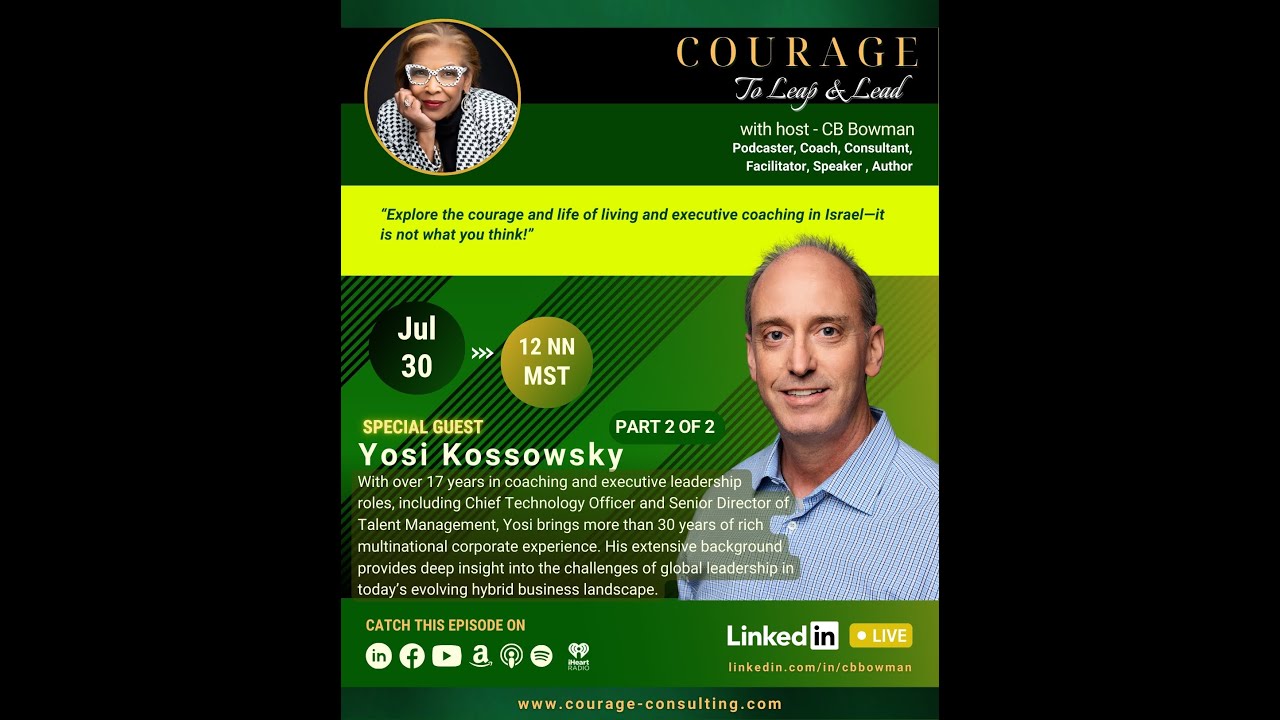
Yosi Kossowsky, an engineer turned coach, shifted from command-and-control management to emotional awareness after a 2013 acquisition tanked morale. He teaches leaders to feel emotions through bodily sensations rather than analyze them, and walks through a live coaching exercise on recognizing a rushed feeling.
Chapters
You've got courage to leap, courage to lead. Be brave and be bold.
Wow!
Let it roar. Welcome to the Courage to Leap and Lead podcast, where each of our guests share the stories of courage that helped them become powerful leaders. Before we start today's show, please remember to visit courage-consulting. where you can find all the episodes and other excellent resources, all at courage-consulting.com. Now, here's your host, Leadership Courage Coach CB Bowman.
Hi everyone, this is CB and it's Tuesday on Courage to Leap and Lead. And this is part 2 of an incredible interview with my colleague and friend Yossi, who lives in Israel. And if you missed part 1, please go back and listen to it because we talked so much about the difference in cultures between Israel and the United States and what people think and how they react and dispelling myths and misinformation. Today we're going to talk about How did Yossi become a Coach? We get the inside scoop. Yossi, welcome back.
Thank you, CB. So glad to be here. It was great the first time, and I'm really looking forward to this one.
Thank you. Hey, so I asked you, how did you become a Coach? Because you have a technology background.
I do. And so as I started telling you last time, I was very— I don't consider myself being a Vulcan, if that reference works for anybody in Star Trek. But I was very logic-oriented and very fact-oriented. And when I started having the opportunity to lead a team, the feedback I got was I was doing a pretty sucky job. I wasn't really listening. I wasn't understanding. I was command and control, micromanaging. And really focused on my experience rather than my team's experience. And so the curiosity led me to wanting to understand what I was missing. What did I not understand about people that I was getting it so wrong? And luckily, with some help of some people giving me direction, I landed on 2 areas. One was neuroscience, and the other was emotional wellness therapy. And as I started really delving into this work, really for my own learning and understanding of myself, I learned about limiting beliefs, triggers, perception, and communication, and what is actually happening in the brain when I'm talking and you're listening, and how you might be perceiving differently than what I'm intending. The role of our subjective perception maps and how that plays a role in how we interpret our environment. And I was blown away in really understanding that the world that I see is not the world that you see. I remember my daughter when she was younger, and I was kind of explaining to her what I was learning. She said, yeah, so how do you know that my red is your red? And I realized I don't know how my red is her red.
How old was she?
I think she was about 11.
Okay, so you knew you were in trouble right then and there.
She is, she is brilliant. She— all my children are brilliant. Um, this daughter specifically is super brilliant. She's going for her PhD in biomedical engineering. So, okay.
Yeah. Runs in the family. All right, go ahead.
It's my wife's side, trust me.
What does your wife do?
My wife is an operational consultant. So she works with companies that are kind of in their startup mode and often will help them. She's super organized and super able to organize thoughts and processes and people. And really helps these, these burgeoning companies put a lot of order, whether it's sales, getting their sales materials ready and thinking about how they do their pitches, and, or getting operational and project management work really in order. So yeah, she's super brilliant, much smarter than me. And I'm lucky to have her.
So we know that.
Yeah, absolutely.
Let me turn this off. Okay. Yes.
Okay. So anyway, back to that story. So after I learned these skills and started applying them at work, I realized that the therapeutic Things were amazing, but not really workplace appropriate. And—
Why not?
Well, so this was in 2008, '09. And we would have— there was an option through HR to go get social counseling or counseling. But that was an outside thing. It wasn't something that there was in-house in the company. The concepts that we now have of mental health especially since COVID I think is much more— is actually relatively still working on being accepted. But certainly in 2008, 2009—
No, no.
It was a no-no. Even the idea of coaches in the company, meaning not coming from outside of, you know, was also not really well accepted. And so, but I did want to stay in corporate. And that's when I, in 2012, got my first coaching certification. And I loved it, but I wasn't sure if that was gonna be my life's calling. So I stayed doing engineering work. And then in 2000— end of 2013, the company I was in, a smaller company, got acquired by a much larger company, a multinational. And the acquisition was bumpy from a people side. So the leaders that were the top of the pile, right, in the company I was in, all of a sudden became middle management. And for them, that was a huge change that they, I think, struggled with, that they did struggle with. And about 3 or 4 months after the acquisition, the morale of the company had gone just to the floor. And I decided I was gonna take a risk. And I mean, it wasn't this simple thing. Like, I had a really chew over this a long time before I took this risk to go offer the leadership coaching. And I was pretty much untested, meaning I had the certification and I had what I did with my team, but I never like coached executives. And I went in—
Scary, risky move.
Well, it was a doubly scary, risky move because after At this point in the acquisition, which was about 5 months into the acquisition, because morale had dropped, so had productivity dropped, and there were already talks about a layoff happening. And my boss said to me, okay, you're gonna take time away from your engineering role to go do this. I'll support you, but if I have to do headcount cuts, you're gonna be the first on my list.
That's quite an option. Do or die.
So I sat back, I talked to my wife, and, and I thought of that Wayne Gretzky quote, right? You miss 100% of the shots you don't take. And I'm like, I really feel like I need to do it. And one of the things that I learned in the emotional therapy work was how to feel, which I had actually never really done before. Honestly, I knew how to act. Feeling.
What does that mean, you learn how to feel?
So I always had interpreted emotion in a cognitive experience, not as a heartfelt experience.
But you love your wife.
So what I learned What I learned was I loved how my wife made me feel rather than loving her for her.
That's powerful.
I learned that when I was getting frustrated with my children, I was really frustrated with myself and taking it out on them. I learned that when I didn't get my way, that, that was my emotions and not because the other person was stupid or wrong.
Tell me more about that.
So there's a quote that I think is attributed to Buddha. That says, holding on to resentment and anger is like taking poison and hoping the other person will die. And as I learned to parse that, I learned to understand that if I'm the one who's triggered, it's mine, not the person who triggered me. And that was a really hard thing.
We talked about that a little bit.
Before.
Yeah.
Do you think that most men need to learn how to feel?
I don't know about most men. I will say that I often find myself paired with data-driven clients, people who are in science or engineering or finance, and who have been taught or naturally gravitate towards logic-based awareness of the world. And many of those people have never considered the option of what if I just experience this emotion without thinking about it? Or explaining it, or defining it, or excusing it.
How do you do that?
How do you do what? Sorry.
How do you experience something without defining it?
Okay. So what I learned was that when you are feeling something, there's usually an experience physically that accompanies it. If you— right. And so, so this touches very much on mindfulness.
Mm-hmm.
If you allow yourself to just focus on the experience in your body, And you let your thoughts come and go and you don't give them any attention. And you just allow yourself to say, okay, I am feeling this tension here in my chest or my heart, my back, my shoulders. Then you are experiencing for the sake of experiencing without trying to give a story to it.
Is that good or bad?
I have found it super helpful to be able to separate Trying to define why I'm feeling something, right? And allow myself to really just experience it for the sake of experience. Because I know how to think. I've been taught how to think, but I was never taught how to feel. Matter of fact, I was taught often not to feel by well-intentioned people when I was a kid and said, stop roughhousing, stop yelling, stop running around. I think I interpreted that as high emotion is not okay.
But you see, I think that most men are taught that, you know, most men are taught you don't cry. Man up is the expression. And I'm not blaming men because women play a large part of this, which is I expect my husband To da da da da da, not to have emotions, not to respect his emotions. You know, he just has to take care of business. Yeah. And so our society, at least here in the United States, which is what I know the most of, doesn't applaud feelings in men.
And I don't, I don't know, again, right, the whole world, or even all of Israel, or even the United States. I will say that by far and large, with the people that I've coached, and before coaching was doing some therapy work with, I would agree that most of the men that I worked with were not in tuned with recognizing the emotion for what it is and learning how to allow themselves to fully experience it without compensating, excusing, overriding, defending.
When you say— I'm taking notes, obviously.
Yes, I figured.
When you said experiencing for what it is, I'm not sure I understand that.
Okay, so let's say I often experience a sense of anxiety or fear. And pre-learning this work, I would always try and find a reason for it.
Isn't that healthy so that you know how to eliminate it?
Well, it depends. If we— in our, in our last conversation, we talked about when I assign a motive or a reason to something, I limit my, I limit my curiosity.
Yes, because you have this predetermined in your head, right?
And so if I determined why I'm feeling stress and I don't get curious about why I'm feeling stress, then I often miss the real trigger.
Say that once more.
If I Predetermine or immediately jump to a conclusion about why I am feeling the stress without allowing myself to really experience it and therefore get curious about it, I often miss the deeper trigger.
So you're, so you're defining it in a narrow sense.
Or not looking in the right or in the deeper place, not in the deeper places.
Hmm.
And what I have discovered, and there's a lot of different methodologies that are now out there, you know, in all of the emotional work, there's great, I think, methodologies about helping people go deeper and understand what are their silent saboteurs or their secondary gains to their behaviors. But in the workplace, the only tool that I found that really is getting people there is, is, is the Immunity to Change work by, by Keegan and Leahy that tries to have somebody use their cognitive ability to understand what are their silent saboteurs. And the Positive Intelligence by Shirzad, I think, is— he's also working in that direction. But we're blind to what we don't know. You know, our biggest challenge is we don't know what we don't know. And especially if we are going to try and follow somebody else's map to this discovery, then we'll take that answer. But the way you were raised started setting the stage for how you created your maps of your filters of how you perceive the world. And those are different than mine. Those are different than even if you have a sibling who grew up with you, they have a different one. And so if I just accept somebody else's version, of why I might be feeling that way. I miss my version, my reasoning, my trigger. I remember listening to one of your podcasts, and I can't remember who was talking, but this guy was talking about this moment of crystallization about where he had this horrible experience near a church. And getting to those, those deeper awarenesses often requires us not to have preconceived notions about why am I showing up this way? What was that trigger?
That's awfully hard to do, to filter, because you're saying to— my interpretation is you're filtering out your brain.
Right. It is extremely hard, especially if all you ever learned to rely on was your brain and you Learned that your emotions were unacceptable.
Um, when you go through this filtering out of your brain, aren't you liable to go into a free fall?
And so what's the danger of free fall?
Did you free fall into a hell of why, why, why, and you stay there?
So why, why, why to me is a thought, not a feeling.
Ah, okay.
So another, another element of this is the story we tell ourselves about emotions. I often— I grew up certainly with defining good and bad emotions. Well, as soon as I've done that, now I have a double problem. I call it my Oreo sandwich, which is I feel something I don't like and I'm judging what I don't like.
Mm-hmm.
I'm doubly screwed. So if I can take away one side of that sandwich, which is now I'm feeling something I don't like, but I'm not going to judge it. as bad, then I can start to relate to it as a different experience. Okay, so I'm uncomfortable. It's like smelling an odor that I don't like. It doesn't make it evil, that odor. It just makes it something that I don't like.
But you're saying I need to analyze— oh no, you're not saying I need to analyze.
I'm not saying analyze.
You're saying Accept that you don't like it and end there, or, and just maybe figure out why you don't like it? Or is that—
So there's another process that I learned about in the neuroscience, and we, you know, it plays— it's kind of connected to the amygdala hijack. So when our amygdala hippocampi are are activated. So the, the, the way I guess the blood flows or the messages kind of go to the prefrontal cortex gets stymied a little bit. Again, this is a layman's, layman's understanding. And so if I'm triggered, I'm not thinking clearly. But when I— So when I can be really with myself, what tends to also accompany it is my parasympathetic, my relaxed system kind of kicks back in. And then I can think more clearly. And then when I look at myself with that extra level of calmness and clarity, then I can go with curiosity and reengage my senses. Okay, what's really going on here? And with that curiosity again, and looking at it from the idea of, if I'm triggered, it's mine. Even if I look at it and say, well, that event, that person did something that kicked off the trigger. Okay. It's still my trigger. And it's still my emotions. So if I want to understand myself so that I can then choose or feel that choice about how I respond the next time, I need to allow myself to be In a state where I have full control of all my thinking faculties, and then understand and be curious that it wasn't because of her or it or that email or this. You know, ultimately, for me, it often comes down to I'm feeling out of control. I'm feeling that I'm in an environment that I don't have control in, that therefore then triggers that idea of I'm not safe because I don't know how to protect myself. Or this is unknown, and I don't know how to make sense of the unknown. But I only get there if I allow myself to feel for the feeling's sake, allow my, my parasympathetic system to kick back in, which means getting calmer. And then I can say, okay, what's— what belief of mine, what filter of mine was just triggered here? And then I can get more clarity on that.
I think that I have to have you on again, and we have to give some examples and some, some do like a workshop interview.
Okay, I would love that. This is my favorite topic.
I gathered. And, and it's, you know, I like to just really process things. And then think, am I in agreement or not? And I'll give you a really good example of how I process. When I was younger, I went to visit my dad who was in the military, and he worked at the Army Pictorial Center. And that was the division that did all the graphics and everything. And in that center, one of his colleagues was Asian. And he was a master, master artist. And he said very proudly, I'm going to show you a picture that I painted, and I'd love to know what you think. And I looked at it and I said, nah, I don't like it. And he looked at me and said— he smiled and he said, why? And I said, I don't know, because I don't like it. And he looked at me and he said, young lady, never say you don't like anything without understanding why you don't like something. Those were the best words of wisdom I've ever received. Since that day, I always sit if I don't like something and I say, okay, Game on. Why? But I think you're saying something deeper. I think I hear you say, don't ask why, feel it. Yeah, feel that dislike. Then once I feel it, what should I be doing with it?
Why do you have to do anything with it?
Good question. Chicken or the egg? Which came first? I don't know.
I don't know either. I've read a lot of books that people want to say the feeling comes first or the thought comes first. I don't know. But this idea that we have to do something with what we're feeling, I haven't found to be true.
I need convincing. Let's do part 3.
I need— All right, we'll do part 3. I'll walk you through it. I'll take you through it. And then you decide what, you know, does it resonate for you or not? And that's—
So, so I'm not disagreeing with you.
No, I'm fine.
I just don't understand. I don't understand how you get there.
Okay.
That's what I'm trying to figure out.
I'm happy to walk you through it. And I'll be honest with you. It's much easier, like in coaching, if somebody else walks you through it than if you try to walk yourself through it. Even having done it now for 12, 13 years, it's still easier if somebody guides me through this than if I try to do it myself. I've learned to be much better about disengaging the brain until I calm down and then being curious.
See that there? I want to get inside your head to know what you're doing in your head to disengage and let it happen. Okay. Are you, are you counting to 10? Are you seeing purple cows? What are you doing?
Okay.
Smoking marijuana? What are you doing there?
Okay. So when we, right before we got on this call, You were dealing with packing up something.
With my husband, packing up a baby gift. Right.
Okay. So I'm gonna ask you in your mind's eye to go back to that experience.
Yes. Okay. My mind's eye is here.
Okay. So tell me about this experience. You're packing it up.
My husband being a pain in the ass? Yeah. Okay. Um, yes, because I asked him to take care of this. several times before I have to go to work and interview you.
Okay. How are you feeling as you're telling me this story?
I'm giggling inside.
Okay. When you were experiencing it, how were you feeling?
Rushed.
Rushed.
Okay. Yeah, because I, I needed to move on and do something.
Okay.
But I also felt— this is funny— I also felt, well, the guy needs me, so I've got to help him.
Okay, that's beautiful. And I'm going to ask you if you can isolate the rushed feeling for a second.
Okay.
Okay, where in your body do you notice an association with the rushed feeling?
Where did I— where is— I felt the sea coming in, in waves to meet the sand. Okay.
And did it have a physical component in your body somewhere that felt a little tighter?
I don't know if it felt tighter, but I smelt the sea.
And was that a good— was that a calming smell? Or in this case, was it not?
It was calming. Okay.
So obviously, if the experience is one that you're enjoying, then this is— you can do the same thing. Which is— close your eyes if you want to close your eyes for a second. So going back to that sea, do you have a sensation in your nose associated with that smell of the sea?
Hearing it. I can hear the crashing.
Okay.
I could smell the saltwater.
Okay.
I could see the, the foam coming up.
So there's hearing and there's smelling and seeing.
Yep. And I could feel the waves hitting the sand.
Where— when you say feeling, how did you feel it?
I'm not sure how I feel it. I could feel the sun beating down. Okay.
So now I'd like for you, just for a second, keeping your eyes closed, Is to just put all of your focus and all of your attention on those experiences. Feeling the sensation of the hearing, feeling the sun on your body, feeling the sensation of breathing in the saltwater. Just focus on those experiences, how it feels for the warmth on your chest, on your face. How it feels when you hear the noise of the sea crashing. How it feels as you smell in the, the salt water.
Okay.
And now just taking a deep breath and notice how your body is feeling. Did anything shift? From when we started this exploration?
Yeah, I was thinking how nice it would be to be on the beach.
How does that feel?
Feels great.
So that for me is disengaging thinking. You're focused on the experience of it, not the story of it.
Oh, but then how do I get to the point of stopping the feeling of being rushed the next time?
Okay, so in this case, right, what I got from you was that the feeling of rushed actually was a positive experience of the sea. So if we go—
I made the connection just now.
Okay. So when you were feeling rushed, then how was that feeling for you?
At that point, I think I was focused on helping.
Okay. But if you recall, Right? If you almost like in your mind's eye, you know, you close your eyes and you go back to that experience sitting at the table and doing what you were doing. As you picture it again, I'm curious what you feel in your body.
Oh, I think I was feeling tense because I had to get everything done. Yeah.
Where do you notice that tenseness?
In my mind, in my head.
Okay. So if we were to do the same thing again for a second, which is to go there and feel that tension or that experience in your head, and you allow yourself to just say, I'm okay with this feeling.
Oh.
So picturing it again, you're sitting there trying to get it all done. You're feeling that experience in your head. And now sending a verbal— a mental message: I am okay feeling this feeling. I am okay in this moment.
Feeling this feeling takes me back to giggling about how I felt.
Okay, so now all of a sudden, that is gone. And now you're in a more relaxed or even happier state. That is not thinking about it. That is just experiencing it.
So the next time he does something like that, I should just close my eyes, experience it, think about the beach, think about things that—
Well, so you could, right? But if you're thinking about the beach to override, you're still not allowing yourself to really feel. You're still overriding.
Gotcha.
Right. So if you allow yourself to feel it, And this becomes like a habit. So the more we practice feeling it, then, like, I don't need to close my eyes anymore. When I'm feeling the tension, I'm like, okay, I'm feeling, I'm feeling all the tension. It's okay. I'm okay with this feeling. And I breathe in and I tell myself again, it's okay. And I can also imagine giving my, like, virtual hug to that part of my body. It, it releases something. It opens. And then all of a sudden, I'm in a different state biochemically.
Okay, Yossi, we have to go. But audience, stay tuned. We're going to learn more about this biochemical release stuff. I'll see you next week. This is CB and my wonderful, powerful guest, Yosi. Until next Tuesday. Bye now.
More from CB



211- Courage to Leap & Lead with Louise Story part 1Courage to Leap & Lead







