194- Courage to Leap & Lead with Dave Sanderson
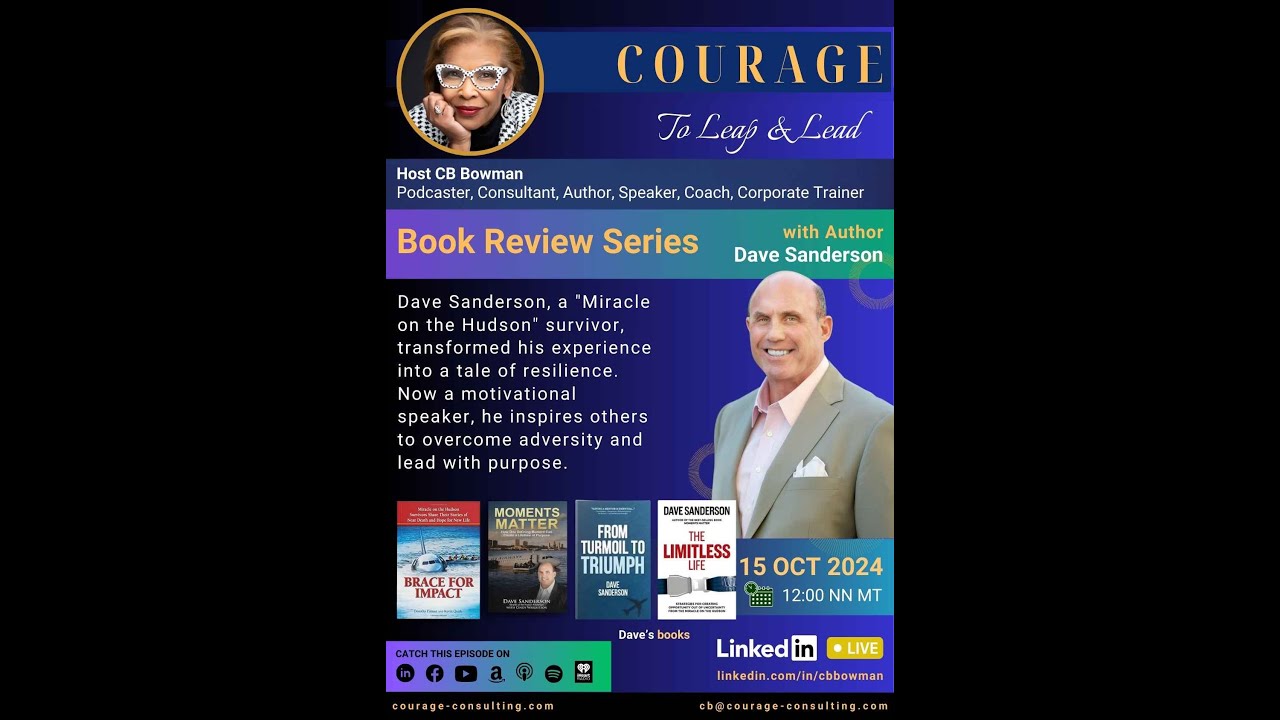
Dave Sanderson, co-pilot of the Miracle on the Hudson, talks about how crisis moments reveal purpose. He shares frameworks like the one-degree shift (tiny changes that transform outcomes) and state-management techniques for staying composed under pressure, drawing on stories from his books and his own losses.
Chapters
You've got courage to leap, courage to lead.
Be brave and be bold.
Wow!
Let it roar.
Welcome to the Courage to Leap and Lead podcast, where each of our guests share the stories of courage that helped them become powerful leaders. Before we start today's show, please remember to visit courage-consulting. Where you can find all the episodes and other excellent resources, all at courage-consulting.com. Now here's your host, Leadership Courage Coach CB Bowman.
Hello, ladies and gentlemen. It's CB on Courage to Leap and Lead. And today I have a guest that we rarely do this. It's the second time I'm interviewing him. The first time was about his being a hero. You may remember Miracle on the Hudson. That was the plane that Sully landed on the Hudson River to save the lives of the people on the plane. You may not know this man, Dave Sanderson, who was the second hero. Dave realized that he had the wherewithal— that's the term my mom used to use— to be able to save 155 people from lessons his mom taught him. So if you missed the first half of this show, you must go back and see it, because today we're going to talk about the books that he wrote that were— I have to say— were triggered By this being a— At the front door. And you know that this is live and we have all kinds of things. We have my dog come on, we have the FedEx man, and in this case somebody's ringing Dave's doorbell and it all works. So I want to start with the book that I have in my hand And I want to talk to Dave about what took— Dave, was this your first book?
That was my second book, CB. Thank you very much.
From Turmoil to Triumphant. Dave, first of all, let's, let's just start with the beginning. Were you writing before The Miracle on the Hudson?
No. In fact, if you go back to my 11th grade English teacher, I told her I would never write anything ever again in my life. And my freshman year in college, to get out of freshman, I had to write a thesis just to get out of freshman English. And I told her I would never write anything again in my life.
What did you write about then? Do you remember?
Back in, yeah, 1970. I know exactly what I wrote about because I got— I was the happiest B I ever got in my life. I wrote on why I— this is— you gotta remember the time period, right? This is the '70s. Why I thought Paul McCartney should be considered a classic like Beethoven and and those folks. I, I, that's what I wrote about. I love, I love Paul McCartney and Wings, right? I loved it. So I tried, I want to write about that and why he should be considered to be a classic like Beethoven. And I said, that's the happiest B I ever got in my life, man. You know?
Awesome. Well, okay. Well, your English teacher must be quite proud of you now.
She is. She's still alive in Richmond, Virginia. I'm actually going to go see her next month, and I'm in Richmond. She's 89 years old, and I, uh, she's got all my books, but I'm gonna go see— I'm gonna make sure she, uh, I can sign the books for her. So I'm gonna go up and see her.
That is awesome. Hey, I wish I knew— remembered my English teacher. If you're listening, send me a note at cb@cbbowman.com because I had terrible marks in, in writing. Due to my dyslexia. So, okay, what was your first book?
My first book, I wrote a chapter for the book Brace for Impact. That was my first entree into this. I was asked, along with 25 other passengers, to write our story in one chapter. So I did. And I— that's when I got to learn a little bit about how books work, publishers and all that stuff. It was, it was quite an experience. But the first book that I wrote just myself is called Moments Matter. And that's— I'm really, I'm really proud of that book. We've— I self-published that book, CB. We put— we moved over 40,000 copies. Yeah, I'm very, very honored that people took on to that book. And that book's really about the lessons that I applied that day, the strategies.
Do you have a copy of the book that you can show us? Yep.
This is the book right here. Uh huh. Moments Matter. Let me pull back up. This is Moments Matter, and this is the first book that we wrote. And this is that the actual. I had to get permission to use a picture of the plane. The gentleman that was one of the first pictures that was taken. And yeah, and there's there's a lot of symbolism in this picture. Number one. If you look under the— you can't see it, but under the U, my head is actually sticking out under the U on US Airways. That's New Jersey where I went. So this picture's taken from the New York side back to New Jersey side. So, and it's hard to see, but if you notice how the plane slanted, the back of the plane is already submerged. Wow.
Yeah, I can see that now that you pointed out.
Most people see the picture of the front of the plane.
You don't see that.
You see the side of the plane. It's already submerged.
Wow. Very—
I'm very, I'm very proud of this book. It's still— people are still buying this book today. So I'm very proud.
And, and so why— just for people who haven't seen the first show, uh, or listened to the first podcast— why, why Moments Matter? Why the title?
I didn't know what the book was going to be called when I was working with a young lady named Cindy Wrightson. I've known Cindy for now almost 30 years. Cindy was giving me guidance on this, right? How, how could you do it and the story and this. But how the, the title came together was I was actually sitting exactly where I'm sitting right now, exactly where I'm sitting at my desk. I got a phone call from my wife. She said some neighbors needed some help. They called because they have trouble with their TV. And they called her to see if she could go down and help. Now, that's not my wife's gig, right? I'm pretty good at that stuff. So she called me and said, "Hey, can you go down and help them with their TV?" And you know, listen, I grew up in a small town, CB, outside Cincinnati, Ohio, where everybody helped everybody, right? And these were two older ladies; they were in their seventies, probably close to eighty at that point. And so you always—I was growing up in a place, in a time where you always help. Elderly people. It just wasn't a question. You just did it, right? So I went down the street, got your TV working, and it wasn't that difficult. But they said, can you stay for milk and cookies? Oh, now I love milk and cookies, right? Listen, especially from 2 older ladies who could probably bake, right? So I'm all in, right? I mean, I'm all in. And now I live in the South, and down south we have these things called parlors. They're basically sitting rooms. Right parlors. Yes, yes, right. This is a sitting room, right? So I'm in the parlor and they have all their stuff, and on the coffee table they had all these books of World War II history. And I love World War II history, so I'm like, wow, this is really cool. So I started flipping through them. They came back with the milk and cookies, and I said, hey, where'd you get these? I've never seen these books. And CB, they both looked at me and they rolled up their sleeves and showed me the numbers and letters down their arms. Get out of here. They survived the Holocaust. They were, they were Holocaust survivors.
Wow.
They said, we're in this book. And so I was blown away. I was blown away. And our next door— their next door neighbor and I had this discussion before she passed away. Same thing happened to her, right? So for 2 hours, they told me this story, how they survived a concentration camp. They had 7, 7 brothers and sisters all died. Mom and dad died. The last thing their mom told them is, you know, always stay together. It's the only person you can trust is your sisters, right? That's why they never got married. And so at the end, I came back up here, I'm blown away. So I called Cindy up, I said, Cindy, I got it, I got it. These ladies I just met, I told her the story, she goes, what I got out of this is they made all the moments in their life matter. They had— and I said, this is it. It's about all these moments in our lives that we go through, we don't think that mean anything. They're there for a reason and a purpose. That's what this book's got to be about. And that's what the book's about. And that's how it came about, from just having milk and cookies with 2 older ladies down the street.
I love that story. And did they know? Did they live to see the book?
They did not. They They passed away, I don't know, probably a year or 2 years later, right before the book came out. And it's— but the part of the other story I actually just wrote about for the first time, their next-door neighbors, her name's Miss Joanne, and she's actually in the book you have. There's a picture of her in that book that you got right there. She mentored my, my third daughter. She was a mentor to her. She taught her how to cook. She taught her how to housekeep, right? All the things that women did back in the '40s and '50s, right? Right. So she was teaching my daughter all these things. So Miss Joanne had bowel cancer and she was dying. So I went down there to say my goodbyes. And she— I wrote this story. I said she lit up a cigarette. She goes, who was it going to be now? Right. So she's in there smoking a cigarette and we start talking about her neighbors. Right. And I said, did you know? She goes, oh, yeah. She goes, she said, I went over there and they told me the story because she was just a little girl during the Holocaust. She told her story and she said, did you notice one thing? And then I said, no. I said, what do you get? She goes, they always had a candle burning because the candle was— there's always light, and light means there's always life.
Oh gosh. Oh, I got the chills thinking of that.
So she told me that story. So I wrote about that story earlier this year because I think this— the country right now needs light. And there's people who've gone through really tragic things, as we know, who still see hope. And that's what this whole story about the Miracle on the Hudson is about— giving people hope, right? How going through all these— going through tragedy and everything that's going on, and all of a sudden you have 155 people did something that never had been done in the history of aviation, come together, who didn't care about each other or know each other and care about each other. And how people can pull together in that moment. And we could just take this one, one instance, just pull together to get— we can get through anything. And that's what Moments Matter really started to come about.
Why is it that something tragic has to happen before we realize that moments matter?
I think, I think it has to— you have to get woken up. I think you have to get— I think people have to wake up. And if you Most of the time, unfortunately, we hear most of the bad things that are going on in the world. We don't hear all the good things that are going on in the world. I mean, I watched a show the other night with Pope John Pope Francis, and I had a preconceived idea. And then I heard him speak like, "Wow, he's got a very interesting perspective on how to get some of these things done." I wish they would listen to him. And my wife, my wife's a Catholic, and we were watching, and. I say, you know, this guy reminds me like Pope John Paul II. Remember back in the '80s where everybody gravitated because he made sense, he was reasonable, and he gave hope, right? So I think a lot of the story that I talk about is there is hope out there, but you have— sometimes you have to be shocked into it. And, you know, my, my second— my third mentor told me this, and so You know, I found— I think I mentioned these notes that I found from my mentor that he gave me back from 1997. I found when I was writing this book, Moments Matter, and my mentor told me something when I shared these notes. I showed him these notes from 1929 that my mentor, my first mentor, gave me. He goes, listen, God doesn't give you the lesson until you're ready for it. You weren't ready back in 1997. You're ready now. I think that's what has to happen. Sometimes you need to get woken up. Right? And God says, okay, now's the time.
But why do we have to be woken up?
As I think so, people are so sedated with what's going on, it just— it's like Teflon just bouncing off people. I mean, you see so much stuff. My life, unlike when I was growing up— probably not you, but I— it was much slower, right? There's a lot of things going on back in the '60s, right? I mean, you had unfortunately Martin Luther King and Bobby Kennedy getting assassinated. You had the riots going on in '68, the Vietnam War. Yeah, but it was much slower pace. Now you get information just like that.
Mm-hmm.
And I think people are so Teflon. I mean, I'm Teflon too, a lot of it's like, okay, you know, I mean, you hear something about a policeman getting killed, it's like, it's tragic, but it's like, okay, well, that's, that's bad to hear until it's close to home. And we had, we had 7 policemen killed here 2 weeks ago, right, right down the street. Then it hits you, right? It's tragic. It hits you. So I think right now people are like Teflon. I think it just bounces off people until something happens. Yeah, has to wake them up. And the plane crash is one thing that woke a lot of people up.
So, okay, going to this book from here, what What triggered you to write a second book?
So the game plan, CB, initially was I was going to do a trilogy, and that was based on my love of Star Wars. I love Star Wars. Everything was— have you noticed everything in Star Wars is a trilogy, right? Right. So I said, okay, but what am I going to do? So when I— this happened during COVID right? I mean, I don't know about you, but I was sitting right here like, okay, I can only call so many people a day, right? I can only do so many Zooms a day, right? So I started writing this book, and when I said— the thought process was, I got these notes, I want to write about these lessons my mentor taught me and how I use them in very crucial and important times in my life. So I wrote— I took, I took the 13th 12 of the lessons. I added one at the end. I'll tell you about that in a second. I took these 12 lessons and started writing a story about how I learned this lesson from him.
But wait, I want to ask you.
Yeah.
When working with your mentor, did he sit you down and say, here are 12 lessons, or did he just give you lessons and then you realized that there were 12?
No, there was a lot more than 12.
Oh.
So there's a lot more than 12. So what he would do is we would have our get-togethers and we'd go out to lunch or we'd do stuff. and he would tell me a story, but there was always a lesson to the story, right? So I would take— I would just take some notes, right? But when he left me those handwritten notes in 1997 before he passed away, his whole thing was dumped on me. His whole thing, right? I had everything. His— all of his thoughts from 1929 I have. So I just picked out the ones that really— I went back through those, the ones that resonated with me. And I said, okay, these are the ones I'm going to write about. So I wrote down the 12 that I was going to write about. And then I went back, started looking at this like, okay, when did he tell me about this? And I all of a sudden, I'll give you an example. One, there's one about faith in the book. And about when our son, we had a 7-month-old son pass away. And, you know, I never had to bury anybody before. This is before my mom and dad passed, so I didn't even know how to go about burying anybody, right? I knew nothing. So I had, you know, long story short, our son passed away. My wife is trying to figure stuff out, right? And now I've got to deal with a funeral. I don't even know what's going on, right? And our son had not been baptized. So we wanted him baptized before he got interred. So I had to put— I was in business mode, CB. I went into some business. I went, okay, this, this, this, this. I had this like my task list, right? And I got it all done. And about a week later, it hit me. And I was a mess. I was at work. I was not good. I was sloppy, right? I was forgetting things. So that's when my mentor and I talked. That's when he gave me these notes. But the story would happen. I told him this what happened. He knew what happened. He told me a story what happened to him. And what happened to him was he had a son, and his, his son was 17 years old in 1948. Okay. And so his son— back then they had to call the something called— we don't have now— called the draft.
Yes.
Right. You're a male, you had to serve, right? At least you had to serve. Not non-negotiable, right? You had to serve. So his son signed up for the Army, went to the Army. It was peacetime until 1950. Korea. He gets shipped over to Korea and he dies. He gets killed in Korea. And he tells me a story. He said, you know what? He said, I could have, I could have probably stopped that. I could, I had enough money. I could have got him out, but I didn't. He said, because everybody has to serve. Everybody's got to do their duty. Then he says something that brought it around. So he goes, listen, he said, we were, we were really struggling. He said, we, my wife, I struggled with this because her name was Bonnie. Struggled with this for a while. But what his minister told him, his pastor told him, is the same God that started this thing was same God was with Jesus on the cross, same God that took your son, same God that took my son, right? That's the only constant we have is God. And he, God has a plan that you'll never know. That was his plan, and that's what got me through it. That was a lesson, because it's not our plan. There's a bigger picture out there, and you sometimes in life you have to give it up. Okay, you know what? There's a reason. I can't explain it. Maybe one day I'll learn it. Maybe, maybe one day I will. But that's what got me through that. I had to have faith that there was something bigger. Than me calling the shots. That's what got me through that experience. And all of a sudden we have 4 more kids, right? Then we were like rabbits, just producing. I mean, just kept coming, right? We couldn't stop it, right? You know, so, but God, you know, God gave us that gift, right? So I tell that story because, you know, I mean, back in the '30s and, you know, we were in World War II, he sends in there during peacetime and You know, his father could, could have paid his way out. You know, he could have paid his way out. There's ways to do that, but everybody has to serve. Tells you about that mindset, right? Or hear about service. It's about giving back first.
And sometimes you don't know what the service is that you're supposed to give.
That's right.
When, when your son was taken, what happened?
He had cytomegalovirus. He had a nervous system disease that got in his body.
And, and your service— you ask yourself, why him and why not me? And your why not you was saving 155 lives.
That's right. There's a bigger mission. Yeah, there's a bigger mission for me. And that question came to me, CB, about a month, month and a half after this, because if you go back to that time, there was a plane crash in Buffalo about 6 weeks after ours. It was a Comair. It crashed in Buffalo, New York, on approach to the runway. All 44, 45 people passed away. I had a client on that plane from Charlotte. I had a client. So I got, you know, back then whenever there was an incident with a travel incident, I would get a call from CBS, usually do an interview about the passenger. Well, I got a call from this TV station in Montreal, want to interview me. Now you gotta remember, look at proximity. Montreal is close to Buffalo, right? So, so they called me and did this interview, and one of the questions the interviewer asked me is why Why do you think those people died and you didn't? Here I am on live TV in Canada. I didn't know what I was going to say. And all I said was this, it just wasn't my time. There's other plans for me. And all I could do is reference back to that, what my mentor told me, right? It's not your plan. Because he has a plan for me that's something different than other people, right? So he set me on a different pathway, and he gave me an opportunity. That's why I say all you know sometimes when God gives you an opportunity, don't shut. You better do it because he may shut that off. You know, he may just shut it off. Say, "Listen, I opened the pathway. Are you gonna take it or not take it?" If you don't take it, he may not trust you with it again. That's why I tell young people. I said, "When you get an opportunity, you better take it and jump on it really quick. It may not turn out to very good for you, right? It may not be the right one." But it may never open to you again.
How do you know which of the opportunities you should take? Is— do you talk about that in your book?
I actually, for the first time in, in public, I actually in my new talk shared my strategy on how I do that, and it's called the Leadership Quadrant. And I share the story, there's— and I, and I give backup for each one of these decisions. And because it really comes down to decision-making and the timing of the decision. See, a lot of people, A, number one, have a problem making a decision. But if they can make a decision, sometimes it's wrong. And so what I shared is this, and this is— so someone asked me that question right after in my Q&A. They said, how do you go about using this? I shared how I do it. There's, there's, there's 4 quadrants, right? First quadrant is you can make the wrong decision at the wrong time.
Right.
And I use the circumstance of Katrina because if you go back to Katrina, uh, you have a tragedy that happens, right? A hurricane comes through, levels that area. And what if you go back, remember what time what happened? The mayor of New Orleans and the governor of Louisiana didn't make any calls. George Bush is flying over it. There's no leadership until a few days later. So wrong decision, right? You didn't have a leader. No one could make a decision on how we're going to do this. Wrong time, too late. People died. But you can also make the right decision at the wrong time, or wrong decision at the right time. Give you that example. What does that mean? You go back to World War II. Before World War II, there was a Prime Minister of England. His name was Neville Chamberlain. And what he's known for is this: He went to see— he was the one who went to see Hitler before World War II, see if he could broker peace with Hitler. And if you go back to what the peace he brokered was, this: fine, you take the Sudetenland, you take Czechoslovakia, you take all that, leave us alone, right? And that's what Hitler told him. What did Hitler do? He took the rest of it, right? Right, right timing, trying to get this thing handled. Wrong decision. Right? Then you can have the right time— wrong time at the right decision. Now I look at Robert E. Lee. I talk about the experience of the Civil War when he crossed over the Potomac to go after Gettysburg. And so if you look at that, what happened, he took his army because he thought he had— and I quote him— my troops are invincible. Right? So he was going to take Gettysburg and start taking the North and finish this thing up. That was actually the right time to do it, right? But it was the wrong decision because what happened was his other generals hesitated. Lincoln put all— brought troops down from New England, crushed him, pushed him back. Now he's on retreat. But then you have decision, what's called the right decision at the right time. And that's what happened on US Airways 1549. You had a captain that made the right decision at the right time. You had the passengers that made the right decision to evacuate. support everybody else at the right time, and it turns into a miracle. So how I go about using this is I say, is it the right decision or wrong decision? First decision I make— I need to make a decision. All right, I want to make a decision. Is it the right time or wrong time? And I just start breaking it down. And then is it an investment? Is it an expense? That's how I start making decisions. And that's why my goal is to be right 51% of the time. That's how I do it.
In your book, in lesson 1, you say demand more of yourself. If people, when they're thinking about how much they're going to push themselves, they think that they're pushing themselves to the ultimate. Yep. How do you know that you're not doing that?
Um, what I've learned is this: Uh, and it became very clear to me when I was training to swim with the Navy SEALs, because the Navy SEAL— I do, as you know, I've done it twice in the Hudson. I've done it once and going back again a second time to do it again in Coronado Bay with special operations. That's where I, I give back, right? My military. And what you learn about being around that mindset, right? You always have more. You always have more, right? They hold you to a standard. So it really comes down to what standard are you holding yourself to, right? And I, I wrote a blog about this a couple weeks ago about it. During one of my— after one of my speaking engagements in Washington, D.C., I talked to a fundraiser slash salesperson. She wasn't getting the results right, and she wanted to understand my mindset, how I was always a top producer. How did I do it? I asked her some questions, and what I came down to is this, is She had, she had the, the commitment. She wanted that. She had a commitment. She didn't have the work ethic. She didn't have the work ethic. She didn't put the time in. She didn't put the reps in. She didn't do everything she could, right? She didn't go all in. Because when you look at what happened in her life, and she's just— I mean, she had everything pretty much come to her pretty easily. Even that job came to her pretty easily, right? And so it's like, okay, I can— I can do this effort to get this result. And as you know, in business, no one cares about getting a trophy. You get a trophy in 3rd grade, everybody gets a trophy in 3rd grade. In the real world, you don't get trophies, there's just showing up, right? So the coaching I gave her, I said, listen, uh, you know, I'm not questioning your work ethic, but what if I were you? I would do this: find the top fundraiser at the Red Cross. Whoever it is, find her or him, reach out, sit with them, understand what do they do every single day, their work ethic, model it, and you'll get the same result, right? Someone who's got the standard you're looking for. Because so demanding more yourself means you gotta raise your standard.
Okay, all right, you're setting the bar pretty high. All right, last question because I know you have to run. How much more time do we have?
We got 10 minutes.
Okay. You talk about in lesson 10, finding the right tools. What do you mean? A hammer? A wrench? How do you find a tool that's related to decision-making?
Thank you for that question. And some people, like some people say, you don't need a hammer when you need a screwdriver, right? And that's— you've heard that one before, right? But this one really comes down to something I learned, and now I'm implementing. It's helped me accelerate 2x my business, and hopefully we'll go 10x the business. This is how it's called finding your who's for your house. And and what does what does that mean? Yeah. Now finding your who's for your house. What does that mean? So, and I I was doing it, but I didn't even know that I was doing it. Someone finally. I give credit to Dan Sullivan. He's the one who gave me the phrase for it, what I was doing. What it means is this: we all have a lot of things to get done, projects, right? We have to get projects done, or we got to get, you know, our sales numbers. We got to get outcomes. And most people— and I was guilty of this for many years— is I would push through, push through, push through, push through, right? And I would ultimately get it. But what I realized is this: the top people, the one who has raised their standards, have figured out, listen, I'm gonna— I, I— let me stay in my lane, which I call my own distinct advantage, which means that what I'm most gifted at and most passionate about. Let me find the whos. Who is best at doing the project that I want? And go out and reach out to them and negotiate and agree with them to help you get that how done. To give you an example, I purchased a CRM system for our company. Now listen, I've been in technology for 30 years. I know nothing about implementing a CRM system, right? But you know what? I hired an operations manager. I was sitting in Toronto and I was getting bludgeoned by people like, why are you trying to do this yourself? I was like pushing myself, right? He said, just find somebody, right? I went out and researched. I found Lisa, who I hired as an operations manager, and in six weeks got everything up and running. And now we're fully functional on a financial CRM system. So you gotta find the right tools. What I mean is right resources, right? The right people. Because one thing I learned from Dan is this: if you have enough money, you have no problems. You know, you got. So I don't have enough money for everything. But I do know this: if I've got a project, I'm going to find the best person I know how. Just like what you and I are doing together, a little bit right together right now, right? You're helping me with my background. You're my who for my how. You're my how, right? I and I told you up front I didn't know a lot about backgrounds, right? I was going to hire somebody, right? I told you this. I I she wanted so much money for me to even talk. I was like. No, no, no, no, no, no. And all of a sudden you became my who for my how. This is how it works. That's the right— find the right tool at the right time, right?
I love that. Can, can I steal that for my next book?
You can use it, of course.
Okay, and I will give you credit. Okay. Um, I know I said that was the last question, but I'm—
That's all right, we got another 3 minutes, we're good.
Okay, very quickly, how do you keep your composure under pressure? You write about that in 12. How do you do that? Because I'm like, sometimes I can do it, sometimes I can't. Like, I could do it for my work. When it comes to my husband, oh no.
Yep, I understand. Well, me and my wife and I, I understand that one, right? And I've learned over the years how to, how to keep my mind, my mouth shut when I want to open it up, right? And that's called you don't want alimony or child support. That's so— but so that's sort of a lesson, right? I put, I put so much pain on this side, right? I've influenced this side, right? I have, I have, I have my own, uh, threshold now. But no, it comes down— an example on the plane, because, you know, it comes down to what's called state management. How do you control your mind when all stuff's breaking loose around you? And there's 3 ways to do that. And I've learned this over the years. I mean, I learned this back in— started in 1993 is when I first learned it. And I started really practicing it, you know, later on. Because number one is the way you move your body, your physiology. You can manage your mind how— because the way you move determines how— what you're thinking about. Because let's think, if you're sitting here, right? I mean, you got all this stuff going through your head. You get up and start moving, your endorphins change, your Your oxygen changes and all of a sudden you have a different mindset. That's why I go out and walk every Saturday 6 miles. I just walk and it opens my mindset up, right? So first way is through physiology. Second way is through what's called the internal dialogue, the questions you ask yourself. And most people ask themselves crappy questions such as, why does this always happen to me? I can never get it done. I always get to the 5-yard line. I can't push it across. Why isn't this person talking? They're asking crappy questions. So, you know, change that around. If I could do this, how would I do this? And all of a sudden you're managing your mind, right? And all of a sudden, whatever you ask your mind is the answer you're going to get. So second is internal dialogue. But the third is what the captain used that day on the plane, is called the power of focus. This is how a genius becomes a genius, right?
Yeah.
They can focus in on what's most important Or what General Schwarzkopf taught me, keeping the main thing the main thing. So how you manage your mind, how do you manage yourself when all stuff's breaking loose? How do you maintain composure? It's through your state management, physiology, internal dialogue, and focus. And the second way you do that is what's the meaning you attach to that? And most of the time we attach crappy meanings, right? And most of the time we have a meeting, it's totally irrelevant, right? Instead of asking the questions, okay, you know, I know this could mean this, but what— maybe they have a different perspective, right? Maybe they're looking at it differently. So it's asking that question, putting yourself in that person's shoes, right? And I'll give you the example that I use is I was in the green room of Good Morning America with many other passengers in the crew after we were on Good Morning America, and one of the passengers started getting emotional, and I started questioning him. It's like, what's wrong with you, man? I mean, listen, we're on national TV. We survived. Things could be a lot worse, right? But the meaning he attached— what I found out later, he went through— he was going through a divorce and he had lost his job. So the meaning he attached to the plane crash was devastation. So he act— he acted devastated. The meaning I attached was a blessing for me because it opened up a whole new world for me. And that's how I act. It's a blessing.
Right.
So whatever meaning you attach produces the emotion of your life, and emotion is your life. Whatever emotion you're in, that's your life. How do you change that? How you— well, one of the strategies I use is I, I— it's called habit. You got to change your habits. Because habits control your flow of thought. So every quarter I change one habit and I add one habit. That way, every quarter I'm adding a new habit to my body or my mind, and I'm taking one away that's not serving me.
Give us a quick example.
Yeah, a lot of it. I mean, I give one physiology-wise. You know, I'm a speaker. I get paid with my mouth. You know, and I, for many years, I was doing the basics for my mouth. Until all of a sudden I was having some issues. So I had to change the habits. And I actually worked with the dental hygienist, right? She said, listen, try this. And she flipped my routine, my habit, 180 degrees. It changed everything. It changed everything I do and the way I approached it. And she just gave me a recommendation. I changed that habit. You know, once again, 21 days, you change it, it becomes part of, part of your life.
Okay, get— tell us what that habit was.
Yeah, I was— I got up in the morning, I brushed my teeth, and I flossed. I did my thing. So, no, no, no, no, before you go to bed, you floss, brush your teeth, get up again, brush your teeth, Listerine. And all of a sudden, it's like I got all that stuff out of my mouth, so that stuff wasn't building up all night long. Oh, and I never thought of it that way. It was— she's a pro, right? She was my who for my how.
Right?
I love it. It always comes down to that, CB. It always comes down to that.
All right. Okay, guys, uh, listen, get the book, get the book and read Dave's other books. Dave, what's your latest book?
It's called The Limitless Life, and that is the lessons I learned after The Miracle on the Hudson that I applied. It helped me grow to become who I am right now. So it's the moments matter of the day from Turmoil to Triumph before. Limitless Life is how to have a limitless life, and I share the mindset and the strategy on how, how you can have a limitless life through these mindsets. Of, um, it came out after The Miracle on the Hudson.
And what's your next book?
That's a good question. I'm actually looking at that right now. It may be about the one degree. I'm looking at the one degree, about how life— this one degree, how life changes in one degree. Because we want to talk about inclusion, but Right? And I talked— in my talk that I did up in New York when I did the 15th anniversary, I talked about how 1 degree changed that entire day. You know, 1 degree of the plane either way, we're going down or going into New York City, New Jersey. 1 degree on the temperature, my temperature, I would have been dead. My temperature was 94. 1 degree, 93, 92, my body's shutting down. So the power of 1 degree is where I'm sort of thinking right now. I don't know where I'm going yet, but That's my initial thought.
I love it. Go with it. I love the title.
All right, thank you for having me today.
Dave, thank you so much for squeezing us in, and I know it's a hugely busy schedule. And please thank Kelly, the person who keeps you on the straight and narrow for your engagements.
I will. Kelly, and I thank you for my recommendation. So next time you see me, you'll probably see Your recommendations in play.
Anytime, anytime, my friend. Thank you, and go with Godspeed, and I will talk to you soon. Ladies and gentlemen, see you Tuesday. Bye now.
More from CB



211- Courage to Leap & Lead with Louise Story part 1Courage to Leap & Lead







