CB Blowman LIVE!: Challenges of the C-Suite: Dr. Stanley Ward, Episode 44
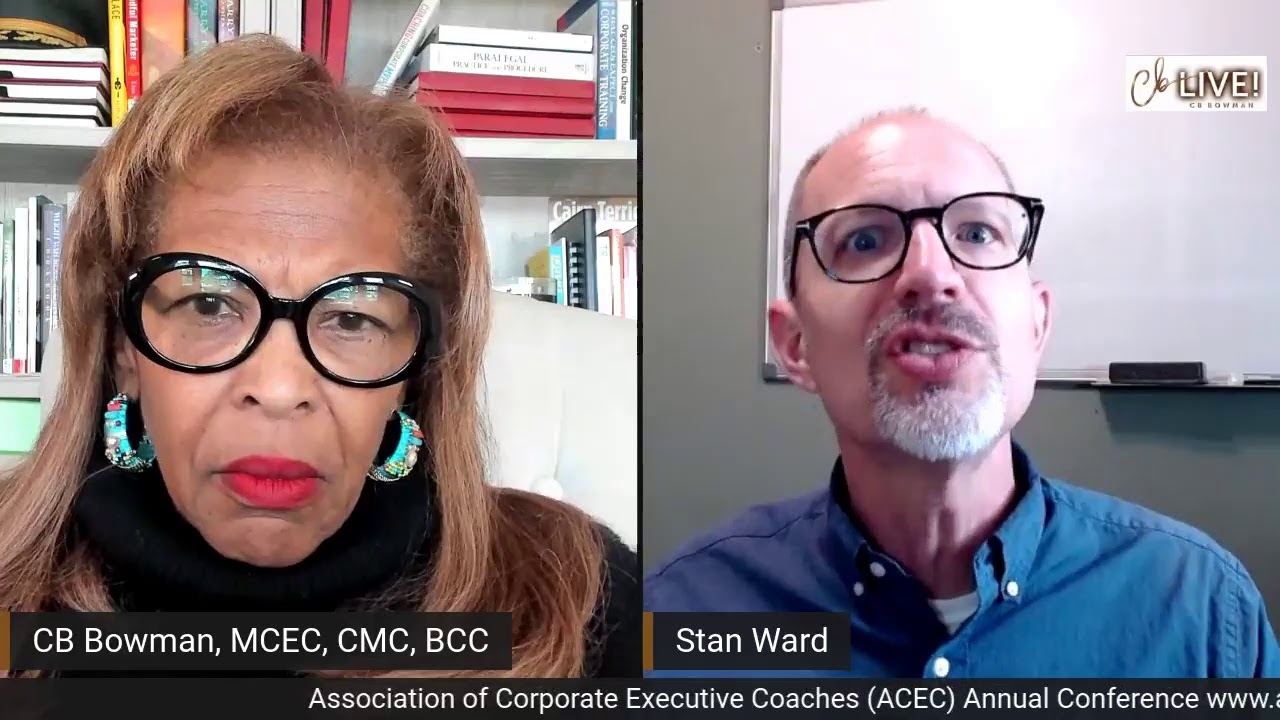
Dr. Stanley Ward discusses burnout's three dimensions—emotional exhaustion, depersonalization, and lack of accomplishment—and why leaders who treat themselves like machines without maintenance crash. He shares frameworks like ADKAR and ARSENAL, and argues that true values require personal sacrifice.
Chapters
Hello everybody, this is CB Bowman Live. And you know, I can't blame being late on technical failure today. I have to blame it on the fact that our guest, Dr. Stanley Ward, is so intriguing. I started to get into a conversation with him and I forgot about you guys. So I'm sorry, but you know what that means? That means this is going to be a Kick-ass. You know my favorite expression, a kick-ass interview. So I'm so glad you're here. Hey, before we get started, I just want to remind you of a couple of things. One, um, the Association of Corporate Executive Coaches is having its annual conference, and this year we're doing it on Zoom, so no excuses not for you not to come. And If you sign up before the 25th and you mention these letters in SCC, then you get to come in for the insider's price. How about that? So it's four days. Can I just tell you four days on May sixth, May twentieth, June third, and June. 17th. You see it scrolling across the bottom. So go to acec-conference.org. That's in 2021. Okay. So what else do I have to share with you? I broke a new LinkedIn Live show last week. Did you catch it? It's called CB Bowman Live Social Media Influencers. Oh my God, if you want to meet the who's who of what's what in SEO and social media, then you have to tune into this show. Aside from this show, which you're tuned into now, which is Challenges of the C-Suite, and Thursday we have Workplace Equity and Equality. Am I busy? Yeah, I'm just having fun. Okay, so with that, I want to introduce Dr. Stanley Ward. He is a powerhouse in the field of leadership burnout, but he just told me he's got other things he's a powerhouse in. Shock to me, did I not do my research? He is also an expert in ethical leadership. So without further ado, I'm going to ask Dr. Stanley Ward to introduce himself. Isn't he handsome? Okay. All right. I'm not supposed to do that. All right.
You're funny. Thanks for that. Thanks for that. Yeah, I'll be, I'll be sure and Venmo some money for the little, little promo there. Appreciate it. Hi, my name is Dr. Stan Ward. I live in Tyler, Texas. And yeah, I have an interest I'm interested in a variety of things related to leadership. I'm interested in the intersection of leadership and burnout and how we can help leaders improve their energy, their relationships, their sense of accomplishment so that they don't burn out. Really interested in what it takes to be a leader who cares about both results and relationships. I'm interested in this idea of followership and how that works, and especially how that relates to ethical leadership, helping our leaders succeed. both ethically and again, from a sense of relationships and results.
That's fantastic. I'm looking up because— oh, here it is. I switched on the wrong thing and I couldn't see the comments coming in. Listen, Stanley, we got into an interesting conversation about ethical leadership. I want to talk about that and then talk about burnout while we're having our invisible glass of wine here.
Okay. Yeah, I've got my water bottle. Is that—
That works. I've got my juice. That works. Okay. So tell us, when did the term ethical leadership come into our vocabulary and what does it mean?
Oh, wow. You know, again, what's interesting, even that term leadership itself, if you were to go to the Oxford English Dictionary, the OED, which is a good place to go if you're a word nerd like me, You're going to see the term leadership shows up around the 1800s. You know, the etymology on ethical leadership I couldn't give you off the top of my head. What I can give you, though, is this issue of ethics as simply following the law, you know, sort of what you can get away with, versus ethics as a sort of higher concept or something that draws us And puts pressure on us to live a certain kind of life. What's interesting to me is a lot of times when we go to ethics conferences on leadership, I think one of the reasons they're frankly kind of boring is because they're just doing legal ethics and they're not asking those larger questions about what does it mean to be a person who, say, really inspires people rather than manipulates them, or what does it mean to be a leader who's concerned about all the stakeholders and thinking about sustainability issues. Again, as we were just talking before we came to the live space here about the 5 pandemics that we're facing, right? Issues— and I wrote them down, right? Issues around social justice, economics, COVID, the environment, healthcare. All of those have an ethical component to them that's not simply about what's legal and what's not.
Exactly. And, you know, I think I researched the ethics part. And if I remember correctly— I'm sorry, the leadership part— it comes from the military. And it makes sense. I'm not sure if I'm right, but I remember looking it up one time. And it occurred that— and of course, this will take us way back to the Roman and Greek Empire when we're talking about military, right? But I think that it came from there. And you have to ask yourself, what has changed? And what are the cornerstones where leadership has changed? So what do you feel those are?
Such a great question. And it's interesting you reference the military piece because certainly if you're familiar with the books on Geeks and Geezers, right, I believe it's Warren Bennis book talking about generational differences between, say, boomers and millennials. Those who are products of the mid-20th century are going to represent more that military understanding of what leadership looks like, command-and-control style leadership. Whereas folks born closer to the—
I've got to interrupt you there because that's very interesting. Because when I go back and look at— I haven't read that book, but I have read The Art of War.
Yes, Sun Tzu.
Yes, really way back. Yeah. And talking about, you know, leadership with compassion and leadership with strategy. And I remember there was something that I read. This is an interesting story which I'll interrupt you with. It was a leader, a commander in the military talking to one of his soldiers, and the commander had invited the enemy to dinner. And the soldier said, why, why do this when we're going to squash them tomorrow? And he said, for that reason. Let people die with dignity and honor.
Mm-hmm.
And I'll never forget that because it translated into so many ways If you're going to terminate somebody, let them go with dignity and honor. Has that part changed with leadership? Because it seems like for a while— I don't know if it's age-related, like you were saying with the boomers— that dignity is no longer being used. So is that a pivotal point?
I hear a couple of questions there. You know, one, I hear this larger question of what has changed in leadership and what has remained the same. Certainly, what has remained the same is I also used to teach humanities. And so, I'm a big believer that what it means to be a human being hasn't changed, right? And so, when you start talking about those issues of compassion, how I relate to another person, those are questions we've been working on for a really long time. as human beings. And so, you're hearing some of that in the work you're reflecting there from Sun Tzu. As far as what's changing now, certainly, I do feel like the emphasis on managing by numbers only rather than managing by other success metrics is part of what we're seeing the consequence of. If we're just managing by spreadsheets, if you will, and I understand we got to keep the lights on.
Yeah.
Right? And businesses are there to make money. I get it. However, if we're only doing results and we're not doing the relationship piece, to go back to where we were talking about earlier, frankly, it is going to be hard to do some of this ethical stuff because we're going to take shortcuts to get those results numbers.
Right.
And yeah, that's going to include how we treat people. We're going to start seeing them as more mechanical in nature. We're also going to see ourselves in a more mechanical worldview. And a lot of the leaders I see who are really struggling with burnout, they treat themselves as machines. And tragically, they treat themselves like machines that don't need maintenance. And I think that's the thing that really boggles my mind. And I've had numerous conversations with leaders where they're using this language where they're kind of talking about productivity and grinding stuff out and all this kind of machine-oriented language. And yet, the idea of self-maintenance somehow is foreign to them.
I want to interrupt you. I just had a, a thought.
Please do.
Would you say that if somebody loves their work versus somebody who's just doing it for a paycheck or dislikes their work, that their chances of burnout are lessened with the same amount of work that's done across the 3 sectors there?
OK, possibly. And I'll tell you why. And this does go to some of the reasons that Gallup's going to have things like an engagement, work engagement poll, right? So burnout has 3 dimensions. The fancy terms, if you will, are depersonalization is the one that relates to this issue of passion and purpose that you're talking about. The primary predictor is something called emotional exhaustion. And the third measure is a lack of accomplishment. This is coming from the Maslach Burnout Inventory. So, that depersonalization is when a person is in a robot-like mode in how they approach work. And it's when they're really becoming cynical. So, yes, if that person is cynical and just collecting a paycheck, just going through the motions, They are expressing some of this depersonalization. On the other hand, if a person is really passionate about their work and they do not know how to manage their energy, in other words, they just give, give, give, give, give, and they do not have the skills or the systems to help replenish themselves, they are also setting themselves up for burnout.
Okay. So, suppose You have great passion, great energy, you've accomplished a lot, um, and those 2 areas are covered. You're really happy about what you do. Are your chances for burnout greater than those that— or less than those that are not covered by any one of these 3 sectors that you defined?
Yeah. So with these 3 dimensions, to the extent that you're in a positive space like you're talking about, that's going to help guard you against burnout. Yeah. So what we know about burnout also is all of us are on sort of a spectrum. Don't think of burnout as an off or on. Think of it as a spectrum. And so one of the questions with folks is, OK, where are you at on that spectrum? And how is that impacting your ability to do the work you need to do?
So 3 dimensions equal 1 spectrum?
The 3 can be measured independently. It's as they come together then that we're seeing true burnout as compared to, say, if you just have one, you're just not feeling very accomplished, we might call that ineffectiveness. Or for example, if you're experiencing, you're just really, really tired, well, maybe that's about emotional exhaustion. Which, if I may, this also goes to some of the ways that burnout has become really a fuzzy term. We hear it thrown around a lot. A couple of years ago, my oldest daughter is a senior in high school and she would say, Dad, I'm so burned out at school. I was like, ah, let's— this is kind of when I was starting to do some of the research in this area. I said, let's go out. Let's get a pizookie, which is basically a cookie with ice cream on top. It's amazing. She loves them. And I said, let's talk about this burnout thing. And we were unpacking those 3 dimensions. And really, one of the things that she realized is she was just really tired. She was essentially emotionally exhausted. The other 2 weren't so much of an issue. And that changed then how we responded to it.
Okay, so now that brings us into another question. So if you take each of these dimensions, it sounds like you can respond to them separately.
Yes. In the work that I do, that's kind of how my model approaches it. We look at where you're at on these 3 factors. We determine which of these seems to be the biggest threat, and we address that one. I come from a systems approach where I believe all of these are connected in some way. And so, to the extent that we can make progress on one, we'll start seeing benefit in the other. So, for example, emotional exhaustion is the number one predictor. And that makes sense because if I'm emotionally exhausted, it's going to be hard for me to be really engaged with my work. Right? I'm going to tend to disconnect from people. And I'm not going to feel as connected to my purpose because I can't give to it the way I want to give to it. Probably have some self-condemning language as well.
Right?
Some of that self-talk, those gremlins up in that head that are running around up there telling us what we don't do well. And so now the effectiveness space is, is being impacted. And of course, the—
is that tied to self-sabotage? Those little gremlins?
Certainly. That's how I read it. Yeah. Are you familiar with Shirzad Shamim's work on positive intelligence?
That's exactly where I hit that from. Yeah.
Yeah, I think he has done some really good work that intersects with this space. And I know personally, I've really benefited from it as well.
I have too. And that's what made me think about it when you said that.
Yeah. And there's, there's some coaching literature as well on this idea of gremlins. And I've forgotten the author. But, but this one goes way back. It's kind of considered a classic.
Yeah. Yeah.
Okay.
So, the emotional sector.
Or the emotional exhaustion.
Yeah. Yep. Which results in ineffectiveness. Right?
Well, they all tie together.
Okay. So, deal with the first one first.
Okay. Excellent. Yeah. So, for emotional exhaustion, when we think about burnout, I like to think in terms of like a car engine. Okay. So, let us talk about burnout versus worn out because that is going to help us get into what we need to do with it. So, the reason burnout is such a bad thing for us as individuals is burnout is like running a car engine without oil. It will run for a season. It will run for a while. But as it does, it is what? It is breaking itself down until eventually the engine seizes up and ceases to function.
Mm-hmm.
Okay? So, that is true burnout. Worn out, if it is just emotional exhaustion, That's like running your engine without gas. So, what do you do when you run out of gas? You refuel.
Yeah.
How do you keep your car from running out of gas? You have systems to make sure it continues to refill as it's expending itself. So, it's the same way with leaders. A lot of the work around emotional exhaustion is about awareness of where I'm at What my emotional energy is at, and having systems in place not only to monitor that, because change starts with awareness, right? If I'm not aware, I'm not going to change. But also having some systems and routines that I can depend on that are going to help replenish that space. I'm thinking of a conversation I had with a leader maybe 2 years ago when I was starting to work in this space, and I became intrigued by this intersection of leadership and burnout. And this person was talking about they look at their calendar and there was nothing on the calendar that they look forward to. It was just one draining meeting after another. And so, listen to this. What we did is we made this very simple adjustment because I'm also a believer in small experiments. We basically said, okay, we're going to create a system to make sure that there are meetings on your calendar that you look forward to. Let's find those meetings that still help you get work done and make sure that calendar has got some of those on there. And just that simple shift alone began to create the momentum needed to get out of this state of emotional exhaustion and really dreading work, right? That's one of the things we look for. If you're waking up morning after morning after morning, you don't want to get out of bed. You don't feel like you have the energy to deal with the issues of the day because leadership's hard. It's about dealing with issues day after day after day. If you don't have the energy to do it, you're not going to be successful.
I love this because it sounds to me, you're the expert, that it's using behavior theory of replacing one behavior with another behavior versus taking away the behavior totally.
Yes. So, I am thinking of William James, a psychologist. Are you familiar with his work?
A little bit.
Yeah, so one of the fathers of psychology, uh, gosh, was at Harvard at the end of the 19th century, right? So I, years ago in college, I read a book of his called Varieties of Religious Experience, and in there he makes this observation that essentially more people are running away from sin than running toward righteousness. It's the same thing here.
Yes.
Right?
Yeah.
Yeah. So, let us make sure rather than just trying to avoid pain, because that can get into numbing behaviors. And oh, friend, if we are just using numbing behaviors to beat burnout, we are in a bad, bad space. That is where you start seeing some of its burnout's ugliest expressions show up.
Oh, yeah. That is when the drugs and the alcohol And the more severe things happen to you.
Yeah. So let's create awareness around what actually energizes you, and then let's create some systems to help make sure those things are happening on a regular basis. Yeah. And that is behavioral.
Okay. So can we take this down that road of awareness and creating systems? Yes. Can a person do that by themselves? Because if they— this is a double-edged question— if they can, would they have not gotten in that place in the first place?
Yeah, this is also where I have to Venmo you, right? Because, because this is, this is like the softball for coaching.
Yes.
Yeah.
Uh, yeah.
So, okay, so I'm optimistic and hopeful enough to say you can make some progress on it.
All right.
Well, okay. So, let's do this. Are you familiar with Prosci, their work on the ADKAR, the change model ADKAR? Okay. So, they have this beautiful change model.
I know what ADKAR is but I don't know about this. Yeah.
Okay. So, yeah. ADKAR is A is for awareness, D for desire, K is for knowledge, A is for ability, R is for reinforcement. So, it's an acrostic for how you make change happen.
I have to tell you, I went in a different direction because my background is marketing.
Okay.
So I'm thinking ads on cars. Okay, rewind.
Oh, ads on cars.
Yes, that's what we call ad car.
Okay, it's good to know. I'm cooler now. Thank you for that. I'll share that with my kids and see if, you know, put a hashtag on it and see what happens. Okay, so ad car, it is an acrostic. And it's a change process. We're going to say change is linear in the sense that if you don't have A, if you don't have awareness, no change.
Right.
And so, sometimes you need that outside help to get awareness. Sometimes, we become aware on our own. And the few times where I've had coaching projects that were train wrecks, it was because there was no awareness. The person refused to I'm thinking, believe it or not, I had a situation where I did 360s on an individual. None of his direct reports filled them out.
What?
They all refused to fill it out. And I asked him about it. And his response was, I have great relationships with my direct reports. This is all because of the HR guy and the president.
Okay.
So, guess what? No awareness, no change.
Yeah.
Yeah, disconnect, right?
Yes.
So, the D stands for desire. So, if I'm aware but I don't care, no change. And so, even in this case, I do suspect this guy had to have— this is a smart guy. He had to have some inkling. But I suspect part of this because of fear or whatever, there was no care, no desire to do the work, no change. K is for knowledge. I can be aware and I can care, but if I don't have the knowledge, if I don't know what I need to do, I'm stuck. I'm thinking of a situation years ago where I became aware our family had just gone through some tremendous, uh, stressful experiences. Uh, my wife had been in a really bad car accident. She'd had a brain injury. I was, uh, taking care of our 2 grade school-aged daughters, working full-time, working on my PhD, doing all this stuff at once. I was just angry all the time, CB.
Yeah.
And I became aware that, you know what, If, if I don't want my daughters to marry somebody like me, I better change me. So, I was aware and I cared very deeply. You know what? I didn't know what to do to fix it. So, I had to go see somebody.
Right.
Right. And in seeing them, they helped me with the A, the ability, the skills. So, they helped me develop the knowledge and the skills. So, K is knowledge, A ability. And the last piece that gets left off the most Often is R for reinforcement. And that's where you get into some of that behavioral theory you were talking about earlier, how habits work, how we can use signs and symbols for reinforcement, things of that nature. One of the reasons that people are suspicious of change management and change projects, they'll say, you know, nothing really changes around here, right? It's a big flash in the pan. Well, when things don't change, it's because of a failure in reinforcement.
Yeah.
And it's also that way on the individual level as well.
Totally agree. Totally agree. Okay. So now we got the emotional part down. Depersonalization. How do we become aware of that? Okay.
So there's a couple of things we want to watch for. I think that—
Okay. This is a big one.
Well, it's okay. Again, going back to the humanities thing. And I think we may have had this conversation once before when we first met. You know, the basic difference between a tragic story and a comic story, it's not that one is sad and one is happy. Okay, comic stories end in community. Like, there's usually a big wedding at the end of a Shakespeare piece, right? And even some of the Greek comedies. Tragedies end in isolation. So, that depersonalization, that disconnect, the reason you get that, oh man, that sigh is because really that's putting you on a tragic trajectory. We were talking about 360s earlier, right? My, the original 360 I was certified on is the Center for Creative Leadership. They call it career derailers. That's really what we're talking about.
Mm-hmm.
So, when we disconnect from people, when we disconnect from purpose, we're in that space. And the flip is true as well. So, I'm thinking of a conversation I had with an executive leader. He had gone on a vacation for 2 weeks, beach vacation, beautiful scenery. You know, you'd think you'd come back from 2 weeks of that just as fine as you could hope to be. He talked about when he got back, he was no better rested, was probably even more tired I remember us talking about that. Yeah. And the irony was when he reconnected to a pet project that he had been working on for his organization, he found that to be better for him than his 2-week vacation.
Why?
Well, it's speaking to this issue of depersonalization. He was able to reconnect to that purpose and that sense of passion. And by correcting that, right, it has system-wide impact. He was feeling more effective in his work. He was reconnecting to his organization. And yeah, actually experiencing a greater sense of rest and refreshment than he had by going on a beach vacation.
But, you know, in a way, it sounds very close to the emotional dimension. And I want to ask you then. So he figured that out by accident, if you will. How do you figure it out not by accident? How do you know that you're in this zone of I don't care about anybody?
Oh man, uh, in the worst places You probably aren't going to know. Right? You know, what makes leprosy so dangerous? Lack of feeling. You don't know where the injuries are. I do. I kind of have a rule of thumb. Once is an accident. Twice is a concern. 3 times is a trend.
Hmm.
So, as I'm engaging with my work and as I'm engaging with my people, We're all going to have accidents. We're all going to have off days. We're all going to have off interactions. We can go back and we can make things right. And yeah, it may happen multiple times. Twice is a concern, but that needs to be a yellow flag at minimum, very possibly a red flag. But once you start seeing these trends, trends of withdrawing, trends of not caring, Again, even going back to the emotional space, yeah, you are going to have times that you are exhausted and you can take a weekend or a day, you know, mental health day, whatever. And you can, you can feel progress. It is when you feel day after day, week after week, I do not have the energy to do this. Okay. Now, you are in a space where you really need Help.
I still— I hear you, but I think the issue is that as a clinician— I'm using that term clinician— we can see it in our clients, but how do our clients see it in themselves? They're not going to think of this as an accident You know, friend, they're just gonna see it as part of life. And I don't care. I just— I'm—
Well, yeah, cynicism. I mean, depersonalization expresses itself in cynicism.
Yeah. And if somebody challenges them, well, don't I have the right to express? Or I have a right to do it my way. You know, the rest can take the highway. Or I don't, I don't see what you're seeing. I'm just getting it done. You know, there's no need to get mushy about this. Let's just get it done.
Yeah. And so in that sense, are you a bull in the china shop getting it done?
No. Yeah, I think that the bottom line here, what we're saying is with these trends, with these dimensions, it's really hard. I'm going to take away the trend. With these dimensions, it's really hard to recognize it in yourself. You may have to rely on other— the comments of other people and not automatically dismiss them as like they don't know what they're talking about. Sometimes it's important to listen to what other people are saying. That's what makes it hard. You have to be able to figure out what's true and what's not true.
CB, I appreciate your pushback because as I'm really reflecting, it's making me appreciate the folks I work with because a lot of times they're seeking me out. Why? Because they've come to some measure of awareness.
Yes.
And so I'm kind of working with the cream of the crop in that space.
Yes, you are.
The biggest thing I hear is a realization that they're just operating primarily out of fight or flight energy all the time. And the consequence it's starting to have on them personally.
Yes. And hiding would be the flight, I think. I think back on a personal situation of mine. When my fiancé died of a heart attack.
Hmm.
And I was just conducting business every single day in my normal way. I would go to work and come home and, you know, fix dinner and stuff like that. And finally, a friend of mine said, you need to see a therapist. I said, what are you talking about? I'm fine. And she said, no, you're not. I said, well, what evidence do you have? I was very argumentative. Yeah, okay, you're hearing it. What evidence do you have? I'm just watching you.
Hmm.
I said, fine, because I respected her. She had shared with me her husband had committed suicide, and I said, okay, and I went I had a total meltdown the first day. That's within the first hour. And I said to the therapist, why didn't I know I was experiencing this? And he very wisely said, because your body was preparing you for today. Your mind was preparing you. You would have had it, but who knows when or how. And so that's what I mean about not knowing.
Can I share 2 stories?
Please.
Well, one, I guess one really isn't so much a story as an observation. This goes back to the importance of community. Oh yeah, you needed that friend Who knew you and could tell when something was off. And this also goes to the, the, the real power of empathy.
Yes.
Right?
Yes, it does.
And, and, um, the value of having people who have, who are empathetic, who are able to connect. Um, the, the thing you're reminding me of, so I'm sympathizing with your stories, or, you know, earlier I was talking about the, the experience when I realized I was angry all the time and I, I didn't have the knowledge or skills to really deal with it. So, fast forward a couple years, successfully defend the dissertation, get the PhD done in spite of all those obstacles, and a week later, I end up in the ER with an obstruction in my bowel. My digestive tract basically just stopped working. And, for 2 years, I was fighting that just chronic digestive system failure. The prognosis here locally was pretty dire. So I went up to the Mayo Clinic, and after 2 weeks of poking and prodding by the best medical minds in the country, if not the world, the doctor sat me down. He said, Mr. Ward, how do you deal with stress?
And you looked at him like, what, are you kidding me?
Exactly.
Yeah.
I was like, this is crazy talk.
Yeah.
And this goes to that whole idea. I think we also, we've done resilience a disservice lately. I know it's kind of become a buzzword.
Oh God, has it?
But is, yeah. And I'm thinking about like some physicians I work with on this issue. There's a real resentment from physician leaders about being told they need resilience, excuse me, because there's a sense of, wait, I got through med school and I'm doing all this stuff. I got resilience. And it's like we've made resilience about being tough enough, strong enough, rather than saying it's a, it's a, it's a human, it's a maintenance skill. Resilience is about your maintenance skills. It's not about just being tough enough, strong enough.
Yeah. And, you know, I'm writing this down because this is an article for me to write. There are, I believe, Different levels of resilience. Because as I listen to you, yeah, you were able to get through your PhD, you were able to get through taking care of the children, you were able to get through your wife's brain injury. Those levels of resilience had to do with personal development and family. But the resilience that's required to get through them as a bundle or to get through them as an office or taking care of yourself, those are all different levels of resilience. And who knows which level will break which person? Make sense? Yes.
Are you familiar with the Areas of Work-Life Survey?
No.
It also goes with—
Don't laugh at me that I don't know.
What? I'll stop that.
OK, fine. Go for it.
Yeah. Well, it also helps measure really what you're describing. Essentially, where are the points in the organization where that resilience is under stress? And it can be helpful. It goes with the Maslach Burnout Inventory. They pair together really well. I think MindGarden is the source on both those. So, would highly recommend folks who are interested in this, watching this, be sure to check those resources out because it can help uncover some of those stress points for resilience. And then, the other thing is a tool called the ARSENAL, A-R-S-E-N-A-L. It's going to be more on the personal resilience side. The work there looks at How, again, awareness, rest, exercise, social support, nutrition, attitude, and learning are functioning to help that person stay in an optimum place. Because as we know, when that brain is under prolonged stress, executive functionings diminish, right?
Yeah.
So, you simply do not make as good a decision. And when the consequence of your decisions becomes more and more important as an executive leader. That's why this stuff's so important.
Yeah. And I know I want to go back to something about personal health because I have a couple of Clubhouse programs. And in one of the programs this last week, one of the women came on who was a coach and she described her medical condition, which had deteriorated so badly. And for several years, the doctors could not figure out what was wrong with her. Just that she had all kinds of tests. And finally, she came across one doctor who said, how do you deal with stress?
Hmm.
And her response was, I don't have any stress. Go to work, do my job, come back. I'm good. She thought about it and thought about it and left her job, opened her own company. All of a sudden, her health went up to 100%.
What amazes me about that story is You know, starting your own organization is like rolling a rock uphill. It's a lot of work. And to think that that would be the restorative.
Yeah. Yeah. That's how destructive corporate life can be. And we don't recognize it because in our minds, we need that paycheck so much. That we're willing to risk our health, our family, our life. And while opening your own business may not give you that check right away, it brings up what you were talking about, the passion. So the passion replaces the upset, the anger, the stress, Everything. And even though it's a tough job to open your own business, you're doing it for inside.
And to the question of effectiveness, you know, one advantage for me of having my own business is that I get to make my success metrics.
Yeah, that's true. I've never thought about that.
Yeah, I have my own KPIs.
I love that. You know, I'm gonna use that line because people have always asked me, like, for the Association of Corporate Executive Coaches, how many members do you have? My response has always been enough. It's not about having 20,000 members like another association out there. It's about having the right members, and we're fierce on that. We— one of our mantras is, if your head's too big to get through the door, you can't get through the door of ACEC.
Well, thankfully, I don't have a lot of stuff up top that would— I'm not gonna have a lot of friction.
But, you know, we're an organization where we support each other and share learning and information. And if you're not up to that, Go to the next association.
Yeah. And you're talking about community, right? It goes back to tragedy versus comedy. You have a comic organization.
Yeah, in a way we do. We do. And it really is funny because each of the members are very protective. They, they won't recommend their colleagues unless they're like, up there. And up there doesn't mean How many clock hours you've been a coach. It means what is your approach towards coaching? What's your— and, and it also means having more than one coaching philosophy, expertise in more than one theory, knowing when to apply what, understanding the 360 triggers of your clients. That's a lot to ask a coach to bring to the party.
It takes a long time. As we were talking, I think before we went live, I've been doing this work since 2011 in one form or another and continue to grow and benefit from the examples of others and continue to catch myself making mistakes and sometimes even feeling like, oh, that was a rookie error. So, it really is an art and a craft. And that's kind of one of the reasons I enjoy it. Yeah.
Hey, speaking about community, we met through a mutual friend, Phyllis, who is part of ACEC. And you were her professor?
Correct. She was a student at Claremont Lincoln University. That's how we met. She was a student in the Ethical Leadership Program there. I was, at the time, I was teaching that program and was a program director and then later was managing her capstone program.
She is an amazing coach and an amazing person. She has the art of— you know how there's some people that introduce you to somebody else just to sort of get them off your plate but don't really have an understanding of how the two people will connect? Not Phyllis. She knows exactly who to put together. And it's such an art form that we've lost today. And so I'm so grateful for her introducing you to me. And you're one of the speakers for our conference. I'll just say that. Now, let's go back. Let's talk about the book that you wrote.
Yeah, which one?
Wait, how many have you written?
Well, I have one on how to beat burnout for yourself, your family, and your team. That's what I use with my coaching clients a lot. And then I was co-editor for a book on ethical leadership called Ethical Leadership: A Primer. Phyllis actually contributed a chapter to that book on authentic leadership. And that's another way we've She and I have partnered.
She didn't tell me that, you know.
Because her head is able to fit through the door.
It fit through the door. She has great humility. I mean, great humility.
And she's current— she's working on a book project now as well. So, uh, if you see her, give her— Give her—
give her— because she's on the faculty of my other company, which is Workplace Equity and Equality. Well, she's doing a wonderful job.
Ask her about the book she's working on, please.
I absolutely will. Yeah, we could talk it up. Actually, we talked about— oh, you know what? I'm sorry, we forgot to talk about the 3rd dimension in burnout, which is the lack of accomplishment feeling.
Yeah, lack of personal accomplishment. And I tend to call that ineffectiveness. Again, as I talk with folks, I try to use non-jargony language. And so rather than flip how we're measuring things, try to keep everything in sort of a— we're measuring it on a kind of a 1 to 10 scale where 10 is bad, right, maxed out. So we don't want to be emotionally exhausted. We don't want to be disconnected or depersonalized. And we don't want to feel ineffective.
But you said personal accomplishments. Do Are business accomplishments not included in that?
Yeah, a sense of, sense of personal accomplishment. In other words, what I am doing is not making a difference, is not seeing results.
Mm-hmm. Okay, that's good. Hey, we've got a question from Kyle. He says, great read, thank you for the book, Dr. Ward. I'm not sure which, which book he's talking about.
That would be The Burnout Book. Kyle was a student of mine years and years ago when he was a high school student. He's now working Working on his doctorate.
Okay, so you you flooded the audience a little bit, huh?
Again, that Venmo account of mine—I mean, that thing is just—it's smoking today.
Well, what is he working on in his dissertation?
I know he's doing his EDD, and you'll have to ask him. So maybe he'll post that. All right.
Yeah, let's give him some. Applause here. Love it. All right. Now, let's talk about— we started a conversation about the word, which I think was fun, followership. And what does it mean? And where does it come from? And how does it relate to our discussion on leadership? So I turn it over to you.
Well, when, when you set it up that way, how does followership relate to leadership? And burnout. Let's go that piece with it first. Then, we can go to the ethics side.
Okay.
Again, the Gallup research is going to say one of the major contributors to burnout. And this is really tragic. As I was studying this in the healthcare industry, this is the same issue. It's like bad management. What followership does, and I'm thinking in particular the work of Ira Shayla, who is just a wonderful human being and has recently released a work on sort of collected work of his history in this space. He's going to have—
You have photographic memory for all the names of everybody who's written a book.
So here's the deal. If you've been dead about 200 years and you wrote something that not a lot of people read, I'm really good with your name. If you're at a dinner party and it's been 30 minutes, okay. Thankfully, Ira's still with us. Anyway, yeah. So he talks about being a courageous follower, and it's this idea of how do we keep the purpose of the organization at the center of our conversations? What are the skills we need to be able to use that purpose? to speak to our leaders, both to support them as they're doing things that support that purpose and also to challenge them when they're not. Again, if we're struggling with poor management, we have to have those skills to be able to speak up in some way. Otherwise, let's think in terms of— are you familiar with the Thomas-Kilmann Conflict Mode Inventory?
Yes, sir.
Yeah, wonderful instrument. Right, that accommodating communication style in conflict. What does it lead to? Resentment, bitterness, burnout.
Okay, so when you were talking just now, I had a flashback from my days in corporate America. And I worked for Fortune 500 companies. One thing I could not stand, and I'm so glad to be able to say this freely and openly now, is every time the CEO read a book on leadership and adopted this mantra, it went up as it's the organization's mantra. And I'm thinking— I always thought, what the heck? This means nothing to me. If you're trying to get me to celebrate you as a leader and you're putting up a bunch of words that I don't see reflected in your behavior, in your communication style, please take it down.
Yeah. So here's another sort of Dr. Wardism. Values have to have a cost. If it doesn't cost anything, it's not a value.
Tell me more about that.
Well, when people talk about core values, One of the ways we can test that is to simply say, okay, so what have you paid for the sake of that value?
Wow, I've never heard that.
Yeah, so my dissertation was on storytelling as a leadership tool. And one of the things that came out of that, Annette Simmons has a book on storytelling leadership. I can't remember the name of the book. So you got me, you set me up talking about how good I am at this stuff. And then now I'm flubbing. But essentially, she talks about one of the stories that leaders have to tell are stories of organizational values where it actually costs something.
That's a mind-blower!
Well, yeah, it's the no-BS test. If you, leader, if you say something is a value in your organization and you can't point to a time that it's cost you something, I'm gonna call BS.
That's causing me to go into a deep reflective mode.
And, and the leaders who are open to that are also going to be open to courageous followers. The ones who aren't, aren't going to be open to them. And we need courageous followers to help our organization stay ethical.
I'm taking notes. Okay. Can you define a courageous follower?
Yeah, again, I'm going to borrow from Ira Chaylis' work. They are the followers who are able to speak up for and speak up to They engage in both support and challenging behaviors. They work as partners with their leaders, not simply implementers.
I'm so glad I'm recording this because—
Yeah, I can send you a bibliography later.
You know, I'm sorry, but I am— you know, the audience knows I usually just go on and it's a fluid conversation, but this is taking me to really examine how I lead the Association of Corporate Executive Coaches, because that is a challenge when you're a coach yourself. Although I only coach coaches and CEOs now, you know, how do you get to tell your peers really That's not reflecting the values of the organization, and I had to stop and think what have those values cost, and it has cost some members, and I you're absolutely right. I just never thought about it that way. It's just my mind is going.
Yeah.
And it is scary when you do things like that. I mean, we have, um, annually at our conference, we identify thought leaders that have affected the space of coaching. They don't have to be a coach, but people that have affected it. And we had a situation recently where somebody was nominated who didn't reflect the integrity of ACEC. And while I'm not on the committee, I had to say to the committee chair, let's really think carefully about this. And I was challenged back, well, the committee will consider it. I'm like, no, no, no, there's no consideration here. You know, it's happened to us before. And then the question is, you have to try to figure out when do you come in and say no and risk upsetting a committee, a person. You know, it's very challenging. And I've come to respect leaders who are able to Say no and leave the person whole again. That is, to me, that's ethical behavior. And it's so incredibly hard to do.
Yeah, again, we know going all the way back to research in the 1950s that leaders tend to default either to relationship-oriented behaviors or results-oriented behaviors. To do both is both somewhat unique and it takes a huge amount of energy. And again, I, as I have reflected in my own work, the leaders I have connected best with are those who care about both. And as I began to chase this issue of burnout, I began to realize all of them were struggling with burnout in some way in our coaching work.
Because it takes so much energy to do that.
Yeah, because of the energy it took. Yeah.
What would you call the middle ground there?
Define what you mean by middle ground.
So if we're talking about leaders on both sides of the spectrum, what would be the middle ground? What would those folks be? Are those agile leaders? Are they empathetic leaders?
One term that comes to mind is holistic. Maybe there is kind of a balanced scorecard thing going here. Self-aware. And yeah, I mean, you're right. You've used the term ethical. Sorry, I'm looking off into space because I'm like, my, my— now you got my wheels going. You know, I think ethics in a lot of ways comes down to what do I believe about human beings? And do I treat them in a way that accords with that? Right. And so, when you talk about how we part ways, even that says something about what you believe about human beings. And so, that is an ethical act.
So, maybe it's a humanistic leader.
Yeah. Humans, humans. Deb Cavillio. She talks about human-centered leaders. She's got a podcast called The Drop-In CEO. Yeah. And so she talks about human-centered leaders.
Do you know what channel it's on? Is it on Apple or—
Yeah, yeah. I've been a guest on her show. Yeah, you can pretty much any Spotify, Apple, all those, you can find it.
Great. I will look for that. Sounds good. We started the conversation, we only have a minute left, of talking about pivotal moments in the space of leadership. You were mentioning the newer generation of folks that have come out, What other pivotal points of change in leadership have you seen?
Well, I, I think the MeToo movement. Yeah. It feels like suddenly there were discussions on accountability That were very different than what we were seeing before then. And it could also be that at the time I had— I was a father of teenage daughters. And so maybe—
I like that, tying it into personal values. Yeah, I hear it.
I can't escape it. Like, why? Look, I wear glasses. I mean, I can't help it.
There's a lens through Okay, I buy that one. What, what about the pandemic itself? Have you seen a shift? The COVID pandemic?
Yeah, I really fear it's been a negative one.
Tell us quickly. We have 6— well, we're over by a minute.
Yeah, well, I fear that because of social media, whereas I think the MeToo movement, we— I think we saw some very positive uses of social media, media. I fear now we're seeing extreme positions becoming more and more extreme because of how social media works to frame issues. And framing is a leadership expression, right? Framing is about interpreting reality. What do leaders do? Leaders interpret reality. Leaders tell us what is and what we should do about it. Uh, and so with, uh, with COVID we've seen such division over What is and what we should do about it.
We've also seen the rearing of cancel culture.
Yeah, yeah. Um, and I, I am fearful about what that means. I, I'm not an advocate of hate speech by any means, please hear that. Um, I am concerned about how we, for lack of a better term, police language. Because yeah, if we cancel anything that makes us uncomfortable, yes, it's going to be really hard to have any kind of leaders show up because leadership is about moving us into the uncomfortable.
And it may be hard for us to Experience learning opportunities to grow.
You're so right.
Yeah, you know, I heard Simon Sinek on Clubhouse the other day, and he was about to say something, and he stopped and he said, I want to think carefully how I say this because I don't want to become part of the cancel culture. I don't want to be canceled out. Something to that effect.
Yeah, and that goes to that tragic path of isolation.
Yeah, and I thought, Simon Sinek is, you know, one of our top thinkers. If he's gonna monitor what he's gonna say, well, how's that gonna affect my opportunity to learn?
And if a giant like him is afraid of it, how are folks that don't have such huge audiences to help support them Uh, how are they going to manage it?
Exactly, exactly. So love what you're saying. Hey, we have to jump off. I want to have you back. We started to talk about some extraordinary stuff, even beyond what we had planned to talk about.
It was really fun. Thanks. I love the freewheeling conversation.
I've gotten a rap for that. Hey, everybody. I'm sorry that we're over by almost 5 minutes, but gosh, this was such a valuable conversation for all of us. So I'm going to quickly say thank you to Stan. And follow me on Clubhouse, LinkedIn, Apple Podcasts, iHeartRadio. YouTube, Facebook, Twitter. I'm there. I've got you. And I didn't tell you a secret for today. Okay. My secret for today is you have got to come to the ACEC conference and use the discount quickly before April 25th. See you on Thursday.
Bye now.
Thank you, Stan.
My pleasure. Thank you, CB.
More from CB



211- Courage to Leap & Lead with Louise Story part 1Courage to Leap & Lead







