CB Bowman interviews Barbara Mintzer-McMahon, PCC, MCEC, MSW, MFT Episode #2
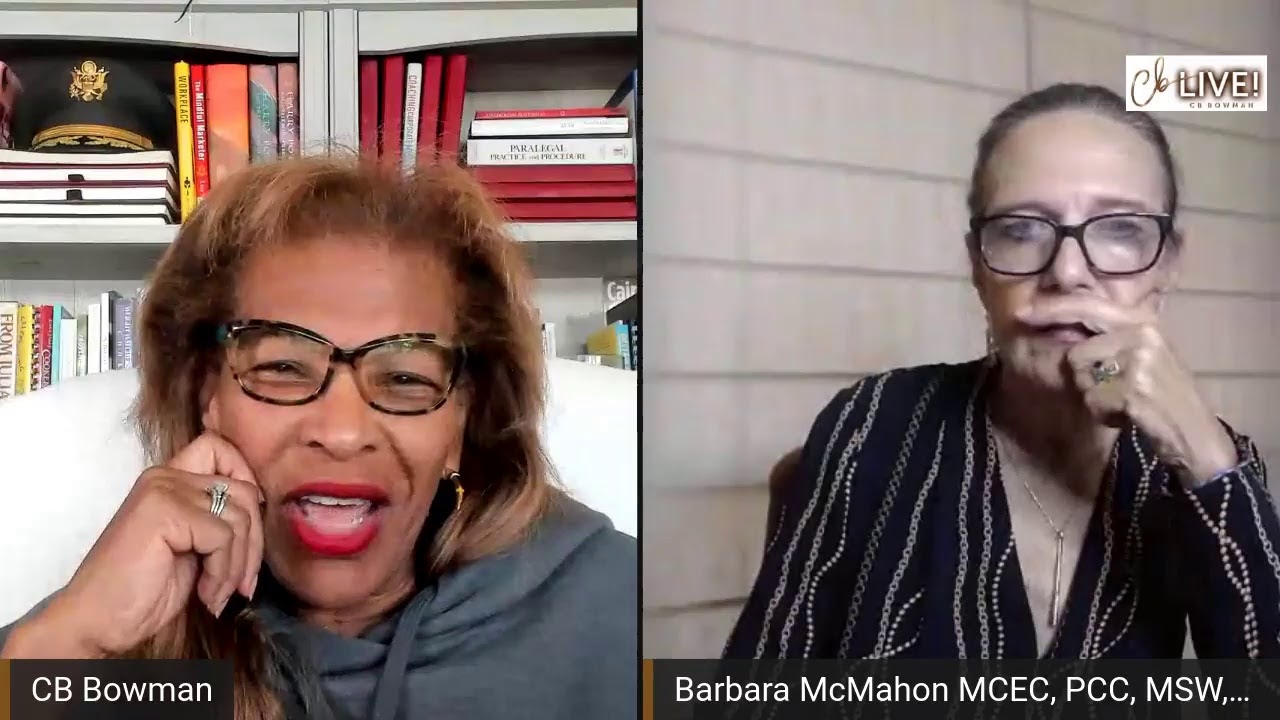
Barbara Mintzer-McMahon, an executive coach who works with Fortune-100 companies and nonprofits, talks about self-awareness and listening as tools for leadership. She describes how ACEC's committee structure introduced her to new coaching methods like positive intelligence, and reflects on being a Black woman in corporate spaces where voices get silenced.
Chapters
Hi, Barbara, how are you?
CB, good to see you. I'm fine.
That's terrific.
It's sunny here in Northern California. Life is good.
Oh, how are the fires?
Well, I'll tell you, you could have had a very large barbecue with all the family and friends, which is not a good thing, but we are better this week. And the air is clearer and it's possible to walk outside and run outside. So life is better, but it was a hard week.
I bet.
I bet.
Hey, everybody, I just want to introduce Barbara McMahon. Barbara is a member of the Association of Corporate Executive Coaches. She is a master-level coach, master corporate executive coach. And we're going to just listen to her today. We're going to talk to her a little bit. You know, as you know, I like to do interviews like you're sitting in your living room learning and laughing at the same time. So I'm looking forward to Barbara telling us about her work and about her role in ACEC and what is she getting out of this association. So let's just roll it. Let's rock it out. So, Barbara. Tell us about your work.
Well, I am an executive coach, trainer, and author, team facilitator, and I've been doing this work since 1989. Oh, and so I've been at it for, for a while, and, um, and, and happy to be doing it. Makes me happy.
And you're doing great work. But tell us details about the kind of work that you do.
Well, I work mostly with Fortune 100s and work with senior leaders and their executive teams. I'm also fortunate to be doing— whoops— a fair amount of work in government and nonprofit as well, which actually for me, It is a great combo because I think like ACEC, the broad perspective on our realities is important to me. Working in these variety of sectors in the corporate world, in the nonprofit world with government folks helps me to get under the hood and understand how things work and connect more. For me, that's important because I think those connections affect us all, affect business, affect leaders, affect our community.
But when you say get under the hood, what type of work do you do exactly?
Well, I do a lot of leadership development. Helping leaders to look at how they approach their role and how they work with their organizations to be most successful. I work doing a lot of team-building because none of the work that we do can be done in isolation. To help folks more able-bodied to work with one another, whether it's teaming or strategic partnering. Building those connections, making them strong and sustainable is a good deal of where I put my attention. And I do a lot of work in, in all of these organizations on change management because that's what we're doing all the time and now more than ever. So to be able-bodied in making pivots, especially during these times, is an incredibly important thing. So we're spending a lot of time getting leaders and organizations more capable of surfing those changes over time.
So I talked to a coach yesterday, and the idea of resiliency and being agile— when you talk about your work with leaders versus teams, one would normally think that a team does not need an executive coach. So what are you doing to help a team that they couldn't do for themselves, actually?
Well, you know, actually, it's interesting that you say that, CB, because I think that when you get more people connected, the complexities of making things work actually gets more difficult. Because there are more moving parts, more differences to manage. So it's about helping folks to first and foremost understand what they bring to the table and what makes them feel comfortable as individuals. So that they can be effective in negotiating how they're going to play with others, and then helping the group to go through those negotiations in the best way, filter their resources, get the best out of each of the members, and figure out The rules for playing well together, because those things are really important. So we work on an awareness, first and foremost, awareness of self, what's important, what's meaningful, what you're good at, where— and then helping folks to be able to better see see each other. Because a lot of times, we come into an experience and see it through our own lens. And that blocks out a lot of the uniqueness and detail that's there and can be better resourced if you have better vision, better capability to listen, better capability to see, and an understanding about how to work with those differences in a way that's going to allow everybody to have space together and be effective.
I'm so glad that you're talking about this, and I think we have to have you on our show, Challenges of the C-Suite. Because I remember when I was in corporate America, how hard it was for me to have a voice in teams. I was always told, shut up, you don't have anything to say. Not in so many words, but that's what the perspective, that's what the perception was. I thought, well, no, I have a lot to say. Why are they telling me to shut up? And I found out it's because I knew more than they did. That's why. And as a Black woman, I was totally on target.
Yep, yep, yep.
But in all seriousness, I think that people are afraid to listen, afraid to embrace a different perspective. And that's so important when you're on a team.
Hugely. And isn't it interesting? Isn't it interesting that that happened? And exactly for those reasons, people don't want to hear what they don't already have going on in their own head.
Yes.
So listening and hearing something that's new and different, or maybe even improved, Often improved is really scary because that means changes are coming.
Or—
and so they have the hardest time doing what they ask you to do. Listen. Yes, just listen. Which is— it's— I find that funny because if they took their own advice, the world would be a better place.
I love that. I love that. And you know, now that we're talking about it, I think that I had repercussions from being told to shut up, right? So when I started leading ACEC, I would talk all the time. Blah, blah, blah, blah, blah, blah, blah, blah. No one else could talk. And, and then people like you and other coaches— I was so fortunate— they said, CB, now you could shut up. But they said it in kindness, not like what I was told in corporate America. And they said to me, CB, it's because you want to invite other people to hear and I— to give you their thoughts. And as CEO now, the minute you speak, even if it's to say good morning, almost you're shutting down other thoughts that could be valuable for you to use in the organization. So now I've learned to like zip it, but not because I'm being told to shut up, but I am. But no. Not for the same reason, but because now I've learned I need to listen.
And that's, that's, that's another really, really good point that I think that that happens to a lot of us. It becomes, you know, there are skills that we get told to use at certain times in our life and with certain roles and not in others. Like, right? What are children supposed to do? Be seen but not heard, right? So when you're just coming into a system, right, as a youngin', you're told to sit down, shut up, and just listen.
Yes.
But when you're— and that when you get to sit at the adult table, when you get to be at the head of the table, then everybody will listen to you.
Yeah.
Okay. So what happens from that is that we lose a lot of the freshness that can come in from all these different perspectives, from folks who have been in other places that we haven't seen, done things we haven't done. And yet because of this notion in our head about when it's okay to practice these certain skills. Sometimes it's a good thing, sometimes not so much. Yes.
And you have to learn when— and I think importantly, you have to— how am I going to word this? You have to think about where the message is coming from. What is the intent of the message? Is the intent to block you out because you're a Black American? Is the intent to say to you, well, I hear you, and I'd like for you to hear me. That's a whole different picture, right? And hear me for not who I am on the outside, but hear me from what I can present to you that you might be interested in. And learning.
Amen. Yeah, I think, I think there's so much wisdom in, in all of that. There's wisdom in that, um, because one of the things that, that you are bringing forward is that when you make a choice, when you are making a choice, being intentional About what skills you're going to use and what skills you're going to hold back on. When, you know, like Kenny Rogers says, you know, when you know when to fold them.
Yes, one of my favorite songs.
Me too. And you're saying when you were a leader, and as a leader in choice, you said, I really want to listen. Yes, because there's so much I can Learn from listening. And if you have a learning environment, which is one of the things that I love about ACEC, there is an awareness that we can learn from each other. And you've set up this incredible culture and way of operating, a thinking environment that makes the space to make that so. where we get the richness of all the human resources because there is listening to each other. When you say, I do want to listen because I'm really interested in hearing your perspective and we can make this so much better if we're inclusive to the variety of perspectives that we share here at this table. So let's take turns. Let's take turns.
And, you know, I'm not patting myself on the back, but that requires courage. And it requires an inner strength to know that you're not going to lose yourself in listening to somebody else. And that's a whole different perspective, right? You have to have that sureness in yourself to let other people's— my grandma— other people and their mindset come into your space so that you're not afraid that it's going to change you. I think that happens to a lot of people. It's going to change me. It's going to move me from my values. It's going to move me from my experience. And the fact is, it's not. It's going to add to.
Right.
Right.
Well, I think that's, that's a really important difference, is that it may change you. And changing you is not necessarily a bad thing. But I think that, you know, that one of the things you're bringing out here, which is one of the things that we work with teams to understand more clearly is mindset.
Yeah.
It's being able to take the time to explore how your thinking does influence the choices you make about how to engage, what behaviors you're going to allow yourself or each other to engage in is based on the way you think. the beliefs you hold, and, you know, fundamentally your values. But I think a lot of times what happens is that what we believe or the way we think can obstruct us from anchoring into our values. You know, the way we believe, you know, how, how we see ourselves.
Mm-hmm.
How we see others, how others see themselves and others see us. All of that, the way we think about things influences the choices we make and the choices about how we interact together. And I think the way to make change on that is to have people make what's implicit explicit. You know, about, um, I am, you know, my belief is that there is a— I remember when I worked for the police department, um, I was a consultant for a police department for a number of years, and after that I, I worked there full-time, and then I came back as a consultant and a coach. And at one point I was brought in to mediate a team of officers where there was a dispute with leadership. And the— I got told by the senior leadership, you can mediate, but we want you to understand that there's a right way and a wrong way to do things. And we do things the right way. We do things God's way. And I remember having to look at, okay, I'm going to— we're going to have to align mindsets. And I said, you know what, it's going to be all right because I also believe in God. So I'm sure that we're, you know, we'll be okay. And they sort of stood back and let us open up the facilitation and it worked out okay. But, you know, that sense of, you know, what is it that I believe? Is there a right way? Is there a wrong way? Is there a willingness to engage in the unfamiliar?
Yeah, I think you bring up several good points. So in listening to other people, you may change, but you won't lose yourself. I think so many people are afraid of losing themselves if they listen. It's so not true. It's so not true. We have somebody who wrote in, Andrew, who's listening to us on LinkedIn and said, very well said, our attitudes and behaviors are key to cohesion. So true. Right now, Barbara, you mentioned this ACEC. What does that stand for and what does it mean to you?
Well, I think that the Association of Corporate Executive Coaches, and what it means for me is that I have membership into a very large brain trust. Actually, I'm really glad you're bringing that up right here, right now. Because one of the most wonderful things about ACEC is the incredible diversity of expertise of individuals, both in terms of, you know, the demographics, in terms of their life experience. And so in terms of their expertise, so coming together there to— and it's all— the orientation is to help from a systemic, from an enterprise-wide lens to really understanding not only the leaders in the organization and what they do, but the how it all fits together from a systemic orientation. And the wonderful part of being a member of this organization is having the opportunity to hear from all of these diverse points on the circle of influence and learn more from people's roots, how being in a certain vantage point helps me to understand the system from a more holistic perspective. And then the solutions can be much more comprehensive and workable from all these different angles. So that's, that's a very beautiful thing.
So do they have meetings?
They have a yearly conference. They have had a yearly conference this year. because of our very special circumstances, we weren't able to get together, but we are doing as many organizations are doing, staying connected through the virtual world. And we meet regularly and are able to have a lot of different ways to learn from each other. And the walls are This is an open wall organization, so it doesn't believe that we just have to stay with our own expertise. The wonderful thing about ACEC is it brings in the best of the best from outside of the organization so that we can really grow together. And I think that's also one of the wonderful parts about its members is that there is a desire to explore. There is a desire to be curious and to hear other perspectives and to learn about different ways of improving ourselves and improving the work that we do in organizations. We have speakers that come in, and do trainings for us as a group. We have the opportunity to— again, let's go back to teaming. One of the things that I think is wonderful in terms of how we bring teams together is recognizing that our richest resources are often underutilized. We create opportunities where Our members train. So the student is the teacher and the teacher is the student, and there is time for both. And there is a lot of taking turns, which is a beautiful thing. And we have monthly meetings where we— and these particular meetings are called It Takes a Tribe, which it means that any member of the— of our group can come in and say, here's the challenge that I'm having in my work or my life. And I need the brain trust of my peers to help me figure out what to do about this. And the time is spent both listening exploring by asking really critical questions, and then by having the time, the opportunity to share knowledge, experience, skill sets, resources to help infuse the member with the challenge to pack their bags so that they can continue on the journey more resource-ready, to get up whatever hill is in front of them.
We just got a note from Beth Polish, who I know. She's part of MG100. And she said, Barbara, I love what you're saying about curiosity and openness. And for those of you who don't know, I like to say that Beth is part of the original New York tech mafia. Beth is, is a brilliant woman. She founded iVillage in New York and also worked in innovation for Hearst Publications as one of the leaders there. So I'm so glad she's listening and wrote in. She is an amazing woman. So this association, and I must say that I'm— I am very much involved in the association. So I'm asking you—
That's me, you know.
Yes, the CEO. Oh my gosh, you just busted me. I was trying to go.
So what are you gonna say?
Yeah, so you know, I I can't talk about it because it it's so in my heart, you guys. And so I have to ask you all, what's your experience and what's going on? And you serve on a couple of committees. And how do committees work? Is there an importance of being on a committee from your perspective?
You know, that's— I'm really glad you asked that because I think that one of the things that you made very clear to me And I think that from a values base drew me into ACEC was that it was a collaborative, that it wasn't about a place to come and get takeout.
I love that expression. So apropos for today.
Everybody was going to be in the kitchen together. And what we made was going to be dependent on our ability to work together and to figure out what we wanted to have and cook it up together and all of that. And so I knew that service, being on these committees, it wasn't just, you know, pay your check at the door and go in and get your order. It was going to be, no, this is going to be, as we were talking about with teams before, this was going to be a collaborative, This was going to be something that we were going to do in partnership and that we were going to do in partnership because we knew that if we put our brains together, we were going to get more than if we sucked the life out of 1 or 2 or 3 or some smaller group of people. But if we came in knowing that it was based on our collaborative ability to work together and, and to draw from each other. So I was coming in with the expectation that I was going to be there to give what I could. And I have to tell you that, you know, I have been playing a role of a service provider, first as an educator, then as a clinician, now as a coach, where I'm used to being in service of others. And so I I had this mindset, you know, I'm gonna go in and my job going in, being on these committees, is to serve up the best of what I've got. And that was my mindset. That was my expectation. And I was committed to the cause. I was surprised in this magnificently wonderful way about how much I got by being on these committees and how much I got in return. And to see in real action what could happen if people really truly were open, like Beth said, to being curious. And Beth, being from the tech world, knows that the best way to advance innovation is to have— is to come with that curious mind. And so that openness and that willingness to learn from others' perspectives, from— to create something new, to go to places that we hadn't gone before through the experience and knowledge of others, that's what makes ACEC really rich. And I've developed a number of partnerships that have enabled my— that I've been able to bring in some of my peers to work that I'm doing, which has made what I can provide so much better. I've been invited and done some inviting of some of the peers at ACEC to join me in learning journeys. You've brought in some great knowledge experts who have offered us opportunities to take a deeper dive into certain modalities, whether it be assessments or theories about leadership or working with resilience to go and/or positive intelligence. I personally do a lot of work in mindful leadership. So the positive intelligence work of Shazir Shamim was wonderful, and we did a deeper dive into that, which has been incredibly wonderful for my work. And we did it— I was able to do it with a couple of partners from ACEC, which is enabling us to do some further work. in this area and enriched, for example, some of the work that I'm doing in teaming. So that's wonderful. That's one of the new skill sets that I've been able to bring into teams to help them look at what's the difference when you face some of the challenges of change from a positive or negative mindset. And this work in positive intelligence helps to give some really great strategies and mental mindsets to understand how that can make a difference. So being on the committees has been a really wonderful thing. And it's also helped me to keep informed because we can't be everywhere all of the time. So when we come and talk about a current event or a current challenge, and I can hear about from all these other coaches, from these, a variety of industries and demographics about how it's impacting the world from these different, in these different ways, in these different places. it makes me a better coach and better able to help the leaders that I work with.
Thank you, Barbara. It is a unique organization. Unlike many, we don't have chapter meetings. It's really built on a different philosophy. The philosophy is, as you said, it's committee-based. The committees are not there to service ACEC. The committees are there so that the members service each other, to learn, to experience, to develop business partners that you would not otherwise have a chance to get to know. So I really appreciate your, your definition of what the association is about. But, and I want to go back to your work of mindfulness. Mindful leadership. What does that mean? Now we're almost out of time, but I would love for you to give us, in your mind, what does that mean from the different types of coaching that are out there?
I think that one of the things that I often start with when I'm doing training on mindfulness is acknowledge how happy I am that people are interested in mindfulness and that they've decided to be a part of the learning experience, that they're with me. Because I think the first thing about mindfulness and the practice of mindfulness is answering the question, stay or go? Are you really willing to be in the present moment with all that is? Are you willing to put your whole self in? Are you willing to be fully connected and engaged with what's going on, not only inside you, but around you and with others? And it's the ability to manage that with clarity and intention, to really be fully present.
You know, it takes me back to my youth, which is a long time ago. We won't go there.
Just 2 blinks of the eye. Yeah.
And my experience with S-Training. You probably don't even remember that. You're too young to remember that.
I remember S-Training. But tell me about what you remember. Tell me about what you remember.
The most important thing I remember was an expression, and we'll end on that note. And the expression was, be here now. Be here now. And I was going to end on that note, but I also want to surface— I just did an interview with Dr. Mongezi from South Africa, and we were talking about the differences between how Blacks in Africa treated apartheid versus how Blacks in America treat racism. And one of the things he said is when you greet somebody in Africa, there's an expression, and translated, that expression means I see you. And the response from the person is, I am here. And it's so related to your work. And it— what it serves is an acknowledgment to the other person that you see them.
Mm-hmm.
Not their face, not their skin color, not their religion, not their weight, not their hair. You see them, and they're here for you to see them. So Barbara, with that, thank you so much for coming on and talk to us— talking to us about your work.
Thank you.
and your relationship with ACEC. And I definitely want to have you back on the show to talk about the challenges of the C-suite because you're doing some incredible work.
Thank you, CB. Thank you for the time and the conversation.
Great. And so everyone tune in on Tuesdays and Thursdays. On Tuesdays, it's 12 to 1 Mountain Time for Challenges of the C-suite. And on Thursdays, it's from 11 to 12 Mountain Time, and the discussion is about workplace racial equality. And that's where you see me all duded up. Today I'm on a casual Friday on Zoom, so I have my sweatshirt on and my jeans.
You're setting a high bar for a CB casual Fridays.
That's my new thing, Casual Fridays on Zoom.
Love it, love it.
Come back and visit us again, Barbara.
See you soon. Thank you, CB.
Bye, everybody.
Bye.
More from CB



211- Courage to Leap & Lead with Louise Story part 1Courage to Leap & Lead







