CB Bowman LIVE!: Challanges of the C-Suite: Morag Barrett Episode 23
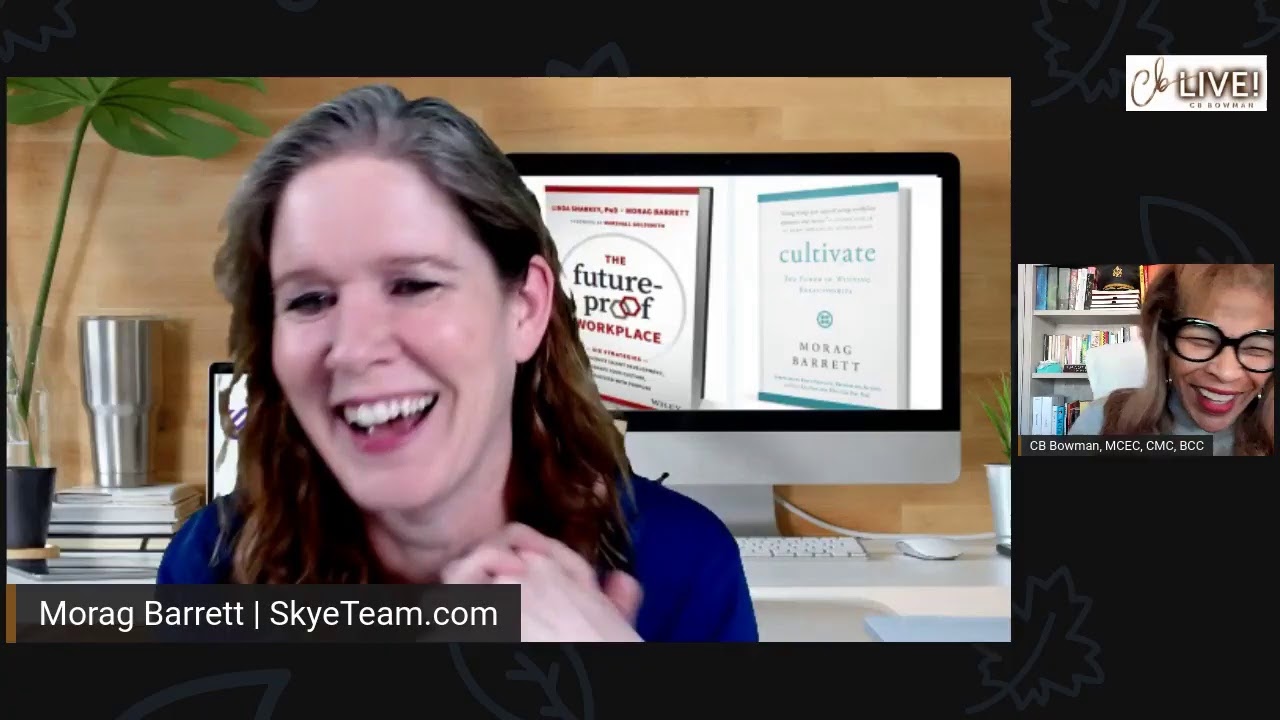
CB Bowman talks with Morag Barrett, CEO of SkyTeam, about leading from the C-suite. They cover building trust and psychological safety on remote teams, shifting from 'me' to 'we' thinking, and practical ways to repair and strengthen professional relationships.
Chapters
Hello everybody, this is CB Bowman Live. How are you? Today we have a really special guest. You know, not that all my guests aren't special, but she has an accent, so we love it. You know how us Americans love those foreign accents, don't you? So this is Moran— Morag And Morag is a colleague of mine in MG100, and she is a hoot. And I'm going to say she's a kick-ass hoot. So you are in for quite a treat today. So Morag, please introduce yourself. Tell us about you.
Well, CB, I have to say, accents, it's all a matter of perspective, because from where I come from, you're the one with the accent. But I will help, um, happily embrace my Texas— well, just east of Texas accent for the rest of this hour just for you.
Great, great.
So who am I? Well, my name is Morag Barrett. I'm the CEO and founder of an international leadership development firm called SkyTeam. We're based in Colorado, and I had the pleasure of getting to know CB through our relationship in the 100 Coaches and our connection through Marshall Goldsmith. And when I am not working with leaders around the world, at last count more than 10,000, 20 countries, 6 continents, I am the mother to 3 6-foot-tall boys and also a classical musician and, well, in the olden days a ballroom dancer. But when you can't get up close within 6 feet of your dance partner, that's a little curbing on the dance steps, but we'll get there.
Yeah, and you live in Colorado as I do.
Yes, I do. So we might as well be the other side of the planet though, CB, for the ability to get together. But we will be having cocktails later this year. I feel good about that.
Absolutely, absolutely. Hey, I see, uh, you know, I'm gonna switch it so everybody can see. Hold on, uh, Morag is teaching me new technology here, so let's go with it. All right. Maureen, I see 2 books on your screen in the back. Tell us.
So Cultivate is my first book, and it's all about the importance of nurturing our professional relationships at work. I had 15 years in commercial finance where I was told it's not personal, it's business. Well, that is BS, because all business is personal. And if we're not investing in those relationships at work, our career reputation, our leadership impact is reduced. And then the second book I co-authored with Dr. Linda Sharkey, another member of the 100 Coaches, and The Future-Proof Workplace. We talk about the 6 things that are impacting the how, what, and where of work. And of course, 2020 is the ultimate crucible that has accelerated that experiment around working from home and distributed teams and the gig economy. So those are the 2 books, with a third in the works that will hit the shelves later this year.
Oh my God, you— can you give us a sneak preview? What's the new one about?
Oh my goodness, I am so excited. So co-authoring with my team, and our working title is Best Friends at Work: How an Ally Mindset Will Transform Your Career, Life, and Organization. So it's the sequel to Cultivate, and we're talking more about how do we show up and be the best that we can focused on mutual success Versus hoarding and the me first, which is endemic in many organizations?
I love it, and I wish it had come out when I was in the corporate space, especially because I worked for General Foods. And, you know, when you work for Fortune 500— actually, I think at one time they were Fortune 50 companies. Oh my God, the sabotage, the lack of mutual respect. And I'm sorry if I'm telling stories outside of school, but we know this. We know this to be fact.
Yeah.
And I've always hoped that this disruptive generation can break that cycle. So I'm so glad you've written about it. I mean, I think that people of my generation, of even Gen Z or Gen X— I'm getting all the gens confused— still, still need this kind of information because there's still a lot of disparate relationships, let's put it that way, in the workplace.
Think about when I go back to my first career in finance And it was very much a separation of home and life. And that whole phrase work-life balance drives me nuts because we get one life of which work is a part of it.
Yeah.
So, it's more about integrating it. But I realized early on, you can have the best, you know, I'm going to make mugs with flags on, you know, it's fabulous. We're all going to be wealthy. But what I realized as I was looking at the cash flow forecasts and all of those predictions, the companies that were successful were the ones that didn't just invest in the what. They also paid care and attention to the how of business, which is the who am I as an individual, as a human being?
What's—
what is happening in my home life that might be impacting my ability to be at my best today? How do we collaborate and work across time and distance? But think about it, CB. Even now, in most school curriculums, certainly in the West, it is all about me. Me versus the exam board, me versus can I graduate in the top 5% of my class. There is very little— it's starting to get into the curriculums— on the we and the interpersonal dynamics. And that's the difference. Work is a team sport. And is it any wonder that we get the politics, silos, and turf wars when we aren't used to essentially playing on the same team?
So what is a company that is an I know I was supposed to ask you about challenges of the leadership and C-suite.
Yeah.
But now that you've brought this up, I really want to know, how does a company that has a culture of disparate relationships, backstabbing, dare I say, in order to claw your way to the top, how do they begin The change to collaboration and we.
Dr. Brené Brown, courage and vulnerability. So I've had the opportunity to work in gold mining. I've had the opportunity to work in healthcare, oil and gas. I mean, very disparate organizational cultures, but a recognition that if we don't invest in relationships, they will fester. That internal fighting ultimately slows down a company and undermines decision-making quality. And the 3 challenges that I see my C-suite clients struggling with right now are only exacerbated by the fact that we're working in a 2-dimensional, 3-by-5 box as we work remotely. Because the cracks and fissures in our relationships that existed when we were in the same building, we could navigate around them through the informal watercooler conversations, by stopping by your office and saying, hey, CB, is that what you intended in that meeting? Or, here's what I've got planned. But right now, what I'm seeing and hearing from our clients is that we've moved back to a more transactional relationship, where it's back-to-back Zoom, Google Hangout, Meet— it doesn't matter what technology— but they're back-to-back meetings where we get straight down to business. And we're not investing the time in how are you doing and making those connections, the foundations of trust, the psychological safety that allows me to give you warnings of impending disaster or to challenge you back. And so those cracks are getting bigger. And here we are at nearly a year later, where we are now working with teams to re-enkindle that sense of community. That sense of teamness that has been lost in the frantic reaction to how do we operate through a pandemic.
So I'd like to respectfully challenge you here. So it seems to me— now, I'm an introvert. I'm a high introvert. So I probably have it all wrong, or I'm looking at it through my filter. But it seems to me that working on a Zoom-like platform allows you greater intimacy with your colleagues because you get a chance to see, if they don't have a green screen up, what their room looks like, what their, what their living conditions are. You get to see the children running in and out, the pets running in and out, exercise equipment. It's, you know, photos hanging on the wall, books that they read. So to me, that brings a person closer. But then I'm not one to go up to somebody and say, hi, how you doing?
So I agree, there are pluses and minuses, but it's the illusion of intimacy because I didn't actually invite you into my house, but now I have to. And we have many clients where it's a challenge even to get people to turn the cameras on. And it's amazing, as soon as I put that off and we start losing and all you've got is the voice, how quickly again we can start to write stories about how connected we are and whether you have my back. And I agree, I now have seen your kids, I've seen the cat or the dog. I've only heard about them before. So in that way, it does bring us closer, but only when we're actually pausing long enough in the transaction of business to say, hey CB, tell me about the books on your shelves. Or what is that cuddly toy that— or it looks like a cuddly toy on the top shelf. When we're curious and actually have that conversation, then it brings us together. But if all we're doing is saying, Morag, where are you with this project? When will it be done? Get to the deliverable, then that is when it becomes impersonal and starts to feel like not only am I trapped in these 4 walls, but I don't have a sense of community.
So, A solution might be, for where we are now, is to take time in a meeting to explore the, the relationship that you have.
Yes, and it can be fun. It can be icebreakers. It could be something as simple as this, CB. Grab something on your desk that just represents you. All right, so you've got your phone. I'm going for this. I got a little unicorn. It says, don't let anyone What does it say? It says— I haven't got my reading glasses on— don't let anyone ever dull your sparkle. Oh my gosh! We've done this with engineers, and it's amazing what people have on their desk and what they choose to show. And if you've got 20 people, maybe you only get to see the screenshot of what people have held up, or you call on a few folks and say, CB, what made you grab your phone? Or, Morag, tell us about the story about the unicorn. And if I go the other way, look, you can see there's one there. We have a unicorn thing that's got out of control here at SkyTeam. Our clients love it, you know. It grows. But that's how you start to make the human connection.
I see.
Because here's the thing, in Cultivate, I talk about 4 questions that we ask ourselves when we're working with anybody. And we're asking these questions consciously or subconsciously. Number 1 is, can I count on you? Can I count on you to get your stuff done back to me on time so I can just get through my to-do list? It's reactive. Question 2 is, can I depend on you to go the extra mile, to give the warnings of impending disaster, to correct the typo in my PowerPoint to coach me before I go into that important client meeting? And those are the transactional pieces. And questions 3 and 4 are, do I care about you? And not in a group hug, trustful way, but do I care about your success as much as I do my own? Am I willing to lend you my rockstar employee because it's the right thing for their career or the project versus hoarding talent? And then question number 4 is, do I trust you? Now, a year ago, CB, when you and I were working in the office, that might be easy 4 yeses. But here we are a year later, and I have clients who will admit, can you count on me? No, because I still don't have access to all of the systems that I need in order to do my job. Can you depend on me to go the extra mile? Well, no, because I've got 3 school-age children that need to be logged into Zoom at the start of the day, and I've got a relative in another state who, or in my case, in another country, who's unwell, but I can't travel, so I'm worried about them. Do I care about you? Well, the only time you call me is when you need something. The last time you asked me, how am I doing? I don't remember. And therefore, do I trust you is at jeopardy. So at best, we become 4 maybes, and at worst, 4 nos. And what does that do for culture and engagement and productivity when we're all working remotely? And so the human side It's critical and it's even more critical today.
So hold on one second. We have a question that came in or a statement. I'm not sure how you pronounce her name, so I'm going to spell it. N-A-Y-A-N-T-A-R-A. And she says, great discussion. Yes, to echo CB, there often seems to be systemic issues, i.e., incentives to being me first. In the college, for example, top 5% in a class, arguably more attractive education options and by extension career options in the workplace. Do you feel like leadership is understanding the real cost of being purely competitive versus collaborative? Do you feel like leadership, the leadership themselves— I think she means leaders themselves— have incentives to change?
Oh, that is a powerful question. Powerful questions. And some of that touches on what I wrote— I've got to get the right way around— in Future-Proof Workplace, in terms of the pace of change has accelerated. So do they themselves have incentives to change? Hell, those who are not willing and ready to change and be more collaborative are not going to be agile enough to be able to respond and innovate in the moment. I mean, think about the mass transformation and the pivot that we all had to make in March of last year. In some ways, it was impressive as to how quickly we managed to do that. Now, as it turns into a longer-term game, the question is, are we able to maintain and grow in this new reality of how and where does work happen? And so I hear the conversations are happening. I've seen it. I've seen teams and organizations choose to do differently. And that has affected change for them and kept them ahead of the curve. This is the thin end of the wedge. Watch. And if you're willing and ready to jump into the deep end, Cultivate and the sequel, Best Friends at Work, they are going to be 2 seminal works that will help us to all nurture the powerful relationships that we need to ensure not just my success, but more importantly, our success.
So the question is, it seems as though the 5 pandemics that we're experiencing right now are causing people to have more of a we mindset. Is that a correct statement?
I don't know that we're there yet, because otherwise we wouldn't have had shortages of toilet roll.
Ah, okay.
Now there's the ultimate me-first focus, isn't it? Um, we wouldn't be doing the debate about whether or not we should be wearing masks when it is the right thing for we, i.e., by wearing a mask, whether I believe it or not, the research is showing that I am protecting you. But if I am choosing not to wear a mask, and it's become a hot topic for so many people. So in many ways, what we're experiencing now has brought silver linings. Like, I would not have learned how to have a film studio at home and do virtual programs to great feedback had it not been for the pandemic. I have clients who are the only, or were the only remote member of an executive team, who invariably would dial in. And then it would be, oh, CB, do you want to add anything? Well, now everybody's dialing in. So it's leveled the playing field. So there are some good things that have come out of this experience in how we work. We now know that hanging a jacket on the back of the chair And turning up to an office 9 to 5 or 8 till 6 isn't what it takes to be successful. What it takes to be successful in this environment, it's back to managing by objectives, being very clear about what we need to do and by when, but then having the high trust to let me do it in and around the homeschooling and everything else that I'm trying to do. Don't micromanage that I have to be at this desk now 8 till 6. If I choose to work until 10 at night, because that's the right thing for my family, but I'm meeting my deadlines, then yay, go us. And so it's accelerating the conversations and the questions that are happening with leadership teams and with teams at all levels in organizations across our clients.
So it's accelerated, but we haven't gotten there yet. So my question is going to sound a little sassy.
Go for it.
I love it.
Bring it on, CB.
Bring it on. If 5 damn pandemics can't get us there 100%, what is it going to take to get us there 100%?
Well, the advice I give when I talk to people about having an ally or a best friend at work, and people say, well, how do I know if CB's my ally? And my answer is, well, it really doesn't matter right now. Am I yours? Because if I'm a yes, then you have to be an ally in order to gain an ally. And so when we're solving for these large, complex challenges, don't worry about what's happening out there. Ask yourself, am I doing the best I can for me? for this team, for this community. And then the ripple effects become the tsunami of change. And that's how you affect change in organizational culture, is one conversation, one relationship at a time. So start thinking about, as you think about the goals that you and your organization, you've got your May conference coming up, what are you trying to achieve? Who are the 3 to 5 people who can help that to be the most powerful event you need it to be? And then invest extra time and care and attention in nurturing those relationships. And if we're remaining intentional about how we show up and how that wonderful Dr. Maya Angelou quote, you know, it's not what people you do that people remember or what you say, it's how you make them feel. When we're being intentional about how do others feel in my presence, how do I feel in my presence, what's the trash talk going on in my head, and how do I help us both to be the best we can. That's how we start to accelerate change and bring the human back to work and take the junior high out.
So let me ask you, we have another question from Ruby who says, loving this discussion about the importance of human connection and being intentional about building powerful relationships at work. As leaders, we have to be thoughtful about checking in on On the human in front of us in addition to the work goals and productivity. In fact, our human connection at work will amplify the impact our teams and organizations have in the world. Thank you both. Thank you, Ruby. Very nice. Now I'm going to ask you a really challenging question which I did not prepare you for.
Is this a challenging or a sassy question?
Hmm, I'm thinking it's more on the challenging side.
Okay. Just so I can steel myself. Right, okay, I'm ready now.
Yeah, but you know what, I know that you have the answer, so it's really not even a challenge. Um, as you know, I'm very involved in workplace equity and equality, and so This all seems great, and I'm just going to go there, for the white population. But for the Black population or people of color, where we probably don't see evidence of trusting people, Mm-hmm. and so therefore giving out that trust is going to be challenging, how do we make this leap? that we're discussing of the we generation. Because when we've tried to be the we, part of the we, we've been shunned.
Oh, worse. Not just shunned. I mean, we've seen it recently. It's happening every day, and it's shocking, and it's appalling. And I look at that, and it's been so forefront, and I'm thinking culpable negligence in not speaking up and not pushing back and What more couldn't— well, forget what I could have done. What more can I do now? And here's, here's the prescription for change. This is not blind trust.
Mm-hmm.
But it is having the courage to give trust within guidelines. Is it— if you and I were to sit down and work on a project together, CB, What I see missing with so many leaders— and I'm coaching a senior leader right now— his approach would have been, OK, what do we need to build? Let's go do it. You do that bit. I'll do this bit. And off we go. We're off to the races. And what we didn't do is sit down and say, and here's the background, you know, the 15 years in commercial finance that you don't see. I'm being typecast right now as an author and a leadership development, a people person. Well, I also understand numbers. I understand what it takes to run a successful organization. What we're also missing is, hey, CB, you just need to understand that when I say, let's go to a meeting on time, that actually means 15 minutes before, we're sitting in reception waiting at 10 minutes before to then announce ourselves so that the message gets up to our host. But when we don't make the rules of engagement explicit, that's when I'm sitting there going at 10 to, and you're just rolling through the door going, oh, She's late. And then you're wondering why I'm a little bit feisty with you and getting a little bit stressed. And without having that conversation, the relationship can be damaged. And you may be hesitating, hesitating the next time you show up to work with me. And I'm being more forceful because I have to implicitly get you to realize that you were late and you've let me down, all for the sake of the conversation. So it brings me back to the 4 yeses. And wherever you are on the gender and diversity spectrum, we need to be able to articulate our expectations and needs of each other and to listen to those with curiosity and openness, and then choose together how and where are we going to meet in order to move forward together. Otherwise, we're only ever walking parallel. We're not walking hand in hand or in lockstep.
So I hear your philosophy and your theories, and they are spectacular. I think your next book, or your book with these books, is to share with us what are the actual steps that we need to take to get there. Because so many great concepts, theories, purpose methods come out that can really improve us. But as I'm seeing in the D&I space, the question is, I don't know where to start.
Mm-hmm.
And I don't know where to start where I won't look like I don't know what I'm doing, or I'll look like an idiot, or or I'll offend somebody. So if I go up to somebody and say, let's establish a relationship of we, I could very much offend somebody by saying, well, didn't we have it already? Yeah, exactly, exactly. Don't we have one already?
Exactly. And that is what keeps us stuck in so many ways. Yes, yes. It could be as simple as, hey, I was listening to this LinkedIn Live and there was this Morag woman and CB— I don't know exactly, but they were talking about the health of professional relationships. And it got me thinking about you. And I, I was thinking about our last few meetings where it feels like we've been butting heads. How was it for you?
I love it.
That could be enough to open the door versus, hey, you've been mean to me, you've been my adversary, be nice or else. Because you're right, there are, there are different ways of coming at it, but this is why it has to be personal. But if you're going home at the end of the day, CB, going You won't believe what Morag said today, or you won't believe what so-and-so did. That's the sign that you need to be having a different conversation back at work with that individual, because the dog, the cat, the significant other, they can't help you. They can listen, they can empathize. Hopefully they can give you the kick in the pants and the courage, the shot of courage to go and have that conversation at work. But that's where we start to affect change. When somebody says something that's a little off-color, what I need to learn to do is to say something, even if it wasn't directed to me, even when my little voice goes, oh, but it was just, you know, it was just a joke. Yes, and it stifled somebody else. So no, I'm going to speak up in future and say, hey, can you explain that? Or no, that's not appropriate. Or take the person aside. We each in the moment can make a choice. It's how do we show up and how do others feel in our presence and how do I feel. And if I'm feeling awkward, if I'm feeling less than, then I need to own that and share it because you may not know. Maybe it's a cultural thing that the way you say it in America is different to how we say it in England. But for that understanding, we would not know to modify. I'll give you a simple example. I remember saying to one of my colleagues, um, way back when I first moved to the States, um, one of my colleagues needed some feedback. And I remember saying, hey, leave it with me, CB. I'll go and have a word with Eric. I'll go and have a word with Eric. And I remember the reply being like, well, don't be too hard on him. Don't be too hard on him. And I was like, what? Well, in America, if you go and have words, plural, Yes. It means you're about to go and tell them off.
Yes.
In England, if I go and have a word with you, I mean, it could be, but it's all in the tone. It's, I'm just gonna whisper in his ear, you know, it's a soft feedback thing.
Yeah.
Yeah. And that's the advantage. That's an example of a small step to we, helping me to thrive in a new culture where it can feel similar because I've been watching American TV since I was little. So I know all there is to know, don't I? Except they don't. And until you're living and breathing it, until you and I are working together, we can have an idea of what it's going to be like, but until we do, we don't know. And if I'm getting niggles, if I'm feeling stepped on because in my enthusiasm I interrupt you, you need to be able to say to me, Morag, no, let me finish. And for me to hear that not in a put-down, but to recognize that my enthusiasm and interruption is actually stifling the results that we could achieve.
Now, is this a cultural thing that we're talking about, or is it building relationships wherever you are in the world?
So it's being deliberate and thoughtful wherever you are in the world, but recognizing that you can't build an ally relationship with X billion of people. There's not enough coffee or time for us to do that, which is why it's, it's being thoughtful around what am I trying to achieve personally and professionally. What is the business asking me to achieve personally and professionally? And then who are those critical stakeholders beyond the usual suspects of my boss and my direct reports? But thinking horizontally across the organization, across the industry, where may I need to invest time, reach out to get different perspectives and additional resources?
So I love how you're saying this, because really what I'm hearing is, You don't have to give up that ego part of you. But what you can do is figure out a way so that it works for everyone.
Yes. So I was coaching a leader only last week. And I used the following phrase: his misunderstood genius ego is somebody else's brilliant— at best, brilliant jerk. At worst, you're just a jerk. And it's the intent versus impact disconnect, because nobody gets up in the morning and goes, I want to be seen as a jerk. I don't want— I want to be seen as the brash, rudest, arrogantest leader I can be. We want to be seen as the driving, decisive, inspiring, engaging, fast-moving leader.
You know, I want to go back to something you said about supporting people in your space. And, you know, it takes so much courage to do this. So we talk about courageous leadership, but we don't talk about the solo person being courageous. And we see acts of that every single day, and we don't relate it to business. So I'm going to give you an example. There was a very well-respected man that you and I both know, who gave a presentation. And in that presentation, he was talking about the relationship between automatic behavior and being aware of your behavior. And so he gave an example using monkeys and bananas. And, and I'm trying to go around the information so I don't reveal who it was, was. And I had seen the same presentation before, but in that presentation, he used people in relationship to responding. It was like Pavlov's theory, right?
Mm-hmm.
So when I saw the monkeys, I thought, oh my God, this is so culturally insensitive that I don't know what to do. I don't know whether to take this personally. I don't know whether to internalize it, or an option would be to reach out to the person and let them know the visceral reaction that I had and that I think people of my race would have. And so I thought about it for a long time because I thought, who gives me the right to contact this person who is like a demigod? In his field. And I thought, I like this person so much that I really need to take that leap of faith.
Okay.
Because the person was from a different country and does not probably understand all the norms of our country, and particularly within specific— the specific culture that I'm in. And so I took the leap of faith and I wrote him a note and I said to him, which is another key, start with a compliment. I said, the presentation was spectacular. And it was. I got so much out of it. I said, there's just one thing that you probably won't be— would not be aware of because you are from a foreign country. But in the United States, using monkeys in the way that you've used them is a culturally offensive deed. He was so thankful and so gracious that it made me feel good that I took the risk.
Mm-hmm.
And I think that's what you're talking about, is also having the ability and the wherewithal to take the risk on somebody. And if it didn't work out, I would say, well, C'est la vie.
Yeah, and I think that's the other nuance. It's the kudos to you, and I celebrate you for having the courage to do that and the vulnerability, because we're always worried about how people are going to respond. And whilst there might be embarrassment or awkwardness or whatever, most of us, when we've reflected on it, are grateful for these warnings of impending disaster that we didn't otherwise know. So first of all, Thank you for doing that. But the second part of being an ally is being willing to speak that truth and hold that judgment lightly, because again, depending on where we are, maybe that is an acceptable analogy or metaphor to have used, but not necessarily to expect change. Because if it is acceptable In my natural day-to-day environment. I continue using that metaphor. The egg will be on their face though if they continue to use it here in the US, having now been told that does not land, it is inappropriate, it is offensive. But we can't control how others react. All we can control is, did I show up as the best I am? Did I show up and give feedback that might have been awkward but will prevent others from feeling this way in that person's presence and do it with generosity, then that's all you can ask for. Now the gift is theirs to do with as they wish, whether it's to exchange it like an ugly sweater or to put it on the shelf or to wear it with pride and to learn and, and change their game.
Yeah, I think that's important what you said. Um, and I will tell you the end of the story is that He immediately changed it. So kudos to him. And I think that one of the things that you said, well, of the many things that you said that are important, is that ability to say if the person doesn't make the change necessary, to not take it personally, to say that you've given a gift of knowledge and now it's up to that person To embrace it, to hug it, to use it in a way that supports their goals.
And then the advanced class, though, CB, is at that point it really depends on the relationship and how, how closely integrated is our mutual success. Because if it's, I went to a conference, I heard a keynote speaker, something that they said didn't land well for me or those around me, I gave them the feedback, I may never meet them again. One and done. Whether they choose to do it doesn't matter. But if it's somebody that we are going to be working together for the next few months, next few years, that I'm going to keep crossing paths, maybe you're on my team, in which case it isn't a one and done. It's a, hey, CB, we've spoken about this before. There's a pattern now. And depending on those reporting lines and integration of the relationship, may may impact the, the consequences and accountability. Because again, in any, any ally relationship, the action and accountability is two-way. Am I showing up and role modeling the behaviors I expect of you? But am I also holding you accountable for what we agreed and how we were going to work together?
But isn't the natural reaction then, well, you've given them the information, they have chose to ignore it, I need to think of another workaround. Or that's—
It's, I'll get a different keynote speaker, or I, you know, it isn't the right place for you on this team. Because this isn't rocket science. The, the human respect that we need to show, the connection and compassion, I believe, just becomes even more important today, as it was yesterday, but perhaps overlooked by many, becomes even more important today and into the future. And so being able to work respectfully together in spite of our differences, working together respectfully, even if we're never going to be best friends outside of work— I'm not going to take you home to meet my mother— we have to be able to work. And that means on the good days when things are easy, but it also means especially on the tough days when invariably I've seen leaders, the rulebook gets thrown out of the window, all sorts of toxic behaviors ensue, or excuses around why I didn't communicate and give you a heads up. And that just ends up with a degradation of norms, damaged relationships, that when the sun comes up the next day, people are hesitating to give you warnings of impending disaster. You're getting nodding heads of, yay, great idea, CB. But in my head, I'm going, that's the stupidest thing I've ever heard. Then we get the passive-aggressive behavior and we're back to politics silos and turf wars.
I want to talk to you about how to correct a mistake. Like we're talking about. So keep that in your mind because we just had a note from our colleague Jordan Goldridge, who just became part of MG100.
Hi, Jordan.
Yes, and is a member of my association, the Association for Corporate Executive Coaches, and a dear friend. And he says, I love, you don't have to give up That ego part of you. As I think you both said, you have to be aware of it and balance it with we. If you believe it is possible, please say something about situations where successful leaders made the choice to focus on self-needs, and that was the right slash most effective thing to do. So basically he's saying, in situations where their focus is on me, has that ever been successful where they've had to do that?
Well, how about from your experience, as you think about your work in the association with executive coaches, with the leaders you've worked with, have you seen that—
is the difference between selfless and selfish I have not seen it to be successful. And hold on one second because I forgot to plug in my computer, so I see my battery's running low.
Oh no.
Okay, we're now plugged in. I have not seen it work successfully, but one of our mantras for getting into ACEC is that, that whole field of humility.
Mm-hmm.
If that's not seen during the vetting process to get into ACEC, you're asked to abort your application.
Mm-hmm.
And I set those rules as being the CEO because in our field we have so much success, and part of ACEC is shared learning at the top of the ladder. If you didn't display a temperament for that, sharing and supporting your colleagues who are coaches and not being worried about, you know, taking business and hoarding business, then you're not a good fit for the association, even though you may be a master coach. So I haven't seen it within ACEC. I have seen it in the corporate space because that's where I come out of, and it's not been successful, Jordan. I'd love to know from you where you have seen it, if you've seen it successfully. And he may be thinking about his book, um, about aggressive leaders. I don't know.
So, like many of these things, an aggressive leader, it's an overplayed strength of a self-confident leader. Being bold can get misinterpreted as arrogant, if I think about the Hogan Leadership Derailers and those 11 behaviours. And so, for me, ego is important in that it is a strong sense of self. It is How, for example, I think about Sky Team. We're not hell-bent on world domination. There's 3 of us in the team where 4 of our 8 corporate values is to have fun and to make it fun for our clients to collaborate with us. We have chosen a different definition of success that maybe the, the pre-21st century definitions might espouse. And so for me, that is a sense of ego in that I know what box and arena we want to play in, but we want to make it inclusive so that others find it fun and engaging and challenging when they choose to play in that same arena with us. And so you don't need to give up who— what makes you special. In fact, it's quite the opposite. Wouldn't it be phenomenal if we could create an environment where we could all turn up as me without having to pretend on the outside that I've got all the answers and I know what's happening, but underneath I know my feet are paddling and I'm going, I don't know. What if I was able to say, CB, you know, this is the first time I've experienced this, I don't know, what do you think we should do? How can we do this together? And so for me, an ally mindset starts with abundance and generosity. Simon Sinek's book, The Infinite Game, talks about this abundance mindset and reinforces some of the concepts we're going to be sharing in Best Friends at Work. But if you see success as a finite resource, you're more likely to hoard it and keep it for me. If we think about it as an infinite resource and a longer-term game, then I'm going to help make you successful, because in doing so, it'll come back to reward me. So I will share expertise, my highs and lows, the mistakes I've made in 14 years of running Sky Team. That's the generosity. I'll drop everything to help you out of a pickle right now. And then from abundance and generosity, it's connection and compassion. Tell me your story. Tell me your experiences of growing up in America, because I have no idea, because this is all new to me. 15 years in, and I was already 40 years old when I got here, so a little stayed in my ways. Help broaden my understanding. Connection and compassion. That's where the empathy and so forth comes through. Because once we have that, that level of trust, then you're going to have courage and vulnerability on both parts. Courage to say, I don't know, I need help, and then take it. Courage to listen to feedback and vulnerability to apologize when I do something that lands poorly. And if we've got courage and vulnerability, then you get candor and debate. I give you the warnings of impending disaster, and I'm not just lobbing a Crandon grenade and saying, CB, good luck with that, enjoy, and watching the crazy unfold. I'm part of the conversation about how do we solve for this and move forward. And then the final capstone piece of an ally mindset for me is action and accountability. I've seen far too many leadership teams that talk a good show, lots of hot air, but then go back to work and carry on doing everything that they did before. So it's having the courage again and vulnerability to unlearn the old habits, And choose to take baby steps in a new direction. And the courage and vulnerability and the connection and compassion that when I forget and go back to using English idioms and talking too fast or interrupting, that you give me the grace to understand that was a baby step back, and then hold me accountable so that I can take the 2 steps forward again.
But more— this goes back to the question I was going to ask you before. In order to ask for that accountability, you have established a circle of trust, right? Both you're trusting the person who's going to give you the feedback and vice versa. My question then becomes, what happens when you really make an intense mistake? I'll give you the CEO of Wells Fargo. I'll give you political figures without naming any. How do you go back, assuming you're interested, and establish that trust if— in fact, it's not going back to establish the trust, it is how do you start because you've created such a rift in either your employees or the people of your country or Your family. How do you go back? And I almost want to talk about Maya Hong Chang's book Saving Face, which if you haven't read—
Oh yes, that's another great one.
Oh God, how do you go back and, and not just sort of surface apologize, but apologize in a way that shows that you will not, will not do this again?
So I— you nailed it. The first bit has to be a heartfelt and genuine apology, and a heartfelt, genuine apology that's delivered without the expectation of forgiveness or forgetness from the other party. That's their gift to give. But if I am truly sorry, then having the courage to say, CB, I messed up, And I'm sorry. No excuses, no explanations, no, but you're too— you're too sensitive, and or whatever. It's no, I messed up. And then the how do I repair it? I have to ask, what do I— what can I do? Because it's not about me anymore. Again, it's what do you need to see and hear In order for me to repair this relationship.
In, in our cancel culture, does an apology work to even start anymore? Are you just automatically deleted, which is what we've seen a lot in the entertainment space?
Sometimes. And it's unfortunate. I mean, there are things that I don't care how apologetic you are, it was just so egregious that there is no coming back. In which case, we walk away from that relationship. I talk about it in Cultivate again, the— when I've done everything I can, I now have a choice. I either stay and work with you in spite of our differences. but I stop poking the bear and trying to inflame the situation. I just have to reframe my narrative and reduce the risk of either of us undermining each other. Or I choose to leave and I go and find a new relationship, whether that's a new team or a new company. So that's, that's the ego again, the self-preservation. And I just posted a short article on LinkedIn about toxic bosses and The research all shows that when relationships are damaged that much, we invariably will leave. But we— I'm about to post one today, and it links into Jordan's comment here. There are times when the other person's not a fit. Well, it actually is more that there are times when I'm not a good fit. And often I stay too long in a relationship that I know is not working, or we hire somebody and we know it's not a good fit and we keep them for all sorts of reasons. But wouldn't it be better again that if we didn't have to wear a mask, we could say a bit like the Zappos— they paid people $2,000 if through the probation period it was apparent it wasn't going to be a good fit. That allowed people to leave with their head held high.
Yes.
Versus the olden way is getting fired or resigning. You've just told all your friends and family, I've got this great new job, I'm so excited, and now you have to go and tell them that it's not a good fit. So we don't, we do the British thing, stiff upper lip, work on through it, but then nobody's thriving. So coming back to you, your question, the apology, the heartfelt apology, if you mean it, say it. And then both of you get to choose how you move forward from there. But if you don't mean it, don't say it. And also, we don't, we don't just gloss over those egregious things. There has to be action and accountability. Otherwise, we're setting a tone that allows for exceptions to the rule for certain people, certain leadership levels. I've seen it in corporate. We're seeing it play out now. We have to draw a line.
I want to ask you now about self-forgiveness. Jordan wrote in a note and said, it may go back to Morag's comment, That there are times the other person is not a fit. Yeah. Forgiveness. Self-forgiveness. I think we've all been in—
all—
I'll speak for myself— been in relationships where you've created such a mess, and you go in and you apologize, and the other person says, I forgive you, and shows that behavior of forgiveness.
But inside yourself you're like, I can't do that, and lying awake at 1 AM.
Yeah, I mean, how do you personally let it go so that you can move on to increase the betterness of a relationship, especially when the other person has forgiven you?
So it is tough, and I've lain there at 1 o'clock. I still ruminate about things that happened years ago, and it may have moved on for the other person. I hope so. And I talk about it in Cultivate. I talk about the trash talk roller coaster and how quickly we go from, wow, this is fabulous, to this is a little bit more dicey, to wow, this is difficult, or it sucks, to I suck. And we, we, we mess and merge. We conflate. That's the, the new word that I've learned. We conflate the sense of me With the it that happened.
Mm-hmm.
So for me, it isn't necessarily that I always have complete self-forgiveness, but what I'm learning to do is turn the volume down on the you're not worthy, you suck, look, she still remembers when you were, you know, you did whatever. I've turned it down to a 2, but what that does do, it means that in those moments where I can hear it buzzing in the back, I'm at least now paying attention to don't repeat that behavior, don't repeat that incident that would turn it back up to a 6 and a 7. And over time, the volume goes and it becomes less debilitating. But yeah, if I could find the pill to take that allows for instant forgiveness and co-forgiveness and self-forgiveness, we'd both be able to retire, CB.
Oh dear, would you please work on that?
Yes, next year, 2022, that will be top of my to-do list.
Okay. Yeah, I think that what we're saying here is the forgiveness, uh, takes 2 parts. It's the person or persons you've offended, and it also takes place within self.
Yep.
Yeah. So, you know, I didn't get a chance— it's— we only have like 3 minutes left, and I really didn't get a chance to talk to you about the other challenges that people in the C-suite face.
So, well, listen, I just covered them all, CB. I'm sorry, you were such a skillful interviewer. You just didn't realize, because— and I'll even bring up my homework, I, I'd written them down— and maintaining that sense of team when we're now working from home or in a hybrid situation, we've talked about that through all Yes. Relationships, building resilience and leadership capabilities for the long game. Well, we talked about that in the self-forgiveness.
Yes.
And breaking down the politics silos and turf wars. Well, that has been everything woven between our conversations. So go you, go us.
Oh, thank you. I'm off the hook.
Yes, for sure.
And thank you for summarizing it. But the problem is, when you let me off the hook, I was going to say to you, And you have to come back.
Oh, well, do that anyway. We can do that anyway. That would be fantastic.
Oh, that— I would love that. You are fantastic to speak to, and you're part of Colorado, so that makes it even stronger. So with that, and let's see if we have any more comments. No, we're good. Um, I do want you to Just mention your books again because they're so exciting and mention the name of your firm and any other last-minute points that you want to talk about.
Yeah, well, the 2 books, you can see them there behind me. Cultivate the Power of Winning Relationships is all about the 4 relationship dynamics and how to convert adversaries into allies. And then The Future-Proof Workplace talks about the 6 strategies that are impacting the how, where, and what of work. But I love the human side of business. I love helping leaders get out of their own way, whether it's the trash talk here or behaviors that are stifling others, to build the high-performing teams that deliver the business results that ultimately we are all accountable for achieving. And you can learn more about that at skyeteam.com, S-K-Y-E-team.com, or connect with me on LinkedIn. And I would love to keep the conversation going.
That's fantastic. Jordan, of course, our buddy, writes in, great conversation, very deep and comprehensive, love it. That's a high compliment from Jordan, so we're going to take that.
Thank you, Jordan.
Oh, so I will see you around the water cooler at MG100, and I'm looking forward— oh, we got another compliment that came in. Thank you for sharing your insights, love the discussion. Thank you. I will see you around the water cooler, and I'm looking forward to being on your show, and I'm looking forward to having you back on our show.
Thank you, CB.
Thank you so much, Mireille, and we are going to sign off. Everybody, this has been CB Bowman Live, Challenges of the C-Suite, and don't forget to tune in on Thursday Where we have CB Bowman Live Workplace Equality and Equity. That's also a great conversation. We'll have a great guest then. And next week, same time, same station, we'll have another guest that you don't want to miss. Have a great successful day, everybody. Bye now.
More from CB



211- Courage to Leap & Lead with Louise Story part 1Courage to Leap & Lead







