CB Bowman LIVE: Challenges of the C-Suite: Guest Sally Helgesen, Episode 36
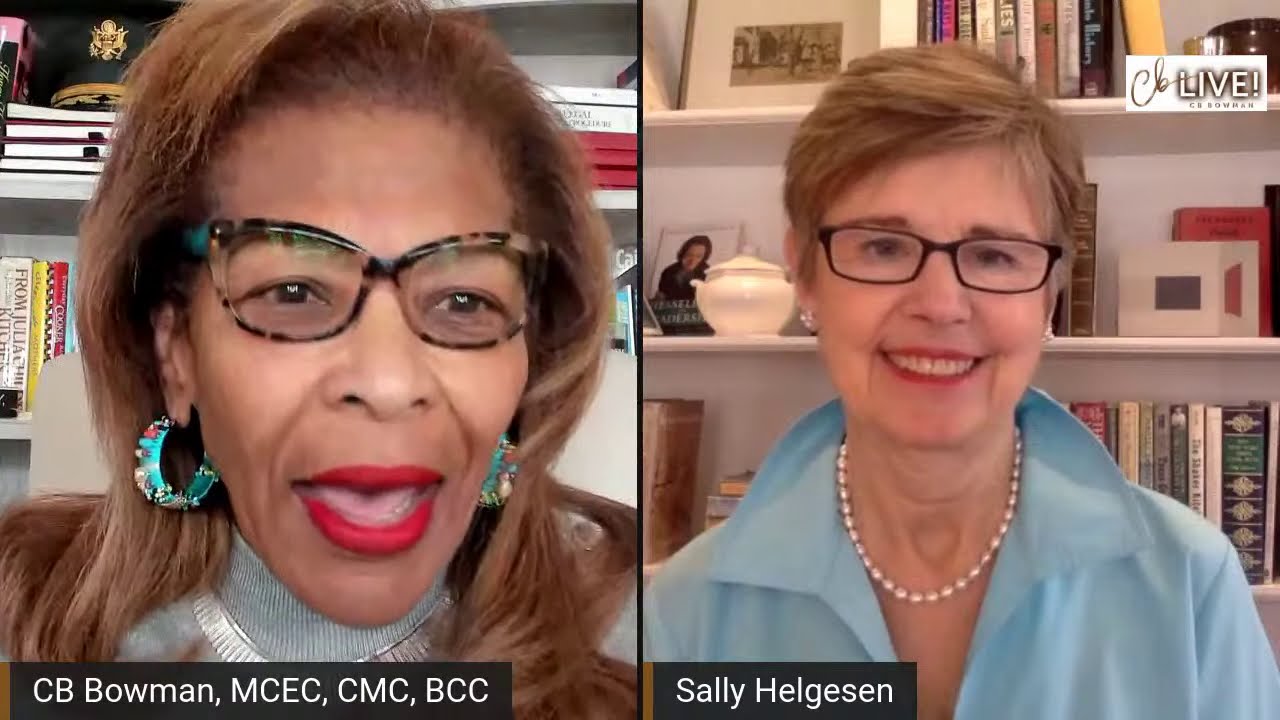
Sally Helgesen, who spent three decades coaching women leaders, discusses the top challenges facing women in the C-suite today: online harassment targeting figures like Governor Whitmer and Meghan Markle, pandemic-driven shifts in hospitality and caregiving roles, and the tendency to over-manage others' perceptions instead of focusing on what you can control.
Chapters
Hello everyone, welcome to CB Bowman Live. Today we talk about the challenges of the C-suite, but I want to tell you the reason why I'm 1 minute late today— not technical problems. I got so involved going down memory lane with our special guest who I will introduce in a second. But meantime, I have to give you the 411. Listen, Thursday we're going to have a fantastic guest. So watch for that. I'm not giving you the name. And ACEC, the Association of Corporate Executive Coaches, is having its annual conference. And this time we're doing it over 4 days, May 6th, May 20th, June 3rd, and June 17th. And it's by Zoom. So no excuse not to come. And remember, we're ready to launch our Thought Leader Award program. And guess what? Our guest was one from our last conference. So I'm not giving away any secrets, but she's also my buddy in MG100. She's the one who nominated me. So you know she holds a special place in my heart. So are you ready? Are you really ready? Because this is a wild ride, guys. I want— I shouldn't have said that. It's guys and gals, right? Okay. Everyone tune in, listen in for pearls of wisdom and laughter. I am introducing Sally, Sally, it's not Sally Helgeson. It's Sally, just Sally. You know what I'm saying? So Sally, please tell everyone who you are and what you're famous for.
CB, it's great. And now I see why you wanted me to wear pearls because you said pearls of wisdom. So I'm on brand. My name's Sally Helgeson. And I've been working in the field of women's leadership and inclusive leadership for the last 30 years. And I'd say at this point, I'm probably most famous for How Women Rise, which is about the habits and behaviors most likely to get in the way of successful people, but also have enduring success with The Female Advantage, a book I wrote in 1990. Imagine writing a book about women in business in 1990 and calling it The Female Advantage. You can see I'm an optimistic person. Not delusional.
And realistic.
Exactly. And The Web of Inclusion, which I wrote in 1995, which was, I can say immodestly, was the first book to bring the language of inclusion into the workplace and the business context. So I've been out there a long time. And, and as some of my cohorts know, that if you just stay at it for long enough, you will become well known for being well known.
I love that. You are definitely a thought leader in the space of all things women as well as all things leadership, and you're an amazing coach. You're a force of nature, Sally.
Thank you, CB. Thank you.
Show the audience your book so they will run right out and get it.
I will. Uh, this is How Women Rise. You can see that it, it matches. I'll hide it in front of my Perfect. You see, it matches my shirt. That's no accident. I tried to be on brand with that, and CB is supporting me today with that, with her earrings. So thank you, CB. Very thoughtful.
So Sally, let's get into some real talk now. You know what we were reminiscing about is we both had living experience in Lower Manhattan And that was during the days of Autumn and Ellie's Meat Shop, Baldocchi's Produce Shop, and coffeehouses where you sat and you talked about Andy Warhol movies and sitting and watching the Campbell's Soup can for what was it, 3 hours?
Easily, easily. I see you're not interested in dating us. She's talking about the '60s and '70s. I might as well let you know.
I only heard about it.
Yeah, it was quite a time.
Here's what I want to ask you. I always have to ask, what do you see are the challenges for leaders now? But today, because I have you on, I want to talk about that in relationship to women. What are the top 3 challenges that you see women have leading The top 3 challenges.
Number one, I think we're dealing with another kind of backlash and division that is very, very challenging environment, and that is particularly often punitive for women leaders. So I certainly hear from women in the public eye, especially those that are on certain platforms which are not LinkedIn, which shall go unnamed, about brutal forms of harassment.
Yeah.
And I think that's a challenge. And intimidation and really nasty talk. So, I think that creates a very challenging and threatening environment for a lot of women who are in leadership positions. And I know that a lot of the women that I know who are very, very high profile have definitely faced that and seen an increase in that. So, I think that's a big challenge for women leaders. It's one that they're dealing with. I don't notice people backing off or resigning as prime minister or CEO or head of a global nonprofit because somebody makes nasty comments about them online. I see incredible bravery. We saw it with the governor of Michigan, for example, Gretchen Whitmer, who seemed to almost thrive on some of the taunts she got earlier this year. But she also, you know, had real threats. So I think that that at the very high leadership, positions at the more visible—
I want to dive more into this because I actually had not thought about it. Now that you're bringing it up, I want to ask, and I certainly saw the interview with Oprah, and wow.
Yeah, yeah, that, that kind of says it all. That was, that was what I'm talking about on steroids.
Yeah, yeah, it was totally heart-wrenching. I I felt so much pain for her.
Yeah, I did too.
Um, so I want to talk about this backlash. You know, my husband and I, we're fairly conservative, and we're noticing things that we look at each other and we say, what the hell are the women thinking? Because I think from the entertainment world. Now, I love the entertainment world, but some of the things I'm seeing— when I watched the Grammy Awards this year, I thought this bubbles up to the surface for men, Mm-hmm. as well as women, but mostly for men to feel like they can trash us when they see this kind of nudity and this kind of performance. Now the question becomes, where do you separate performance from real life? Where do you separate the kinds of things we're seeing so that it equals respect for women, especially the men that are of a particular age who are really holding the reins of business?
So, yeah, and, and, and I think it's always important to understand and not excusing it. I mean, I come from a different world myself, but, but When you see female entertainers who are presenting this, you know, very problematic and, you know, provocative— I mean, beyond provocative ways of behavior— they're being selected, they're being chosen for that. That's, that's why they're, they're popular. And a lot of this goes back to the social media and the kind of algorithms we have now that promote people who who say outrageous things. And that is highly problematic. And I think it's because we're still in the frontier when it comes to social media. We don't understand what kind of protocols need to be in place to build a healthy society. We're just starting to learn that. So, I think that there's, you know, people who get a lot of clicks and, you know, response, even when it's negative response, are the ones that, you know, entertainment gravitates to. That's a very different issue than leadership, however. And I think that I don't see women in leadership positions, or women who have any degree of, you know, gravitas or something they're contributing beyond, you know, getting out and stirring people up. I don't see them impacted by that. Now, does it impact You know, an audience of especially males who send people negative, nasty messages online, maybe so. But it's, it's beyond our circle of control. It's beyond what we can deal with. And so, you know, it's provocative, but I don't think it speaks to the exact issue.
So, I think I want to push back a little.
Okay.
Because when we talk about leaders, you and I, we're both talking about business leaders. But when you look under the COVID and you say, okay, you have Beyoncé on the stage. Beyoncé and her husband have more money than most Fortune 500 company CEOs. That is a business leader of a different And they certainly have the connectivity in the world of leaders, right? More than many, many leaders at the top of organizations. And you see somebody get up on the stage that accepts an award in a beautiful dress, but except you could see the pubic hairs.
Oh, well, I don't— I didn't see it.
I'm gonna— you know what? I'm known for being straight out there. Okay.
I didn't see it. Wow, that's quite something.
Accepted award with Beyoncé, and a lovely woman, but what kind of message is that sending when you realize that this is a woman receiving an award that's a leadership award for that field with a powerhouse in the field? Uh, you know, I have to say that I think mentally it's very hard for people, especially men, to make that separation, that provocative state. Because when you read some of the comments that are so harsh against women, a lot of it underlining those comments are sexual innuendos.
But you know, I'm going to push back against you now, CB, because Yeah, I don't— I think that kind of blames the victim. And when we were listening to the Oprah interview with Meghan Markle, here's a woman who has conducted herself with the most remarkable warmth and grace and appropriate behavior imaginable. And she was the, you know, recipient— I don't want to use the word victim because I don't see her as a victim. I see her as a very, very strong person. But she was a recipient of horrible abuse. So, and am I going to blame that on what Beyoncé wore to accept an award? No, I'm not going to do that. So I think that, that, you know, while it stirs the pot, I, I don't think it's really germane.
I just want to clarify something. Not what Beyoncé wore, the other person wore.
Oh, really? Oh, okay. I didn't, I didn't watch it, so I don't— wow, that's—
But I hear where you're going. I, I, I actually agree with you. Also, because I think that there are so many types of abusive language that you know I don't know if one feeds into the other psychologically or just in what we hear and what we see. But I totally agree with you. There are just multiple types of abuse, and I think what she received. Was so heartbreaking that it's hard to even understand where the humanness, the humanity, the human behavior existed in those kinds of comments.
Yeah, also, you know, we've lost, we've lost hold of a very interesting concept which used to be common, which is It's none of my business.
Oh, I love it.
People seem to have forgotten that there's a lot of stuff that's just none of my business. And I know, you know, I feel that way about a lot of things. And often when I— somebody will ask me what I think about something and they'll say, well, do you have an opinion? I'll say, well, it's not really my business. People are very surprised because I think, I think it's a concept we could bring back, you know. There are things that aren't any of our business, so just let them go. Let me tell you the other thing, though, CB, that influences any kind of pushback you're getting from me on this. And this has guided the work that I've done in women's leadership and inclusive leadership as well. And that is years ago, probably in the '80s, when I read that very popular self-help book, 7 Habits of Highly Effective People by our colleague Stephen Covey.
Yeah.
It— one thing really stuck with me. I don't remember the 7 habits, you know, but one thing stuck with me. He had on one page a little diagram that showed circle of concern and circle of control. What is within your control and what is— what are you concerned about? And what he said was that the most effective people have a good match between their circle of concern and their circle of control. So you're not concerned about a lot that you can't control. And in the work I do with women in terms of leadership, be— I always say, focus on what you can control, which is not going to be everybody's perception of you. But focus on your own ability to show up and represent strongly and with intention What you're trying to put out there in the world rather than, well, that person doesn't like me. And, you know, what if they think I'm arrogant or this, that, or the other? So we want to keep our circle of concern and our circle of control aligned. And however I feel about it, somebody wearing the kind of dress you're describing at the Grammys is way outside my circle of—
Concern.
control. So I prefer to put it outside my circle of concern.
I love that. I love that segue. Thank you. And I think what, what we're talking about and what makes that nice segue is Markle's circle of control and her circle of concern. And I could see where the time as she spoke, it became blurry for her. And I love the work that you're doing to help women understand the difference between the two and, and understand how they can respond to the difference between the two. Because I think that that helps us create sanity and gives us back our power. So, agreed.
And those are two very important things, promoting sanity in the world And manifesting our power.
Absolutely. I love it. So, okay, so what can we do given that concept? What can we do to manage backlash? What do you advise women to do?
I advise 2 things. I advise, number one, distinguish between what's important to address and what's not. Somebody making a stupid comment Depending, it may not be that important. So, in that case, I'm going to give our colleague Marshall's advice, which is let it go. When it's something that needs to be addressed, you want to be direct about it, not confrontational, not defensive, but also not really letting it go. And say, you know, I take exception to what you just said. I recognize that you're a person of goodwill and humanity. And you know what? I say that even if I don't. I say, I recognize you're a person of goodwill and humanity, but I don't— I'm not sure you understand some of the implications of that or how that landed on me. So I don't say, maybe it's just me who—
No.
I say, you know, I'm not sure you understand the implications, but that's not, that's not a good way to speak. That's not a helpful observation. I don't think that's going to be of benefit to you or to other people here. So it's easier to do, I will admit, you know, when you get a little bit older. People are, are, you know, especially younger men are less threatened when you say things like that. But it's very important to, to decide, is this worth taking a stand on? Because not everything is. You want to save it for when it's valuable. And, and if it is, then you want to confront it directly. And if you can't get any kind of resolution, then you go to the next step. You know, one of the things that I think that's happened in organizations Is there's no middle process for a complaint and for it going into full-on, you know, suspension with, you know, legal action. And there needs to be a little bit more of a middle way because I've talked to women who said, you know, that guy's behavior was really a problem, but in some ways he was a really good guy and I didn't want him to lose his job over this. And so we're at a place where there's not that middle thing. So it's good to speak up for yourself and get used to speaking up for yourself. I sometimes— women say, well, you know, I'm just not very good at that. Get good at it. How do you get good at it? You do it. You do it over and over again and you get pretty good at it.
So, Sally, you are amazing at that. Okay. You take no prisoners. And I love you for that. And my question is, and this is the tough part, when this happens, you're triggered.
Yeah, right.
How do you hold back that trigger, that emotional response, in order to get on top of that emotional response to be able to respond like you would, take no prisoners, in a very kind way?
It's hard to do. And I have that in other areas. So what I find helpful, I really think a lot in terms of this idea of the sacred pause. Always remember, you don't have to respond right away to anything. You do not have to respond in the moment to anything. So when something happens, that triggers you, and that happens, you know, to all of us, the best thing you can do is to just say, hmm, that was triggering. I'm feeling something. I'll revisit this. And then do revisit it. Don't then, you know, sweep it under the rug and say, oh, well, that wasn't a problem. But it's usually, if there's emotion involved, and there is in these situations, because you're exactly right, CB, when you're in a situation that triggers you, You are feeling, and the best thing to do is to just wait and not instantly respond because you may respond with emotion. Now, here's something else that's very helpful because women often get a reputation in org— oh, she's so emotional. You can't use your emotion. Don't deny your emotion. Say, well, I'm feeling that. It must be— use your emotion. So if you think about it a little bit, then you can always go back and say, you know, as you know, I'm a person who has strong emotions, and I was stirred up when you said that, and that was a problem for me. So you're distancing yourself, but you're not dissociating yourself.
But does it give the other person the power? Because now they know what triggers you?
No, because, you know, okay, they know what triggers you. So if they're a A really bad person, they're going to say, aha, she's triggered by that. I'm going to do it again. If they're a normal person, they're going to say, ooh, well, that wasn't what I was— what I expected. So if they're a bad person, they do it again. Then you say, wait a minute, you're doing it again. I told you this trigger, you know, just approach it. I find if you have a light touch, it doesn't send the message that this isn't important. It sort of lets them off the hook in a way so that they don't lose face and feel that they're being accused of something. So if I have done something like that, you know, I've been around a long time. I've had every experience. That's why I can speak to some of this. But, you know, you've told someone, well, that, that really, you know, I'm a person who has strong emotions and that really stirred it up. So I don't think that's a great, great tactic for you with me. I'm going to give you some help here. I'm going to give you some coaching on this. It's free advice, but that doesn't work with someone like me very well. And there are probably other people here like me. So, Assuming you want to be effective, it's probably a bad idea. So if they do it again, they come back and say, wait a minute, I think I informed you that that triggered me. I see you're doing it again. I hope I don't have to think of you as somebody who's deliberately trying to provoke me into this. It, you know, you give them a way out. You want to offer people a little bit of ability to feel they've saved face and not been proven that they're a complete jerk, even if they are. Listen, have you ever met anyone who said, thank you for pointing out that I'm an absolute jerk?
Yes, I have. Yes. Okay, that was kindness, as you said, but— and it took me a long time to develop develop the skill. It does.
Yeah.
And incredibly, you know what? It's a power-packed skill.
Yes, it is. It is. So get going, start practicing it, because the sooner you get good at it, the better it'll be for you and for other people.
And it does increase your credibility and the respect that people have for you. Especially when they know you're coming from a place of kindness to help them.
Exactly right. And that's why I think, you know, we've watched our colleague Marshall, and somebody starts to go down a road and he'll, you know, they're not his client or anything. And I'll say, wait a minute, coaching moment. And then he'll basically say, what you're doing is ridiculous. But he does it in the guise of a coaching moment. So the person isn't humiliated, the person doesn't feel attacked. And it's very effective. So I think that something like that, using your own language. If you're not— I mean, Marshall uses that language. You're getting free advice from one of the world's top coaches of all time. If you're not a coach, that's not terribly effective language. Who wants a coaching moment from somebody who's not a coach? But whatever it is, I'm going to give you some insight Into what will be— make you more effective in this kind of situation. Because I think, I think that I have a pretty good handle on a way you could do that better, rather than, you know, how dare you know. Yeah.
And we have to realize, forgive me, Colorado air is a bit dry. We have to realize that a lot of times, A lot of times people don't realize the effect that they're having on someone else. So you really are helping them.
That's exactly right. You have to have a belief in your own ability to help them, which means that you have to have a belief that what you observe has legitimacy and power. So that's where you want to put the work in, is in believing, well, if I think that, Then, you know, I'm probably onto something because that's happened in the past. I've noticed that when I notice something like that, that it's often very legitimate. So I'm going to have faith that my instincts are good here with the willingness to be challenged on it too.
Oh yeah, absolutely. I love it. Okay, so we talked about backlash. Yes, I probably want to talk about the Some more. Number 2, because I want to, I want to talk about social media with you, because I'm sure that's going to be your next book.
That would be such a bad idea since I'm the most social media-averse person you've probably ever met. I don't think I have much to say on that subject.
Oh, but you do, in relationship to women. Women seem to be taking over social media like a storm. The young women, I'm so proud of them. It's so exciting to watch what they're doing. So we have backlash. What's the second thing that you see for women leaders today in terms of challenges they face?
Well, do you mean that specifically in terms of social media? Because I No, okay, in general. I think that, you know, it's interesting. I get asked all the time the question about, well, the pandemic has had this terrible impact on women, and we find more women losing their jobs, et cetera, which is absolutely true. It's 2 things. First of all, women are heavily represented in hospitality and retail, which are the sectors that have been probably most impacted in terms of job loss during the pandemic. And of course, the other thing is that You know, women are home often taking care of children who are not in school. So, somebody has to be, you know, they're supposed to be supervising their homeschooling or whatever. So, for me, I think, you know, on one hand, the impact, the negative impact of the pandemic on women is very temporary. And once kids get back to school and people can have other people in their houses, whether those people are family members or neighbors, or their kids can go to a little neighborhood center, or whether they're, you know, having someone paid in the house to help them, that a lot of that's going to get resolved. And the discovery by many organizations that indeed having more flexible work hours and not requiring people to be in the office just to show up in the office and prove their loyalty somehow because they endured a 2-hour car ride to get there. I think this is going to be a very positive thing for women. So I think that one of the challenges, you talk about it in terms of challenge, is to distinguish these and to think, you know, what are the immediate impacts of this situation, but how can I make this a better situation for myself, for other women, and for our daughters going forward? Because I think, you know, we're going to look back and we're going to say, you know, the pandemic looked pretty challenging in terms of these issues, but actually turned out to be very, very positive for women.
So give me an example of how you feel it will be positive for women going forward.
Well, you know, I was talking to a client recently, the HR head of HR at a client that's pretty conservative, O-line energy company based in the south of the US. And she said, you know, we have had the worst time recruiting women because we have absolutely no flexibility in terms of, you know, sick days, snow days in the— you know, you're in Colorado, you know what a snow day is. Sick days, snow days, we have no possibility of working from home, kids are home sick, whatever it is, we've had absolutely no flexibility. And because of that, she said, we've lost some very, very desirable recruits that we've had, or we've had women leave and say, you know, I got to go to a place that's a little more flexible. So that's essentially what I mean. Executives have learned that the link that they were making between productivity and always being on site was in their own mind. It wasn't real. And I hear that everywhere. So we're gonna, we're gonna be in a very different situation. And I think that women want to look at it in terms of how can this be of value to me, and how can I move forward given the fact that we've got a real change here? You have an opportunity to advocate more for yourself in terms of setting up a work schedule and way of working that will work for you. And guess what, CB?
Men—
women have been pioneers in doing this, and when women manage to get it done, then, you know, the men will follow along. They're doing something.
The reason why I asked for clarity on that, and I think you're absolutely right, is I'm seeing it through a different lens, which is because I'm on Clubhouse now an awful lot.
Mm-hmm.
I'm telling you, that is a learning experience and a half. First of all, to understand the algorithms to be successful on it, and then 2, in terms of the exposure you get to information that you otherwise would not get because the radio is long gone.
Can I say something? My, uh, my security guy won't let me on to it.
Well, there are issues, but you know what, there's issues in all social media, right? This is— I know we're living in— but what I was going to say is I have seen an incredible amount of creativeness coming out of young women to start their own businesses.
Sure.
That will give them the flexibility that they're looking for to support their families. Um, we just got in a message from Shelley, and she's saying, I totally agree, Clubhouse is a new world. Okay, Shelley, follow me on Clubhouse.
Okay.
Everybody follow me on Clubhouse. It's great. I just got 2 Clubhouses. One is called Leadership Challenges, and the other one is called Executive Coaching Club. And so I am so proud of this new young generation of women. They are a tough act, and they are doing it all. In our generation, we struggled to do it all. But the difference is we struggle to fit into a mold. They are creating the mold. So yeah.
CB, I think what you just said is so important. And I often get asked, you know, what are— I've been in this, in women's leadership now, it's this, the 33rd year that I've been in this. And believe me, people many times said, get out of it. There's no future in it. There's no money in it.
Say it.
So I thought, nah, I like it. But people often ask me, you know, given that you've been at this for so long, what are the biggest changes you've seen? And they are 3. One is confidence. And that's what part of what you're speaking with. I especially see it in a younger generation of women. They, they have more confidence in what they have to contribute. The second, and this is really important, Oh my God. Solidarity, old-fashioned word, is key. And that solidarity was hard to find 30 years ago. I remember in the '90s when companies would put together a women's network, you know, the equivalent of what we'd call an employee resource group. They would put it together. And the senior women would make themselves as scarce as possible. They didn't want anything to do with it. They would say, I, I want to be thought of as a leader, not a woman. Ah, good luck. Good luck to begin with.
Yeah.
And then also, you know, that just that fear that if I try to bring another woman along with me or even acknowledge that I have relationships with other women, it will undermine how I'm perceived. I don't find that. It's such an exception to find that attitude now. Really rare, really. So that solidarity is so important, especially, you know, relationships are what give women their resilience. That's where our resilience is embedded.
Yes.
So, being able to build these relationships based on a solidarity is such a magnificent Proof of progress, I would say. And the third thing is a recognition that we can't do this without men. And so greater eagerness and interest in engaging men as allies in this journey, which is— all of these 3 things, I think, are just culture-changing.
And you know what? The men are eating it up.
They are eating it up. And guess what? Women have a role to play in helping them do it. You know, I've said this before, but I really got a wake-up call on this. I was doing a leadership conference in the construction industry in Las Vegas. I think this was 2018. And, you know, it was a huge hotel, big fancy venue and all that. And I had a workshop and it wasn't a, you know, wasn't a Full session. It was a workshop. And I figured that I was going to go down to the room and it was going to be those women who are in construction who wanted to talk about women's leadership. And I walked in and it was about 70% men. I couldn't believe it. I was floored. First of all, I was totally unprepared. My remarks weren't, so you need to, and you can do this. Tips for women? Forget it. It's all men. So, I'm kind of fumbling around thinking, what the heck am I going to say? And I said, why are you here? I want to hear from a couple of you why you're here. And the first guy who stood up, he said, look, and he was the owner of a small construction company in the Midwest. And he said, look, please do not waste your time telling us that we need to get better at attracting, retaining, and developing women. Every time I go to something like this, that's what I'm being given— statistics from McKinsey about why we should do this. We understand that this is what we need to do. Otherwise, we wouldn't be here. But we don't have a clue how to do it. We do not know how to do this. So that's what women can help men with is understanding how to be helpful. You know, some woman says something in a meeting, nobody picks up on it. A couple minutes later, a man says the same thing. Say, it's a great idea. You notice that, you know, it's a great idea. I think it's wonderful you agree with Julie. In other words, she's the one who said it, you know, dodo. But, you know, notice that, be aware of that, understand that happens all the time. And put yourself in the conversation about it.
Yeah, I love what you said. And you know what? Hate to take this over to the race situation, but here's the other thing I'm noticing is that with that solidarity, it is— it includes inclusion as we're defining it with social justice. Because I'm seeing young Black women feel and experience being toe-to-toe with young white women, and it's this bonding that is absolutely magnificent. I didn't think I was going to see this in my lifetime. I agree.
I didn't think I was going to see it either, and I see the same thing, and you're almost making me cry because Those kids grew up together. They played on sports teams together.
Yes.
They played together. When I went to a public school in Kalamazoo, Michigan, they were for all purposes segregated. There was a school downtown, Lincoln, that, that's where the Black kids went. And then there was Central High School, and it was white. I mean, that's how it was then. It wasn't officially segregated. It was Michigan. We're not talking about Alabama. But that's how it was. And people didn't grow up together in the same way that young people grow up. And the expectations are tremendous. And the feeling of, as you said, being— standing up there toe to toe. Why is she this and I'm that? No. And their parents gave them the message, too.
Yeah.
You know, I think parents now give their kids— are more likely to give their kids a message, you can do anything. You know, don't—
that's exactly what I'm hearing. Exactly. When I hear these folks talk on Clubhouse, that is the message that they're— we did a good job, Sally.
You know, maybe you're right. Maybe you're getting me so excited, maybe I'm going to push back on my, uh, website security guy and say, you know, I got to check out Clubhouse a little bit.
It's fascinating. It is so It's so rich to see this. I am— I'm just very proud of this new generation, I have to tell you. Yeah.
Yeah, I agree with that. And I find, you know, that the women, and especially the women of color, they're often the first ones to ask a question. I mean, that's what I love. You know, I'll give a talk. And what I find is the first— you know, used to be 30 years ago, first of all, if there were 5 men in the room and 50 women, You know, all the questions would come from men. Women would be intimidated. Then the women started asking questions. And now the women of color are often the very first ones to do that. So it's a huge change. It's just really significant. And you know what? Nothing can stop it. A bunch of idiots feeling threatened?
Nah. But they're going to feel threatened about anything and everything. in the world. But we have to, as you said before, we have to pay attention to the control and to the concern.
That's right.
The control is in the hands of young women right now.
Agreed.
Flash news. Drop the mic. That's where it is. So you've given me 2, backlash and the impact of COVID What's the 3rd thing that's affecting women in leadership roles today at the top of the house?
I am consistently— you know, I talked earlier about the circle of control and about managing perceptions. I am consistently surprised by how much I see even women in very senior positions trying to manage the perceptions They want to be liked. They want everybody to think they're a wonderful person. That's— well, that's important. It's nice to be a wonderful person. And it helps your career to a certain point to have everyone think you're a wonderful person. But when you privilege being thought of as a wonderful person over being very clear about what it is in the larger context you are trying to contribute— and the language of contribution can be more helpful than achievement— then I think you run the risk of being— putting yourself in danger. The other thing I see is that women will still often be reluctant to accept a job that they feel that they're not completely ready to do. And it's so common. And I've heard from 30 years that we're headhunters and internal search people will say, women will apply for a job beginning I'm not sure I'm ready to do this job, but you know, and here are all the reasons I'm actually not qualified. And a man who's far less qualified will begin, I can do this job because of X, Y, and Z. It may have nothing to do with the job, but because they're very confident that they can do the job, they'll end up getting the job. But I've also talked to senior executives who said, you know, every time we try to promote a woman into a higher position, she tells us she's not ready. She doesn't have all the skills. She doesn't have the experience. Oh, I've still got more to learn at the job I'm in. Really? That— it's fascinating. Of course you don't have all the skills. You haven't done the job. You know, doing the job you do, you're only perfect for the job you have. You're never perfect for the next job. So I'm still surprised. I did a program on International Women's Day for a big consulting company And the woman who— I'm talking a little bit about this— and the woman who was the senior-most woman there who was, you know, on the program said to me, she said, I just did that last month. She said, just last month I had— I was made an offer and I felt, well, I'm not really ready to do that yet. So I backed off. So there's a kind of a risk aversion, a belief that you have to be perfect, a belief that you can't do a job unless you've already done the job.
Right.
that I think is probably still holding a lot of women back and at a level that I find quite surprising. Now, so, yeah, so that's— I think that's really important. And you just have to think, you know, would the world be a better place if I had more authority, influence, and power, or would it be a worse place? And usually it would be a better place. So go for it.
So I have to tell you, I'm smiling like crazy because, you know, one of the things that I do, aside from owning the Association of Corporate Executive Coaches, is I coach other coaches. And this morning I had a call, and I don't charge them if they're a member of ACEC yet. But I had a call this morning from somebody I just fell in love with. This is my second, uh, conversation with her, and she has been offered an amazing opportunity. You and I would just cry for this.
Yeah, right.
And I could hear the concern in her voice, and I said to her, we can't have this business discussion until that concern goes away.
Hmm.
So, because it's going to get in the way of your seeing numbers, uh, in terms of the possibilities of you expanding this. And I said, so let's talk about what are your fears. I said, because what's happening is your fear is leading your success.
Right.
And her concerns were very valid. She said, I am concerned about paying attention to my family, making sure that they have what they need, and, you know, a few other things. Now, this is somebody— I'm guessing her age is 40s. Clubhouse early this morning, I'm listening. And so the way you have it, you have host of rooms.
Yeah.
So it— this was 3 women. And so one woman was saying, okay, we're ready to start the discussion. And it was about, um, recognizing why you need a following in what you're doing and how did you come upon becoming an influencer. Right? This one woman said, guys, you'll have to forgive me, I'm gonna be talking to you, giving you ideas, and I'm driving my kids to school. This was a younger woman.
Mm-hmm.
In her 20s.
Yeah.
Do you hear the difference?
Right. Yeah.
That is amazing.
You know what, CB? It's an attitude. It's not just age because I read an interview and this resonates with me and I try to broadcast this every chance I get. I read an interview a number of months ago with Nancy Pelosi, who is 79, I believe. And the interviewer, I think it was in Politico, it was a male interviewer. It was an excellent interview, a long one. And The interviewer said, you know, your ability to handle very fractious Congress and get people on the same page and enforce some level of discipline is so remarkable. Is that because your father was the 6-term mayor of Baltimore that you were able to absorb some of those political skills? You know what she said? She said, no, that's not where I got these political skills. I learned to manage these kind of chaotic and fractious situations and relationships because I had 5 children in 6 years.
Wow.
She said, I had to do that or I was going to drown. So, I had to get very good at enforcing boundaries, giving people tasks, holding them to account, keeping an eye on what was going on, but still giving people the opportunity to grow and mature. sure, as she said, in that case, as human beings, in this case, as potential leaders. She said, so that's how I learned to do that. And I think that when women have more confidence, and as they have more confidence, that this— the whole range of skills they have, not just their skills in the workplace, but the whole range of experience and skills, which is so rich, has relevance to leadership positions, then they'll be— then they'll have the confidence that that 20-year-old had, you know. And by the way, I bet she didn't say, oh, I'm so sorry, but I'm driving my kids to school. No, I'm driving my kids to school. That's the reality. Doesn't demand an apology. I'm here. I'm participating. Let's go.
Yeah. And I'm going to inform you. Yeah.
Right.
It's so— you've got to get on. It is addictive, I will warn you. I can tell you, I am learning so much. I'm thinking, was I in the Stone Age all these years?
Well, you know, I don't— I have to say, I don't think that I risk being in the Stone Age because I do about 7 programs a week, interactive, which are for different clients, or they're, you know, young women, one of my favorite groups, women in STEM, young women in the military, et cetera. So I feel like I see demonstrated every day. And I will tell you, it was watching those increases in confidence and solidarity and comfort with engaging men as allies. That, along with the way in which our common understanding of what excellence in leadership looks like, is what kept me in this for 32 years, even when it looked like, and when I heard from everybody that, you know, women's leadership was so '90s, which I heard a lot of that. So, It was watching that that, that's kept me here.
And you know, it's not so '90s. It has evolved just like men have evolved.
Yeah.
And it calls for different skills than it did in the '90s. And so, as with anything, you have to continue to learn. We have to have observers and speakers like you, Sally. who take the time to look at it from a micro and a macro view, who can tell us historically what we went through and why we went through it and how we got to where we are so that we could use that information to further propel us.
Yes.
Into the stardom that we deserve.
That's exactly right, because I will often hear people say, you know, it hasn't changed. I'm sorry, I was there. I was there back in the '80s when, you know, the common form of client entertainment at large regulated utilities was taking clients to strip clubs and women were expected to go along. I was there, I saw that. That was the reality, you know, where the, you know, office Christmas party was just, don't get me started. It was very, very different in a different era. And it's changed remarkably. And women have been the key to that change. And it's all good.
And how we think about each other. I have to tell you this brief story because we're coming on close. I remember the days when I was at a major Fortune 500 company and I was in branding and the advertising agencies would come in and present to us. And there was this one woman who I had heard so much about, who men feared and loved at the same time.
Ah.
And when she spoke, the room stopped. And I thought, who is this woman? And so I was walking down the halls of GF one day, and I saw this tall blonde woman in a red suit and red stilettos. And I'm thinking— and this was the days when, you'll remember this, when women dressed like men with the pinstripe suits and the little bow tie, right? Oh, yeah.
Oh, yeah.
And I'm like, boy, she is dressed outrageous. Who is this woman? And I go into the meeting, and this woman walks in. And I thought, Hmm. When she walked in, you could hear— and the room was filled with men. There was only two women, myself and her. You could hear a pin drop. These were some senior men. When she spoke, they did not move their eyes off of her. She spoke with such.
Yeah.
That represented that red suit. And everything she asked for, she got for her company.
I think she was my, my boss at Doyle Dane Bernbach, the advertising agency in 1968. You're describing the woman who was my boss. And it's, it's remarkable. And, you know, as you were just talking about that, I was thinking, I keep Going back and harping on this thing, don't manage people's perceptions. That was her strength. She walked in that room and she wasn't thinking, do they like me? Do they think I'm a wonderful person? Are they thinking I'm too aggressive? Am I too this? Am I too that? She didn't think that. She walked in. She had a mission. She was going to share her idea. She was going to do it as clearly and as strongly as she could. And that was her focus. And I think that that was really her power, that she was not trying to meet other people's expectations. She was trying to be, you know, beyond effective. She was trying to be creative and fun and interesting and show up. And, you know, if we can do that, look out.
She was brilliant, I have to say. And I often— I just made the connection now after so many years, because people say to me, CB, when you walk into a room, everything stops. I never connected the two, but I want to tell you, I studied that woman from the moment she walked into the room, and I just locked it in.
Yeah, that's great.
So Sally, this has been a great conversation. We have only 3 minutes left. I really invite you to come back because I love the yin and the yang and the pull and the pushback that we experienced. And, you know, I interviewed Chris Coffey—
One of my faves.
Last week or 2 weeks ago. And what he said to me that he misses that we don't do as a people is the art of arguing. And I immediately went back to the Lower East Side and those coffee shops, right? And with you, Sally, I have found a female soulmate. I love the conversation. I love the pushback. I love the learning. You just— you excite my brain.
So thanks, CB. That's one thing we did learn in those in our sort of beatnik habitat was to argue. There was no problem with it.
Yeah.
And it makes for— it's interesting that Chris would say that. You know, he spends so much of his year in France, and where people really enjoy these kinds of conversations, sort of testing their ideas in a kind of intellectual combat that nevertheless is governed by warmth. Rules of civility and warmth and discourse.
Respect. Yes. I love it. Well, maybe this is something that we have to take on to teach the world again, especially here in the United States. You may be right.
We'll take that on as another mission.
Will you promise to come back?
I promise. I loved this conversation. Great.
Please show your book again.
Of course, How Women Rise. It's really a handbook for addressing what lies within your control.
I love it, and I am looking forward to the sequel, Women Have Risen. You got it. And how we did it. Sally, thank you. Audience, please come back on Thursday and, um, next Tuesday and see who we have as guests. Please think about ACEC, register for the conference, follow me on Clubhouse, and let's just have fun learning and sharing. You know, I always leave with some good words, and the words today are rise to the top this week. Let's make that your goal. With that, we'll see you on Thursday, and we'll see you next Tuesday. Remember, on Thursday we are an hour earlier.
Thank you.
Oh, we got in some last-minute comments. Sally said, I've had this very conversation with 2 of my coaches and their CEOs this week. I think it may have been related to Clubhouse, I'm not sure. And then Denise says, Sally, this is great. Thanks, CB, for bringing Sally's work to so many women who can benefit from her work. Oh yes, we can unleash, all caps, Us all to play. Yes, play and work in a more inclusive world. And Orly writes, Sally and CB, what a great conversation. Thank you. Hey everybody, write in. This is great. It will be posted. Thank you so much. See you, and remember to rise.
Thank you, CB.
More from CB



211- Courage to Leap & Lead with Louise Story part 1Courage to Leap & Lead







