CB Bowman LIVE!: Challenges of the C-Suite: Guest Adrian Gostick and Chester Elton, Episode 50
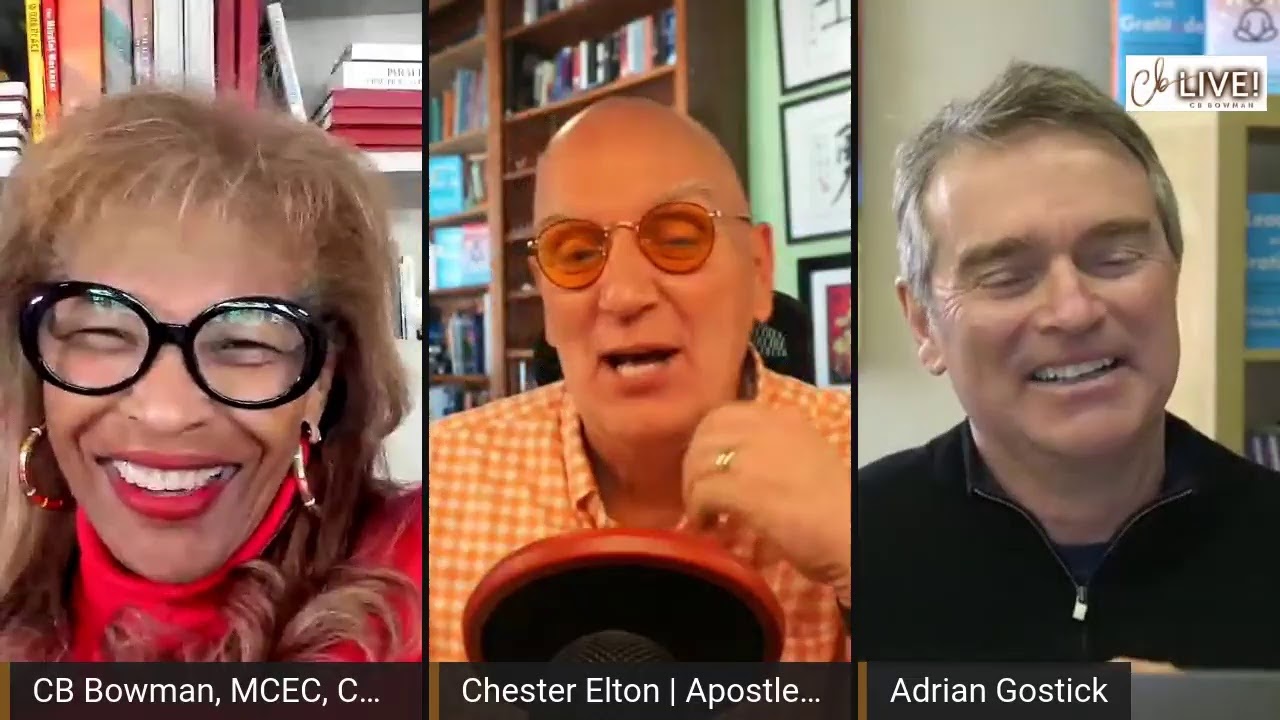
In this live interview, host CB Bowman talks with bestselling authors and leadership experts Adrian Gostick and Chester Elton about their 20‑year partnership, how they built a prolific writing career, and the insights behind their newest book Anxiety at Work. The conversation weaves personal anecdotes about how they met, the role of complementary strengths in their collaboration, and the evolution of their recognition‑program business into a global thought‑leadership platform. They discuss the impact of COVID‑19 on workplace anxiety, the importance of transparent communication, trust, and empathy from leaders, and practical strategies for identifying and reducing anxiety in teams. The dialogue also touches on diversity, inclusion, mask and vaccine policies, and the personal experiences of the host as a Black woman navigating corporate culture. Throughout, they emphasize the value of allies, honest leadership, and creating cultures where employees feel safe to be themselves.
Chapters
Hello everybody, welcome to CB Bowman Live. Hey, today I have 2 guests on, so we are super excited. And these guys are just a little touched, you know, you know what we're saying here. So I, I don't want to say anymore, especially the one in orange. Oh my God, are you in for hilarious Hey, you know what? Remember, we won't be on this Thursday because Thursday is the ACEC conference. And these 2 guys are speaking. So that's my secret for today because I couldn't think of anything else. I'll tell you, I am just so swamped with work. I have 2 conferences going on overlapping each other. Talk about insanity. True definition. One for executive coaches and one for workplace equity and equality, which I hope you'll all tune in to know more about. Just follow me on LinkedIn. Come on. You know where to find the scoop of what I'm up to. Today, our guest— well, on a more serious note, this is Mental Health Month and our guest has written an incredible book about anxiety at work. And this Wednesday night, 6 o'clock Mountain Time, you know I have my Clubhouse show on Challenges of Leadership, and we're going to talk about leadership and suicide. So please follow me on Clubhouse and come into that room. This is a serious subject. So, but before we get to the serious stuff, let's talk about these 2 characters. Oh my gosh. As I said, they're a ride. And they have written together so many— can we talk? So many bestseller books together. So I want to examine— first, let's find out about each one. Then let's examine on Challenges of the C-Suite, how they got this partnership to work so well. Let's get the inside scoop. Let's start with Adrian. He's the quieter one, so we'll let him go first.
Adrian, hi.
Welcome.
Hey, CB, thanks. Thanks for having us on.
Thank you. Tell us a little bit about yourself first.
Great. Adrian Gostick. For the last 20 years, Chester and I have been writing on leadership. I hail from England, born there, lived there until I was about 10, grew up in Canada and moved down to the U.S. for school. I've been here really since. So, eventually became a U.S. citizen and that was a fun process. So, my work is all around helping leaders build great cultures. So, we've surveyed more than a million employees now. Chester and I have written 14, as you mentioned, bestselling books together. It's been a fun ride. That's It's taken us around the world helping organizations and leaders.
Wow. But what's the secret to how you got to where you are? You know, Marshall, how did you get there?
It is true that what got you there won't get you, you know, further in your career. But, you know, I had the fortune about 20 years ago or so to meet this wacky sales guy up in the Northeast. We were working for the same company. He had an idea to write a book. And I'd written a few books before this point, but nothing like the ride we were about to begin. So, we began writing these books on recognition. And it's interesting as we, you know, they were moderate successes. They were selling 30,000 to 50,000 copies, which is, you know, for business books is quite good. But Chester, who I'm referring to, was actually on stage in China. We were asked to speak around the world and And a New York Times reporter was in the audience, saw him speak, and wrote a front-page business article on Chester Elton in the New York Times. And the next day, we got a call from a big publisher in New York. And, you know, sort of the rest is history. We began publishing on a big scale. We wrote a book called The Carrot Principle. And we caught lightning in a bottle. It was the right time, the right place with that idea. And our work has grown since then.
Okay, so that kind of— it's like the Marilyn Monroe story, right? When she was discovered in a, uh, um, sort of a soda pop store, right? Uh, so it just happened that the right person was in the audience. Fantastic. Okay, now we go to the wacky one.
Okay.
You can recognize Chester when you're walking down the street if you see a guy with orange on. And I'm quite serious. Normally he even sports the orange hat. You got the socks, you got— I mean, do you have orange shoes?
Oh, uh, they're all orange. The strings in my tennis racket are orange. Yeah, I mean, it's, uh, it's an obsession.
You're not gonna beat anybody with a faster wit than Chester. Okay, Chester, you are on. Tell us about yourself.
Well, you know, uh, like you, CB, I was, I was born at a very young age, and, uh, I, I wish I could take credit for that line, but it's a, it's a great British comedian. I've got to give him credit. Um, yeah, you know, I, I grew up in Canada. Uh, Adrian pretty much grew up in Canada as well, and born in Edmonton, grew up in Vancouver, British Columbia, spectacularly beautiful city, and Um, just grew up in a ridiculously happy household. You know, my mom and dad were happily married for 65 years. Um, I have 4 older brothers that are still my best friends. Our wives are all best friends. And I grew up thinking everybody grew up like that— happy and healthy and loved and, and, uh, and, and so on. And come to find out that actually we're becoming more and more of a novelty. Um, took a job with a record— we all grew up in broadcasting. My dad, uh, was a radio announcer. And, uh, he would tease me later. He'd say, you know, Ches, you have the perfect face for radio, you know. And, um, and that's why we podcast, right, Adrian?
Absolutely.
And, uh, and, and it was just, you know, came down to the States for school like Adrian did, fell in love with an amazing American woman. We've been happily married for 38 years now, 4 great kids. Uh, grew up in a really competitive family. So where Adrian and I met, after I'd spent some time in broadcasting in Detroit and New York, just selling on the selling side, um, got a chance to work for a recognition company. That's where Adrian and I met. And actually, the story about the New York Times is even a little more bizarre than that, is one of the editors for the New York Times just lived down the block, and our daughters played in the high school marching band. So we would go to the high school football games, and our football team was horrible. The marching band was pretty good though. So we would suffer through the first half and then so we could watch the halftime show and then we'd all leave, you know, because our kids were done. We were sitting there one time, we were talking about our work and he says, I said, yeah, I'm going to China. He says, we've got a reporter in China. I'm going to call him and have him sit in there on your thing. I said, you're kidding. He goes, oh yeah, it'll be great. We love stuff like this. And Adrian, the title of the article was hilarious because it was Who in the world is Chester Elton? He goes, you don't know him here. Like, literally, it was like, he's an absolute nobody in the U.S., and yet he's huge in China, you know, which wasn't true. We'd been to China like twice. And, uh, yeah, it was this full-color picture of me in China throwing carrots at people. And, uh, that's when Simon and Schuster called and said, hey, I saw your article, would you like to publish With Simon Schuster, and we laughed. That's like saying somebody calling you and saying, would you like to play left field for the New York Yankees?
I'm not a sports fan.
Yes, uh, it means would you like to be the head designer for Chanel?
That I get.
Okay, there you go. Yeah, and, and, and I literally, uh, CB, we, we haven't laughed about this in a long time, Adrienne, but I remember thinking it was one of my brothers punking me. Yeah. Hi, I'm calling from Simon Schuster. Have you heard? Yeah, right. Come on, Byron, stop it. And then I called Adrian. I said, hey, Simon Schuster called. He goes, you're kidding. I said, no, I got a meeting with the guy like next week.
So, so your brothers are as crazy as you are?
Oh, not even close. They're way— they're way Yeah, no, when, when, when our— when I get together with my brothers, I don't get to talk.
No way.
No room.
And if there's a microphone in the room, people fight. The 5 of them will fight for that microphone.
Yeah, yeah, yeah.
Oh my God.
Oh yeah, listen, the blood has been spilled.
Your poor mom.
So yeah, so, and you know, to get back to Real business. Yeah, we've written 14 books together now. We've— it's— I think we're approaching 1.6, 1.7 million copies, 30 languages. And, you know, whenever you hear these stories, you think, oh boy, how lucky, what fortune. You know, as you know, CB, it was a lot of miles. It was a lot of little conferences and then little bigger conferences and then big conferences. And, and, um, I never have these conversations without saying, listen, Adrian's the writer, and he's— and every book we write, he gets better. And he's fast, he's brilliant, he's insightful. And we collaborate, we do the interviews, and we do the strategy together. But when the, when the pen gets to paper, which of course you don't do anymore, but when it comes time to actually put the words, you know, in the book, that, that's all Adrian. And, uh, he says he's lucky to have met me. It's, it's— we absolutely are mutual admiration club presidents. Because Adrienne's, uh, talent is what wins us those accolades of, you know, bestseller lists and OWL Awards and all that great stuff that we've gotten. So it's, it's been a wonderful partnership. Why has it lasted? We live about 3,000 miles apart. It doesn't hurt. It doesn't hurt.
First, I want to tell the story that Marshall tells, you know, our friend Marshall Goldsmith, and he tells about a bunch of, uh, young 20-year-olds who come up and visit his house and they all say, I want to be just like you. You know, I want to be at the top of the ladder. And he turns around and he shows his bookcase of, what, 100 books that have been published and hit the bestsellers? And he goes, yeah, that's pretty easy to do. All you have to do is publish all these books and make the New York Times bestseller list each and every time. It's not just that. just a drop in the water. It's, it's, it's, you know, people like to dream past the difficulties and the exhaustion that it takes to be at the top. But I want to talk about how is it that you two get along together? Seriously. Yeah, okay, you live so far away from each other. But did you have— tell us the secrets here. Did you have periods where you didn't like each other or that you argued with each other? How does that work?
Yeah, it's funny. In 20 years, we've probably argued, what, a couple of times? And it's extremely rare. And even then, we call each other up and, hey, I love you.
Love you.
You know, it is interesting, CB. We were just recording our podcast, Anxiety at Work, available where you find your podcasts. And we're really proud of it. And, uh, we were just talking to, um, Scott Jeffrey Miller, and he said, you know, it's really interesting, you don't, uh, you don't leave bosses that you love. You don't leave people that care about you. And honestly, you know, Adrian has gone from being, you know, a co-worker to we had a book project together to, um, you know, Adrian's my brother. Um, and it is interesting, Adrian, when she said, you know, have you fought? Did you not like each other? Geez, I don't think so.
Yeah, I mean, we fought a couple of times. I mean, it's literally a couple of times in 20 years, but I mean, even then— but I don't think we— I know we've never had a period where we didn't like each other, or really, and respect and love each other too. That's never been an issue. And I think, you know, what it is that, you know, and you're asking such a good question, CB, is how do you make a partnership work?
Yes.
And you have to be really respectful of the other person's strengths And, you know, I've got weaknesses, Chester's got— we've all got weaknesses, but you don't focus in on those. Well, why isn't Chester doing more writing? It's like, well, that's not his strength. That's not what he brings. He hits the road, he sells books, he's on a plane every single day back when we used to fly. You know, that's his strengths. And if you start getting frustrated with what people don't bring to the partnership, the partnership's not going to last very long. What you do is you value those things that they do bring. And, and you see the genius because, you know, we— there's this whole thing we get hung up on, you know, oh, she's a genius or he's a genius. Everybody's got genius within us, and Chester has genius within him. Um, and you, you have to value what, what each person brings.
That— those are the wisest words I've ever heard, which is focus on the value, not on the bullshit. I mean, I kind of like—
I don't think that's what he said. You heard a whole different conversation.
Well, my audience knows that I tell it like it is. I just condensed it.
Yeah, yeah.
But there is such power in that because I hear so often with partnerships. Oh, we broke up because of this. And I'm like, really? I don't hear anything major in this that would cause a breakup. But it's where you put your focus. So, you know, in Challenges of the C-Suite audience, I want you to know, when you're looking for a partner, look for a partner that has that belief system, and you want to have the same thing, right? So can I just focus a second when you did disagree with each other? How did you resolve it?
You know, very quickly actually. It's kind of interesting. And, and I think the, the couple of times where we've had a bit of a divergence is it's what Adrian said. It came back to, uh, I, I love you too much to let this divide us. Let's figure it out.
And there's times too where, like for instance, we were working for a big corporation and there were times I wanted to head out on our own and Chester wasn't ready at times he wanted to, and you, you have to trust the, you know, the one that, you know, the other that— and if the timing's not right, you have to, you have to both feel, you have to come to some agreement, and you have to trust the other if they're being, you know, they're not feeling the timing's right. And it's, and it's also taking ego out of the equation too, um, is that, uh, you know, no matter who succeeds in, in our partnership, we are thrilled for them. Genuinely thrilled. And there, you know, you've got to be able to remove that ego or your partnership's really not going to work.
Yeah, yeah, yeah. I remember those. There were 2 or 3 times when we were— one of us was just fed up and ready to go. And we'd had the conversation and it was because of family situations. And the 2 times that I remember, so, you know what? I'd love to jump. I can't do it right now. You know, the insurance won't cover what we need to do. We're in a really tenuous spot with one of our kids. Um, let's give it another year. And it was, it was remarkable. At one time it was me and one time it was Adrian. And it was, it's that relationship that we both stepped back and went, okay, I'll wait.
Yeah, you gotta trust the other. Yeah.
Yeah.
Oh, wow, wow. Gosh, that reminds me of when I got married to my husband, right? I was And we met on eHarmony, and, uh, he wanted to get together, and I got sick for like a month, and he said, okay, I'll wait, I'll wait. And I thought, that's the one I'm gonna marry.
You know what, Adrienne, we should change our story and say we met on eHarmony.
How did you decide who was going to be the one who wrote and who was going to be the marketing?
That was really easy because I really— I mean, I write in my journal, you know. It's like, it's like deciding who's going to be the singer. Is it, well, I sing in the shower, but you're Beyoncé, you know? I mean, you know, so that part was easy. In fact, the idea for our first book Really interesting. So, I had a sales territory in New Jersey. We were selling recognition programs to companies.
What's a recognition program, Father?
Years of service. You hit 5 years, 10 years, 15, and there'd be a ceremony and there'd be some symbolism. We sold those programs, patent awards, sales awards. It was really fun because we grew up in a really competitive family. So, you win, you get something, right? And I remember calling our CEO. We had a great relationship with him. Kent Murdock. We still revere Kent. He's long retired. But, and I said, hey Kent, I just had this amazing experience with a client. They brought in a consultant. And I thought, hey, we should do more of this together because you've got this philosophy and strategy we can actually implement. And I asked him about his company. And he sent me the book that their Senior VP wrote on talent management. And I called Kent and I said, hey, this is brilliant. They're the thought leaders. So people call them to get advice and then they win their business. It's easy. We should be the thought leaders. Nobody's written the definitive book on employee recognition. We could write that book. And then, you know, and he goes, oh, that's brilliant. He goes, well, write the book. And I went, uh, again, you know, you didn't hear what I said exactly. I was like, you should write the book and I should benefit from the book. And he said something really interesting. He said, well, you know what? You're a smart guy. Figure it out. Isn't that brilliant? And so I thought, oh well, okay, well, how do you figure it out? Well, I knew nothing about writing books. So literally for like a year, every now and again I would write like a title or a chapter head or an idea. You know, we had certain things that we sold in the company. And, and then he calls me back and he says, hey, I was thinking about that book idea again, and I've hired a new head of communications. His name's Adrian Gosling. The guy's actually written books. Introduce yourself and write the book. Genius. So, you know, I had an idea. He's put out a challenge, and then he gave us the way to actually achieve that goal.
Wow.
And Adrian and I met at the big sales conference down in Florida. He grew up in Canada. I grew up in Canada. We— he'd written a book about hockey. It was perfect, you know. And, uh, and, and we hit it off, and he said, okay, here's how you write a book. And then it was really funny. He says, now listen, we've got this idea for a book. We may have to go to like 30 publishers because, you know, nobody knows us. We, we've got a meeting with a, a book publisher in Layton, Utah that wanted to start a business division. Yeah, we met with a guy, we talked to him for like 20 minutes, and he offered us—
Park bench outside. They had their building in a barn.
Yeah, he had a picnic table outside.
Yeah.
And we inked the deal, and I got back in the car and I said, Aiden, what are you talking about? This is the easiest thing ever.
But, you know, I think the point is, you know, who did— how did we decide who did what? You know, everybody has a gift, and what we try and do in business sometimes is force somebody to be something they're not. And, and, you know, even Kent had to admit after a year, okay, you're not the writer. I Let me partner you with a writer because you're the idea guy. You're the sales guy. Let me find a writer for you. That's what genius leaders do is everybody's got a gift. Not all our gifts are the same. And that's okay. We have to realize that as leaders.
Yeah.
I'm writing this down because this is great. And I'm going to be using it in my new tips column.
Are you going to condense it down and throw in a bunch of profanity?
I wouldn't do something like that, Chester.
Oh, I think you have. I think we're recording.
Oh, darn.
Okay, well, what could I say? Okay, so now let's turn to—
ah, anxiety at work. Hey, I have one too. Adrian, do you have a copy?
You know, I just happen to have a copy.
Yours looks different from mine.
Oh, well, we have the hardback.
Yeah. Well, thank you so much for sending this to me. So for those of you— how— wait, I've got to get it centered on the camera. All right, there you go. These guys have written this incredible book that's endorsed by like John Maxwell, um, Leah Weiss, Marshall Goldsmith, just to name a few. But my name is not on it.
So, I mean, we just didn't think we could get you.
Actually, you missed Jay Shetty. Jay Shetty is— I stalk Jay Shetty. We were so delighted to get his endorsement.
First of all, I have to disclose that Adrian is part of my association, which is the Association for Corporate Executive Coaches, and we are so excited to have him as a member of our family. And he's just worked on a really important committee, which is identifying the international thought leaders of distinction. distinction for 2021. Those are people that have made a difference in the leadership coaching space and in the diversity space. I know who the winners are. He knows who the winners are. I can't tell until June 3rd.
No, it's not you, Chester.
I'm just curious.
They told me I couldn't nominate you. That was one of the Kind of guidelines when I was put on the panel.
And CB wants to know why I'm not a member.
Members nominate themselves, Adrian? I don't know.
Yeah, maybe, maybe. But we— well, yeah, if you nominate yourself, we look at— looked at it a little bit more askance than somebody else nominating you. That, that had some more oomph in our deliberations. Yeah.
We have somebody who nominates— nominating you for next year, Chester. Yeah, I won't tell you who, but we did. It just— it came in too late for this year.
Yeah.
So, um, um, and then the other full disclosure is that Chester and Elton are part of MG100, which I'm a member of— Marshall Goldsmith this 100 top coaches, which is now what, 250? Yeah.
Or 1,000. We're not sure. People just keep showing up.
Exactly. But it's a phenomenal community. So with that said, let's talk about Mental Health Day.
It's Mental Health Month. You're right. This is really an important subject. Now, before we jump in, if you'll hold up the book just one more time. This book is is unique in that we've always been Gostick and Elton, Adrian Gostick and Chester Elton, Lennon and McCartney, right? Except for this book, you'll notice it's Adrian Gostick and Chester Elton with Anthony Gostick. So it's Gostick, Elton, and Gostick.
Yes.
And, uh, I'm going to turn it over to Adrian to say why we did that. That's enough, CB.
You know, she's the—
she's the Oprah here.
Yeah, yeah, yeah. So there's a reason for that. And Anthony, Adrian's son, was a tremendous asset and researcher in writing this book. So Adrian, brag on your son.
Well, you know, Anthony is 25. He's a genetics researcher, so he's a really smart young man. And yet he has had to live with anxiety throughout his life. And so he was very helpful in helping us understand. He's done a tremendous amount of research on anxiety and mental health. But he also put us in touch with a lot of younger people that we began talking with. And what was really interesting was to hear the voices of the 20-somethings that are now in the workplace, who to a person told us, we talk about mental health all the time. I mean, every conversation, pretty much, we are talking about our mental health. You oldies, you never talk about this. So it was really interesting to see this And there's a generational difference, CB, between the, you know, the more established generations in the workplace and what the younger people are feeling. One of the things they told us, again, almost to a person, is you can't fix something you don't talk about. And if you don't start talking about mental health, this is never going to be corrected. This is never going to be able to give the people the support they need.
Do you think this is Do you think it's because of COVID that they're talking about it?
You know, that's, it's interesting because we began the work a couple of years ago, writing Anxiety at Work, where we had about 18%. So let's call it 1 in 5 people at work who had a full-blown anxiety disorder. And in most cases, 90% of the time, they hid it. They wouldn't tell their boss about it. So we have a huge number of, like, what can you imagine something else where we have 1/5 of people. I mean, can you imagine 1/5 of people in an office who have broken limbs and don't talk about it? Uh, you know, it's insane. And yet this was happening with mental health, is that people would not talk about this. So COVID— it's a great question, CB— the COVID— COVID has not just made younger people— they were talking about it before— but it's made us older generations talk about this. And in many cases, we've realized this is a real thing. You know, I'm trying to keep a team motivated remotely. I'm trying to keep my kids work on schoolwork, and we're wearing masks, and we're worried if we're gonna get sick, and our parents are. We have all these fears, and our anxiety has built up so that most of us now have felt this, and we realize, oh, this is a real thing. If there is a silver lining in the pandemic, it's that more and more people have realized we need to start talking about our mental health.
This is an interesting subject because I think about COVID and both my husband and I had COVID. I live a life where I'm a hard-charging Black woman. And I take no prisoners and I make no excuses for it because I did that all of my young life. And I finally got to the age where I said, screw it, I'm here to play. But when I came down with COVID all of a sudden I was faced with mortality.
Yep.
In a way that I have not been before. And it just— it freaked me out. And fortunately, I have a really, really good doctor. And I said to him, what the heck is going on with me? I felt like I walked in some kind of mental— mental— um, um, I don't even know how to describe it. It was like, you know that new— there's a new TV show on, um, about this space you walk into and you can't but it just changes you. And I thought, I don't get myself, right? And so I talked to him about it, and he said, oh, what you're feeling is quite natural. You're not sure where you're going to end up with this disease. And I said, oh. That, that's what's going on? He said, yeah. And I said, okay. But it was kind of like a relief. Now I— not a happy relief, but now at least I understood what was going on. So I think that a lot of things that we hide is because we don't understand what label to put on it. We don't know what it's called because it's a new Right? And because no one else has talked about it, we just—it just hits us like walking into this cell that things start happening and you're not quite sure how to deal with it. So I love the fact that you are talking about anxiety at work, and love the fact that people are talking more. Since COVID It seems like COVID has given the older generation permission to talk about something that we didn't know existed or that we hid from. Um, it's quite strange.
Yeah, I, I agree with you, CB. The, the universality of the virus brought a lot of things into focus for everybody because whether you were— you know, the virus didn't care if you were the CEO Or you were the guy, you know, stocking the shelves, right? And so that commonality that all of a sudden we were all worried about our health, we were all worried about aged friends or family, we were all trying to figure out how to remotely work and educate our kids and, you know, cancel all those vacations and graduations were going to be online. And, and that I think brought a lot of people together because it was a lot easier to empathize because we were all kind of in that same dark hole, right? Yeah. So now you, you could talk about it and people would believe you, right? You say, oh, I know exactly how you feel. You go, do you really? Yeah. Like, do you really? Well, on this one, they're gonna go, yeah, they probably do.
Yeah, yeah.
Because before it was, oh, come on, you know, suck it up, you know, just, yeah, it's a high-pressure environment. And, and, you know, the other thing that's— that happened with COVID and I call it the knock-on effect, you know, you could get over COVID and yet there were residual impacts. You know, a dear friend of ours got severe tinnitus and, and so on and so on. I mean, um, I actually, um, went to my doctor and, you know, after I— we had COVID as well, not, not really bad, bad enough.
Yeah.
And then, uh, went and got the shot and had a bit of a reaction to that and got inoculated and all that stuff. And, um, my wife said, you know, there's something wrong with you. You got to go to the doctor. So I said, oh, I'm fine. I'm just tired. She goes, you're never tired. Go talk to the doctor. And, you know, it was one of those moments where he's talking to me. He's been my doctor for 15 years and he takes my blood pressure and we're talking. And then he does it. And then he takes my blood pressure again, which I thought was odd because usually you only do that once. Right. And then he took my blood pressure a 3rd time. And I said, hey, doc, is everything okay? And he gives the answer that everybody wants. He goes, maybe. What? I'm like, what? So, you know, that residual effect that happens, you know, people lost their taste or their sense of smell. And I think we're going to be seeing, you know, because we didn't know so much about it and we rushed the vaccines, which have proved to be really highly effective, we don't know what we don't know.
Yeah.
You know, a friend of mine said, I, I went to my— I had aches all over. I said, what do you mean? He says, yeah, I went to my doctor. I said, you know, doctor, when I, when I, when I touch here, it like really hurts. And my shoulder, when I touch here, it really hurts. And even when I touch here, it really hurts. Yes. Well, what was going on? He says, well, I had a broken finger. Come on, that's an old joke.
It's a long way for that, but that's it.
Adrian saw that coming a mile away.
Did you see her face, Adrian?
She's like, yeah, yeah, yeah, yeah, yeah. You were perfect, CB. You were perfect.
Well, not fair, because I'm a COVID long hauler, so I was buying this, you know.
Well, and, and, and back to the serious part, there are a lot of ailments and even some deaths that weren't attributed exactly to COVID that were absolutely caused by COVID. We've seen suicide rates go up. And you'll probably talk about that in your Clubhouse show.
Yes.
And listen, and that's where we say, look, everybody got hit by it. It's very believable. Empathy did go up. So to your previous comment, yeah, I think COVID allowed leaders to be a lot more transparent, a lot more vulnerable, and a lot more empathetic.
Yeah, absolutely. Look, we have a colleague Mitali, who sent me a note in our— on our Monday meeting and said that she had lost 20 family members. Oh my gosh. Oh my gosh. This last 30 days due to COVID.
Was it in India?
Yes. Yeah, yeah, yeah. And that's what we—
yeah. And you know, you know, from our 100 Coaches Marshall Goldsmith group, The folks in India right now, it's so tragic that each of them will say, every one of us knows somebody in our immediate families who has died.
Yeah.
It's not just, oh, I know of somebody who knew somebody. No, it's everybody knows somebody. And it really is tragic. And what we have to understand is this has now been going on here in the US for 14 months or so. This has built up trauma. And so it's these mini Ts that firefighters, police face, and others, soldiers, others face this. These little traumas that we had all gone through and that we have to begin talking about and also identifying. And now we're adding a new trauma of going back to work. And this is just as scary for a lot of people because, you know, they've— we've all sort of hidden— not all, because not everybody wore them, but most people who wore the mask, it became a bit of a security blanket. You take that mask off in a public place. That's anxiety-inducing for a lot of people. And so we're going to have just as much anxiety as we start going back. And there's a tremendous amount of peer pressure because I'm in a state now where, you know, the mask mandate has been lifted. And so everybody feels like, oh, it's up. And there's tremendous amounts of anxiety and peer pressure for a lot of people to go, oh, okay, I guess I'm— I have to take it off too, even though they don't want to.
Now we have to be aware of that discussion because I'm just going to grab a Lifesaver. My audience knows my throat just goes here in Colorado. Um, what's interesting is that I, the last week or two, I would get out of the car and I forget my mask and I go, oh crap, uh, and I'd have to go back and I'm like, why am I doing that, right? Because I'm a gung-ho wear your mask Then when they said here in Colorado they lifted the mask, like you could actually go into Costco today without a mask, and I thought, you know what, I don't know if I feel comfortable with going around without a mask because we don't have herd immunity yet, right? So yeah, it's become my little protection blanket. I had a little moment, but yeah.
You know what though, CB, and there's even reverse on that. Right? So the, the CDC says, okay, if you're inoculated, you don't have to wear a mask indoors or outdoors. And I'm with you, I kind of go, well, even though I'm— I've been inoculated, I still feel like for others I'll wear my mask. One guy comes up to me and says, so you're wearing a mask, so you haven't been— why didn't you get the— why didn't you get the vaccine? Oh, I did get the vaccine. So why are you wearing a mask? So it's almost like, you know, you were— you were the hero wearing your mask. Now if you wear a mask, it's like you're, you're the knucklehead that doesn't believe in vaccines. You know, so it's almost like you can't win, you know.
Yeah, well, I said to— hold on one second. When they said to me— oh, audience, you know, I can't find my, uh, Lifesavers. Oh well.
So while she's gone, Adrian, what do you want to talk about?
Go along with me. Um, just mute yourself for a minute, CB, and So the question is, when I heard that, because I've got friends at Costco, I'm in Costco every week, you know.
We love Costco.
Definitely a mental problem staying away from Costco. Anyway, so they said to me, hey, CB, you won't have to wear a mask as of tomorrow. And I said, what are you talking about? And they said, yeah, we're lifting it. I said, okay, how will I know if somebody has received the shot? Are you gonna check our health passports? And she said, HIPAA, I don't think we can.
Nope.
But the airlines are. So Costco is like getting on an airline, you know, on an airplane. She said, I don't think so. I said, I think I might be wearing my mask in Costco. Let people laugh at me.
This comes back to workplaces too, because some workplaces, and we have not figured this out yet, and no matter which way you lean on vaccinations or masks, that what we have to do is make it very safe for people to— if you want to wear a mask, you're welcome to wear a mask. We are not going to judge. It has to be very safe for people. But you also have to be very aware that, yeah, a lot of people are going to, you know, maybe I have been vaccinated but I just don't trust anybody around me. You know, you got to talk about those types of things, but you also can't do it in such a way that you create factions, the survivor-like, you know, are you in the tribe or not? That doesn't work.
Well, but here's, here's the out, I think, is because, um, I think they're gonna find this is is just guess, that more young people are going to contract COVID because they have not received the shots because we said you're not likely to get it.
Yeah.
So as they age, they're going to be from the mindset, I don't need to get a shot, and we're going to see. But I want to get back to talking about your book, Anxiety at Work. Helping teams, uncertainty, getting stuff done. Are we talking about anxiety with teams? Are we talking about anxiety of individuals?
Yes, yes, we are. Yeah, okay. It's really both, CB. You know, we talk about leaders and how they can identify anxiety and then build that resilience within your teams. And the 8 strategies, as you A little higher. Okay, I can't see my name. Oh no, you can't see Adrienne's name. That's fine. Um, so, um, we do— we talk about, you know, how do you spot members of your team that have anxiety? What are some of the tools you can use? You know, all our work is really based on a lot of research, a lot of interviews, and a lot of case studies. So, you know, the, the numbers— what does the research tell you? What are some of the case studies of people that have dealt with it very well? And then the most important part. So what can I do to replicate that kind of success? And the number one cause of anxiety in the workplace is uncertainty. Uncertainty about my job, uncertainty about my career. And Adrian, that was really interesting, wasn't it, that communication needed to go up. People wanted to know, where do I stand? Because there was a lot of anxiety about just job security.
You know, and you know this, CB, too, as you coach leaders, is like, you know, though maybe they'll tell us, no, no, I had a discussion with my people about our company strategy back in October. No, no, it's all good. It's like, so what have you done this week? Because, you know, having a discussion 6 months ago about the company strategy is not helping people right now. This is a constant process we have to go through to help reduce uncertainty is that Here's where we are. Here's what we know right now. And yes, we are going into that misty area you talked about, CB, on the TV show. But we can go in there together and we can work through this. So, help people know where we're going as an organization. Also, do I add value? Am I making a difference? If you help me understand that, you're going to bring down my anxiety level. And also, do I have a future here? Are you going to invest in me? And do you feel like I can make a difference?
So one of the things I saw when I was in corporate America, which I worked for Fortune 500 companies in branding and marketing, is that the CEO would inevitably make this grand statement that's supposed to put everybody at rest. You know, we all— numbers are up. We're in great shape. In the meantime, you come in the office the next day and 2 of your colleagues have been terminated. So what is it that, you know, a CEO can communicate in a way that makes them trustworthy and believable? I think that that goes a long way to reducing anxiety. But we're— I don't know whether it's just my generation or all generations, It's the crap that's sent down from the top that makes it high anxiety and unbelievable.
Yeah, I mean, you have to follow through. You have to tell the truth. You know, I mean, this sounds like really basic stuff, right? Um, the case study we have in, in the book about this really is remarkable. Uh, was it Yahoo?
Yeah, yeah, yeah.
It was Yahoo where they did exactly that. Oh, everything's great, everything's great, everything's great. And then they Like massive layoffs.
Yeah, like the claw would come down, pull somebody, and nobody would talk about it.
Yeah, yeah. And then came out and said, you know, no more of that. Look, I know. And, and, but, and then they did it again. So yeah, you know, if you're gonna say stuff, you better, you better follow through, you know. Um, my son works at American Express, and, and for our last book, uh, Leading with Gratitude, we interviewed Ken Chenault right after he retired. brilliant leader. And the reason he was not just liked, beloved, is he kept his promises.
Yes.
And there was, there was no doubt about when, when he said something, it was going to happen. And there was no doubt that he put people first. Now, his successor, much in the same mold. You know, it was really interesting. My son was talking about they were having, you know, their all-hands, you know, meeting, and everybody's Zooming in and And he said, look, uh, we are not going to lay off anybody through this. Um, we figured it out. There'll be natural attrition. People will get opportunities. They'll go other places. No one will lose their job because of COVID I mean, if you're incompetent or you steal from the company, yeah, you're gonna lose your job. Nobody's gonna lose it because of COVID And then there was a question, and it was great. Carter relayed this to me. He goes, well, are we going to get bonuses this year? And he kind of smiled and he said, You know, we have contingency plans for, you know, being down 10%, even 20%. We had no contingency plan for being down 45%. He said, so, so just really candidly, um, no.
Good for him.
Yeah. And, and he said, look, you know, as things get better, we'll always address it. Listen, we want you to, to get bonuses. We want the company to do well. You just gotta understand We've never seen anything like this before. Yeah. So we have made the bet. We've got reserves. No one will lose their job because of it. Bonuses? Talk to us in 6 months. You know, we'll figure that out. The thing is, you just loved his candor.
Yes. Yeah. Yeah. So, so is it the advice that you give to people at the top and those that are coaching them is to be honest despite what it may cost you. Because the reason why people at the top never told the truth is because they never wanted to see an exodus.
Right.
You know, where people got the word. I remember when General Foods was purchased by Kraft Foods, and you'd walk through the halls and you'd see empty cubes for like miles and miles. And yet they were promised We will promise, don't worry about your job, things are going to be fine, you know.
Yeah, it's the old promise. Yeah, if they say nothing's going to change, that means everything will change. Yeah.
And then the philosophy is, well, uh, the people— the problem is that the people at the top that you want to keep, they're the ones who could find a new job the fastest, and they make the exit the fastest. But then there's the theory of People at the bottom who know they're going to lose their job get out quickly. And those are the people that are holding up the organization to some extent, right?
Yeah. Yeah. One of the, one of the case studies we've spoken about in our books is Doria Cammarata, who is actually one of the senior vice presidents of American Express. And, you know, remarkable leader. You know, she is really one of the best leaders we've ever had. And we've seen her in action. And she is Brutally honest. She says, look, I will tell you what I know when I know it. And sometimes you're not going to like it, she says. But, and so we've seen her even working through terminations that are, you know, your job has been eliminated, but this is what we're going to do. But it's amazing the kind of freedom that creates in people because they know that she will never lie to them. They know that she will always be honest. And so that when she's telling them something, they know that this is all she has right now. And it just creates a tremendous amount of trust. You know, it's a word— that word trust is something that, you know, should be taught in every business class, you know, for every business student. But unfortunately, it's not, because if you lose trust, it's extremely hard to get it back. And it takes really a lifetime to build that up. And that's what Doria has done with her team and in South Florida, and she's been promoted and promoted because she knows how to build a trustworthy organization. And so, you know, it's such a fragile commodity though that managers really have to understand that.
So let me ask you, you talked about the big one that creates anxiety at work, which is, will I have a job tomorrow? What do you find are the small things that could anxiety at work that— by the way, your son looks just like you. He's got the beard, right?
Yeah, he's got the beard. I just can't pull it off. Yeah.
What are the small things? You know what they talk about when you, when you, when your foot starts bothering you, you know, you have a hairline fracture. What are the hairline fractures in in jobs that you feel create anxiety. Did you guys take a look at that?
Well, not in that exact language. We did take a look and say what causes anxiety. A lot of it, and this is right in your wheelhouse, CB, diversity and inclusion. Do you feel like—
I was trying not to mention that because people are going to say she mentions that at every show, let it go.
Oh, absolutely.
It's all about letting go.
Like you're one of the others. We use the old analogy. We've all felt it. Like we were all the last kid picked for the softball team or whatever, right? And when you don't feel comfortable being who you really are in the workplace, your true self, that causes a lot of anxiety. And we talk about that. Are you the only woman on the team? Are you the only Muslim on the team? And you need to find a place to pray 3 times a day. Are you the only LGBTQ+? Do you dare put up a picture of your partner? Are you the only Black person on the team? And so on. That can cause a lot of anxiety because it's hard to be your true self.
Yes.
And we talk about finding allies in the workplace. And great leaders know their team stories. I know your story. I know where you've come from. I know how you got here. I know where you want to go. I know a little bit about your family and your aspirations. I know not just your CV. I know what you're passionate about. And if you feel safe with your team and you feel safe with your leader, boy, that just unleashes all kinds of creativity and all kinds of innovation and so on. I'll tell you a cute story, CB. So my wife and I are very active in our church, young single adults. It's a singles congregation. It's really kind of fun, and it's a rainbow coalition. I mean, it looks like the United Nations, right? And so we've gone to wearing our ally buttons just to let people know that you're safe here, right? A judgment-free zone. Oh, that's great. And a guy came up to me and he goes, hey, a cool pin. You know, I've always liked rainbows, but who's Ali? You were so close. It was so close, man. Being serious though is that relieves a lot of anxiety. If I can talk about my partner, if I can talk about my faith, If I can talk about, you know, that I'm a vegan, you know, working at a meatpacking plant, whatever it might be, those, to your point, and I kind of like that expression, Adrienne, that hairline fracture. We think, oh, that's no big deal. Nobody cares that you're Muslim. Well, they don't know that.
Right. Absolutely. They're bringing that anxiety and looking for calmness. You know, my husband works with somebody who's transgender. And I've met the person and just phenomenal. And he said to me the other day that he's changing to a night shift. And I said, why? And he said, I believe it's because he's tired of being looked at like he's different.
Yeah. Yeah. And I will tell you this, just one last note on this. If you really care about people and they know you really care about them and you make mistakes, they forgive you.
Yes, that's true.
Yeah, we, we, we've got a transgender member of our congregation, and, and he/she will get up there and say, I want to be referred to as they and them. And, you know, I'll, I'll talk to them, and I said, you know, I get the pronouns wrong, don't I? And she goes, All the time. You get them wrong all the time. It doesn't matter, I know you love me. I said, thank you so much, because it's, you know, I just, I don't, I, I didn't grow up talking like that.
Yes, you know, it's very hard. It's like learning a new language.
It is a new language. And yet, if you care, they forgive you. If, if, if you're indifferent, yes, it's, it's hard.
Ask about it, then they won't. Let's call it what it is.
And, and what you've done, Chester, is you've actually talked to somebody who is going through something that's different than you, and that's That's one of the beauties of being an ally is that, you know, because some people say, ah, this, it's politically correct. And they said, and the response is, have you had any conversations with somebody who feels like this? Because they're really feeling not only marginalized, but in many cases, and you know the term, CB, of microaggressions that we heard over and over again.
Yeah.
You know, a Black guy will say, well, I'm in the elevator and a white woman's kind of paused before she got in with me. It's like, he's like, what the heck? Uh, he says, I work here, she knows me. Uh, and so those things we don't understand sometimes if we're in the majority. You've got to listen, you've got to talk with people.
Yeah, yeah, this is so true because I find, like, for example, when I go into Costco, um, thank goodness Costco is, uh, visibly showing their support of diversity in my Costco. I mean, we've got transgender, we've got gay, we've got Blacks, we've got whites, we've got— and I shouldn't have said gay, I should have said LGBTQ+ community. And, you know, when I went to school, I went to an art school, And it was basically 90% LGBTQ. And so I'm raised with a very different mindset when you come from the arts, right? But I can see people who are in this persuasion, I could see the angst on their faces.
Yeah.
that they won't be accepted. And it rips me apart because I don't even know how to say that it shouldn't be because I know being a Black woman that it is. So how do we create in the workplace— how do we create a workplace where everyone can feel welcome, that they're not going to have anxiety because of their choices or their ability not to choose becomes the question.
Right. You know, I, CB, I think it just comes down to when you know somebody's story, everything changes.
Yeah. And I think just being respectful. One of the guys at Costco who I love, he is truly a makeup artist. He comes in and he's got the most beautiful eye makeup on. And I said to him, Taylor, is this your field? Are you a makeup artist? And he said, no, I can only do my own. I said, when I was getting married, I said, I really wish you could do mine for my wedding. And he just cracked up. And he said, I've tried to do other people, I can't. I said, you're so good. We had such a wonderful conversation about it, and he gave me advice about what to do. And I think about the opportunities that we have to learn from each other that we miss because of prejudging.
Yeah, that's where I think travel is a great educator as well, CB. You know, I, I remember, you know, the first time I, I went to, uh, well, Adrian and I were doing stuff like in, in Kuwait and Dubai and, and Saudi Arabia. And, uh, boy, you, you are definitely the minority. You're going to those meetings and stuff and you dress differently and you talk differently and, you know, uh, and it, it's a wonderful education. And I remember coming back and talking to my friends, super, you know, you went to Saudi Arabia? Like, you, you, you went to, you know, Turkey? And I went, yeah. And said, well, what was it like? And I said, you know what, it was really weird. They love their kids too.
I love it. I'll tell you, when I was in Istanbul, you know, you always— as a Black person, you always wonder whether or not you're going to be accepted right here in the United States. I hadn't thought about it when I traveled to Europe because I had done a lot of traveling in Europe and always felt accepted. When I was in Istanbul, however, I didn't realize that the kids had never seen somebody who was Black. So it was a different kind of thing. And it wasn't a question of being accepted or not. It was—
You're novel.
This Black person walks and talks. So the little children would hide, run and hide behind the buildings, and then they would peek out and look at me. And said, and then they peek out again, and I had so much fun.
I'd go, you know, it's really funny, CB, that happens to Adrian all the time, but he's being mistaken for Brad Pitt.
Oh yeah, it's a common problem. If I had a penny for every time.
Well guys, you know what, our time is almost up. Do you want to mention slowly your list of other books besides this one that I just happen to have at my side here?
Thank you for holding it up so high. Well, thanks, CB. This has been a delight just to be on and with your allowing us to come on and share with your community a few thoughts from new book Anxiety at Work. We're also the authors of Leading with Gratitude, All In, which is our book on culture, We got started with a book called The Carrot Principle. And you can find out more about us at gostickandelton.com.
Yeah, follow us on LinkedIn. We've got a wonderful website, anxietyatworkbook.com, with a lot of free videos and stuff. You know, more than anything, we just appreciate you loaning us your platform and your audience to talk about anxiety at work and mental health. We've had a lot of fun. If there's one thing that we'd want people to remember though is that you're not alone, that there are communities you can reach out, that there are allies in the workplace, and you don't have to suffer. It is one of the most universal issues in the workplace. Everybody has suffered from anxiety to some degree. And so don't be afraid. Find that ally. You're not alone. And we can do this together. Together, remove that stigma. Let's empathize more. Let's normalize it more. And we'll create amazing cultures and amazing workplaces. So thanks, CB, for the forum and the platform.
Well, I want you to come back. And I want you to talk about Leading with Gratitude, right? And let's do each of your books.
Let's do 14 episodes, Adrienne.
That works. That works. You know, I want to say on a personal note, When I joined MG100, I really felt very much alone being one of maybe 2 Black people that came to the meetings and being a Black woman. And I have to say, Chester, you are so welcoming.
Good.
Adrian didn't come to the meetings. But you were there, and you were the one person that made me laugh and made me feel like this is a place that I should be and happy to be there. And so I just want to publicly thank you so much, Chester.
Oh, thank you, CB. Just for those of you that don't know CB, it's not hard to make CB laugh. That's right. That was not a stretch. And I'm glad you felt welcome. You know, that leadership group really is remarkable. And, uh, we, we're delighted to, to be a part of that. And we, we see you often, and Adrian's a part of your group and the whole bit. It's, it's interesting that when you just get a chance to know people's stories, how friendships form, relationships grow and develop. And that's what's happened with you and us, and it's been beautiful.
Yeah, I mean, Adrian is like— I said to him, could you please serve on this committee? Oh yeah. And I thought, who is this guy?
Oh no, you ask CB and we're there for you. So that's, it's what friends do, right? And we are dear friends now.
So thank you so much. Hey, audience, I, I hate to say goodbye to these 2 characters. As you could tell, there's lots of love. And, and Chester didn't mention that his wife makes him cookies.
Oh, brilliant. Yeah.
And then And then he has the nerve to put them on LinkedIn and makes us all hungry for these wonderful cookies. Like, you can just smell them right through LinkedIn, right? So I want to encourage her to start shipping them out to her friends, right?
She doesn't make that many. Hey, it's been a delight.
Guys, thank you so much.
Thanks, everyone.
We'll see you around the water cooler. Bye. Bye-bye. Don't forget, Thursday I won't be here. And check my profile, check my profile for the next show. Great to have you. See you around and have a very successful and anxiety-free week, month, and life. Bye all.
More from CB



211- Courage to Leap & Lead with Louise Story part 1Courage to Leap & Lead







