CB Bowman LIVE: Challenges of the C-Suite: Barbara McMahon, MCEC Episode 22
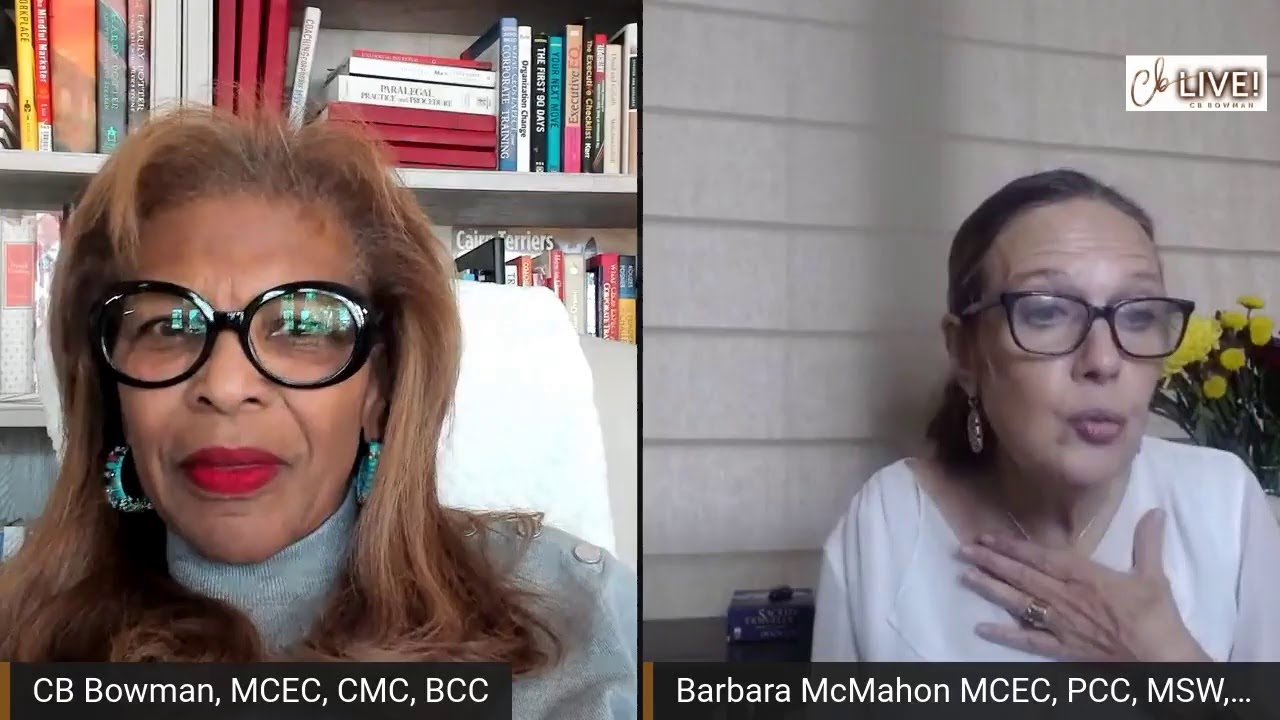
Executive coach Barbara McMahon outlines a four-part framework for C-suite leadership: Perception, Practices, Partnership, and Performance. She argues leaders must build new capacities to navigate five concurrent crises, and that real change requires inventorying values, seeking feedback, and incremental trust-building to break semi-unconscious habits.
Chapters
Hello, Barbara. How are you? It looks like we're having some technical issues here, but we're going to try to move through this because, you know, this is the new world that we live in. Hello, everybody. Welcome to the new year and welcome to CB Bowman Live Challenges of the C-Suite. And we are kicking off this year with Barbara. Is her cameras has her a little fuzzy. We're not sure why, and a little dark, but the important thing is what she will have to say. So let's bear with that camera. Okay, everyone, it's really good to see you and hear you and hope you had a wonderful break. We missed you. I was down with my husband with COVID We came through it. We're now part of the club that we never really wanted to join, which is the survivors club. I mean, we wanted to survive, but being through COVID, forget about it. If you have not had it yet, I cannot say you're in for a treat. You're lucky not to have it. So with Barbara— Barbara is putting back on her glasses so she could see us. Barbara, can you tell us about yourself? Give us the 411 on who you are.
Well, well, first of all, it's really lovely to be with you. And I'm a little bit worried about— am I echoing for you? Are we okay?
Your voice is not keeping up with your mouth, but, you know, As one of, one of our listeners said, Elena, I think is how you pronounce her name, Costin Jordan. She said, hi, everyone, no worries on camera. I could see you. Thank you for making us feel better. So speak, Barbara. You have support out there.
That's really lovely. And I feel it and it makes me feel much better. Who am I, CB? You know, my— I'm an executive coach and trainer and have been doing this work for a couple of decades and feel very, very lucky to play the role that I do in the times that we're in.
So, you know, there's a lot of executive coaches out there, Barbara. So give us a little bit more information. What your specialty? Um, you know, what do you focus in and what do you do and how do you do it?
Well, you know, maybe a good place to start is how I came to do the work, um, because this, um, unfolded, I think, through several lifetimes of of a professional career. But there was a golden thread that went through all of it. In all of the different roles that I played, what has always been important to me is helping people to maximize their, their potential. And in— back in the days of the dinosaur, when I started out in my professional career, I started out in education and I started out as teaching 7th and 8th grade kids who couldn't make it in the public school system. I ran an open classroom with 7 other faculty to help these kids adjust and to begin to tap into their full capacity. What happened to me as a result of that experience was that I realized that I wasn't as enamored, as passionate, as heartfelt about developing them academically as I was to helping them understand who they were as human beings and what they needed to do, what enhanced and obstructed their ability to make the most of their lives. And so I carted myself back to school, got my clinical degree, and worked in the clinical world for 20 years, which overlapped my executive coaching. And as part of that experience, I was a full-time clinical consultant to a police department.
Wow.
And came into that role at a time when police officers weren't very fond of working with women, and less fond still of— well, of working with psychologists, and less fond still of working with women who were psychologists. So The welcome wagon, it didn't quite make it around the corner. And that meant that, you know, I got lots of feedback that I shouldn't try to get involved in the work that they were doing or get involved in their heads. And I had to admit, I really didn't know about the work that they were doing. And I asked to basically shadow all the— officers in the department so I could learn. Which, for me, in that experience, as well as a takeaway that has assisted me in helping other leaders, was a really, really good move. Because it helped me to learn about that world. And it also gave me an opportunity to spend time with the individuals who I would be working with over time and to understand them as human beings. And both of those things were really important learnings. I, I like to, um, keep track of my experiences, good and bad, because in both instances, when it works and when it doesn't work, there is rich learning to be had that has influenced me and the design of what I want to do moving forward. And that was true with this.
So I just want to— you are going on and off and your voice is elongated. But Ayana said— she wrote something so beautiful. She said, we are I, this together, and not looking for tech perfection. And Julia wrote in, I had a similar experience with the police department. So I'm so glad people are hanging in there through our technology meltdown and connecting with you.
Me too.
So—
Me too.
I want to talk about— I see you have a whole bunch of initials after your name. Can you just tell people who are new to those initials what they mean? You've got MCEC. PCC, MSW, etc.?
Oh my goodness. Well, I'm not sure that I can unravel the alphabet soup. It just sort of sits at the back of my name. But Master Corporate Executive Coach. PCC means that I've been certified by the ICF to do professional coaching. My MSW is a master's in social work. I have an MFT, which is my clinical license to practice as a marriage and family therapist. And I've been certified as an executive. And that— I think that covers it.
Wow. Okay. So you are a great person to ask our famous question, which is, what are the challenges that you're seeing that people in the C-suite are facing today? And what do you think about it? How would you help them, support them in resolving them? So let's start with challenge number 1.
I think that the biggest challenge is sustaining transformational change. And it's an area where I do a great deal of work. Can you define that first for our listeners? Transformational change?
Yes.
CB? To really create something new that enables us to maximize our capacity in the environment and the circumstances that we're currently in and to really adapt in a way that's sustaining and allows us to thrive in our new environment and experience. That we have to remake ourselves to fit the complexities of the world that we live in, and it is constantly evolving.
So have you seen those complexities increase as a result of the 5 pandemics that people in the United States are facing?
Oh my goodness, yes. Yes. I don't think that there's been a time of greater and more complex change than we're going through now. And I think that that does— I think transformational change is a really good thing. It allows a kind of recreation, an ability to grow in new ways that can allow us to create and exist in, in new and better ways. I think that those changes are opportunities for us to learn and grow, and I think that that's a critical part of the challenge of leaders these days is to be open to learning from our experiences. Sometimes leaders who have been successful for years in a consistent way are more convinced that they're doing it just the way they should do it because it's always worked and it always will work. And so why change? And so being open to the possibility that there is another path, possibly even easier and more efficient, to get up the mountain requires an openness and a courage that has to be developed over time.
You know, you said it right. I mean, as our dear friend who we both know and love, Marshall Goldsmith, said, in his book title, which— What Got You Here Won't Get You There.
Oh.
And we, as a culture, we Americans have been a sleeping giant for eons now. And now that we are in the midst of 5 different pandemics, not just one, but 5. And so let's just be clear what those are. We're in economic pandemic, we're in a COVID-19 pandemic, we're in a racial pandemic, we're in an environment pandemic, and we're in a mental health pandemic. I mean, burnout is now a diagnostic— medical diagnostic code. Who would have thought? So the stress on everyone, much less than the leaders, is just more than what we ever fathomed would happen. So how do you create transformation, even if you want to and you recognize the pandemics? And then how do you— how does it sustain itself?
Well, you know, I think that you had the right path, the first directive has to be wake up. I think that we have and continue to go through life in a state of semi-unconsciousness.
Yes.
And that the, the— sometimes the more seasoned we are in the industry and world that we have lived in, the deeper that sleep is. And so I think a challenge for leaders is to wake up, to be able to reflect on who they have become and what are the behaviors that they have begun to rely on, the habits that they've formed that may in fact have gotten them where they are, but may have and may continue to be costing them dearly. And to be able to see that more clearly and to make conscious choice about taking a different path, developing different habits, regulating themselves to engage in new ways is, I think, a very big challenge.
And when—
they don't take that challenge on, I think it affects their relationship with others because they don't have an awareness of how those habits are affecting the quality of connection to others.
How do you recommend that they start to pay attention to this? Because clearly, if it's a habit, it's repetitive. So how do you wake up and say, I need to change, or something needs to change. Especially when there's been success to that point, right? I mean, these pandemics hit us clear out of the blue, as far as we think. There may have been signs, but we ignored the signs. So it's all just like boom, and it's there. So How do we wake up before these challenges occur and say we need to change or we need to modify, we need something?
I think that one of the things that's key, you know, over time, CB, I, when I was with the police department, I researched and then all that had been written on stress management and developed one of the first systemic programs in stress management, which over time I transitioned into a program on change management. Because I think what causes people stress is not being resource-ready to manage the changes that are in front of them, whether they chose them or they were chosen for them. And I think that those— being resource-ready can be an internal, you know, am I ready to deal with my life as it is, or it can be external, developing the skills or creating the environment that will allow you to survive in the changes that you're facing. But I think that there are 4 critical areas that you need to learn to traverse to master any real— and to master and sustain any real transformational change. And the 4 areas are these. The first is perception. How you see yourself and how you see others, how others see themselves and others see you, and how you all see the situation or the business or whatever it is you're looking at. And I think to get— wake up and see how those perceptions, your beliefs, the way you think, the ideas that you hold affect your practices is by reviewing both your own understanding of what you're doing and why, and comparing and contrasting that to how you're seen by others. So I think one of the things that can be helpful to leaders is to make a decision that they're going to do that review, and that they're going to ask themselves, what am I doing that's really working and helping me to build on my objectives? What am I doing that's getting in the way? And what am I not doing that I could be doing that would help me reach them sooner? I think it's important for the leaders to reflect on that for themselves and to develop a feedback team that will enable them to compare and contrast their perceptions of what they're doing with the perceptions of those who are in the experience with them, and to decide— make a decision based on whether or not those perceptions are in alignment. And if they're not, what they want to do about that. Because sometimes what you perceive to be the things that are making you successful, or the things that are making others run away from their connection to you. And success is not going to happen in isolation. So you need to know how what you're doing is not only working for you— you may be willing to accept the consequences of those behaviors, but they may be more than others can bear. And if you want a bigger success, that has to matter.
So, Barbara, it occurs to me that Um, in order to do this, we have to figure out how to manage our ego and how to manage our sensitivity to feedback. Any tips on how to do either or both of those? Because it seems like that's what holds us back from visiting perception.
Well, I'll tell you, one of the things that I think is really key to that is the— is really making an inventory about what you value and about what you believe is most meaningful. Because I think that sometimes we lose sight of what's caused us to act in the ways we do. And if we— once we are clear about the purposefulness of our behavior, we can understand that we can find alternative ways to meet the same end that has less negative consequences. And we can— and what really makes our ability to stay strong is to feel like we can lead a meaningful life. So I think part of it is about inventorying what is it that really matters to you and to really assessing the upside and the downside of getting what matters in the way that you are. And if you understand that it may be working for you but not working for others, for those who can see beyond themselves, That's enough to help that shift happen. Because what they really want is to hold on to what's meaningful, not to be of harm to others.
Hmm. That's powerful. Wow. Okay, Barbara, I'm almost afraid to go to the next thing, which is— I think I'll be booking an appointment with you, Barbara.
Anytime, CB.
Okay, so we talked about— we're talking about 4 critical areas. One was perception.
And the next— yes, is— so let me say that perception, our ideas, the way we think, and fundamentally our values, which is what's meaningful to us, is what influences our practices. But what I think gets in the way for people sometimes of choosing effective practices is that we, we don't get rooted into our values because of the way we think about things. So, for example, if a woman values being a good communicator, values relationships, but she's working in a system that says, you know, a woman's voice is not as important as a man's, or we don't value you for making connection to others, we value you for what you can get done. If she perceives that that's what other people want from her, then she may have a hard time anchoring into her values, and that influences her practices. And so when her practices get influenced, like she doesn't take time to build relationships because she's too heads down and trying to get things done so that other people will like her, that's one of the things That, as you asked before, can affect her ego, her sense of living a valued life, that she's doing stuff that doesn't make her life feel meaningful, which influences the 4th P, which is performance. That's the reality we live versus the ideal we want. And, you know, the, the piece about making transformational change is closing the gap between these 2 things.
So wait, so we've got perception, we've got performance. Would you say values, examining your values is another one?
Values is within perception. Perception is about your ideas, your beliefs, the way you think, and fundamentally your values.
Okay.
The way you see the world and, and what matters. And your perceptions influence your practice. If you, if you're living in a system or in relationships where you feel that others don't connect to you because they think they have a difference about what makes you valuable, what makes you— what makes you compelling to connect to. If you are with people who constrain you from living the life that you feel is meaningful, then your reality and the ideal you want are going to be— have more— have a bigger gap. The 4th P, so it's perceptions, practices, partnership. Partnership is about the dynamic way that you interact with others and the way that maybe even more importantly that you teach others to interact with you.
Yeah, I like that because we think about partnerships as coming in equal, but we forget about the training part. That's required for a good partnership, which is teaching others how to interact with you.
Yes, yes. And once you recognize that that's your responsibility, you have to look at what is it about my perception about myself or my belief about what other people hold as valuable about me that influences My practices, my habits, the ways that I choose to engage, the lessons that I'm communicating to others about how they should engage with me. So I'll give you an example.
Barbara, I have to interrupt you. Isn't part of this figuring out how the other person or your partners will receive the information that you're admitting?
Yeah, absolutely.
If you, if you decide to, uh, present yourself in a way that only benefits yourself, even though you're trying to teach the other person, if you haven't figured out how they receive information, it all goes for nothing.
Well, I'm not sure that it goes for nothing, but I think what you're saying is that it's important to know, and I agree with you completely, how someone is taking in and interpreting.
Yes, exactly.
Absolutely. That's a really important part of, I think, CB, you asked about the 3 critical challenges for leadership. I think that this really speaks to one of them, which is communication.
Yes.
And communication is first about having time and ability to reflect with yourself about what it is that you want other people to know and why it's important for them to know it. And then it's about how do you communicate that? How do you get that across so that you don't lose people and it isn't for naught? How do you influence them in a way that opens up their willingness to consider new possibilities? And I have an answer to that.
Yes, but I have to hold that answer. Do you think that leaders don't consider the others and how to support them in listening because they're afraid that it will reflect negatively on their abilities to lead. Is there vulnerability there?
Yes, I think that's a really good point, CB. I think that for me, what you're saying is that there are some leaders who are so attached to their belief that they're right.
Yes.
And their way is what will allow them and the organization to survive and thrive, that they don't want to hear or see any other reality exposed.
Yeah.
And that, and that really influences their— so many things, like, and including that they shut out this expansive range of perspectives and opportunity and knowledge and experience because they're so invested.
Mm-hmm.
They're so frightened. about trying a new path. That, that, and, and that is deadly because that means that they're not open to change.
And that shuts down any trust, right, that you're trying to build?
Yes, it does. Yes, it does. So You know, they're— so a leader's confidence in their ability to actually manage change matters. Hmm.
How do you get to that confidence? How do you— so let's take this, and I still want to go back to your story, your example. How do we as coaches Help these leaders to understand how to build trust in them, communicate better, understand partnerships better. I mean, this is all— first of all, is this a coaching opportunity or is this a therapy opportunity?
Well, that's a really good question. That's an excellent question. I think that if a leader— my response to this is it depends. What you need to do is explore how locked that individual is and how willing, if at all, they are to imagine other possibilities. And so for me as a coach, one of the things that I will do is try to hone in like a heat missile on what's the most critical belief that this human being is holding that is obstructing them from exploring ideas, differences, new ways of innovating. What is it that's keeping them stuck and entrenched in the path that they're on. Once we get to that belief, whether it's about a judgment they hold about themselves or a judgment they hold about others or a judgment that they hold about circumstance, then my job is to query them, not to push them, but to let them be right where they are, And just ask them, what if that wasn't true? What if that wasn't true? What might be true that would create more of an openness for you to consider getting to this alternative way of being? What if that wasn't true? What might be true that would enable the change that you really want to make? I'll give you an example, CB. I'm working with a senior leader in a very big tech company who's a woman and who's extremely excited and worked very, very hard to get this C-suite position in this organization. And she was brought in under very difficult circumstances where the organization that she's responsible for has gone through numbers of leadership that have failed and caused the division that she's now heading to be in extreme disarray. And they brought her in because she's an extreme knowledge expert in the— in this particular area of operations. She She knows how to make things work, and she knows the strategies that will enable this division to be successful. So what she did was she came in with a plan and brought the plan to her team and made it quite clear that this was the plan that they were going to go with. She became their human GPS system. Except she had no alternative routes, nor did she believe in any alternative routes. She said, this is the way we're going to go and this is the way we're going to step through it. And what happened was that she basically dropped a nuclear bomb on the creative team that she had beneath her. and stopped all of their creative growth and work and engagement in the organization. And when we explored what was the belief that she held that was stopping her from putting her attention to what she really needed to, which was vision and strategy— why was she so overly engaged with controlling the— every step of every member of that team that she was responsible for. And turns out it was about trust. It was about not believing that they had the creative capacity, the knowledge and ability to do the work themselves. And so we really had to explore What if that wasn't true? What if they were really capable? What would that enable that she wasn't able to get to without that belief and understanding? When she was able to see, to consider what would be possible if that belief actually proved false, she could see that she could actually engage in the ways that would enable her to do to really step into the role that she had been given. And it would enable this team to really be empowered and enabled to do what was possible for them. And she could bring a bigger part of the organization up. And so we started to look at what were the small changes that she could make that would help her incrementally build that trust. Not that it was going to turn over overnight, that she was going to get anything that was going to give her a flash of insight and make her see things totally differently, but what were the small steps that she could take that might enable that trust to grow in small incremental ways? And she was willing to take those moderate risks, which enabled her to step through that and to broaden her perspective and understanding of the way she saw others. Is that always possible? No. Do you come across people who say— who are too frightened, who are too entrenched to believe that things could be different? Yes, you do. Are they coachable? Sometimes not. And part of that, you know, part of the work in the initial phases of coaching is to figure that out and to help ensure that they're getting that— A, that partnership is worth continuing, and if there's a better resource like therapy, helping them to engage in that.
You know, we can have another session Another session, another meeting. I'm now into your land, um, which talks to, uh, listeners about when to let go of a client. When do you actually have to fire a client for your health and being and for their health and being? And, and that's something that we, especially younger coaches, don't think about. But what I want to ask you is, how did this client come to you? Did they— what was it they recognized? What did they say they wanted to have happen that you were able to funnel all of the discussion down to, this is our focus area?
Well, you know, it's interesting because you said before Does a client's ego or sense of themselves ever get in the way?
Yes.
And this was what really enabled an opening. This client really did believe in themselves and believe in their ability to handle this expanded role and set of responsibilities. And in some way, her perception of herself was not an issue. It was her perception of others. She had that— she thought that for others to be successful, she had to— she saw herself having to be involved in a very controlling way.
So the play I'm sorry, the plane that she rode in on to meet you, to meet with you, is saying, I am having trouble with my staff?
Was, I want to be more successful, but I'm so split because if I go do what I want to do and can do, I will have to leave these people in a tenuous position, and none of them are going to survive. And that's part of what my mission is, to enable this team to survive and to be effective. And the only way that she— her misperception was about what it required of her, what kind of partnership she had to engage in with them for them to be successful.
But initially, it was about her being more successful.
Right. It was, can you help me to figure out a way to take care of these— of my direct reports and still have enough time and space left to go after what's important to me in the role that I ultimately want. And she saw it as an either-or choice. And I think that that's an interesting thing that a lot of leaders and service providers, whether it's coaches, or the people that they hold as their client. That, that's a misconstruct— that's, that's a misperception that gets a lot of us in trouble, that it's an either-or thing. Either I take care of the people who I'm connected to and hold my— and, and feel responsible for, or I do what will take care of me. And the problem is that For a lot of folks challenged in this way, it's an either/or choice. And when they're looking at it as an either/or choice, somebody dies, lives are lost, possibility is diminished.
So it's interesting that she was able to see that her success was not moving forward. A lot of people, I think, can't see that. They think, oh, everything is wonderful, and I'm moving forward. So be curious to know, what was it that gave her that aha moment? I need to do something else.
Well, I don't think she held the belief that she was moving forward. She felt overwhelmed. It was a question of who, who has to manage the overwhelm, me or them?
I think this is very valuable to our coaches listening because we are often given assignments where the starting point is not clear. The fact that overwhelm is present allows us to tackle and break down the barriers and the parts that we want to support our clients in. That overwhelm is a critical statement, especially with 5 pandemics.
Well, I think that this brings up a point that It's a question of how do— how does transformation happen in your life? For some, it's something they choose and work for, and for others, it's something that chooses them. And that circumstance becomes so difficult in the moment that one's health becomes so bad that you have to pay attention to what you're going to do to revive, recover, and heal, your circumstance becomes so untenable that you have to think about doing it differently. I think that as we've been hearing, the challenges we face, as bad as they've been, can be an opportunity for growth and learning. Because otherwise, if the pain had not been as great as it was, the desire for change would not be there because not everybody believes that continuous learning or continual growth and transforming is a valuable part of our experience. It sometimes isn't until, like the alcoholic, you hit rock bottom and there isn't any other choice. But to choose to do things differently that enables you to see that there are possibilities that you never imagined or would never consider.
Is this a cultural thing for us?
I think it's a basic— that's just a tremendously interesting question. I'm not sure I have the answer to it. CB? I mean, it's a great question. It's a great question. And, you know, my first response was, well, you know, from the beginning of time, our first charge in life is to figure out what it is we need to do, a range of ways of being and behaving that's going to allow us to survive and thrive. I think sometimes when figuring that out at the early stages is hard for whatever reason, because our life circumstance is hard or because the people who are guiding us have very strict and constricted ideas about that, that once we get it, once the program is in, it gets really, really hard to change, especially when there's, you know, a resistance or a difficulty in getting clear about the program to start. And so is that cultural?
And when I say cultural, I'm not talking about it on the race side, although that could be a lens. I'm talking about it from America's culture. I mean, we could also talk about it from the lens of it— is it professionally cultural driven? So a tech person might be less driven to accept change than an artist. But more driven than a financial person. It's a, it's a good way to look at it through different lenses.
Great way, great way. And wouldn't it be cool if we were awake enough to be able to understand what part of our life experience that choice or perception was attached to. Because like you're saying, you know, this is like one of those— I think, I'm not sure, is it a kaleidoscope that has those different lenses? So if you switch it up, it looks really different.
You—
so, you know, like, we need to be like more childlike in switching those lenses. intentionally to see how does that shift things for us and how does it reshape our ideas about what should be. And I think you're right that there is an incredible number of lenses that we're given and look through and we forget that that's part of what affects us, whether it's industry. That's just a brilliant recognition that it, you know, if you're an artist versus you're a tech person versus you're a financial person. And also I'm thinking about a doc that I work with who became a doc because of his own early childhood experience with illness. And that experience and the connection that he actually made to his service providers got him engaged in his desire and interest to be a doctor. And he wasn't super smart. So in order to be successful in his pursuits, he was very, very, very, very driven. Super driven. Good news is that that drive enabled him to become very successful. But he came out of that experience thinking that without that kind of intense drive, that it wouldn't be possible to be successful. And he didn't see that as a, this tells me something about me because I chose a profession not because of my aptitude, but because of my experience.
Yes, yes.
He came out of it believing anybody who wants to be successful has to be driven like me. And so when he got in charge of a large division, his expectation on his people and his, his worry would come up in magnitudes that was just unbelievable if people weren't working 14 hours a day. He goes, they're never gonna make it. It can't be done in less than 14 hours a day. No, you can't go home. And it took us, you know, doing the 360 and really looking at and understanding more about him, more about where he came up with that belief and why, to help him to unlink that with the direct reports he worked with and what he required of them. And when he was able to do that, he found, oh my God, if I let them be in charge of the balance that they need, they are much more productive in the hours that I have them.
So this is such a great story and we're running out of time, but I want to tell you, This also takes me to another area of what's the socioeconomic impact, that lens, because then we can also look at the racial side, right? You know, I look at my past and I look at the many blocks that I had. And so, and, and it drove me, as with this doctor, To be more successful. But what it also did is it gave me less tolerance for people who have excuses. I'm like, what the— oh, I'm online. I'm on the air. What is wrong with— I'm gonna clean it up. Wrong with that person? Why can't they just, just do it? As Nike says, get over yourself.
Yes.
And I don't understand it because my psyche won't let me understand it.
I think that that's it. And with that, I mean, I think it's important to recognize that in some way that's us trying to use our experience to keep other people safe. And the expectation that if this is what I needed to do to make it work for me, this is obviously what it— what it's going to take for you to be successful. And if you don't do it, you're gonna mess yourself up. Don't go that way. And this compassion, caring, it's like, wait a minute, Wait a minute.
Yeah. And then we pull down the God flag. God helps those who help themselves. So get busy and make the change. Oh my God. We all have such work to do.
I'll leave it there. And if we only knew that and were willing to take inventory and do that work. And I think that, you know, too often, especially for the, you know, when we've achieved some degree of success, we figure if I've been this successful, I must have the right program. All I have to do is reprogram you to be like me, and then we'll all be okay.
We'll all be happy. We'll be perfect.
You will all be happy. We'll all be happy. So I'm going to try to make one more point by going back to something we, we started to cover before, which was communication.
Yes.
And how we can get messages across and make people consider things that they might not have been willing to consider before. And I think that My secret sauce for that is peanut butter. Would you like to hear why?
Yes, definitely.
Okay.
And is it a specific brand? Is it—
No, no, no, no. Any kind of peanut butter will do.
Okay.
Here's the story. So when I was a clinician and I had an office and was seeing patients, So I had an office and a waiting room. I got very sick and I, and I was going to work anyway. I had the flu. And, you know, I'm one of those endurance people, endurance runners, endurance, you know, if you can keep going, you should keep going. So I was continuing to work. The man who shared the floor with me at the office building, Was an Asian architect. And he just got sick of hearing me coughing and all of that. So one day he said, Barbara, come with me. You're going— come with me. Lunchtime. Come with me. I thought he was going to take me out for soup. He brought me to an herbologist.
Yes.
An Asian herbologist who gave me a tea to deal with the incredibly bad flu I had. And it took away the flu. The tea tasted terrible. It was horrible. I said, you know, I wanna work with you. I want— I'm open to herbs, but I can't. Is there any other way to do this? He said, well, if you were more aware of your body and you got aware of when your body was off earlier, you could take a pill that would get rid of your symptoms and eliminate your illness earlier. But you have to, A, be aware of your body.
Lesson number 1.
You gotta stay attuned to your body. So I started taking the pills. I started being more aware of my body and I had kids. And I asked, went to the doctor and said, will this medicine, is it okay for kids, this natural compound? They said yes. And so I wanted to give it to my kids so that when they got sick, they wouldn't, it wouldn't last as long. It wouldn't be as intense, but these pills were big. And I had children who were 2 and 3. And I said, what am I gonna do? I'm not gonna be able to get these kids to swallow the pills. They'll choke. What am I gonna do? So I decided I had to put it in something that was manageable for them. And that would be, that would be appetizing. So I smashed it up and put it in peanut butter. And I told them, look, Mom's smashing up your medicine and putting it in peanut butter. But when you take the peanut butter, when you get the beginning of a cold, it'll help you to get better faster. And I taught them how to be more aware of their bodies and tell me, Mom, I need yanchao and peanut butter. And so they stopped fighting with me. They took the medicine. My kids made it through school. I didn't miss a lot of work. Everybody was happy. The moral of the story is this. A lot of times during change, you have to message difficult information, situations that people don't want to hear, and it's hard for them to swallow. And what you have to do is find their peanut butter. What can you wrap it in? that is tasteful and compelling and that they will want to be open to and will be easier for them to digest. So not only do you have to understand how it's purposeful to you, but you have to build relationships enough so that you understand what's meaningful to them and wrap the change in something that is valuable to them as well. Even if it's for a totally different reason.
I love the story. And by the way, that's how I used to give my dogs their pills is I'd put it in peanut butter.
Everybody needs a jar of peanut butter, essential item in the kitchen all the time. No question.
But I want— I'll tie this up, but I want you to send me the name of that pill and where I can get it.
Okay, deal.
So everybody, I hate to say goodbye to Barbara because this has been just amazing conversation. So I hope that you stay to the very end. And Carolyn Boyce said, find your peanut butter. I love it. And Carolyn and I know each other from the— oh gosh, I'm gonna screw this up. Chief Financial Officer Leadership Center for Diversity and Inclusion.
That's right.
She was gracious to invite me on her board. I hope I got it right because I'm new to the board. I'm so happy that she tuned in. Everybody, this has been CB Bowman Live, Challenges of the C-Suite with Barbara. And reach out to Barbara if you have any challenging clients in this area. I'm sure she's gonna guide you and use some peanut butter.
Thank you, CB.
It's been fantastic. We have to have you come back because we only got to like one or two of the challenges.
I love it.
Wonderful. So everyone, I hope you'll tune into Challenges of the C-Suite: Workplace Equity and Inclusion, or Workplace Equity and Equality. It's all of the above, and that takes place on Thursdays an hour earlier than what we did today. I will see you all soon. See you next week. We have another fantastic Fantastic guest. And remember to have a wonderful new year and make it successful. Bye now.
Bye.
More from CB



211- Courage to Leap & Lead with Louise Story part 1Courage to Leap & Lead







