CB Bowman LIVE: Challenges of the C-Suite: Oleg konovalov Episode 11
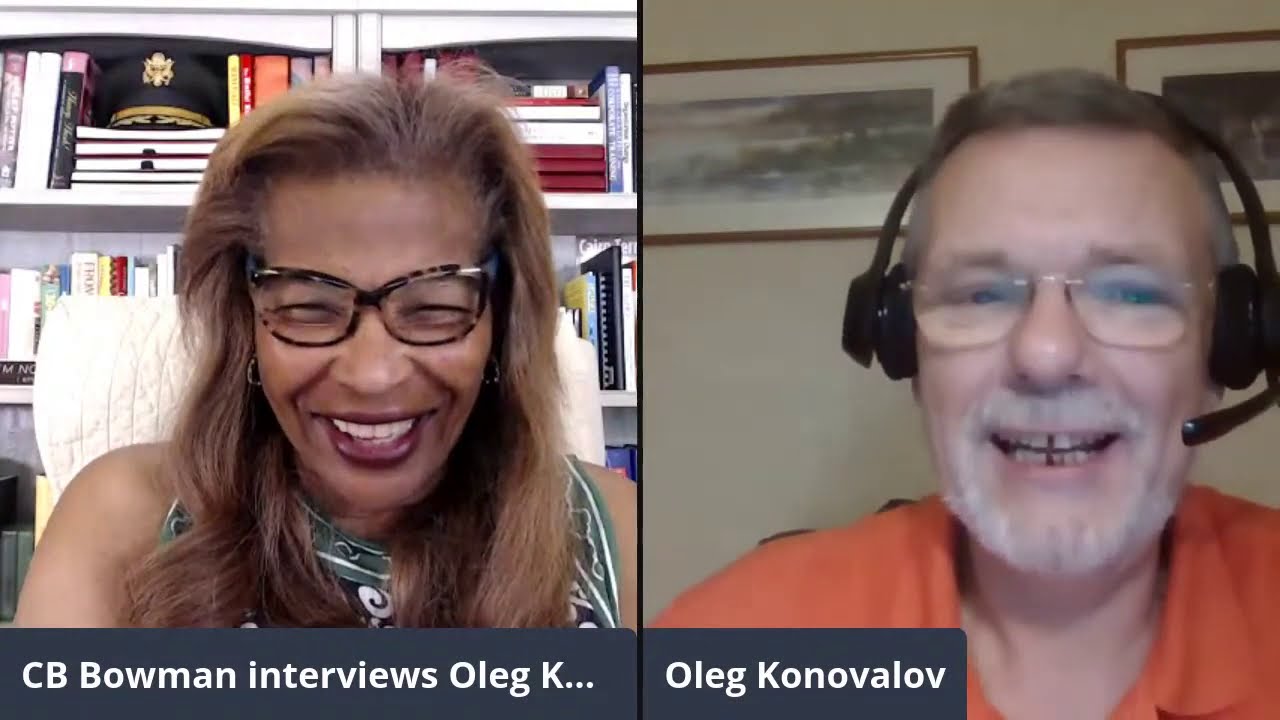
CB Bowman interviews leadership coach Oleg Konovalov about what derails C-suite executives: ego, lack of vision, silos, and micromanagement. Konovalov, author of The Vision Code, discusses how visionary companies like SpaceX and WD-40 succeed where others waste time in pointless meetings.
Chapters
Hello, Ulluk! How are you?
CB, nice to see you. I love to see you every time. Thank you.
We had a few technical glitches, but it makes it more juicy, right?
No, because we're still calling ourselves being in the 21st century, you know, being advanced, but we are not. Come on, be realistic. You know, we're still old-fashioned. You know, that's fine.
So listen, you know what? I heard that Marshall Goldsmith, our guru in leadership and coaching, has given you a new acronym to call yourself. You are the Da Vinci of visionary leadership. Yes.
Yes, and I even allowed myself to avoid dishwashing for 3 days at home. I don't know, would I withstand 3 days, but I will try. But actually, I really am grateful to Marshall. He was involved as one of the respondents or key respondents in my last or newest book, The Vision Code, and he was generous enough to write the foreword because I came up in this book with a 6-step model, how to create vision, how to grow as a visionary leader, how to structure to make it functional, your vision, how to influence, how to execute, and to revitalize. So I call it CAVER. And Marshall found it really, really practical and groundbreaking. And so when he wrote to me, your Da Vinci Vision Leadership, it was just like Blessing, you know. And then, you know, and I was staying quiet because whatever, it's just like— and then he put it in the Forward, and, uh, yesterday he put it on LinkedIn, and it just like a bombshell. Boom, you know. So it's almost like me waking up in the morning asking my wife, am I famous? You know, but of course it's a joke, but you know, it's incredible.
So, Alik, I need to get your autograph now on your book.
Oh, I should have it with me next time we'll see you.
Okay. Okay. So now let's roll the tape back. I know that you are a bestselling author and you have lots of experience in giving advice to the C-suite. So let's start with, tell us a little bit about you. And I hate that interview question, but it's so appropriate here.
Oh yeah, you see, we love talking about the past, but what about talking in the future? Because we, when we're meeting someone, we're more interested what we could do together in the future rather than— because we can't do much in the past. But actually—
The past builds the credibility, so—
Yes, and here you see I have a really diverse experience being in a fishing industry, being a thought leader, uh, yes, writing books. I hate writing, but I write books. You know, that's incredible, you know, pivot in my life.
Mm-hmm.
Actually, I spent many years in a practical business in the corporate world, and then I turned into that thought leadership consulting and then later into coaching. So I'm still looking for solutions. I'm very curious. I'm an explorer and this is about me. I lived in different countries, I'm still Russian, you know, thanks to my parents, you know. But I was always keen to look what's going to be over there tomorrow, you know, how I could grasp it, how I could make it different, what I could do myself. That's a big deal of exploring and curiosity. And well, it is a wisdom or reason why Marshall named me the Da Vinci of Visionary Leadership. I'm looking for that golden ratio of the things, for instance, in leadership and management, how we could make them Beautiful, artful, not ideal, because it can't be ideal, but they are beautiful, and we are creators of it. And to find that golden ratio is our duty, you know.
Okay, so now I'm gonna stop you there. Uh, now tell us just a little bit, your first book that made you so famous. What was the name of it and what was it about?
Oh, it was called— the name of it, The Corporate Superpower. It's about corporate culture. I came up with a power pyramid, how to build or cultivate a strong culture or fix it if it's gone negative, right? And I know there's a reason, because all my books before, I devoted to my wife, and that was the first book I devoted to my son, and immediately I got a different result.
You are gonna be in so much trouble tonight.
No, no, no, no, I got a reason, I have a very valid reason, because you see, when I'm writing something, I always have a metric, a simple metric. Would it be relevant to my son in 20 years' time? If it does, it's worth putting on a paper. If not, don't waste your time. Just pin it, you know, don't use it. Because if it's for today, do it. Don't put much on a paper, you don't waste people time. But if it would be relevant for the next generation, this is important.
Okay, so getting down to important for the next generation, and I also think for this generation.
Oh yeah, for sure.
What do you see are the challenges that exist in the C-suite is part A of the question, and part B of the question is, are all challenges the same regardless of the country if you're running an organization?
I will tell you something.
Yes.
And this is— I, I love the corporate world for being exceptionally brave. They're really brave in doing stupid things and not admitting them. They're really brave to put their life and career for meaningless conversations. They are bravest on repeating the same mistakes again and again and again and again and blaming others. They're the bravest people in the world.
You are going to get me in so much trouble for this, Braco.
Look, you ask me, you know, but this is true because think, the greatest population of Silas is in corporate world and it's not the not on the, you know, bottom row. It's on— it comes from the top. It's from C-suite, because a C-suite allows the silos to grow without any responsibility, without any deep thinking. They're not allowing or enabling decision-making.
Hmm.
They are good at supporting politics, but politics never let any company fall, right, and accept into the trouble. We know for that, for the last 50 years, the life— average lifespan of a large corporation is fall down from 75 years down to 15 years on average.
Yeah.
Right? It's not a market, because every market is about change, but stability at the same time. But it's people who are not thinking what will happen with that company tomorrow, or what will happen with the company customers tomorrow. They're thinking about their bottom line, paycheck at the end of the year, And they're brave enough to come back home, look at their family life, eyes, and said, look, I got a check. But if it would be honest conversation between that executive and his son sitting together around the, you know, campfire, for instance, if they went fishing and talking, you know, listen, son, I did something wrong just for the money. What would be the lesson? How brave you need to be to do such stupid things. They are brave. They are brave. They are brave not to stand up and, you know, do something real instead of nodding their head. It's one thing.
But, you know, I want to stop you there because I think you have such a valid point. Because look what happened as a result of that for COVID-19.
Yes.
The companies were spinning like they lost their balance.
Absolutely. Absolutely. You know, to be weak in such a situation is— you need to be brave. You know, because when you do something really important and valuable, you're not thinking about emotions. You're not— you're not spinning that people's emotions. You're not brewing them. You're brewing a result.
Mm-hmm.
But when you have nothing to do, you just— you're making them, you're pretending them. Hey, you know, come on, stop it, guys. But that's all right, they're brave enough, cool. Another problem I could see, and I wrote it in my last book, this, The Vision Code, we're living in the times of leadership blindness. 0.1% of modern leaders have vision. Tell me, how many companies you met yourself Have real vision, not a vision statement. I had a nice chat today with Chief Strategy Officer of a huge financial organization, and he said to me, "Look, we paid some silly consultants tremendous amount of money, and they came up with 36 words vision statement and left." Right now, he said, "No one remembers." What's in that statement? It's a blindness. So we are brave and but blind. Okay, it's a good combination already. We don't know where we go. And the same case, you can't hit people to such extent when you work in the corporate. in C-suite, you must love people. You must respect them at least, whether they are customers.
If you—
when I'm just either coaching people or work as a consultant, I'm always asking for a simple thing, my C-suite clients: when did you talk to your real customers last time? It makes them blank. They never talk to people for whom they should actually work. So, they have problem with listening and seeing the world around them. So, then—
But the original problem starts with, they have problem asking. The question.
Well, or either they're asking to argue.
Yes, you have to ask the question before you can listen, right? So knowing what the right question is, asking the question, and then listening for the answer.
It's another point. It is amazing transformation happens every day to these people. Amazing, incredible, you know, because they are brave enough to tell their customers, oh, our software doesn't work or doesn't support your problem, you know, whatever. But as soon as they're leaving their office at 5 or at 6 or whatever the time, they're coming back home, they are not brave to tell their wives, look, I went to a shop, I didn't get milk. They are not brave.
They—
how comes you ignoring customers or your employees during working hours by being a customer at the same time in the evening?
Mm-hmm.
It's incredible transformation, you know, because these people coming to a shop and they're trying to be a sophisticated customer, and it doesn't work.
Let me ask you, for today— well, even yesterday— for me, I think one of the greatest visionary leaders was Steve Jobs. Do you feel the same way?
I can't say that one is better than another, because we don't know— he, Steve Jobs, created his impact in one area, right? He changed the world. What about Martin Luther King?
Ah, you're talking about consumer, my mind went to consumer products.
Okay, consumer product. To what extent Elon Musk Moved the world.
Uh-huh. Good point. Yes.
Actually, if you would talk to people who are really in this AI, or for instance, driverless cars these days, we don't see much of the result yet, but I believe that within few years' time, we will see a result, And we will be saying, aha, it just happened. No.
No.
They do it now, and we will be hearing new names. And I already know quite a few of those names. I could— I know a number of people who do really great work, and we are not aware of them.
Yeah.
I had a chat again. It was one of my clients, and we've been chatting about my work, and I said, Why are you focused on people like, you know, call it in a premium league, right? But not really like top champions. And I said, okay, what's the chance for you to meet in your life, to meet and talk, for instance, with Elon Musk or Bill Gates? Zero? Once? And they said zero. And I said, agree, but people want to learn not from those superstars with whom they they don't have a chance to talk.
Yeah.
Or to get a real lesson. We have visionaries around us, and it's best if you could bring somebody from whom you could get practical lesson, learn about their challenges. You could get the window into the way how they think and act, to feel to be in one room with them. And that is a huge difference.
Yes.
Because those people, those visionaries, create incredible world now, while we talk.
All right?
Yes, we have that time lag in understanding of the value which they created, but look, we're using these Stream StreamYard platform or Zoom platform isn't amazing. We realized its value only because of a COVID. But those guys who created it, they were working for Cisco, and when they offered to Cisco, the Cisco said, "No, no, no, no, no, no." Okay, we still have a vision for it. We will do it. Thanks to them, they connected us during the COVID Isn't a vision? How important that Zoom platform became for all of us.
Yes. What, what do you think stops those in the C-suite from Touching the people in the street, from hearing them, from asking, from listening? What stops them?
Ego. Ego. Because ego kills your vision. Ego increases the distance between a person and other humans. You know, ego. To listen to people, to feel their pain points, to create a vision and see where I could add value for people, I must kill my ego. Ego and vision, they can't live together because ego kills vision instantly, because it's everything about me, me, me. But what about for people? Because vision is creating value for people, acting for people, and do something for them and with people, you know. But when I have ego, I'm really egocentric. It's everything about me. I have bigger, more, I don't know, shinier, you know.
It's skills.
Not why we ignore people, because we think we are better than them. Why I should listen to someone on the street or in a shop? Because I think I'm better than this person. Many businesses went down because of this. They ignored the world, they ignored people, they ignored own Our own experts who've been coming to the board and saying, look, we should do something differently. It's all went wrong. Ego.
What else gets in the way besides ego?
I would say, We all trying to be smart. The problem these days, we are not trying to be wise.
Oh, I love it.
And the reason is simple, CB. Think, we read books to tell our colleagues that, oh yeah, I got this book, you know, But look, a million books published every year, you can't read them all. But it's a matter of what you have learned out of reading something, or talking with people, or being in touch with people, being really connected. We became knowledgeable, but our outlook didn't become broader. And so our neurons are disconnected. They're just working as a— in some kind of uniform way. We are not wise enough. We're not wise to allow people for agreed decision-making. You know, to— you know, there are 2 things which are critical to enable this good decision-making in a team. Purpose, where we go, and enablement in terms of giving people a freedom by giving them a direction. Think for a moment, if you know clearly what do you need to buy, you're going to a shop, you buy it, your money not wasted, your time spent efficiently. If this product, jeans or shoes, not on the shelf, you simply turn around and walk away. Okay, the money with you, you will buy it next time. But if you don't know what you want, you spend a day shopping around, the money wasted, you bought a pile of the things, you know, a few bags, you came back home, all this stuff will be covered with the dust in a cupboard, and the best scenario, it will be given to a charity. Your day is wasted, money is wasted, a result is not achieved. How good we are decision-making? If people don't know where they go, how they could allow others to be free in making appropriate decisions? And this is about— it's not a Matter of a process of decision-making in the large corporation. It's a matter of not knowing where they go.
So, how can, how can the C-suite CEO change this?
Start from himself. Because no one will do more than his leader. No one.
Hmm.
It's, it's very simple. You know, if you can't, as my leader, if you can't show me, or be my example, be my model, how you expect me to be a model of doing something better? No chance. Right? It's one thing. If, if a CEO doesn't have a vision or direction, How his people could have a direction? If you support those dirty politics in the company, if he tolerates or he or she tolerates silos in the company, how he could nourish an effective team performance or company performance? How he could create— I could, I could tell you from another angle. Leadership reflects— sorry, culture reflects leadership. The problem is that majority of companies still have negative fragmented culture. Who cultivates that culture? A girl at a canteen? Or a woman at the reception? No, it's tolerated by a CEO. If he doesn't put any energy, any effort, any direction to the people, it takes culture— quite capricious woman, she takes revenge immediately by, you know, Bad behavior, low performance. It actually quite quickly kills company. Who is responsible for that? CEO. You know, and if CEO tolerates meaningless conversations and do nothing about this, pretending that he is busy. People can't be taken for that, you know. If we think for a moment, how much time we spend in meaningless conversations or meetings.
Hmm.
I took a little research. A middle-sized company, on average, wasting between $6 to $10 million per annum on meaningless meetings.
Oh my God.
Roughly, I would say 5% is wasted, just like that. Larger corporations waste more.
I am very curious to know, I'm very curious to know, what do you consider to be a meaningless meeting?
A meeting where people know what they came for, And what result they aim to create. We know that not every conversation could lead us to some kind of a good outcome. We might still be in search for some kind of a solution. But we did not exercise our power or status over each other. We collaborated on that meeting. You know, we put resources together. We did not challenge each other. And so, most of those meetings are about, I'm not guilty, he's guilty. You know, it's not our fault. It's not— people are not contributing. They're just, you know, fighting with each other. Or they're just speculating on somebody's time because, to show that they are important to some extent.
Why?
Yeah. Yeah.
I have to agree with you. I remember the meetings that I had when I was in corporate America, and I hated them, hated them with a passion. Because first of all, to me, it was the person at the lead table, at the top of the table, pontificating about what they wanted to do, and everybody saying, yes, yes, yes, absolutely correct. And if you dared to challenge, and I was a rebel, So I dared to challenge, shut up, know your place, you know, only contribute valuable conversation. What was valuable conversation? Valuable conversation was agreeing with the lead speaker.
We could say that many of these C-suits today, uh, Top performers in micromanagement. You know, they are Premier League micromanagement players. Because when we talk about micro— micromanagement, we, we think about it like low level or middle level of hierarchical. But it starts from there, from the top. And this is exactly what you said. A pontific, micromanaging people who are paid a ton of money, who are supposed to know these things themselves. And he is micromanaging them on absolutely silly things. Because he or she, Doesn't have a direction to go. They're all attuned to the bottom line. Doesn't work. It kills company.
Well, but at the same time, the expression is they succeed in spite of themselves, right? I mean, look at Jim Collins' book Good to Great. When I first read it, I thought it was the Bible. Now I think, well, it was very smart writing for the time, but how many of those companies exist now? We had them on a pedestal.
You know, I love you, and I think it's simple because what I'm always arguing is if we actually— if we'll try to write down the list of really effective companies, not just well-known or big, the list wouldn't be long. It wouldn't be long. You know, it's not a list of stock exchange, you know, traded companies. You know, it's nothing about that. We're talking about effective companies with a good culture, with a good leadership that's really progressing. How many pieces of paper do you need? Might be 2, 3. You don't need much because the rest is just pretenders. Well, I have all sorts of leaders these days. We have pleasers. Leadership is not about consensus, it's about leading people. So when you were trying to please people, shareholders, you know, everyone, you wouldn't get far. And again, For what you will be remembered. Pleasers are faceless. They're not remem— you don't remember that.
Mm-hmm.
You know, they disappear as a fog. Then we have these guys with incredible personal ambitions. Ego. Have you ever been attached to someone because of his huge ego? Tell me.
Yes.
Did you? I never. You know?
It blinded me. That's my claim. It blinded me.
Yeah. And we talk with you. It's not about a corporate America or corporate Britain or corporate Russia. Just talk about a corporate world. They have a special map.
Yeah. So tell me, of the companies that exist now— and I'm going to narrow this down to America—
Okay.
Which companies— name 5 companies that you feel Have visionary leadership.
We know about WD-40, right? I love them. I love talking with Gary Rich. He's incredible. He's brilliant. I will give you examples of companies of different sizes and in different States, you know, the different industries.
First, I want you to tell me, why do you think Gary— and we both know Gary— yeah, why do you think that he is brilliant and he's a visionary leader?
You could see a drive of all his team members, tribes, right? And a simple indicator The engagement is about 95%. It's probably the highest in the US or in the world, right? That means everyone on board believes in what the company does. They have a great person, their why is about to make a lasting positive memory. And they're fulfilling it, every day. You know, and it's really, you could see people really smiling and doing something with a meaning. That's incredible. And I love the Gary Rich statement, my vision doesn't have a period at the end. He's always evolving, which is phenomenal. You know, he's always learning. We sat together at the Thinkers50 event, Just like next to each other and been listening to all these phenomenal lectures. And Gary Rich, famous guy, he was writing his contract as a student, first-year student, you know, just like learning, learning, learning, learning. I think people could learn from him, I don't know, a lot. But he was learning, Himself, and this is incredible attribute. You know, or trait of a visionary. It's San Diego. Another example from Florida. It's a small company, 150 people. I venture solution. It's IT world. Well, it's a bit you know IT. Whenever we say IT, it's like covered with a mist. You know, incredible 2 guys, and they create a company which really grows. And I, I love the way they, they strived during this lockdown. You know what they did? They ran almost daily cooking show on Zoom, 150 people. They've been watching someone in the kitchen cooking and doing the same in their way. So, more or less, their lunch was spent together. Right? They've been ordering the food from the same Mexican restaurant and eating it together in front of their screens. That allowed them to go for IPO within 3 months.
Give the name of the firm again.
IVenture Solutions. I just came to know them very recently. They're not my clients yet, but I love the way they do, you know. This is incredible. We know, of course, about SpaceX and Tesla, which are great examples, you know, for not just for the US but for the whole world. So there are a number of great companies in the US which could be said, yes, they are visionaries, they are making a difference to this world. Yeah.
Is there any hope for companies that don't have vision? Do they need to scratch everything and start again?
It's not suicidal, for sure. You see, CB, it's— when we say that we are advanced into technologies, well, it's not true. We're actually very superstitious because we still believe in old things. Vision is not a gift. Come on, guys, stop it. Vision is an algorithm of thinking. It's a beautiful system thinking about complex things which you present in a simple way. It's elegant thinking about complex things. And a vision comes when your conscious awareness of a problem that you want to solve reaches its peak.
Mm-hmm.
It's not about statement. It's not about a huge shiny plaque on a, in an, on a reception wall. No, it's your conscious awareness of what you want to solve and how you would add value to people. How you would define your future? It's aspiration for a future which you make a reality today. So, if you want to create a positive lasting memory, as in case of Gary Rich and W40 company, or you creating your show and you're trying to make a difference to educate people in the best way by bringing top experts and get people into a conversation, that's also a vision. It's a matter of scale, you know. So, where is your aspiration?
Mm-hmm.
I never seen anyone in real world whose aspiration is in the bottom line. If you pull the people out of that corporate world for a few minutes, and I will talk with them, and you will ask them, where is your aspiration? They will talk differently.
Hmm.
And the same case, we're all taught or said that vision is a gift. It's only few people in the world can do this. No, no way. I've been said, okay, I'm the whisperer of vision because I have a vision for a vision, which is a bit of Hey, new title, Visionary Whisperer. Somebody already said it, you know. And the thing is, I was born without silver spoon in the mouth. I came from, you know, all that stages, from, from a fishing trawler engine room up to that red carpets. CB, it's a matter how you learn, Where is your aspiration and how you focus?
Mm-hmm.
Where is your focus? Where do you create your value and how you pass this value to people? So, it's, it is coachable or teachable, you could learn about it, you could put your thoughts into it and it will grow. But if you're focusing on the bottom line, you'll get a bottom line.
Well, you know, I think part of, a great part of the problem here is that even if you're a visionary leader, the board forces you to stay focused on the bottom line and not on the vision. And it's, it's a vicious cycle.
So you, as I mentioned, you're either a pleaser or you are a leader. Yeah, you guys are putting a stake in the ground firmly. No, we have a vision, right? What I will tell you something, I have a Visionary Oleg Kanavala Visionary Leadership Coaching Certification Course, right?
Yes, I was going to lead to that, but you need to talk to me, and I will tell you the reason why I'm so excited about taking this I will see you next week. Next week, as I lead the Association of Corporate Executive Coaches, the MECO Institute, and now Workplace Racial Equality. Leadership is not easy. It is not easy by any stretch of the imagination. You almost have to give up you. in order to embrace others and then come back and form you and tease out what you learn and put it into practice. So that sort of in and out and molding of yourself has to take place continuously. And it, it is exhausting, but it's also incredibly rewarding.
Thank you.
As you see your organizations flourish and grow and You become like the proud parent.
Exactly. It's nothing more rewarding.
Exactly.
You must lose yourself to find yourself. You must kill your ego to reveal your true self. You know, and that's incredible journey. And the thing is, what I'm talking about, think for a moment where we are in a realistic world. There is a 6-step process which you could be trained. Why leaders must be coaches? Because if, for instance, a visionary leader came to a new company or whatever, he has a team which is not visionaries. His duty is to make them visionaries, to coach them. Because it's all— vision is a team sport. Right? I can't be visionary with— without my team having the same properties.
I like that a lot.
Yeah, it's— I must be coach to my people. It's not a matter that you would make money by being a coach. No, but you must be coach as a leader, because that allows you to get your team to the next level, and to the next level. And when you're helping your people grow, they will help you to become a better leader in return. That's secured. That's guaranteed.
You know, Olof, I'm going to invite you to be a speaker for the Association of Corporate Executive Coaches because I believe that to be— to pass mastery in executive coach You have to be an enterprise-wide business partner. Being an enterprise-wide business partner means not only knowing your clients, but the environment in which they reside and helping them to become visionary leaders. That, I think, is a responsibility of an incredible coach.
I'll give you a tip. A simple, simple tip. It's the funniest, easiest question you could ask, but it's quite difficult to answer. If you ask people why vision is important for you, they often stuck because the people they say yeah we need vision we need. Why? Because when you have that really conscious understanding that, yes, I need vision because I want to make something different, and there are different reasons for it, then you really would fight for your vision. You would really put yourself into it because you see it valuable. If you don't see it valuable, Would you care for it?
No.
And that's the first message that leader or master coach should deliver to his people and say, guys, we're about to create the most valuable thing in your life. Because if you don't have a vision for your life, you're still living meaningless life, routine.
Mm-hmm. Well, that is a good point to end on, but I want to actually end on another point. I remember that you and I had a great conversation one Saturday morning, 8 o'clock in the morning when you called me.
Come on, it was my afternoon.
Of course, of course. But we had an amazing conversation. And one of the things that I loved, at the end of the conversation, you asked me this question. You said, what did you learn from our conversation? And I am here to tell you that I hope my audience has taken away a great deal of knowledge. I know you as my friend, and I thought I had all the knowledge in your head. But you know what? I'm like a sponge. Give me more. Give me more. I have learned so much today. And the C-suite listeners here, I hope they reach out to you. I hope so. I hope they really listen, they read your books, because there's so much power in what you said. And we've got to stop the ego. We've got to stop the fear. We have to get people We have to get people asking, and we have to get people loving what they do and getting rid of the fear. We have to get to wisdom.
Oh yeah.
And leave smart behind.
Thank you very much, CB, because I love your questions. They allow me to think differently.
Thank you.
You know, and routine, how boring is it? I wouldn't be good at bookkeeping, for sure. No, it's not my business. True. You know, I'm about something more risky.
Yes, for sure.
You know, and the good, great conversation, it's not about you or me. It's about the subjects that we put between us and we're both adding to that subject. And thank you very much. It was a great conversation. We both added to it.
Thank you. And I hope our listeners will tune in for the next episode of Challenges with the C-Suite. We're going to talk to Dori Clark, who is also one of our MG100 family, and Thank you to Marshall for putting together such amazing people to have great conversation. Thank you all. This has been brought to you by the Association of Corporate Executive Coaches. Stay tuned and be successful. Bye now.
Bye.
More from CB



211- Courage to Leap & Lead with Louise Story part 1Courage to Leap & Lead







