CB Bowman LIVE! Challenges of the C-Suite: Mongezi C Makhalima Episode 15
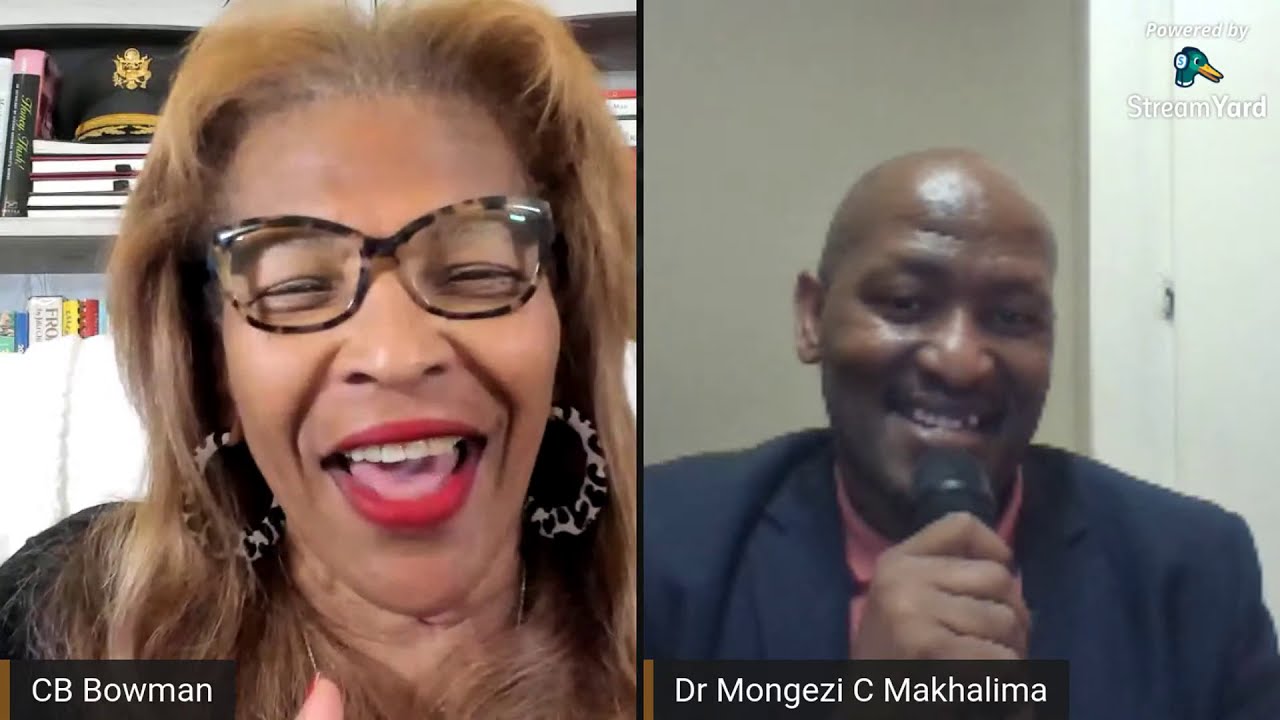
Dr. Mongezi C. Makhalima, a South African scholar, discusses workplace racial equity with CB Bowman. He argues that race is a "red herring" masking economic inequality, points to the scarcity of Black CEOs in Fortune 500 companies, and introduces an eight-factor model of human uniqueness to explain why generic diversity programs fail.
Chapters
Okay, so audience, we're having a lot of fun here trying to get the doc to move into the best position. So audience, I want to welcome you. This is CB Bowman Live, and today on Thursdays we talk about workplace racial equality. And we're so honored today to have a representative from Africa, specifically from South Africa, Dr. Mongezi. Did I pronounce your name correctly? We can't hear you, Doc. So I think you unplugged yourself. Try again. Nope, still can't hear you. So go back to the other mic. There you go.
There you go.
Now I can hear you. So how did I do on pronunciation?
Can you hear me now?
Yes.
That was perfect. That was perfect.
I've been practicing and practicing, and I thought, I'm gonna screw this up. Not because your name is so difficult, but because I'm dyslexic, so I read it differently than what you see it as. And there are times when I actually screw up my name, which is CB Bowman Ottomanelli now. And my husband comes after me and goes, you can't spell my last name correctly? And I'm like, we just got married July 4th. Give me about 10 years and I'll be able to get it.
You know, you know.
So I'm not even going to attempt your last name. So why don't you say it for the audience?
Hello, audience. My name is Munges Makalima, and I think in my grand— in my grandfather's language, it actually means the one who reprimands. So the one who reprimands but also makes people smarter because it's a wise man. That's what the Makalima actually means. Fabulous.
Now here's the thing, you're going in and out using this mic, so I think we need to go back to the other mic, the, the round one. It's, it's the same mic.
It's the same mic I was using. Yeah, I haven't changed it. I just removed it from the cradle.
Oh, okay. Well, maybe put it back in the cradle then. All right, because as you can see, It's making noise, and I want people who are listening in, who are kind enough to listen in, to hear every word that you say, because what you have to say is so important, and it gives us a global perspective versus just an American perspective. And I— please, I want people to write in on the chat and participate. Okay, so we're almost set. Okay, Doc, let's see if we can hear you. Now we can't hear you, so flip the button. Not yet. Try it again. Nope, still can't hear you. Still can't hear you. Try it again.
There you go.
Now we can hear you. OK, you found the right channel.
Yes, I think I have now. Can you hear me?
We can hear you now.
Thank God.
Okay, so in full disclosure, everyone, I want you all to know— clap your hands— Dr. Mongezi is on the faculty of Workplace Racial Equality, and he is such a powerful member, uh, helping us to set up an incredible, uh, training program for organizations that are struggling with how to address the whole frame of workplace racial equality. So reach out to us if you're interested, and we'll talk to you more about it. Meantime, I want Doc— I want you to tell the story, because it's an incredible story, about how you first saw race. And when was it that you first saw a white person live? That is just— You know, we don't think about that in the United States, but when you told me that story, I was riveted. So tell me about how you were raised around color.
Yes, look, it's, it's an interesting story, and I think, uh, it's— it was when I was doing my coaching training when I, uh, had to confront it, um, and, and confront my relationship with race and realize that in the '80s, because I grew up in apartheid South Africa. And at that time, um, Black people lived at least, um, what, 15, 20 miles away from, uh, the city centers and, and the CBDs, away from white people. So we didn't actually see white people quite a lot. I would see some white people on TV, but I didn't know they're white people. It would just be people that are kind of acting on television, but I didn't know it's white people. They just look like like humans, right? And I notice I'm getting out of out of frame because I'm getting I'm getting quite excited about the story all the time. But then I think it was around the late eighties. I had to go to my mother's to to meet my mother at in town because she worked for one of the big, uh, stores. And when I got there, they were like these white people all over the place. And I'm gonna— oh my God, like, so there's like some people, like those people I see on TV, they actually live also in town. But you know what was so sad was that they, they, they look like they didn't actually want us there because I was a kid, so I didn't know. I was probably about 9, 10 years old. So I didn't know what, what, what that was all about when we were playing as children in the aisles and they chased us away and told us to go and sit outside and, and play outside where the Black people should be sitting.
Wow.
And that was my first interaction with the fact that I am not enough. It was quite fascinating for me. I'm quite annoyed by the fact that I keep getting out of range. Hold on. It was a bit annoying but surprising for a child, only annoying as I was growing up because I realized and built up rage. For that rejection, and I didn't know that I had until I had to confront it.
Wow! And so what did your mother say about all of this?
Look, I think you you have to understand how it was here in that it it it was it was something we don't necessarily even have to fight because it was so in in in my in my father's language, isiZulu. We have a phrase that says, I'm just gonna go loose English translation. What's been created?
What's been first? Give it to us in your language, in your father's language, and then translate.
Okay, cool. So in isiZulu, we have a phrase that says "Okwenzekile kufana nokudaliwe," meaning what has happened is the same as. That which has been created. So it felt in a sense like creation, we would accept it and surrender to it. So I think my mother was just wanting to make a living, be— make money for us to bring home to the township where we lived. So we, except for obviously the politicians and some of us, some of our people who I later I had to join, who fought for the struggle of freeing or changing this. It was really accepted. So she didn't have to say— she didn't say anything at the time. And I think my grandmother, who was more the person that I was raised by while my mother was working, she had taught a lot about how to be human. And she also worked for a white Italian family, and then they would give her clothing, they would give her books. And I think a lot about learning about Africa I learned from those books that she was bringing, um, as a kid. And we would wear these clothes, and she would talk very beautifully about, um, the, the Italian family. I won't mention the name. She would talk very beautifully about the Italian family and how they treated her and how they gave her work both in the kitchens at the farm but also at the company because the boss, her boss, was also running a tiling and painting company in town. Wow.
I have so many questions that come out of that. presentation of information. And so do you feel that your grandmother and your mother— this is a tough question— did you feel that they were not protecting you by feeling upset over the situation of you being chased out of a store or not being accepted? How— what was their internal response?
No, I don't, I don't think so. I mean, you should remember, this was now the '80s, which means we had been living with apartheid for about 40 years, give or take. So it had been a way of life, which meant us living in the townships, that's our lives. So when I grew up with, with my, with the Black people that surrounded me, They were my people, they were, they were their people. So I had no desire or connection or, um, I mean, even today, most of the time, and because I actually think that's more to your answer, that's more the situation than anything else. I've never really felt a need to associate necessarily, not that there's anything wrong with whiteness, but I never really felt any need to associate with whiteness because I actually grew up with blackness all over me. Wow. That's a powerful statement. Yeah. I mean, even now with all the work that I do, because there's a lot of people that sometimes look at me and expect me to be raging against whiteness, and I go like, I don't rage because it's irrelevant. It's never It's never been relevant to me. It only became relevant as I was growing up in my teens, when I was like probably 18, 16, 17, going to university and starting to realize and feel it for myself, the separation, the segregation. And then that's when it became personal. But before then, it wasn't personal. It was like, oh, okay. That's how it is.
So, so with that perspective, which is quite unique for us, I feel, in the United States, how do you view the struggles or the situation or the environment, whatever you want to call it? How do you view what's happening here?
Are you referring to America or the world at large?
America first and then the world at large.
I have to say, it is very scary to continuously be confronted with so much violence because it is, it is a very violent— as I grew up, remember now, a lot of my my opinions are informed now by studies. Because I've studied quite a lot in the area of diversity, in the area of identity as a psychologist. I work quite a bit and very closely with Blackness and whiteness and difference, being male, being an African male. In fact, my master's thesis starts very interestingly as As a Black African male growing up in South Africa of the 1990s, here is my perspective. And so by its nature, it was a revolt in terms of that's not how academically you're supposed to start your thesis. So essentially, it's in my assessment of America and the race politics, is always shocks me at how violent and how in your face that difference is. And because we have it, we have apartheid here quite a lot still, even long after 25 years after we've gotten our democracy and all of that. But it's sophisticated. It is It is subtle. But the American— I mean, I was looking at the statistics. I was watching one of the presentations, only 4 Black CEOs in the Fortune 500 companies. That's horrible for today. When you go to Harvard and you go to Yale and you go to Columbia University and you see how many Black people are studying, And you realize they will get out of there and do what?
So, so are you saying that in Africa there are more Black CEOs? I mean, that must sound like a stupid question, but I'm asking in comparison to the United States. That's— yeah, that's number one question.
We do.
Yeah, it would make sense. And of course, you know, it absolutely makes sense. But, but I'm also hearing you say that your approach to racism is much more sophisticated than it is here in the United States, that we, we deal with racism in terms of rage. and you deal with it more sophisticated. What does that difference look like to you?
All right, sure. Yeah, when you put it like that, it sounds quite smarter than I meant. But yes, I think the first thing, just to go back, we have more CEOs. We have—
Let me just add something to that. You say that you've had apartheid for 40 years. We have had slavery for much more than 40 years. So what happened before your apartheid? How do we synchronize the two, or can't we?
Yes, we can actually. I'm glad you asked that. I actually like that question because we never go there. We always act as if, um, Africa's history in, in total anyway, because Africa is 52 countries, and starts when, when the white man landed on the continent, which is kind of not true, right? And so in apartheid South Africa, essentially before, uh, the 1920s, uh, what was happening in South Africa was the fact that People, there were people were people, and white people were guests. So in and in order to understand that, you actually have to understand what the rest of the continent looks like because South Africa is probably the whitest country in the whole continent. Essentially, with five percent, five percent of of white people. in it, right? So, so you have, you have to imagine how much of a little ratio difference. Yeah, it is, because there's 5% of white people, but they occupy about 65%, um, of top leadership positions. And about 28% or so, uh, are Black people, of which about 10, 15% are Black women. So we are really making progress in terms of what apartheid looked like. The only challenge in terms of the work we need to do, and I think it's the work that the world needs to really start also moving into, because I think that's the problem, the issue here, the parts that we are caught up with, CB, is the paradox of the skin, the race, because that's a red herring. Forget—
Say that again, Doc. You broke up.
It's a red herring. It's a misleading thing. The fact that we keep sitting and talking about race, which we should, but we should be talking about race in a very intersectional way. We need to talk about race in an economic way. Because when we can talk about race in an economic way, in a benefit way, we would actually start realizing that actually all of us are people who are really just looking to feed our families, to grow our wealth, and to connect and contribute to the world. And I think most of Africa is like that, except we have a lot of multinationals that then come in and try to plant a lot of that violence in terms of the way other people think about the world to say, look, Africa is open, the second biggest continent in the world, it's open, come through. That's how my grandmother was. In fact, I have to tell you, I have to tell you this because you like the old stories about— my growing up. One of the things that used to annoy me growing up with my grandma at my grandmother's house was the idea that people would come in, would come in for a day and they would stay for a month. And it would annoy us.
What was it, the cooking, the conversation? What was it?
Her generosity We haven't— because that's the essence of humanity. And I'm bringing this story to talk really about what I'm talking about when I talk about economics, economics of race, right? And so my grandmother was an epitome of an African woman in a sense that when you come and visit, then that's how our culture is in many places, whether you're Zulu, Xhosa, and all of the other different 2,500 different identities. But there was one thing that we have in common. We call it both humanity, Ubuntu in isiZulu, is when somebody shows up, they are a human being.
Wow.
Before we ask them, before we ask them who are they in terms of position, Before we ask them who are they in terms of gender, in terms of race, we see them. That's why the greetings, the greeting in many of our languages, in isiZulu, for example, my father's language, we say sawubona, meaning I see you. Then the next person would respond and say, Yebo, meaning yes, I'm here, right? And that's where it starts. And I think what you asked me, going back to the question about what do I think then about the racial violence in America, but also the race relations in America, not just the violence, is that people don't see people. People see the color. And that's a misleading conversation that we are having when we are having conversations about race. We need to ask ourselves, what would it be like if all of us were human in America? How would we treat each other?
It's scary when you really go down deep inside you and think, you say to yourself, I'm not racist. I'm not. And when I say racist, I mean not just color. It could be— it could be religion. It could be, you know, language. I'm not.
Yes.
However, however, the first thing that happens is you see the exterior.
Yes.
You don't see the person. And it's a scary, scary acceptance within the nature of humans. I'm going to go there and say in the United States, because if we compare it to Africa, when it's part of your vocabulary to say, I see you, I'm here. My God, that is so powerful. It gives me the chills.
That—
how often are we missing the essence of another person because we don't see you? Yes.
Can I add something to that? Um, just to give you an example, I mean, you know, Nakonde. Nakonde, um, is from Zambia, our board member. Yes, from Zambia. When we met, Nakonde and I, we never— we didn't know each other 10 years ago. And I went to Zambia for the first time to go and do, uh, work there for one of the major banks here. And we don't know each other. We meet on the passageway of, uh, the PricewaterhouseCoopers building there, which was the biggest building at that time in Zambia. And immediately we clicked, not because she's Zambian and African, or because we are in coaching. No, because the first thing we are taught is you— when you see a person, it doesn't matter whether you know them or not, you greet them. And to greet them is so. I she was in the cafeteria. I don't know her, but I pass and say, "How are you, sis?" How are you? And not because she—it's how are you, my sister? How are you, sis? Because she is my sister. It doesn't matter that I know her. And we sat down and she said, "Who are you?" And then I told her and we said that. Oh my God. When she now found out that, no, I'm running coaching body and all of those things, obviously we connected at another level, which is now a professional level and the kind of work that we do. But before then, even if we had stopped at just having a meal together, we were human. So to bring a little bit of science then into it, because do you know that Freud, by the way, a little bit of tidbit, Do you know that Freud studied in Africa and the psychoanalysis theory by Freud was actually an African spiritual framework?
No way. What else am I going to learn from you today, my brother?
Yes. Yes. So Freud puts it very nicely. So I think when I— I mean, I always hated psychoanalysis because it never really made sense to my rational mind. And I think many people who studied psychology would connect with it. But, um, when I now started having to do real work with it in terms of, um, human relations and understanding human relations and why we act so crazy and why we are so stupid when we are actually supposed to be human and get along— because a lot of the racism is stupid, honestly. Am I lying? Racism is stupid. Genderism is stupid. Yes.
It's a waste of the human spirit, the human mind.
It's—
yeah, it's sad. It's throwing it all— it's taking the human mind and throwing it in the garbage.
Yes, we actually don't see the mind. So this is where I was going, is that, um, so when Freud divided his, um, theory of personality into the id, the ego, and the superego. I think what he was actually saying was a Kemetic framework of the ka, the ba, and I think there's another one that I always forget when I have to mention it, but essentially the mind, the body, and the spirit. When we meet the people in much of what racism has taught us the last 400 years, because it's actually a very new thing, human. It's a new thing that has no scientific basis. We learned to look at the body, right? And that's always what it calls it, the primary dimensions of being: your gender, your height, your weight, your skin color. It's things you can do nothing about because they were actually created by Earth, the Earth that you are on. They were not created by you. So you are not that. You are more. That is only a small part. Then your mind and your spirit are actually your essence of human. In fact, in Kemetic spiritual framework, which we also believe in, here where I come from is that your body is only really temporary. It's a temporary space that's holding the spirit. So when I see you and I remember when we met at the Marshall Goldsmith, we connected. I didn't have to say anything. And then we connected as you were going up and down and not because of your skin color, but because first I see the spirit. And then when it comes then to because somebody would say, so what does— how does it work then when we're working with white people? Um, is that first we— it's people. But now Freud talks about defense mechanisms. So many times people who've learned to be racist come in with a defense of their spirit like this, which means— and that's why sometimes I look at these masks and I'm gonna Are they protecting—
in that defense, are they trying to protect their spirit or are they trying to hide? Which is it?
Well, both, because remember— but I think the first thing is an unconscious effort because they've been taught. They've been taught to be afraid. Of working with the spirit. In fact, that's what for a long time Freud was misunderstood because he was trying to tell people that you guys are repressed.
Just one second. We have a message from Goldie and she has to leave, so I want to be sure to get her comment in. Emotion is a universal language, but it's sad to see how society ignores the emotions of others. Based on their own personal dislikes. Then she says, wow, beautiful culture celebrating the existence. So thank you so much. I'm so sorry you have to leave us. Yes. Yeah.
Yeah. Yeah. So just to finish this piece, and you have to stop me, by the way. I don't stop, right?
And I'm a trigger for you to continue. So we're good. We're good.
Yes, please throw some questions. But I think what I was saying then is that Freud was talking about repression, and, and, and which was a, what he was actually, um, trying to get the people in, in, in, in Europe at the time to see that what had happened as the people were fleeing the continent and moving further away from the continent They were learning ways of fear. They were learning ways of protection, and they lost contact with just being human, just being here. In Nigeria, they have a phrase. When I see you and you're not doing anything, you're not saying anything, you're sitting just relaxed, then they say, she's just there. Which means I see you.
And is that okay? Yes. To just—
Because you can just be. You can just be.
And I think in the United States, for most— this is only my thoughts— most cases, if somebody's just there, There needs to be an explanation attached to it.
Yes.
There's an uncomfortableness with just being there. I know I'm a high introvert, and so I like to just be there, and I know it makes my extroverted friends uncomfortable. And so I've learned to say, I'm processing. It's okay, I'm processing.
Yeah.
So you don't have to worry. I'm not being the Black angry woman, right?
Yeah.
I'm— I hear what you're saying.
Yeah.
And I am deciding to take apart what you've said, put it back together again, And then determine if I can add value to the dialogue. Yes. So I'm processing it.
Yeah. And in fact, I can tell you this. This is where, I mean, as coaches, that's kind of like the work we are trying to do, isn't it? Yeah. We are trying to get people to reconnect with that. So when I started being introduced to coaching, it was actually quite funny. I mean, there were 18 of us in the classroom and I was the only Black person, which is always annoying, but it had been a pattern for a long time. And I was sitting there and going like, but this is what my grandmother used to do. She would just sit with us and just be quiet and we're just quiet. We just play. But it's quiet. There could be a radio playing in the background, but there is no need to do anything. It's just to be. And when you think about a lot of the Southern cultures, you think about a lot of— because most of the Spanish are actually former African colonies, a lot of them, they still have that siesta culture.
Oh, gosh, yes. Connected.
The Italians still have it. The French still have it. Yeah. So, so—
And you know what's interesting? When I first started traveling abroad and everything would close at noon to 2:00, what the hell's going on here? Don't these people want to make any money? I mean, I was so uncomfortable with it. And now that I'm older, I'm going, how wise were they?
And would it scare you to realize that's actually 83% of the world that's doing that?
It's shocking. And now that I'm older, no, it would not scare me. When I was younger, yes. Is the world closing?
Essentially, it's probably— 3 or 4 countries in Europe that still run on an analog clock in terms of we are busy, we are working. But a lot of the countries in Europe are actually embracing a lot more of, oh my God, we actually forgot to be human. Such that in France, they actually laugh at you as an American or even— us South Africans who are trained in Western ways, because I'm very weird in that I've been trained in both Western and African schools, so I can carry both as I need it, right? But in France, they actually laugh at many Americans and many of us Southerners who are having a British mindset, when we want to be working for a living, when they actually do the other way around. They live to work. Well, sorry, that's the other way around. They, they worked to live. Yes. While many of us, we live to work, and which is kind of weird.
But I, I will tell you an experience I had where it worked sort of against me, because then I got into the European mindset of everything closing at And I was in Beirut during the war with a fiancé at the time, and he was off doing photography, and I was walking in the city by myself, and it was noon and everything started closing. And so I went into the shops and I said, oh, is it siesta time? And they looked at me and they said— No, the war is coming closer. We have to close. But it's important to know with the culture you're in at the moment, right?
Yes.
And I quickly scurried back.
That's fascinating.
Yes. So, so we have to be careful of not making anything universal, even if it's good. We have to be aware of our surroundings. And I want to stop a minute. Holly writes in, And she says, you are such a beautiful human being. If we could all adopt your way of looking at humanity, we might have a chance of creating a better world. This is a refreshing conversation. We lose so much by ignoring the gifts and essence of all others in this world. Our biases and judgments cause us so much trouble. Oh, it's so true. And Holly is a beautiful, beautiful spirit. She is a member of the Association of Corporate Executive Coaches and just a powerhouse of a woman, a powerhouse. So she's giving great respect to you. Yes.
Thank you. Thank you. Thank you.
Now, I do want to go back to something that I think— I'm sorry, Doc, go ahead.
No, no, I was saying I try. I try. It's, it's, look, it's It's really hard. You said something before you move on. You said something just before you spoke about Holly, which I wanted to latch on very quickly because I think it's one of the challenges that we struggle with in the West, in the world today anyway, which is the whole idea that there's not one story. In fact, when I was doing my doctoral thesis, One of the things I was trying to find was just talking about credibility and finding what makes a human being credible. But what I came up with was 8 factors that actually make us different. They don't even include race or skin color or gender, although they can include it, but I didn't count it. So what became interesting, CB, in terms of that was realizing that we are all trying to look like somebody else, yet we are actually 1 in 8 billion. There's 7.85 billion people on Earth as we count, but not a single person on Earth I haven't met all, but so far the ones I have met, Not a single one has the same combination of those 8 elements.
What are those 8 elements? Give them to me slowly. I'm writing it down.
Well, so I'm just going to go very high level. Your skills, your knowledge, the things that you know for sure, your values, what you hold dear is very different. My research shows that Actually, only 18% of the people in the world hold the same values, which means the chance that your values are different from the next person is about 80, 83, 82%.
Wow.
So we should already be aware that the decisions I make and the decisions you make are informed by very different spaces inside, right? Your passions, So your attitudes, so the things you like, right? So, um, I love this kind of stuff, for example, but somebody else loves to make cars, and somebody else likes— loves to work with their hands. And we judge people who work with their hands as opposed to people who work in the office, which is kind of weird. Who's going to repair our cars, right? Yes.
The plumbing.
Right, right, right. And then the next one is the— I'm trying to find my way back— our motives. And so Maslow, for example, talks about us working on a hierarchy of needs. Our motives are very different, such that I think the source of influence for all of us if we actually understand what you need versus what I need, we actually can create much more power in terms of influencing each other than if we make somebody look like me, need the same things that I need, right?
Yes, yes.
Because we are at different places. Then the personality, I think people know a lot more about the personality stuff. And I think there's, there's a whole personality theory that says there's about 72 types of personalities, which means there's actually a 71-to-1 odds that the next person is different from you anyway, right? And then your attainments. This is the second last one, your attainments, or the results you've achieved in your life, the successes, which many times— and this is always also interesting When you work with Africans, I don't know in America because I haven't worked a lot with African Americans from an American perspective. I've worked mostly with Caucasian Americans. And what I find in Africa is that many times, and in India and in Asia, because those are the places I've worked, many Asians don't celebrate the successes Because they take them as if it's an accident that has just happened. It was meant to happen. It's coming from God.
Right. That does happen in the United States. However, it's prominent amongst women.
Yes. And we need to start asking why. have we created a world where people actually have successes that they are afraid to celebrate? Because I am back to WRE very quickly in terms of some of the work we are doing. Because the stats that have come out show, particularly in America, that when you're applying for a job and you're a Black woman, And you have a Black-sounding name, you actually have a 10% chance only.
You have a what?
Being appointed.
You have a what only?
10%. A 10% chance only of being appointed into a job.
As opposed to— we have to stop here because we have to talk about this. First, give me the 8th one, and then we're going to go back and talk about this.
All right, so the eighth one is is purpose. In so purpose. Yeah, purpose. And my my worldview, and it might not be shared, is that each and every single one of us are here on earth to do something. That's why we are we are coming in and we are different. And once you find out what that is. In fact, Malidoma Some, he is actually in Harvard, which is always interesting. He's doing some fascinating work, but he's a Ghanaian shaman. And he puts it very nicely. He says, when a child is conceived, the community knows what the child is there for. Not born, conceived. So as soon as Your mother discovers that she is with child, the community comes together already to start saying, who is this child and what are they here to do? And that purpose, once you start really connecting with it and living it, almost everything else in your life aligns. And that's the work I do now with people. It's kind of helping them to align that stuff because then all the other 7 stuff I mentioned just kind of fall into place.
Wow. So I want to go back. My mind is exploding with information. You do this to me all the time. I have to rest after. My brain has to rest. But I want to go back to 2 things. Apartheid, coming out of apartheid, and us coming out of racism. I want to compare that. And 2, the attainment part, the naming part. This is a big discussion that I have within myself. Yes. Black Americans— we no longer say African Americans because not all of us are from Africa. Right. Black Americans have paid homage to our mother country, as we define Africa, by giving their children African names. This is in vogue.
Yes.
My heart bleeds because it— the blood in my heart doesn't know which way to go. I don't know whether to celebrate this— I don't have children that I have birthed— or to have fear, because the minute that name goes on a resume, they have reduced their opportunities— not for the job, for the interview— by 90%.
Yes.
And so these children are— have, we say, have a star-crossed— I think I have the expression right— going into the job market, their income for the rest of their lives is going to be affected because in that generation coming up, we will not see the end of racism. We will not. And so therefore, what are their parents doing in this desire to pay homage to our motherland? My heart bleeds because I don't have an answer.
Yeah, I think you do actually have an answer, CB. It's just that it's a very difficult answer. Because it requires a lot more work than we are in control of. It requires us to really get back to being more human. It's not about us removing racism, it's about us becoming more human. But we won't get there.
We won't get there in their generation. And I'm sorry, I'm starting to tear up because I— That's okay. I'm so frustrated because I understand what we're trying to do theoretically, but then there's the reality of my race not being able to have the money to take care of themselves. Health-wise, the whole Maslow's hierarchy and their children, it's killing me.
Yeah. And I'm wondering, CB, because I feel that pain and there are days when I'm sitting in bed and I can't come out because this is like the entire work of all of us, right? Yes. I feel that if we started having integrated conversations about— let me put some science again to it. Our brains perpetuate what we spend time focusing on.
Yes.
And you know this, there's lots of research that shows this. Haven't you asked yourself why you get to spaces and we people create opportunities for us to speak about race as opposed to us speaking about being human. Because that's the secret. It's a tough one, but the secret is how can I be— how can we, all of us, be more human? Because if we are going to fight racism, my belief, and I don't know if it's true that that would work, but my belief is that when you're working with something like racism, we need to smother it with love. We need to create so much beauty that there is no space But we give racists so much time, so much space, so much airtime, such that actually the racists believe they are the default. In fact, there's so much data that shows just between Dr.
Manzega, your camera froze at a critical point. So audience, if you would just hang on for a few minutes and see if it will unfreeze. Remember, we're talking to a different country, and so technology will happen. And if it doesn't, then if it doesn't cooperate, then what we'll do is we will end this session and continue it again. We will definitely have Dr. Manghezi back on, uh, to talk to us because he is such an incredible spirited person and, um, we all want to hear what he has to say. So it looks like he was disconnected. Let's give it a few minutes to see if he can come back on. And in the meantime, please feel free to send us some more questions and comments now that we have time to actually look at the chat. And let's talk about the work that we're doing in workplace racial equality, which is to provide organizations and people within that organization to have raw and true discussions about Creating equality. I was going to say racism, but after what Dr. Mongezi just said, it's really about how do we create equality in the workplace? What is it that we really need to do? And part of what we really need to do is to move this whole thing out from the center, from the core of an organization, and to have some discussions around what's eating at us. What, what is— what are we questioning so that we can't move forward? What can we do so that we can move forward? So I hope you all reach out to us. It looks like Doctor is back. Hi, Doc, you're back. Good.
Yes. Sorry, I don't know what happened today.
That's okay. It's technology at its Best.
I think we actually— I think actually we were lucky that we've gone this long without being interrupted.
Yeah, technology likes to put in its 2 cents. Yes. So, Doc, I wanted to continue that of the conversation. But I also, I noticed we have only a few minutes left, and there's an important point that I want to get to that's— well, I shouldn't say important, the rest wasn't, because trust me, it was a phenomenal conversation. But when I hear you talk about sophisticated, right, how did Africa approach coming out of apartheid in a more sophisticated way than us trying to come out of racism in a warrior-like manner? What, what were the actions that allowed your country to be more sophisticated than our country, even though we'd like to believe we're more sophisticated?
Yeah, I don't even know I have the answer, CB, but I think it relates very nicely to what we were talking about just before we got cut off. That says, I think the unique perspective about being African is that first of all, you are born of love. So that's all. That's how we learn everywhere. Which means, because people talk a lot about Nelson Mandela and the transition and all of that, but I think if we were to tell history a lot broader, we would say many of us were just ready to be human. All we needed, and I think that's all people want is to just be left alone. Not necessarily alone, but people need to just be left to be themselves as human beings.
And I think what you're saying is that difference in the— yes.
If I can finish that sentence, if it's okay. So I think the sophistication here is not so much from the perspective about how we approach it. It's about how then the perpetrator of racism is essentially able to hide because they're not meeting any overt violence. And they would look really bad if they were to be that overt in their violence. So that's how then they get into a whole sophisticated ways of disguising this process. We have laws in this country, and I think we've done a little bit better than many many parts of the world from that perspective in terms of at least putting laws in place. Of course, the challenge is about enforcement because every new government has its own problems.
Yeah, I agree. And I think also it takes me back to something you said earlier about Blacks in Africa. It is their homeland originally. And so When apartheid came in, for lack of a better term, think of it this way. It came in as a guest. And it was then uninvited as a guest.
Yes.
In the United States, for Blacks, it's not our homeland. We are guests here. And we want to stay as guests. That— no, I'm not saying that right. We want to stay as not guests, but as owners, as being human in this space. You're saying no, I've got it wrong.
It's not true. Again, it's about how the perpetrator of violence and the perpetrator of segregation wants us to believe.
Ah.
But we are— I mean, one of the first things I wanted to do when I came to the US many years ago was to walk Central Park. It had always been something I wanted to do because I think, unknown to many people, Central Park was actually the seat of of an African tribe. It was essentially a chiefdom for a long time, long before the white man arrived there. A lot of Mexico had— was under a lot of African kings and queens long before it became the Mexico of the US. So, it's not true that you are guests. What— and I like Abdullah Ibrahim, who is, I'm sure, one of our leading jazz artists here. He puts it very nicely. He says, people were taken— slaves were not taken out of Africa to America. People, shamans, doctors, healers, teachers were taken from the continent to another part. But before then, we had been traveling the world long before. But they were told as part of the whole slavery movement, which is a system that was an economic system, Because that's all it is. It's really about removing the benefits. So nobody is a guest anyway. The borders that we've created, and if I can say this last thing, the Khoi, who are essentially some of the oldest humanoid people here on this part of the world, They have a— they say, they put it very nicely when they say that you can put your walls everywhere and the fences and close me out, but who owns the air that goes over your walls? Because that belongs to God who created all of us.
I stand so corrected and so beautifully corrected. I accept. I accept. Thank you so much, my brother, and please come back again. There's so much more for us to talk about. And think about this, wouldn't the world, and especially America right now, be in such a good place if everyone could have the kind of conversation we just had?
Oh.
And the kind of conversation we want to have in Our organization, WRE, Workplace Racial Equality, that is our goal. So thank you for opening those doors across countries, across continents. Thank you for bringing the air over. I'm grabbing it. Audience, please join us next week. Thank you.
Thank you so much. Thank you for having me.
Thank you for being here.
Thanks, everyone. Ciao.
Thank you so much. Please join us next week for another great, enriching, real conversation on CB Bowman Live Workplace Racial Equality. Go with success, everyone, and go with humanity.
More from CB



211- Courage to Leap & Lead with Louise Story part 1Courage to Leap & Lead







