CB Bowman LIVE! Challenges of the C-Suite: Guest Timothy R. Clark, Episode 35
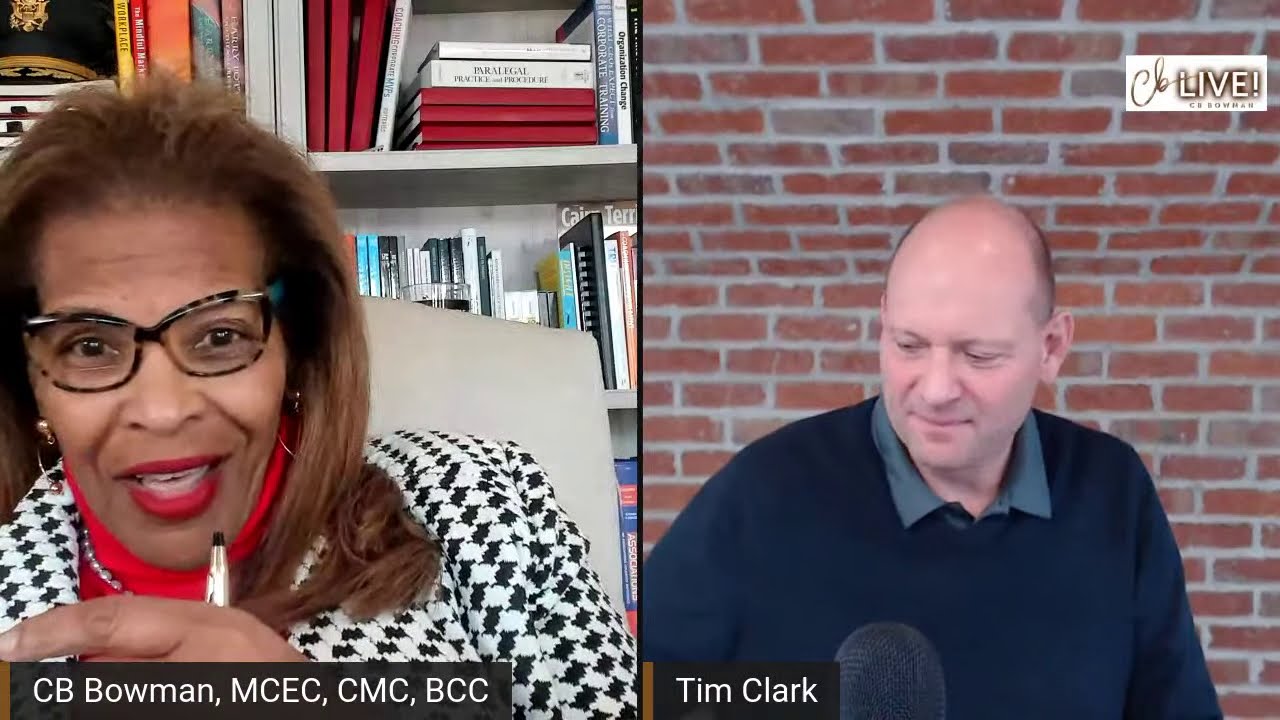
In this live interview, host CB Bowman talks with organizational‑culture expert Timothy R. Clark about how the COVID‑19 pandemic and other concurrent crises have "liquefied" the entrenched status‑quo of corporate culture, creating a rare window for intentional cultural redesign. Clark introduces his framework of the four stages of psychological safety—Inclusion, Learner, Contributor, and Challenger—explaining that each stage represents a deeper level of rewarded vulnerability that must be built sequentially. He argues that culture change must be behavior‑focused: rather than merely raising awareness, leaders must model concrete inclusive behaviors, replace toxic actions with purposeful alternatives, and use a "bonding vs. bridging" lens to move beyond natural affinity groups. Clark critiques traditional DEI compliance approaches, emphasizing a "worth test" (treating every person as inherently valuable) over a "worthiness test" based on demographic criteria. He describes discrimination as moving toward subtler, covert forms and highlights the importance of self‑awareness, willingness, and coachability in individuals. Leadership’s role is distilled to two levers—modeling desired behaviors and enforcing accountability—while acknowledging compassion fatigue and the need for sustained conviction. Clark also mentions practical resources: his book The 4 Stages of Psychological Safety (available in print, Kindle, audio) and a free Behavioral Guide on leaderfactor.com that lists concrete actions for each safety stage. The conversation touches on real‑world DEI challenges (e.g., attracting people of color, micro‑aggressions, the limits of DEI offices) and ends with plans for future episodes.
Chapters
Hello everybody, this is CB Bowman Live, and as you know, technology and I are not friends. So you know, when my show comes on, you've got to allow 30 minutes swing one way or the other to make sure. But you know what, I don't think I'm going to accept the blame for this one. This is our guest.
I'll take it. Phoebe, just give it to me. Yeah, I'd love to take it. Yeah.
Oh my gosh, what a riot! So we're learning more and more about live streaming each week, and one of these weeks it's going to be so boring because you're going to come on and there'll be no issues and everything will be on time, right? And you're going to say, where's the fun? CB Bowman always brings the fun with learning.
It's just a reflection of real life, right, CB?
Yeah, absolutely.
We got a wrinkler too.
Okay, so today— by the way, if you missed the free, uh, conference that we had today this morning for an hour for ACEC followers, that's the Association of Corporate Executive Coaches, You missed a good one. Uh, we had Doug Sanders on and he talked about how to monetize your podcast. Oh my gosh, you see, you have to, you have to follow CB. So today we're going to introduce Tim Clark, Tim R. Clark. He is the world expert in creating psychological And he has a wonderful book that talks about the steps that you need to follow to create psychological safety. And we know how important that is when you're trying to create a solid D&I program. In addition to some of the other things that we're going through with this pandemic, you need to create safe spaces for people to speak. And that affects their psychology, their psychic, their mind, as well as yours and the people around you. So we're going to have a little bit more serious discussion today, but we'll try to insert some laughter because you know that's our style. So with that, I'm going to ask Tim to introduce himself. Tim, tell us.
Well, first of all, CB, thanks for, thanks for the opportunity to be with you. I'm delighted. And I appreciate the opportunity to talk about psychological safety and organizational culture and what, what people want and need. And especially, all of this has been rocked lately, right, with the pandemic. But I want to start with this point that maybe your listeners will find not only interesting but useful. And that is, a crisis has the ability to liquefy the status quo.
Whoa.
So I want you to think about that. Okay, I need to write that one down. Think about what we're up against when we try to change cultures. Cultures become what we call fossilized. They become hard. We get very entrenched in the way we think and the way— and the things that we do, the way we behave. And then when we say we need to change our culture, we need to change our We need to transform it. We're up against this fossilized, calcified status quo. Think about how hard that is. The benefit of the pandemic is that it has thrust us into this fluid state of disequilibrium. It has liquefied the status quo. So if you ever wanted to change the culture, change the environment, change the, the climate, now's the time. You have a once-in-a-lifetime opportunity to shift the prevailing norms on your team or in your organization. Now is the time to do that. So I just, I want to start with that by way of context, CB, because I don't think people realize the opportunity that they have in their hands. Some people have been hibernating during the crisis.
Yeah.
And what I would suggest is that you not do that, that you accelerate, not hibernate, because that's the opportunity that we have.
So, okay, hold on. You started us off with a heavy one.
Oh yeah.
Repeat that again. Give it to us again.
Sure. So a crisis has the ability to liquefy the status quo.
Okay, so based upon that, you mentioned that we're, we're in this pandemic, but the fact is that we are in 5 pandemics right now. Does that create muddy waters in this liquefaction process?
No, it just liquefies it even more. So you have COVID-19, you You have, and then let's layer on top of that racial tension on top of that. And we can add whatever else is affecting you and your location or your context. So you could layer it on. It will only serve to further liquefy, further disrupt the status quo, knock you out of equilibrium. So you have the opportunity.
Okay, so now we're getting feedback. Great energy, excellent. Looking forward to learning what techniques we can use to get leadership to recognize the opportunity to shift the norms. That's from Matt Bowman. Hey Matt, are we related? Huh? Okay, hit me up, as the kids say, after this. Let's see if we're related. So what do you mean? I mean, liquefy— does that mean it makes it easier for us to approach psychological safety? Does it mean we're all on the same playing field? What does it mean?
It means that we've been shaken up. Right? We've been jarred. We have been moved out of our comfort zone. We've been pushed out of it unwillingly, involuntarily. That's where we all are. And so now the opportunity is when you have this fluid state, the opportunity is, Are you going to do culture by design or by default? There's always a choice. Are you going to do it intentionally, deliberately, by design? Or are you going to just do what you do and let it happen? And then whatever you get, you get. That's how people approach culture in organizations, by design or by default. It's always a choice. And what I'm suggesting is that now we have, we've had a global reset. We have an opportunity to do it again, to push, to hit refresh and do it again by design. Cultural patterns, cultural assets are things that we can design if we want to.
How do you, how do you design a culture when in fact a culture has been embedded in various systems for years and years and years. How do you then take it apart and redesign it and say, okay, done?
Well, it's a great question. You used the— you used the word, CB, embedded. That's a beautiful word, and it's an accurate word. Culture becomes embedded, entrenched, so it's very hard to dislodge To change it. But what happens is the crisis has done a lot of that work for you. And so much of it has become dislodged. It's fluid and it's giving you the opportunity. And so if you don't have enough, for example, let's talk about psychological safety. Psychological safety is the heart of culture. It's the core. What does it mean? Let me define it in 5 words. Psychological safety is an environment of rewarded vulnerability. That's what it means. It's an environment of rewarded vulnerability. It's this, it's, it's the core of culture. If you don't have that, you'll never get to inclusion. You'll never get to the patterns and the norms that you want. You'll never get to the outcomes. So now you have this incredible opportunity to say, ah, we need to, by design, we need to create more psychological safety in the culture. We need an environment of rewarded vulnerability. Why do we need that so much? Because you can't be yourself, you cannot perform without rewarded vulnerability. Rewarded vulnerability allows you to be yourself. It allows you to learn. It allows you to contribute. It allows you to challenge the status quo. If you don't have that, it's too— let's just start with inclusion. If you don't have that, it's too expensive to be yourself. You can't bring your whole self to work. It's too expensive. So you're going to change your behavior. You're going to modify your behavior, what you say, what you do. And you're going to change that. And a lot of people do, right? Because the environment, it may not be hostile, could be. I mean, some organizations move all the way to, right, to a toxic culture. A toxic culture, by definition, is a culture where people are acting and behaving immorally and unethically and even illegally towards each other. And so that's what toxicity is all about. When we talk about—
Yeah.
Harassment, bullying, public shaming. That's what that is. So there are toxic cultures, but then there's, then there are cultures that are in between where they may not be toxic, but they're pretty dysfunctional. They're not that healthy. They need to be changed. And even healthy cultures, even if you are working in a vibrant, healthy culture today, chances are there's room for improvement. You need to be able to assess accurately your current state and figure out where you need to go. Everyone should be doing that right now. This is the opportunity to do it right now, to take inventory of the team or the organization's culture, accurately assess the status quo and say, ask the question, what—
What's missing?
What norms do we need to change? What norms do we need to change? And by the way, what I would advocate, CB, is a behavioral approach. What does that mean? That means jump into behaviors. We can talk all day about increasing understanding and awareness and appreciation of who and what we are today. That's fine, but that turns into a philosophy class. We have to jump into behaviors because when we model, when we implement behaviors that work, those behaviors generate confirming evidence that they work. So for example, well, go ahead. Do you have a question?
Yeah, because you're throwing a lot at us. Hmm. Okay, let's start with the behaviors. So if we look and we say the behaviors need to change, we also know that behavior theory says we can't change a behavior without replacing it with another behavior.
Yep.
Right? So if we look at these behaviors that we have that are creating toxic culture, we don't have— We don't seem to have a replacement. So let's just take storming on the Capitol, regardless of what your political—
Okay.
Okay, notice that joke, right?
Okay.
So we're not talking politics here.
Right.
We're talking behavior. So we don't know what behaviors triggered it. And we, as a society, okay, some of us are scratching our head. Some of us think we know the answer, and some of us just Don't care, right?
Right.
But so if we take that group of behaviors that cause that, we don't know what to replace it with. Or should we replace it? Is it stimulating thought for us that says something is wrong or something is right? But what do we do about it if we believe it's wrong? What do we do about it if we believe it's right? Now, if we go back to what you mentioned about toxic behavior, about it being illegal, blah, blah, blah, blah, blah, blah, blah.
Yeah.
Then we're still— we're sinking deeper into trying to figure out what's the replacement behavior, because we don't know which is the correct behavior. And this was all stimulated through, let's say, social justice Sure.
Well, now we're kind of talking about 2 different domains.
Okay.
There's the organizational domain and professional life, and then there's the political domain. Okay, where does behavior come from? It comes from your, your beliefs, your values, Your assumptions, right? Those and your motivations, your intent that generates behavior. So let's talk about one domain and then the other. So let's talk about the political domain. And you talked about storming the Capitol. Where does that behavior come from? Well, let's go to the Constitution. We have a right to peaceably assemble. Peaceably assemble. For many of us, that's not just what it says in the Constitution. That's a value. That's a personal value. And so if we go beyond peaceably assembling, it's out of bounds. It is, it is beyond the scope of civil society. We don't do that, right? Millions of us don't do that because the political culture that we have absorbed, there's a limit there. There's a boundary there. We observe that limit to maintain and sustain civil society.
Mm-hmm.
So that's the political realm. In the organizational realm, where, where do the limits and the boundaries come from? Same place: values, beliefs, and assumptions. And so, for example, I would have an internal limit that says, I don't bully, I don't harass, I don't publicly shame another human being because I believe in the inherent value of my brothers and sisters. So there's a boundary there. And it's, it's who enforces it? I do. I do. So the enforcement comes from within. Right? The challenge that we have in many organizations is that we're on a compliance track. And we're trying to enforce the creation of a deeply inclusive culture. How do you do that?
I don't know.
You can't do that because your heart's not in it. Right? That's why we come back to behaviors, because we can focus on, let's take, let's take a look at a lot of diversity, equity, and inclusion initiatives. They're trying to create deeply inclusive cultures. What do they focus on? Let's increase awareness, understanding, and appreciation of differences. Now, that's not wrong, but it's not going to get you there. You're going to— because what we're expecting is that if we increase awareness, understanding, and appreciation of differences, at some point my heart's going to change.
Yeah.
I'm going to cross a threshold of conviction, and I'm going to do the right thing. Now I'm going to exhibit inclusive behaviors, and I'm going to get rid of my bias. I'm going to get rid of my prejudice. I'm going to get rid of any exclusionary behaviors that I exhibit. You're going to wait, you're going to be waiting a long time for your heart to change. Long time. So go ahead and do that. That's not wrong. But we need to jump into behaviors because behaviors accelerate They accelerate crossing that threshold of conviction because, for example, if I engage in inclusive behaviors, I can see the confirming evidence that those work and they are right. Let me give you an example, CB. So I grew up in southern Colorado among the Navajo.
Wow.
Second largest Native American tribe next to the Cherokee. My father was a teacher among the Navajo, so I was deeply socialized as a child among this, this, these Native Americans. And there's a couple of things that I learned even as a child. So number one, I felt included. I felt that they had invited us into their their society. We felt deep bonds of affection with these people that, that, that treated us this way. But I also knew that there were big differences in culture and customs and mores. We were not Navajo. And that was not lost on me, even as a child. So inclusion, what does inclusion mean? And by the way, with the 4 stages of psychological safety, inclusion safety is stage 1. Inclusion safety means that we acknowledge, we appreciate, and we protect the differences. We are not trying to neutralize or remove the differences. So the Navajo, they did not try to erase or remove or neutralize the differences. They appreciated the differences. They acknowledged the differences. And hopefully we did too. That is how we create deep levels of inclusion. If there's ever an attempt to remove the differences, what we call deracination, it doesn't work. That's not the goal. The goal is to appreciate and protect and acknowledge those differences. Now we're on the road to a deeply inclusive culture. Right. The homogenization is not the goal. We're not trying to do that.
Agreed. It sort of reminds me of many years ago, I was on a speaking platform with a psychologist, and this is going way back to the days of Martin Luther King. And she was talking about— this was a white psychologist, and she had a Black client, and he was having trouble finding a job. He wanted a job, you know, in the business world. By the way, he happened to be, in this particular case, a musician.
Hmm.
And what he was trying to do was apply musician norms to the corporate world. So he went in with his hair braided, etc., etc., and he was not able to land a job in corporate. And so she said to him, you might want to look at the persona, the visual presence of the people that you're talking to and mimic them.
Yeah.
In order to get in. And when she said mimic, she's talking about the visual presence.
Okay. Right.
And he said, I don't want to give up my soul. I don't want to give up who I am.
Mm-hmm.
And I'll never forget her response. Her response was, you don't have to. The minute you walk out the door, you can go back to who you are, or you can apply for a position as an executive in the music world, in the creative world, which is going to be more accepting, more inclusionary in what you're presenting.
Right.
And, you know, those seem at the time like incredible words of wisdom that she offered. I don't know if it'd be considered wisdom now, because you're actually saying if you want this type of job as an executive in the non-entertainment business, you do have to give up yourself from 9 to 5.
Okay.
So I'd love to get your feedback on that.
Interesting, interesting case study, CB. Let's talk about it a little bit. Sounds to me as if the counseling psychologist was saying you can't retain your physical appearance, the features of your physical appearance, because there's such a big gulf between you and the corporate environment. Now, there may be a big gulf. So that brings in, let me, let me bring in a concept that might be helpful here. And I'm gonna, this is not my distinction, but it comes from Robert Putnam, who is a political scientist at Harvard. And he makes the distinction between bonding behaviors and bridging behaviors. Now, I think this is very important because if you bring people together and they represent diversity, in many different ways, and you just let them go interact and associate with each other, what will they do? They will start to form groupings based on natural affinity characteristics. So ethnic and along ethnic and racial lines, maybe along gender lines, maybe along age. Right? So we see this very naturally. It's not a bad thing. So because where you have shared characteristics, it's easier to bond.
Yes.
So what do we do? We start bonding. We start exhibiting those bonding behaviors, and we start bonding based on the, the shared characteristics and attributes that we have. That's a very natural thing to do. But what we're talking about is we've got to go beyond that To bridging behaviors so that we can bridge where we have bigger differences and the natural affinity isn't quite there. And so for the musician, my advice to him would have been, you know, I'm really happy that you want to retain your physical and your, your physical characteristics and your, the attributes of your appearance. That's fine.
Okay.
But you need to go to work on the cultural context of the environment in which you are going into. And you need to become a student of that context. And if you— so, because think about what you're asking of the organization. You're asking them to bridge to you. And, but yet there's a big gulf. Okay, now that's fine, but you have to bridge to them too. So you've got, you have an obligation to them and they have an obligation to you. That's what we call the reciprocal obligation. And we all have that to each other. All I'm pointing out is that it's a lot easier to bond with people that are like you. That's not hard. But what we are not good at and what we have to work on are the bridging behaviors. Because now we can— you want to talk about leveraging diversity? That's a pretty trite phrase that we use. Diversity does nothing and blesses no one unless we can draw out its power, unless we can liberate it. How do you liberate it? You've got to engage in the, in the bridging behaviors, in addition to the bonding behaviors. Now we can create something special. And that's what we're trying to do. So think about organizations that are trying to pursue inclusion on a compliance track. Good luck. It's not working very well.
This brings to mind Another conversation that I had with a person who sat on various boards, and this was around the time of killing of Floyd. And in our conversation, our living room conversation that we had now, she said to me, I'm so proud of one of my organizations. Because we are recognizing that we do not have diversity in our workforce. And right now, what the conversation was about racial diversity. And I distinguish that because diversity is a catch-all for many things. And I don't mean that in a negative way. Right?
Right.
And she said, um, so the HR department had made this decision and was presenting it to the board, and she was really very pleased. And I said, that's great. And she said, but we have a stumbling block. We don't know how to attract people of color.
Yeah.
Fair enough.
Fair enough.
been the space you've operated from, you are going to have trouble.
Yeah.
And I said, so tell me, what does trouble look like? And she said, well, where our company's located, we don't have any Black churches, we don't have any jazz clubs. And she went on to list various things. And I said, so are you saying that you're proud of your company for figuring out that without these churches and jazz clubs you would not be able to attract people of color, or are you saying that people of color would not be interested in your company because of where it's located? Or are you saying that there is not an opportunity for people of color to have a shared experience being the white experience, so therefore you're afraid they wouldn't fit in on either side? I'm not sure what you're proud of and what your concern is. So if they went to an HB S University, they were concerned what they— what could they use to raise the flag that says, come and work for us? Because none of these things were put in place, these cultural things that would be the attractor.
Right.
What's your thought there?
Well, first of all, I would want to understand their, their motives and their intent. Is it genuine? Is it could be disingenuous, right? Talking about those things as if those are the things that, that matter. I think you have to try to find a beachhead. You've got to, you've got to establish a beachhead and begin the process. And it may be that some of those things are true, but How do we? How do? To me, I don't know that those artifacts are really the issue. The issue is when if you were to come in as a board member into this organization, are you respected? Are you listened to? Are you acknowledged? Are you appreciated? Are you given the opportunity? To create, to help create value. I think that's what matters the most.
Let me just be clear here. They were talking about these are the barriers that they felt they faced in hiring people of color in the general workforce.
In the general world. Okay. Okay. Yeah. Well, I think that the beginning of the journey is going to be maybe a little bit difficult because It does need to be attractive in some ways. You, you have to believe that you can go in. Let me look at millennials today. Millennials assume psychological safety as a term of employment. They want to go in believing that they can make a difference. That's what you have to believe. If you can convince For example, people of color, that if you come here, you're going to have a legitimate opportunity to make a difference and contribute. People are going to be opening the door. They're going to be coming your way. Right. But it's got to be real. It's got to be real. This is not about— this is not about optics. This is not about image. This is not about PR. This is about the substance of who you are and what kind of opportunity and experience you can provide. This is not marketing copy. This is the real deal.
So doesn't it also assume that you're saying that people of color can't and are not interested, won't assimilate, uh, during the day into a different culture, or they may not be interested in learning about a different color culture. Does it make those assumptions?
It could. It could be making those assumptions, but hopefully that those— that's not what the organization expects, that people coming in assimilate and adopt what we are and who we are. How about you come in and enrich who we are and what we are. That's a very different model of integration. So assimilation can be— can have a real pejorative interpretation versus integration. We're trying to build something that is richer and different from what we are and who we've been in the past. I think that's what we're shooting for. I think that's the goal. Please come and enrich who we are. Please contribute and add. Because guess what? We have, we have, we have some gaps. We have some holes. We have, we are dripping with bias. We need some help and we would love you to come in and help us. How about that as a value proposition to new hires? That's a That's a very different message than come in and see if you can integrate with who we are. Excuse me, I think I'll probably call timeout now. That's not an attractive value proposition for a new hire. Right? That reminds me when I, when I played college football, right? So we had 3 distinct ethnic groups. We had the white kids, we had the Black kids, and we had the Polynesian kids. But we integrated into one whole because that was the nature of the culture. We understood the terms of engagement for Division I football, and we didn't have separate sets of norms. It was one integrated whole. Now, would sometimes— would there be groupings sometimes by ethnic groups based on natural affinity? Yeah, but that's okay. There's nothing wrong with that. But the overall organization was an integrated whole of mutual respect and appreciation.
So, so that's the case. Why are people so afraid of integration?
That, CB, this is a brilliant question. People are— fear is, is a natural inhibitor here. We talked about bonding behaviors and bridging behaviors. Bridging behaviors are scary. Let's acknowledge that they're scary.
Why?
Because we are scared of the unknown. The unknown creates fear. It always has. But we've got to do better. But it, it does. And so, and, and unfortunately, fear changes behavior.
Does fear come from a source of Scarcity or abundance?
Well, probably it comes from scarcity first. I would need to ponder that a little bit.
But but I like to ask pondering questions.
You do. You do. You're you're not easy. But see, but but but look what look what fear does. Fear neutralizes people. It— what does it do? It triggers the self-censoring instinct. We process fear the way— our brains process fear the way we process physical pain. And so it triggers the self-censoring instinct. We start to manage personal risk. We withdraw, we retreat, we recoil. We don't want people to act that way. And so we need to facilitate more. We need the lubricating oil of collaboration so we can work together. But what if that requires a bridging behavior? Ah, that's where leadership comes in, CB. And let's talk about this for a minute. The leader's role is to model The right behavior. The modeling behavior of a leader is the single most important factor in culture formation. Period. End. Number 1, model. Number 2, reinforce through accountability. You can do everything else that you ever wanted to do. But everything else is scaffolding. Everything else is secondary. Number 1, model. Number 2, reinforce with accountability. That's how you build and reinforce and sustain a culture. And so the leader has a very special role. The leader has to model the norms that you want, the behavioral norms, which are a reflection of the values. And there's no other way to get there. There's no workaround. There's no workaround. That's it. Those are your 2 levers.
But people get tired of reinforcing an accountability. They become exhausted.
It's true.
It's kind of like Black people saying, it's not my job to teach these white I'm tired.
Yeah. But may I just say something?
Yes.
Based on what you just said, please, please, please, please, please, we need you to keep going. Don't— fight through the fatigue. I know it's what we call— so there's a term, we use this term in social and behavioral science, we call it compassion fatigue.
I love that.
Right. It's compassion fatigue. And please don't stop because we've got to keep helping each other. We have a long way. We have a ways to go. Look at the racial tension that erupted this past year. We have a ways to go. We have work to do, but that work cannot be done from a place of resentment. That doesn't work. It doesn't work. It has to be done from a place of affection and appreciation and respect. It really does. So we cannot— this is one of the things that I talk about in the book. When it comes to inclusion, we have to apply a worth test to each other, not a worthiness test. A worth test means that I acknowledge your inherent An intrinsic value as a human being. Therefore, I include you. It's a prejudgment based on your humanity. Now, look what happens if I don't do that. If I don't apply a worth test, what will I do? Well, the only other option is to apply a worthiness test. How am I going to do that? I don't know. I'll invoke— I'll use some factors. Maybe it's race, maybe it's gender, maybe it's age, maybe it's education, maybe it's socioeconomic status. You know what the problem with applying a worthiness test is? All of those factors are illegitimate. They're junk theories. You can't create inclusion Based on worthiness tests of demographic or psychographic factors, you're always going to fail. That never works. So it's a worth test, not a worthiness test. When I lived among the Navajo, they applied a worth test to me, right? Not a worthiness test, because worthiness tests Worthiness tests introduce what we call arbitrary distinctions. The moment you introduce an arbitrary distinction, you start to create divisions. You start to introduce exclusionary behavior. You can't get there. We have to remove all of the arbitrary distinctions. Even the great social reformer Frederick Douglass made this unbelievable statement. He said, I know of no rights of race that are superior to the rights of humanity. So you, you can't invoke any of these factors. You have to go to the top— membership in the human family. That allows us to apply a worth test to each other. And lo and behold, We are able to create a deeply inclusive environment and sustain it. But as soon as we break from that and we use an arbitrary distinction, we invoke some junk theory of superiority based on I'm better than you or superior to you on some basis, it's totally illegitimate.
Okay, but Can we as Blacks get paid for all this hard work? Because it really is hard work.
Oh, CB, do you know what? I don't know how hard it is, but I can see, I can see, I can see that, that it's hard. But I don't know how hard it is, but I, I plead with you to keep going, keep teaching, keep instructing, keep coaching and helping. We have to have it.
Okay, so here's, here's the subject for your next book.
Okay, I'm ready.
I want to come back to talking about psychological safety, but here's the thing. I'm, I'm starting to have this conversation about how Discrimination has gotten smarter.
Okay.
What does that mean? So I see it in the workforce, I see it in professional meetings, professional advisory groups, professional gatherings. People are not gonna call you out directly because you're a Right. That's not legal. That's not—
Sure. Yeah.
They're going to call you out based upon your work. It's going to be hidden in the work comments.
Okay.
You know what, I am not sure you're approaching this correctly. You need advice. That's a comment about a Black person. A white person in the exact same position, exactly the same, mirror. Yes, that is just brilliant. I'm all supportive of you. Let's go to the next step. Do you hear the difference?
Yeah, and I can see—
No, we don't know if there's truth in that quote-unquote support or if it's discrimination that represents demoralizing— yeah, the Black person. Stay where you are, don't come into my zone.
Yeah, discrimination has gotten Okay, well, that, that certainly— it has to happen. It does happen to, to a certain extent. If we look at discrimination on a spectrum, at one end it's very overt and aggressive and visible. We can see it. At the other end, it's mild and subtle, and that's what you're talking about.
Not mild.
Okay, but there could be mild expressions of it because we're trying to hide it, maybe.
Mm-hmm.
And well, that just means that, uh, the person is looking for a way to do it, and it comes down to the substance of what they're saying, right? If they're, if they're trying to couch it in the language of Support. Support, coaching, mentoring, corrective feedback, constructive feedback, whatever it is. Ultimately, we need— we should be able to discern it based on the substance of what is being said. But if a person is intent on doing that, then they will certainly try, and that would be tragic. I mean, that's, that's terrible.
It is, I grant you that, and it is the next step in quote-unquote sophisticated discrimination.
Okay.
And I don't even, I don't even think that we're ready to discuss this yet because we're still dealing with basics, but it's clear and present and a danger.
Yeah, well, and people who do that though, CB, these people who do that, um, they, they are the ones that, um, have deep prejudice or deep bias, and they want to be discriminatory. They want to be hostile. They want to be hostile in palatable ways. They want to try to hide it. I guess my overall thought is we need to We need to come back and focus on the basics. And where, where's the, where, where's the biggest progress to be made? Where are the opportunities? Right?
That's an interesting question. Everybody knows about this time I take a mint because the air is so dry here in Colorado. Um, there's, there's several parts to this. One is the people that are doing it are not necessarily aware that they're doing it.
Right.
And that's why I call this really the higher level of discrimination. And so without that awareness on their side, and there's also a lack of awareness on the side of people of color. All they know is that they're walking away not feeling good, not feeling sure of where they're going, their next steps, right?
Right.
On the white side, it's, I think I've done a good deed because I'm trying to help them.
Yeah.
Not understanding this unconscious bias. We just got in somebody, I've been the only Black employee, I've been the only Black senior ranking manager. In every case I've observed, 360-degree microaggressions are ever-present on both sides, mostly unaware.
Okay.
I'm not sure that they're microaggressions, and that's the reason why I didn't label it that way.
Right.
Microaggressions, yes, tend to be unconscious, but they certainly are not micro. They're not small by any sense, any way you look at it, because they cause great danger.
I agree. So there will be— so this kind of behavior will be coming from both conscious and unconscious bias, right?
Can be, yeah.
And you mentioned being aware. So I would go to— I think a helpful concept is coachability. Coachability is a function of 2 dimensions. Number one, self-awareness. Number 2, willingness. If you're high on self-awareness and you're high on willingness, you're highly coachable. And so that is a person that can make a lot of progress and change and transform. But we also have people that have high willingness but low self-awareness. They're still coachable. What is unconscious needs to be made conscious. And usually that means they need help from some other people. But that's good news because they are willing. Where we get into trouble is on the unwilling, right, with the unwilling. Now, the worst of all combination— combinations is low self-awareness, low willingness. That's, that's a dangerous place. But it's also dangerous to be self-aware and unwilling. That means you're doing things deliberately that are not right.
Mm-hmm.
Right. So there's a, that's a little bit of a 2 by 2 matrix that helps us understand Those that we can make progress with and those that are, are kind of stuck, and it's, it's, and it's self-inflicted, and that's a tough, tough place to be. Those, those people that are pretty hardcore in those areas, they shouldn't be managing other people. They have no business managing other people because they're going to hurt people. Unfortunately, I'm just—
Yeah.
I think that's true, right? I think that's true. But there's a lot that we can do where there is willingness. So at least I want to mention that.
Absolutely. I want to go back to the discussion of sustained— the ability to sustain a program a direction, an event that represents D&I. How does a company sustain that energy over time? Do we need— do we need more killings? God forbid. Do we need the government to step in? Affirmative action, which we saw didn't really work. For all.
Yeah.
What is it we need to sustain this energy of change?
You got to get it into the DNA.
How?
Well, it begins with the modeling behavior of the leaders, but even they will get tired if it doesn't come from a place of conviction, right? They'll stop doing it. They will experience compassion fatigue, and they won't do it anymore. And so it has to be internalized deeply. It's what you believe. It's a matter of conviction. There's no other way to interact with people, to manage people, to collaborate with people that's That's how you do it. And then what happens is— so let me go through a sequence, 3-step sequence. A pattern of thought or behavior in a person is a habit, right? So we're talking about individuals. A pattern of thought or behavior in a person is a habit. A pattern of thought or behavior On a team is a norm. So that means we share it. And we, and we reinforce it because we share it. So there's peer-based motivation and there's peer-based accountability, both.
Mm-hmm.
That's, so now we can see that we can sustain it. So that's, that's the second step, a pattern of thought or behavior In an, or a collection. Let me, let me go back through it. A pattern of thought or behavior in an individual is a habit. A pattern of thought or behavior on a team is a norm. A collection of norms in an organization is a culture. So we go from the individual to the team to the entire organization. We have to get to a place where we share the norms, we are encouraged by the norms, we are motivated by the norms, and we are held accountable by the norms. So where's the anchor in this? The anchor is in the conviction that we have, as that we, that we need to treat each other this way. But that is continually reinforced through modeling behaviors, through peer-based accountability, and then the motivation because the result is beautiful. We create and sustain a deeply inclusive culture, but it's not just inclusion. So let me bring in the stages, CB. We go from inclusion safety to learner safety. We now Allow each other and make it safe to learn. And then we go to contributor safety. That's stage 3. We make it safe to jump in and make a difference and contribute. And then we go to stage 4, which is challenger safety. We make it safe to be able to challenge the status quo without retribution or retaliation.
Wow.
If we get to that point, We're world-class. We've created a different kind of society where I'm not jeopardizing my personal standing or reputation if I take a shot at the status quo, because I've been given— not only am I included, not only is it not expensive to be myself, but I can take a shot at the status quo. And people accommodate that. They respect that. They appreciate that. Okay, now we're getting somewhere. That's an advanced civilization that can do that.
So are these the 4 steps of psychological safety?
They are.
Okay, so we've got inclusion, learning, learning, Contributor and challenger.
You got it.
If a company wants to start a D&I program, they must have these 4 stages. All right, then how do you start with— start with the first step, which I— you're going to tell me, read your book. Um, inclusion.
Yeah, you Yeah. So, so let's get— let's go to your question, CB.
Please show your book. Show you.
Yeah. Yeah.
So, The 4 Stages of Psychological Safety by Timothy R. Clock. And is it also out on Kindle?
It is.
And audio?
It is. Yeah. Everywhere.
No excuses.
No excuses. Let's go back to your question. If you're pursuing a DEI initiative of any kind, you have to— what is stage 1? Stage 1 is inclusion safety. What does that mean? That means I feel included. I feel accepted. I feel a sense of belonging. You cannot have a successful initiative if you don't first focus on Creating inclusion safety. There's no other way. There's no other route. There's no workaround. There's no compensation. There's no way to compensate for not having that. It's the only path forward. How do we know that? Because we've done global survey research across societies. And what do employees and people tell us all around the world?
Yeah.
My first need, the first need that I have to satisfy is to be included, accepted, and to belong. That's why this is the foundation. You have to put the foundation in place first. And then we can build on that learner safety, contributor safety, challenger safety. But we have to put the, we have to put the foundation in first place, or we do not pass go. We're not going anywhere.
How do you create a sense of belonging? If we talk about Dr. Richard Boyacksey, and I'm sure I pronounced it wrong because I can't get it right, are we talking about reaching the empathic zone in order to create the sense of belonging?
Well, I think that's part of it. Richard Boyatzis at Case Western Reserve, maybe that's, yeah, that's who we're talking about. And his work is incredible.
Yeah.
Yes, that's part of it. It's part of what creates inclusion safety. Yes, you need to be able to exhibit those behaviors and generate that kind of emotion. If you're not, then you are doing what we call surface acting.
OK.
Right. And this goes to the, the work of Arlie Hochschild at Berkeley, the great sociologist. Are you gen— are you generating the real emotions that are required for inclusion? Or are you, are you, are you trying to manufacture them because you don't really feel them?
Yes.
That's what surface acting is.
Yes.
So human beings have a natural ability to smell intent. And if you're not generating the real emotions, you don't pass the smell test. We got it. We got it.
Yeah.
And so, yes, those real emotions are necessary for inclusion. I need to be able to engage in behaviors that invite That share, that include, that, right, those behaviors are, they create inclusion as a natural byproduct. We have to exhibit those with the right intent, with the right emotions that are fueling those behaviors. So yes, empathy. Yes, compassion. Yes, that's part of it. Otherwise, it's not real. It's got to be real.
Okay, so then we have a bigger problem. A lot of people who are trying to install these programs, they themselves, as leaders of trying to put in these programs, do not display and don't have the compassion, don't display the intent to fuel this, right? And they get stuck. So the excuse was, is, well, their heart's in the right place.
No, it's not.
Not so much.
No, you, you may be— let's make, let's make the distinction. You may be interpersonally awkward. You may be clumsy. You may be introverted. You may be hesitant. You may be inhibited. We'll give you a pass for all of that. We'll give you a pass.
Thank God, because I'm introverted.
So, right, you may not be charismatic. We'll give you a pass for that.
That's okay.
But you can still bring clean, real, pure intent. We will feel that even if you are interpersonally clumsy and awkward. That's all right. It's not— this is not about— this is not stylistic. This is about— this is about what's in your heart. And That's what matters. People can sense that. They get that. We can see that. Now, we still have to practice though, right? Intent. We have to practice behaviors. We have to practice both the bonding and the bridging behaviors that create inclusion. Those take practice, right? So for example, An inclusive behavior is asking and inviting and including. So I can practice my asking skills. I can practice asking you to tell me your story so that I can get to know you.
Hmm.
I have to practice those skills and those behaviors. It takes practice. Inclusion is a matter of belief, but it's also a matter of behavior. So we have to practice our behaviors.
Are there tools out there that we can use that you recommend to practice?
Yes. So I wrote a companion to the book that is called The Behavioral Guide. And you can provide that to all of your listeners and viewers, CB. It's, it's a free resource. And what it contains, and it's based on an exhaustive literature review of the research literature, it includes concrete behaviors that are associated with each of the 4 stages of psychological safety. So what are the concrete things that I need to do? Let me give you a couple of Let me, let me show you how basic this gets. Inclusion safety. It's very important that I face you with my whole body instead of going like this, because it communicates respect and validation if I face you with my full body. That's one very simple concrete behavior. Here's another one. Learn people's names. How to pronounce them and use them. Very, very important. And there are many other concrete behaviors that are just included for Stage 1 inclusion safety. We have to do those things. They can't remain in our heads. We have to do those things because they change the experience and they change reality for the people that you're with. And they change Your own experience and you walk away and say, wow, that those, those behaviors work. And you know what? I have a greater appreciation and respect for those people, and I am more deeply motivated to exhibit inclusive behaviors. I'm a different person on the other side. That's what we need to have happen.
So tell us, where do we— and I'm also going to add to this guide one of my old classic favorite books by Julius Fast, Body Language.
Okay.
So tell us, where do we get the behavioral guide?
So if you go to our website at leaderfactor.com, And you look at the resources related to psychological safety, you can find the behavioral guide. It's a free download resource companion to the book.
Thank you so much. We have another statement question. Accountability, the other, in quotes, way to make change is through costly punishment beyond customer canceling support. I stopped going 30 inches— I think he means, oh, I stopped going 30 in the 15-mile school zone after 3 $60 tickets.
Okay.
Corporate social responsibility to D&I will happen.
Yeah.
Become culture. when there is clear financial cost to rewarding white privilege? This is in diversity management/leadership. Not sure I understand the whole thing, but it's an interesting concept.
So let me, let me see if I can maybe make a comment that might relate to it. I don't know how You create and sustain a deeply inclusive environment unless ultimately we are accountable to ourselves, which means that we are accountable to the unenforceable— ourselves. Can we get there through compliance? I've never seen it happen. Because all you're getting is, you're going to get my hands, you're going to get a little bit of my head, you're going to get none of my heart. So how do we get there?
Mm-hmm.
Not going to get there. So that's why I keep going back. We have to practice the behaviors that generate confirming evidence that this is where we need to go. And then little by little, because what changes last? Hearts change last. So we need to jump in to the behaviors, jump into the practice, jump into the modeling. And, and then we need to be soul-searching at the same time, conducting really honest, unsparing personal inventories. And we need to move ourselves along. This is where we need to go. And if we If we hold on to junk theories of superiority, we got to let go because we, we have a lot of those. We know their faults. We'd like to, to cling, cling to them, but we need to let them go because we're going to a better place. We got to go to a better place. Right. That's how we get there.
I interviewed Sandra Quinn, and I know we're going a little bit over, um, who is in the diversity space of Bank of America, and that's her sole job. And she bought through— and listeners can go back and listen to that interview on YouTube or LinkedIn Facebook. She brought such positive energy that I said to her, I said, how is Bank of America allowing you to come out and speak your true north? She said, I created it. I said, no, the answer is that you are doing such an amazing job presenting your heart and your intent and your commitment that you're actually selling Bank of America. I would no longer think of leaving Bank of America as a client after hearing this, that I would think of leaving Costco. And my middle name is Costco.
Okay.
So What is your thought about organizations that ask people to lead a D&I program as a second or third job? Does that represent intent? Does that represent truth? Does that represent any of the things that we're talking about?
Well, my, my personal opinion, CB, is that The folks that have primary responsibility for creating that kind of environment are the leader, the leaders. It's not a DEI office. A DEI office provides support, which is fantastic, but it's a leadership stewardship.
Hmm.
This is how it works. You're not going to have a DEI office that's going to transform the culture without the hearts and minds of leadership. That's never going to happen. It's leadership's primary responsibility. And so it goes back. So there are 2 kinds of motivation in life. One is attraction to something great. The other is repulsion, moving away from something that is painful. What's the— what is the stronger source of motivation in life? It's attraction. It's the aspiration to something that is better, greater, more desirable. That's what gets us fired up in life. That's what DEI should represent. We are going to a better place. It's a portrait of the future. And it's exciting. It's better than what we've accomplished in the past. That is a more powerful source of motivation than moving away from something that is painful or undesirable. That will not sustain motivation over time. Moving away from the pain? or moving towards something that is so much better. That's what DEI is all about. But we don't, we don't often frame it that way, do we?
No. And, you know, I want you to come back because I have this theory that it doesn't start with the leaders. It does start with leadership. And that leadership takes place in the middle of the organization, because we have seen where the attempt has been at the top of the organization.
Yeah.
Those leaders get distracted, and people resent theories, philosophies, systems, being pushed down from the top. My theory is that this is where it needs to reside, in the middle of the organization with leaders, because the middle, the magic middle, Yeah. has the strength to push up and push down, and therefore it becomes a collective initiative. Versus one of the leaders at the top of the organization. I want to talk to you about that theory.
Happy to. Happy to.
All right. Well, we are over time, but I am sorry, audience. This has just been the best conversation. I, I am just in love with Tim. I'm in love with his brain. My gosh. I feel energetic now. I don't know about you guys, but I'm ready to run that marathon now. And I've never run one before.
I'll pay you a compliment though, CB. You, you're, you're a very fluid, natural interviewer, and it's pretty easy to have a conversation with you. So there you go.
Thank you. And I'm going to invite you to be a speaker at the Workplace Equity and Equality Conference that's coming up this summer.
Well, thank you.
So I'm going to get a commitment, and I'm doing this in front of an audience because you—
What am I going to say?
Yeah, only one answer.
You're putting me on the spot.
I know I am, on purpose. Listen, audience, this has been an incredible conversation. One that I hope that you'll replay. And remember that it goes out on LinkedIn Live, Facebook, and YouTube. It's already out, and by the end of the week it will be on Apple Podcasts and iHeartRadio. So we don't play around with getting the message out. I also want to remind you, tune in on Tuesday for CB Bowman Live, Challenges of the C-Suite, because we're going to have Sally Hegerson, who wrote the famous book Women Rise— Why Women Rise. So you don't want to miss that one either. You don't want to miss any of my shows because I have amazing people on. And so with that, thank you so much for your tolerance and tuning in late. Um, and if you missed part of it. Go back to some of the formats that I just talked about. I look forward to seeing you on Tuesday. I look forward to seeing you next Thursday. And thank you so much, Tim, for gracing us with your knowledge and experience and wisdom.
It's been my pleasure to be with you. Thank you.
Thank you. Okay, so we're going to end
More from CB



211- Courage to Leap & Lead with Louise Story part 1Courage to Leap & Lead







