CB Bowman LIVE! Challenges of the C-Suite: Guest Gregg Ward, Episode 74
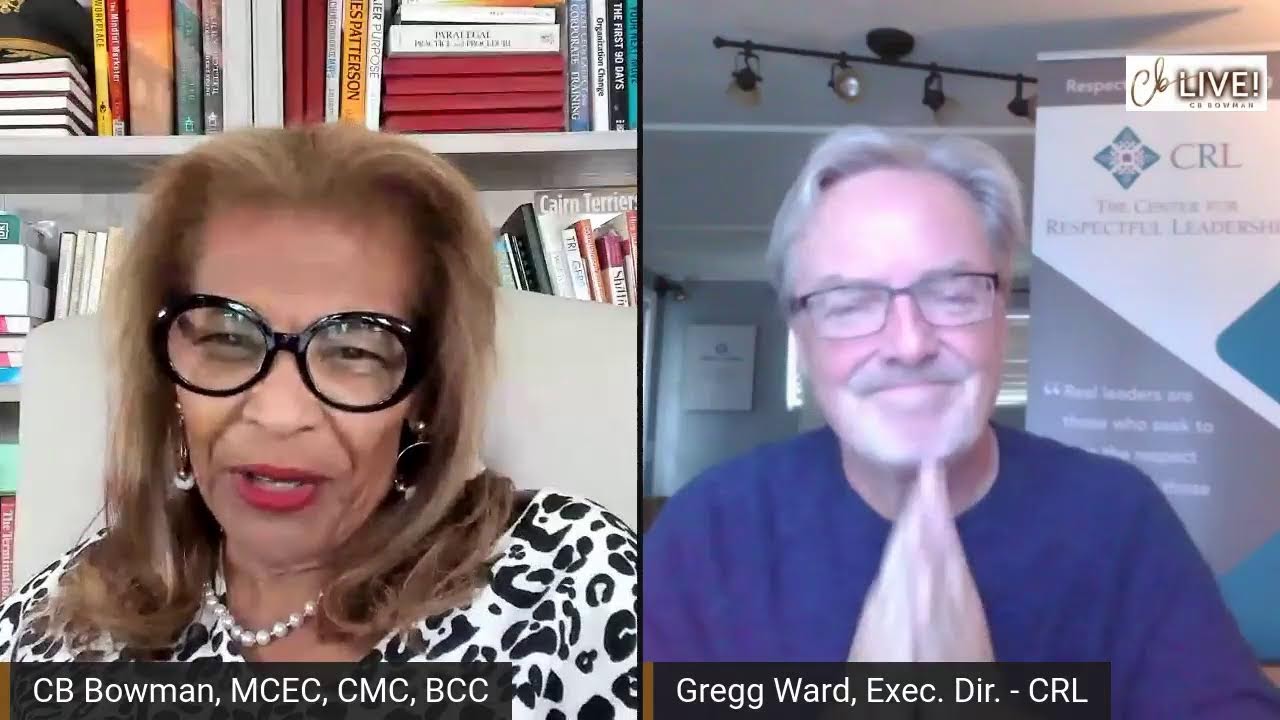
In this live interview, host CB Bowman talks with Gregg Ward, founder of the Center for Respectful Leadership, about the critical role of respect in modern organizations amid the Great Resignation and post‑COVID workplace turbulence. They explore why respect drives employee loyalty, using Costco as a benchmark of respectful culture (low manager turnover, high associate retention, above‑market wages, and proactive employee care). Gregg explains his training methodology, which blends neuroscience, experiential role‑play with professional actors, and the Platinum Rule (treat others as they wish to be treated) alongside the classic Golden Rule. They discuss concrete conflict‑repair tools such as the “two‑to‑tango” process for restoring broken respect, and the concept of an “unrightable wrong.” Gregg shares two personal failure stories—a mis‑managed healthcare department intervention that taught him never to rely on a single source, and a divorce that was resolved through mediation, illustrating respectful negotiation. The conversation also touches on broader societal respect issues, including political polarization, cultural expectations of deference, and the growing importance of alternative dispute resolution (ADR) as a respectful alternative to adversarial litigation. Throughout, Gregg emphasizes listening, empathy, and tailored communication (e.g., phrasing respect without “but”) as core leadership skills. The episode ends with a call to action for leaders to adopt respectful practices and a reminder to stay safe during Thanksgiving.
Chapters
Hello everybody, guess who's here? Well, you know, it's Tuesday and so you must be here with me. This is CB Bowman Live Challenges of the C-Suite. Hey, you know, today I'm gonna change up my format. So it's Thanksgiving week. Happy Thanksgiving to everybody. Make sure you get that turkey in before you start your New Year's Eve resolution, resolution about going on a diet, right? Mine goes out the window about a an hour after I make it. So forget about it. Hey, I'm going to start doing some research on my show. So instead of giving you a secret, I'm going to start to ask all of our guests 2 important questions. One is, give an example of a complex problem that you had a simple solution to. And the other question is, give us an example of a failure you've had that turned out to be a learning opportunity. So we're about turning failures into positive situations, so be prepared. Hey, if I forget to ask those 2 questions, you all send me in a note in the chat, okay? So you'll be my backup team. Okay, let's rock it out for today. Who do we have as a guest? Well, we have a dear friend, and full transparency, he's a member of the Association of Corporate Executive Coaches, which you know is my group of very, very special, incredibly talented master corporate executive coaches. I mean, these folks have written the book on how to be an enterprise-wide business partner with your clients. And Greg, I think it was 2 years ago, he was responsible for our annual— semiannual conference. And if you missed that in California, oh my gosh, I owe him my firstborn.
Okay.
He and a colleague, Cynthia, did such an incredible job. I had nothing to do. I slept through most of it. No, I didn't. Well, I was dealing with a migraine, and thank God they had my back. It went off without a hitch. He's my guy. So without further ado, I'm going to introduce Greg, who has an incredible company about the respectful leader. This is something we don't hear much about, right? We don't even think about our leaders being respectful, at least not before COVID right? COVID started to change the landscape. Have you noticed how many people are— have left their jobs? We are in a period called the Great Resignation. Employees are getting back, fighting back, and saying, I want to be respected. I want to respect The company I work for. It's a two-way street. They don't like how their companies handled COVID. They don't like how their companies handled social justice. And here in the United States, it was the killing of Floyd that set the whole ball in motion. They don't like how their companies are responding to the environment. How they're responding to mental health. We have a crisis, and you think that this is not touching you, even if you're happy at your job. But guess what? It is. Because let me tell you what happened. I walked into Costco last night. You guys know my middle name is Costco, right? And they had no roasted chickens. They had 4 packages of Atlanta-raised salmon. Now everybody knows me at Costco. Miss B, how you doing? Actually, it's Mrs. Ottomanelli now, but you know, who could pronounce that? I said to the guys in the meat department, I said, Am I seeing things? There's nothing in the roasters back there. They looked at me and they laughed. They said, oh my God, we were hoping you were not going to come in the store today. I said, well, I don't understand. I said, I've been shopping at Costco some 25, 30 years. I've never seen no roasted chickens. And he said to me, this store has been open for 7 years. I said, I know that. He said, we have never not had roasted chickens. I said, well, do you guys want to explain to me what the heck? And he said, CB, normally our store, this one store, sells 400 roasted chickens a day. I said, yeah, and what's the problem? You own the chicken farms. Because you all know the story about Costco and their chickens. Their chickens are plump, juicy, yummy. $4.99 for these big fat chickens. And they couldn't get those chickens in and guarantee that price. So the CEO said, that's simple. Let's just Buy a chicken farm that covers half of the state. So I said, so I don't understand, you own the chicken farms and this is Costco, why aren't there chickens in the case? And he said to me, we can't find people to work on the farms, we don't have truckers to truck it in. We have no labor. I said, what? He said, we are in such a crisis, you're going to see more and more shelves empty of food. So if you think that this lack of respect, this one facet of leadership and management, is not affecting you, You're totally wrong. You know, walking into Costco last night, I saw how they spread the few things out that they had to make it look like the shelves were filled. At Bed Bath and Beyond, the shelves are empty. I'm telling you, I have not seen this in my lifetime in the United States. The last time I saw this was in Cuba. Empty shelves. So we need to listen to Greg now. We need to hear what he has to say and what his company has to say and what his book has to say about being respectful to employees. Employees have got the game. I have never seen so many For hire, work for hire signs in Colorado. You can't go a block without seeing 2 to 3 stores that are looking for people.
It's the same here in California. Absolutely.
And so wait, so now let me introduce Greg.
Oh, okay.
Greg, welcome.
Thank you.
Tell us about yourself from the beginning.
Okay.
I want you to share about the acting part, and then let's talk about Respectful.
All right, I was working as a professional actor, writer, director, and producer in New York City way back in the 1980s, so that makes me old. And—
It makes you a silver fox, come on now.
There we go, I'll take it, I'll take it. And I fell into a job. I literally fell into a job helping the New York City Police Department create a training program on how to handle what they call EDPs, emotionally disturbed persons. And we use live professional theater as part of our training program on how to handle these kinds of folks. And it was far more successful than anybody thought it would be. In fact, the New York Times wrote it up, CNN did a special on it. We were able to get through to these hard-bitten New York City cops in a way that no other training program was able to do because we were able to use this technique of very realistic portrayals of situations that cops find themselves in on a daily basis.
Wow.
So that began my career using theater as a training tool on really complicated, loaded topics Yes. Such as conflict, such as diversity, equity, and inclusion, such as respect and what we now call respectful leadership. So I've been doing this work for about 25 or 30 years or more, essentially trying to help leaders in all kinds of organizations understand how important respect is. And you brought up Costco. We actually did significant research On the difference between Costco and its most clear competitor in the United States. Can you guess who that is?
Well, in my book, Costco has no competitors.
There you go. But in the, in the industry, in the food industry, Sam's Club might be—
I was just gonna say Sam's Club.
It's Sam's Club. Now, what we found, and we looked at External metrics with their customers, growth rate, profit margins. And then we looked at internal metrics such as the Net Promoter Score, the internal Net Promoter Score, employee loyalty, employee theft. And all of the indicators show that Costco is a leader in creating a very respectful culture. Did you know turnover of managers at Costco, turnover of managers is less than 1%?
Wow!
Less than 1%. Turnover of associates after the first year, which is always a probationary period, is only 5% to 8%. At Sam's Club, it's industry standard, 33% to 40%. And now under COVID, it's even higher. So what we are— we love to give the data because there's always the doubting Thomas out there who says, oh, respect, that doesn't matter. Who cares about respect? Just keep your head down, keep your nose clean, do your job, and you'll be fine. Well, sorry, that's a very old-school way of looking at it. And what we found is respect is a key driver of loyalty, of performance, of partnership, and profitability.
You know, you're so right. I actually sit down and talk to the employees at Costco. Not while they're working, obviously. And one person recently retired, and we had such an amazing conversation. I said to him, how and why does Costco keep people employed?
What did he say?
He said, we care. 2 words, we care. We treat them well.
They treat them with respect.
And you know what that respect looks like? It's sitting down and talking to, for example, young employees about being sure that they set aside money for retirement. I said, you do what? He said, yeah, we talk to them about taking care of themselves health-wise, retirement-wise. He said, Many of these people, employees that come in, have never thought about retirement. But we make sure that we surface it. We put them on rotation so that they know— I have seen managers on garbage pickup rotations.
Absolutely. Absolutely.
And they're doing it with pride. Yeah, I saw a little tissue on the floor at Costco, a little piece of paper last night, and I was about to pick it up because I felt guilty. My Costco, it's got dirt. Before I could get to it, an employee scooped it up and threw it. I'm like, it was lightning speed.
The other thing they do is they pay higher than the national average, their basic wage. Employees contribute only 8% towards their healthcare premiums, whereas most other retailers, if they offer healthcare at all, are paying— they're paying upwards of 50% of their premium. So Costco makes it really easy to work there, and it also makes it a warm and welcoming place, even though it is your warehouse store. There's nothing frilly about it or fancy about it in any way, but it's clean. People care. They take care of you. They take care of their customers. They seem to genuinely like each other and like their customers. You can't beat that formula. You can't beat it.
I remember in New Jersey, New Jersey Costco. So I'm at Costco every week, if not twice a week. It's a sickness. It's truly a sickness. But I remember one of their employees, a young girl, passed away. And I, as I drove up, I saw bunting on the building.
Wow.
And I said, what the heck is going on? I walked in and there was a very somber atmosphere. Not unfriendly, still friendly, still taking care of business, but you felt Wow. And I said to them, what's going on? And they said, we lost somebody yesterday. A young girl was driving drunk and she hit somebody. And do you know, at her register where she worked, they had laid down flowers?
Oh.
Where do you see that? You don't.
You don't.
You don't. Not at all.
You don't.
And so that kind of— yeah, there are people that don't agree with each other and everything, but you never see that. And I'll tell you one other thing. If you want to know where something is in Costco and you ask one of the people, they will take you to where it's at over there.
Yeah.
One time somebody new was working there and they pulled this, it's over there. And I walked up to the managers and I said, Jeff, he hasn't completed his training program. And Jeff just laughed. And he said, okay, CB, we got it. We've got it.
You know, other retailers are now doing that. The Home Depot is doing it. Lowe's is doing it.
Yeah, but try to find somebody in Home Depot to help you.
I know, I know. But Costco led the way. Costco led the way in that practice. I love the organization. Did you know they also, during the great downturn of 2008 to 2009, the CEO actually mandated that across the board everybody was going to get a raise, even though there were layoffs all over the place? And when he was asked by the media, why would you do that? He said, the last thing we need is our associates being worried about making enough money because that's going to translate into poor service to our customers. And they actually grew during the Great Recession. They actually grew.
I did not know this.
And they grew during COVID During—
That I knew. Yeah, they're stuck. Yeah, I'm telling you.
And, uh, and, uh, their competitor Sam's Club actually stalled during COVID Now coming out of COVID I will give Sam's Club credit. They've, they've reorganized, they've got new leadership there, and guess what they're doing? They're copying what Costco is doing. Gee, what a surprise.
And they have a long way to go.
They're getting better results, so they have a heck of a long way to go. You know, you asked me at the beginning, you said, Greg, I want you to talk about a mistake that you made. And boy, you— I immediately jumped. Is it okay if I tell you that story now? Because I went, I went there in my head and I'm like, oh boy, am I gonna admit this on live? Yes.
Okay.
All right. So I was approached, I would say about 7 years ago, by a very large healthcare company who said, we've got a location where one of the departments in this hospital area, uh, the, the, the physicians are at each other's throats. There's a lot of disrespect, and can you help? And I said, I think I can. I, I need to talk to people, and so on and so forth. So they put me in, in touch with what they call the physician in charge or physician in chief of the site, who reassured me in what I thought was a very empathetic and understanding way that it wasn't as bad as HR was pointing it out, painting it to be. The mistake I made was I took this person at their word.
Wow.
When I eventually showed up and we had a preliminary meeting with all of the players in the room, The thing exploded, absolutely exploded. And I felt terribly blindsided because that person reassured me that everything would be fine. I come to find out that that person depends upon the physicians to give them a vote of confidence in order for her to keep her role. And, and so she wanted to downplay everything, that it wasn't such a big deal. Well, it was a huge deal. And my mistake was in trusting one source and not investigating things privately and quietly before I waded into the middle of something. So the big key learning for me— and, and the whole thing blew apart. She blamed me, which I felt doubly set up there. Uh, but maybe, who knows, maybe that was the plan all along, is, is They knew this was unfixable, so they bring in the outside consultant, it blows up, and then they get to do other things. Who knows? Who knows? But at the end of the day, I was basically let go and blamed for the whole thing going sideways. So I learned from then on, never ever just trust a single source when they tell you what's going on and how serious or not it is. You've got to And I never ever again will make any promises whatsoever that I can fix anything or, or, or make any positive difference. I'd say, I will take a look at this, I'll explore this, and if I get a sense that it's not going to work, I'll be the first to tell you, no, I'm not going to get involved with this. So I learned my lesson. It was a very painful lesson, but I learned.
But incredibly powerful.
Yes.
You know, you could even hypothesize that your success now was in part due to that experience, right?
Yes.
Because in working with identifying, helping people become more respectful, you can't just take one perspective, right? Because perspectives are so influenced by who we are.
Yes. Yes.
And so who knows if that's, that's the way she wanted to see it.
Yes.
And so that's the rose-colored glasses she looked through, right?
And I, you know, I, as a human being, I understand that. And looking back on it now, I totally understand it. What I should have done is said to her, I totally get how you see this. Can I speak with the people on the ground there to get their perspectives on it too. And instead, we developed a relationship right from the get-go where I thought I can trust this person. Well, I could trust them to give me their perspective.
That's the keywords.
Yep.
Their perspective.
Their perspective. So that's the key learning for me. That's the big mistake I made. And I learned a heck of a lot from it. I would say that when it comes to Feeling respected. That is one of the key learnings that we try to help all of our clients understand, is that respect is very much a— comes from the primitive part of your brain. It's a feeling. It's not a cognitive, rational thing in any way, shape, or form. And it's dependent on your— how you see things and your perspective. So it's imperative, not only our key learning, if People always say to me, well, what's the key learning about respect and respectful leadership? And I usually say, well, look, we've all heard of the Golden Rule. Do unto others as you would have them do unto you. And that's great. That's not a bad way to lead. There's just one little hiccup. Not everybody wants to be done unto the same way. So I'm very outgoing. And if you said to me, Greg, hey, can you lead a workshop for me next week on Monday morning? I'd say, sure, CB, no problem. I'll be fine. Just tell me when and where, what, what, you know, who might, who might, who's the audience, and, and we'll get it done. But if I wasn't available, if I turned to one of my staff members, and I have great staff who really know what they're doing, doing— Cindy, who you mentioned, she could do it in a heartbeat. She'd say, oh sure, you can't do it, Greg, I'll do it for CB, no problem. But if Cindy couldn't do it and I turned to a number of, another member of staff who's really awesome She would be up all night worrying. She'd want to talk to you in person. She'd want to have— get all the details.
She'd—
and she would be customizing the program all hours of the night. She'd lose the whole weekend preparing for this thing that I or Cindy could have done in our sleep. But— and she could do it in her sleep too, but she's always the kind of person who likes to prepare. So not everybody wants to be done unto the same way. And that's where we bring in the Platinum Rule: do unto others as they would have you do unto them. So respectful leadership is nothing more than the Golden Rule— do unto others as you would have them do unto you— and the Platinum Rule— do unto others as you would have them do unto them— working in concert together.
I love it. By the way, Cindy is listening and she says, thank you, Greg. So on my show, you never know who's listening. Good thing we said good things about her, right? She's gonna kill both of us.
Hi, Cindy.
She is such a force of nature.
Yes, she is.
I adore her.
Amazing.
Adore her.
And we, we have created— and so are you— we have created at the center what we call our Advisory Council. You're both on our advisory council, and we try to— I surround myself with the best of the best.
Yes, you do, Greg. Absolutely.
I have these wonderful colleagues and friends who sit on our advisory council, like you and Cindy, and we would be nowhere without you. So thank you for being a part of the center. It is an honor and a privilege to have you with us.
Now I feel guilty. I haven't been able to attend as many meetings as I would like.
I know you missed one hell of a party. You missed one hell of a party in October. Cindy was there, and I've got to get my— our swag to you. You haven't gotten the swag yet, have you?
Oh no, I want my swag.
It's really good swag.
Okay, well, I think our next meeting has to be in Colorado.
Why not? Why not?
Because I'm— yes, yes, I'm at the, I'm at the stage where I don't do flying. I'm just—
I know, I know, I know.
Um, but so, so you moved from being an, an actor, yeah, to coaching. Do you find any— do you use any of your old skills?
Gosh, I do. You know, as an actor one of the most important skills for us is to learn how to listen very, very carefully to what, what the other person's giving you so you can respond either in kind or in the opposite to create the drama, right? And so I, I really developed a listening skill that I'm very proud of, and I eventually, I started working, uh, After I did the work with the police department, I actually moved to the UK and I lived in Scotland and in England for many years. And I worked as a freelance correspondent and journalist. My father was a journalist, so I grew up with journalism in my blood. And I did a lot of journalism work in the UK. And again, learning to listen to people tell their stories and then being able to take that and translate it into journalism. Is, is a key skill. So I think it's a key leadership skill. Listening is, is probably the most important respectful leadership skill that you can have.
So, okay, so now tell me, what is it that you do in your company? How do you get people to be more respectful? Do you have to identify their flaws first?
Well, that's a great question. Usually what we do is workshops, highly intensive small group group workshops, usually of 10 to 12, maybe 14 leaders working together over 2 days. And it's an experience. First, we, we help them understand the neuroscience behind respect and why we feel the way we do and how it impacts our conscious and unconscious biases and so on and so forth. And of course, inside of all this, there is a DE&I discussion all of the time about the diversity, not only of race and gender, but of perspective, of experience, of you name it.
Mm-hmm.
And so once we help people understand the neuroscience of respect, we then help them understand how it has impacted their own lives, both disrespect and respect, and how it helped shape who they are as an individual. One of the exercises we do is we ask them to recall a time when they were disrespected by a boss or a colleague or a vendor or a customer. And it could have happened 10 or 15 years ago. And they almost immediately recall the feelings that they had at that time.
Yeah.
And I make the point of that never goes away. It's, it's always with you and it informs how you behave going forward with your teammates, with your colleagues, with your direct reports, with your bosses. Those incidents have a significant impact. We always try to cap that exercise, a very powerful exercise. Sometimes we have tears, sometimes we have heartfelt confessions, and so on and so forth. I always try to cap it with the words of Maya Angelou. who said late on in her life, people— she was asked by a journalist, in all the things you've done over all your career, what have you learned about people? And she turned to that journalist and she said, I have learned that people will forget what you did and people will forget what you said, but people will never forget how you made them feel.
Yes, I love that.
I love that quote. And once we do that exercise and cap it with that You can just see the light go on in the manager's eyes. You could just— they totally begin to understand how powerful respect can be. And then there are skills that we introduce to them. They actually practice the skills either with each other or, if we have the opportunity, using our live professional actors to role-play. We call it experiential learning. We know everybody hates role-playing. But we call it experiential learning, where they will practice their new skills and techniques on respectful leadership opposite a professional actor who is playing a fictional employee in their company, who walks and talks just like their employee of the company with real issues. And they get real-time experience using the techniques with these, uh, with the, with the fictional employee. People come out of our workshops saying That was the most powerful, impactful training I've ever experienced on a leadership issue. The best compliment, CB, I ever had was from a highly decorated admiral in the Navy who I did a workshop, a Respectful Leader workshop with that admiral and his team. And at the end of it, he goes, Ward, that wasn't half as bad as I thought it would be.
That's a military response.
Oh, I tell you, I was, I was beaming. I was like, Admiral, that is the best damn compliment I've ever had.
Oh my God, I love it. I— well, you know, I'm an Army brat, so I get it.
You got it.
Oh my gosh. You know what, I want to go back a moment, and I want you to please tell us, what does respect mean?
That's a great question.
How do you define it?
Well, when I first started working in this field, I thought everybody's got the same definition of respect. It's just treating people with genuine courtesy and civility regardless of who they are. Well, that's not quite right. That's how we try to define it at the Center for Respectful Leadership. But I'm sure you're aware that there are many cultures where respect is a requirement. behavior, at least a surface behavior where you're supposed to show respect, for example, to your elders or to people in authority. And when I was growing up, you probably had this too. My parents said to me, you must respect your elders. That includes your grandmother. You have to respect your grandmother. Well, CB, my grandmother was a jerk.
Really?
My grandmother was disrespectful, begins with A and ends with E, and we ain't talking awesome. This woman was so abusive verbally, just just incredibly disrespectful, and yet my parents both said to me, "You must respect your grandmother." So even as a child, I was having this this discontinuity in my head. I didn't understand how why right. I'm not allowed to behave the way she was, and and I was told that that behavior is disrespectful, but I'm still supposed to respect this person?
Yes.
And it just never made sense to me. And, and that— and, you know, we have, uh, folks from Latin America on our advisory council who said, said to us in, in one of our sessions a number of months ago where we were learning about different, uh, uh, way respect plays itself out in different cultures, they said, oh, in, in Latin cultures, Latin American cultures, You have to respect authority, even if that authority is kidnapping and, and, and torturing your family members. You must respect them. I mean, it's, it's, it's that powerful and strong. And so there's this, there's this pretense that you have to feign respect for someone that you don't necessarily really respect.
And the, the performative part of it is just as important as genuinely Do you think, Greg, that that's the reason why the term respect has depleted?
Yeah, yeah.
The meaning of respect versus the term.
Well, we strongly support the term respect, that we should continue to use it and define it as treating others with genuine courtesy, civility and decency, not only in the way you want to be treated, but in the way they want to be treated, regardless of who they are, what level they are at. It doesn't matter.
Yeah.
And I have worked with many leaders who have respect. But yes, the term has become in some cases a pejorative. People don't— they— it's loaded for them, but it's not yet politicized the way the term diversity has become politicized which drives me insane. It's so frustrating. I'm sure it does for you. Diversity has become this political football that everybody's throwing around and being incredibly disrespectful to, and, and that really troubles me. And I think it should trouble any leader of any organization when diversity is maligned and called some kind of politically correct movement. You do that at your peril. And, and the same with respect. It hasn't become politicized like diversity has. But you're right, some people don't want to talk about respect anymore because it has such negative connotations for them.
Well, I think the part about diversity has come to play because we— many people, in order to accept diversity, have to attach it to money.
I know. Isn't that sad? Isn't that sad?
Be diverse so that the— your share of the market increases.
Right, right.
Your ROI increases.
Right.
So, so wrong.
I know.
In so many ways. And when I think about respect, it breaks my heart to see the lack of respect our nation has For those in power. Now, let me give you an example.
For those out of power, you mean, who don't have—
In power. In power.
Okay, say some more.
So let me give you an example. I was raised that you respect the office of the President of the United States.
Yeah, me too. Yes.
Whoever is in there. It has nothing to do with your agreeing With what they say. And somehow that has gone away in the United States. When you start— I saw it with Obama particularly. I don't know if I saw it with him more because we share the same race, or whether I was just tired of it. But seeing that— or because he's young. Well, was young when he took the—
Relatively young.
Oh my gosh. But calling him the prez and calling him out in the way that they've done, not that other presidents haven't been called out, but it seems to be getting worse and worse. You look at the late night shows and all of the trashing and the making fun of and, you know, the cultural Dismissal of the president's office really makes me sick.
I hear you. I hear you. I would also say they can take it. They can take it. You know what?
They may be able to take it, but here's the thing. When other countries look at us and listen to us, we're trying to say that we stand for this.
I agree.
We stand for respect of everyone in our country.
But we don't.
You attack the leader of our country in a disrespectful way.
It's— and what happens? What happens when we feel disrespected by our leaders? We have a— we have a series of what we call the respectful dos and the respectful don'ts in this canon of respectful leadership. And one of the respectful don'ts is don't respond to disrespect With more disrespect.
Yeah.
And so what's happened in our culture, especially in the last 4 to 5 years, is disrespect has become kind of a blood sport. It's kind of been okay to just disrespect anybody you don't agree with and to do it in the most destructive and volatile and violent way.
Yes.
And so I think we all agree we're, we're in a very serious place in this country.
Oh yes.
With regard to a lack of respect for others. And if we continue down this path, and you and I both know there's more guns out there in this world than there are Americans, um, I am concerned regardless of where we sit politically. I am concerned that more and more people are going to resort to violence than to public discourse, a respectful discourse.
Oh, we're seeing it. There's no doubt about it. We're not talking the future. We're talking about the here and now.
Yeah, yeah, we are. So my mission at the Center, our mission, is to introduce people to the power of respect and how important it is in productive, healthy relationships. And that Not only at business, but in our personal relationships and with each other in our communities.
How can you— I think the question that people want to ask you, Greg, is how can you respect somebody and disagree with them?
That's not hard to do, actually, if you know how to do it. It's essentially— you cannot, in the expediency of trying to avoid a conflict, You can't tell someone that I respect your opinion when you don't actually respect that opinion. When you don't agree with someone's opinion, a lot of people tend to spout their opinions as if they're facts. Ever notice that?
Yes, I think I've been guilty of that myself.
You and me both. So what I advise you to do— well, if you tell someone that you respect their opinion, When you really don't, just because you don't want to have an argument with them, you've done 2 things. You've given them the impression that you actually are validating their opinion. That's number one. And number two, you've actually disrespected yourself and your own sense of integrity about your own— where you stand personally. So I, I advise everyone, never tell someone you respect their opinion When you really don't. What you can say instead is, I respect you as a person. Now, if that comes off as too— as a backhanded compliment, you can say, I respect you. And I think— and then we use— I like to call it a general purpose agreement.
Wait, wait, Greg, can you say to somebody, I respect you and I disagree with you, or I respect your opinion and I disagree? You can.
You, you can. I respect you and I disagree with you. Try not to use the word but because but negates the— what you just said about respecting them as a person. You could say, I respect you as a person and I disagree. And then I would follow it up, if you don't want to have any more conversation, I would follow it up with, and I think we can agree that this is a highly contentious issue. We're probably not going to be able to solve it here. And then how about those Yankees? You could—
that makes it another—
you want to deflect and go in a different direction, right? But psychologically, if you were to say, I think we can agree that this is a controversial topic, what happens to that individual in their head is unconsciously they hear the words, I think we can agree. And so what you've done is created that opening for them to see you as somebody who is agreeable, and they're less likely to be fighting with you. Of course, if they're a sociopath and they just want to push your buttons and trigger you, this stuff isn't going to work. You could just say, you know what, I got to go to the restroom. I'll see you later.
And that's the end.
That's my fallback position.
Okay.
You know, whenever I'm meeting with someone or talking to someone who was just expressing incredibly disrespectful stuff, just to poke the bear, I just say, you know what, I'm not feeling so good, I got to use the restroom. Now, I did have someone follow me into the restroom.
No way!
To continue the discussion. But finally I said, excuse me, I'm going into that stall and I really need privacy.
Go to the pooping stall.
But generally people will leave you at the bathroom door.
I love it. Hey, we have about 15 minutes left, and I do want to ask you, um, the other big question.
Sure.
Which is, can you identify a complex problem that you resolved simply?
I can't, I can't. I'm trying to think of which one.
Oh, we've got time for 2.
Okay, because we, we've got a couple that we solved. I think where I'd like to go is talk to you about when 2 people fall out of respect for each other.
Okay, so since you're gonna tie this to your work, you get one for your work and one personal.
Okay, okay, you got it. You got it. So here's the work one. When 2 people fall out of respect for each other, sometimes that cannot be solved. We call that an unrightable wrong, where one or the other perceives that the other has done something so disrespectful That it's— it is an unrightable wrong. There's nothing you can do to change that. But if they're both willing to at least to try to repair the relationship, then what you can do is talk to them about— I know it sounds really simple, but it's called the two-to-tango. It takes two to tango process. If you get them to agree that any relationship between 2 people is based upon those 2 people working together and, and getting things done together, dancing together, that when they fall apart, the only way to get the dance back going again is for them to start dancing with each other again. So once you get them to understand that it takes two to tango in any relationship— and this comes out of marital therapy and mediation and all that kind of stuff— Once they realize, well, they're not going to be able to get that relationship going without the other, then you can find common ground on what, what is working between them, what do they respect in each other, and how can they begin to work together again. So that's— it's, it's really helping them understand the two-to-tango process. So that's, that's on the work side.
Okay, so I'm gonna just dive into that a little bit. Do they ever feel that They'd be better off dancing alone.
Um, they could try that. You know, we, we explore that with them and say, sure, we, you know, but how far are you gonna get, um, with this, with, with your work when you're just trying to be a Lone Ranger? You know, uh, that, you know, the, the solo gunslinger. I mean, that might work for a little while, but we are all so collaborative, we're so interconnected these days. You can't You can barely do anything without the help of others these days. So yeah, they could try. They could try. And there are people out there who do try, but it doesn't last very long.
Okay.
Does that answer your question?
Yeah, it does. It does.
Okay. So you asked about a personal one. I'm going to talk about the failure of my first marriage. And I definitely played a role in my first marriage failing. And so did my ex-wife. And what I decided to do, I must admit, I sought out therapy and coaching and counseling from real pros.
Bravo to you. Bravo to you.
Well, thank you. Thank you. That's because my mother's influence when I was a child. She said, everyone needs therapy. I don't care how well adjusted they are. Everybody needs therapy at some point in their lives. And it turned out she was absolutely right.
Yes.
So it was— therapy never had a stigma for me growing up. You know how people, some people—
Yeah.
My mother was a social worker. So go figure, right?
It helps a lot.
It does. It does. So I decided through my therapist that, yeah, I could be all angry at my ex-wife. I could really— I could stake my ground and I could say, this is the way I want our divorce to go. And she said to me— and I always, I always— I'm better served by female therapists for some reason. And female coaches. And, and my entire staff at the center is made up of women, very powerful, strong women.
I love it.
Very diverse, powerful, strong women. And I would say the majority of our advisory council are women.
They are women.
I, I don't know.
I'm seeing a pattern here. Yeah, a little bit.
So what she said to me, Greg, is, what is that going to get you? You put your Flag in the ground, say, don't cross over this line. This is the way the divorce is going to go. What's that going to get you? And, and she said, I want you to tell me honestly. And I said, well, it's probably going to mean, uh, very, uh, formal, uh, communications with my ex-wife about our son and how, you know, visitation and all that kind of stuff. And, and the lawyers are going to get involved and it's going to be really expensive and really a lot of heartache. And she goes, is that what you want? I said, no. And she said, what do you want? And I said, I want this to be the easiest damn divorce for both of us in the history of divorce. And she said, well, what have you thought of? Why don't you get a mediator? That was the best damn decision I ever made in my adult life. When I got divorced, we had a mediator. My ex-wife completely signed up for that. We both realized it would benefit us both. And I actually, even she says I was very generous in the divorce. I feel really good about myself. We, we still have a relationship to this day. And, and my ex-wife actually works for my current wife.
What?
Yes. That is Wow.
Yeah, that's all I could say to that. Yep, Greg, only you could pull that off. Now that is a definition of a respectful relationship.
Thank you. Thank you. So that's how we solved that big problem. I just decided, you know what, a mediation is the best way to go.
And interestingly enough, one of my dear friends I think she was the starter of the Media Divorce Mediation Society in New Jersey. Yeah, yeah. So I know about this area for a long, long time. And, you know, when she first told me what she was going to do, she said there aren't people really doing this. And she told me about it and I said, you know what, that sounds like a really good idea.
Yeah, yeah, a lot of heartache can be solved. You get a good mediator in there who understands not only the law but relationships, and they can help you sort things out in a way that 2 opposing counsel who are there to make money, who are there to generate conflict— 2 opposing counsel are never going to end a marriage in a nice and clean way. It's going to be ugly and messy. And that's how they make their money.
And she came out of the financial world. So she knew her numbers back and forth. Her name is Anju Jasina. And just amazing how that field itself has grown because people were tired of contentious divorces.
Yes.
No one won except the attorneys.
Exactly, exactly. By the way, we now have an expert in alternative dispute resolution, Adam Nokes. He is on our advisory council, and he and I are looking to write a book together about alternative dispute resolution as it relates to respect and respectful leadership.
What? Great.
And the alternative dispute resolution movement is really, really growing. Can you imagine— think of a, think of a world Where instead of you and I going into civil court with separate lawyers to do battle with each other, actually are told by the state you must go to an alternative dispute resolution mediator first before you go to court. Now, there are some municipalities— and I'm not talking arbitration, you know how companies like people to go to arbitration— we're talking about an independent mediator, alternative dispute resolution expert. who says, okay, let's look at this in its entirety. They don't have any skin in the game. They're paid by the state or the county or the city. And it's, it's all about trying to resolve conflict rather than build it up and make money off of it.
You know what, let me introduce you to a really dear friend of mine, who is an attorney in the labor law area, who is a specialist An alternative dispute.
I love it. Please do.
Her name is Miriam Cork. She's out of New York. She is— she's my Columbo.
Ah, okay.
Yeah, the show on TV, Columbo.
Yeah, sure. Oh, now we're aging ourselves.
Oh, wait, I was told about this. And I watched the reruns. Yeah, oh dear, oh dear. Now we have a channel out here that has great reruns.
There you go.
Also on, um, what do we call it, Roku?
Yeah, yes, you can stream them, you can stream them.
Exactly, exactly.
Peter Falk plays Peter Falk.
Oh my gosh. Yep, he— after— he's never done something as great as that series was.
No.
Yeah, absolutely. And, and she is a true Columbo. I love it. Just brilliant, kind-hearted, scary smart.
I love it.
So I will introduce— hey, we're running out of time.
All right.
And I just love talking to you. It's just been fantastic. You know, I sit on your advisory committee. I totally didn't get all of the, the things that you brought to us today. It was at a different level.
Thank you.
So I'm hoping that you'll use this to let people see the inside of you that allows you to do such incredible work.
With your help. With your help. Thank you.
Goes both ways, my friend. Goes both ways. So, um, I'd love for you to come back and talk to us some more about your work without disclosing anything that's proprietary. But I think—
I give it away. I give it away all the time.
You sound like Marshall Goldsmith now. Hey, he's, he's Buddhist, and he said, just take it.
Just take it. That's been my attitude my whole life. Just take it. It'll come back to me. Through, you know, karma. It's all good. I'll give it all. I give it all away.
That's just amazing. I love it. And, you know, particularly now you're doing such important work.
Thank you.
It really is important. Uh, we've been through so much as a country and as a world. We need to stop and breathe and get back to the place of respect You are right.
You are right. If we don't, the consequences are going to be pretty dire.
They're scary.
And I love my country and I want the best for it. I know, I know you do too.
I do too. And it's interesting, I was talking to a dear friend who used to be my therapist, who, who is a dear friend who now lives in China. And he's lived there for the past As we used to say, umpteen years, and we were talking about the difference in the 2 countries. And basically, it comes down to the same thing. I don't care where you are right now, because COVID has been the great equalizer. It's respect.
It is.
It's respect. And we, we moved so fast before in this world that we forgot about that. And now we're taking the time to get back to that basic feeling. And quite frankly, it's confusing. It's confusing to all of us. What does it mean after what we've been through? You know, we've been so used to this blame and shame that how do you get from there to respect?
Yes.
Is the goal.
Yes.
So thank you so much for the work that you're doing. Audience, I hope you've enjoyed this. It's been a little bit more serious than what we normally do, but the time is right. And so please get in touch with Greg through LinkedIn. Find out more about his company and what he does. It's so important for all of us, especially here in our homeland of America. And with that, this is C.V. Bowman, and I want you to have an incredible. Have an incredible, safe Thanksgiving. Please do not drive while you're intoxicated. Take care of yourselves. We need each other. Thank you, Greg.
Thank you.
Bye now.
Bye-bye.
We'll see you, hmm, possibly next Tuesday. I think so. Okay, bye now. Bye-bye.
More from CB



211- Courage to Leap & Lead with Louise Story part 1Courage to Leap & Lead







