CB Bowman LIVE! Challenges of the C-Suite: Guest Nankhonde van den Broek, Episode 32
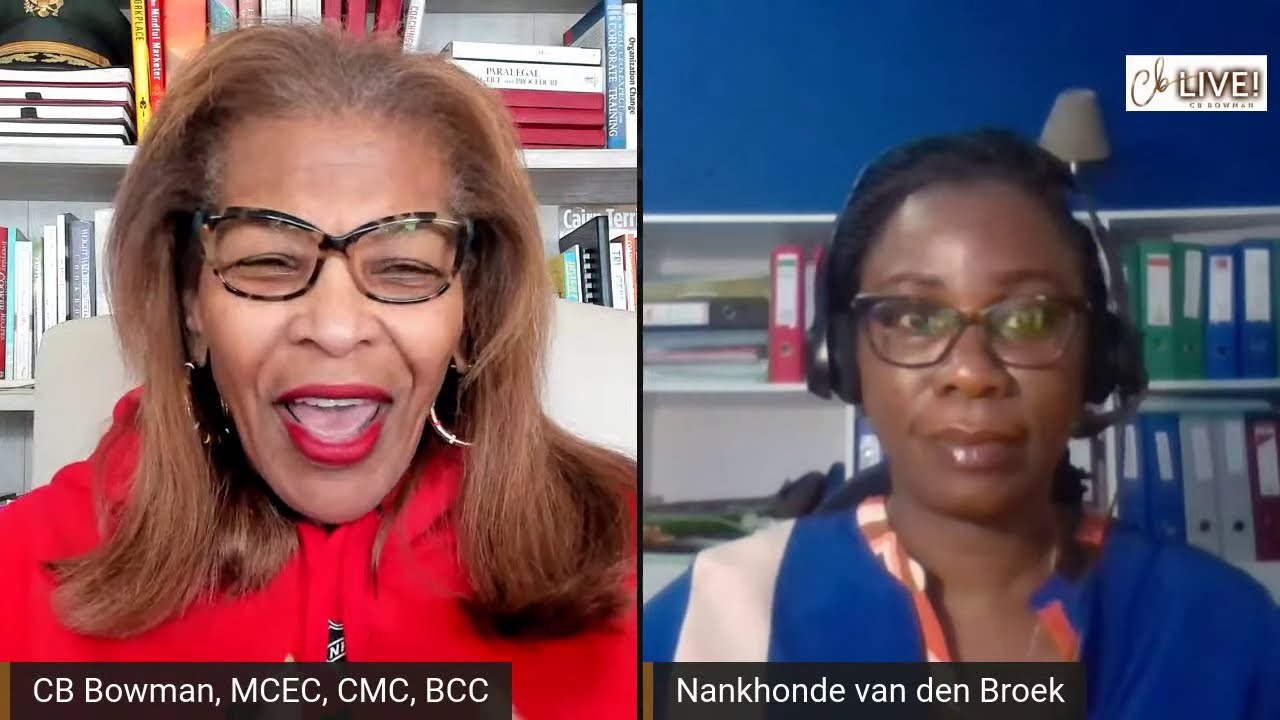
This content was created by CB Bowman. This content was uploaded by CB Bowman. This is a YouTube live episode titled "CB Bowman LIVE! Challenges of the C-Suite: Guest Nankhonde van den Broek, Episode 32" (published Feb 19, 2021). It is a recorded conversation hosted on CB Bowman Live with host CB Bowman and guest Nankhonde (Nankhonde van den Broek), a Zambian management consultant and CEO who describes her cross-cultural assessment work. The discussion covers workplace and social justice topics — cultural differences in defining success, psychometric assessments tailored to African contexts, equity vs. equality, behavior change for inclusion, generational dynamics, wealth distribution in African countries versus the U.S., and the role of technology/media in sustaining social movements.
Chapters
Hello everyone, welcome to Thursday's CB Bowman Live. And you know, today we talk about the workplace, especially in relationship to social justice. And you know, I promise you, you know me, I'm not going to beat you over the head with anything. We're just gonna have a fun, uh, living room type conversation and, um, Let's rock it out. 'Cause today we have a special guest. You know, I always say that, don't I? But that's because all my guests are special. You know, I mean, come on, they know CB Bowman. What are we talking about here, right? And so today we have Nakande, and Nakande is from Zambia, Africa. So we get to hear what's going on in another continent, another part of the world. We're gonna get the inside scoop. Nakande, welcome.
Hi, CB. Thank you so much. It's a pleasure to be on the show with you. Hello, everybody.
So Nakande, tell us about yourself.
So where do I start?
Um, when you, when you first came out of the womb. Wow. Kicking it then. Wow.
Um, so So yes, I'm Zambian and I am a mother. I am one of 5 girls. We're all girls in our family. I'm the third. And I have a management consulting business here in Zambia where I do change management and executive coaching. I also sit on the board of my late father's company where he was a co-founder, the first and now the largest private medical university in the country. And I also have— I'm the CEO of Zanga African Metrics, which is a platform for assessments in the workplace that actually factors in culture and context into how we actually show up at work in Africa.
Okay. All right. So you studied where?
I studied in Zambia, and I had the privilege— and I always say one of the greatest privileges my parents gave us is education, and one of the best. So I went to boarding school in the UK, and I then went on to university in Geneva, in Switzerland, and then in Senegal. And so I feel I had the best of 2 cultures, an African culture and a European culture.
Have you spent any time in the United States? I have.
I spent, uh, my first stint in New York was, uh, as a single woman living on 42nd and 5th. Um, and, uh, I had been seconded to the UN headquarters, the United Nations headquarters, to support the world's response to the then pandemic influenza, or the the suspected pandemic influenza. Nothing like what we're seeing now, but, um, I was seconded to help, um, support the development of guidelines for governments, um, and countries really on how to prepare for a pandemic, a global pandemic. And thank God then it never got to what we're seeing now, but our role was to prepare the UN system and their contribution to governments around the world. to know how to handle it, how to handle the different pandemic levels. My second stint in New York was married with a child and my husband, and we lived on the Upper East Side. Again, my husband, I met him through the United Nations. He's Dutch, and I also worked at headquarters the second time, although with a small child. I think I, I sort of settled moving to New York to follow his career because I took a notch down from my previous job. But it was great to have the family together in New York, and this time no crazy late nights. It was very sort of comfortable, quiet.
Are you really giving us a peek into your past here?
I am.
Can we talk offline? So the reason why I asked you that question is to, to let all of our listeners know that you have experience in developing your assessment both in European, American, and African cultures, so that we could, we could count on you to be able to tell us, you know, in a comparative state what the differences are. And the fact that you've developed an assessment specifically for the African culture, knowing what you know in the European and the American culture, is very exciting. So tell us what your assessment does.
So I've been working for 10 years supporting people's development, leadership development, um, in Zambia, and, uh, before that as a, as an international civil servant for the UN across countries. And so I'll go back to my development experience. You know, I was responsible for supporting policies, development of policies initially. Then I went on to actually manage grants and programs out of headquarters and now going into the field at country level. And I had the chance to support programs in West Africa and in East Asia. And that experience really showed me you know, there are differences in the way we approach or define success. And there are differences in need across different sectors, whether it's the health sector, education, the different economic areas, there's a difference. And so I've always been intrigued by, you know, how do we define success across countries? And what does that mean when I come in with a program to work on HIV response in a given country. And it's similar to fighting the same disease in Africa and in Asia. And I started to see differences in how their work ethic, their approach to work, and the context had similarities and differences. So from very early on, I was always curious about, you know, how do we achieve results across cultures? And how can I facilitate that process? Because when we sit in Geneva and New York, we are sort of far removed from the realities on the ground. And so I've really felt called to this. And I'll never forget, in— I think it was about 2006, I was working on—
One second. London has to have his point of view on this.
He's joining the conversation.
Yes, he's joining the conversation. So for those of you that have listened to me before, you know I have A 4-legged— who's looking at me like I'm crazy— a 4-legged Cairn Terrier. That's the, the pooch that's in The Wizard of Oz. And he is a redhead, and he has to let it be known that he's part of the conversation.
Hi, London.
We have diversity amongst, uh, animals and people here. So yes, continue. I'm sorry.
No problem. So I was in a West African country, and the minister I had been sent to support and negotiate a grant agreement with, um, I had a very interesting meeting with him. It's about 2006, and I never forgot, and it's really shaped a lot of what I do now. Um, I was in his office, and I had come in, you know, representing the donor and supporting the health sector, and he basically said to me, you know, Nankwanda, you're an African. The terms in this agreement, uh, are not something that I can say I can sign and meet. And so at the same time, you know, I need this funding to support the health— the program. And you— I respect the fact that you need to have your checks and balances in Geneva, but this is going to be very difficult for me because there are certain things that I would like to change, um, to make sure that I achieve the outcomes or the results. And he asked me to leave his office. And, and it was, it was, that was a dilemma. I was a young, you know, diplomat at country level, and it really stuck with me. And I thought about what he said, but eventually we did get to terms. I called Geneva, they said don't get on the plane without that signed agreement. So I went back, I had to start negotiating, and we had a conversation, and finally he signed. But it stayed with me, and even when I left the development world, I always wondered You know, we— a lot of wonderful people work in the development space. A lot of money is pumped into developed countries, but the impact— I feel a need for greater results. And I always felt there was something missing. And that conversation stuck with me. And over the years, I started to think, you know, maybe that link could be a better understanding of the actual people. How do we make sure that people's differences can be leveraged to make sure that they define success, but also that they can be held accountable to something they recognize? And so when I went on after leaving the UN to start my own management consulting and coaching business, I started to do this more for leaders and managers, and to support them to not only apply the tools that I had available, the Western tools that I used, psychometric assessments, you know, different training programs that I was certified in. But I started to build on them. Because I felt, you know, it's like a painting. When you paint a picture, the painter actually puts the frame where he wants you to focus, he or she wants you to focus. And it's almost like I was seeing this painting, And my employers or my worldview only allowed me to see within a defined frame and left out so much of the cultural nuances and, and the developing nature and context that affect results, and that affect the definition of success. And whilst there's some universal principles and, you know, competencies around achieving, defining success and achieving success, how we actually show up, and attain it does have some flavor to it. And that comes from the culture, and also the context. And so I became intrigued. And I started to put together all this information. And finally, building on Geert Hofstede's work, he did some work at IBM, he's a Dutch psychologist, he did some work at IBM across countries and came up with these 6 parameters around the differences across culture. when it comes to work, things like work avoidance and how we manage relationships, hierarchy, power balances. And I started to think about it and build on it, and I recognized that I could contribute something. I could actually develop something that factors this in, because why do I see the painting the way I see it, and why do I feel so strongly that it if I was able to apply this message, we could actually start to put people on development pathways that are not only more relevant, but are more impactful and sustainable in the long run.
So this, this is a mouthful, Nokande, but what I'm loving here, and I'm going to ask you this challenging question, is in the work that you're doing, because what I loved is you actually described a sleight of hand. Right? In a very sophisticated manner. And it takes me back to my studies at the New School. Whereas if you focus the eye on a specific spot, which is what magicians do, then you really don't see what's going on around that frame.
Uh-huh.
Right? So it's this whole sleight of eye. So now what I want to do is I want to tie what you're saying in terms of universal and that sleight of eye into what's happening here in the United States in terms of social justice and what actually specifically happens in the workplace. So if we use your assessments to look at universal success, are we defining success differently or the same in the United States? And how does that success impact the storm and— it's even hard for me to say— the killing of Floyd? Is it all together or how do you separate it out? How do you start to look at solution?
This is a very good question, but it's also a very deep question. you're asking. And I think the little contribution I can bring to this, especially as a spectator from the outside looking into the US, it's a very—
What I love is that you're a spectator of color from a country of color looking at what we have now. That's very valuable.
Yes. And I think there's a lot that we can share in our experiences You know, as people of color across the board, there's certain parallels and similarities in our experiences around oppression, around always feeling that you're not necessarily judged at the same level, you have to work harder, that there are always questions around your presence, your credibility, and we make extra efforts to overcome those. And so coming from the background that I do, and even knowing, you know, I recognize I do have a British accent tinge when I speak. That was deliberate. That was planned. My parents knew that in order to give us a head start in life, they had to give us the best education. And so they did. And a byproduct of that boarding school and the education system is the articulation and the language. Um, but I'm saying this because they made deliberate choices to make us fit into a white world. Um, and I don't think there's anything wrong or right, you know, I don't judge it. Uh, I'm, I'm a beneficiary of it. Um, and so this brings me to the US, because as a spectator from the outside in a country where We are the majority, um, and we have had an experience of segregation, and we've got— gotten through independence. You know, there's something that comes from our, our story to independence and post— shortly post-independence. Our first president, Kenneth Kaunda, had a philosophy called humanism. And, you know, for whatever he did right, whatever he did wrong, this is something that passes generations and we hold on, hold on to. One of the things we have in Zambia is that we are one Zambia, one nation. Every Zambian will tell you that we are one Zambia, one nation. So we— the ideology was that we are human first, then we are our respect— we are Zambian and our respective tribal lineages. So the, the key thing was human. So as a human being, how can we work together if we all see together— you see each other as humans? So then you, you sort of, again, the, the— you change the, the playing field. You almost even it because we have 73 ethnic groups in, in Zambia. And, you know, so he needed a way to bring the country together post-independence so that we could work on the development agenda. And so humanism was one way to do it. And I put this forward to the American story because one thing that has been brewing for a while is how human post-segregation is the playing field. And how— to what extent has— have the generations as they've come along been able to embrace the differences and work with the challenges as well and develop into this nation? And so what's happening at the— what we see, especially through the media here, and I must say that those are my main forms of information other than colleagues and friends who are also in the US like yourselves, is really trying to see where did it go wrong, what happened, because we have deep empathy when we see what's going on in the US around social and racial injustice. But at the same time, We know that these run deep. And if you think about apartheid in South Africa, as a Zambian, even I am a spectator into that situation of apartheid, but I'm also closer to it because of where I am and my family, and also Zambia being one of the countries that played a role in supporting the ANC. So for me, these waters run very deep. They run deep here when we were moving into independence and we had to now move into these new nations that were born out of colonialism and a different master sort of subservient roles. And I put parallels to where the US is, is because even though you would, if I say, got independence much earlier, um, there was still so much unfinished business.
Yes.
And this unfinished business manifests itself in different ways. And so even in Africa, across different countries— and when I say Africa, it's really a generalization because we're 54 countries and we're quite different, um, but we have certain common value systems. And, and so when I say this, uh, in relationship to how I look into America, I look into America sad. I look into America knowing that there's a lot of deep work to be done. And I look into America thinking that I don't think America is really ready to go there. But I think we are in the season and the era of naming the elephant in the room in a much louder way than has been ever done before.
So let me just go back. You said something that struck me. You said, uh, in In Africa, you have 54 countries with common— so I take from that in the United States you don't see common values across our countries. Is that true?
There are certain things that are common across the countries for which we know America. You know, the world recognizes America as the land of opportunity, the place where hard work pays off. Um, but there are differences when it comes to, you know, a more— I would say we are more of a collective society and America is more of an individualistic society. And so when you get that, there is this freedom to express, freedom to be, and freedom to live, which then gives more of a tapestry of different values and different experiences, different opinions. In a way that maybe is not as general here because of our collectivism and because of some of our value systems. What I see in America is really there's certain values that come across that are universal and that make this opportunity available to everybody. But there's also underlying tones to what is universal. that is surfacing and continues to surface the more you look in.
Yeah, so I understand what you're saying because then that, that's where the question of equity and equality come in, right?
I'll give you an example. I lived on the Upper East Side of New York. Maybe New York was also different to other places, so, you know, I can't say I know America. I lived on the border of, um, uh, Black Harlem Spanish Harlem and Jewish Upper East Side. And integration was so interesting for me to watch because I noticed that this, this is a sort of melting pot, but everybody actually still lives in their own cultures.
Yes, that is a really good example. And it's not only the Upper West Side or East— I think the East Side is more of a melting pot, but even still And probably the most congenial section is the newest sections of New York in Lower New York, which is called SoHo and NoHo, you know.
Yeah.
But you're right. And I guess I never thought about it before that the separation exists even in what's considered a very congenial area of the United States.
Yes.
But I also want to go back to the point that you made about America is known as the place that if you work hard, you'll get someplace. And that is such a misnomer because it goes along with what you were saying before. Certain people, if they work hard, will get someplace. Others can work hard their entire life and they're just going to stay in the same place.
Mm-hmm.
So is it accident that these people move ahead? Is it good fortune that their parents, like your parents, sent them to the right schools, they spoke correctly? It's so uneven and so imbalanced, and that's what you're hearing is the uproar, you know. And it doesn't only happen to people of color, but it happens Much, much more to people.
Yes.
So one of the things I want to ask you about is what I'm hearing that's happening in South Africa, because it almost flies in the face of what you're saying. And is that because South Africa has become— I don't know, I don't want to say Americanized, but if we compare the riots to the uproar that we hear about in South Africa, where South Africans are mutilating their own folks, people out in plant— I don't want to say plantations, but in farms.
Mm-hmm.
So what happened in South Africa that doesn't seem to be happening in Zambia or the rest of Africa?
So I think there's, there's something around the transition of power and the roles and relationships, uh, and the systems that converged in the transition. And, um, you know, uh, South Africa is, is, is— I think South Africans will speak better to this, but I will share what I, what I— this little thing that I see. One of the things I see in South Africa is that Whilst there was a transfer of power, and maybe in that sense political power, and I think you see this in most countries where there are issues of inequality and even social injustice. Whilst there's a transfer and doors opening for a certain type of power, be it political, be it opportunity to work in certain companies by climb, we're sort of jumping some steps. What is missing is economic transfer, so wealth transfer. And, and I think when I look into South Africa, the economy is still very much owned, um, by a small majority, if you want to call it that, of wealthy families.
So in Zambia, the, the economics are more a level?
In Zambia, that's not as level, but the, the, the ownership is also Black.
Ah, okay.
Whereas in South Africa, the ownership is, is white. It's white and Black, but the, the, the balance is not the same as in Zambia. And the size of the economy, the size of the country, obviously is much bigger. But when I look into the story, and you know, um, I may have the wrong lens on this, I really see a difference in who actually owns the economy in South Africa and also in Zambia. The ownership of the economy, it's, it's, it's in— it's not equal, but it's also made unequal by Blacks, by colored people of color.
How's that?
So in— you have this, um, the, the— I think inequality across this continent is perpetuated not purely by, by race. It's perpetuated also within races. And so we have in Zambia an imbalance in the distribution of wealth across Black Zambians. And you have, you have wealth in white, uh, people of who originate from other countries and became Zambian, were second, third generation born Zambian or Indian. We have that, but you notice it more, um, maybe we tend to focus more on it around race, but Africa is not the same story across. The inequalities are really where you have people of color, Black Africans, in, in countries and in economies where the distribution of wealth and power is held by Black people.
I see. And so how do you see the United States in terms of the distribution of wealth amongst Black people?
I, I see that where Black people have been able to make a name for themselves, there has not been enough attention or visibility to those success stories. Um, and those pathways that they— or the hurdles, or even the opportunities they had to get to where they are. Because we hear of various names, but these are famous names. You know, you hear about Oprah, you hear about athletes. It's usually media athletes, um, that you hear success. But across the board, you know, when I started to engage more, for example, with MG100, I started to now listen and hear more about not just the, the people in, in media or in, um, in athletics and sports, but actually people who are working hard running successful businesses, whether it's investment firms, whether it's, uh, other businesses, um, that are role modeling what the opportunity is irrespective of your color. But it's needed even more so in the Black cultures and the Black neighborhoods and the Black sort of society groups of people, because they're not enough that are made visible. You have a lot more visibility around success that is more Caucasian and from other races than you do of Black and even Indian, I would say, I hear more of, and Hispanic to a certain extent. But even there, I still see challenges. And what has happened with this new president and vice president and the team they've put into place is that you're starting to see people of different genders, races, abilities, and preferences in roles that traditionally they have not had access to.
Well, you know, yes and no. There have been in previous presidencies people of color, different ethnic backgrounds, different religion, different sexual preferences. You certainly saw that in the Obama administration. But what happened is then we went into the Trump administration, and no disrespect for our presidencies, the role of presidencies and of president and who was president, because I was raised that you respect whoever is in that office.
Yes.
You don't have to agree, but you respect.
You respect the office.
But I think there was such a stark change between Obama and Trump that we forgot that there was over the years more pulling in people of color and people of different persuasions because we visit— we saw Trump as being very insular, right?
Right.
Now we've got Biden in, and Biden is bringing back what happened before and adding a plus to it. And that's because Perhaps there's a lot more people that are eligible because now we have different generations that have moved through and our newer generations are more— display more diversity, right? So Biden has a wider pool to select from.
Okay. Yes, because we're seeing it. We haven't seen it like this, at least from this end, the way we're seeing it now. It's a very colorful administration.
Yeah, yeah. Well, when you, when you go from stark to colorful, you know, and then, and then on plus of that, adding that— I can't speak today— adding to that, you have a wider pool to select from. You darn well should see something different, right?
Yes. Yeah. And I think that encourages the, the role modeling. Yes. Um, that you see in Black communities Um, and that go beyond the sort of role. But I think there's also beyond the church, uh, that we see a lot, uh, I mean, looking from this side. Um, and you start to see, you know, role models who are Black who are doing great things across a myriad of sectors. Um, and that makes you think that, as you've said, you know, time also allows more people to, to sort of grow into different positions and take up opportunities that previous generations didn't have before.
And the other thing that's happening is the younger generation— Gen X, Gen Y, Gen Z— are more supportive of diversity. That's just a given. I mean, you can't close your eyes to that. So as this generation moves through and up, you have a wider a wider pool that support each other, right?
Yes.
I come from the generation where it was protect yourself at all costs, um, because we were fighting to be known, fighting to be recognized, fighting to be heard, and there was a huge focus on self, right? Um, now with a little bit more room, we could focus more on supporting each other. And perfect examples of that is you look at people of color of my generation, and the reach down to help the next generation was fierce.
Yes.
It was just not happening. Not just the next generation, but the generation alongside of you. We have organizations, associations that were set up so that it only, only included the top, top. And I'll give you an example.
Yeah.
ELC was an organization that still exists of Black people who report— had to report, I think it was no more than one level down from the Wow. Now that just cut off like 99% of Blacks who were struggling to get to that level. They added a new group of the lower, um, lower in the ranks, but still, but still, that new group was really filled with the next generation. It didn't support the current generation. I was always so disappointed. And it became a private little club of people.
Yes.
But the reach down didn't happen. We also saw in my time that there was a huge separation between women of color and men of color in the organization. Men of color supported men of color. Women of color supported each other sometimes. You had the female against the female. Interesting.
That exists here as well.
Yeah. Yeah. So we had so much not going for us. I'm just happy that we got to where we are now. But yes, go.
No, no, I think what you're saying is so interesting because if you think about, uh, organizations, organizations sort of being a microcosm of the nation, um, and having to learn to work together, uh, and how the different generations, um, are dealing with different sides of this coin because the Generation X and Y sort of have taken this for granted that this is how it should be.
Yes, excuse me, I'm choking.
You okay?
Yeah, stand for a lot.
And then the older sort of senior generations are sort of working in the same places and spaces, but when you come to race in the workplace, across generations, the, the— I would say the healing or the, the, the pathways to come together, uh, actually require different steps. And so from what you were saying, I'm really hearing that there was a time where there was more of a reason and a need to maybe for the older, the, the, the generations that were older, um, to be together, work together, because there was something connecting them. There was. And I think about this in relation to, to my parents' generation as well. You know, my, my— I always think that my dad's generation, they had the struggle for independence to unite them. They had this cause that they were fighting for together, to get the race, to get the, you know, the indigenous people somewhere. And I feel that somewhere along the line that connection, that rallying cry has either been diluted or lost. Because what is it that ties us together? What is the glue that is bringing us together?
In the United States, it's interesting that you said that because we were focused on the cry to move forward as a Black people.
Mm-hmm.
Malcolm X, Martin Luther King.
Yes.
We weren't— because we couldn't— we didn't have enough energy to fight that battle and then fight the battle in the office.
Yes.
You know? And so while I speak about the things— excuse me— that didn't work, there is a reason for it.
Mm-hmm.
You know, it just took up so much.
Yes.
Just to be part of society. Then you look at the workforce. Just didn't have enough. So the millennial generation— I'm sorry, the baby boomers. Excuse me.
You okay?
I'm just choking. It's fine. The baby boomers and the generation before that, I mean, the focus that we had to survive as human beings took over.
Yes, the survival. But to a certain extent, that is still there. It's amazing to see that this fundamental basic Um, uh, right. Um, it's still a major problem to survive.
Yeah, absolutely. Because, and you know, we've tried a lot of different things. Most of them haven't worked.
Why do you think that is?
You know, I have several theories on it. One is we had a, a point in history where we didn't have the media that we have now.
Mm-hmm.
And that just is the technology became greater. Technology became a voice. So back in the day, the quote was from Marshall McLuhan, which said, the media is the message. Now it's technology is the message.
And everybody has access.
Not only do we have access to it, think about it this way. Before, you saw a headline in a newspaper. The next day it was another headline and we threw away the old newspaper.
Mm.
Or we used it to wrap fish or to line the garbage pail or whatever.
Yeah.
Out of sight, out of mind.
Mm.
Today the media does not let that happen with— I mean, I'm sorry, technology does not let that happen. You've got Twitter, you've got Zoom, you've got Facebook, you've got LinkedIn, you've got the newspaper, you've got the magazine, you've got the TV, and then they're all combined because then when you go on your email, you've got news feeds, right?
Yes.
People can continue to experience what happened before it's experience left the page, right?
And the story is told as it, as it happened. Yeah, you can see it. Yes. Yeah.
The other thing that's really interesting as I'm talking to you is that we have created this— I'm going to call it the celebration mindset. Which causes reminder. So if we look at the Nazi prison camps and, and, and the whole picture of what happens, but the Jewish population does— it's not a celebration, but it's a memory that is constantly enforced.
Uh-huh.
And for good reason. So that doesn't happen again, right?
Yes, don't forget.
Um, with what happens with the block culture, this did not happen. It was one and done, except in, in the hearts and minds of people that were immediately impacted.
Interesting.
Now we have a situation with the killing of Floyd and the killing of others, where it's going to be repeated. It's like 9/11. There is an anniversary of 9/11 every September 11th, right?
Yes, yes.
This is starting to happen with social situations and injustice. It is a constant reminder So we don't have to say it's one and done in our minds. It's here. It's in front.
It's the right—
Yeah. And while some of my colleagues have said, you know, CB, your organization, Workplace Equality and Equity, you need to get it out there right away because this whole concept of social justice is going to go away. And I said to them, no, it's not. It's not going to go away until it is repaired. And it will not be repaired as much as our hearts want it to be. And I'm talking about people of color, people of non-color. As much as our hearts want it to be, we're not going to see it in our lifetime.
You know what's interesting you say that, because I think there's always the mantle bearers of the cause and the mantle bearers of the change, those who champion or want to see or can envision a different world. And I think the— as we go through right now what's happening, you can see that we have to get comfortable not only defining a world where equity and equality matter, but also we have to learn how to live in it because we, you know, to a certain extent, it's behavior change all around.
Yeah.
And that's where I think the comfort zone is sort of always looming and threatening in the background because it's so much easier to continue Because yeah, there's a nudge, but it's not that— it's not poking too much. And so we can continue to define. We've made some progress and we can start to talk about it. But the change is really an invitation at an individual level of everybody, irrespective of what your color is, what your gender is. And I think that's where the beginning of this, if you want to call it the snowball, is starting, is that it's categorizing it, it's putting it into pockets that it's a racial thing, then it's a female thing. But actually, these snowballing together are going to get to a point where actually everybody needs to deal with this. Everybody has to learn to live in this new world that we are— Mm-hmm.
Well, yeah, and, and one of the major things that we don't look at is behavior.
Mm-hmm.
So behavior theory says you— one of the things it says is that you cannot, you cannot have change in a behavior without replacing the existing behavior with a new behavior.
Yes.
So we are asking folks— Black, white, purple, green— to change a behavior.
Yes.
A replacement behavior.
Yes.
Now, we could say the replacement behavior is that the company will make more money, everybody will be happy, people will be supported and recognized, but that's not a behavior That's replacing another behavior. That's an outcome, a desired and a wanted outcome, right?
Yes.
I can want to stop smoking. I know it'll be healthier for me. What am I replacing it with? What am I replacing opening that package, lighting it up, smoking in— I don't— I never really smoked, so So that's—
but I hear what you're saying.
I don't know, people smoke when it's cold. I guess maybe it warms you up or something. Um, what are we replacing those actions with? Now, we talked to, um, various theorists and researchers, and they say, well, if we look at the empathic part of our system, we can touch more people. Yes, we can. Is it sustainable? Because that's what behavior change is looking at. Can they sustain— can anyone sustain that change in the behavior without a replacement?
And I think that, you know, I Empathy is a great character trait. Empathy does help to see a different perspective, to create sort of a different harmony in relationships. But empathy is not a priority for everybody. And empathy is not— And to some, empathy is not necessary. And so it's, it becomes a challenge, challenge when we have different value systems that needs to create, needs to replace the behavior, because you've got to think about that, because there's some people actually who don't care.
Yeah, I mean, there's a whole population of people who are low on the EQ spectrum.
Right.
So we're leaving that whole population out.
Yes.
And it's a big population. It's not a small one. And nothing is— we're not saying anything is wrong, but it's a question of, can you break through to this large system? To your point, not everybody cares.
And that's why I think defining, um, sort of, you know, and, and I hate to use these words that I, I, I have been listening with intention every time this comes up. When I hear people say, well, what's in it for me?
Hmm.
Initially it triggered me.
Yes.
Um, and it turned me off, but I started to listen. If you really listen deeper Um, it's basically a request to understand.
Yes, yes.
How can I relate it to my life, to my life, at my level, to my value system?
Yes.
What are you asking of me?
Yes, exactly.
And when I listened and I heard that, I thought, okay, maybe we have a way forward that is not going to be— it's, you know, It's, it's my way or the highway, you know what I mean? Yes, we have to listen to each other.
Yeah, absolutely. So we have a little— okay, came back good because we're in the midst of something good here. And so the question is, how do you create a solution that allows for these variables?
You know, um, I, I, I have an internal conflict around what this definition of this— what equity and equality, this vision of what the other side looks like, because we all need to get the other side.
And, and wait, wait a second. Here's the thing that's interesting. I've had, since we started creating— we— I'm changing my camera.
angle.
So many people have said to me, CB, what's the difference between equity and equality? And I would try to explain it, and suddenly the realization hit me that no 2 people are going to define it the same.
No, they're not.
It's really based upon you, your experience.
Yes.
So I interrupted you.
No, it's all right. And, and that's why I think, um, we have to start somewhere. So we have to map this vision of what the sort of world we can create where more people have opportunity, uh, more people are, uh, are sort of not necessarily defined in ways that restrict or limit, but rather play and leverage on strengths. So what is it that you bring? What is it that you could contribute? And that makes up our definition and the success, not who are you. Because the way I see, I see it is that equity and equality should not wash out identity.
Whoa. Wow, okay, I love it. It—
because that is where the experience and the individual is, and that is where the original belonging source comes from before you associate it to groups, to communities, um, and you link it. But the challenges at an individual level You must feel secure because—
That's a tall order, Nakande.
And the more you get— we work on people's purpose, people's sense of self, and their identity around why is it that I am drawn to certain things? Why is it that I have certain gifts and strengths? That value around who you are then allows you to show up to different places and recognize that irrespective of what I look like, what I have come to do is serving this present moment and this role, because I can give something and I can contribute to that. And, and what I'm trying to communicate is that, that, you see, at a, at a, at an identity, uh, in a way, uh, identity is associated with, uh, inequality because certain groups are feeling like they're being left out and other—
And I totally agree with you. And I want to go back to the fact that— because we only have a few minutes left— what you just said requires an incredible strength. Because to have the confidence to know that you can walk into a space that's in disagreement with you—
Mm-hmm.
And that you will walk out whole, intact requires confidence that I would say 90% of the population does not have.
And what I'm trying to say is not necessarily that you will walk out, uh, damaged, because you will be able to appreciate who you are and what value you bring and also accept That you won't be accepted everywhere.
Yes, but that is walking out whole.
And even with that experience, there are still scars in it because we're not trying to clean the world. We're not trying to heal every wound. We're actually imperfectly whole, and we have to start from there. We are imperfect. And that's, that's the reference point. But if we try to clean, who gets to say that you are more right than the other person? But what we can say is that whatever you bring to this moment, to this situation, to this relationship, to this society, to this community, therein lies a value. And you, and in your identity, being Black, being Asian, being Caucasian, now becomes part of your experience in showing up.
Yes.
And, and so for me, getting to that other side is about this, actually preserve the identity, leverage the cultures, leverage the experiences, But find that shared place where the contributions matter because we're building something bigger than any of us. But I have my piece in that pie. And the problem I see is that the pie right now is, is a scarcity mindset because the pie is not big enough, so some must own it.
Yeah, you know, I had this discussion with a colleague, uh, and who is— she likes to define herself as being on the hyphen. She's Black and she's Cuban, right? And she said to me, the way she put it, she revealed to me that she has relatives that are part of the Proud Boys. Now, I said, now that's interesting. What is Thanksgiving dinner like for you?
Right.
And she said, you know, I'm really interested in interviewing some of the people that are part of the Proud Boys because what I'm hearing is that their position is more about being ignored than anything else. And I— you know what, I would love to have somebody who was part of the Proud Boys.
Mm-hmm.
Because I'm very curious to understand that, right?
The voice.
The voice. And I think that this world, especially the American side, would be so much better off if we just listened. Doesn't mean that we have to be converted. We can still each have our own point of view. You know, yesterday I interviewed Chris Coffey— no, Tuesday, interestingly.
Mm.
Now, Chris, as you know, is a really good friend of Marshall Goldsmith and Frank Wagner, our other friends. And his background was that he was trained to be— and I'm sure there's an official name for it— in the art of arguing. And he said to me, you know, CB, this art is long gone. So therefore nobody can hear anyone else's thoughts. I said, yeah, that's called the cancel culture.
Yeah.
Very different than the culture that I grew up in, which is Greenwich Village, sitting in the coffee houses and discussing, I don't know, government, religion, your thumbnail, pair of eyeglasses, for hours. And walking out feeling so rejuvenated and excited because you heard a different perspective. And while you may not agree with it, it was really exciting to hear a different point of view.
Don't wash it out. Yes.
Don't wash it out. So you grew up thinking, well, you know, remember back when that was said? Huh, that's a possibility it applies now or not.
Yes.
But the energy that you got, and we have depleted that energy.
And I hear what you're saying because I'm in a biracial marriage. You know, my husband is Caucasian, he's white and he's Dutch.
And, um, he's white and he's Dutch.
Yeah, there's 2 things to handle.
I am too. My husband is white and Italian.
And, you know, one of the most humbling experiences in our marriage is raising kids. Yeah, because looking at nobody's culture is better than the other. Both we've— both races have still trying to figure out how to do it. And so we take, take the best from both. But also in it, he has learned, um, certain things about my culture and my race. And I have also learned when we're together how we can hold it together and preserve this. But when we go out, you know, I need to learn— I have had to learn to stop having expectations. When we walk into a restaurant and people look at me and I think to myself, oh, they must think I'm this— the, the girl he picked up on the side, and you know, where's his wife?
Take care of the kids.
Yeah. Oh, I was in the park, I was in Central Park, and this woman looked at my daughter and she said, oh wow, her mother must be so happy, she's beautiful. And I looked at her and I was like, I am the mother. Um, I can laugh about this, and you need to be able to laugh about it. And I need— and because I can get triggered by it, and, and what does that just— where does that take me? And learning this, like you said, to see different perspectives, for me is that whole purpose of we're looking at the same painting but we're seeing different things in it.
Absolutely.
And it's okay.
Yeah. And I had the same experience the other day in Costco. My son was with me. Our son was with me. And of course, he looks like his dad. His mom passed away. And so he was buying his little things and I was buying stuff and he was helping me put everything on the cart. And so I said, you have to pay for that yourself. And he said, no problem. And I handed him my Costco card.
Mm-hmm.
And this woman who was in the register— and I love Costco.
Yes.
You can't do that. You can't give somebody else your card. And I said, it's my son. She looked at him, looked at me, and I know I could hear in her head, this woman is lying. She is helping my son. And she proceeded to have a fit with me. And I said to her very gently, I said, we can resolve this by calling Jeff over. Jeff is the general manager. Wherever I go, the general managers know me in Costco because that's my middle name. It's CB Costco Bowman Ottomanelli, right? She goes, that's okay, I was just letting you know. And I said, thank you very much. 2 days later, I went up to Jeff and I said, Jeff, we've got a problem. And he said, oh no, CB, what happened? And I told him, and he's like, oops. But you know, you and I can have fun with that because we get it. We get it. Yes.
And I know it's a lot to ask, um, especially for Black people to be— you know, have we not been through enough? I hear this a lot. To be asked to be more accommodating.
Yes, I've heard it all my life, and I'm a lot older than you, Dan.
But I found peace in this, in this way, in this path. I have— I found peace for myself.
Yes, I have found peace in just laughing and doing what needs to be done to educate Yes. One person at a time. And yes, I am Superwoman. I am a Black Superwoman. I love this conversation, and we are 3 minutes over, so it's great we could end on laughter, um, with such a serious subject. Audience, I am so happy that you joined us today. This is CB Bowman Live, and I hope you'll be back on Tuesday when we do Challenges of the C-Suite. And you know, we'll have to have Nan come back because one of the things she forgot to mention is that she serves on several for-profit boards in Africa. So we want to find out all about her work and the work that she's doing to help children. In Africa, what can we do? We have a direct contact there, which is not to say we're going to ignore children in the United States. We can do both. So, Nan, thank you so much for coming in and joining our living room, our virtual living room, and having a conversation with us and educating us about what's going on in your country and how it relates to our country. Thank you.
Thank you, CB. It's been a pleasure. I've really enjoyed it. And thank you to you for hosting this and for being who you are. Since I met you in London in 2019, yes, it's just been a wonderful journey and a wonderful relationship. So thank you.
Well, we have to stop counting the years soon because I, I'm getting younger, right?
You are always beautiful.
Audience, see you on Tuesday. Remember, we're an hour later on Tuesday. Nan, thank you.
More from CB



211- Courage to Leap & Lead with Louise Story part 1Courage to Leap & Lead







