CB Bowman LIVE: Challenges of the C-Suite: Guest Michael Bungay Stanier, Episode 70
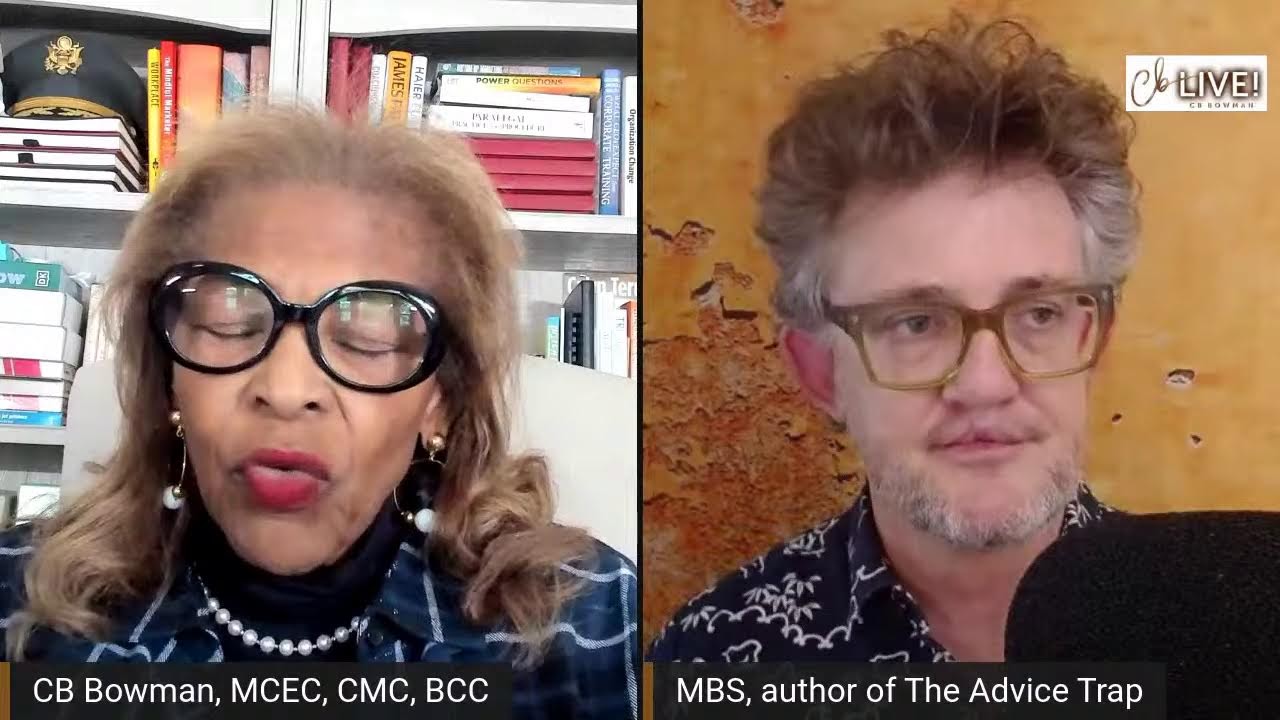
Leadership coach Michael Bungay Stanier discusses why C-suite leaders struggle with ego-driven legacy building and the tendency to keep adding rather than subtracting. He shares his "prizes and punishments" framework for deciding when to leave a role, the hidden crisis of male post-retirement loneliness, and practical tactics for busy executives who want to write books.
Chapters
Hello everybody, you see me just finishing my cookie. Um, listen, you know what, you know, you guys know how I love Costco, right? Costco has the most amazing pecan cookies that you ever want to taste, and I couldn't resist grabbing one before the show, so forgive me. But you know, it's real with me, right? And so I'll take a sip of my juice in a few minutes, but I just wanted to tell— welcome to CB Bowman Live. Today is Tuesday, so we do Challenges of the C-Suite. And you know, you're always waiting for a secret from me, and I gave the secret first. The secret is those pecan butter cookies at Costco.
Oh, yes.
And do you love my cabin-type flannel shirt? It's from Costco too, and it's only $14. So those are my 2 big secrets for today. Other than that, how are you? I missed you last week, but I think now we're running— I know I say this every week, but Char, who does our program sadly has been infected with the flu. And so we ran a little bit behind in our scheduling, but hopefully she's getting all better. I know I received an email from her yesterday saying she's working on it because she misses us. So just follow me on LinkedIn and you'll know when I'm gonna be here. And when I'm not here, I miss you a whole bunch. And today we have Michael on the line. Well, I shouldn't say on the line, on the screen.
On the screen, on the line. A bit retro there, going on the line, CB.
Yeah. So Michael and I met in 2019.
Yeah, that's right.
Yeah, in London.
Exactly.
At a Marshall Goldsmith meeting of people that— 50 people he selected from 50 different countries that represented titans in their industry.
The best-looking coaches. They picked us, the best-looking coaches. They picked us for our beauty. Yeah. I mean, we can coach a little bit, sure, but we're mostly very beautiful people, you and me.
Yes. And, and I saw this guy Michael, and I thought, who is this character? Because Michael dresses and looks very punk, right? And I'm thinking, what? And he talked to me, and I'm like, I heard the accent, and I'm like, he's like the Beatles, right? And little did I know that he was so brilliant and such a gifted leader. That I want to dive into today about how he got that way, right? What happened at birth that gave him this genius? Because wait till you hear his story. Michael, please introduce yourself and welcome.
Thank you. Although, quite frankly, everything's going to be an anticlimax after the pecan cookie Costco reveal. I'm like, it's like, how do I compete with that? I got nothing. But thanks for having me on the show. I'm happy to be here. It was nice to meet you all those years ago, and I know you and I've been planning this for a while. So yeah, Michael Bunge Stanya. I got my complicated name because when I got married 30 years ago, my wife and I combined our names. So I went from Michael Stanya to Michael Bunge Stanya. So that's a name that nobody can pronounce or spell, but it's a Wait a second.
Are you telling me you took your wife's last name and added it? I have never heard of this. Now, I know that you're cutting edge, but wow.
30 years ago as well. So it does create confusion at times. I once got a letter, CB, addressed to Michael Banging Spaniel, which was both a high point and a low point of that mispronunciation. But so I grew up in Australia, had a happy childhood. I'm the oldest of, uh, 3 boys. Um, so, you know, for— if I'm a leader at all, in part it's just because I'm good at bullying and bossing my 2 younger brothers around. That's part of the deal. Um, went to high school there, took a year out and went to England for a year because my dad's actually English. So I went back and I worked in a school As an assistant teacher and kind of jack of all trades. But what was kind of cool about it was it's actually the school he went to school 40 years ago or 50 years prior to that. So it was a kind of returning to my roots. But then I got back to Australia. I went to university there and was saved from becoming a lawyer because I did a law degree amongst other things by winning a Rhodes Scholarship, which took me from Australia to England. to Oxford, which is where I now have a kind of slightly English, slightly Australian accent. Met my wife there, who's Canadian. She was doing a PhD in literature.
Um, for those that don't know, what is a Rhodes Scholar?
Well, what is a Rhodes Scholar? That's a fine question. It, it's one of the fancy scholarships. Um, it was founded by a guy called Cecil Rhodes, who also gave Rhodesia its name before it became Zimbabwe. Um, he made his fortune mining, um, in, in Africa. Um, and he founded, um, a scholarship that was meant to be this embodiment of leadership. Young, virile white men who are smart and good at sport and active in their community and in their world. So as he says, to fight the world's fight. That was his thing.
How do you get identified as being a Rhodes Scholar?
Um, well, it's an application process. Um, there's about 150 per year from now around the world. They've also thankfully expanded the qualifications so women are allowed to apply and people of color are allowed to apply. And, you know, people who aren't cisgendered straight white men are allowed to apply.
This is all good.
It's, yeah, exactly. It's all good. It's pretty competitive, um, because it really is one of those signs of, I'm not sure, something, eliteness, let's call it. So, you know, in the States, Bill Clinton was a, is a famous, uh, Rhodes Scholar. Uh, more alternatively, Kris Kristofferson, the country music singer, was a Rhodes Scholar.
Really?
Um, in Australia, Bob Hawke, Prime Minister, was a Rhodes Scholar. In fact, The last 3 or 4 people have had that background. So it's kind of a tap on the shoulder saying, we see you with the potential to do great things. And it does have some prestige to it. And then occasionally they just let in any old riffraff. So that's how I managed to win it.
And they're located in England, is that it?
Yeah. You get a scholarship to study at Oxford University. So, um, you know, that's pretty amazing. You know, because Oxford is one of the great universities and you show up and it's like nothing you've ever really seen before unless you've watched Harry Potter, in which case you have seen it before because it's, everything looks like Harry Potter basically without, without quite as many monsters or baddies. But you know, there were definitely, there were wands, there were spells, you know, there are potions.
Stop it.
So I did a master's degree in literature at Oxford. More importantly, saved from being a lawyer, met my wife. And because she was finishing off her PhD, we stayed in London for a while and I finally got a job. And it was in the world of—
Was your wife a Rhodes Scholar also?
She wasn't. She has a great story of her own. She was a high school dropout and Went back to university in her 30s and kind of just did brilliantly well because she's very smart and did a couple of degrees in Canada and then won a different scholarship to go and do a PhD at Oxford.
Oh my God, what is her specialty?
Well, she, um, uh, she wrote about spinsters In the time of Shakespeare, because spinsters are a really interesting group of women because they were really the only women that were economically independent. Every other woman, every other category of woman— daughter, wife, uh, sister— were reliant on men for approval. But the word spinster actually comes from the idea that these women spun wool to make money. And they were the only— if you're a spinster, you weren't controlled by a man of some sort. So she was looking at the wills of these women and kind of what their lives were like, and then how they were portrayed in literature. And then when she did that, she spent some time as a bookseller, some time as a librarian, and she retired 3 or 4 years ago. So now she's just becoming a masterful retiree.
So this is fascinating. I'm sorry, the sidebar to your wife.
No, she's more interesting than I am by quite a long way. I'm surprised you didn't invite her.
Well, I'm getting there, right? So the word spinster is actually a good thing, and we think of it— women think of it as a bad thing.
So I got— it got— it kind of came with its burden of judgment. A little later when families got richer and it wasn't— if you're a rich landowner, you didn't really want your daughters to work. You wanted to marry them off. If you couldn't marry them off, then they became this kind of ornament hanging around the house and using resources at 23 or something, some ridiculously young age. So it's only collected baggage over the years. But originally, in its original use, a spinster wasn't really detrimental. It was a— it was like a category. It's like being a cobbler. So, you know, you're like, you did something.
Yeah. I love it. It— yeah, it sort of set the, the, I guess, the framework for today. Right.
Um, I think now spinster is being kind of— it's a bit of an old-fashioned word, and if it's used at all, it's kind of reclaimed as a, as a, an identity to be proud of, you know. And just, you know, luckily, thankfully, there's no kind of judgment around, you know, whether a woman's married or not.
Darn, if I had known that, I wouldn't have gotten married.
Well, there we go. It's not too late. You can throw over your marriage and kick off a whole new life.
Good thing he's not here. So now, okay, going back, you have fascinating story. Um, going back to you.
Yeah, well, so, so I'm at Oxford. Um, I'm wondering what to do with my life because now I'm in my mid-20s and I still don't really have a clear idea because I've been 8 years in university. Um, I find my way into a company that helps invent stuff. So it helps invent new products and new services. Um, new product development is the jargony term for it. And they were a great company because they were very much against, um, going against the, the, the normal way business is done.
So what kind of new products?
Uh, pretty much anything. So, you know, I played a, a role in, very small role in helping invent stuffed crust pizza for Pizza Hut.
No way.
Exactly. I invented a terrible single malt whiskey that's now considered one of the worst single malt whiskeys ever invented called Lochdhu. But everything from, you know, how do— if you're a bank, how do you think about what products and services and experience you want to create that create loyal customers and the like? So anytime you are going into a shop and buying something, there's been a bunch of people trying to figure out what it is, what they should have on the shelf and what they shouldn't have on the shelf. Because if you're in retail, say, you only get a certain amount of shelf space. So you have to be figuring out what's the stuff that people really want? What's the future? What are they stopping buying? Where's the profitability? So I helped all of those sort of companies come up with ideas.
Yeah, so I'm— you're bringing me back to my days at General Foods, right?
Exactly.
Yeah, well, we did a lot of psychometrics, um, demographics, the eye tracking to see.
Exactly.
Yeah.
So ours was, um, same kind of customer-centric, but often me in a room running a focus group with the type of people who might buy these products and just testing ideas with them. So in some ways, that's another way where I build up a capacity to ask a question and then shut up and listen to an answer, which is in essence, you know, what coaching is.
So what do you think about Faith Popcorn? Is she of your era?
She wasn't my era. So I haven't thought about her for many years. But, you know, anybody who's kind of a predictor of the future, You kind of go, that's a bold statement because I can barely predict next week, let alone 5 years away. So I think if you start assuming it's true, then you're in trouble. If you start going, that's an interesting trend, what if it was true? What would we do in response to that? So I'm more interested in Something like what Shell, the oil company, does with scenario planning, where they go, look, we're going to map out, we're going to create a future scenario and we're going to map out different responses to it. It feels like that's a little more kind of grounded in what's happening. How would we react? What are the unintended consequences? Where are our blind spots to that? Because Otherwise, there's a whole bunch of people, you know, predicting a whole bunch of stuff about the future. And, you know, there's that paradox about expertise, which is the more certain people sound, the more likely they are to be wrong.
Well, this is interesting. I'm going to push back a little bit on this, not knowing as much as you do about this arena, but I remember meeting Faith and reading her books and This comes from my background at General Foods in marketing. And I thought, oh, she's crazy, right? She's a bit interesting in herself, right? But when you think about it, a great deal of what she said has come to be.
Right.
Now, the question is, which came first, the chicken or the egg?
Yeah.
Um, is what she said true because she said it, or was it destined to happen before she even said it? And I'll give a perfect example, is the whole cocooning effect, right? And we started to see that trend before COVID and then COVID set us right in the middle of it.
Yeah, for sure.
You know, the question becomes, did she— is she some kind of sorcerer, or was she following a trend, or what?
Well, you know, there's the challenge, I think, with people who are thinking about the future is always, um, it's a bit like reading your horoscope. You kind of— you remember the bits that feel true and you forget about the stuff that wasn't right. So, you know, it'd be interesting. They've got some interest. They've got some interesting long-term studies about people trying to predict what happens in the future. And I can't remember the name of it, but this was a really rigorously done thing where they got lots of experts to make specific bets about what would happen in the future. And honestly, most experts just got it totally wrong.
Wow.
Because they're blinded by their own expertise and they're blinded by their own biases and they suffer from recency effect much more than they realize. Actually, more interesting were people who had more of a cross-disciplinary background and had more comfort around ambiguity. Actually, that's probably where you have somebody like Faith Popcorn who's going, look, I don't have an expertise in anything one thing, so I'm looking for connections across things. And that's where her, her predictions, I guess, might turn out to be interesting.
Do you think that people who do predictions are more successful if they stay in a particular lane?
I guess it depends what you mean by successful, CB.
Or more tend to be correct. And this doesn't mean that they don't have an expertise in a wide area of disciplines, but the areas that they're predicting future, they stay in that lane. Like, for example, what would happen with consumer products versus looking at consumer products and aeronautics? And, you know, yeah.
Well, I'm speculating, but I'm guessing if you've got a deep expertise in consumer products, You're more likely to be right about shorter-term nuanced changes, and you're more likely to be wrong about bigger leaps and evolutions that might happen.
Mm-hmm.
I mean, I say that just, you know, having spent a number of years just working directly with people who were experts in their field, and every, everything we ended up putting out in the world was an incremental thing. Rather than a significant jump. Because, you've, you've got too much invested in your own identity as much as anything else.
Yeah.
To be able to go, I'm abandoning everything. If this is true, everything I know is now not worth that much because everything changes. So it's, like, hard to untangle yourself from the prediction that you're making.
Yeah. That's a really good analogy because When I think back to my days at General Foods and the area that I was mostly involved with was ready-to-eat cereals.
Right.
And how we went from Grape-Nuts to Grape-Nuts Flakes and then assortment of various things in your cereal to now coating cereal.
Yeah.
You know, they were small leaps and bounds. for the most part, for the big guys like General Foods, the smaller guys were more willing to take a risk.
Right. I mean, I worked, we worked for Kellogg for a little bit and they're like, we want you to innovate around cornflakes, but you're not allowed to change the corn, the flakes, the shape, the taste, the size, the bag, or the packaging.
Yes.
I'm like, okay, where do we go with that? They're like, no, these are all iconic parts of the brand. And You know, in the, in the years that followed, people have, have, um, innovated around it. They've innovated around the, the packaging and the placement and special cornflake bars or whatever. Actually, it was Special K, not cornflakes, but same, same basic problem.
Right, right.
So they, but they tend to go, oh, there's the rise of the protein bar. Now how do we bring Special K into protein Eating because that's a thing for people. Can we bring that brand over? Yeah, they're unlikely to be the people who go, "We're going to try and create a category called protein bars and then take our brand over there." Yeah, yeah.
So this is a good conversation, and in terms of one of the things we'd like to talk about is the challenges that people have in the C-suite, which is so complex because everybody wants to lead. People don't realize this, but everybody in— particularly in consumer products, when they reach the top, they want to leave their mark on the brand.
Yeah.
Before they exit. Um, even if it's as simple as changing the box.
Right, exactly.
And in my opinion, a lot of times it's for the worse. It's more for the ego than it is for the Brand itself.
Yeah.
So Michael, how do you, how do you get people at the top from, to stop putting their egos in front of the brands?
Well, sometimes you can't because they're the boss and, and they have the ego around that. So, you know, really in some ways it's a cultural thing just to say, what's the culture of being able to challenge and push around this? And what's the, what's the, um, the level of proof required for somebody to go, this is worth me doing this? Now that's tricky because you can make up a case for anything if you want to, if you try hard enough for it. You know, you can retroactively explain the thing and put some numbers around it and conveniently forget about some other numbers and make it sound like it's a good idea. But, um, you know, Look at just on a broader level, the number of mergers and acquisitions that happen that are an utter destruction of value, often because some CEO goes, this will be my legacy. I'm bringing this big company and this big company together and diminishing all of them. So you're absolutely right. I often think people, um, there's a kind of heroic heroism associated with being the, let me break it and fix it and take the big leap around that.
Yes.
Just like, look at me, I made a, I made an amazing change around this. Um, and you're right. I think sometimes you're like, yeah, what's the, what's your motive for doing this? Um, Often the question is not asked clearly or boldly enough. What are the advantages of keeping things as they are? The other thing that's really interesting, I think, is, um, I'll just show you a book I've been reading. I think it's powerful.
Okay. Don't you love his background? It's so artistic.
So this is a book by Lady Klotz or Lady Klotz. And it's called Subtract. And at the heart of it, if I was to give you the kind of the one sentence summary of it, it is like human beings are wired to add rather than subtract.
I love it.
Yeah, we always think that the thing to do is go, what are we going to build, start, add, create, supplement, enhance? And sometimes the most powerful changes you can make are, what do we remove? What do we subtract? What do we stop doing? But the problem with that is those are not often things that, that stroke the ego, because the stuff you remove is invisible. The stuff you've stopped doing just doesn't exist anymore. So it's not like you can point to something and go, see that? That's me. It's more like this absence. I was involved in that. But, you know, one of the ways to frame what strategy is, is strategy is what you decide to say no to so you can say yes to the stuff that really matters. And You know, too often, I mean, and we all know this, it's not just C-suite, it's through up and down an organization, is that we, we love to say yes to stuff because who doesn't like the shiny new thing?
I, I love that. That is a powerful statement. You know, I've actually, when you were going to get the book, I was actually thinking that what we're discussing, I'm actually seeing in television shows here in the States. And a very interesting statement my husband made the other day. We, we like to watch 2 shows that are comedies for relaxation. One was The Neighborhood, and the other one is— I can't pronounce it— Aboushula and whatever, Bob. That one is about an integrated couple, and we're an integrated couple, so we sit and giggle. The first show, The Neighborhood, are about a white couple and a Black couple that are neighbors to each other.
Mm-hmm.
And just some really funny things. But last week, uh, the white couple, the woman was pregnant and she lost the baby. And I said to my husband, wait, this is supposed to be a comedy show, right? And he said, yeah. He said, you know what, I'm not watching it anymore, right?
Right.
And I was stunned. And I thought, you know what, you're right, because Why are they doing stuff like this? They take a drama and all of a sudden it's a murder series.
Right, right.
Everything now has to be about murder and conflict and—
I mean, it was CIS.
Yeah.
CIS Neighbors. 2 couples living together. CIS investigates what's going on across the fence.
Exactly. Now you got CIS Hawaii. CIS Los Angeles, CIS this. I'm like, are you trying to tell me that we have lost our creative sense? That there's just no— some of this worst programming I have seen in my life. What is going on there in, in your view?
I don't know, you know, CB. I mean, you look at— I don't know that much about this, so I'm just making stuff up and speculating. But if you look at, uh, the movies that are successful, if you look at the top 10 movies of the last 10 years, there's— I think they're all part of a franchise, um, or, you know, 8 out of 10 are part of some sort of franchise like the Avengers or whatever it might be.
Yeah.
So there's— so you can argue 2 different ways around this, which is like, well, look, people like a world building and connections and a complexity that is above and beyond a single movie. Um, and honestly, when you look at what the Avengers put together over 20 movies to build up to the culmination of the kind of final 2 movies, I think it's incredible. It's like, I don't know where the whiteboard was that sort of explained who all the characters were and how they're developing and when they'd meet and how they'd build up the baddie and stuff, but it's Somebody put a lot of thought behind that and rolled it out over 15 years or 20 years. I mean, it's, it's pretty extraordinary act. So you can argue both ways on this. You can go, on the one hand, it is building a complex world building that's never been seen before in movies.
Mm-hmm.
On the other hand, you go, are we just giving people comfort and familiarity and they know the characters and Um, actually, they're just rolling through a formula of Marvel-style movies. Um, and you get to roll out a character that's known with an actor that's known. You know roughly what the plot's going to be. There's going to be some fighting, there'll be some aliens, there'll be some baddies, you'll conquer the baddies, good will triumph in the end. Um, you know, you're like, okay, so that's, that's a tired story framework. On the other hand, it's, it is an An, uh, story framework. It is the story framework. You know, it's, it's all stories have something like that, which is you start, you go into the darkness, you come out, you conquer the thing, and then you come back out of the darkness. That's just a universal trait in terms of how stories are told. So I'm not sure, you know, CB, I think it's, you know, the market probably ebbs and flows. People, uh, it's what you were saying with Faith Popcorn before, which is like, Are they responding to the market? Are they creating the market? It's both. But how does that work? And I'm like, I don't know. I'm guessing.
I love it. So let's go back to— we ended that you were at Oxford and then you started to work for a company on innovation that started us down a different stream. I love it. So tell me more about that company and then how you moved forward.
Well, I was in that company for 5 or 6 years and I liked lots of it. But after 5 or 6 years, I couldn't actually point to really anything that I'd done of any substance. And all the stuff that I did point at, I just didn't really want to talk about that much. I mean, as fun as it is to go, look, I helped invent a bad whiskey, or I played a very small role in stuffed crust pizza. It's like, I don't want to— that's not something I want read out in my eulogy particularly. I'm hoping for a a life that contributes a bit more than just that. So, um, I decided to go and figure out just what— why, why weren't we succeeding as much as I thought we might as a company? So I went into the world of change management and organizational development and, and the like. So I joined another consultancy. I'm in London at this stage, in England. And Worked with them for a number of years, including moving with a group of them from London to Boston. And we set up an office in Boston in an attempt to set up an American part of the company. And so my wife and I lived in Boston. She liked that a lot because she's a Boston Bruins hockey fan. So she's like, amazing, I get to go and see my team play. Um, but for me, the work wasn't that great or that— which I saw, we struggled as a company. Um, so after 2 or 3 years there, I quit, headed across the border, got a job lined up in Toronto, and, um, arrived in Toronto. Well, actually had a flight out of Boston to Toronto on 9/11. So that was dramatic. Amongst all the other stuff that was happening, it meant that my job disappeared. It wasn't there when I finally crossed the border. So shortly after that, so this is roughly 20 years ago, I set up Box of Crayons, the company that I kind of became best associated with. And it grew from me just doing my thing to being what it is now, which is like a successful training company that brings practical coaching skills into organizations to help them move from advice-driven to curiosity-led. So that's a team of about 20 people. 2 years ago, I stepped away from being CEO of that and had a brilliant woman come in and play that role.
And so now I'm more focused on a B2C initiative, a business-to-consumer kind of one-to-one Now, I want to go back to something that, that I think really points to your leadership skills. Um, you stepped out of a very successful company. Are you crazy?
Well, um, it is true that founder transitions are not, are not always easy. So here's the thing. I became— I was CEO because I started the company and I'm not that good a CEO. Like, I don't suck, or at least not all the time. I did it sometimes. But, you know, it's just the skills required to grow it from X million to XX million are not really skills that I had, obviously. And the ones that I did have, they weren't, they just weren't that interesting to me to do that. So I was pretty excited about the idea of stepping away from the CEO in theory, but in practice it's quite difficult because you, it's not just a successful company, it's you're entangled as a founder. You're pretty entangled and you're pretty identified with the company that you've started. So you're stepping away from elements that nourish you and feed you. You're giving up control on something that you spend 20 years trying to build and grow. And so it was a bit of a challenge to, to take that on. Made easier for 3 reasons. One is Shannon is very good at her job and a very good CEO. Secondly, we hired a coach for 2 years a year before and a year after to manage the transition process for us. Um, so to basically stop me colluding in meddling. And thirdly, we just set up a series of structures that enabled Shannon and me to be very clear about who, who had control over what. And honestly, CB, that was mostly about me understanding that I had control decision-making over much less than I might, I might presume. And that was part of the success.
So you had a coach, and then you decided who did what.
Uh, it was—
it was—
I, I refined how you said that, which is like, then we decided who had what decision-making process over what. So, um, you know, when it comes down to it, I'm only allowed to make 2 decisions about Box of Crayons, the company that I own. One is whether I fire the CEO, and second is whether I sell the company. Those are my decisions, but every other decision rests with Shannon or her team.
Okay, what gave you the intelligence to understand the 3 key components to leave the organization in someone's hands? What gave you— the wherewithal to look at the transition steps, to bring in a coach, and to identify the 2 areas that are in your willpower?
Well, you know, number one is looking across the— looking around me and seeing how hard it is for a lot of founders to hand their companies over to people. You know, a lot of them just do a poor job at it. The company fails after they leave, um, or they come back to rescue their own company, and none of those are great results. Um, it helped that I built Box of Crayons as a brand independent from me. So it wasn't Michael and Box of Crayons, it was Box of Crayons. And even though I was still quite strongly associated with Boxer Crayons, it made for a little bit easier. Whereas, you know, if you're trying to run the Tom Peters Group and Tom Peters isn't there anymore, it gets confusing as to what's happening around that. So building an independent brand name from my name helped as well. And then it was just a process of, that's why you hire a coach for them to make clear the stuff that you kind of know, but you may not know Fully. So hiring a coach really helps. So Jill was really clear. She and she wasn't my coach, and she wasn't Shannon's coach. She was a transition coach. Her job was to get both of us across the line in two years' time. And then I do have a degree of emotional intelligence because I think about it and I work on myself, and it's part of my profession in some ways. Where I'm like, look, I know. I know what I do well, and I know what I do badly in transitions. So I'm able to have those conversations explicitly going, here's how I will trip us up.
So, Michael, there are a lot of people, especially now as a result of COVID who have said, what the hell am I doing here?
Yeah.
And at the top of the organization, the middle, and the bottom. But let's concentrate on the top. What's the advice that you're giving people who want to leave that don't have the emotional intelligence that you have? And it may be a different scenario, right? How do they recognize— let's start with how do they recognize That it's time to leave other than this uneasy feeling that I'm, I'm just not excited about going to work?
Yeah. Because it's, it is a hard thing to shake because if you're at the top of the tree, you're in the C-suite or close to it. You, you, there's just a whole bunch of things you get from your, your status and your seniority and your authority. You know, you, you get status, you get money, you get a bunch of things that nourish you, even if they're kind of slightly ego-driven, short-term stuff. So, and it's pretty easy to tell yourself a story that things are okay, but, but I think COVID has got more people going, are they okay? Is this— am I really happy? Is this the best use of the years that I've got left? Um, So there's a model that I use. I introduced it in the book, The Advice Trap. You can see my kind of name tag there. I go into it further in my new book called How to Begin. And it's like prizes and punishments. That's it. And prizes and punishments is just another way of framing up this insight. You are constantly at choice. Every choice you have has prizes and punishments. Do you know the prizes and punishments? Because until you really see those more clearly, it's hard for you to make a decision that has a nuance and a robustness. So I think there are 2 questions to ask yourself. What if I stayed and committed to be in this role and doing this job for another number of years? Prizes and punishments. Definitely prizes, money, status, security, authority, legacy perhaps, but also punishments, stuck, lost connection to my sense of purpose, not sure if I'm doing meaning, overly attached to financial gain, all sorts of reasons why you might choose to sort of say, well, here's the price I would pay. If I stayed in this role longer, yeah. And you know sometimes it's good to do that by yourself. Sometimes it's good to hire somebody just to kind of help you go through this, just to figure out what are the prizes and punishments of me being committed to the status quo. That's kind of the question. You would just if if you were to stay really committed to just how where you are now and what you're doing now, the status quo prizes and punishments. And then a trickier question, which is like, imagine you leaving, imagine you having, finding a new goal, a new way, a new focus. What are the prizes and punishments of that? And the prizes are often around things like legacy and self-expression and re-engagement with purpose and sense that you're using your remaining time in a good, better way. You know what David Brooks would say, you know, you're figuring out what's the second mountain to climb? First mountain you climb is your career. Second mountain is more legacy-based. So you're figuring out your second mountain. But what's at risk is status, money, failure, being, um, losing an infrastructure around you that supports you in ways you don't even see anymore. Um, you know, not having an assistant, uh, not Not being sure about how money works, becoming a beginner, but mostly failure. You know, one of the things that's nice about the way things are right now is mostly you succeed. You know, you do the stuff; most of the stuff you do works more or less. And when you step away from that, you increase the chance that stuff won't work. And I think that's that's the foundational. tension that you're looking to explore this, which is like prizes and punishments of staying where I am, prizes and punishments of stepping into a new world, a new self, a new way of being. And those aren't easy questions to, to wrestle with, but it's the start of getting a better understanding about why you might stay or why you might go.
Is your book in front of you so you can hold it up? The Advice Trap?
This is, this is The Advice Trap. So this is— this came out 2020. So a year and a half ago.
Okay.
And then the new book is called How to Begin. I should— I'm— the copies are on their way to me, but they haven't arrived yet. So that comes out in January.
Well, let us know so we can put the word out. Let it— let us be part of your launch team.
Well, thank you. I'd love that.
Okay. I wanna go to the sad part of this. conversation. And I don't know that this is true. This is a hypothesis that I think I see, which is that men, when they— particularly men, when they leave their prime job, it seems that they lose the will to live.
Right.
They pass away within a fairly short period of time. This whole notion of happy retirement for men doesn't seem to really exist. This may be my imagination.
I don't think so. I think that I've seen research that says more people than you would expect die within 12 months of retiring because they're adrift.
Mhmm. What does that mean?
You know, I just, um, interviewed a woman this morning, uh, for a podcast that I run. Her name is Naomi Shrug— Shrug— Shruggy, I think it is. Um, it's not spelled like that, but her book is The Man Who Mistook His Job for His Life. And it was just a, you know, there's a lot in which, um, first of all, It's very easy to get overly entangled in the status that your job gives you and the meaning that your job gives you. And you know, if you want a language to put around it, is most of us don't think anti-fragility around the life that we're building. So when you and an anti anti-fragility is when you're building up. Forms of redundancy and other forms of nourishment. So when one fails, others fall into place for you or have your back. And we're not very antifragile when we think about our careers. We're like, I'm all in on work. Who am I without my work? You know, even, I mean, not even, but, you know, I think about this stuff. I've got a degree of intelligence and wisdom around it. And when I stopped being CEO at Boxer Crayons, I'd spend a year drifting around going, what the hell am I doing? What can I do? How do I rethink about myself? It's very hard to see yourself as somebody different and new that isn't a kind of just a variation on what you've just been doing before. And then you, you look at, for men in particular, we are not that good at making friends. Like, women are better at making and holding a friendship group than men are. Um, I saw some statistics a little while ago. I'll get these wrong, but broadly, right, which are 25 or 30% of American men say they don't have a single close friend, um, maybe other than their spouse. And, um, less than 20% have more than 5 close friends. So there's— and that's not getting better, that's getting worse. So there's a sense around men just often aren't that good at building those kind of deeper connections. And I see that in my life. I look at my wife. She's been retired for 3 years. She's done just a great job at building this tight group of amazing women. And she just has a really good time with them. And they feel like genuine friends, people she can call on if she needed to. And I don't have as rich a network as that. I have a pretty big network of associates like you, CB. You're somebody I know a little bit, but you're not a friend of mine. You're somebody I like, but we don't have a history of building a friendship. And I have far fewer people like that where I'm like, you know, we've got history together. So yeah, I It's, it's a hard thing. And we, we live in cultures where, um, you know, particularly for— well, I just think, you know, success in your job is fetishized in some circles. So, you know, it becomes a bit of a vicious circle. The way I love it, I get excited by it, I get meaning for it, I get external validation for it. And then when it goes away, you lose a lot of the stuff that has created safety and structure and meaning for you.
Is the solution— as I listen to you, I think about the MG100 and the men in there that had— that were titans of industry or that had very successful careers, and they left their organizations, and now we see them being coaches.
Mm-hmm.
Now, without the skill set to be a coach, but successful coaches because they know the right people to connect.
Yeah.
I wonder if longevity for men is, is preparing for another career before they leave their current career. which would give them still a connectivity to people, uh, give them still a purpose. But, you know, like, coaching is ideal because you can take on as many clients as you want or not, right? Um, or even mentoring, mentoring people to get to where you are. Is, is the solution for men to Plan a next career, even if you don't need it financially, that sort of like steps you down but keeps you involved?
Well, sometimes the word career comes with kind of some baggage associated with it. So I'm not sure it's about a career.
A job.
Well, a commitment that is about— that has a degree of purpose built into it. You know, there's a person I know who has finished her main career and after a certain amount of drifting around is building a shelter in honor of her son who was homeless and then died from Drug issues, and she's it's a woman. She's found a way to reframe that thing that has been a source of sadness for her for many years into a driving purpose and a sense of connection. And so, you know, like if I think of my dad, who when he retired as an aeronautical engineer. He volunteered in the local science center. He was on a board for his local primary school and helping out with that. He ran a little friendship group of men who had all worked as aeronautical engineers, so they had lunch once a week. He was on another— he loved committees, which is something I don't understand at all because I hate committees, but he loved it. So he built a portfolio of purpose-focused activities that nourished him, built, created community. And I mean, it was as much around his strong sense of service was how he found purpose. So I don't think it needs to be a career. I mean, you're right. It's an easy thing for senior people often to go, well, I'm a coach now and I'm an okay coach, but I also am senior and experienced and I know people so I can do an okay job at that. But I think it's more and more challenging, which is like, where might you find purpose beyond your work? And how do you test that out? Because it's not always obvious and it doesn't always work. It's not like you just springboard into something which is immediately nourishing and fulfilling for you. In some ways you're like, I've got to start figuring this out again. So in some ways, really, The time to start doing— I'm saying this to me as much as to anybody listening. The time to start doing this is now because now's the time you need to start building the layers of, of a richness of a life so that when your, your mainstream thing goes, like work, you've got other things for you to step into.
Yeah. It's amazing to me when, as, as I work with senior executives, one of the questions I ask, and it's not— I don't ask it from— I'm gonna— people are gonna kill me for saying this— a touchy-feely perspective, because I'm just not that kind of a coach, right?
Mm-hmm.
But I ask, what makes you happy? Because if it's just tied to your work, you're not looking to tomorrow.
Right.
And you're not preparing for tomorrow, which is my job.
Yeah.
To get you through today and to prepare you for tomorrow.
It's also— it's interesting to, to go, what are the clues that are here today that might tell you about tomorrow? So, you know, for me, a job for me is writing books. Like, that's how I generate revenue. It's how I grow a company. It's how I try and have impact in the world. But actually, I think writing books or creating is actually a purposeful thing that doesn't have to be associated with, well, what's the business model behind this book?
Yes.
There's a way of doing that. So it's like, what is it about this role that gets you excited? That if we strip away an org chart and a brand and a salary and an executive assistant and assorted perks, You know, what, what is it about the essence of what you do that gives you a clue as to what the future might be?
I totally agree. Hey, we've got somebody that wrote a comment. Let's see. Mike. I'm not sure how Mike pronounces his last name, but—
The fact that he's called Michael just makes him obviously a smart, intelligent, sensitive guy.
Oh, yeah. Right. Okay. We're going with that. Okay, I'll spell it. M-A-L-E-F-A-K-I-S.
I would say Malefakis.
Malefakis. Okay.
Sounds Greek to me, but if that's— if I'm getting that badly wrong, Mike, I apologize.
Yeah, it's a great name. Um, @Michael, thanks for your honesty. It is something we men don't speak about. Another challenge for us. Yeah, you're absolutely right. And that's why I'm bringing it up.
Yeah.
Yeah. Because I myself have experienced a loss because of this. And so that may be your next book, and I'll write it with you.
Sounds great. Well, there's a lot of interesting stuff written about the loneliness of men and the disconnect of men. I, you know, I know that I don't want to retire and then play golf. That will not be satisfactory for me. But I also know that it might be surprising as to what is satisfactory. When my wife retired, she spent a year experimenting with stuff and she ended up doing a bunch of things that I would not have guessed would be sources of pleasure for her in terms of her retirement. I was like, oh, I wouldn't really— you're doing that? You've kind of been against that for the last 30 years that I've known you going, I'm not at all interested, but you kind of found your way into a community that seemed right for you. So There's also, there's also just something here, which is like, you, you experiment to figure this out.
Well, I think it's what's interesting that we're talking about is in this day and age, there's more than one retirement that you go through. It's like the 3rd or 4th retirement. Right? Yeah. If you're looking at the true definition of retirement, Ceasing and moving on to something else that's hopefully more pleasurable, more exciting for you. But it's, it's not like yesteryear where you had this one massive job for 50 years.
And then you get a gold watch and then you, you're different. No, it's like—
Exactly, exactly. Yeah, because I look at how many retirements I've been through. And I think each one gets better and better. Where was I? Why didn't I do this before?
There we go. Maybe that's, that's where we need to end. It's just like on this high point, which is like retirement only gets better, but you got to keep practicing it.
Exactly. Mike says spot on.
There we go.
So now, okay, so you've left Box of Crayons from an everyday Mm-hmm. Where you're going in every single day. And now you're writing books.
Mm.
Powerful books that we all need to read and know about.
I hope so.
What's next?
Well, this new book, How to Begin: Start Doing Something That Matters— so it kind of connects to our conversation— comes out in January. So the next 3 months are quite obsessive-compulsive book launch. which is a very tedious part of the year because you do a whole bunch of stuff to try and get people interested in your book because the only thing harder than writing a good book is then having people actually buy it and read it. So there's a certain amount of getting that set up and that kind of going in the world. And then I'm still playing around with what happens next. I'm wrestling with these questions myself, CB, but I've got 3 really good books in my head. Like, I can, I, I can see the shape of all 3 of them. I know how long they are. I know the key bits of content I want to write for each one. So I'm playing around with the idea that what if I could try and write 3 books in a year?
Wow.
It's a very audacious goal. Most of my books are shorter rather than longer, so it's not like I'm trying to write 100,000 words times 3. Um, I want— I, I I find short books are more helpful for people. Um, but I do think, I do think that that might be an interesting, uh, it might be an interesting experiment to, to see, treat myself as a writer rather than as a businessman who writes. Yes.
Yeah. But how in the world would you go about doing that when you get the plots mixed up or They're 3 very, they're 3 very different topics and they're 3 different structured books as well.
'Cause I love to have books with structure. The form is the message often. So, you know, you take a Cal Newport and you need to do deep work. So you need to, you can't do 10 minutes on one and 10 minutes on the other.
Yeah.
But I could easily see me going, look, Mondays I write this book, Tuesdays I write that book, Fridays I write the other book. And Wednesdays and Thursdays, I do other stuff.
You know, so here, I'm going to ask you a couple— a stupid question.
All right.
Um, you're CEO of Box of Crowns.
Uh, no, I'm founder, but Shannon's now the CEO. I'm the ex-CEO. Yeah. Oh yeah. Okay. Right. All right. Back in time. Yeah.
Um, you— did you write The Advice Trap at the same time that you were CEO?
I did.
Yeah. Okay. Michael, please tell me, how do you work full-time and write a book? Especially at the level of the organization where you work?
Yeah.
Because a lot of us would like to know that secret.
So the first is I decide that this is the most important thing that I can be doing. And that takes a bit of wrestling with. And going, is it really? Because everything's noisy and I can fill up 80 hours a week if I want on miscellaneous stuff. And then I hire somebody to hold me accountable. So I go, look, I hire a coach to go, this is my deliverables to you. Or I hire— or I don't hire somebody, I get a support person, but I set up just really clear structures to help me get this across the line. And I set dates. I set up, you know, with my publishing company, I set up dates to— I'm gonna deliver stuff. So I just build structures around me to make it harder for me to not do it.
Okay.
Yeah. But it's, it's like, you know, I just wrote— typically, I would try and write an hour a day. So I'd get up and I'd try and make it the first thing that I do. And I had a series of, of trips where I went away on vacation, but I'd also write an hour a day on vacation. And I just, yeah. And I also had a team around me who took stuff on so that I could do that. But I was just like, this will be an important book for the company, not just for me. So I'm going to write it as one of the, my, a contribution that only I can make. Other people can do other chores, but only I can write this book. So it became important enough that it got done.
Thank you for that advice because I've been trying to get a book out, and I didn't even write the whole thing.
Mhmm.
I haven't even had time to read the chapters that people have submitted to me.
Right.
And it's just, as you said, there's just so much noise. Right.
But so at the moment, it's not important enough. Other stuff is more important for you. Yeah.
Okay.
If you wanna make this important enough, what will you say no to so that your yes actually has some meaning to it?
Prizes and punishments.
Prizes and punishments. Exactly. You gotta make, you gotta make a choice. And at the moment, the prizes of not doing it outweigh the punishments of doing it. One of your options is you increase the pain of you not doing it. Because if I did this to you, CB, I went, for every week that you don't get this book as a final draft to your publisher, I'm gonna charge you a bit of money. Here's how it works.
No.
First, first, first week is, is just $5.
Yeah.
But the second week it doubles to $10 and the third week it doubles to $20 and then the fourth week it doubles to $40 and then $80 and then $160. Or I could start even, I could start with $50, $50, $100, $200, $400, $800, $1,600. So by the seventh week, if you haven't got that draft to your publisher, you owe me $1,600. My bet is that if it's gonna cost you $1,600 or maybe $3,200 or maybe $6,400 to not write your book, You're gonna find newfound inspiration to write your book.
You know, Michael, I love the look on your face when you said that. It was like the demon came out.
Right. And then, and then if you're like, and then you go to make it kind of, you can play around with this idea, but you're like, the money goes to an organization that you don't support. So, you know, Like whatever political party you currently support, if you're actively politically, it's a donation to the other side, whatever side that might be. And you're like, okay, I really don't want that to happen. Or a charity or whatever you don't actually believe in. You can play around with this, but it's sometimes some of us react better to punishment. Some of us react better to prizes. But if you're like, okay, I need the pain to be higher, make me really focus on this. Well, then you can play all sorts of commitment games around that.
I, I think you've thrown the gauntlet down.
You, you get to choose whether you pick it up or not. The choice is yours.
Okay, I'm not committing right now. Hey, it's been a pleasure.
Thanks for having me along.
I— listen, please come back when your next book is out.
Sounds great.
That's the, uh, the offer I'm making to you.
Thank you.
I also want to take a moment to acknowledge, uh, the passing of Colin Powell yesterday. Uh, an incredible, incredible loss to America and the world. And, um, The good ones go fast, right? And young. So I just wanted to acknowledge that. And with that, I am so excited with the advice that you've given us, and particularly when it comes to men, what you've said is so critical. And I hope that you will take this interview and spread it amongst your posse, as they say, because there is a critical message— messages embedded in this interview. And I thank you for sharing. I thank you for being open. And hopefully we'll be able to help a lot of men out there.
I hope so too. Thanks, Stevie.
Thank you.
Thanks, everybody. Thanks for listening in for us.
Bye, everyone.
Bye-bye.
More from CB



211- Courage to Leap & Lead with Louise Story part 1Courage to Leap & Lead







