CB Bwman LIVE! Challenges of the C-Suite: Guest: Sheila Farragher-Gemma, Episode 52
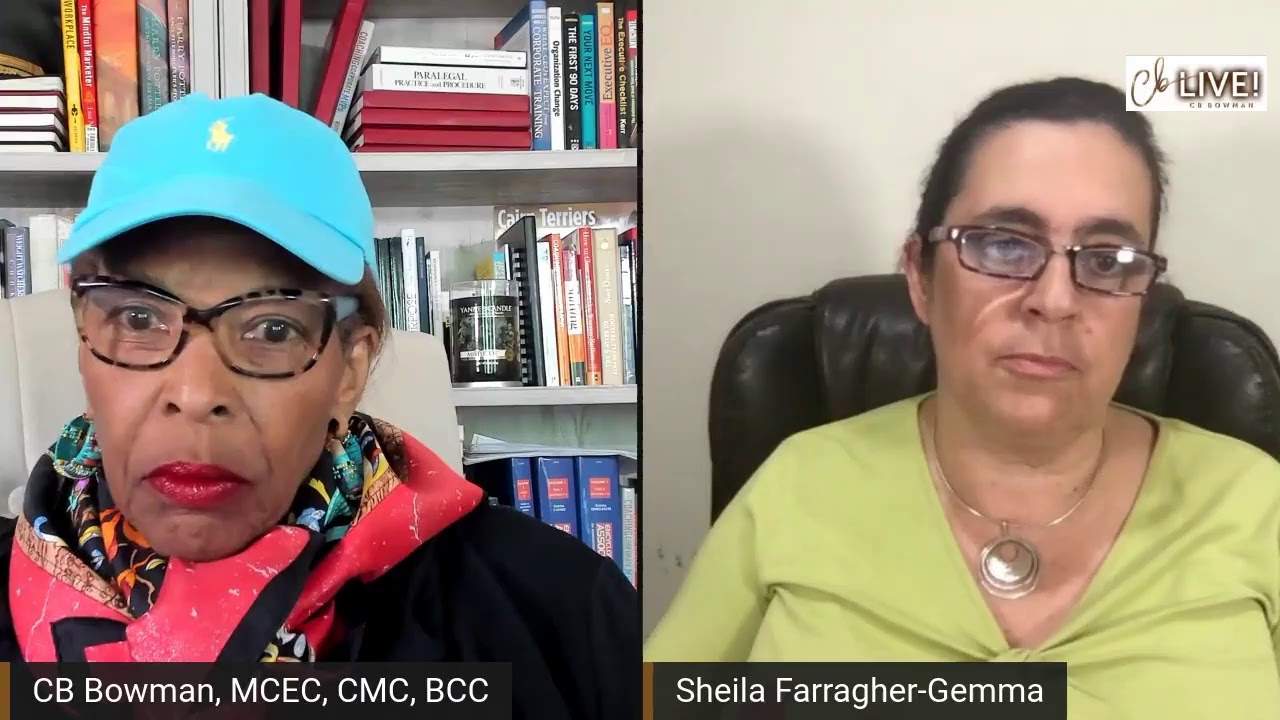
In this episode of CB Bowman Live, host CB Bowman interviews sponsorship expert Sheila Farragher‑Gemma to uncover how to secure and structure sponsors for events, especially those focused on Diversity, Equity & Inclusion (DEI). The conversation covers Sheila’s background, the philosophy of sponsorship as a three‑way partnership (sponsor, host, audience), differentiating strategic partnership from pure branding, and practical tactics for pricing, tiering, and engaging sponsors of varying budgets. They discuss inclusive event design for the Workplace Equity & Equality (WE) collaboratorium, emphasizing intimate, workshop‑driven formats over traditional conference booths, and share real‑world examples—including a small Association of Corporate Executive Coaches conference that successfully integrated sponsors through full‑session participation. The dialogue also explores virtual sponsorship dynamics, the importance of aligning sponsor outcomes with audience transformation, and actionable resources such as a free worksheet for finding sponsors. Throughout, the tone remains conversational, supportive, and enthusiastic, offering concrete advice for event planners, solopreneurs, and larger organizations seeking to build sustainable sponsor relationships.
Chapters
Hello everybody, welcome to CB Bowman Live. This is a special Thursday show because, you know, we're having the big conference now for the Association of Corporate Executive Coaches. So our Thursday shows are on hold until after the conference, which, let's see, the last day of the conference is June 17th. And then we switched to taking a vacation on Tuesdays because the Workplace Equity and Equality Conference is on. And if you don't know about that, you want to reach out to me because that's going to be quite a conference. I'll tell you more about it in a second. But in the meantime, don't you like my new look today? I'm rocking it, right?
Okay.
So I've got my cap on, my dangling earrings, and my Hermès scarf. Right? Don't I look cute today? So anyway, I know you guys think I'm crazy. It's okay. This is our special new show, which is CB Bowman Live, of course. Uh, and this— at this time on Thursdays, we talk to thought leaders, Mm-hmm. and social media influences, and we talk to people who helped them get there And we talked to people who are already there and how they got there, and they give us some tips in terms of how you can get there and how you can reach them. So today we have a special guest. This is Sheila. Sheila is the person you want to go to if you're having an event. She gets you sponsors. And we all know how important that is to financing your webinars, your conferences, whatever it is you're gonna do where you need sponsors. So she's like— you know how I like to give secrets on my other show? Well, I have to tell you, she's like my secret sauce here. So you're getting an inside scoop On what goes on behind the scenes. And Sheila is going to help me in terms of how to get sponsors for the WE conference. Now let me just give you the dates for that because you don't want to miss it. It's WE. It's June 21st, 22nd, and 23rd. And WE stands for Workplace Equity and Equality. And we're going to talk— It's It's not a real conference. It's a collaboratorium. Do you know what that is? No. Well, that means we're going to have few speakers. I know you're all Zoomed out with the talking heads. We're going to have only 4 over 3 days. Now, here's the thing. If you're working on a D&I program in your company, Or you're helping a company with their D&I program as a coach, you want to be at this conference. Because what we're going to do is you'll hear the famous speakers, but we are actually going to have a workshop. And you get to pick from 2 different tracks for your workshop. And the first track is how do you develop a D&I program? The second track is Watch the marketing. So how do you make sure that your marketing is consistent with what's going on? And the third track is, how do you find talent? How do you find talent that represents people of color or disabilities or Asian Pacifics? We have the answer. So you want to come to this conference, Guess what? It's so inexpensive. We're just giving away value. So go to WEE— don't you like that acronym? WEE, W-E-E, hyphen, conference.org. And so let's go over to Sheila. So Sheila is going to tell us, how do we secure sponsors? How do we talk to them? How do we prepare to talk to them? What should we ask for? What's the dollar amount we should request? I mean, this is a whole education in itself, so I'm so glad you tuned in. So first, Sheila, tell us about yourself. How did you get to where you are this—
Sure, I can hear myself echoing again.
Okay.
So, um, I started out— I've been doing sponsorship for about 10+ years or so, um, but I really started out just a little over 25 years ago when my daughter was born and I decided that I did not want to be working in a job and not be with her. So I had the, you know, to find something to do to make money and pay the bills and all the rest of it and not have the two of us homeless, and my husband of course. Um, so I, uh, launched a business and ended up selling it and launched some other businesses And one of the things that I always did in my businesses was I kind of, um, uh, my talent was networking and forming strategic partnerships with other businesses and other people. And, um, through that, I, uh, had a business with a woman who got recruited out of it and went to work for a company called Digital Marketer. And she asked me to come in and help her with sponsorship, which I did. And then people saw what I was doing and asked me if I could help them too. And basically that's what happened. And, um, here I am doing sponsorship.
Wow. So would you say sponsorship, a sponsor is the same as a strategic partner?
Um, I would, because so there's a couple of ways you can look at sponsorship. You can look at it as just, you know, bringing in sponsorship dollars, but I think there's a bigger opportunity there if you can find a company that's— actually, let me just step back a little bit again. You know, I think of sponsorship as, as kind of there's 3 aspects to it. So you have your sponsors, you have you as the host or the platform owner or the event owner, and you have, um, a third person who's your audience. So if everyone is kind of feeding everyone, it's going to become this great sponsorship, like a great marriage. And why would you not continue that and have it for the rest of your life if you can? So, um, with sponsors, um, you're helping them get in front of their target audience, which is your audience. Um, what you're helping your sponsors I mean, your audience with is they're coming to you for some sort of transformation, some sort of change. They have some problem that they think your conference, or they know your conference is gonna help them get through, like a D&I, which I have no idea what that is. But I was in my head, I was like, do not incorporate. I'm not sure.
Diversity, equity, and inclusion.
Yeah, I got that. But the D&I piece of it, I wasn't sure what that was. You said if somebody's trying to start a DNI or doing a DNI.
Oh gosh, I don't remember what I said.
It's okay.
I think I was saying DEI.
Oh, maybe, maybe. And then I heard it. Yeah, but, but anyway, so, you know, your audience are coming looking for some sort of transformation, some sort of change, some sort of knowledge. So if you can find the sponsors that are going to support that for them And those, you know, by supporting them, they're getting new clients and new leads, and you're, um, you know, getting this great partnership. You're bringing value to your, um, your audience, and also you're getting paid for it. So it really is like a total win-win-win situation when done that way. I see a lot of people look at sponsorship and say, you know, I need to pay for this event, so I need to bring in some sponsors. And that's just so kind of like on the surface level, and there's so much more that you can do. And it's, you know, maybe a little bit more in the beginning to think that out, but once you have, uh, you're done. on. You, you know, it just happens over and over again. You can bring them back to all the other things that you're doing. You build this great relationship with each other, and, um, it's just, you know, it's very symbiotic.
So what about— I'm seeing, um, sponsorships, at least I think I'm seeing this, where they're not necessarily looking to your audience in terms of change But they're looking at the conference as a way of letting people know that they're supporting what you're doing.
True, true.
Therefore, they— I hate to say they look good, but they in fact do.
Yeah.
Look good that they're supporting either the underdog or a cause or a relationship that they would like to have a bigger, bigger sense of involvement with. Yeah.
Right. Yep. And that is a type of sponsorship as well where, you know, they just want to be aligned with something that's kind of going to be more positive for their image. Sometimes companies will do it when maybe the image hasn't been so positive in the past and they're trying to like turn that around. A similar type of sponsorship as well is when people, when companies like the Coca-Colas of the world are looking for just impressions. They just want everyone to see that Coca-Cola logo everywhere, which is, you know, it's a kind of a different type of sponsorship because it's not tied up in ROI or return on investment. A lot of the sponsorships I tend to work with are kind of not the big kind of Coca-Colas, but smaller corporations or smaller companies, and they're looking for ROI. So they're looking to do lead generation, to get customers or guests or clients out of the deal. You know, the impressions isn't as big a thing for them. them because it's not paying the bottom line. They're not like a giant like, you know, Amex or Coca-Cola or, you know, American Airlines or one of these that, you know, they can do that.
So I want to talk about— so let's bring it into reality and let's use, uh, WE.
Yep.
Now stands for Workplace Equity, Equity and Equality. Yeah. So let's, let's take that as an example at the size of client that you're working with? Because what I'm noticing now is that while there's a lot of entrepreneurial-type size organizations, they too want to be involved in the D&I space because they realize how critical it is. And, and so here's the thing. A lot of solopreneurs, but more entrepreneurs. So I'm That's the spectrum I'm going from solopreneur to entrepreneur to bigger companies, whether it be medium or large companies. They are having a hard time expressing their support of the D&I space and therefore their bottom lines are being affected.
The bottom line is what? Sorry, I missed that last piece.
Being affected.
Ineffective?
Affected.
Yeah. Oh, affected. Yeah. Yeah.
By the lack of ability to connect with people that are doing— people and companies that are doing something in this space.
Right. Yep.
And so— oh, there's also— so I want to talk about those companies as being the smaller companies that do want to invest. And so do you have like— I guess the question is, how do you do this? Do you have a scale, for example, where sponsors who have a smaller budget but who want to connect with you come in? And then there are the bigger companies that may want to come in with you, and the price ticket is different, right?
Yep.
You know, managing that those kinds of relationships is, I think, is going to be the new normal.
Yes. Yeah. Yeah, it is. And I think as well, companies struggle with the whole thing. I think they're struggling to know what's appropriate, what's right, what to say, what not to say. It's kind of people are walking on eggshells a little bit, I think. Nobody wants to offend or say the wrong thing. But at the same time, there's definitely a need for, for education. And I think we kind of talked about this in the last interview a little bit, either beforehand or just when we were on. Um, but it's, it's just, you know, it's great that you're doing this and just opening up communication in kind of a safe way that people can just be like, you know, this is, this is what I, you know, I don't understand, or what should I do, or how should I say, or, you know, you know, because nobody wants to offend everyone. really wants to just try to navigate it and do the right thing.
Well, it's interesting that we're bringing this up because we have a faculty that— not only will we be having the conference, but we have a training platform where we help employers with their employees in opening up dialogue and having conversations. We came to a stumbling block within the faculty and we said, Wait a second, this is good because we are a microcosm of what's going on out there. And so we stopped and really got to know each other. And I am telling you, it was the most thrilling experience I've had in a long time.
Yeah.
I just walked away so energized, and we all said, this is what we want our clients to Exactly. Let's train on how to do this. And so here's what came out. It was things in the group that are very serious to each person. Um, that admission of what they're struggling with, uh, was So breathtaking, because, you know, we assume that everybody's okay unless we see otherwise on their face or their behavior change. That's so not true. You know, we hold so much inside because we don't have safe places to discuss. So WEAK shows organizations how to create these safe spaces and safe conversations. I'll give you an example. I said to the team, there is a group of people that I would like to see part of the faculty and we have no representation. Somebody else said to me, well, there is another group that you haven't thought about. I said, yeah, I'm not so sure that that group wouldn't derail us. And I said, and let me speak from personal experience. And everybody was like, you've had this personal experience? And I said, yeah. And so what, what do we do if we want to include this group? And everybody said, well, you know, that's a really good point. Well, we could screen for— to make sure that this particular population would be not destructive but supportive. And I said, you know, I like that idea. And so we came to— through honesty and discussion and surprise, nobody knew that I had this experience that we were all talking about. And it was like suddenly okay for me to talk about it because now I'm part of the in-crowd, right? So we want to help people get to the same point of discovery. And I think that what— and that I think, I know that smaller organizations are going to— are faced with the same dilemma that we had. And what better opportunity to be able to talk to a group of people to say, hey, this is what we're faced, what do you think, what could we do? So I, I think there's definitely a space in our conference for all size organizations. And I don't know if it's true of all conferences, but I would employ people to look beyond what your immediate target audience is to see how inclusive your conference can be to all levels and all sizes of sponsors. Does that make sense at all?
Um, it does make sense. Yeah, it's, it's, um, you can— I mean, you can certainly be inclusive. Um, I think the bottom line for sponsors is that there, there needs to be, just from a business point of view, there needs to be an outcome that they receive from being there. So it needs to make sense for them. So, you know, if they sell fishing tackle and they go to the tennis conference, it's, you know, they may find a couple of people who like fishing, but they're, you know, it's just probably not a good fit.
Well, the fishing tackle is used for the tennis rackets.
Oh, there you go. So see, you see, I should just be more diverse, really.
That was very interesting how we did that. Yeah, that's why I say you've gotta, you've gotta look beyond because you may be missing sponsors that could very well connect with what you're saying.
Exactly, exactly. Yeah, yep, yep.
So, um, yeah, so, okay, so assuming that, uh, people who are running conferences can open the doors to expand their thinking. And it's been— let me give you a really good example too.
Okay.
2 years ago, the Association of Corporate Executive Coaches had a conference. Now, our conferences are quite small. We cap it at 7— anywhere from 75 to 100 people. That's it. Yeah, otherwise you can't get in. And We had a company that came to us that's been doing mega conferences. I mean, we're talking 1,000. And they said, we want to sponsor— we want to be a sponsor at your association conference. And I said, why? I'm like, we're not one of these— because I track them and I know the company.
Yeah.
We're not one of these Jagunda companies, and they said, that's exactly why. I said, explain that to me. And they said, we are tired of spending money at these mega conferences, and we don't make the real connections.
Yeah.
So it's about, you know, shaking hands, taking business cards, and then we never hear from anybody. And we would like to try a small, intimate setting. You know, of course, the dollars that they offered were much less than the other conference, but it was very meaningful to us, right?
Mm-hmm.
After the conference, they came to us and said, this is the best conference we've ever been to. And I saw them flitting around the conference, and I said, why is that? And they said, because your rule for sponsors And our rule was that the sponsors had to attend all of the sessions, they had to attend the dinner parties, and they had to get to know their target audience. And they had a blast.
Yeah.
People were asking them questions that they might not ask when they were on stage, or that they might not meet because it's just a sponsor, right? And, and sponsors are treated as though, as you said, give me the money and fine, goodbye. Yeah, no, we treated sponsors like they were part of the family.
And that's, you know, the point of that as well, CB, is like a lot of times I talk to sponsors initially and they're like, how big is the conference? How many people? And And, you know, my answer is like, honestly, how many people can you make a meaningful, you know, connection with? It's like, you know, if you want a million business cards, that's one thing. But what you did was very clever, like incorporating them into the sponsor, into the, um, the event, having them sit at the tables with their prospective clients and listen to the same message that's coming from the stage or whatever. Um, I think that was— I think that's excellent. Very, very clever. Thank you.
We just figured we'd try it out because The association is a very close-knit family, and nobody comes in with a head too big to get in the door.
Right.
Everybody's supportive of everybody, and it's made out of— made from 4 master-level coaches who are coaching people in the top tier of organizations or academic institutions or medical facilities or what have you. And so for the sponsors to sit down and break bread with people who were actually going to use their products, it was an incredible experience.
And not just for the, the possibility of doing business with them, but just to get the feedback and to understand. Like, have you ever tried to sell something or promote something and you just have no idea what's going on in the mind of the parent of your prospect? It's like, do they like it? Do they not like it? Do they need it? What, you know, what are their problems? What are they struggling with, and just to have that kind of intimate type of back and forth. Yeah, that's amazing.
Yeah, it was really good. Now, we didn't— now, ironically, I was a little nervous about doing a sponsorship this year, um, because we went on Zoom. Yep, the other was in person and this was in Zoom, and we weren't sure about how to translate that experience. And it was a missed opportunity for sponsors.
Yeah, I mean, that's been a struggle with a lot of people in this past year with COVID And I sometimes I feel like the— now your event and what you did aside, like the typical kind of booths in an exhibition hall versus a Zoom, I feel like a Zoom ends up being a more intimate type of experience as well because you have sponsors in sponsor rooms. People are coming in because they want to talk to them, not because they're passing them in the hallway and kind of glancing to see, Is this something I want to look at? I don't want to get stuck in a conversation. I've got to go for lunch right now. You know, that type of thing. So I think in a way the Zooms and the virtual stuff for sponsors is actually, I wouldn't say better, but it's definitely not worse than being at a live event. I feel like they're doing very well out of it. And it's more of a one-to-one kind of intimate relationship that they're building with their prospects versus, you know, people just passing them in a hallway.
You're so true, because going back to that conference that I told you about where the sponsors were very happy, we had a sponsorship room. And do you know that nobody went in there?
Yeah.
Because they were busy talking real time, real discussions. The sponsors— we had like a cocktail hour and we had high-top tables, and the sponsors were at that table. You know that the tables were so packed with people wanting to join the conference And at the same time, we had rooms where the sponsors had a representative. Nobody went in there.
Yeah. Yeah.
What? What? So you're so right. And the feedback that we got this year for this conference, which is still going on, we have 2 more days, is from— this is from the attendees. CB, this is, if not better, definitely better than the live conference because we didn't have to pay and you created such an intimate experience. And I'm like, I did? And I'm still trying to figure out how I did that. But every single evaluation we read, which was, um, the first 40 people that came in, the second group comes in the next, the next day, that was the next 40. They, they were like, we felt like we were delivering on the stage because you asked each one of us about ourselves and we got to— we had the breakout rooms and we got to hear speakers. And they said it was an amazing experience. And I thought, oh crap, and I didn't have sponsors.
Yeah, yeah, it's, um, you know, but you can't— again, I mean, you can't look backwards, but, uh, Yeah, just having that kind of event. I have one of my clients who runs a real estate event, and he actually does roundtables and has each of the sponsors lead the roundtable, which is another idea for you that you can use. And it just, it's like it brings them right in, but it makes them kind of the expert as well because they're leading this table. So they're the leader, but it just works very well. And then they swap tables throughout the thing. So they end up— if it's 10 tables, they end up being at all 10 tables throughout. So another great way to just, um, you know, because sponsors are looking for exposure to the people, and the more you can do that for them, um, the better it is for your audience and for your sponsors. And they'll just keep coming back for more if you look after them like that.
So getting, getting back to, to the work that you do, Do you have sponsors that are like in different industries, different sectors, or are they all the same?
Um, so they're in different industries. It depends on, um, it depends on what the event is, you know. So I have— I do a lot in digital marketing, um, I do some in accounting, um, I've done some health events, things like that. So it's, again, you kind of have to look at the event and look at what the people are going to need, the attendees are going to need, and then kind of work backwards to figure out who good sponsors will be for that event. And then you approach the sponsor with, you know, I'm gonna have X number of this type of person at the event, you know, that they want to get in front of, if that kind of makes sense.
Yeah, so okay, so I mentioned that when you say the kind of person, are you talking about the speakers or the audience?
I'm talking about the audience. So, you know, the, and the kind of, you know, what they're— so usually an audience is looking for something. They're there for some sort of education, transformation, whatever. And then, um, if you, you want to find sponsors that can help them be the, the, um, resources for that. So I often think of it as if you, um, you know, if you're at a typical event kind of in a ballroom, um, you're, uh, leading the group in whatever it is that you're teaching, and then they walk out the door and there's this like whole shopping mall of the resources they need to be successful, to get to where they're trying to, to get there to for the next stage of their journey. So it's just like, if you can curate that type of a, a level of sponsorship or a level of sponsors, um, you know, it's going to be again successful for everyone. It's going to make sense.
So, uh, you said that you're in the digital marketing space. That means that you couldn help People like myself who are not in that space?
Um, yeah, no, I could for sure. So basically, um, in the last kind of year or so, what I've done is I've kind of moved from a role of actually out there doing and finding sponsors myself to teaching it. So I can definitely help anyone. I can teach you how to do rather than do for you. So I can teach you how to fish, not give you fish.
Well, they say if you teach a person how to fish, they have a meal for a lifetime.
Exactly, exactly.
Yeah, so one meal.
Yeah, exactly.
Hold on, I'm, I'm— so audience, you know that CB runs this live, and so I have to tell you this story. I have to interrupt. Uh, I— my husband gave me a new iPhone 12 Pro for Christmas, and I didn't know how to use the thing. My last one was an iPhone 6s, right? And so I called Apple, and Apple— I don't even know how to describe this company because they're so consumer-oriented. It is incredible. So I called them up and I said, I don't know how to set up my iPhone. This gentleman spent 3 hours on the phone with me. What he did was he showed me how to use my iPhone. He set it up. He, he connected it to my, my iBook, my MacBook Pro. He connected that to my iPad. He connected that to my iWatch. He set up my entire system. What company? And there was no fee. What company does that?
I mean, we all need to be Apple.
So in love with Apple. I would never ever switch brands. I'm just like, they had me at hello. But, but the only flaw is that while I'm doing this show now, my phone rings through on my computer. I don't know how to turn that off, so I have to call Apple again.
You just have to call your friend again and spend another 3 hours. But that's a good lesson in life as well, you know, be Apple. Yeah, in everything that you do, just like, you know, give more than is ever expected and you will have fans for life.
You, you said it exactly, exactly.
Yeah.
So now going back to, um, the school you're conducting. So you are teaching people how to help other people and sponsor and getting sponsors?
Correct. Either how to— yeah, correct. So either how to help other people or how to do it for themselves, depending on who the people are. But yeah, so I work with, um, a lot of event planners who want to add it as part of their business. Um, I work with, uh, You know, people who run events, they may send somebody on their staff to learn how to do it so they can learn from me, or people who are just looking to do like I did and just start a business and start doing this. So yeah, there's kind of a little bit of a range there.
Okay, so for people like me who are scared of cats—
You are not scared of anything, let me tell you.
In this particular space of picking up the phone and saying, will you be my sponsor? I, I don't want to do that. I can't do that.
Yeah, you can, you can, you know you can. Um, but yeah, so like, I wouldn't put anything past you. You're amazing. Um, so basically, I just kind of pre-framed the conversation in your head beforehand. Um, I always say, and I'm not unique in saying this, but it's what's in it for me. You've got to think of it from the point of view of the sponsor is, what's in it for them. So that's what you're selling them. You're selling them your audience, you're selling them the experience. Um, so bring it like that. So rather than, you know, I need and I want and can you come, and, you know, it's just like, I, I've gathered together this audience of X number of people, this is who they are, um, I think your service would be really great for them, it's something that they need, would you be interested in coming and supporting that?
Hmm. I'm glad we're recording this because I was so nervous I couldn't even write that all that well. I keep stumbling talking about it.
It's ridiculous. Yeah, yeah.
It's— to me, it's—
So why are you nervous? Are you nervous because you're asking for something? That you feel uncomfortable asking for something? Yeah, so try and like, try and turn that in your head if you can a little bit. And I think it's hard for us as women to do this. We're all kind of like, you know, if it was a guy, he'd be like, hey, Buddy, you know, come on, let's do this. Um, try and turn it in your head a little bit so that, you know, what are you giving them versus asking them for something? So you're giving them this great experience, you're giving them a great opportunity to meet, you know, like, so for the workplace, um, equity and equality, you said it's about 70 people. Is that the one that's 70 people?
Um, well, no, this one has to be smaller.
Okay, because which is even better.
Yes.
So you're giving them a very intimate, um, a way to connect with people over 3 days, which is a long time, that you're going to incorporate them into the event, make them part of the event, um, and just, you know, they're going to walk out with, um, you know, 25, 30 great relationships.
Yeah.
You get 25 or 30 clients in, in 3 days.
Yeah, because so here's what's happening. First of all, I have to tell you about the Okay. I can't even believe that I have these people. One is Sandra Quint, who helped put Bank of America on the map for their DEI work.
Okay.
I mean, they are an incredible bank, period. And then they started working on DEI long before it became vogue.
Yep.
And so she helped put it on the map. That's a huge company to tackle something like this.
That's amazing.
Um, so, and she is an incredible speaker. I mean, she will be able to answer all of your questions that you have about, you know, moving a huge audience, a huge employee into Being one of the leaders in the D&I space. Then we have Dr. Timothy Clark, who is just an expert in psychological safety. How do you create an environment in which people can talk to each other in a safe manner, in a no-blame, no-shame manner? Oh, Oh, gosh, he's so impressive. Then we have Brandon Lloyd. Brandon was an NFL football player who's doing work now helping underserved young adults while they're in school to learn really executive positions in organizations. And so they do what's common in Europe but not common here— apprenticeship— where they actually work. And I'm not talking about emptying trash cans, you know, or filling up the water cooler. They actually get in and do executive work.
That's amazing.
Then we just got As a speaker, Eric. Eric is CEO of Aparion. That group specializes in international concerns around diversity. And you couldn't ask for a better group of speakers to come into this. And then—
Absolutely.
So you hear speakers and then you go into workshops to talk about concerns your company or you may have in serving companies like this. So I'm so excited about it. So what, what would a sponsor get? They get to go into those workshops and actually find out what's going on that they might be dealing with in their own company. Hmm.
Yep.
Yeah. And meeting people. So each of the workshops are going to be facilitated by WE faculty. which— don't get me started about greatness and ability. Oh wow. Um, Dr. Elena Love has created the Passion Profile where she looks at archetypes in relationship to how people communicate with each other.
Wow.
So, um, sponsors, yeah, this is the place where you want to be to either tap into uh, the D&I space or, um, to help make a difference so that your organization can learn and move forward in this space.
So who would be your goal? Like, if you could wave a magic wand and get that one sponsor, who would— what company would it be? We're live on LinkedIn and other places. Who knows, someone might be listening.
Wells Fargo.
Wells Fargo?
Yeah, because their CEO made a horrible mistake, um, earlier this year in saying that he did not have the ability to identify people of color. And one of the tracks is about seeding and growing talent. Yeah, so I'm looking for people who we can seriously help. Google got into trouble for terminating people who were speaking up in this space. LinkedIn got into trouble for not supporting enough people of color as members of LinkedIn. Clubhouse is in the same space. So, you know, these are bigger companies. You know, I don't know, you know, if they realize the kind of work that we're doing, but that would be awesome. In addition to the smaller companies so that they don't make the mistake that the bigger companies have made, right?
Right, yeah.
Academic institutions would be great because they're going out and they're, they're teaching this without the experience of real-world expertise. It's not book learning anymore. You can't, you can't do D&I from that perspective anymore.
Yeah.
So I would say, and in, and even research companies that are trying to research this space, come and hear what's really going on versus handing somebody a survey to fill out, right? So I— that was a long answer to, um, just about everybody. But the top 3 would be, uh, the firms that have hit the news because of errors they've made. Jeep would be an outstanding company that we would like to go after. Because they made a huge mistake in— I think it was Super Bowl, one of those major football programs, games. You could tell I'm not a sports person.
Events. The main speaker.
I leave that stuff to my husband. They had a commercial for Jeep. Uh, and in that commercial, Bruce Springsteen spoke about the coming together of America as one, and they showed people from out the United States and talked about, you know, couples and individuals about how important it is to come together. During that commercial, there was no one of color. Hmm. Now that is a massive mistake. Are you saying that no one of color buys a Jeep? Because that I have a problem with. Um, are you saying that you just don't recognize people of color being able to afford a Jeep? What are you saying? That's such a big mistake. That's a cultural—
And you know what, they may not be saying anything. It may just be like they just didn't think, you know.
That's saying enough. Yeah, talking to lack of awareness.
Yes, exactly, exactly.
And here's the scary part, they could have a big D&I program going on within their organization, but then you go out with a commercial. Yeah, that's anti-inclusive. That's a problem. So there are so many companies that I would love to call into this. There is my business partner in this, Elena Love, went with her fiancé to shop for a boat. All of the pamphlets, none of the pamphlets had a person of color. Wow. So what, what, what is going on? We have to— and that's one of the tracks in the program, is cultural awareness.
Yeah.
So did I answer your question in terms of who would be the number one? I think so.
Yeah. I'm really hoping, please, CB, that there's like somebody from each those companies going, you know, messaging you right now. So when you get back on LinkedIn, it's there.
Yes, I would love that. Yeah, send me a DM, contact me, cb@cbbowman.com. Love to hear from you, love to support you in your change and transition through what we're doing. So what's the next question I would need to answer?
Um, let me think about that and see. So, um, what— so the other conference you had, you brought them in, um, you included them in the actual conference. What could you do with this one that makes it just as inclusive so it's not just booths in the hallway type of thing again? Yeah, what are some of your plans for that?
That's a great question because in this, this is actually not a conference It's a collaboratorium, right?
That's right, I just can't pronounce collaboratorium.
It means that we will have workshops, uh, where people who are coming have a chance to bond and connect and work on a particular project. And so it would be awesome if the sponsors brought in their particular issues or their particular the program and really talk to the experts that'll be there to support them and help them in making this. So they're definitely part of the entire program.
That's amazing. Yeah, that's really good.
Mm-hmm.
So, so it's a working conference. I mean, people are just going to be— they're going to walk away with tangible, you know, to-do lists and a plan and all of this kind of stuff to just kind of move this forward even more? Because I think that's the, the hard thing with all of this is it's, you know, if you, if you don't know, you don't know, and you don't know who to ask. You don't want to be ignorant by not knowing, and so you don't want to admit that you don't know. And, you know, it's just, it's, it's tough.
So in this conference, to get in, you have to commit to no shame, no blame, and any and And all questions are okay.
Yeah.
For the— and this is what our company is about, because we realize that there are a lot of people out there. And let me just be very direct, there are a lot of white people out there that would love to be part of this movement. But what's holding them back? They have no one to ask questions. They have no one to explain. They cannot walk in the shoes of a Black person. We keep saying, you know, well, walk in our shoes. They can't.
Yeah.
So if they can't do that and there's nobody that they can turn to, what is our expectation for change? So our company takes a very different approach in that Come and ask, come and talk, come and learn, and it's fine. It's fine. You can ask me if I get sunburned in the summer on the beach. You can ask me why my hair is not like yours. You can ask me why stretch objectives given by a company are things that I might not go after. Because heretofore stretch objectives have been used as a way to cancel people out of color. Right? So let's talk about those things. Let's talk about why, if you have a competition, why in fact it doesn't work if the bars to get in are so high. And I think I actually have to jump into another meeting. So we started at what time?
We started at 3. We're about 48 minutes in.
1. Okay. So where's that? Is that 1 my time? We started—
That's 1 your time. Yeah.
Yeah.
Okay.
So I have a few more minutes.
On the left, north. Okay.
We have a few more minutes to talk because I believe my meeting starts at 2:00 my time, and I need to be at that meeting. But I hate to end this meeting because it's, it's more than what I thought it was gonna be. With that—
Yeah, it kind of went in its own direction, which is absolutely fine. It's, it's interesting. Yeah.
Yeah, yeah, that's the way I roll.
Yeah, we love you for it.
Thank you. Are there any last-minute words of wisdom that you would like to give somebody?
Um, last-minute words of wisdom. I'm just trying to think. I mean, we, we've veered so far from kind of the original topic. Um, so I guess my, my last-minute word of wisdom just around the, the, um, diversity, inclusion, all of that is You know, just be you, be vulnerable, and be open and honest. And I think if you do that, it's going to be, you know, if you're coming from a place of honesty and just a want to understand, I think people will see that for what it is. And, you know, you don't have to worry that you're saying the wrong thing or you're insulting without meaning to or anything like that. You're just—
Sheila, how do you figure out what the sponsorship dollars are that are appropriate?
So it depends. So I do a couple of things. I look at kind of what a typical, what a similar event will be charging. I'm looking at, you know, what value is it that we're giving to the sponsors? So if, you know, 'cause again, you want everyone to be fed in the end, so you don't wanna charge so much that they, you know, either couldn't sponsor or that they would never get an ROI on it or get enough value from it. I suggest starting out going a little bit lower in terms of what you think you wanted to charge. And also at times as well, you might want to, if you're starting a new event, you might want to comp a few sponsorships just to kind of get through it and figure out, you know, what's going on and show, you know, sometimes to show the sponsor that this is what I can bring you for value, and, you know, have them charge them the following year or the following event or something like that. So just, um, it's, it's, it's, it's a very kind of— that's like a very broad, a broad, um, a broad question, um, to decide what value is, because you see sponsorship tables, you know, it's something very local for maybe like $100 for a table, and you see another conference where it's $100,000 to start, you know. So it really depends on what you're delivering to the sponsor and what they're looking for.
Gee, I never thought about comping a sponsor. I mean, how does that work? We have only a few minutes, but that's—
Yeah, so I mean, if you're really starting out, you might want to just either— in a few minutes, it's gonna be hard to go through all of it, but you might want to just just literally comp them, have them come to your event, ask them to give you testimonial afterwards, but also feedback on, you know, how you handled the event, if it was valuable for them, what you could do different, that kind of stuff. There's also a lot of companies will have what's called an affiliate opportunity where you can get paid kind of a commission based on what they sell at your conference. So that's a kind of a no-risk for either of you. So, um, you know, you may have some money coming in and the sponsor's just really paying for the results that they get from the spot, from the conference. So when you're starting out, it's, it's hard. You're not— you're unproven. Um, you don't really know how the conference is going to be. So that— those are kind of 2 quick things that you can do to, you know, get sponsors in. And it's like the mall, you know, when you— I've never built a mall, but I assume it kind of goes like this, that you get Neiman Marcus and Macy's and maybe, I don't know, I'm not a shopper, so, but you get those cornerstone stores in first and then you go like, hey CB, you've got this little boutique, we've got Neiman Marcus and Macy's, you could be right in the middle of the two of those and you're going to get all this traffic. So it's kind of the same thing with sponsors. You approach, you get your first couple and then you approach the people that you want and say, you know, we have, you know, American Express Express and Marriott or whoever, and, um, you know, we'd love to have you too. And then they're thinking, oh, those are really great companies, it must be a great event, and they come in and sponsor. That's very simplistic, but, um, yeah, so just kind of think kind of strategically like that as well about it.
Well, Sheila, as always, you bring a wealth of information, and I'm going to talk to you offline. So I hope everybody listening who's doing an event reaches out to you Um, in your bio is a way to get in touch with you, but do you want to just give— it's info at info@connectedsponsors.com.
And then is it okay if I give them a little— um, I have a free worksheet that I can give them as well.
Yes.
It's a one-pager. It's, um, about how to find sponsors. It's just some low-hanging fruit ways to find sponsors. So they can go to connectedsponsors.com /finding-sponsors. So connected-sponsors.com/finding-sponsors.
Connected— give it to us again.
connected-sponsors.com/finding-sponsors.
Okay, I'm certainly going there. Hey, we— I'm gonna jump off a little bit early.
That's fine. This has been awesome. Once again, thank you so much for having me on here. I really enjoy it.
I'm talking to a potential sponsor.
Excellent, excellent.
Hey, I'm gonna definitely reach out to you. It's been a pleasure. Everyone, please, if you're having an event, call on Sheila. She is Really an amazing woman. And I'm gonna see you next week. I think I'm on on Tuesday, but you know how to check for sure— follow me on LinkedIn, right? So with that, and you know, I always give you a secret, but my secret, as I said earlier, is Sheila. She's a great friend, a great teacher, a great supporter. And you definitely want to reach out to her. So with that, have a terrific week, and I hope you get at least 50, 50% of what you're hoping for. Bye now. Thanks.
Bye.
More from CB



211- Courage to Leap & Lead with Louise Story part 1Courage to Leap & Lead







