CB Bwman LIVE! Challenges of the C-Suite: Guest Brandon Lloyd, Episode 39
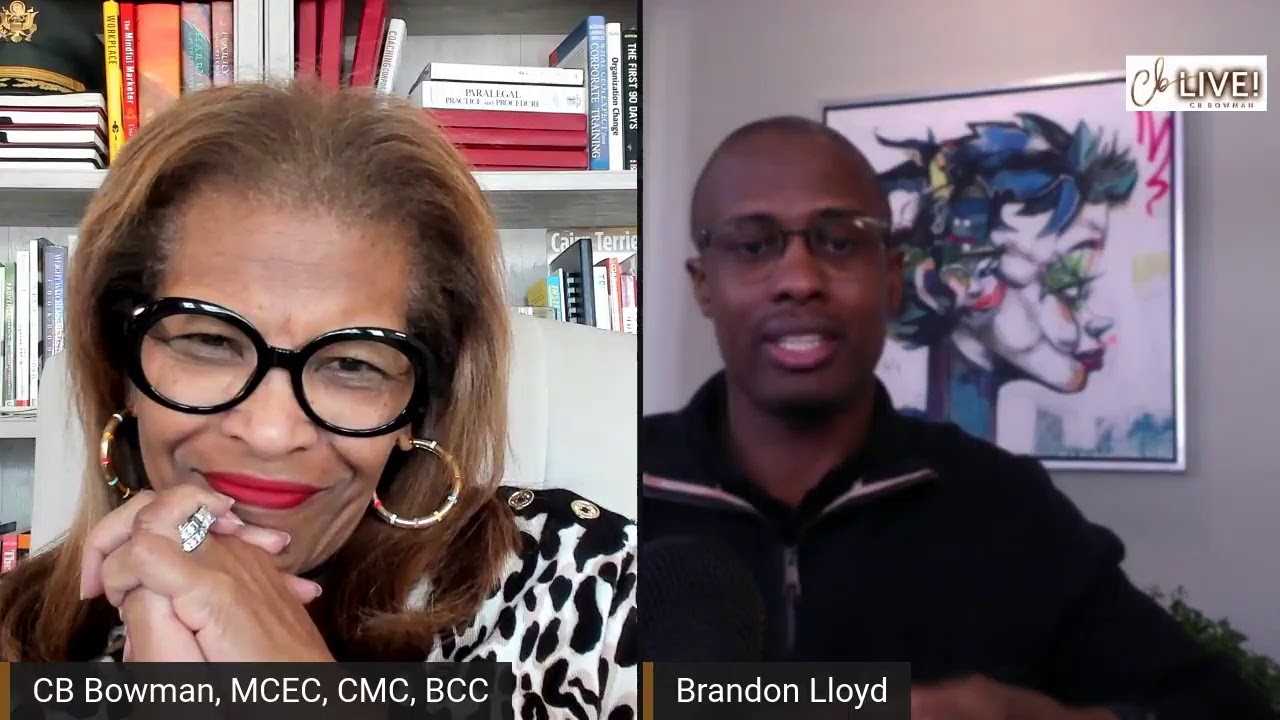
Former NFL wide receiver Brandon Lloyd discusses his upbringing, racism in professional sports, and his work with CareerWise Colorado, which pairs high school students with paid apprenticeships. He and host CB Bowman announce a forthcoming "Breaking Through" series about athletes' transitions and a support network for entertainers moving into second careers.
Chapters
Hello everybody, welcome to CB Bowman Live. And you know, it is Thursday and that's when we talk about what's going on in the workplace with regard to racism, Asian hate, anything that doesn't allow everyone to have the same rights, opportunities, to move ahead within the workplace. Hey, and you know, you know what, I always have a secret, right? You know, CB. So today's secret has to do with my guest. We're talking to Brandon, who is an NFL player. Now you could tell from the way I said that I know nothing about sports, right? But You know what we're going to do? This is a real secret now. We are going to be launching a program called Breaking Through. And we're going to be talking to athletes about how did they come from where they were as a child and broke through to such fame and fortune, and then what happened next in their career. So you're going to have a chance to have some real insights into the sports world. And Brandon and I are going to launch that together. So it's a secret, remember? Okay. So with that, I'm so happy that you're here today.
So good to see you.
And I'm excited to introduce Brandon. No, I'm saying I'm happy to see my audience, not you. I'm happy to see you. You're going to be my partner in crime. What, are you kidding me? So with that, I'm going to ask Brandon to tell us first to introduce himself. Yeah, what team he played for, and then we're going to go back to the past. How did he get there? So you're actually going to find out more secrets today. Ready for this ride? Let's rock it out. Brandon, welcome.
Thank you, CB, and thank you everybody for tuning in. It's a pleasure to meet your audience. Thank you for introducing me to your audience, CB. It's an honor. I'm Brandon Lloyd. I would say that I'm famous for superhuman feats of athleticism and effort over an 11-year span in the National Football League. And I played— I started my career in San Francisco with the 49ers. I went to the Washington football team from there. I played for a season with the Chicago Bears. I came to Denver, and in Denver is when I had my most productive seasons. Well, season. I led the NFL in receiving yards. I was on the All-Pro team, voted to the Pro Bowl. And from there, I played with the St. Louis Rams. I played with the New England Patriots, and I finished my career with the San Francisco 49ers in 2015.
I'm talking to a star. You are so humble. I would have never guessed that.
Thank you.
Wow, wow, you are such a kind man and so humble, and the work you're doing now— I would have never guessed that you had all this stardom. You, you're just a poster child for how do you manage your life and your career. And so it's such an honor to have you here.
Thank you.
Let's, let's go back and let's talk about how did you grow up?
Well, I'm the, I'm the youngest of 7, and—
God bless your mom.
They're beautiful people. You know, my parents were married at 17 years old. in Kansas City, Missouri. They started a family early in high school, and my dad heard that if he moved to California, became a resident, then the state would pay for college. And so that's what he did. He moved the family to Los Angeles. He went to— he started attending college. He went to seminary school. He raised the family out in Los Angeles, and And so that's where my background and understanding of my place and my race and my role in America. And, you know, just like, you know, many of your guests that have come on the show and talked about that sense of pride that— and responsibility that we have to have as young Black men growing up in America were the same values that my father and mother instilled in us and our family, starting with— education. You know, my father was saying the same things like, you know, you got to get that paper. That's something they can't take away from you. So I was, you know, a traditional student, you know, looking forward that way. But, you know, my parents, you know, lived in Watts in Los Angeles, and then when they finally moved back to Kansas City, they lived in the inner city. And my— fortunately, my parents made sound financial decisions. So, uh, for example, you know, they got out of credit card debt in the '90s.
Wow.
And, uh, they paid off their house within the 30-year loan. So they bought a home in the suburbs, um, in the 1980s. And so the last 3 of us grew up in the suburbs in Blue Springs, Missouri. So we went to blue ribbon schools. We We, you know, and we can touch on a lot of this, the way I view a lot of these race-related terms like assimilation.
Yes.
So growing up in a predominantly white environment, my parents were like, well, no, you're not going to have nappy hair. No, you're not going to wear big baggy clothes. You're going to speak properly. You're going to shake people's hands and look them in the eye when you meet them. And so we— those values were instilled in us at a very young age. And so that's what— that's that humility that comes through when you— when we're on today.
So let me ask you this question. Was there— and we have a question that came in, so— oh, how nice of you. Zach wrote in and he said, very well said, CB. Increasing quality from the first time meeting Brandon Lloyd, I thought the same thing. He's very humble. Do you know Zach?
Yeah, it sounds like— I mean, it may be, uh, Zach from manufacturing.
Zach Mofield.
Yeah, yeah, I knew it. What's up, Zach?
Fan club is already listening in. So I want to ask you a personal question. Was there jealousy in your family Because the last 3 children were raised in the suburbs and the others were raised in sometimes troubled areas? Or were the areas troubled after you left? So let's talk about that.
Yeah, I wouldn't say there was jealousy, mainly just because of the support system that my parent— my mother and father had.
Yes.
And so when I talk about my childhood being the last of 7, I say, you know, I was one of the spoiled— I was like a spoiled baby of the family where it's like, you know, my sister Cheryl would come home from college like, hey, you want to go see an R-rated movie? You want to drive my car? So, you know, we were— we're a very loving and doting family. We love on each other and dote on one another and support one another and You know, it was, it was a very supportive family, and I realized that that's not normal.
Yes, I love how you said that. Yes.
But for us, it's normal, and so we embrace that and we, and we live that.
So, okay, so you had this very rich, uh, supportive family, which Gosh, so lucky. So very lucky. Let me ask you a question. Do you feel that children who don't have the wealth of that support that you had from your family can get it elsewhere?
100%. Well, both of my parents were public school educators. And so even when my parents moved us to the suburbs, they still taught in the inner city.
Oh.
And my dad would fit in, he'd fit this line in every year, all year. He'd say, you know, I'm only doing this to reach one student, one student, that's all I'm doing it for. You know you're not a school teacher for the money, right? You know that, right? And, you know, he'd fit that in all year in a whole bunch of different conversations. And my dad was popular, he was a popular teacher. My dad is charismatic, he's funny, he's intelligent, and, you know, he's a math teacher, and he brought all those components into the math room, and he was popular, and he reached thousands upon thousands of students. But yet he always talked about just one, thinking about just one. And, and, and that's where my, uh, sense of, you know, yes, I can love on my immediate family and I can care for my immediate family. But then I have a greater sense of community when I am choosing to do, you know, my philanthropic work. For example, when I got an opportunity to do Touchdown for Tots in the Bay Area, I picked a small daycare in Chinatown to donate the money to. I brought Blessings in a Backpack to Blue Springs, Missouri, which is a food insecurity program. I worked with DACA recipients in Boulder. I attempted to bring a financial literacy program to Lowell, Massachusetts, one of the most dangerous and underperforming communities in America. I really tried to target my efforts in the smallest areas where I can make the biggest impact in lives because I know, I've seen it. My father was proud of us. He brought us all into the classroom. whenever he had an opportunity, all of his kids, and especially me. It's like when I became a public figure at 16 years old, when I was on the COVID in the sports section of the Kansas City Star at 16 years old, I became a public figure. My dad wanted to continue to show me off and show me as a role model to the students. He always gave me platform to speak to his students. He always gave me a platform to speak to students in other classrooms. He'd have me come talk in the library after class or over lunch and to provide that example. I've seen it at a young age. I know the impact to see these kids, to see someone who looks like them, to say that someone cares and loves them and cares about their future. It's important to me. That's why I choose to do the work that I do and the work with CareerWise Colorado today.
I have to tell you, You're gonna make me tear up because the love and respect you have for your father, it's like walking into the sun. It's so bright, it's so radiant.
Hmm.
And boy, Do we as a race need to hear the possibilities? Not to be jealous, but to say, I may not have had this, but I have the ability to find somebody like this or some people like this and put them in my Rolodex. I have the opportunity to build a personal board of advisors, and I'm not afraid if one of those advisors doesn't work out to replace them.
You know, I subscribe to, uh, Carla Harris, uh, Expect to Win, and she put— and my major takeaway was the mentor, the advisor, and the sponsor. Those are my— that was— those are my major 3 takeaways. And that, that mentor, you get the down and dirty, they get the everyday, day-to-day, how, how you're struggling, how you're succeeding. But then there's that— there's another handoff to an advisor. And the advisor just really wants you to be coachable. Do what you're told. And, and, and, and, and and report back on the successes and failures, and we'll tweak and adjust, but just be coachable. And those— and mastering those 2 relationships are what open up the door for the, the most valuable part of networking, which is that social currency. If someone's going to put their professional network on the line for you, And, or for me, or for anyone, any one of our listeners, or especially the young people. And this is what I'm getting at with career-wise. This is what's important, is that to nurture those first 2 relationships. Because when you get— when someone puts their career on the line for you, you better, you better be prepared to show up and deliver.
Show up and show up right. Yes. And So before you talk about the sponsorship role, let me— this must be another friend of yours. Ryan says, I'm impressed by the attention and adherence to the family rules. As a 28-year— As a 28-year, I definitely learned those to— learned those to a T, but wasn't anything unexpected. You mentioned them, so do— so do believe of them as vital and really important or not entirely necessary? Question mark. You know, it's a little hard to read the writings because people are texting, so they're leaving out words. Did you get the drift of that one?
So maybe, maybe is, uh, is that— and that's Ryan— maybe is Ryan talking about about the role of parents. Is that kind of what you were getting, CB?
I think that's what I'm reading. I think it says, I wish that people could come—
Yeah, yeah, I think I can maybe pick up on that. It's vital, but at some point we outgrow the nest, right? And what was important about being the last of 7 was I watched a lot of failures and successes. I had to be observant. I didn't want to make the same mistakes that my brothers made before me. My father communicated. He told me the stories. And, you know, as a young person, you can probably be skeptical, and I wasn't. I listened to him intently. I followed those stories that he shared with me, and I learned what not to do first, and then I executed on what to do. And, and so—
I want to add to that because this is a place that a lot of people— Black, white, purple, green— get stuck. Do not be afraid of Failure is just a lesson you learn on your way to being a success. It's a step on the ladder to success. That's right.
And fail intentionally though, right? Um, uh, I always remember the story from my childhood, you know, of the 3— there's, there's 3 men, uh, uh, The wise man who learns from, you know, the, uh, smart man who learns from his own mistakes, the stupid man who never learns, and the wise man who learns from other people's mistakes.
I like that one.
Right? And so I— so if I'm, uh, being intentional and I'm executing on what to do and then I fail For example, you know, I'm getting good grades and I'm— I made the football— or made the football team or the track team. I'll use track for example, a personal experience. And I make it to state and I lose in high jump. That's a failure, but I was doing the right things along the way. All right. And that's— and that's what I mean is it's, um, failing with intention. with intent, with good intentions in mind, as opposed to making a stupid mistake and then saying, oh, well, I'm learning from my lesson. It's like, well, could we have prevented that so that it didn't go sink to those levels?
Yeah, I want, I want to take what you said and make sure that our listeners are clear on this. So What we're talking about is not planning to fail. What we're talking about is reap the lessons learned in your steps to success to make your success faster, greater, better, right? We're not talking about planning to fail. That's a whole different thing, and it's not healthy.
Just to close out that thought on Ryan's question. When I turned 18 years old, my parents put a lot of responsibility in my court when it came to choosing colleges. I was getting letters from all over the country. I was a 7-foot-2 high jumper in high school, which was top 3 in the nation. I was invited to— be an athlete in the Pan Am Games and train for the Olympics. Um, uh, I was a 25-foot long jumper, sub, you know, sub-14 hurdle, high hurdler, uh, top football athlete, uh, ranked in the nation. So I was like, the letters were coming from all over. Uh, and, and so the decision that for me to attend college, my parents said, this is your decision. And so I had to take the responsibility with all the lessons that I've learned over those 17, 18 years with my parents. And I made the decision to attend the University of Illinois. And it was the moment, it was like I shook my dad's hand and was like, thank you, I got it from here.
Wow, I love it.
Thank you. Right, that was amazing.
Recognition of all of his work to say, you've prepared me well, I got it from here.
And it was that observation, you know, as a— now as a father, I'm raising 2 teenage boys. And when I reflected on what— on Expect to Win by Carla Harris, I was like, oh, wow, it was neat because my father went through that transition. He went from a mentor Everything down and dirty to when I got into high school, he became an advisor. You know, I can't— he said, I can't, I can't whoop your ass anymore. That's what he said to me.
Yeah.
I'm not, I'm not gonna, I'm not gonna do it. I'm not gonna go there, you know. And, and that was mainly for legal ramifications. He could still whoop my ass. He's an amazing man. And, um, but he went to an advisor, and then when I went off to college, or, uh, college, he became a sponsor.
Wow.
You know, it was just, it was like, all right, you, you, you shouldn't be calling me telling me you're getting in trouble with the law in college. You shouldn't be calling me telling me you're not, you know, you're getting popped for drugs, you know, in college. We should be way beyond that. And so, and, and so that was the— that's just to close out Ryan's, um, comments. Say, yeah, we fly the nest and we're ready to go, but, you know, parents also follow in that, uh, mentor, advisor, sponsor role.
Absolutely. So would you share with the audience, uh, the sponsor role outside of the family?
Yeah, the the sponsor role of what I noticed is it's the it's the the currency of the the network and and burning those bridges in the business community is it's unwise. And so when someone is giving their word or and speaking on behalf or vouching for someone, then you know those it needs to come through. You know, I'm not saying you need to be batting a thousand. But you need to provide more help into the community, uh, than you are providing failures into the community.
Yeah, I love it, I love it. And, and another way to look at sponsors is that these are people who have the ability to whisper in somebody else's ear to select you for the role That will push your career ahead. You know, these are the people that whisper to other people on the golf course, in the bathrooms, you know, in the boardrooms. Listen, Brandon, he's your man. Yeah.
You know, and it was, you know, there was a point in my NFL career when I was with the Washington football team where I had had several run-ins with the, uh, head football coach, and that— and I ended up breaking my collarbone and, and getting cut 2 years into a 7-year blockbuster contract. And because of those, uh, altercations with the head football coach, with, uh, the position coach, and, and Uh, poor interaction with the media. That team all tried— not that team, those people in power on that team did a lot to try to blackball me from playing in the NFL in only my 4th year.
Yeah.
And you know what it came down to was my college football coach was the offensive coordinator for the Chicago Bears. He told the head coach, Lovie Smith, at the time, he says, I can't vouch for whatever just happened over these last 2 years, but I know Brandon since he was 16 years old. I've known him. I know his mother and his father. I know they're good people, and he deserves another chance. And that's what got me back on my footing in the NFL and back on a track to continue to pursue my dreams. So it's like That's a sponsor, that type of sponsorship.
That's a clear definition of a sponsor. And I want to say, weren't you lucky? But it was more than luck, right? But let's talk about the, the part that didn't go so well. Yes, the confrontation part. And, and let's talk about how you realized after the fact what you had done that could have been done differently?
Right. And, and honestly, CB, I, I wouldn't have done it differently. I, you know, that's— that is one thing that I've— and I've inherited from my mother's side of the family is a strong constitution. And, and I, I believed in my talent. I believed that I was brought into that situation to add value, athleticism, those spectacular plays to that organization. And then there was a certain level of accountability that I felt professionally wasn't being upheld on the other end.
Ah. Now The—
how I can communicate that, that's where the— that systemic racism rears its ugly head in the NFL, where the Black players, you just shut up and take the money regardless of how you feel. You know, the white coaches are in control.
Mm-hmm.
We are— I'm calling the plays. You just be quiet. And, and that's what I was hearing from my personal interactions with the head coach. Just shut up and take the money, he would say. Just, just be quiet. And to me, it was squelching the potential that everyone saw that I had. I was ready to come on that team and, and, and be an integral part in taking that team to the playoffs and beyond. You know, those are my childhood dreams. I'm going to play in the Super Bowl. I want to, you know, on this, the number one franchise in, in all professional sports. Like, though these were my goals and dreams that were being squelched because of what I felt was, um, uh, inadequate, uh, game planning. So I, I, you know, I, I approached it the way I approached it, and, um, and that was the outcome, and, and it was a, and it was a failure. But when it, when it came down to it, on my past record from a certain sponsor, Ron Turner, from a certain sponsor, I did have another opportunity.
I'm going to push back that it was a failure because it wasn't. It was incredible success. You know, I went through the same thing in the corporate side, which, um, I felt I The oppression that was there, I took it for so long. And then all of a sudden— and this was the help, with the help of therapy, actually. That's how bad it got. But I had a wonderful friend slash therapist slash career coach who said, something is wrong. Let's, let's start examining this. This was a Jewish guy who I believe God sent me.
Hmm.
I really do. Because it was through him that I realized what was happening to me. And I was allowing it to happen because of lack of knowledge. Right? I had not faced discrimination before I walked into the corporate world. Even though I grew up in totally white neighborhoods, somehow I was always protected. Even in my high school, the bad girls, they would not let anybody touch CB Bowman, you know. And, and I look at the John Travolta movies and I'm like, wow, I was in that group and I was protected. protected, man. So I had no idea what racism was until I went to the corporate world.
Wow.
So with that innocence, let's call it, I had— I didn't understand the play. It took somebody who was white to explain the play to me. Who would have thought, right?
Right.
And my choice at that time was to continue to be a victim or to fight back. And I chose to fight back. Could it have been done different? I don't know. You never know. All I know is that I— and I had to continue to work at the company while I was fighting back. Hmm. Now, did that take a toll on me? Yeah. As I grew older, I realized the toll it took on my health. But here's the thing. I can always look back now and say I opened the door for my brothers and sisters.
Sure.
And that means more to me than the results of the case, which I won, by the way. But I'm just saying that to me was worth the pain that I had to go through Working at those companies.
That's powerful.
Fortunately, I had my sponsors who came and said to the companies, you guys are heading down a rabbit hole with this. She may seem like she doesn't know that she can't take care of herself, but you're heading down a rabbit hole.
And we mean Yeah, and, and talk about the stamina that it takes emotionally, that what you were going through.
Can I just tell you that I was shunned more by people of my own race who were at the company than others? That was the worst toll.
Right. Yeah, and then, and some of it, it's the internalized oppression where a lot of times in the Black community, from what I would experience as a youth, was, you know, Black people don't talk like that, you know, Black people don't listen to Green Day, you know, Black people don't golf.
Yeah.
You know, Black people don't watch them kind of movies, and it's like, how many lines from, you know, The Color Purple can you recite? Or how many lines from, you know, Friday can you recite to test your level of Blackness?
Yeah.
And so it's like, I can— I was fortunate enough to have 7 bro— you know, 6 other siblings who were supportive, who were positive, who were college graduates, who were in the workforce and 2 parents who were saying, you can be whatever you say you want to be. You can do it. And so I can only imagine how tough it is for the Black youth who don't have that reinforcement in the home to where they're like, you know what, you're right, Black people don't do that. And then you start missing out on those abilities to be sponsored, like you were talking about earlier. Like, who's talking at the boardroom? They actually, they do golf. Actually, they do, you know, listen to classic rock. And so, you know, those are lessons that I learned at a young age where it's like, so for the, the Black community who was not in athletics at the level I was, I didn't fit in. I was like, well, my teammates listen to Green Day, so I'm listening to Green Day.
That's right.
My coaches are listening to classic rock, so I'm going to learn to love it.
It's not about giving up your heritage.
Right.
It's adding information. It's like when you go to school, you add information, and that information allows you to make wiser decisions. Without that information, you can't make wise decisions. I'll give you a really good example. We could— you know what, we're going to be talking for days, but I love it. Um, the situation with Teen Vogue that just happened, where here you had, uh, a woman who in her teen years made disparaging comments against Asians. Vogue fired her. She's now in her 20s, right? And I was all up in arms about that, you know. I mean, my people, what, what, what are you talking about here, right? Give people a chance. Don't go automatically to cancel culture, right? Last night I was on Clubhouse and an attorney was on my show. And she said, well, you know, CB, that was not Vogue's decision. I said, what are you talking about? They were deter— they made the decision to terminate her. And by the way, audience, I am not supporting negative statements about any race, any religion, any sexual— I am not supporting it. I'm telling a story.
Mm-hmm.
And I said, what are you talking about? And she said, a cosmetic company came to them and said, if you don't terminate this person, we're pulling our contract. The contract was worth millions of dollars. So now we're looking at, is it punishment? Is it a business decision? Is it both? I'm not in the position to make that call. Before I had the facts, I was in a position to make the call based upon my feelings being a Black woman, because we have all made mistakes. You know that expression, young, dumb, and stupid?
That's right.
We've all been there, right? So I'm simply saying, without all the information, even though you think you might have it, you don't know. You have to build up your ability to go out and get all the facts. Doesn't mean you have to change your mind. It just means that you have a wider breadth of information to make some decisions. So saying that, oh, because you're Black, you should not be exposed to other things that people listen to— when I grew up, French music was my thing. I wanted to hear Piaf. Doesn't mean I'm not Black.
Right.
I'm not giving up my Blackdom. I'm increasing my knowledge.
That's right.
So I, I take exception with people who say you're giving up because my position is you're adding on.
That's right, I agree.
So tell us, tell us about what you're up to these days. You're doing something with a group called CareerWise. Tell us about it.
Yeah, it's a high school apprenticeship program. And what I enjoy about my service to CareerWise is that it combines all of those elements that I talked about from my past philanthropic endeavors. And what I realized being on the COVID of the sports section, it wasn't putting food on these kids' tables. It was, you know, I go speak to kids about doing better and being better, but then I just leave. And with CareerWise, we actually are leaving the students with the game plan in order—
My husband wants your autograph, so let's— Okay.
Hook me up, hook me up. Yes, and equipping students with the skills to build careers in it. So it combines their existing high school education with real-world business experience. So it's a Swiss model. It's the dual education model. Noel Ginsberg, our incredible founder of CareerWise, went to Switzerland with a delegation under the then-Governor Hickenlooper with a bunch of business leaders and philanthropic leaders. When they returned back to Colorado, they said that this would be a good model to introduce to the students in the Denver Public Schools.
Yeah, I'm loving it. How does it work? How many hours a day do you spend in school? Are any of your subjects shortchanged?
The program starts when they're juniors in high school and it replaces their electives. So there's a bunch of creativity with the employer partners where, you know, some of our employer partners, they go for a half day every day of the week. You know, some of them go for 3 days at school, 2 days at work for the first year, and then the second year that flip-flops. And so while they're at the worksite, they're getting school credits so the students graduate on time. And there's, again, there's a lot of the opportunity for the students to be indoctrinated into a work culture. They're exposed to that social network. And what's amazing about it is the, you know, due to the unfortunate policing events last summer, our white brothers and sisters out there are looking to do more into our community. And so we've launched the Equity First Initiative, which is actually giving more resources to students of color and giving them more opportunity in order to get into the workplace while they're in high school. And that's for— and our Equity First partners make an explicit statement that our students of color are unprepared going into the workforce, and they're willing to add additional boot camps to our students who are in CareerWise in the summertime, which is— it could be office skills with Microsoft Word or Google Word, all the way to technical skills on what they're actually working with. Now, CareerWise is not a anti-college program. So our employer partners are participating in our students', um, college education. So in that 3rd year of their apprenticeship, they are able to attend a semester of community college, uh, college work that's relevant to the work that they're doing with their employer.
Okay, I have lots of questions. Are you ready for this?
I'm ready.
I had the experience when I was designing and implementing an internal university for a company. And I would see kids coming in for the summer to work. And so employees would bring in their kids to work. Here's what I saw, is that the Black children were relegated to stapling papers. The white children were taken out to lunch with the executives.
That's right.
How do you monitor that in your program?
Well, that's part of our customer success managers. We have a complete service that where not only are we training our students on etiquette and how to communicate with their supervisors and their team members, but we also work with our employer partners and we provide training on how to communicate with Gen Z and what to expect out of a high school apprentice because it's different. You know, they're training on potential. versus an adult hire who already has experience. So the— there's, you know, 2 types of managers, 2 types of hires that we are experiencing, or 3 types. It's companies that are looking to hire for workforce development for the future because of an aging workforce, companies who are looking to do a social good, and companies who are actually looking to make equity-first statements and to help students of color. What happens with Career Rise is it's not an internship, it's an apprenticeship. They go on as a W-2 employee and they get paid minimum wage. We are the intermediary between the Department of Labor and the employer. These students get a nationally recognized certificate. For example, if a student goes into a company and our biz ops and is going in as a sales associate, business operations sales associate, they can get the national, uh, certification Toastmasters. And the employer partner pays for that. And the students are, are actually integral parts of the workforce. They, they're not to be, um, getting coffee or stapling papers. They're actually getting trained to work Which was an amazing statistic that we found during COVID where 67% of our apprentices stayed on at a time where interns was coming to a dead stop, full stop. But that just shows how much of an integral part our apprentices were to our employer partners, that they were deemed essential and were kept in place and switched to remote.
Wow. Yeah, that's exactly what I was getting to, is how do you, how do you manage the work that they're actually given to be sure that it's meaningful? That's right.
Yeah.
Okay. My next question is, you mentioned that they also receive support in going on to a community college. Why community college? Why not the top 5 colleges or univ— why not university of top ranking?
Well, because we can pluck colleges from— we can pluck courses from the community college system. Now, the point of CareerWise is to present working opportunities for students who may not have 4-year college in their horizon. You know, we're sitting on top, you know, the pandemic is bubbling on top of a bunch of other epidemics, and the college debt crisis was the newest one, and it finally come, come to a head. And so maybe students are turned off by that. Maybe they don't want to deal with that, and so they want to get into the workforce. They want to— they maybe they need to support their family, and, and, and our business partners are looking to support the community. And it's like looking forward, how are we going to manage this pandemic? The record unemployment, government assistance. I'm sure students are looking at their parents, just gruntled about the workforce. What do you think that they're thinking? I'm sure they're thinking they're probably turned off by the workforce also. But career-wise, we want to encourage them that no, There's businesses out there who need you, who want you, and who are ready to train you and get you and use their social currency and get you involved into the economy. Because my biggest fear is that students, you know, our young people are becoming, you know, subjects of the economy and not participants in the economy. And that's where my passion for CareerWise lies is Giving these students the power to understand how money works, how you fit into how money works in the economy. And then you have people willing to be your mentor, your advisor, and your sponsor and help you elevate.
And, and so then the question becomes, uh, is there an opportunity— and I'm checking the time because I want to come back to something— um, is there an opportunity for these students to learn entrepreneurship.
Right now, the pathways that— the occupations that we create, there's a lot of intentionality that go behind them. And so, you know, we're testing if they're a springboard for upward mobility. We pressure test to make sure it's not a static job. And we're— and so we want to make sure that You know, there's potential for the future. And so we haven't quite figured out how entrepreneur works as an occupation. But, you know, we're working on it, you know, because it does come up. It does come up.
Yeah. Yeah. So my last question on this subject is, because I'm sure we have listeners, how can companies get involved in this program?
Well, you can reach out to me via LinkedIn, you can reach out. You can visit our website, careerwisecolorado.org, and you can get involved and rather immediately. We have a lot. We work with 60 schools in the Denver metro area. We are 100 schools statewide. We're in New York. You know, we're working with, you know, the largest philanthropic organizations, Bloomberg, the Walton family. the, um, Daniels Fund. Uh, we were in JPMorgan Chase in New York and Amazon in New York. We opened Elkhart, Indiana. We're reaching into Indianapolis. We have outreach from 36 other states that are looking to, to, to bring, uh, CareerWise into their state. We just opened up a new, uh, 401 in DC. So, you know, it's expanding. We're getting amazing uptick, and we do need more partners. We need more business partners who are ready to step forward and, and have a forward outlook on our economy and give our young people a chance.
Here's another question. I know I said that was my last question, but you know, I didn't tell the truth. If there is an entrepreneurship that's interested in this program, a solopreneur, And they don't have the money to fund a student going through this. Is there a scholarship available?
Well, there's grant applications.
Okay.
We realize we, we rely solely on our philanthropic, uh, and endowments and the state and federal government for grants. So The Biden administration is about to roll out an unprecedented amount of support for apprenticeships here soon. Governor Polis is an amazing advocate for apprenticeships and is about to roll out a 5% initiative where he's going to challenge corporations to hire 5% of your workforce as an apprentice. Governor Polis is bringing on 30 career-wise apprentices at the statewide level. Mayor Hancock's bringing on over 10 apprentices into the city of Denver. And so, you know, this dual education pathway is gaining remarkable momentum. And, and it's— we call it a modern apprentice, and we're not quite focused on the trades yet. We're, we're really focused on getting students into office roles— HR, IT, uh, facility maintenance, business operations, sales. We're getting students into modern roles, but, uh, eventually we will get into some of the trades. But we feel like there's already existing infrastructure for apprentices in the trades, and so we're just not treading in that, uh, in that water yet. We're just focused on these modern roles.
Well, please keep me in the loop for grants for smaller businesses to be able to participate in this because I think that that is a wealth of information because these children get a chance to experience an office from a 360 experience. And to see what it takes to start your own business and to succeed in your own business. I think that that's a different education and one that's incredibly important because as we look, I think Obama said that— I love what he used to say— this country is run by small businesses.
Right.
So I want to go back. Oh God, we're just almost at an Time, and I wanted to talk about how did you make the leap from being a football star to the work that you're doing now? Was there downtime? Was there upset about losing your status as a star? I'm like, you're a star now, but I'm trying to be gentle about it. Let me just tell you what it is. How did you feel after you left football, and what made you decide to move into this? And how did you get the interest in, you know, all that kind of—
CB, retiring from the NFL was an incredible loss. Okay, incredible loss of self and identity and worth. It, it was emotional. It was an emotional loss. And it was only the support of those mentors, advisors, and sponsors who stepped right up and were like, no, no, no, no, Brandon, you have transferable skills. I'm like, what?
Yes.
I'm like, what? I have what?
Yes.
And they spent time with me, you know. So it was like, it was opportunities where, you know, I'd vacation with my friend Jeff Murray in Steamboat, uh, with the family. And then it wasn't until the family went to bed and we were doing the dishes, then we'd start talking about my plan post-NFL, like how you're gonna— what the next step was gonna be. What's the next step? Go back and get your undergraduate. Let's do that. Great. What's the next step? Start building your resume. What's the next step? Let's start— let me start introducing you to people in the aerospace sector. And I think that what's— what set me up for that was I actually worked in the offseasons in the NFL. So, you know, I had foresight to what I was going to be doing thanks to another man here in Denver, Colorado, um, who, you know, I met him at Nuggets games, who owned the aerospace company here in Colorado. And he asked me, what are you going to be doing with yourself when you retire? See, I thought I was about done. This was my first year with the Denver Broncos in 2009. And I was like, I don't know. He's like, what are you gonna do? You're gonna, you're gonna be a rapper? What are you gonna do? You know, because I have a hip-hop catalog. And I'm like, no, I'm not gonna do that. And so he says, why don't you come work for me in the offseasons, and then I'll give you a leave of absence to go play in the NFL?
I love it.
And so I began managing, you know, some of his most, um, uh, prestigious accounts. I had the Boeing account, I had the SpaceX account, I had the military contractors with the F-35. 5, um, project. Um, I got to study under a metallurgist in, in Tacoma, Washington, you know. And then, um, that, uh, Mr. Murray, while I was in the NFL, he was my neighbor when I was with the Bears. He says, you know what, you don't— you remember I'm in the aerospace sector? Let me introduce you to the CEO of Spirit AeroSystems. And so I had this role in aerospace and I had my own Rolodex, which was very valuable. And so it was that type of networking and business, um, pursuit that I was doing outside of the NFL that prepared me for my retirement.
You know what, so audience, you just heard the next secret. The work that Brandon and I are going to be doing is to support entertainers. When I say support, we're not talking money here. What we're talking about— sponsorship, mentorship, coaching— people in the sports arena who went through what Brandon went through. And you hear my 4-legged son agreeing, right? So we don't want athletes to have to go through what Brandon did. He was lucky. He had— he wasn't lucky. Yes, he was. A strong constitution, right? And that constitution came from his family. But there are many athletes and entertainers that don't have the privilege of having what Brandon did. So we are going to create that privilege.
And what's amazing is that it exists. It's all around them. It's all around us. Those people, you know, I thought this man was my neighbor, but in reality he was an advisor. So these, you know, people exist around us and we just have to Activate them. And, and that's, you know, the point of the coaching is what skills do you have, what skills are transferable. And when it comes to being an athlete, and, um, what I realized, the, the best, the, the best part of being an athlete was the access. People wanted to, you know, the actors and politicians and billionaires and sheikhs of Qatar. And like, everyone wants to be associated with that level of excellence.
Yes.
And so, and so, but what do we do with that? What do we do with that access? The worst part about being a professional athlete is the lack of privacy. So what do you also do with that? You know, so it takes a lot of, uh, of, of discipline To, to stay in between those 2 extremes.
Yes.
And, and, and, and stay in the clear from those, uh, pitfalls that are right there for everyone to fall into. And just kind of— and providing a network for, for, uh, athletes and, and entertainers to, um, uh, have a community to support them, support.
And, and that's That's what we're going to do. And, you know, I don't think that we realize as a general public the pain that people that we worship go through. And there is no— there's no safe space.
Hmm.
And so we want to create that safe space and, and to be able to be advisors because Because as you said, Brandon, so many opportunities come at them. But are they opportunities that come from the heart? Or are they abusive opportunities, which we've seen a lot?
Absolutely.
So we want to help athletes figure out what's real here, what can help them move forward? And what can they give back? And when should they give back? And if they have the interest in giving— there's just so much. And we need to provide that safe space, that advisory space, that coaching space. So I'm so happy Brandon is going to join me in creating this wonderful opportunity to support those who have entertained us, who've given so much of themselves, and we haven't been able to provide for them the security and safe space to continue to operate once they go to their second career or second life.
And, and the community is honored to be coached by UCB. I mean, you're, um, an incredible visionary listener, and the advice that you give is sound. It's rooted in education and experience, and, and that's what it's about. Because it's when— it's those— it's the people like you who came into my life where I was like, all right, I can be coachable. to this person, because there's a lot of people that came along where it's kind of like, uh, I'll dismiss that. But it was people like you who came along with intent, with experience, and with energy. And so the, the community is going to be lucky to have you as a coach.
I love you. Don't tell my husband. Hey, we have a listener. Caroline Boyce. She is a dear friend. She's a sweetheart. I actually serve on her board of advisors. She's with the Chief Financial Officers Association. And then— and there's a diversity sector where I served on the board. And she says, love your honesty. To you. You have great skills, Brandon. And supreme compliment. Thank you so much. Yeah, no, I'm gonna get into so much trouble. I really am. It's the privilege of being older. You get to say stuff. We're a minute over. My goodness, everyone, please stay tuned and, um, join me on Tuesday for Challenges of the C-Suite, where we're going to have another spectacular guest. So, um, stay tuned for the work that Brandon and I are going to do. You're going to love it. And I know there's a lot of people out there that are going to raise their hands and say, CB, I want to be part of this. You can be. Reach out to Brandon and I. Let's make this happen. Let's bring some light through all the pandemics we have been going through. Let's bring some happiness. Let's bring some spirit. What are my closing words for today? Humility. Go out there, use your humility, It will take you a long, long way. And Carolyn writes, I love you, CB. Back at you, girl. I love you too. So with that, Brandon, thank you so much for coming to us and speaking from your heart and uplifting people who have not had the opportunities that you had. And I am so honored to be working with you. I, I just can't wait.
Same.
Thank you. All right, everybody, so stay tuned and remember, use that humility. It really works. Have a great week and I'll see you on Tuesday. Behave yourselves out there. Bye now. Bye.
More from CB



211- Courage to Leap & Lead with Louise Story part 1Courage to Leap & Lead







