CB LIVE: Courage- Challenges of the C-Suite GUEST Maïna K. M'Poyo, Episode 83
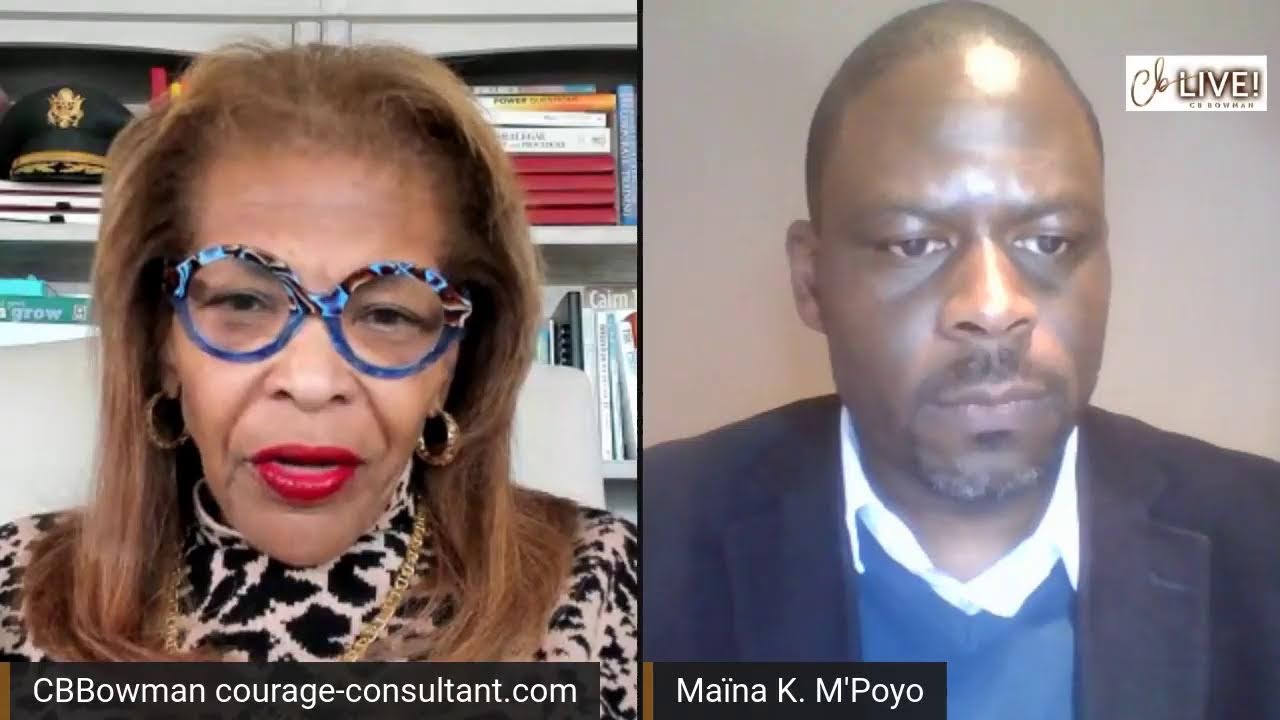
Maïna K. M'Poyo, whose grandfather founded the Democratic Republic of Congo, talks about three forms of courage in the C-suite: purpose, leadership, and refusing the status quo. She argues that purpose must be embedded across corporate strategy, not just in CSR, and shows how Costco's price-holding strategy and consumer backlash against Apple illustrate the tension between profit and purpose.
Chapters
Hello everybody, this is Tuesday, so you know on Tuesday you have the best of the best. Hey, we're having a little technical problems with StreamYard in the fact that we're getting an echo, so I hope you'll be able to bear with me. Maybe it'll help if I turn down my mic, my mic a little bit, see if that helps. Um, Manina, can you still hear me?
Yes, I can see— I do, I do hear you.
Okay, good. So I think that may have helped a little. Hey everybody, I have a great guest on. He has a fabulous background. You can— you guess what my secret is today? I'm rocking new glasses. Aren't they fun? I look like a superstar. Okay, listen. Down to serious business. We have an expert on the line, and he has a very rich background. Originally, he is from the Congo. And you know what? I'm old enough to remember when it was called the Belgian Congo, and now it's the Republic of Congo. Did I get it right?
Democratic Republic of Congo, indeed.
Yes. Yes. And so, and now he's in Brussels, which I love because I love the little statue, this little statue of the boy. Yeah.
I have to do one of those.
What is he called again?
Manneken Pis.
Yes. He's, he's all in the corner so you can barely find him, but it is a riot. And I miss it. The Brussels fish. Oh my God, the fish, the pâté, the soups.
Mm-hmm.
I'm so jealous that you're there. So without further ado, please introduce— oh, you know what? Before we start, I have to remember to remind everybody to please subscribe to my newsletter in LinkedIn. And when you listen to this, please rate and comment on— for us on your favorite platform. It could be Apple Music, it could be Amazon. We are all over Spotify, iHeartRadio, YouTube. We really appreciate your feedback and your comments. And we're going to start to call people out in a good way If you comment. So now, without further ado, let me introduce my guest, and I'm sure I'm gonna screw up his name, so I'm okay if he pronounces it correctly for me. Manina. Manina. Manina.
You're very close.
Very close. Manina. Does it have a special meaning?
Yes, it does. Actually, my two names do have a meaning. So, Mina. has a meaning as alter ego. And the Kitumaini, which is my second name, means hope.
So I want to ask you, how in your native country, how are names created? I mean, how does your— how do your parents select your names for this special meaning?
Basically, it's a matter of the I would say that the character that the parents want to see in their children and how they, how they see the child moving forward in life. And it's really about the character that people want to see.
That's fascinating. And so how does Alter Ego play into the character? Are your parents proud of how you fit the name?
Oh, it's a very good question. You should ask them the question, but I do, I do, I do try and strive to to bear the name with distinction and pride. So I hope they are.
So how have you demonstrated an alter ego?
Basically, I would say in the way I am on a daily basis. If you ask myself to introduce, basically to introduce myself and tell a little bit about myself, I would tell that I'm very much a global African business citizen. And there you can already see the alter ego side of, in your question, in the sense that there's this dual perspective I do have, a global perspective in general, but at the same time very much African at heart due to the education I received by my parents. And on the other side of the equation, as far as the business citizen of the world is concerned, I'm very passionate by the corporate world. I'm very passionate about strategy and corporate strategy in general, and it's very much the reading grid that I do use and that I use basically to look at the world. Although my passion in business also leads me to transcend it and to look for other areas and other disciplines and see basically how they can interact with the business, how they can interact with strategy, and how basically my own business perspective can be enriched by those alternative perspectives.
Well, I'll tell you what, if I was your parent, I would be proud of you. I love it.
Thank you very much.
You're freezing a little bit on your frame, so there's a little bit of lag time. Now, how did you end up— first of all, I have to share with the audience that we met through Thinkers 50, right?
Right.
Yes. And so, um, how did you get— 2 questions. How did you end up in Brussels from the Congo? Was that your direct route, or were you in Canada, United States? I mean, what are the countries? What was your travel route?
It's even more straightforward. I'm actually born in Brussels. That's what my parents came actually to Belgium, and I'm born in Brussels, so it's even more straightforward than what you told.
So, okay, now if you're born in Brussels, how did you then get to the Congo and become educated there?
Actually, I've done most of my— all of my education in Belgium, and I would say across Europe, uh, and the perspective I did get was actually through my parents. through my education and through, as I told, the history of my country. And the interest I do have in Africa and then in the rest of the world has always intertwined and has always given me this dual perspective I do have on when I look at international things, either on geopolitical side or in all on the, more on the business side.
So in the United States, we say that you have the wanderlust For travel, right? It means that you like to go all over and examine and learn and explore. So how did you select the Congo from Belgium? Is this a natural transition, or how did it happen? By natural transition, I mean, did your parents work there? Did they travel there? Were they in government? How did you select?
Actually, um, there are two sides of the equation, or two sides of the story. So on my mother's side, um, the thing is that my— the story of my family, uh, and the story of my country actually one and the same country, because my grandfather was actually the first president of the Democratic Republic of Congo after the independence, and my mother took over from him as well and later ran for office. And my father was actually also born in Congo, but my father came to Belgium for work. Basically, at that time, he was working as a diplomat, working for the Ministry of Foreign Affairs. And my mother was actually studying here, and basically that's where they met.
Now I'm fascinated by your mother because, you know, being a woman, I want to know about her success and how she came to be. Let me ask it this way. In the Congo, is it normal and accepted that women have a higher education and move into prominent positions?
It has been a challenge. It has been a challenge because, as you said, as you, as you can imagine, a few decades from, you know, uh, ago, um, there were very few women. So in, in the political, on, in the political scene, um, so she really imposed herself as a, as a leading figure, and at that time as a leading figure of the opposition, uh, and achievement after achievement, um, basically she very much stood up very strongly for a vision and for a strong willingness to, to transform the country. That is something that she had taken over from her father, um, and moving forward, that's the vision she's always stood for and basically that she brought forward, she put forward, uh, in her own political party. Because at that time, she was also, after some time in the leading party of the opposition, she, she basically became president of her own party. And she also went in the government after the fall of the dictatorship of Mobutu in 1997-1998. But after that, she felt that it was not really the ideal that she was pursuing, and then she decides to quit because she was not aligned with the way that things were conducted.
So, you know what, I would love to interview your mother. I love her history. And, you know, we are, we are moving this program to talk more about courage. And it sounds like your mother just embodies the word courage. And so it's no wonder that she has such a strong son.
Thank you. But to say that, to really, I mean, if I have to really then connect the dots with my personal history or the history of my family, and then the type of leader I strive to be, and I strive to be as a strategic advisor today, I would say that— and that's why I did mention that I really believe that in hindsight and with the benefit of experience, it really influenced me as a leader on, I would say, on 3 areas. The first one is what I would call The courage of purpose. The second one is the courage of leadership and the courage of refusing the status quo. And naturally, the third one is actually a very strong sense of transformational leadership aspiration. And an anecdote that I would like to share with you is that back then, so 10 years ago, rather than celebrating the 50th birthday of the independence, And I had been very curious about the speeches of my grandfather as president. And I was actually amazed by the accuracy of his vision at that time. But I also realized that it has been so reversed by a coup. And he didn't really oppose the coup because in his mind, the purpose of the nation was greater and bigger and more important than his own personal destiny. And when I relate that with my career, I've had some times where I really also had to basically measure whether I was standing for the purpose I was actually defining for myself and for my own trajectory. The second side is that, on the second point, is when you grow and you evolve in an environment where the discussion around the table is how can we change the country, how can we, how shouldn't we just accept the status quo? To a certain extent, it also leads you to a point where you actually grow with a sense of responsibility towards the society. And on the third point, on the transformational leadership aspiration, the thing is that by nature, if you're in an environment where the thinking is about how can we change the nation, naturally there's a natural drive for transformational leadership that I— that they just, you know, that just— they just transmit, I would say, from generation to generation. So I would say that those 3 elements has been really key in my own development. And now if I relate that to my career, Today, I very much define myself as a strategic thinker, as a strategic leader, and as a strategic advisor. And on the thinking side, it's very much tied to my passion for strategy, most importantly to my passion for ideas and my passion to actually turn those ideas into insight and then turn those insights into strategies for companies. On the leadership side, and the things that also My greatest ambition when I think about thought leadership is really to provide insight that inspires leaders to think, lead, and act strategically and distinctively. And I've made really a point of honor to really try to bring very, very much a very fresh perspective in every strategic insight that I do share with my clients, or more generally with the community. On the leadership side? Yes.
Yeah, I want to first go back to discussing changing the country. So, so your grandfather had this dream of changing the nation over his, his own concerns in life, right? And then there was a coup.
Mm-hmm.
In the United States, we have been fighting to change our nation. We, you know, for many of us, especially people of color, we haven't seen that change. We've seen like maybe a little inchworm, and then it goes back and hides, and then, or moves in a different direction, and then we move forward. And, you know, for the age of our country, relative to how much we've moved, it hasn't been significantly measurable, right? Because it's been so small.
Right.
For you, in looking at what your father designed and had in mind, have you seen great changes in the Congo? Because at this point, so many of us are frustrated here in the United States. We don't know, we haven't figured out the secret sauce to bring the courage together in the 3 areas that you presented so that we can really observe change in a significant way.
To answer your question honestly, I'm afraid that unfortunately we haven't seen the change that he really had started instilling in the country. Because the leadership that has followed after the coup unfortunately didn't really share that perspective and didn't really inscribe itself in that perspective. And for 30 years, and then afterwards, unfortunately, the sense of development not that strong in what, you know, what you could observe in the country.
So you— go ahead.
No, I was just about to say, so when looking at some of the speeches and when he really projected his vision, not only for the country but for the continent and more generally speaking for the world, part of the accuracy was also due to the fact that unfortunately it hasn't been put forward and followed by effect throughout the leadership that followed him.
So if we take, okay, the governmental leadership and we see that that has not succeeded, it occurs to me that your approach is more taking the organizations and directing them towards courage in the 3 areas that you presented. Do you think that those 3 areas, do you think that that work will bubble up to government, to the level of government? Is that your vision?
I think, I do think it will, and I would even say that government will have no choice. And when I say government will have no choice, I would say government in partnership with corporations. One of the key themes that I'm really now very much attached to, and which is one of the premises on which I started my consulting firm, is the notion of strategic purpose. And the notion of strategic purpose, as I defined it, is really a synthesis between the societal aspiration of a company and its strategic ambition.
Because— Give me that again. Just based on strategic purpose defining—
Yeah, sure. As I said, strategic purpose is the synthesis between the societal aspiration of a firm and its strategic ambition. And the reason why I do believe it is pretty critically important, and now after 2 years where everyone has had the opportunity to rethink very deeply about its own purpose and how he wanted to be aligned with what he was actually doing, working for a corporation. And for some of, you know, for civil servants in public service, the purpose they see instilling in the nation. I really believe that we are at a critical time where both strategy and purpose are more needed than ever. And back to your question about Do I see that put forward and actually moving forward into government and businesses? Yes, I do think so, because I really see both parties needing to converge to actually help moving the society forward. If you look at what we see today, there's a strong momentum around purpose, which is led not only by a sense of macroeconomic responsibility, because when you have 41% of the top 100 economies who are corporations, it really puts a sense of responsibility on the corporate world. Now, on micro level, when companies are able to really embrace the notion of purpose and are really able to implement that on a daily basis, you actually find out that they do find opportunities to innovate to satisfy new customers who are actually very much keen, very keen in not only consuming products and services but consuming meaning. They are very much also attached to the idea of giving a sense of purpose to the employees. So you do have a convergence of factors which make it today very compelling for companies to embrace the notion of strategic purpose. And the reason why I get back to my— but getting back to my definition of the strategic purpose, I do believe it's very important for companies to look at the strategic purpose but from a multi-dimensional perspective. Very often today when you hear talking about purpose, we have the notion of purpose through the lens of corporate citizenship, but an organization and certainly corporations much more than that, they are multidimensional. And beyond the corporate citizens that they, that they are or that they aspire to be, companies are industrial players, they are economic agents, and they are market-driven organizations. And in that sense, I do believe that the notion of strategic purpose perfectly aligns all these dimensions of the companies, and more than just them, a strategic direction a societal aspiration, I profoundly believe that being able to put a strategic purpose to work is actually a vehicle through which they can shape the legacy that they do have for society, and not only for the corporation.
Yeah, I, I understand where you're going, but I have great concern that this is not going to happen in our lifetime. And, you know, so when I look at the reality of what's happening, I see, you know, big corps talking about this as a theory, as a concept, and not truly embracing it from the top down or the bottom up. And I think evidence of that is things like the Great Resignation that we are dealing with worldwide. People are saying, you know what, this company does not represent my values. Well, if it doesn't represent your values, then how does that work with the strategic purpose of the organization if it's to make major change not only in the product and services that they're delivering, but their state of being as a corporation? Do you see where I'm going with this? You've got employees.
I do, yes.
rebelling and saying, this is all bullshit, you know, to use a straight word here. I don't see— I thought especially with the 5 pandemics that we have, my hope was that we would see dramatic change. And instead I'm seeing things that say, well, big corporate saying, let's figure out how to work around this. Not let's figure out how to solve this. I love that. I think evidence of this, your evidence in the United States, is I take a look at job opportunity and I look at the descriptions.
Yeah.
I saw one the other day. It was— I don't even remember who it was for, But it was for a restaurant. The job description, when I read it, I sat there and I laughed. It was 4 jobs in 1, literally 4 jobs, 4 distinctly different jobs in 1 under the lowest pay you can imagine. And I think this is evidence that companies— and it was a big chain. Companies have not got it yet in what they're looking for and, and their intent for use.
I would answer this in, in, in 2 ways. Um, firstly, I, I do think that we arrived at a time where, and probably it's still in, you know, the idea still has progress to make. But today, CEOs— I do believe CEOs need to recognize that the notion of purpose actually has become the ultimate level of strategy. You know, for a very long time, we used to think about strategy—
I totally agree. I agree.
And now that I— having said that, The challenge is indeed that the purpose doesn't just stay as a thinking exercise at the top, but it then cascades down throughout the organization. I do believe that it's a challenge for companies, but if you think of strategy as the ultimate level of strategy, then I do believe that at different levels you can cascade it down. The first level you need to cascade down is the corporate level strategy. So basically, when thinking about corporate strategy, you think about 2 sides of the equation. The first side is the portfolio of businesses, market segments, geographies, or value chains you want to invest in. And then what is the parenting or the corporate center strategy you need to put forward in order to make sure that the whole is actually putting purpose to work. But that is actually the very first level, because that also, that means that you're going to decide about the businesses you want to, to be in and to compete in, not only purely on— in terms of strategy, in strategic or economic terms, but also in societal terms. And that is the first level of incorporating the notion of strategic purpose into your strategy, is basically that it becomes the decision maker in where do I decide to put my investment in terms of business. If you go one, one level lower, at the business level, it's essentially a question of how do the business model dimensions fit into the strategic purpose. Are we organized? Is our business model— does our business model reflect the purpose we want to achieve? And then here at that level, basically you look at, basically at the value proposition. You will look at the client dimension, you will look at the infrastructure, and ultimately we look at the the profitability measurement of the company, and all these 4 dimensions need to reflect that purpose. And then you come one layer, one, one, no, one layer lower at the functional level, basically at the business operation levels, and you need to ask yourself, okay, now that we have that business model in place, we are sure that these dimensions do reflect and do support effectively the business model, how do we basically put the operations to work in order to reflect that. So I really believe that— I would say intellectually you have that methodology you can use and you can actually put forward in order to make sure that from a business perspective, the notion of purpose is actually cascaded down through all the levels of strategy. But I do believe that there's another factor, which I would call a softer factor, which needs to come into play in order to make sure that the notion of purpose is really embedded in the company. And as you said, to avoid the sense or the sensation or the feeling of employees that basically we're thinking it's just a nice purpose statement on a blank sheet of paper, I would encourage CEOs to really use the corporate culture as a vehicle to use in order to actually help them really put, you know, really put their purpose to work. And I do believe, on one hand, you might think that culture is very intangible in order to put another element into, into practice. But at the same time, if you think of purpose as the overarching core values of the company, if we think of purpose as a new kind of DNA you want to instill in the firm, then leveraging the culture and the different dimensions of corporate culture is actually— does actually make a lot of sense. And I do believe that by combining both approaches, I would say the most strategic approach, which will allow companies to really cascade down the strategic purpose throughout the organization on one hand, and then soft side, leveraging the dimensions of the corporate culture to actually instill that strategic purpose, to make sure that it does reflect in day-to-day behaviors, that it does appear and occur in organization and in operations. I really do believe that by combining both approaches is the way forward to actually make sure that strategic purpose actually works and that at the end of the day, the corporations will be able to deliver on their societal promises.
So here's where we differ. I totally agree with you here I think we differ on something that I would like to see. I would like to see the soft side and the hard side become one. And not first look at the hard side as the business strategy and purpose. And then as it trickles down, look at the social responsibility, the social justice. I think that that's got to be moved up to the top. So—
You're absolutely right, and that's why I really insist on the notion of strategic purpose as a synthesis between the strategy side and the societal side. The way I've described it, naturally very social, but you're right in the fact that you won't make it happen just by moving sequentially. It really has to be To be done scientifically. And then there is another side, which is the consumer responsibility, right?
Because I remember in my days at General Foods where we had so much pushback from families, from parents saying we needed less sugar. For example, in the cereals. When we produce cereal that had less sugar, the feedback, oh, it tastes terrible. We have to be consistent in what we ask, and when it's delivered, we have to accept. We have to figure out—
That's right.
What's the ask? What's the why? And can we deliver it that way and then get feedback before we launch? So yeah, I agree, but I think it's 3 parts. It's the company as a person, it's the employee as a human being, and it's the consumer as a buyer. That all has to be mixed in with the purpose and the strategy.
Yeah, I would even add one area which is also very important and which is very increasingly important is the investment community.
Ah, yes, yes.
Which, you know, which, which really, which is now very much, um, looking forward to investing in corporations that embrace their purpose and that really translates their purpose into a real societal improvement and at the same time strategic and financial and economic results. So, but I think that I would add one element to the equation, and it's the responsibility.
Let's not forget the board.
I was exactly about doing that. Uh, basically, I would even say, so I'm about to talk about the role of the CEO. And as you said, it's not only about the CEO, the CEO is the C-suite, and it's the board. The way I see it moving forward, I like to think about CEOs today as complex equilibrium officers. Because the complexity of the equilibrium that they have to match has actually increased, their role is really increased. And if you talk about— if I relate that to the general theme of the show, the notion of courage, and how in this sense you actually mix the courage with strategy, as you said, at the intersectionality of courage and strategy, CEOs, I do believe that CEOs need actually to enrich their strategic leadership repertoire, uh, and by that I mean, see, is I see CEOs as purpose-driven business leaders, but purpose-driven business leaders who have on one hand assets to manage on the other side, liabilities they have to manage as well.
Yeah.
By the asset, I basically, I really see 3 assets that are key in the strategic leadership repertoire of CEOs, and I believe which can be very important in order for them to be effective in their, I would say, mandate extension, as we see it now with the notion of purpose. The first one is really to have a dual leading grid about the world. So for a very long time, there had been a dichotomy between the business orientation and the society, which was more considered part of the environment. But today, CEOs really need to intertwine both perspectives into one, and they have to constantly have that dual perspective, that dual reading grid in their mind, in order to effectively lead the their companies, uh, through the achievement of the strategic purpose. The second asset that I see and that they can actually leverage moving forward with that notion of purpose is actually really what I activate, what I call the soul of the firm.
Okay.
And the soul— and I really do believe that the purpose today, more than the ultimate level of strategy of the companies, has become the overarching value but also the overarching soul of the firm. And it's the role and the responsibility of the CEO and the board to reactivate that back to what I said a little bit earlier through the different methods or the different lever— levers that they can use in order to put that to work. And then, um, the, the, the third aspect I would see, uh, for, for CEOs, as I said a bit earlier, is really trying to create the culture and, and to make sure to actually translate that culture into a culture of purpose. So those are the 3, I would say, the 3, what I would say, positive elements, I would say instruments that CEOs need to leverage in order to be effective. But on the other side of the equation, you have assets, but you also have liabilities. And by liabilities here, I would really think the trade-offs that CEOs need to manage, trade-offs you can, you might consider tensions The first one I see is managing the scope of the firm versus the scope of society. Today, we are very much evolving into a moving variables environment with blurring boundaries between industries, the emergence of ecosystems that actually blur those boundaries, those borders even further, and you have a constellation of companies moving from what we called previously industries to another one. So there's a level of complexity in managing the scope of the firm, and I do believe that it has become more complex than ever. But at the same time, if I put that in perspective with what I call the dual reading grid that you need to have, they also need to manage the scope of society, and the scope of society with the sense of responsibilities that goes along with that is also moving. The geopolitical environment is moving, it's a variable geometry environment. As you said, the sense of power that you find in consumers, in citizens, investors is also part of the environment, and basically they have to have those 2 dimensions into— to take all these dimensions into account. And moving forward, they basically have at the end of the day to make a successful strategy out of it. So that is the first trade-off that they really need to manage, scope of society versus scope of the company. The second one that I believe is very important—
But let me just ask, why is it that there seems to be a separation of church and state here? You know, I mean, I'm going to give you an example. Here in the United States, price of goods is escalating beyond control. I mean, it's scary. The price of food is doubling since the pandemic. And companies are blaming it on labor and supply, right? Okay, I, I can accept supply a little bit, but just because this scarcity demand doesn't mean you have to follow the traditional seesaw, you know, which says scarcity, you increase your prices, right? Because you can. Um, this is a lack of purpose. It's a lack of consideration. It's a lack of thought for the ultimate consumer, right? So I don't see where society is being considered in the decision-making of the company right here and now.
On one hand, you might think of the customer as the center point of decision of companies. On the other hand, as I said, with the different challenges that companies are actually going through, that CEOs actually are dealing with, it's certainly a change of paradigm, but it's a change of paradigm that also goes with a learning curve. So we're still at the very beginning of, you know, of this purpose-driven era, And probably, you know, there's a lot of also trials, and there might be trials and error, there might be mistakes along the way in order to make sure that at the end of the day, the decision really do reflect the purpose. But back to what we identified a bit earlier as a challenge to really put that purpose to work. If you, if you're not clear about how the strategic purpose Really translate at all levels of the strategy. And at the end of the day, at the end of the day, it might be challenging for you to find the right equation between how you deal with it on an organizational and operational standpoint, and how at the end of the day find the balance between, between serving the customers in a way that allows the firm to grow forever. And so if I get back to the challenges that was identified, the trade-off, the first, the second one that I saw is actually about the time frame. And by that I mean you have a trade-off between, or you might have a trade-off between, the time realization of society contribution, which you might have as part of your societal aspiration, and the time of business results. And you might find yourself as a CEO, as a board, as a senior manager, senior executives, in a situation where you have to decide between, okay, do we go further right now with the achievement, an intermediate achievement of a United Nations Sustainable Development Goal as we had identified in our strategic roadmap, Or should we prioritize the short-term business result because it will in the long term allow the company to have a better strategic positioning? So this is the kind of trade-off that you might actually find yourself in when you're basically at the helm of the company. And it seems like, like a simple trade-off, but it can be very, it can be very challenging. My stance on this one is that you have 2 kinds of companies. You know, you might be a company, uh, like, you know, like, like the GAFAM, or like, you know, like very prosperous companies who have both kind, you know, cash market capitalization and net profit, um, which come— which do compare with the GDP of some nations. And in this case, basically, you know, you're a multi-billion dollar company and it wouldn't be a problem for you to reallocate some of those resources in the achievement of the strategic purpose. But for all the others, I really believe that there's a very clear roadmap that you need to build and to design in order to make sure that step by step you allow the economic performance of the company to actually nurture and provide fuel for achievement of social aspiration. But you need to be very clear on the roadmap in the first place, and that comes back somehow, that relates to one of— another challenge that you need to have, and which directly relates to what you told about the involvement of the board, is that you need a very strong alignment between the board and the C-suite. And it's very important to have, for both governance bodies, to have those purpose discussions in the first place. Because I don't see any trouble or any very, you know, insurmountable or very big challenges for boards and, and C-suites to agree on what the strategic purpose might be. But then along the way, when the financial results are coming, uh, both need to be aligned about the roadmap and what it really means financially speaking to go throughout the strategic purpose journey.
I want to just interrupt you a second here. I think there's also an opportunity to involve your customer or your clients in these decisions so that you receive more support. I'll give you an example, and everybody that's listening knows that Costco is my top favorite store. Costco has made a decision. The CEO made a decision to hold its prices on hot dogs and chickens, right? So it's really like a loss leader for them. Their philosophy is this is what our customers expect, and this is what we're going to deliver. And so when they, for example, when they ran into trouble about the chickens, when companies that they were working with said, Sorry, we have to increase the price, so therefore you have to increase your price. Costco said, oh, hell no, no, no, we don't have to do that. What we can do and what we will do is open a chicken farm, and so therefore we'll keep the size of the chickens the way that they are, which are huge, and guess what? We get to keep the price. Now, everybody who's a Costco fanatic knows that story, right? And so I envision that if Costco raises the price on their chickens from $4.99 to $5.99, customers are going to say, you know what, they held it tight for years and years. They even went and built a chicken factory so that we could have the same size chickens and still hold the price. We're going to go with the increase in price. You see, because there is a point where consumers know that if you're trying to work with them, they're going to say, yeah, we have to tighten our belt, but we get it. But these secret meetings and these explosive—
Go ahead.
reason and without fighting the consumer from the very beginning, that's not purpose-driven, that's greed-driven.
I think that what is very interesting and might be taken as an insight, at least a path to investigate for business leadership, is what you've just described is the co-creation of product and service between corporations and customers. And I do believe that it might be a way forward. It obviously, it will not translate exactly the same across the different industries, but having customers recognizing themselves in the purpose of the companies or they want to buy product and services from and customers and companies, corporations delivering quality and services with a sense of purpose that customers do recognize. As from the moment that you do have that alignment, I don't believe it's a very big stretch to think about a co-creation between customers and companies, and that might be a way forward to make sure that at the end of the day both parties agrees on how to put things forward. And as you said, customers are smart, they're intelligent, uh, and if they are really recognizing corporations as, as organizations that really deliver on the purpose in which they do recognize themselves and, and with which they do align, it might be the way forward for them as well. So, uh, absolutely.
And, and know where your breaking point is. So I'm going to give you an example. Microsoft, when they started— when I personally perceived them as not caring about the customers but caring about greed themselves, I said to myself, well, you can't live without certain Microsoft products if you're not a tech person. But you can certainly limit the purchase. of Microsoft products, right? Why do I have to rent software that I'm buying, right? Which is really, in essence, what they did. Now, Apple, on the other hand, their prices are exorbitant. And they come out with so many product relaunch— new products. But I have to say, my first Apple computer lasted 11 years. And it's still working. So I say to myself, well, I take those 11 years and I divide it by the cost. It's actually less money to buy an Apple product. Now, there is a breaking point, and I'm quickly reaching it with Apple to say, okay, you know what, you're a little bit out of control with these prices and these constant changes. Yeah, the product is still top. But I'm going to tell you, the minute that product stops being top, I'm going to look elsewhere because I think you're out of control. So there has to be— and Apple has built its reputation on quality. So don't slip on that quality because I am not going to then justify for the price. So there has to be that kind of recognition, that kind of communication. from big corp that connection with their customer, otherwise you're going to fall to the wayside. So I think to my point earlier, the customer's got to be pushed up in the dialogue of purpose and strategy.
It's very much so, and today part of the— what might have been felt as a pressure from, you know, from business leadership came from the customers because because the consumer behavior we have been observing was not only tied to the quality of the product or service, was not only tied to the quality of, you know, of the value proposition, it was very— it's really now very much tied to the purpose that the companies put forward, but not just the purpose that the companies put forward, the purpose that the customer do see in the delivery of the product and services. So the same way you see that with the investor or with the employees who basically want their companies to stand for something.
Yes.
The same with investor community. So from all angles, it actually is becoming a decision-making factor, and the customer will certainly, yes, have power. But you might even say, you might even make an analogy with politics. At the end of the day, citizens have the power to vote, and by voting they decide whether or not a government move forward is conducted or not. And basically the same applies with the customers. They do have that electoral vote, electoral consuming vote They just have— basically, they just decide whether or not their previous provider was worth the trust that they have put in them. If not, they will just switch to a company with whom they feel much more aligned and which delivers on their promises in terms of purpose.
What do you think is leading to— and we only have a few more minutes, I'm so sorry, because this This is such a rich conversation, but what do you think is leading to the strength of voice that the consumer has unlike any time before?
I do believe that it starts with, I would say, a personal rethink about their own purpose. Now, we are now out of 2 years where people have really had the opportunity, we think, very deeply about who they were, about how they projected themselves, about how they consume. I don't know whether it was that astute, you know, that acute in the US, but in most of the continent, you had this distinction made by government between what was considered essential versus non-essential businesses. And all of a sudden you realize that 80% of the businesses shut down just from, you know, just based on that taxonomy or that way of defining the businesses. But then at the same time, then people start realizing or start thinking about what is essential to me.
Yes.
I really believe that It has been a journey. I don't think that it really just started over the last 2 years, but I think that previously it was marginal. But now the pandemic and the 2 years we've been through recently basically exacerbated that thinking, that thought. And the reality is that, as I said, we are all multidimensional. We are individuals, we are citizens, we are customers, And all of a sudden, you had people realizing that they could actually bring that in every dimension of their lives. They came back to work and they realized, okay, here, this is how I want to move forward because I'm now thinking about who I am. I start realigning with myself and moving forward. Should I work for a company? I want the company to you know, to go that way because otherwise I won't be aligned and I will go elsewhere. The same applies to customers. For a long time, we've been very much the fruit of the marketing that we've been served, and that we— and today people or customers realize not only that they do have power, but that they can consume in a way that aligns with their values. So I really believe that this is the starting point, and then the second and the next step has been, okay, now I want to bring that, to put that forward in every dimension of my life. I have a very interesting anecdote about this one. I discussed a few weeks ago with a senior executive in the automotive industry who actually is involved in sustainability and all these initiatives. And he told me that he could really see a distinction in the requirement of new applicants, the so-called Gen Y and Z. And he told me that the Gen Y was very much, you know, basically they came and they had like a set of requirements. Okay, this is my vision, this is my purpose, And I want your company to work that way, that way, that way, and that way.
If not, I'm moving elsewhere.
But then he told me that the Gen Z, now they're coming and they go even further. They're telling, okay, I mean, with the purpose, but if I don't find it in my job description, if I don't see a way for myself to contribute effectively on a daily basis to what I believe are important causes for the world, then I'm not interested. So you see, the, the question, the question you ask about how can I see, how can we see a way forward for customers to have power is actually a question which transcends the notion of of the customers and which transcend basically all the dimensions we are in the way we just conduct our lives.
Oh, well, all I have to say is, uh, companies, hold on, it's just the beginning.
It's just, it's just the beginning, but it's also for them the beginning of a great opportunity.
Yes.
A great, a great opportunity to contribute, a great opportunity to be strategically and economically performant, but then a great opportunity to shape a legacy for the next generations. And when you look at the, you know, what we see now, not only on the climate change, but more generally speaking, in the change of paradigm that we see, uh, in the sense of mixing the notions of ecology and the notions of economy, you also see a trend moving, you know, a trend moving forward, uh, where all the— basically all the pieces of the puzzle are starting to fit together, and what was previously opposed or separate is actually now part of the same story.
Well, let's say that there is an opportunity for strategic purpose if they hire your company?
Thank you very much. As I said, it's very much an— it's more than an idea. I really believe that it's critically important for the success of the company, but also for the success of society. And as you rightly put, there's also an opportunity for government to think that way as well. And at the end of the day, both partnerships will actually— I'm very convinced of that— will actually make it happen. But there are challenges along the way. There's a learning curve for CEOs, but also for government officials. But we are all part of the same story. As you said, as customers, as citizens, as individuals, as business professionals, we at every step along the way, at every on the table regarding, you know, according to the way we are, according to where we are and where we act. There's a— basically, there's an opportunity for everyone. But I do look forward to, uh, to, yeah, to be— to, to, to have the privilege to, um, to advise companies and to then serve their strategic purpose.
Well, what is the name?
Please give the name of your company and how to reach So the name of my company is the Mpoyo Consulting Group, and the easiest way to reach would be through my LinkedIn profile, so Maina K. Mpoyo. And there you will have obviously the opportunity to, to, to, to reach out to me directly, but you also have the opportunity to see all my publications, my posts, and, and basically all the ideas I've put forward, not only around strategic purpose, but more generally speaking around strategy, which basically, as I told, is the very core of my passion.
Wow, this has just been so enlightening. It's an intense subject matter that we really need to have the courage That's a plug for my company, The Courage to Move Forward With, The Courage to Hire Your Company. So if you need that courage, reach out to The Courage Consultant. That's me. So this is CB. I want to thank you so much for being on our show and really talking, talking to us in depth about strategy and purpose, which The time has come. Thank you, audience.
Yes. Allow me to thank you for the great opportunity to be on your show. I was very much looking forward to that conversation, and I really enjoyed that conversation as well. So thank you very much for your curiosity, your passion, your energy as well. And I look forward to other conversations as well. So thank you very much for the opportunity.
Absolutely. So with that, I want to remind everybody to please tune in to CB Bowman Live on either your podcast or your video podcast, and be sure to be here next week, and be sure to rate us and comment. I'm so looking forward to your comments. See you again next week for another guest, and you know I never tell you who the guest is 'Cause it's a secret unless you subscribe to my newsletter on LinkedIn, and there you'll see the secrets. Bye now. Have a very successful week. It's CB Bowman Live.
More from CB



211- Courage to Leap & Lead with Louise Story part 1Courage to Leap & Lead







