CB LIVE! Courage to Leap and Lead: Guest Mary C Curtis, Episode 99
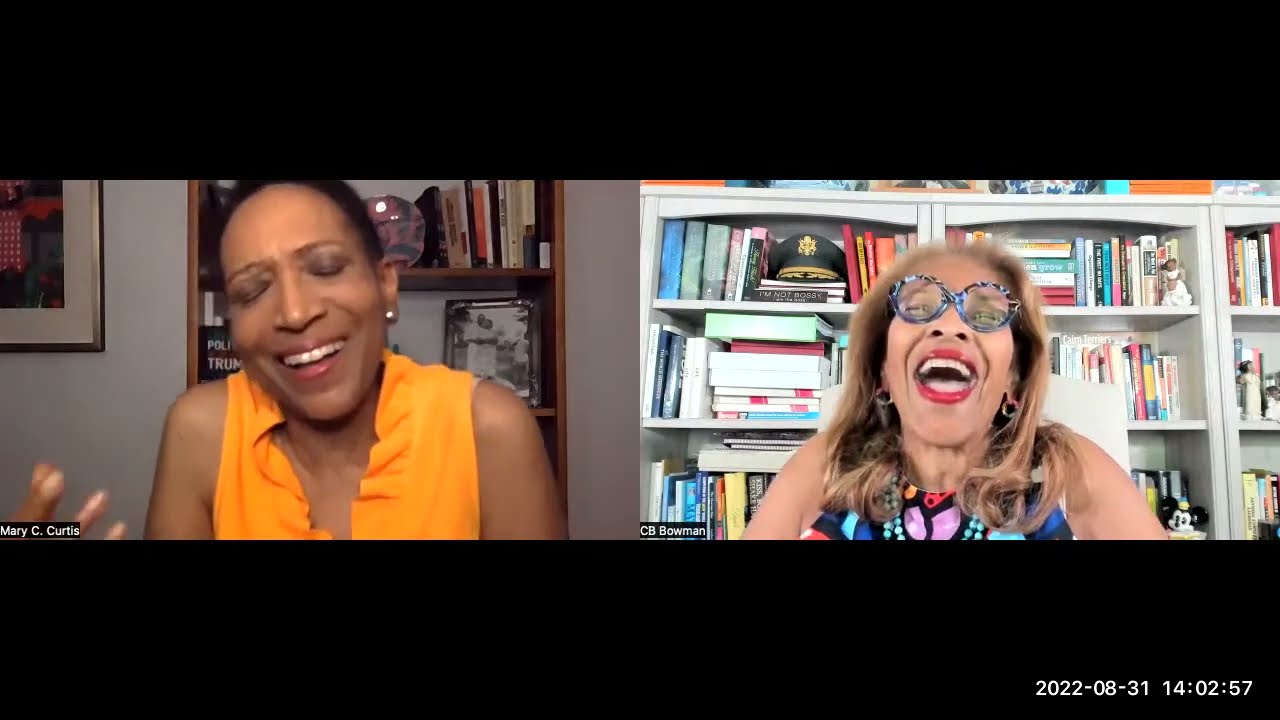
Mary C. Curtis, a Baltimore-born journalist who covered four presidential elections for the New York Times, talks about her path from a working-class family to the Nieman Fellowship at Harvard. She credits her grandmother's legacy, her mother's push for reading, and early exposure to civil rights activism for shaping her career and her belief that journalism requires curiosity and civic courage.
Chapters
Hello everybody, how are you? As you know, this is CB Bowman Live, and of course I'm glad to see you again. And I have a guest on today who I met during Renaissance Weekend. And ladies and gentlemen, if you don't know about Renaissance Weekend, what can I tell you? It's not the Renaissance Festival. It is Renaissance Weekend. It's very different. It's a group of powerhouse people that's like an explosive think tank. And I was so honored to meet Mary. Actually, I heard about her from another guest and I said, wait a second, who is this person I haven't met? And they said she was just on stage and I couldn't make the connection because I'm Terrible names. But then she was in a webinar, or actually it was a group meeting that I did, and I saw the name tag and I said, that's her. Okay, I'm going over to talk to her. And I mustered up my courage and I went over and talked to her, and she was the nicest, smartest. It was wonderful, absolutely wonderful. So I am so glad to bring her here. And let me stop talking. Let me introduce Mary Curtis. Mary, thank you for joining us today.
Thank you so much. Yes, we, we want to make— let people know we're, we're not talking about the Renaissance where you're eating big turkey legs. This is totally different.
Although I'd like to go to that one.
Yeah, you're— we're meeting people from astronauts to archaeologists to financial wizards, to folks like yourself who are innovative and strategic thinkers. And it is just a pleasure because you never know who you're going to bump into and sit at the table with. And it just really does break your brain a little bit, which is a good thing.
It does. I remember having the conversation with Danny, astronaut Danny. And we had the best conversation about Harry Potter.
Well, he's amazing because, you know, it really— he proves that some of the most accomplished people are the most modest and humble and generous. Because here's someone who has many, many times been out in space by a tether. Just the accomplishments of an engineer, astronaut. And when he comes up, he wants to talk about you. And it just makes you realize some of the most accomplished, some of the smartest folks are the ones who are the most humble because they don't really have to brag. And they don't. It's a good lesson.
And in fact, I said to him, you know, what you've done sounds amazing. I wonder how people with dyslexia like myself could ever do what you do. And he looked at me dead in the eye and he said, CB, I'm dyslexic. He said, there's no way. How could you memorize all that astronaut stuff and be dyslexic? And he said, I created systems. And it was as simple as that.
Wow. You have to be creative. And no, it's really— yep, I know. But it's always a nice— one of the most interesting persons I met was involved in fisheries. And equity issue when it comes to fisheries and such. And it's just, just some things that you just never know— knew that you didn't know. So yes, and it was great because I met you.
Yeah, same here. Same here. So Mary, let's get to it. Tell us about yourself. What happened during your life? How did you grow up? Tell us about your parents. Tell us how you got from here to there.
Well, I'll tell you, first of all, my byline— I'm a journalist, and how I'm known and always has been, have been known is Mary C., middle initial C., Curtis. And that comes from a couple of things. One, I was named after my grandmother, uh, who died before I was born. I'm the youngest of 5 children, and when my little— when my big sister Janice was little, my mother's mother died, uh, of cancer very pretty young. And my parents said, if we have another girl, we will name her after, you know, Mary C. And my mother, being a good Catholic, got pregnant like 5 more times, 4 miscarriages, and me. So I'm the youngest of 5, and I carry the name of someone that I never met. And I've only seen photos. She was a very elegant lady, and she had a tough time in many ways. But she raised my mom with the help of her mom and her sister. And so that's— I carry the name of someone. So also, we are cradle Catholics, and I went to Catholic schools, and there were always many Marys in the class, or several anyway. So we were named— known by first and second. So in fact, one of my best friends, I'm still friendly with her from grade school, was Mary Eileen. And I'm Mary C. So when people say, are you being pretentious throwing that C in there? I said, no, it's just a little bit of tribute to my grandmom, and also the fact that it's almost— I've always been known by it. I feel naked without it. Um, and so I did grow up in a working-class family.
But wait a second now. Tell us about your grandmom. You said she had a difficult time.
Well, no, she, she and, uh, my grandfather, my mother's father divorced when my mother was 5. And so that's what I mean, because, you know, she was in a way a single parent, although he was kind of in my mom's life. And then his second wife died, and I remember that he and my mother reconciled in a very real way. And, you know, he was a longshoreman on the docks in Baltimore. He came from the county. He worked on oyster boats. He was one of those Maryland oyster boat folks, which was really tough. So moving to Baltimore and becoming a longshoreman was easier, which even though that was pretty hard.
Ironically, yes.
And he actually was illiterate, although he knew his numbers. And so my mother helped him in that way. So even though they had been as— had not been as close when he divorced her mom, they did reconcile. So I do remember him in my life, and he lived to 92 years old.
Clarence Lee?
He was a tough guy. Yeah, my grandfather Clarence Thomas. And so, yeah, so she was very elegant, my grandmother. And that's what I mean when she did what she had to do to raise my mom with the help of her mom and sister. And my mother was always hardworking. I know we're going to talk about courage, but I see pictures of her when she was maybe 12 or 13 on roller skates collecting insurance payments, premiums. Remember how working-class folks used to buy just enough insurance to bury themselves?
Yes, I remember my mom had it.
Yes. And so my mother worked hard always, and she— that's who she was. And, you know, she was a person of courage. She took care of her mom. She went to high school and she was in college, but she dropped out to take care of her mom who was dying of cancer. And she went back to college when I was in grade school. And she became— had a whole nother career as a teacher. She taught in the parochial schools in Baltimore. So she was in college classes when she was 40s with, with people in their 20s. And that didn't bother her. She had a young spirit. And I remember as a Catholic, she always wanted to go to Rome and see the Pope. That was one of her dreams. And the year before she died, she did go on a church trip to Rome, and she did see the Pope, and she brought me back a rosary that the Pope had blessed.
Oh!
So she was a very positive person, and I never heard her say a bad word about anyone. And of course, obviously, growing up in Baltimore, there was racism there, and, you know, she suffered those slings and arrows as well, and she always put us forth. You had to tell her to her face the no. And when my oldest brother, who's quite a bit older than I am, he actually has more education than anybody. He got a law degree and he became a judge. He's semi-retired now in Maryland, although he still works with— now he's working on a project with police and how they interact with people with disabilities, because sometimes there's that confusion, you know?
Yes. Yeah.
And so, but he wanted to go to a Catholic high school. school in Baltimore, which they weren't accepting Blacks. You had to take a test, an entrance exam, and he would always score at the top. But when he would go in for the interview, they would say, we can't accept you. We're not accepting Blacks, even though we were Catholic, right? And so he still wanted to go. So she found a school in Wilmington, Delaware, that was a high school, Salesianum, which was an exclusive Catholic school, and I believe it was a boys' school, and, uh, he was accepted there. So my oldest brother commuted to high school. He had to get on the train every morning at 6:30 in Baltimore to take the train to Wilmington, Delaware to go to high school.
Wow.
And he did not miss a day, and he ended up at the top of the class, even though they did a little bit of trickery. So they said he was second, but really he was first.
Yeah.
But, you know, We know how that works. You know, I guess they figured accepting a Black person was enough of a risk, right? And so I did. I did. By the time I came along, I took the entrance exam. I went to a good Catholic school in Baltimore, and I was valedictorian, and they did not take it away from me. But— They wouldn't dare. Yeah. When I was little, I used to look at the TV show Romper Room. which was a syndicated children's show, but it started off in Baltimore.
Yeah.
That was the original one. And the original— it was a Bert and Nancy Claster production. They produced it and then syndicated it around the world. And the original classroom teacher was Nancy Claster, Miss Nancy. And I would watch it on the television and want to go. When I was like 3 or 4, I would sit with my, you know, chocolate milk. I want to go on Rom-Rom. And my mother put my name in. And when we got to the studio after they called me, we— there was no Black people. And they kind of looked shocked. But of course, I was with my crinolines out to here, my big, you know, hair ribbon and braids. And they— we got on the show. I was the only, for 2 weeks, little Black girl there. And Miss Nancy could not have been nicer. She always put me in the middle and always would call on me and say how smart I was. And they had show and tell.
Mm-hmm.
And the little boy brought in a little car with the, the top that went back and forth. And Miss Nancy says, now, did any of you children know what's this called? What this is called? And nobody knew. And I yelled out, it's a convertible! And my father would tell that story until the day I died, you know. Now remember when, like at Christmas, he'd had a couple of glasses of scotch, and he said, remember when Mary was on Romper Room, and none of those little white kids knew what a convertible was, but Mary knew? And it was so funny. But you know, that's what I mean. You— she would put us forward. There was never a no, and expose us to everything. She took me for my library— reading is my thing, you know, and when I was about 3 years old, I already knew a little bit to read and write already, and she took me to the branch of the library, Enoch Pratt Free Library in Baltimore. for a library card when I was 3 years old, and the woman handed her the, the card to fill out. She said, no, Mary will fill it out, you know, and I was printing like this, so it took the whole card, right? And the woman was looking surprised. My mother was fine. And that's what, you know, when I hear about the book bannings now, and people want to take books out of the library, there was never any question that I could read any book I wanted if I could read it. And that if I had a question that I could come and we could talk about it and figure it out. I don't understand these people that do not want their kids to learn. I love the library. It was free, and you go downtown to the main branch. You could listen to music. They would show movies. What a resource! I don't get people who do not want to learn, and that branch I got the library card at is still there, a community center library. And it's across the street when they had the Freddie Gray, when the Baltimore police officers, they did the rough ride and his spine was, was broken, severed, and he died. And there was the unrest. And everybody wanted to take a picture of the CVS that was burning. But across the street was a community center library that stayed open, untouched the whole time, which is why those kind of experiences helped me be a better journalist, because You know, so many journalists don't have those experiences. And when they think, I'm going to go to Baltimore and cover this unrest, this protest, I'm just going to get these couple of shots of what I think should be the story. But they don't know the real story, and they don't stay and see the community that comes and cleans up and all. And so in a sense, I learned that the things that people would put me down for, my upbringing, working-class Baltimore, They make me stronger because as when I get into these rooms, whether it's the New York Times or Harvard, where I was a Nieman Fellow, I have to know everything that these folks know. But then I know more.
Yes.
And also, I would say that a big, big part of me becoming a journalist is I became a professional observer. I like to say I became a journalist before I knew what a journalist was because my 3 eldest siblings were involved in the civil rights movement. They belonged to an organization called the CIG, the Civic Interest Group, and they would march and protest and make signs and have meetings in our home. And I was pretty much a toddler at the time, but I do remember that it was very exciting. I knew it was— when one of my brothers got arrested, I think my parents were freaking out, and his girlfriend was, because they had this high bail on him, and my father was looking for the deed to the house, and they went. with Juanita Jackson Mitchell, who was a civil rights attorney. The Mitchell family was a very prominent Black civil rights family. Her husband, Clarence Mitchell Jr., I believe, was the lobbyist for the NAACP, and she got my brother out of jail. Well, of course, if it was all normal, I would be in bed. But if the house is going crazy because we're trying to figure out that Tony's in jail, I— nobody cares about me. I'm wandering around, like, kind of peeking around. So I can observe. And that's really what a journalist was. And I knew it was important. And I was kidding you in saying that I would sing. But, you know, I remember all those civil rights songs, you know, Black and White Together, We Shall Not Be Moved, Keep Your Eyes on the Prize. And they would sing them in our home. And I didn't quite know what they meant.
Yeah.
But I did know this is real and this is important. So I think birth order has a lot to do with it. If I were the oldest, I might not know these things, but being the youngest by far, I could just take that all in, and that really informed my interest. I had to be where the action was. And my parents were supportive, whatever I wanted to do. I remember I loved the theater. We got all the newspapers, and I would read about the arts. And, you know, when I was in high school, I was in the opera appreciation class, and we would go up to New York once a year to see the student production at the Metropolitan Opera. And when I was about 13 years old, my— I had a birthday, and my mother said, what do you want? Maybe 13 or 14 for your birthday. And I said, I want to go to New York and see a Broadway show because I've never seen one, and I read about it. Now we're a working-class Black family from Baltimore. A lot of people would have said, oh, give me a break, you know. What, what do you want? You want to go out to dinner? You want your favorite food? My mother said, okay. We got train tickets, went to New York. We didn't have any place to stay. We went to a broker. They got us a hotel. She wanted to see Hello, Dolly! with Cab Calloway and Pearl Bailey. And then she— we got a couple more tickets, and we went We went to a taping of a TV show.
Yeah.
We went out for a steak dinner, and then we took the train back. I mean, that was amazing. That's just because I said, I want to see a show, and she made it happen. And that's what I mean about having parents that really were supportive of my dreams. Because when I started got— getting that library card and read about all over the world, I said, I'm going to visit all of these places, and I don't know how, but I will. And I have, you know, I've taught writing programs twice in South Africa. I've been, you know, all over. And it really also gave me a roadmap for my son, because all the things they did, like encourage reading, right? We always had books in the house, and I would say, read whatever you want, right? I remember in first grade he had show and tell, and he took this big, big book that had the collective works of Shakespeare in him that he had started to read. And I asked his teacher, how did that go over? She said, well, he asked the students, I want to read from my favorite play, which is Hamlet. Do you want to hear the speech where the ghost of Hamlet's father comes? And they said yes. So he read it.
Good.
And I said, and he's— I said, did the students like it? And she said, honestly, Mary, I think they were impressed by the size of the book. And I've taken him— I told him when he was little, your mother's a journalist. She doesn't have a ton of money, but she can give you adventures. And we— and when he was 7 and he got a good report card, and I said— I was working at the New York Times at the time. We were living in suburban New Jersey. I said, what do you want for your reward? You think ice cream? He says, I want to go and see the revival of Guys and Dolls on Broadway.
No way!
And it reminded me of me.
Yes.
And we went. You know, when we were sitting close, he was out of his chair. When he was little, we went to see Penn and Teller on Broadway. And every time they would say, we need a volunteer, he would raise his hand. But he was like 4, so they wanted older. So finally they said, OK, kid, you keep raising your hand. They took him on the stage. He started joking around with Penn, the one that talks.
Yes.
At a certain point, Penn said, listen, the name of this theater is the Eugene O'Neill Theater. And Eugene O'Neill wrote a lot of long plays, which is appropriate because we're going to be here on the stage with this kid all night. And so, you know, they gave me that roadmap. You know, and he went on to get his PhD at Yale, and he's a professor. And he's so curious. He has so many books. And I figure, like, yes, he's our kid, right?
Yes.
So, but this was, you know, I was a working-class kid in Baltimore, Maryland, and when a lot of my friends that I grew up with who were real smart and beautiful and all of those things, but to many of them, their goal was to, you know, graduate, get a really good civil service government job, you know, was secure, good benefits, and That's just not what I wanted to do. You know, when I said I want to be a journalist, my parents didn't know anybody who really made a living at that. You know, my mother wanted me to be a doctor because our doctor— our doc, that's what you know, you know, your Black doctor, lawyer.
Yes.
My oldest brother was the lawyer, so I'm the doctor. We had a doctor who was a Black doctor who was a Tuskegee Airman. He had no kids. And he would always say, well, you're— you can get my practice. You're smart. And so when I decided I didn't want to be a doctor, my mother and my doctor just thought I was nuts. But still, when I was working at the Baltimore Sun, when I went back, my mother came to visit. She wore a little pin that said mother on it. You know, it's it. I have to say, that was it. There were always the possibilities, and all nothing was said that you can't do this. And I was so happy. My father died of lung cancer, and he lived to see me. somewhat achieved my dreams, but my mother really lived to enjoy it. And I had an event that Harry Belafonte was the guest, and he spoke. And I would— my husband didn't care, so I would always take my mother as my date to things. And she went, and she loved, of course, you know, an older Black woman, Harry Belafonte.
Oh my God, the crowd!
Yeah, they had the receiving line. And everybody was— my mother was 5 foot tall, maybe. And you know how tall Harry Belafonte is.
Yes.
So everybody was wondering, what is the delay in the line? And I looked, and my mother was talking to Harry Belafonte, who was bent in half, just saying, oh, I love you, Harry Belafonte.
I see you.
I'm thinking, oh my God, move along, Mom. But I was so happy that we were able— that she was able to at least enjoy. And I would take her out to dinners and formal things. Like I said, my husband could care less, but she really got the glory. And that was, you know, she deserved it. She, she really did. But I was really a daddy's girl. I was close to my father. We were very much alike, you know. I got his sense of humor and his cheekbones. Thank you. Um, I have their picture behind me. My late parents, when they were younger, they looked like movie stars. They were, they were gorgeous.
Can we see the picture closer?
Oh yeah, you will see it. This is when they were engaged. And you know, I have a picture there and a book I contributed to on the other side, and my son meeting George Bush when he was president up there. I have books, but I have my stuff. Okay, hold it up.
Where is it?
Oh, aren't they handsome? My mother was so pretty, and my father looked like Cary Grant. Look at this, with his wingtip shoes.
You look like a cross between the two of them.
I do. I do. And my father was such an elegant dresser. And as you can see with those cheekbones, and my mother was adorable, and she never really changed. She, she looked like that. So I always have them behind me because I feel like they're over my shoulder, you know.
Yeah.
And I have my little cactus because I lived in Tucson for a while, and that's where my son was born. So I like to have that. And this is my son who Was a President Scholar, and he did go to Washington and meet—
Well, let's see his picture also.
And then this is the book I contributed to, Covering Politics in the Age of Trump, with top political reporters. And, uh, this is my son. Wait, wait, wait.
The glare, the glare. Good-looking guy.
Wow. I think so. I think so.
Wow.
Yeah. And he has a PhD in history.
Uh-huh.
So his fields are contemporary U.S., particularly housing policy and labor policy. And he is a professor at Bard Early College in New York. And when I was teaching this summer a class in D.C. on political commentary in the School of the New York Times Summer Academy, I was very gratified because I was teaching 11th, 12th, and incoming college freshmen. And this one student came up and said to me, are you Professor Zane Curtis Olson's mother? I was like, yes. And he said, I go to Bard Early College, and you know he's the most popular professor, and his class has a waiting list. He has a class he created on the '70s, which he uses multimedia. He says, that's the most popular class in the school. It's really hard to get into. He said, can you help me get into it? I said, well, I have nothing to do with it. So I told my son, did you know? I said, why didn't you tell me that you're like the hot professor, you know? And he's like, oh, you know. But it was so much fun because, you know, sometimes I know he gets annoyed because if I'm on NPR or TV or something, I know people will say to him, oh, I— is that— was that your mother I heard?
Yeah.
Because it's Curtis, right? So now it was fun for me to hear, are you Professor, is that Curtis Lofton's son? Mom! You know, so I was like, oh, I guess now he's, you know, I'm, I'm on his coattails. So.
Yes. Oh my God.
So that was so much fun. But he enjoys that. And of course, they don't have many, you know, young Black professors. And so, you know, he, and he loves New York, having grown up there. Every time I talk to him, he's going to some lecture or something. And when his Grandma, my husband's from there, my husband's mother, when she was alive, he helped look after her a bit. She died this summer, 100 years old. She lived— she was a New York City social worker. She was in the Women's Coast Guard in World War II. So the funeral was quite moving. The military sent an honor guard of 2.
Oh!
And they folded the flag on her casket and knelt and presented it to my sister-in-law. So yeah, it was really impressive. She's a World War II vet. And when we called, They said, oh, someone will be there. The military said, we will send someone. And the 2 young men, my gosh, it was totally moving because, I mean, 100, she had lived a life. She, she lived at home. She never went to a facility. She lived on her own terms.
Wow, how awesome.
Yes.
Hey, you've taken me down memory lane and I love it. And you know, one of the things that You know, you think about your past and then you forget about it. But when you talked about the library, it brought me back to understanding where my curiosity for things came from. When I was younger, they would have story reading at the library, and my mom would always take me, and we'd sit around, you know, knees crossed, and listen to fascinating stories. And I never associated it With my bucket list of writing a book and my curiosity. Wow.
Now, where did you grow up?
I grew up in Manhattan. Oh, wow.
New Yorker like my husband.
New York, Lower East Side.
Oh, he lived there for a while. He was born in Brooklyn, but then they moved to Stuyvesant Town, which is the Lower East Side.
Gotcha. Absolutely. Yeah.
Wow.
And I knew I liked your husband. So now I have—
You did bond. You were in that session on love, right?
Yes, absolutely. I was ready to steal him away if my husband wasn't. But now you've put together some interesting pieces for me in my life. Yeah. And my dad was in the military. You see his hat, and he's Laid to rest with my mom at Arlington National.
Oh, that's wonderful. That's beautiful. Was she a veteran too?
No, she wasn't. She just dealt with his being a veteran.
Oh my goodness.
They're together forever and ever. They met when they were in elementary school.
Wow. Talk about childhood sweethearts.
Yes, absolutely. So I get it. I get it how, you know, and my dad was a voracious reader of newspapers.
Yes.
He would get the Mirror, the Daily News, the Post, the New York Times, and they would all be Sunday stacks, and he'd read the whole thing cover to cover. And I said, Dad, it's the same thing.
What are you reading?
And he said to me, it's a different Point of view, right?
Yes. Oh, definitely. Well, the thing of it is, is that's why these attacks on the library and censorship have hit me, because to me, I just can't see in my head who would not want to open their minds up and learn new things. And, you know, we are global citizens. Why would you not want to learn about every kind of person? Why would you want to limit knowledge? That's something I can understand. And it's not as though you can close your kids' mind off, because the very thing that you hold from them, they're gonna be curious about.
That's where the curiosity comes. I totally agree with you.
Yeah. Whereas if you— if they— like, as I said, if you come across a book or something you don't understand, then you sit and talk with them. It's all about being a parent. And What, you don't— you want the government to be— you don't want to be a parent to your kid? I don't get it. And I think, you know, reading about gay people doesn't make your kid gay.
Yeah.
Reading about unrest in the civil rights movement doesn't make them angry. And then if your kid is gay, of course you want to have books that show they're not alone. Because if you look, you see that the rate of suicides, there are young people who feel that there's nobody who understands them. And don't you want to be supportive in every way possible? So that's just, as I said, because the library holds a sacred place in my heart, these things that are getting librarians fired and all of this is almost just too heavy. But, you know, and also I'm a journalist, which I am curious about everything, and I think it's a profession It's amazing to me because I can ask the president tough questions. I can go into a forest full of Confederate heritage folks who are singing Dixie and screaming rebel yells and ask them questions and know they're going to answer because they want to tell me about themselves.
Yes.
I can— when I was Filling in for, you know, when I'm doing a podcast, whether it's my own or Slate's, and I can— it's on climate. So I've got to do some research to understand enough so I can ask smart questions. It's funny because my guests on the one on the climate-related one was David Gelles, who—
Nice.
He and his wife, Allie Gelles. Yes. And so it was a little bit funny because he was the The expert. And I said, oh, David, how you doing? How's Ali? Even before the conversation started being taped. Oh, she's in the other room. So you do meet all kinds of, you know, people. And then for the one on the death penalty, of course, I got to interview Sister Helen Prejean of Dead Man Walking and talking about Oklahoma ramping up the death penalty. And we could talk about Catholicism and what it means to be pro-life. And I just love that, being able to talk to smart people like them, like you, and increase my knowledge. And, you know, the year I spent that I was a Nieman Fellow at Harvard, which is a prestigious journalism fellowship. It's 10 people from this country and 10 from around the world, and you spend a year at Harvard. You can do whatever you want, take any class you want, and it's just— you're like a kid in a candy store. You can You know, take any class. I took classes in the law school, in the Kennedy School, in the music school where I heard teachers play Mozart, and I could take piano lessons from a graduate student and rent out a music room with the grand piano and just satisfy all of my curiosity and go to every lecture as well as the Celtics game. And it's just, you know, covering 4 presidential elections, interviewing Barack Obama before he was Barack Obama, interviewing Michelle Obama the day after she gave her big speech in Denver when they were nominated in a room that, that next day in Denver, it was just Michelle Obama and 5 female journalists. And I was one of them. I mean, I was— I know I was one of them because I was from a swing state, North Carolina. And they were nothing if not strategic. Whatever gets you there. I interviewed her, oh my goodness, about a dozen times and, you know, interviewed him and even going to Tea Party. I went to the first National Tea Party convention in Opryland in Nashville.
Wow.
Sitting in the middle of that, it just— and I'm never— I'm not the journalist who stands in the back of the room. I sit down at the table with people and I get talking with them and I see they're human and they see I'm human. So when they're booing all the journalists in the back of the room, they're kind kind of looking at me like, but you can come to my house, you know. But that's just the whole thing when you can demonize people. And I, I, I worry about that now because if you disagree with people now, it's not just you disagree, it's like they're evil and they're horrible and they're not even human, you know.
Right.
Which gives you the license to crack them over the head or do something violent or dehumanize them or think that they're not worthy of good treatment, or that their vote somehow shouldn't count. Like, if you're a voter in Atlanta or Detroit or Milwaukee or Philly, that somehow your vote shouldn't count as much as somebody from Wyoming's or, you know, Kansas. It's a very dangerous road we're going on.
I, you know what, I totally agree with you. I had this conversation with Chris Coffey Sadly, soon after he passed away, and, and our whole conversation was, what happened to the art of disagreement? You know, I'm a graduate from the New School, so we, we looked at everything with a microscope and then some. And we learned how to talk to each other. We learned how to disagree. We learned how to listen. We learned how to read. And when I say read, I'm not talking about just your ABCs. I remember assignments like taking a newspaper from the right, the left, and the middle and comparing the same subject and seeing how we're influenced by the vocabulary that's used to introduce the subject. It's all gone. It's all gone.
I know.
People don't celebrate learning and they don't celebrate disagreement. Anymore. It's all violent, and I'm so afraid where we're going.
I am too. It's like people don't want to— they put on the blinders. They have a certain point of view. They see the world a certain way, and they don't want any facts to get into the way. Well, you know, I just—
I don't care if they put on blinders. My objection is they're putting on blinders on other people.
Oh yeah.
Hey, my child can't study this in school. Don't make it universal that the school system should not offer it.
Yeah.
Just tell your child, don't read it.
Yes. Yeah.
And I, I too agree with you that it's so disturbing that it is scary.
Oh yeah. I mean, if, if 6-year-old Ruby Bridges, who isn't that old now, she's only in her 60s, could stand going to school, sitting in a classroom by herself, having to have marshals escort her because angry parents are thrusting in her face a coffin with a Black baby doll in it and shouting slurs— if she could do that and withstand it as a 6-year-old, your child could certainly stand to learn about it.
Absolutely.
And that is It's not triggering. It is American history as it is. It's not myth. We came here a certain way. And the thing is, we will repeat this if people don't learn from it. You know, my son is a historian, and he always says to me, things are in cycles. Things happen, but they've happened before.
Mm-hmm.
And also, with progress always comes pushback. Always. And if you feel that you have this little piece of privilege of the pie and America's a zero-sum game and something that someone else gets, it's not adding to the brilliance of the country, but it's taking something away from you. That is a terrible attitude to have.
Mm-hmm.
Because, you know, just look at so many of the states, say in Mississippi or whatever. There's a reason why they're below any other state. in things like education and healthcare and health outcomes. It's because they put so much of their energy and budget into maintaining separate systems that they didn't realize that you thrive when you all work together.
Mm-hmm.
So do you wanna end up that way? People grabbing for the same little pot as opposed to growth. You know, look how much that the knowledge of all kinds of people now who can go to college and such, that, that has added to, you know, the GDP of this country, to all the things that have been invented, and, you know, everything like that. And it's really— it, like I said, it is difficult for me. You know, my grandfather was an illiterate longshoreman on the docks of Baltimore who actually owned his own home and his own car and lived on his own. His grandson— his daughter was a teacher, his grandson was a judge, you know. And this is in very few generations at a time of segregation, because these folks didn't make excuses. They just worked hard. And you want to say, if you spent a little bit of energy working on yourself and try— instead of trying to blame other people for your unhappiness, what you could achieve. You know, all these folks who are spending weekends going to militias and this and that— read a book, build something. Yes. Yeah, create a business. I don't get it.
I don't either. Hey, Mary, listen, we're running out of time, but I want to stop this interview now, which has been amazing, and thank you. But I want to continue to part 2 and talk about your coverage. Can we do that?
Okay.
All right, ladies and gentlemen, you'll have to come back for part 2 of my conversation with Mary C., and I'm looking forward to it. Talk to you later.
More from CB



211- Courage to Leap & Lead with Louise Story part 1Courage to Leap & Lead







